RISK ASSESSMENT IN
DISASTERS RISK
DEFINITION OF RISK ASSESSMENT IN DISASTER RISK
Risk assessment in disasters is a crucial process that involves identifying,
evaluating, and prioritizing risks associated with natural or man-made disasters.
The goal is to understand the potential impacts of disasters on people, property,
the environment, and the economy, and to develop strategies to reduce these risks.
1. CONCEPTS AND ELEMENTS IN DISASTER RISK ASSESSMENT
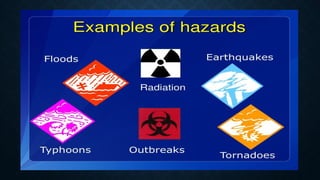
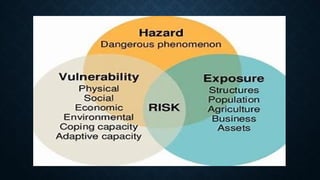
1.Hazard: A hazard is a potential threat that may cause harm, such as a flood, earthquake, or disease
outbreak.
2.Exposure: Exposure refers to the people, buildings, infrastructure, and other assets that are at risk
from a hazard. It includes the number of people and the value of assets in the area.
3.Vulnerability: Vulnerability is the susceptibility of a community or system to the impacts of hazards.
It depends on factors such as the strength of buildings, the effectiveness of early warning systems,
and the availability of emergency services.
4.Risk: Risk is the likelihood of a hazard causing harm to people, property, the environment, or the
economy. It is calculated based on the hazard, exposure, and vulnerability.
5.Risk Assessment: Risk assessment is the process of identifying, evaluating, and prioritizing risks. It
involves analyzing hazards, exposure, and vulnerability to determine the level of risk.
6.Risk Management: Risk management involves identifying, assessing, and prioritizing risks, and
taking steps to reduce or mitigate them. It includes land-use planning, building codes, and emergency
preparedness measures.
2. DISASTER RISK REDUCTION
Disaster risk reduction (DRR) refers to the concept and
practice of reducing the damage caused by natural hazards
like earthquakes, floods, droughts, and cyclones, through an
ethic of prevention, mitigation, and preparedness. It aims to
minimize vulnerabilities and disaster risks to avoid or limit the
adverse impacts of hazards, within the broader context of
sustainable development.
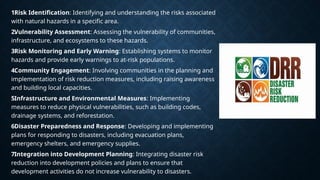
1.
Risk Identification: Identifying and understanding the risks associated
with natural hazards in a specific area.
2.
Vulnerability Assessment: Assessing the vulnerability of communities,
infrastructure, and ecosystems to these hazards.
3.
Risk Monitoring and Early Warning: Establishing systems to monitor
hazards and provide early warnings to at-risk populations.
4.
Community Engagement: Involving communities in the planning and
implementation of risk reduction measures, including raising awareness
and building local capacities.
5.
Infrastructure and Environmental Measures: Implementing
measures to reduce physical vulnerabilities, such as building codes,
drainage systems, and reforestation.
6.
Disaster Preparedness and Response: Developing and implementing
plans for responding to disasters, including evacuation plans,
emergency shelters, and emergency supplies.
7.
Integration into Development Planning: Integrating disaster risk
reduction into development policies and plans to ensure that
development activities do not increase vulnerability to disasters.
3. GLOBAL DISASTER RISK SITUATIONS
1.Climate Change: Increasing global temperatures are leading to more
frequent and intense natural disasters such as hurricanes, droughts,
floods, and wildfires.
2.Urbanization: Rapid urbanization in many parts of the world has led to
increased exposure to disasters, as more people and infrastructure are
located in disaster-prone areas.
3.Poverty and Inequality: Poverty and inequality can increase
vulnerability to disasters, as marginalized communities often lack access
to resources and infrastructure to cope with disasters.
4.Conflict and Fragility: Countries experiencing conflict and fragility are
often more vulnerable to disasters, as resources are diverted away from
disaster preparedness and response.
5.Pandemics: The COVID-19 pandemic highlighted the global
vulnerability to health emergencies and the need for strong health
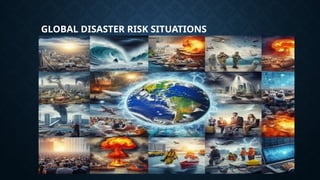
GLOBAL DISASTER RISK SITUATIONS
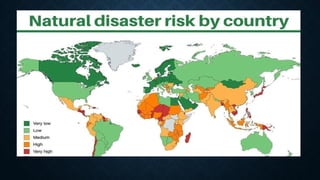
4. NATIONAL DISASTER RISK SITUATIONS
1.Geographical Hazards: Countries located in areas prone to earthquakes, tsunamis,
hurricanes, floods, or droughts face higher risks of disasters related to these hazards.
2.Infrastructure and Development: The level of infrastructure and development in a
country can affect its ability to prepare for and respond to disasters. Developing
countries often face greater challenges due to limited resources.
3.Population Density: Countries with high population density, especially in urban
areas, face greater challenges in managing disasters, as more people and
infrastructure are at risk.
4.Governance and Institutions: The effectiveness of governance and institutions can
impact a country's ability to manage disaster risks, including the implementation of
policies and regulations.
5.Climate Change Adaptation: Countries that have implemented effective climate
change adaptation measures are better equipped to manage the risks associated with
changing weather patterns.
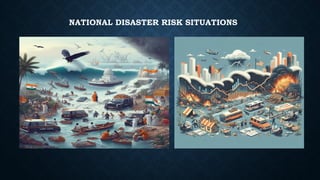
NATIONAL DISASTER RISK SITUATIONS
THANK YOU

Risk assessment in disaster risk.pptcrucial process that involves identifying, evaluating, and prioritizing risks x

  • 1.
  • 2.
    DEFINITION OF RISKASSESSMENT IN DISASTER RISK Risk assessment in disasters is a crucial process that involves identifying, evaluating, and prioritizing risks associated with natural or man-made disasters. The goal is to understand the potential impacts of disasters on people, property, the environment, and the economy, and to develop strategies to reduce these risks.
  • 3.
    1. CONCEPTS ANDELEMENTS IN DISASTER RISK ASSESSMENT 1.Hazard: A hazard is a potential threat that may cause harm, such as a flood, earthquake, or disease outbreak. 2.Exposure: Exposure refers to the people, buildings, infrastructure, and other assets that are at risk from a hazard. It includes the number of people and the value of assets in the area. 3.Vulnerability: Vulnerability is the susceptibility of a community or system to the impacts of hazards. It depends on factors such as the strength of buildings, the effectiveness of early warning systems, and the availability of emergency services. 4.Risk: Risk is the likelihood of a hazard causing harm to people, property, the environment, or the economy. It is calculated based on the hazard, exposure, and vulnerability. 5.Risk Assessment: Risk assessment is the process of identifying, evaluating, and prioritizing risks. It involves analyzing hazards, exposure, and vulnerability to determine the level of risk. 6.Risk Management: Risk management involves identifying, assessing, and prioritizing risks, and taking steps to reduce or mitigate them. It includes land-use planning, building codes, and emergency preparedness measures.
  • 6.
    2. DISASTER RISKREDUCTION Disaster risk reduction (DRR) refers to the concept and practice of reducing the damage caused by natural hazards like earthquakes, floods, droughts, and cyclones, through an ethic of prevention, mitigation, and preparedness. It aims to minimize vulnerabilities and disaster risks to avoid or limit the adverse impacts of hazards, within the broader context of sustainable development.
  • 7.
    1. Risk Identification: Identifyingand understanding the risks associated with natural hazards in a specific area. 2. Vulnerability Assessment: Assessing the vulnerability of communities, infrastructure, and ecosystems to these hazards. 3. Risk Monitoring and Early Warning: Establishing systems to monitor hazards and provide early warnings to at-risk populations. 4. Community Engagement: Involving communities in the planning and implementation of risk reduction measures, including raising awareness and building local capacities. 5. Infrastructure and Environmental Measures: Implementing measures to reduce physical vulnerabilities, such as building codes, drainage systems, and reforestation. 6. Disaster Preparedness and Response: Developing and implementing plans for responding to disasters, including evacuation plans, emergency shelters, and emergency supplies. 7. Integration into Development Planning: Integrating disaster risk reduction into development policies and plans to ensure that development activities do not increase vulnerability to disasters.
  • 8.
    3. GLOBAL DISASTERRISK SITUATIONS 1.Climate Change: Increasing global temperatures are leading to more frequent and intense natural disasters such as hurricanes, droughts, floods, and wildfires. 2.Urbanization: Rapid urbanization in many parts of the world has led to increased exposure to disasters, as more people and infrastructure are located in disaster-prone areas. 3.Poverty and Inequality: Poverty and inequality can increase vulnerability to disasters, as marginalized communities often lack access to resources and infrastructure to cope with disasters. 4.Conflict and Fragility: Countries experiencing conflict and fragility are often more vulnerable to disasters, as resources are diverted away from disaster preparedness and response. 5.Pandemics: The COVID-19 pandemic highlighted the global vulnerability to health emergencies and the need for strong health
  • 9.
  • 10.
    4. NATIONAL DISASTERRISK SITUATIONS 1.Geographical Hazards: Countries located in areas prone to earthquakes, tsunamis, hurricanes, floods, or droughts face higher risks of disasters related to these hazards. 2.Infrastructure and Development: The level of infrastructure and development in a country can affect its ability to prepare for and respond to disasters. Developing countries often face greater challenges due to limited resources. 3.Population Density: Countries with high population density, especially in urban areas, face greater challenges in managing disasters, as more people and infrastructure are at risk. 4.Governance and Institutions: The effectiveness of governance and institutions can impact a country's ability to manage disaster risks, including the implementation of policies and regulations. 5.Climate Change Adaptation: Countries that have implemented effective climate change adaptation measures are better equipped to manage the risks associated with changing weather patterns.
  • 11.
  • 13.