Assignment on “List of Hazards”
Submitted by
Md. Asif Hasan
Roll: SH-037
Date: July 21, 2019
What is Hazard?
Ans: Hazard may be defined as any object, condition, dangerous events that are
threat or have the potential for causing injury to life or damage to property or the
environment. Hazards can both natural and manmade.
What is Natural Hazard?
Ans: Natural hazards may be defined as threat of naturally occurring events that will
have a negative effect on human life and environment. They may be caused due to
natural phenomena with meteorological, geological or even biological origin.
What is Disaster?
Ans: A disaster can be defined as serious disruption in the functioning of the
community or a society causing wide spread material, economic, social or
environmental losses which exceed the ability of the affected society to cope using
its own resources. It is a result from the combination of hazard, vulnerability and
insufficient capacity or measures to reduce the potential chances of risk.
What is the difference between Hazard and Disaster?
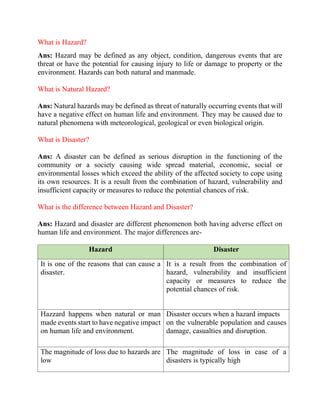
Ans: Hazard and disaster are different phenomenon both having adverse effect on
human life and environment. The major differences are-
Hazard Disaster
It is one of the reasons that can cause a
disaster.
It is a result from the combination of
hazard, vulnerability and insufficient
capacity or measures to reduce the
potential chances of risk.
Hazzard happens when natural or man
made events start to have negative impact
on human life and environment.
Disaster occurs when a hazard impacts
on the vulnerable population and causes
damage, casualties and disruption.
The magnitude of loss due to hazards are
low
The magnitude of loss in case of a
disasters is typically high
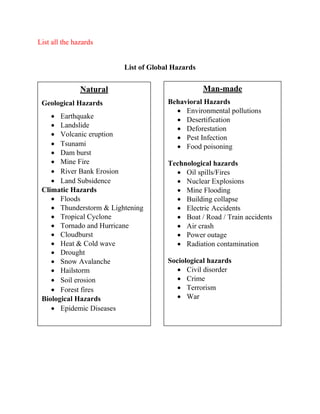
List all the hazards
List of Global Hazards
Natural
Geological Hazards
• Earthquake
• Landslide
• Volcanic eruption
• Tsunami
• Dam burst
• Mine Fire
• River Bank Erosion
• Land Subsidence
Climatic Hazards
• Floods
• Thunderstorm & Lightening
• Tropical Cyclone
• Tornado and Hurricane
• Cloudburst
• Heat & Cold wave
• Drought
• Snow Avalanche
• Hailstorm
• Soil erosion
• Forest fires
Biological Hazards
• Epidemic Diseases
Man-made
Behavioral Hazards
• Environmental pollutions
• Desertification
• Deforestation
• Pest Infection
• Food poisoning
Technological hazards
• Oil spills/Fires
• Nuclear Explosions
• Mine Flooding
• Building collapse
• Electric Accidents
• Boat / Road / Train accidents
• Air crash
• Power outage
• Radiation contamination
Sociological hazards
• Civil disorder
• Crime
• Terrorism
• War
Hazards in Bangladesh: Most of the previously mentioned hazards are common
in Bangladesh which are listed below-
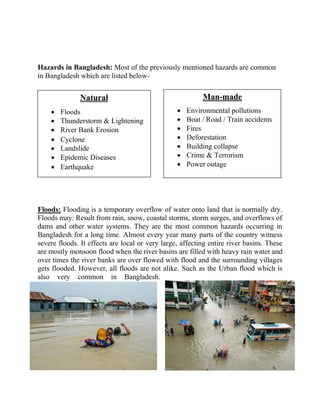
Floods: Flooding is a temporary overflow of water onto land that is normally dry.
Floods may: Result from rain, snow, coastal storms, storm surges, and overflows of
dams and other water systems. They are the most common hazards occurring in
Bangladesh for a long time. Almost every year many parts of the country witness
severe floods. It effects are local or very large, affecting entire river basins. These
are mostly monsoon flood when the river basins are filled with heavy rain water and
over times the river banks are over flowed with flood and the surrounding villages
gets flooded. However, all floods are not alike. Such as the Urban flood which is
also very common in Bangladesh.
Natural
• Floods
• Thunderstorm & Lightening
• River Bank Erosion
• Cyclone
• Landslide
• Epidemic Diseases
• Earthquake
Man-made
• Environmental pollutions
• Boat / Road / Train accidents
• Fires
• Deforestation
• Building collapse
• Crime & Terrorism
• Power outage
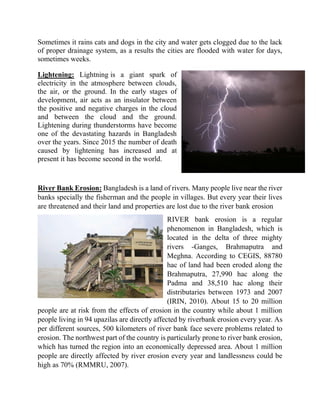
Sometimes it rains cats and dogs in the city and water gets clogged due to the lack
of proper drainage system, as a results the cities are flooded with water for days,
sometimes weeks.
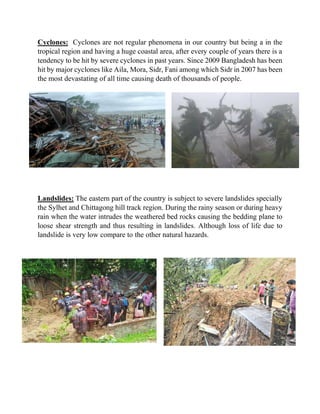
Lightening: Lightning is a giant spark of
electricity in the atmosphere between clouds,
the air, or the ground. In the early stages of
development, air acts as an insulator between
the positive and negative charges in the cloud
and between the cloud and the ground.
Lightening during thunderstorms have become
one of the devastating hazards in Bangladesh
over the years. Since 2015 the number of death
caused by lightening has increased and at
present it has become second in the world.
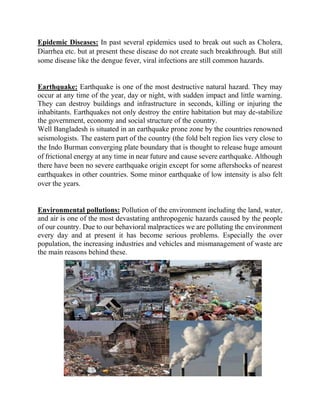
River Bank Erosion: Bangladesh is a land of rivers. Many people live near the river
banks specially the fisherman and the people in villages. But every year their lives
are threatened and their land and properties are lost due to the river bank erosion
RIVER bank erosion is a regular
phenomenon in Bangladesh, which is
located in the delta of three mighty
rivers -Ganges, Brahmaputra and
Meghna. According to CEGIS, 88780
hac of land had been eroded along the
Brahmaputra, 27,990 hac along the
Padma and 38,510 hac along their
distributaries between 1973 and 2007
(IRIN, 2010). About 15 to 20 million
people are at risk from the effects of erosion in the country while about 1 million
people living in 94 upazilas are directly affected by riverbank erosion every year. As
per different sources, 500 kilometers of river bank face severe problems related to
erosion. The northwest part of the country is particularly prone to river bank erosion,
which has turned the region into an economically depressed area. About 1 million
people are directly affected by river erosion every year and landlessness could be
high as 70% (RMMRU, 2007).
Cyclones: Cyclones are not regular phenomena in our country but being a in the
tropical region and having a huge coastal area, after every couple of years there is a
tendency to be hit by severe cyclones in past years. Since 2009 Bangladesh has been
hit by major cyclones like Aila, Mora, Sidr, Fani among which Sidr in 2007 has been
the most devastating of all time causing death of thousands of people.
Landslides: The eastern part of the country is subject to severe landslides specially
the Sylhet and Chittagong hill track region. During the rainy season or during heavy
rain when the water intrudes the weathered bed rocks causing the bedding plane to
loose shear strength and thus resulting in landslides. Although loss of life due to
landslide is very low compare to the other natural hazards.
Epidemic Diseases: In past several epidemics used to break out such as Cholera,
Diarrhea etc. but at present these disease do not create such breakthrough. But still
some disease like the dengue fever, viral infections are still common hazards.
Earthquake: Earthquake is one of the most destructive natural hazard. They may
occur at any time of the year, day or night, with sudden impact and little warning.
They can destroy buildings and infrastructure in seconds, killing or injuring the
inhabitants. Earthquakes not only destroy the entire habitation but may de-stabilize
the government, economy and social structure of the country.
Well Bangladesh is situated in an earthquake prone zone by the countries renowned
seismologists. The eastern part of the country (the fold belt region lies very close to
the Indo Burman converging plate boundary that is thought to release huge amount
of frictional energy at any time in near future and cause severe earthquake. Although
there have been no severe earthquake origin except for some aftershocks of nearest
earthquakes in other countries. Some minor earthquake of low intensity is also felt
over the years.
Environmental pollutions: Pollution of the environment including the land, water,
and air is one of the most devastating anthropogenic hazards caused by the people
of our country. Due to our behavioral malpractices we are polluting the environment
every day and at present it has become serious problems. Especially the over
population, the increasing industries and vehicles and mismanagement of waste are
the main reasons behind these.
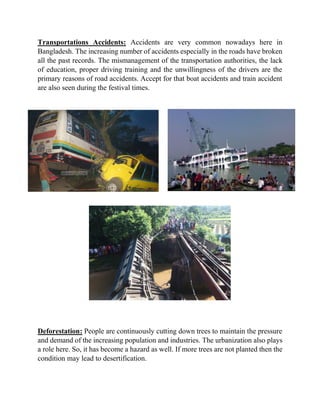
Transportations Accidents: Accidents are very common nowadays here in
Bangladesh. The increasing number of accidents especially in the roads have broken
all the past records. The mismanagement of the transportation authorities, the lack
of education, proper driving training and the unwillingness of the drivers are the
primary reasons of road accidents. Accept for that boat accidents and train accident
are also seen during the festival times.
Deforestation: People are continuously cutting down trees to maintain the pressure
and demand of the increasing population and industries. The urbanization also plays
a role here. So, it has become a hazard as well. If more trees are not planted then the
condition may lead to desertification.
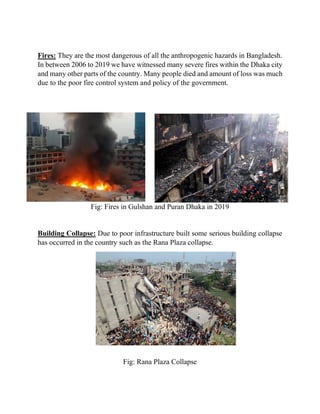
Fires: They are the most dangerous of all the anthropogenic hazards in Bangladesh.
In between 2006 to 2019 we have witnessed many severe fires within the Dhaka city
and many other parts of the country. Many people died and amount of loss was much
due to the poor fire control system and policy of the government.
Fig: Fires in Gulshan and Puran Dhaka in 2019
Building Collapse: Due to poor infrastructure built some serious building collapse
has occurred in the country such as the Rana Plaza collapse.
Fig: Rana Plaza Collapse
References
"Disaster News Network" (http://www.disasternews.net/)
"Global Risk Identification Program (GRIP)" (http://www.gripweb.org)
"Natural Disasters News" (http://www.naturaldisastersnews.net).
"World Bank's Hazard Risk Management"(http://go.worldbank.org/BCQUXRXOW0).
http://en.wikipedia.org/wiki/Man-made_hazard " Categories: Hazards | Man-made disasters

List of hazards

  • 1.
    Assignment on “Listof Hazards” Submitted by Md. Asif Hasan Roll: SH-037 Date: July 21, 2019
  • 2.
    What is Hazard? Ans:Hazard may be defined as any object, condition, dangerous events that are threat or have the potential for causing injury to life or damage to property or the environment. Hazards can both natural and manmade. What is Natural Hazard? Ans: Natural hazards may be defined as threat of naturally occurring events that will have a negative effect on human life and environment. They may be caused due to natural phenomena with meteorological, geological or even biological origin. What is Disaster? Ans: A disaster can be defined as serious disruption in the functioning of the community or a society causing wide spread material, economic, social or environmental losses which exceed the ability of the affected society to cope using its own resources. It is a result from the combination of hazard, vulnerability and insufficient capacity or measures to reduce the potential chances of risk. What is the difference between Hazard and Disaster? Ans: Hazard and disaster are different phenomenon both having adverse effect on human life and environment. The major differences are- Hazard Disaster It is one of the reasons that can cause a disaster. It is a result from the combination of hazard, vulnerability and insufficient capacity or measures to reduce the potential chances of risk. Hazzard happens when natural or man made events start to have negative impact on human life and environment. Disaster occurs when a hazard impacts on the vulnerable population and causes damage, casualties and disruption. The magnitude of loss due to hazards are low The magnitude of loss in case of a disasters is typically high
  • 3.
    List all thehazards List of Global Hazards Natural Geological Hazards • Earthquake • Landslide • Volcanic eruption • Tsunami • Dam burst • Mine Fire • River Bank Erosion • Land Subsidence Climatic Hazards • Floods • Thunderstorm & Lightening • Tropical Cyclone • Tornado and Hurricane • Cloudburst • Heat & Cold wave • Drought • Snow Avalanche • Hailstorm • Soil erosion • Forest fires Biological Hazards • Epidemic Diseases Man-made Behavioral Hazards • Environmental pollutions • Desertification • Deforestation • Pest Infection • Food poisoning Technological hazards • Oil spills/Fires • Nuclear Explosions • Mine Flooding • Building collapse • Electric Accidents • Boat / Road / Train accidents • Air crash • Power outage • Radiation contamination Sociological hazards • Civil disorder • Crime • Terrorism • War
  • 4.
    Hazards in Bangladesh:Most of the previously mentioned hazards are common in Bangladesh which are listed below- Floods: Flooding is a temporary overflow of water onto land that is normally dry. Floods may: Result from rain, snow, coastal storms, storm surges, and overflows of dams and other water systems. They are the most common hazards occurring in Bangladesh for a long time. Almost every year many parts of the country witness severe floods. It effects are local or very large, affecting entire river basins. These are mostly monsoon flood when the river basins are filled with heavy rain water and over times the river banks are over flowed with flood and the surrounding villages gets flooded. However, all floods are not alike. Such as the Urban flood which is also very common in Bangladesh. Natural • Floods • Thunderstorm & Lightening • River Bank Erosion • Cyclone • Landslide • Epidemic Diseases • Earthquake Man-made • Environmental pollutions • Boat / Road / Train accidents • Fires • Deforestation • Building collapse • Crime & Terrorism • Power outage
  • 5.
    Sometimes it rainscats and dogs in the city and water gets clogged due to the lack of proper drainage system, as a results the cities are flooded with water for days, sometimes weeks. Lightening: Lightning is a giant spark of electricity in the atmosphere between clouds, the air, or the ground. In the early stages of development, air acts as an insulator between the positive and negative charges in the cloud and between the cloud and the ground. Lightening during thunderstorms have become one of the devastating hazards in Bangladesh over the years. Since 2015 the number of death caused by lightening has increased and at present it has become second in the world. River Bank Erosion: Bangladesh is a land of rivers. Many people live near the river banks specially the fisherman and the people in villages. But every year their lives are threatened and their land and properties are lost due to the river bank erosion RIVER bank erosion is a regular phenomenon in Bangladesh, which is located in the delta of three mighty rivers -Ganges, Brahmaputra and Meghna. According to CEGIS, 88780 hac of land had been eroded along the Brahmaputra, 27,990 hac along the Padma and 38,510 hac along their distributaries between 1973 and 2007 (IRIN, 2010). About 15 to 20 million people are at risk from the effects of erosion in the country while about 1 million people living in 94 upazilas are directly affected by riverbank erosion every year. As per different sources, 500 kilometers of river bank face severe problems related to erosion. The northwest part of the country is particularly prone to river bank erosion, which has turned the region into an economically depressed area. About 1 million people are directly affected by river erosion every year and landlessness could be high as 70% (RMMRU, 2007).
  • 6.
    Cyclones: Cyclones arenot regular phenomena in our country but being a in the tropical region and having a huge coastal area, after every couple of years there is a tendency to be hit by severe cyclones in past years. Since 2009 Bangladesh has been hit by major cyclones like Aila, Mora, Sidr, Fani among which Sidr in 2007 has been the most devastating of all time causing death of thousands of people. Landslides: The eastern part of the country is subject to severe landslides specially the Sylhet and Chittagong hill track region. During the rainy season or during heavy rain when the water intrudes the weathered bed rocks causing the bedding plane to loose shear strength and thus resulting in landslides. Although loss of life due to landslide is very low compare to the other natural hazards.
  • 7.
    Epidemic Diseases: Inpast several epidemics used to break out such as Cholera, Diarrhea etc. but at present these disease do not create such breakthrough. But still some disease like the dengue fever, viral infections are still common hazards. Earthquake: Earthquake is one of the most destructive natural hazard. They may occur at any time of the year, day or night, with sudden impact and little warning. They can destroy buildings and infrastructure in seconds, killing or injuring the inhabitants. Earthquakes not only destroy the entire habitation but may de-stabilize the government, economy and social structure of the country. Well Bangladesh is situated in an earthquake prone zone by the countries renowned seismologists. The eastern part of the country (the fold belt region lies very close to the Indo Burman converging plate boundary that is thought to release huge amount of frictional energy at any time in near future and cause severe earthquake. Although there have been no severe earthquake origin except for some aftershocks of nearest earthquakes in other countries. Some minor earthquake of low intensity is also felt over the years. Environmental pollutions: Pollution of the environment including the land, water, and air is one of the most devastating anthropogenic hazards caused by the people of our country. Due to our behavioral malpractices we are polluting the environment every day and at present it has become serious problems. Especially the over population, the increasing industries and vehicles and mismanagement of waste are the main reasons behind these.
  • 8.
    Transportations Accidents: Accidentsare very common nowadays here in Bangladesh. The increasing number of accidents especially in the roads have broken all the past records. The mismanagement of the transportation authorities, the lack of education, proper driving training and the unwillingness of the drivers are the primary reasons of road accidents. Accept for that boat accidents and train accident are also seen during the festival times. Deforestation: People are continuously cutting down trees to maintain the pressure and demand of the increasing population and industries. The urbanization also plays a role here. So, it has become a hazard as well. If more trees are not planted then the condition may lead to desertification.
  • 9.
    Fires: They arethe most dangerous of all the anthropogenic hazards in Bangladesh. In between 2006 to 2019 we have witnessed many severe fires within the Dhaka city and many other parts of the country. Many people died and amount of loss was much due to the poor fire control system and policy of the government. Fig: Fires in Gulshan and Puran Dhaka in 2019 Building Collapse: Due to poor infrastructure built some serious building collapse has occurred in the country such as the Rana Plaza collapse. Fig: Rana Plaza Collapse
  • 10.
    References "Disaster News Network"(http://www.disasternews.net/) "Global Risk Identification Program (GRIP)" (http://www.gripweb.org) "Natural Disasters News" (http://www.naturaldisastersnews.net). "World Bank's Hazard Risk Management"(http://go.worldbank.org/BCQUXRXOW0). http://en.wikipedia.org/wiki/Man-made_hazard " Categories: Hazards | Man-made disasters