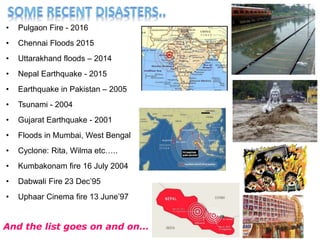
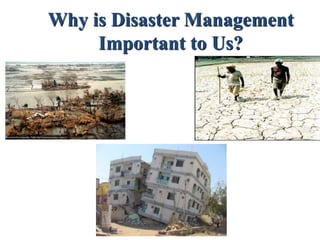
• Pulgaon Fire - 2016
• Chennai Floods 2015
• Uttarakhand floods – 2014
• Nepal Earthquake - 2015
• Earthquake in Pakistan – 2005
• Tsunami - 2004
• Gujarat Earthquake - 2001
• Floods in Mumbai, West Bengal
• Cyclone: Rita, Wilma etc…..
• Kumbakonam fire 16 July 2004
• Dabwali Fire 23 Dec’95
• Uphaar Cinema fire 13 June’97
And the list goes on and on…
Definition
Disaster:
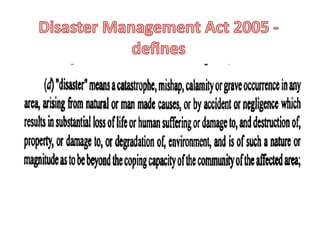
Any occurrence that causes loss of human life, damage,
ecological disruption, deterioration of health on a scale
sufficient to warrant an extraordinary response from
outside the affected community or area
(WHO)
4
• Disaster is a sudden, calamitous event bringing
great damage, loss, and destruction and
devastation to life and property.
• Losses exceed the ability of affected to cope with
it using its own resources
Definition
Introduction
Etymology
Originated from Greek
dus = bad aster = star
Calamity due to position of a planet or a star.
Then evolved in Italian as disastro,
To become French désastre (de.zastʁ).
& then disaster .
7
Why is Disaster Management
Important to Us?
The Myths
• It Can’t Happen to Us (me).
• The Nature’s forces are so deadly that
Victims will Die anyway.
• There is nothing we can do about it.
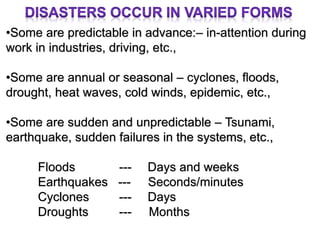
•Some are predictable in advance:– in-attention during
work in industries, driving, etc.,
•Some are annual or seasonal – cyclones, floods,
drought, heat waves, cold winds, epidemic, etc.,
•Some are sudden and unpredictable – Tsunami,
earthquake, sudden failures in the systems, etc.,
Floods --- Days and weeks
Earthquakes --- Seconds/minutes
Cyclones --- Days
Droughts --- Months
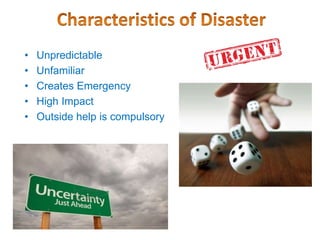
• Unpredictable
• Unfamiliar
• Creates Emergency
• High Impact
• Outside help is compulsory
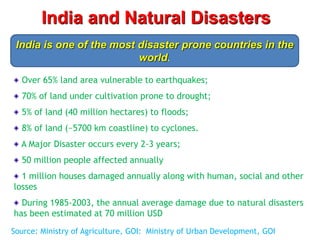
India and Natural Disasters
Over 65% land area vulnerable to earthquakes;
70% of land under cultivation prone to drought;
5% of land (40 million hectares) to floods;
8% of land (~5700 km coastline) to cyclones.
A Major Disaster occurs every 2-3 years;
50 million people affected annually
1 million houses damaged annually along with human, social and other
losses
During 1985-2003, the annual average damage due to natural disasters
has been estimated at 70 million USD
Source: Ministry of Agriculture, GOI: Ministry of Urban Development, GOI
India is one of the most disaster prone countries in the
world.
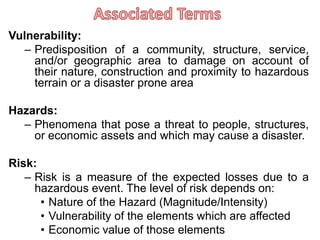
Vulnerability:
– Predisposition of a community, structure, service,
and/or geographic area to damage on account of
their nature, construction and proximity to hazardous
terrain or a disaster prone area
Hazards:
– Phenomena that pose a threat to people, structures,
or economic assets and which may cause a disaster.
Risk:
– Risk is a measure of the expected losses due to a
hazardous event. The level of risk depends on:
• Nature of the Hazard (Magnitude/Intensity)
• Vulnerability of the elements which are affected
• Economic value of those elements
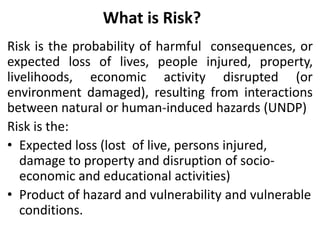
What is Risk?
Risk is the probability of harmful consequences, or
expected loss of lives, people injured, property,
livelihoods, economic activity disrupted (or
environment damaged), resulting from interactions
between natural or human-induced hazards (UNDP)
Risk is the:
• Expected loss (lost of live, persons injured,
damage to property and disruption of socio-
economic and educational activities)
• Product of hazard and vulnerability and vulnerable
conditions.
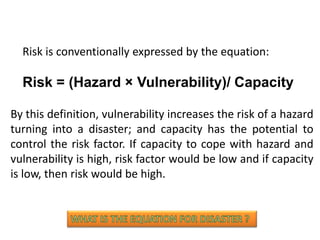
By this definition, vulnerability increases the risk of a hazard
turning into a disaster; and capacity has the potential to
control the risk factor. If capacity to cope with hazard and
vulnerability is high, risk factor would be low and if capacity
is low, then risk would be high.
Risk = (Hazard × Vulnerability)/ Capacity
Risk is conventionally expressed by the equation:
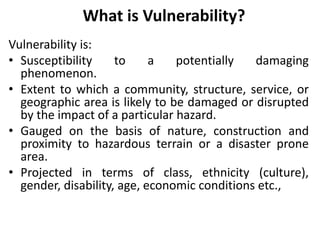
What is Vulnerability?
Vulnerability is:
• Susceptibility to a potentially damaging
phenomenon.
• Extent to which a community, structure, service, or
geographic area is likely to be damaged or disrupted
by the impact of a particular hazard.
• Gauged on the basis of nature, construction and
proximity to hazardous terrain or a disaster prone
area.
• Projected in terms of class, ethnicity (culture),
gender, disability, age, economic conditions etc.,
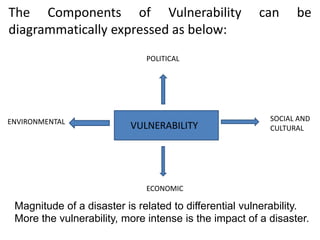
The Components of Vulnerability can be
diagrammatically expressed as below:
VULNERABILITY
POLITICAL
ECONOMIC
SOCIAL AND
CULTURAL
ENVIRONMENTAL
Magnitude of a disaster is related to differential vulnerability.
More the vulnerability, more intense is the impact of a disaster.
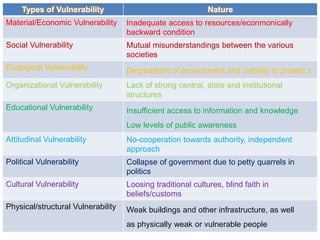
Types of Vulnerability Nature
Material/Economic Vulnerability Inadequate access to resources/econmonically
backward condition
Social Vulnerability Mutual misunderstandings between the various
societies
Ecological Vulnerability Degradation of environment and inability to protect it
Organizational Vulnerability Lack of strong central, state and institutional
structures
Educational Vulnerability Insufficient access to information and knowledge
Low levels of public awareness
Attitudinal Vulnerability No-cooperation towards authority, independent
approach
Political Vulnerability Collapse of government due to petty quarrels in
politics
Cultural Vulnerability Loosing traditional cultures, blind faith in
beliefs/customs
Physical/structural Vulnerability Weak buildings and other infrastructure, as well
as physically weak or vulnerable people
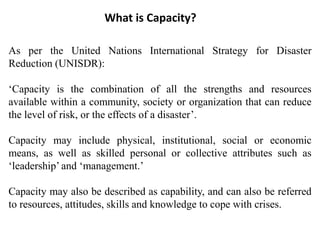
As per the United Nations International Strategy for Disaster
Reduction (UNISDR):
‘Capacity is the combination of all the strengths and resources
available within a community, society or organization that can reduce
the level of risk, or the effects of a disaster’.
Capacity may include physical, institutional, social or economic
means, as well as skilled personal or collective attributes such as
‘leadership’ and ‘management.’
Capacity may also be described as capability, and can also be referred
to resources, attitudes, skills and knowledge to cope with crises.
What is Capacity?
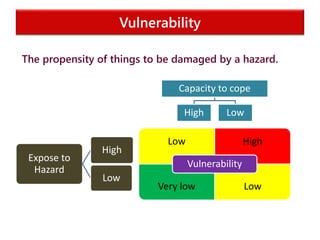
Vulnerability
Low High
Very low Low
Vulnerability
Capacity to cope
High Low
Expose to
Hazard
High
Low
The propensity of things to be damaged by a hazard.
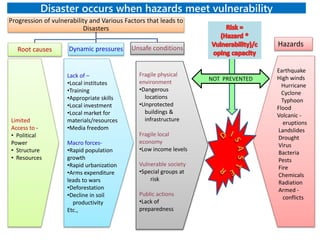
Disaster occurs when hazards meet vulnerability
Progression of vulnerability and Various Factors that leads to
Disasters
Root causes Dynamic pressures Unsafe conditions
Limited
Access to -
• Political
Power
• Structure
• Resources
Lack of –
•Local institutes
•Training
•Appropriate skills
•Local investment
•Local market for
materials/resources
•Media freedom
Macro forces-
•Rapid population
growth
•Rapid urbanization
•Arms expenditure
leads to wars
•Deforestation
•Decline in soil
productivity
Etc.,
Fragile physical
environment
•Dangerous
locations
•Unprotected
buildings &
infrastructure
Fragile local
economy
•Low income levels
Vulnerable society
•Special groups at
risk
Public actions
•Lack of
preparedness
Earthquake
High winds
Hurricane
Cyclone
Typhoon
Flood
Volcanic -
eruptions
Landslides
Drought
Virus
Bacteria
Pests
Fire
Chemicals
Radiation
Armed -
conflicts
Hazards
NOT PREVENTED
Disaster Management
The body of policy and administrative decisions and
operational activities that pertain to various stages of a disaster
at all levels.
An applied science which seeks, by systematic
observation and analysis of disasters, to improve measures
relating to prevention, emergency response, recovery and
mitigation.
Encompasses all aspects of planning for, and responding
to disasters, including both pre and post disaster activities.
• Is a continuous process
• Managed at all levels— interlinked
– Individual
– Groups
– Communities
• Actions based on risk perception
• Integration of plans – government/ private
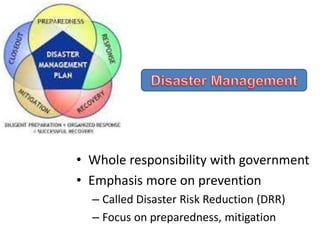
• Whole responsibility with government
• Emphasis more on prevention
– Called Disaster Risk Reduction (DRR)
– Focus on preparedness, mitigation
In India
– Apex body- NDMA
– National Institute of Disaster Management (NIDM)
– United Nations Development Program (UNDP) funded
disaster risk management programme
Disaster Management – DM Act 2005
A continuous and integrated process of planning, organizing,
coordinating and implementing measures which are
necessary for -
● Prevention of danger or threat of any disaster.
● Reduction of risk of any disaster or its severity or
consequences.
● Capacity-building.
● Preparedness to deal with any disaster.
● Prompt response to any threatening disaster situation or
disaster.
● Assessing the severity or magnitude of effects of any
disaster.
● Evacuation, rescue and relief.
● Rehabilitation and reconstruction.
Unit i

Unit i

  • 2.
    • Pulgaon Fire- 2016 • Chennai Floods 2015 • Uttarakhand floods – 2014 • Nepal Earthquake - 2015 • Earthquake in Pakistan – 2005 • Tsunami - 2004 • Gujarat Earthquake - 2001 • Floods in Mumbai, West Bengal • Cyclone: Rita, Wilma etc….. • Kumbakonam fire 16 July 2004 • Dabwali Fire 23 Dec’95 • Uphaar Cinema fire 13 June’97 And the list goes on and on…
  • 4.
    Definition Disaster: Any occurrence thatcauses loss of human life, damage, ecological disruption, deterioration of health on a scale sufficient to warrant an extraordinary response from outside the affected community or area (WHO) 4
  • 5.
    • Disaster isa sudden, calamitous event bringing great damage, loss, and destruction and devastation to life and property. • Losses exceed the ability of affected to cope with it using its own resources Definition
  • 7.
    Introduction Etymology Originated from Greek dus= bad aster = star Calamity due to position of a planet or a star. Then evolved in Italian as disastro, To become French désastre (de.zastʁ). & then disaster . 7
  • 8.
    Why is DisasterManagement Important to Us?
  • 9.
    The Myths • ItCan’t Happen to Us (me). • The Nature’s forces are so deadly that Victims will Die anyway. • There is nothing we can do about it.
  • 10.
    •Some are predictablein advance:– in-attention during work in industries, driving, etc., •Some are annual or seasonal – cyclones, floods, drought, heat waves, cold winds, epidemic, etc., •Some are sudden and unpredictable – Tsunami, earthquake, sudden failures in the systems, etc., Floods --- Days and weeks Earthquakes --- Seconds/minutes Cyclones --- Days Droughts --- Months
  • 11.
    • Unpredictable • Unfamiliar •Creates Emergency • High Impact • Outside help is compulsory
  • 14.
    India and NaturalDisasters Over 65% land area vulnerable to earthquakes; 70% of land under cultivation prone to drought; 5% of land (40 million hectares) to floods; 8% of land (~5700 km coastline) to cyclones. A Major Disaster occurs every 2-3 years; 50 million people affected annually 1 million houses damaged annually along with human, social and other losses During 1985-2003, the annual average damage due to natural disasters has been estimated at 70 million USD Source: Ministry of Agriculture, GOI: Ministry of Urban Development, GOI India is one of the most disaster prone countries in the world.
  • 15.
    Vulnerability: – Predisposition ofa community, structure, service, and/or geographic area to damage on account of their nature, construction and proximity to hazardous terrain or a disaster prone area Hazards: – Phenomena that pose a threat to people, structures, or economic assets and which may cause a disaster. Risk: – Risk is a measure of the expected losses due to a hazardous event. The level of risk depends on: • Nature of the Hazard (Magnitude/Intensity) • Vulnerability of the elements which are affected • Economic value of those elements
  • 16.
    What is Risk? Riskis the probability of harmful consequences, or expected loss of lives, people injured, property, livelihoods, economic activity disrupted (or environment damaged), resulting from interactions between natural or human-induced hazards (UNDP) Risk is the: • Expected loss (lost of live, persons injured, damage to property and disruption of socio- economic and educational activities) • Product of hazard and vulnerability and vulnerable conditions.
  • 17.
    By this definition,vulnerability increases the risk of a hazard turning into a disaster; and capacity has the potential to control the risk factor. If capacity to cope with hazard and vulnerability is high, risk factor would be low and if capacity is low, then risk would be high. Risk = (Hazard × Vulnerability)/ Capacity Risk is conventionally expressed by the equation:
  • 18.
    What is Vulnerability? Vulnerabilityis: • Susceptibility to a potentially damaging phenomenon. • Extent to which a community, structure, service, or geographic area is likely to be damaged or disrupted by the impact of a particular hazard. • Gauged on the basis of nature, construction and proximity to hazardous terrain or a disaster prone area. • Projected in terms of class, ethnicity (culture), gender, disability, age, economic conditions etc.,
  • 19.
    The Components ofVulnerability can be diagrammatically expressed as below: VULNERABILITY POLITICAL ECONOMIC SOCIAL AND CULTURAL ENVIRONMENTAL Magnitude of a disaster is related to differential vulnerability. More the vulnerability, more intense is the impact of a disaster.
  • 20.
    Types of VulnerabilityNature Material/Economic Vulnerability Inadequate access to resources/econmonically backward condition Social Vulnerability Mutual misunderstandings between the various societies Ecological Vulnerability Degradation of environment and inability to protect it Organizational Vulnerability Lack of strong central, state and institutional structures Educational Vulnerability Insufficient access to information and knowledge Low levels of public awareness Attitudinal Vulnerability No-cooperation towards authority, independent approach Political Vulnerability Collapse of government due to petty quarrels in politics Cultural Vulnerability Loosing traditional cultures, blind faith in beliefs/customs Physical/structural Vulnerability Weak buildings and other infrastructure, as well as physically weak or vulnerable people
  • 21.
    As per theUnited Nations International Strategy for Disaster Reduction (UNISDR): ‘Capacity is the combination of all the strengths and resources available within a community, society or organization that can reduce the level of risk, or the effects of a disaster’. Capacity may include physical, institutional, social or economic means, as well as skilled personal or collective attributes such as ‘leadership’ and ‘management.’ Capacity may also be described as capability, and can also be referred to resources, attitudes, skills and knowledge to cope with crises. What is Capacity?
  • 22.
    Vulnerability Low High Very lowLow Vulnerability Capacity to cope High Low Expose to Hazard High Low The propensity of things to be damaged by a hazard.
  • 23.
    Disaster occurs whenhazards meet vulnerability Progression of vulnerability and Various Factors that leads to Disasters Root causes Dynamic pressures Unsafe conditions Limited Access to - • Political Power • Structure • Resources Lack of – •Local institutes •Training •Appropriate skills •Local investment •Local market for materials/resources •Media freedom Macro forces- •Rapid population growth •Rapid urbanization •Arms expenditure leads to wars •Deforestation •Decline in soil productivity Etc., Fragile physical environment •Dangerous locations •Unprotected buildings & infrastructure Fragile local economy •Low income levels Vulnerable society •Special groups at risk Public actions •Lack of preparedness Earthquake High winds Hurricane Cyclone Typhoon Flood Volcanic - eruptions Landslides Drought Virus Bacteria Pests Fire Chemicals Radiation Armed - conflicts Hazards NOT PREVENTED
  • 24.
    Disaster Management The bodyof policy and administrative decisions and operational activities that pertain to various stages of a disaster at all levels. An applied science which seeks, by systematic observation and analysis of disasters, to improve measures relating to prevention, emergency response, recovery and mitigation. Encompasses all aspects of planning for, and responding to disasters, including both pre and post disaster activities.
  • 25.
    • Is acontinuous process • Managed at all levels— interlinked – Individual – Groups – Communities • Actions based on risk perception • Integration of plans – government/ private
  • 26.
    • Whole responsibilitywith government • Emphasis more on prevention – Called Disaster Risk Reduction (DRR) – Focus on preparedness, mitigation
  • 27.
    In India – Apexbody- NDMA – National Institute of Disaster Management (NIDM) – United Nations Development Program (UNDP) funded disaster risk management programme
  • 28.
    Disaster Management –DM Act 2005 A continuous and integrated process of planning, organizing, coordinating and implementing measures which are necessary for - ● Prevention of danger or threat of any disaster. ● Reduction of risk of any disaster or its severity or consequences. ● Capacity-building. ● Preparedness to deal with any disaster. ● Prompt response to any threatening disaster situation or disaster. ● Assessing the severity or magnitude of effects of any disaster. ● Evacuation, rescue and relief. ● Rehabilitation and reconstruction.