
Land Subsidence
Md Asif Hasan
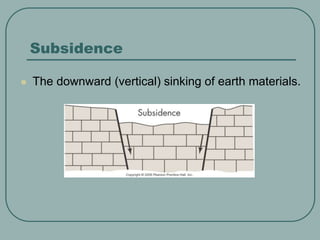
Subsidence
 The downward (vertical) sinking of earth materials.
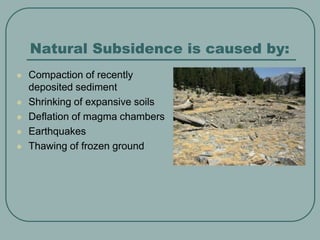
Natural Subsidence is caused by:
 Compaction of recently
deposited sediment
 Shrinking of expansive soils
 Deflation of magma chambers
 Earthquakes
 Thawing of frozen ground
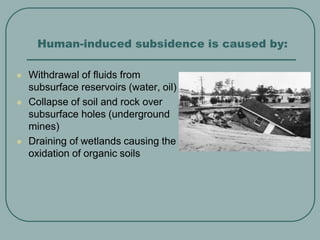
Human-induced subsidence is caused by:
 Withdrawal of fluids from
subsurface reservoirs (water, oil)
 Collapse of soil and rock over
subsurface holes (underground
mines)
 Draining of wetlands causing the
oxidation of organic soils
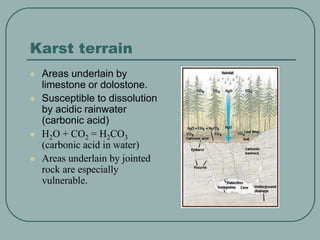
Karst terrain
 Areas underlain by
limestone or dolostone.
 Susceptible to dissolution
by acidic rainwater
(carbonic acid)
 H2O + CO2 = H2CO3
(carbonic acid in water)
 Areas underlain by jointed
rock are especially
vulnerable.
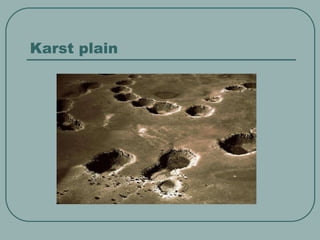
Karst plain
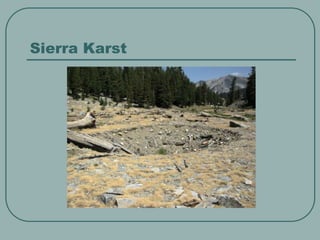
Sierra Karst
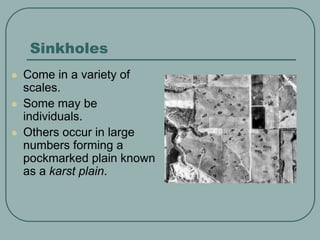
Sinkholes
 Come in a variety of
scales.
 Some may be
individuals.
 Others occur in large
numbers forming a
pockmarked plain known
as a karst plain.
Cont…
 The sudden and sometimes catastrophic
collapse may be triggered by groundwater
declines caused by pumping
 The high solubility of salt and gypsum permit
cavities to form in days to years
 Carbonate bedrock: slow process- centuries to
millennia
 Human activities expedite cavity formation
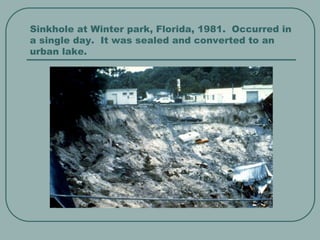
Sinkhole at Winter park, Florida, 1981. Occurred in
a single day. It was sealed and converted to an
urban lake.
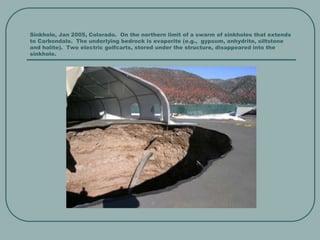
Sinkhole, Jan 2005, Colorado. On the northern limit of a swarm of sinkholes that extends
to Carbondale. The underlying bedrock is evaporite (e.g., gypsum, anhydrite, siltstone
and halite). Two electric golfcarts, stored under the structure, disappeared into the
sinkhole.
Slow Subsidence
 Less obvious than catastrophic sinkhole formation
 Develops gradually and is typically widespread
 Mapping is critical: InSAR (inteferometric synthetic
aperture radar) uses repeat-pass radar images
from Earth-orbiting satellites to measure
subsidence at sub-centimeter resolution
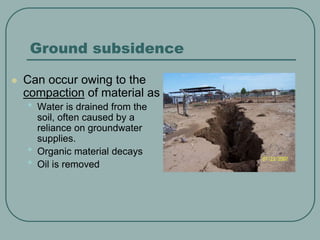
Ground subsidence
 Can occur owing to the
compaction of material as
• Water is drained from the
soil, often caused by a
reliance on groundwater
supplies.
• Organic material decays
• Oil is removed
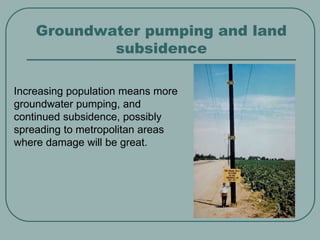
Groundwater pumping and land
subsidence
Increasing population means more
groundwater pumping, and
continued subsidence, possibly
spreading to metropolitan areas
where damage will be great.
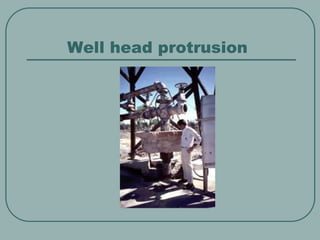
Well head protrusion
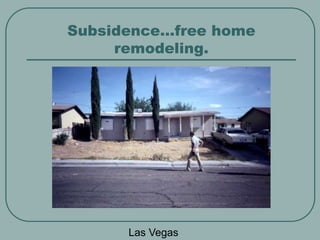
Subsidence…free home
remodeling.
Las Vegas
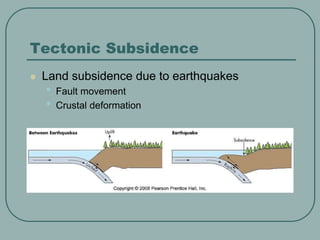
Tectonic Subsidence
 Land subsidence due to earthquakes
• Fault movement
• Crustal deformation
Drainage of organic soils
 Occurs when soils rich in organic carbon are
drained for agriculture or other purposes.
 The most important cause is microbial
decomposition, which, under drained
conditions, readily converts organic carbon to
carbon-dioxide gas and water.
 Compaction, desiccation, erosion by wind and
water, and prescribed or accidental burning
can also be significant factors.
Hazards?
 Easily polluted water supplies
• Rapid water flow and little filtration. Point source
pollution drains rapidly to drinking water source.
• Three municipal sewage lagoons have collapsed in
southeastern Minnesota, sending millions of gallons of
sewage to the aquifer!
• And what about…manure storage areas; feedlot
runoff…
 Loss of buildings and infrastructure
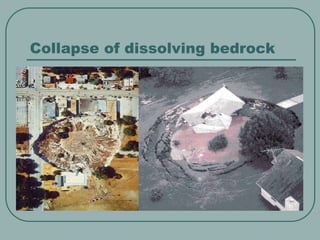
Collapse of dissolving bedrock
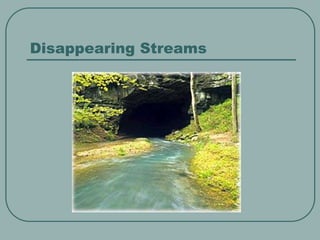
Disappearing Streams
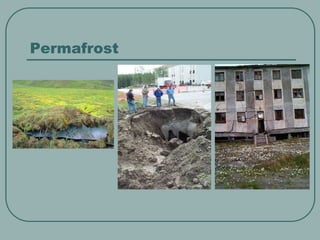
Permafrost
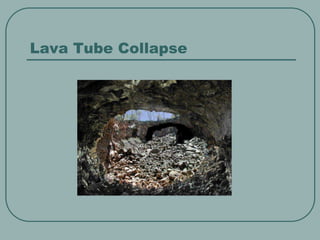
Lava Tube Collapse
Benefits
 Karst provides unique and seldomly
explored frontier
 Caves contain many rare endemic
species
• Troglobites
 New sinkholes create new lakes
Thank You

Land subsidence

  • 1.
  • 2.
    Subsidence  The downward(vertical) sinking of earth materials.
  • 3.
    Natural Subsidence iscaused by:  Compaction of recently deposited sediment  Shrinking of expansive soils  Deflation of magma chambers  Earthquakes  Thawing of frozen ground
  • 4.
    Human-induced subsidence iscaused by:  Withdrawal of fluids from subsurface reservoirs (water, oil)  Collapse of soil and rock over subsurface holes (underground mines)  Draining of wetlands causing the oxidation of organic soils
  • 5.
    Karst terrain  Areasunderlain by limestone or dolostone.  Susceptible to dissolution by acidic rainwater (carbonic acid)  H2O + CO2 = H2CO3 (carbonic acid in water)  Areas underlain by jointed rock are especially vulnerable.
  • 6.
  • 7.
  • 8.
    Sinkholes  Come ina variety of scales.  Some may be individuals.  Others occur in large numbers forming a pockmarked plain known as a karst plain.
  • 9.
    Cont…  The suddenand sometimes catastrophic collapse may be triggered by groundwater declines caused by pumping  The high solubility of salt and gypsum permit cavities to form in days to years  Carbonate bedrock: slow process- centuries to millennia  Human activities expedite cavity formation
  • 10.
    Sinkhole at Winterpark, Florida, 1981. Occurred in a single day. It was sealed and converted to an urban lake.
  • 11.
    Sinkhole, Jan 2005,Colorado. On the northern limit of a swarm of sinkholes that extends to Carbondale. The underlying bedrock is evaporite (e.g., gypsum, anhydrite, siltstone and halite). Two electric golfcarts, stored under the structure, disappeared into the sinkhole.
  • 12.
    Slow Subsidence  Lessobvious than catastrophic sinkhole formation  Develops gradually and is typically widespread  Mapping is critical: InSAR (inteferometric synthetic aperture radar) uses repeat-pass radar images from Earth-orbiting satellites to measure subsidence at sub-centimeter resolution
  • 13.
    Ground subsidence  Canoccur owing to the compaction of material as • Water is drained from the soil, often caused by a reliance on groundwater supplies. • Organic material decays • Oil is removed
  • 14.
    Groundwater pumping andland subsidence Increasing population means more groundwater pumping, and continued subsidence, possibly spreading to metropolitan areas where damage will be great.
  • 15.
  • 16.
  • 17.
    Tectonic Subsidence  Landsubsidence due to earthquakes • Fault movement • Crustal deformation
  • 18.
    Drainage of organicsoils  Occurs when soils rich in organic carbon are drained for agriculture or other purposes.  The most important cause is microbial decomposition, which, under drained conditions, readily converts organic carbon to carbon-dioxide gas and water.  Compaction, desiccation, erosion by wind and water, and prescribed or accidental burning can also be significant factors.
  • 19.
    Hazards?  Easily pollutedwater supplies • Rapid water flow and little filtration. Point source pollution drains rapidly to drinking water source. • Three municipal sewage lagoons have collapsed in southeastern Minnesota, sending millions of gallons of sewage to the aquifer! • And what about…manure storage areas; feedlot runoff…  Loss of buildings and infrastructure
  • 20.
  • 21.
  • 22.
  • 23.
  • 24.
    Benefits  Karst providesunique and seldomly explored frontier  Caves contain many rare endemic species • Troglobites  New sinkholes create new lakes
  • 25.