VLSI Circuit Design
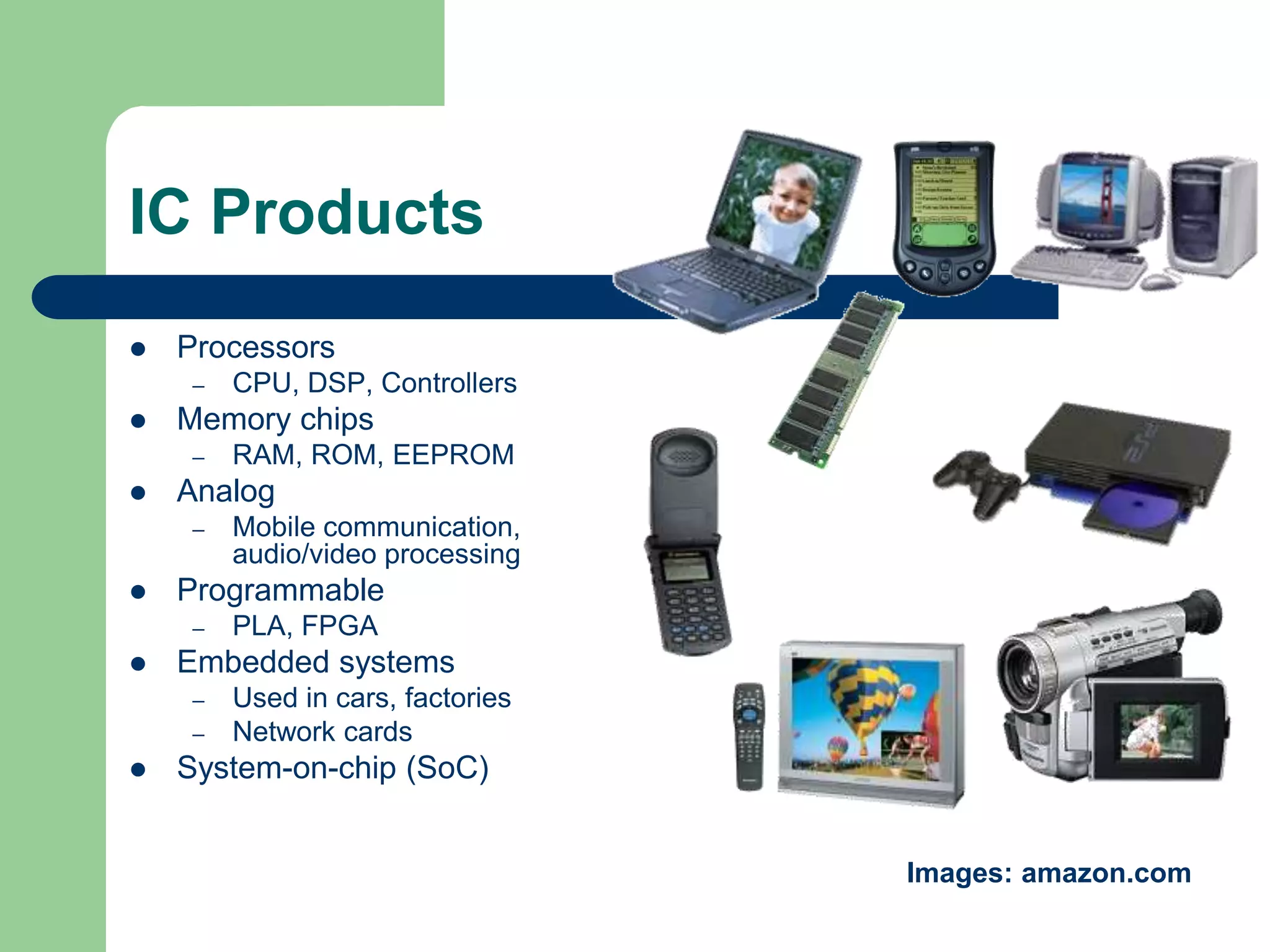
IC Products
 Processors
– CPU, DSP, Controllers
 Memory chips
– RAM, ROM, EEPROM
 Analog
– Mobile communication,
audio/video processing
 Programmable
– PLA, FPGA
 Embedded systems
– Used in cars, factories
– Network cards
 System-on-chip (SoC)
Images: amazon.com
VLSI:Very Large Scale Integration
 Integration: Integrated Circuits
– multiple devices on one substrate
 How large is Very Large?
 SSI (small scale integration) – Transistors<10
 MSI (Medium scale integration) – 10<Transistors<100
 LSI (Large scale integration) – 100<Transistors<1,000
 VLSI (Very large scale integration) –
1,000<Transistors<10,000
 ULSI/SLSI (Super Large Scale Integration) –
10,000<Transistors
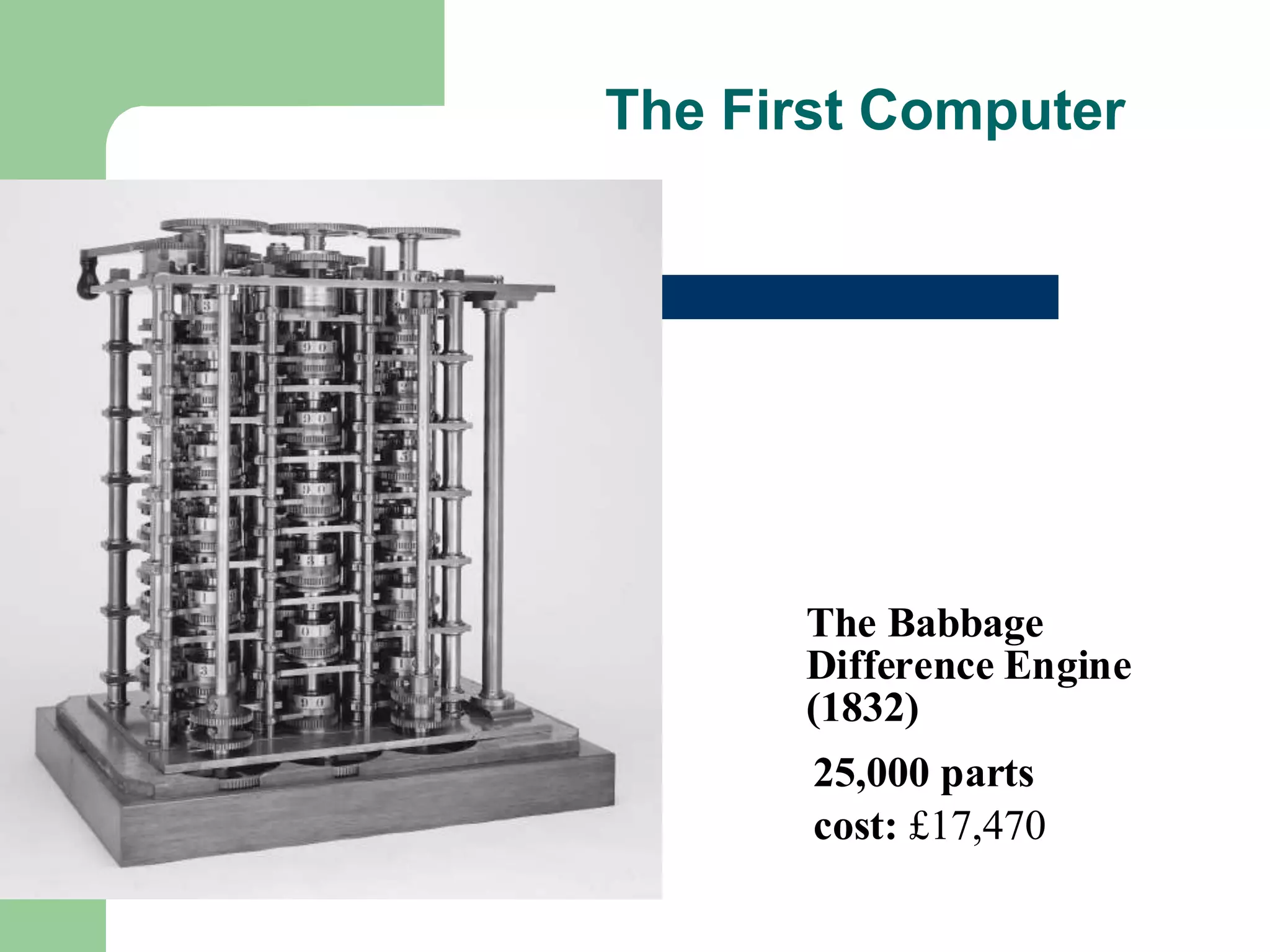
The First Computer
The Babbage
Difference Engine
(1832)
25,000 parts
cost: £17,470
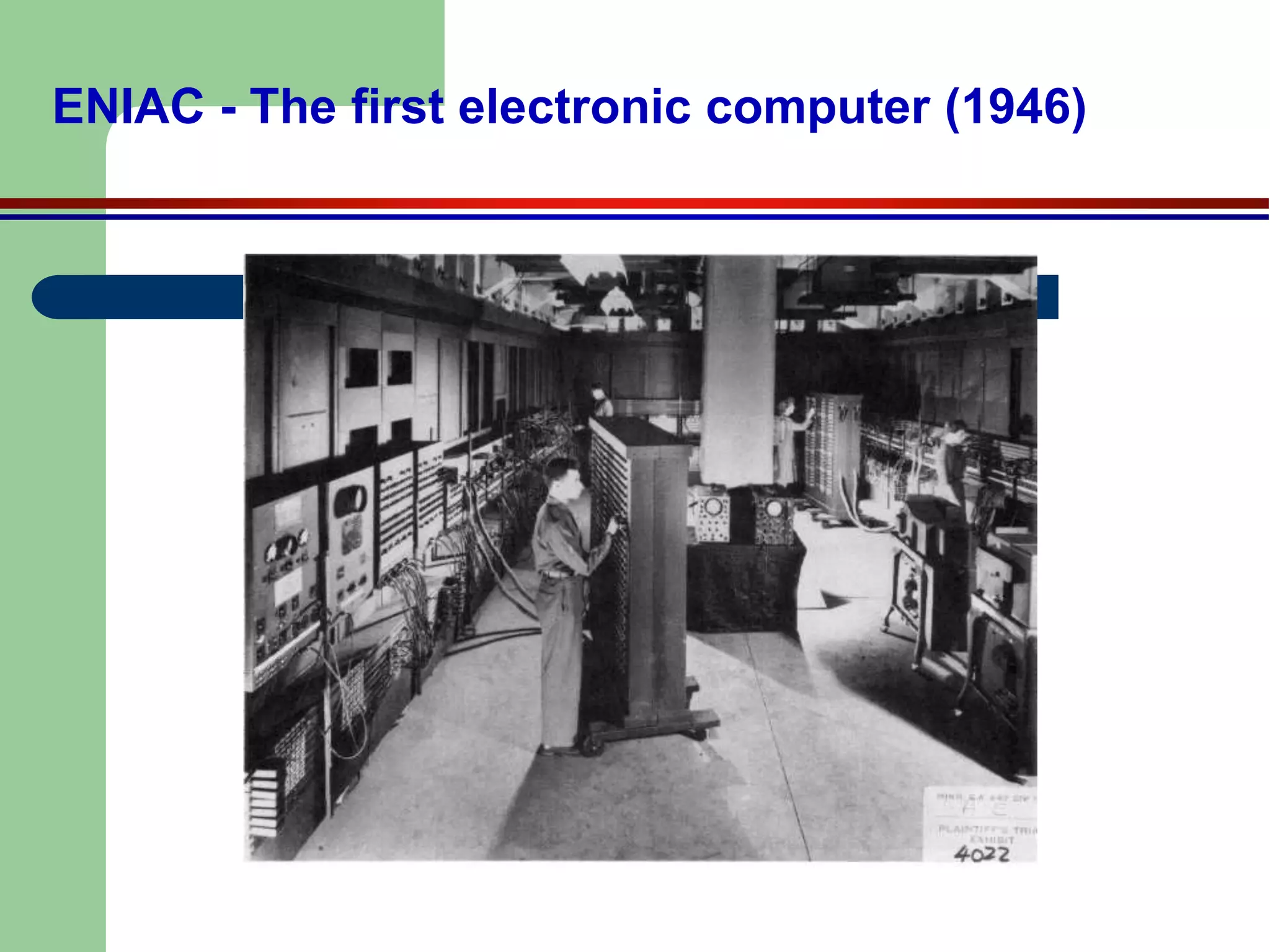
ENIAC - The first electronic computer (1946)
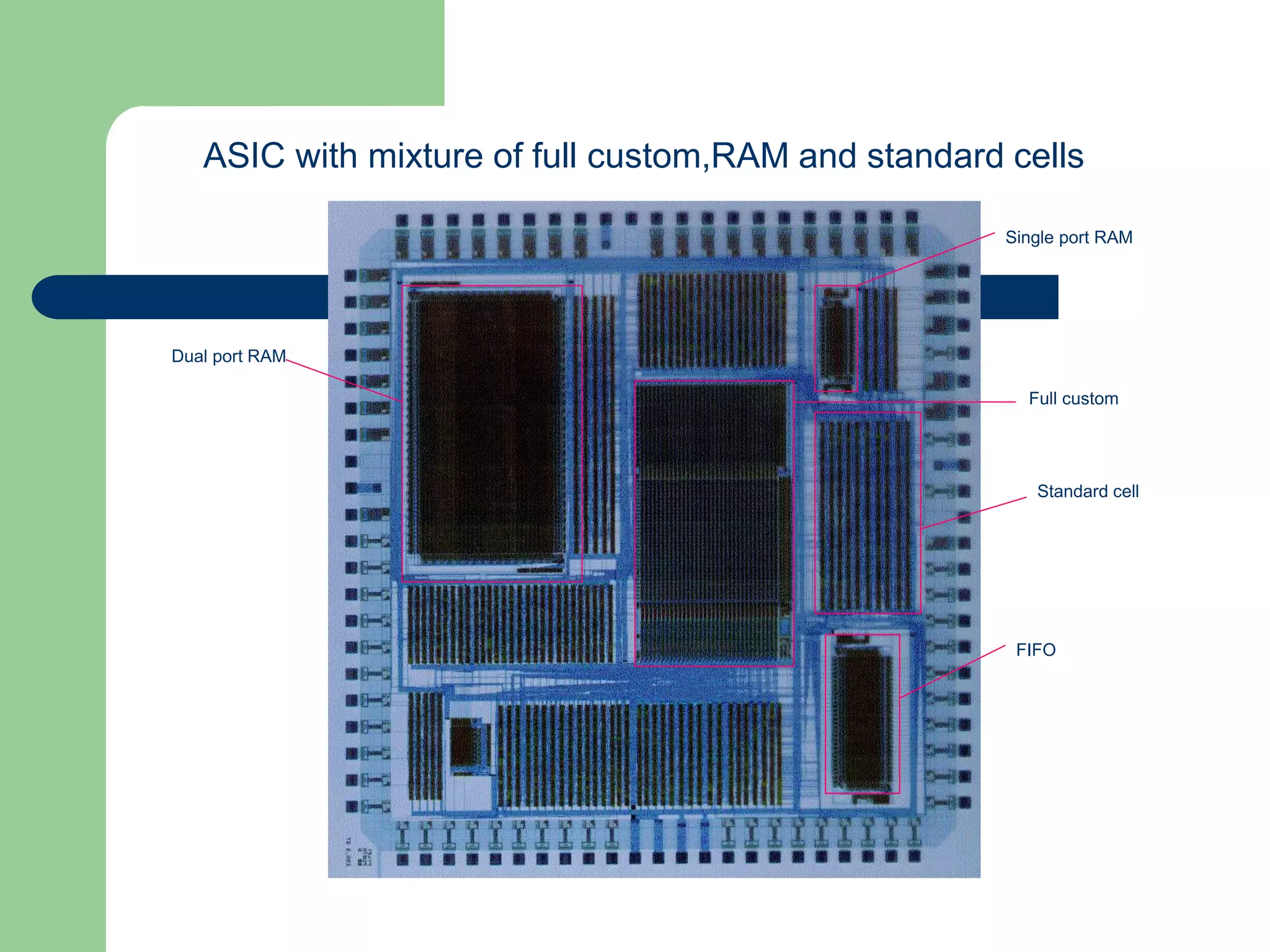
Dual port RAM
Full custom
Standard cell
ASIC with mixture of full custom,RAM and standard cells
FIFO
Single port RAM
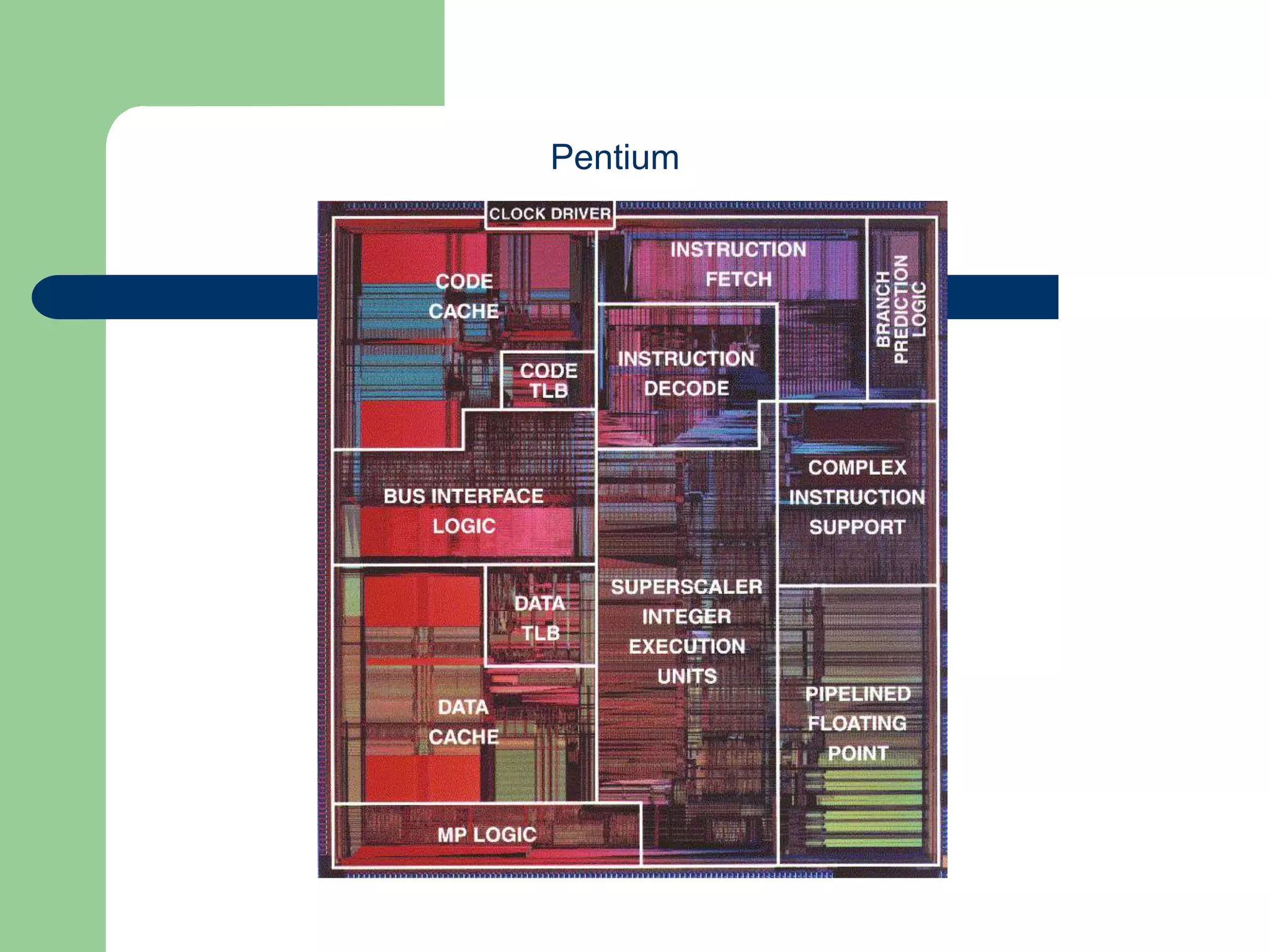
Pentium
8
VLSI Trends: Moore’s Law
 In 1965, Gordon Moore predicted that
transistors would continue to shrink, allowing:
– Doubled transistor density every 18-24 months
– Doubled performance every 18-24 months
 History has proven Moore right
 But, is the end is in sight?
– Physical limitations
– Economic limitations
Gordon Moore
Intel Co-Founder and Chairmain Emeritus
Image source: Intel Corporation www.intel.com
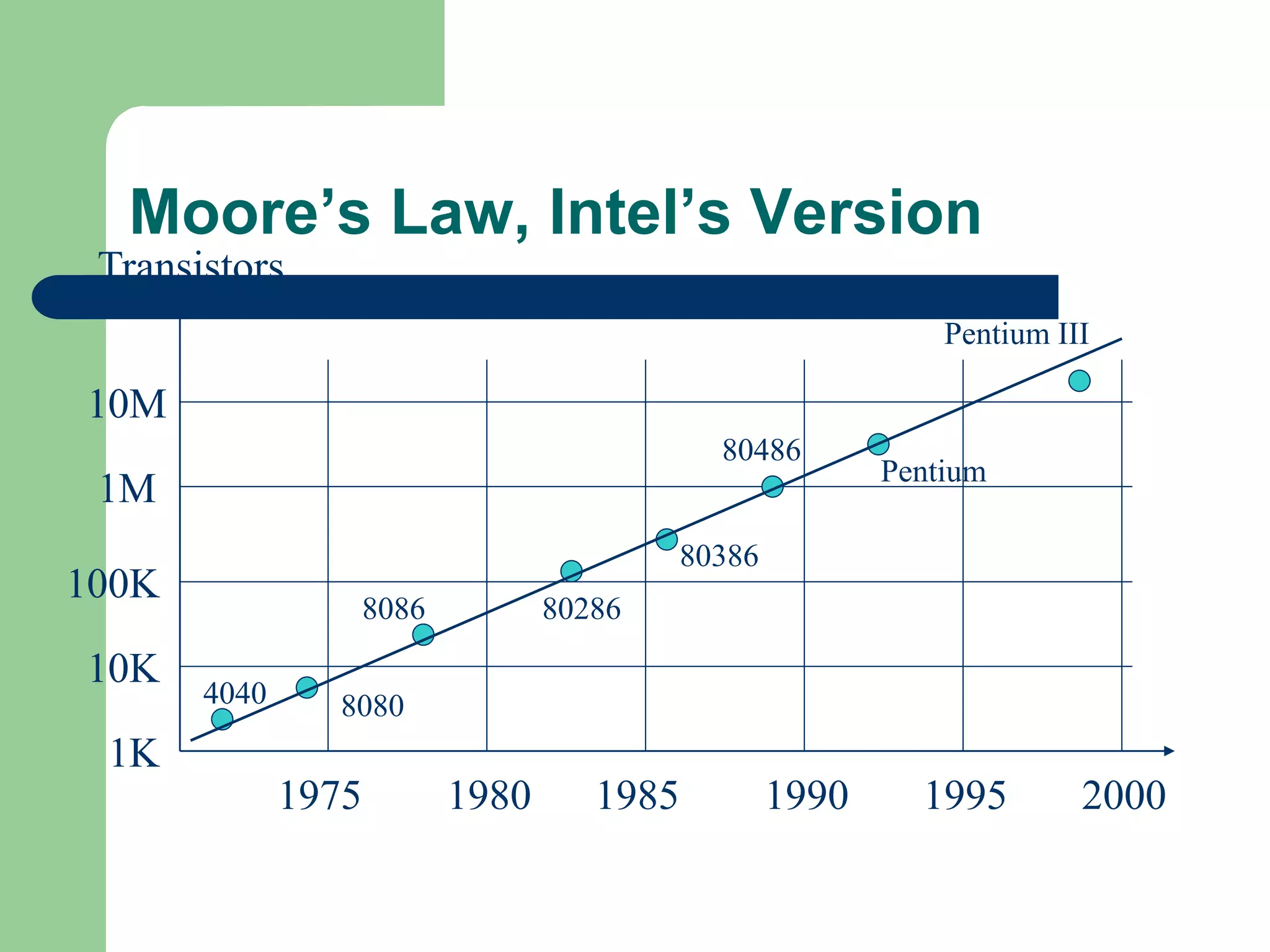
Moore’s Law (cont)
 Intel co-founder Gorden Moore notice in 1964
 Number of transistors doubled every 12 months
while price unchanged
 Slowed down in the 1980s to every 18 months
 Amazingly still correct, likely to keep until 2010.
Moore’s Law, Intel’s Version
Transistors
10K
100K
1M
10M
1975 1980 1985 1990 1995
4040 8080
8086 80286
80386
80486
Pentium
Pentium III
1K
2000
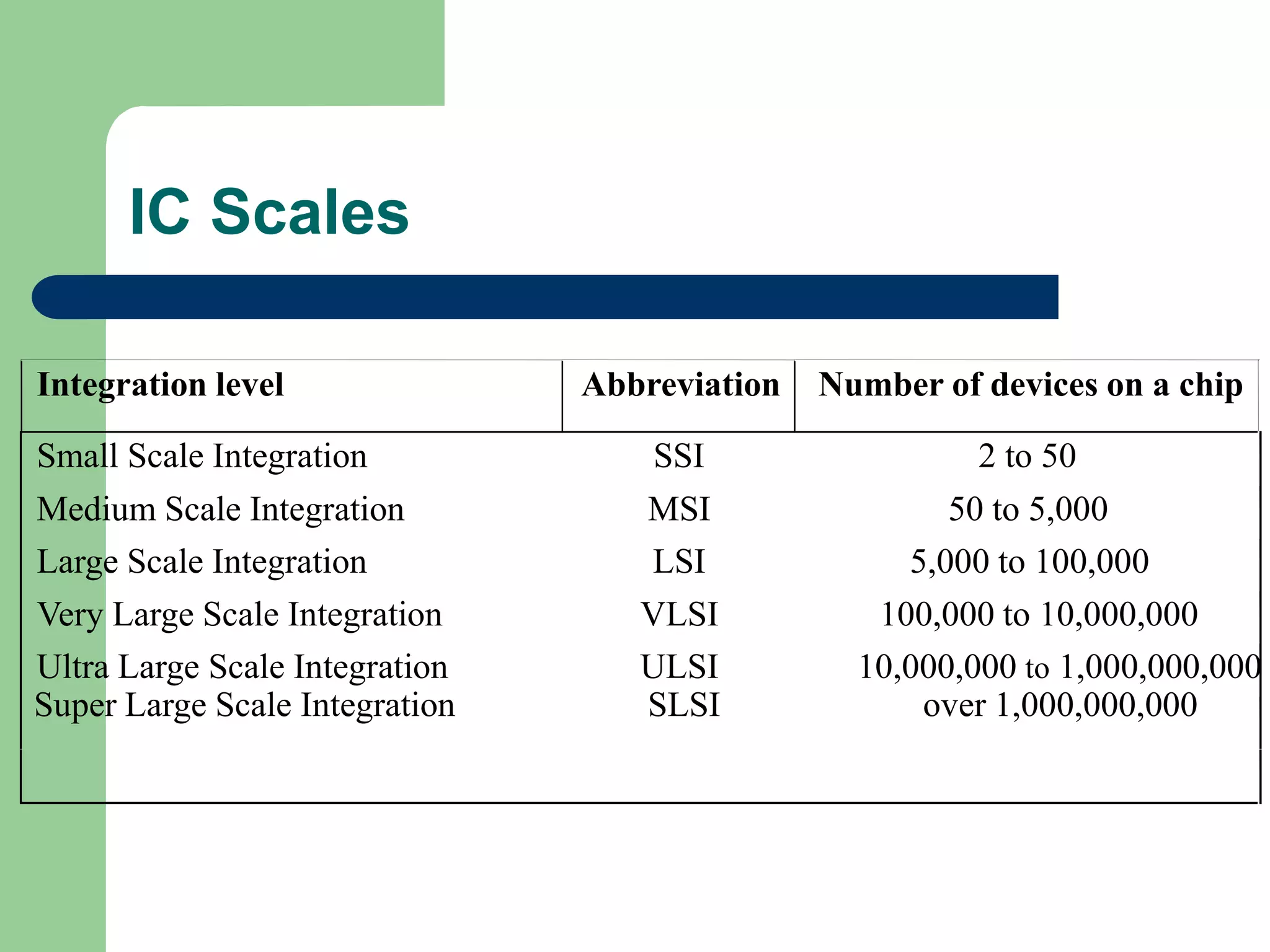
IC Scales
Integration level Abbreviation Number of devices on a chip
Small Scale Integration SSI 2 to 50
Medium Scale Integration MSI 50 to 5,000
Large Scale Integration LSI 5,000 to 100,000
Very Large Scale Integration VLSI 100,000 to 10,000,000
Ultra Large Scale Integration ULSI 10,000,000 to 1,000,000,000
Super Large Scale Integration SLSI over 1,000,000,000
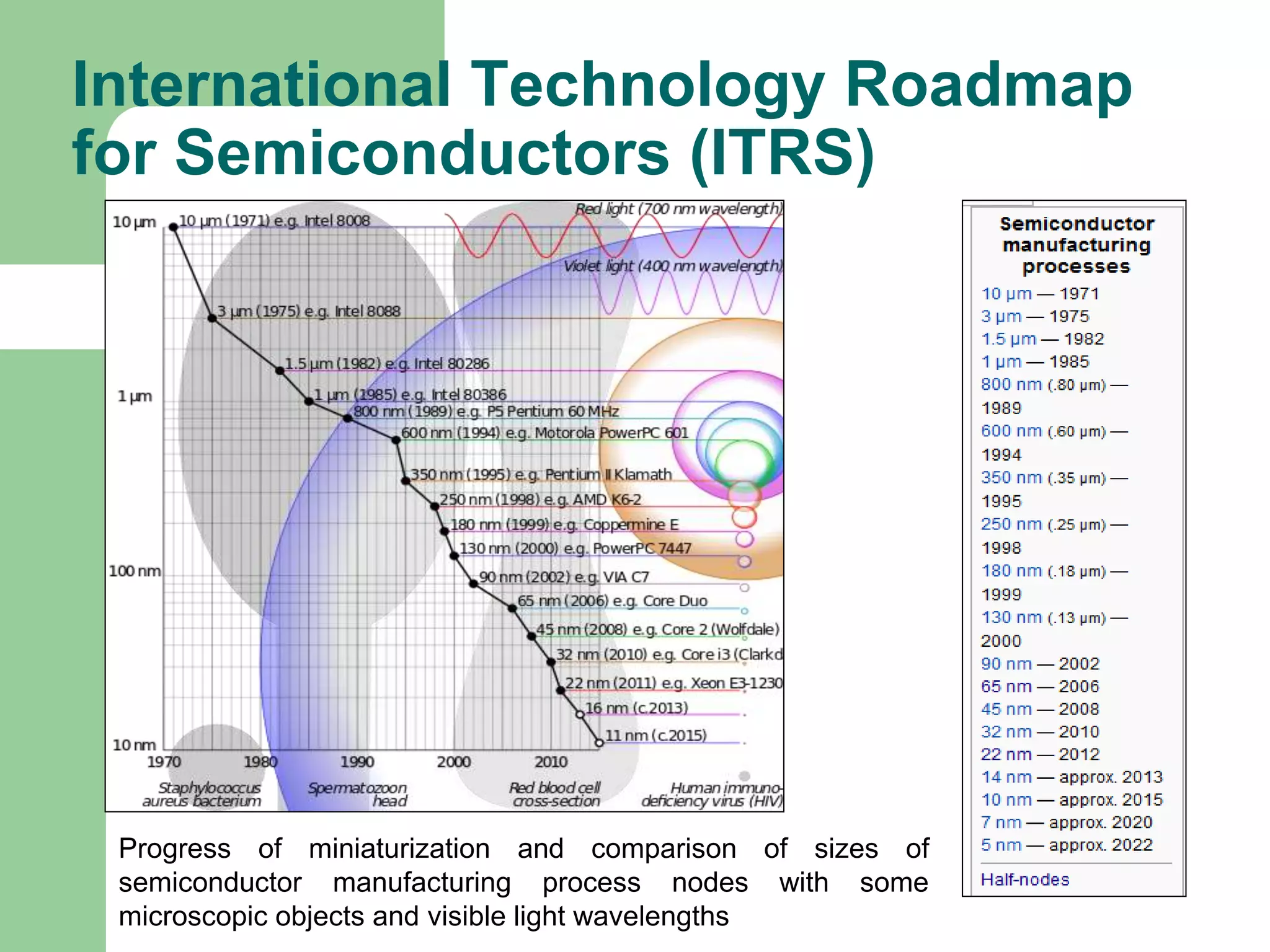
International Technology Roadmap
for Semiconductors (ITRS)
Progress of miniaturization and comparison of sizes of
semiconductor manufacturing process nodes with some
microscopic objects and visible light wavelengths
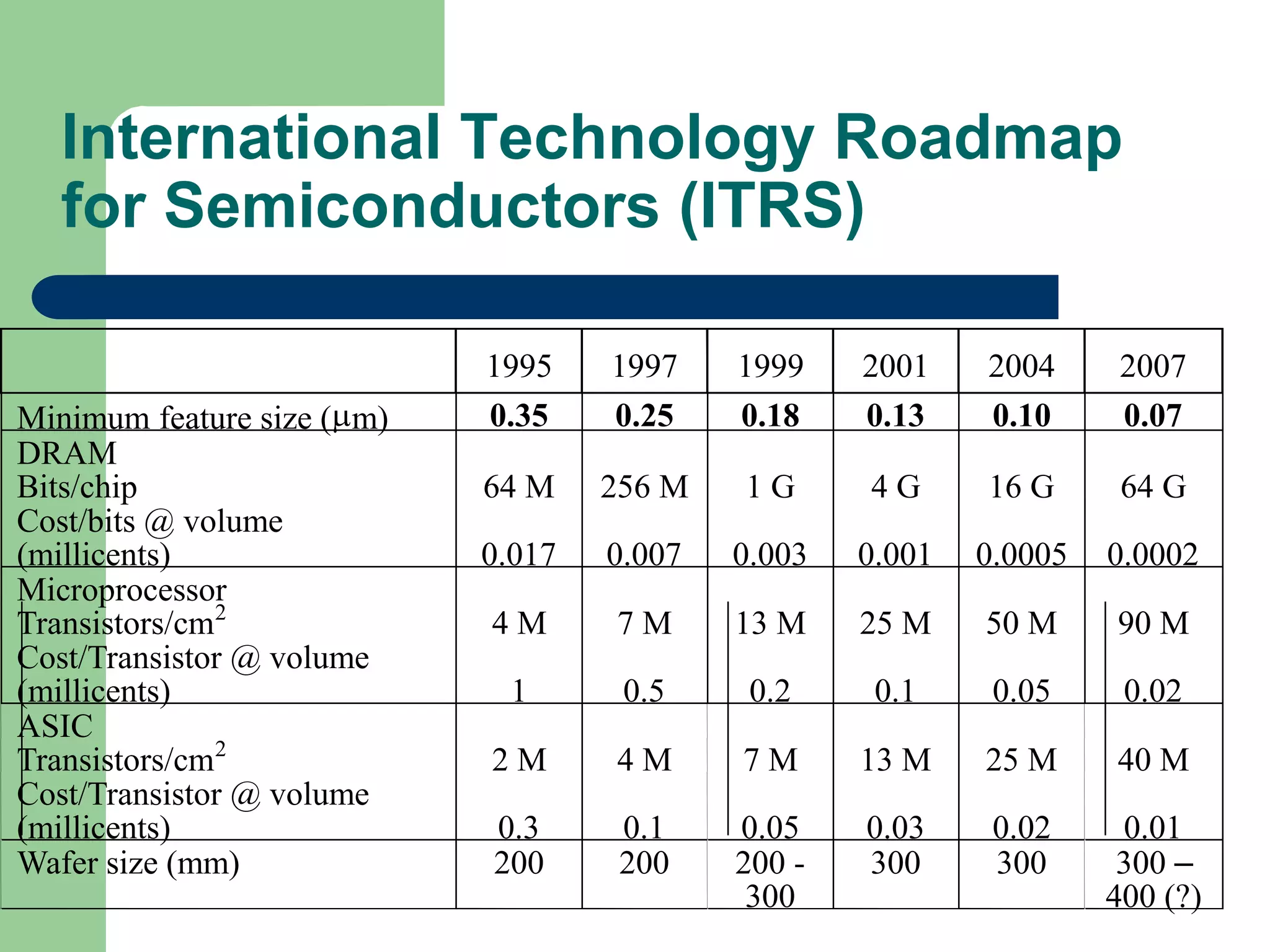
International Technology Roadmap
for Semiconductors (ITRS)
1995 1997 1999 2001 2004 2007
Minimum feature size (mm) 0.35 0.25 0.18 0.13 0.10 0.07
DRAM
Bits/chip 64 M 256 M 1 G 4 G 16 G 64 G
Cost/bits @ volume
(millicents) 0.017 0.007 0.003 0.001 0.0005 0.0002
Microprocessor
Transistors/cm2
4 M 7 M 13 M 25 M 50 M 90 M
Cost/Transistor @ volume
(millicents) 1 0.5 0.2 0.1 0.05 0.02
ASIC
Transistors/cm2
2 M 4 M 7 M 13 M 25 M 40 M
Cost/Transistor @ volume
(millicents) 0.3 0.1 0.05 0.03 0.02 0.01
Wafer size (mm) 200 200 200 -
300
300 300 300 –
400 (?)
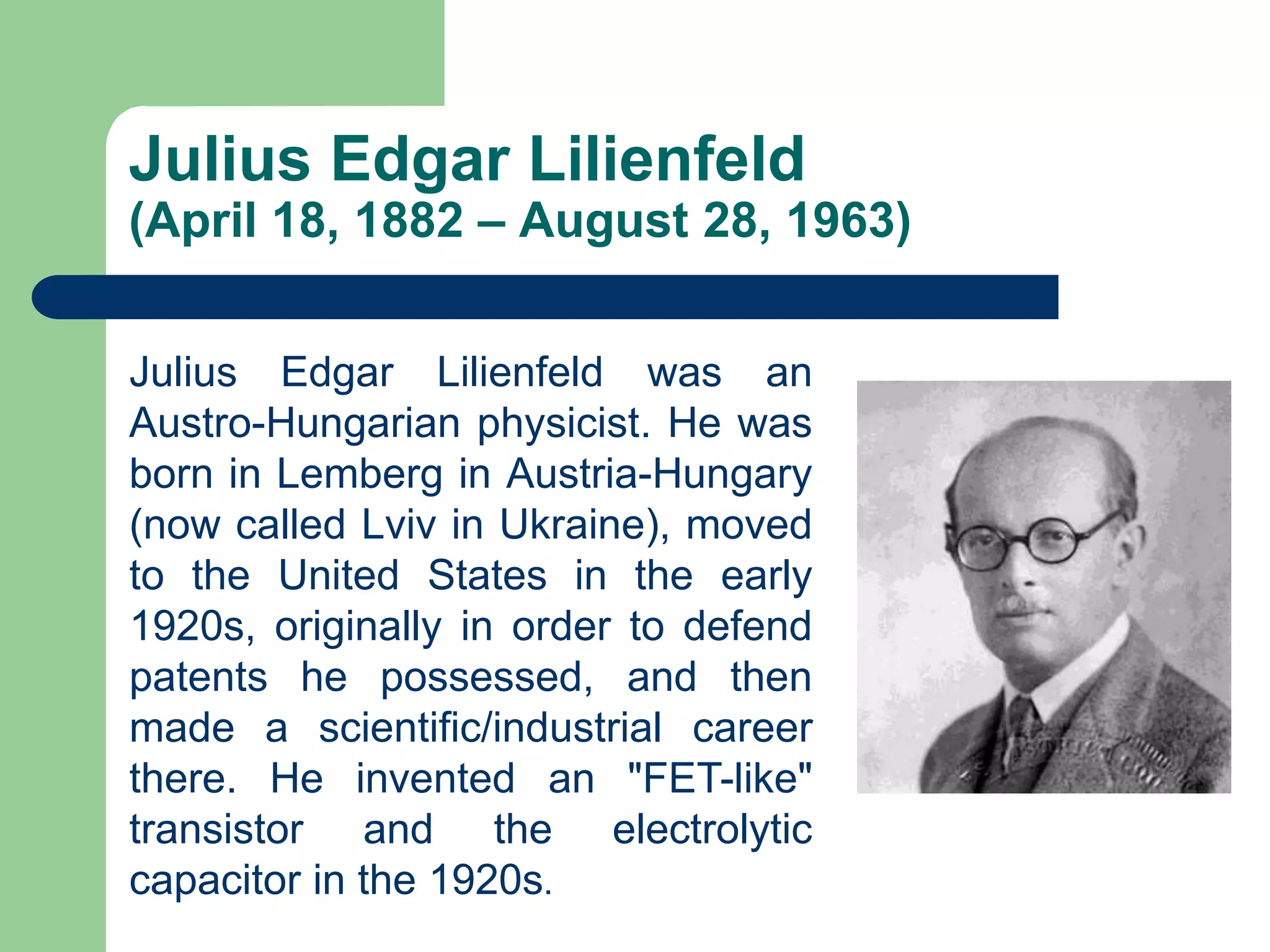
Julius Edgar Lilienfeld
(April 18, 1882 – August 28, 1963)
Julius Edgar Lilienfeld was an
Austro-Hungarian physicist. He was
born in Lemberg in Austria-Hungary
(now called Lviv in Ukraine), moved
to the United States in the early
1920s, originally in order to defend
patents he possessed, and then
made a scientific/industrial career
there. He invented an "FET-like"
transistor and the electrolytic
capacitor in the 1920s.
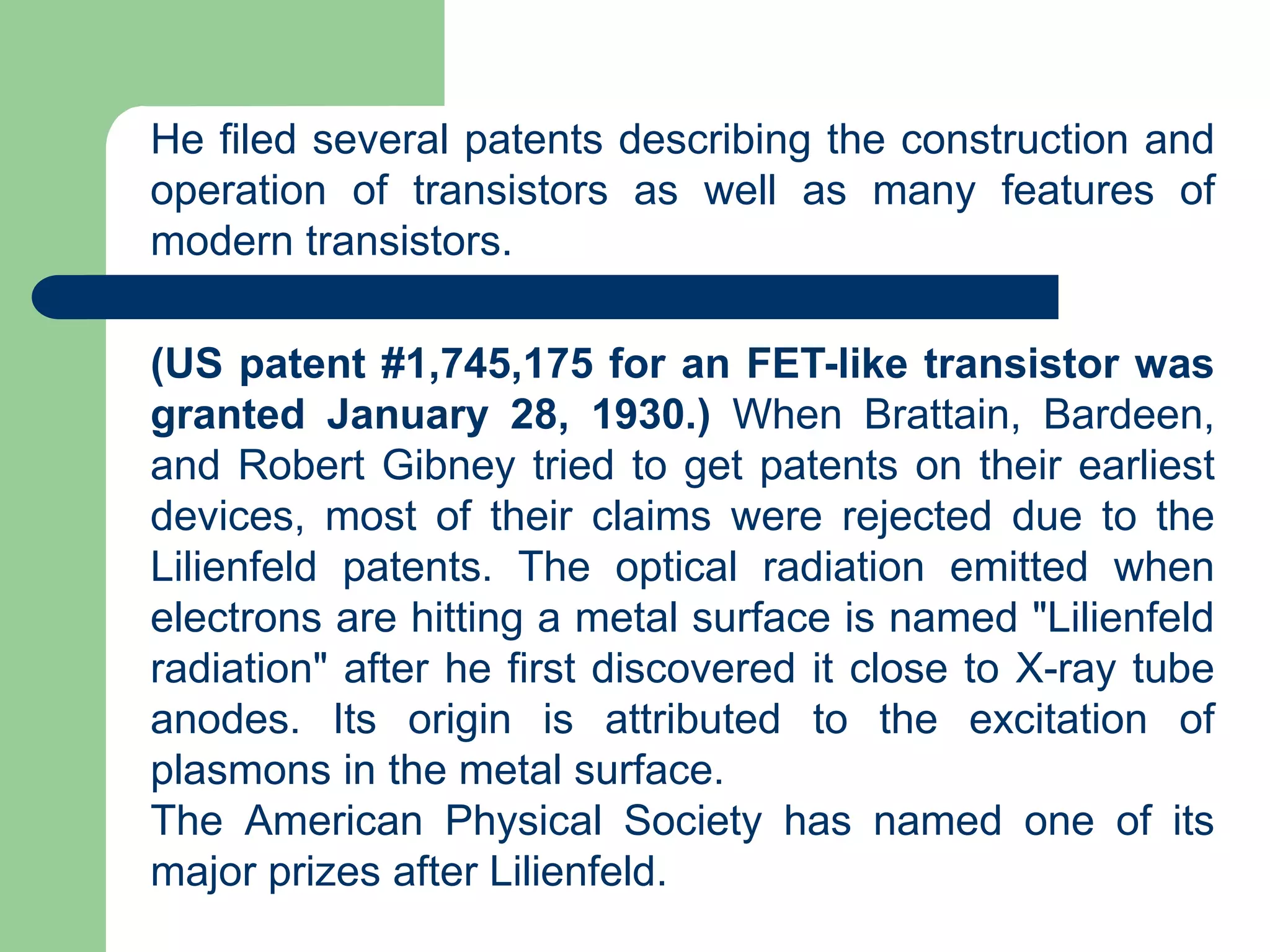
He filed several patents describing the construction and
operation of transistors as well as many features of
modern transistors.
(US patent #1,745,175 for an FET-like transistor was
granted January 28, 1930.) When Brattain, Bardeen,
and Robert Gibney tried to get patents on their earliest
devices, most of their claims were rejected due to the
Lilienfeld patents. The optical radiation emitted when
electrons are hitting a metal surface is named "Lilienfeld
radiation" after he first discovered it close to X-ray tube
anodes. Its origin is attributed to the excitation of
plasmons in the metal surface.
The American Physical Society has named one of its
major prizes after Lilienfeld.
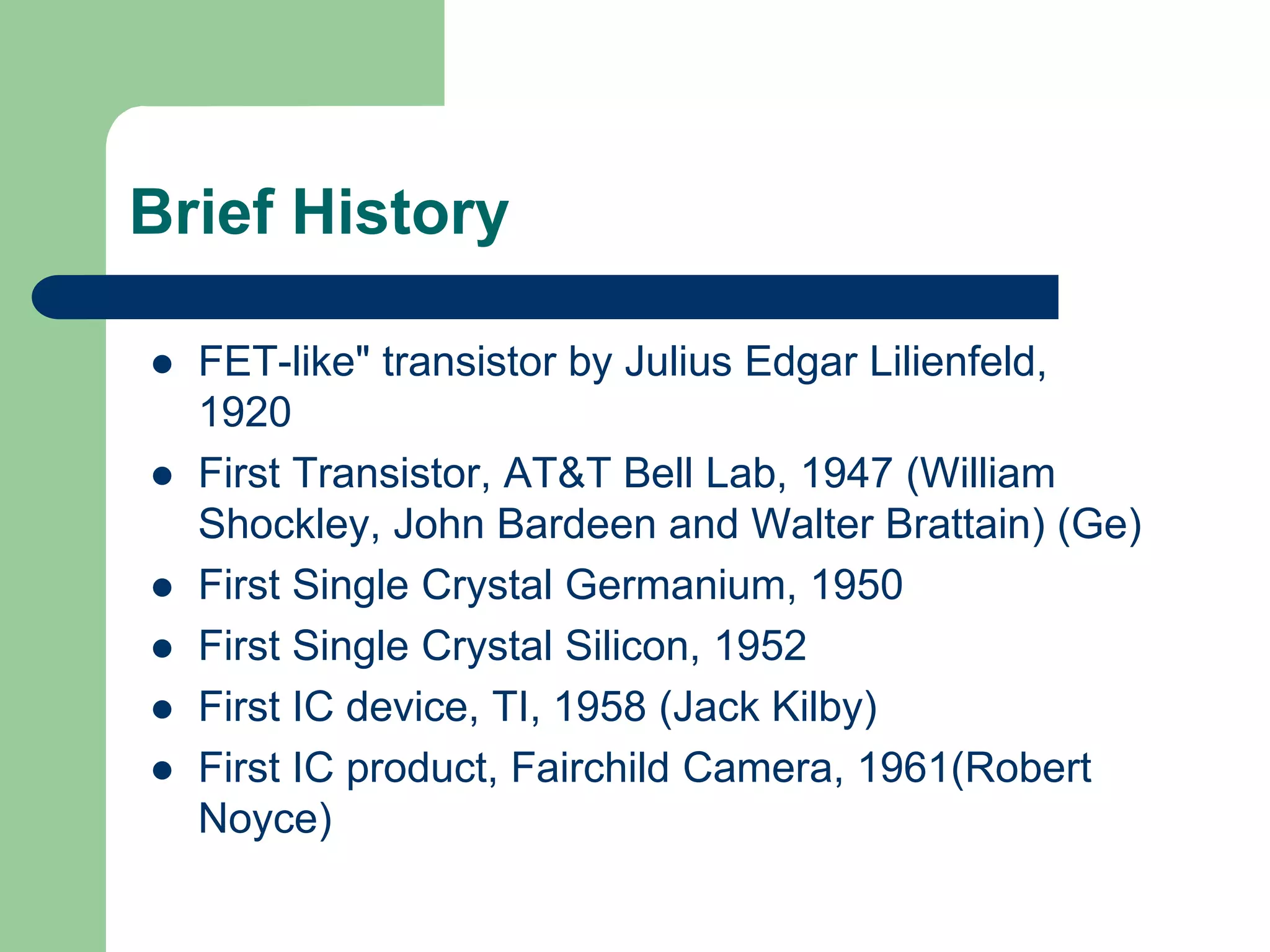
Brief History
 FET-like" transistor by Julius Edgar Lilienfeld,
1920
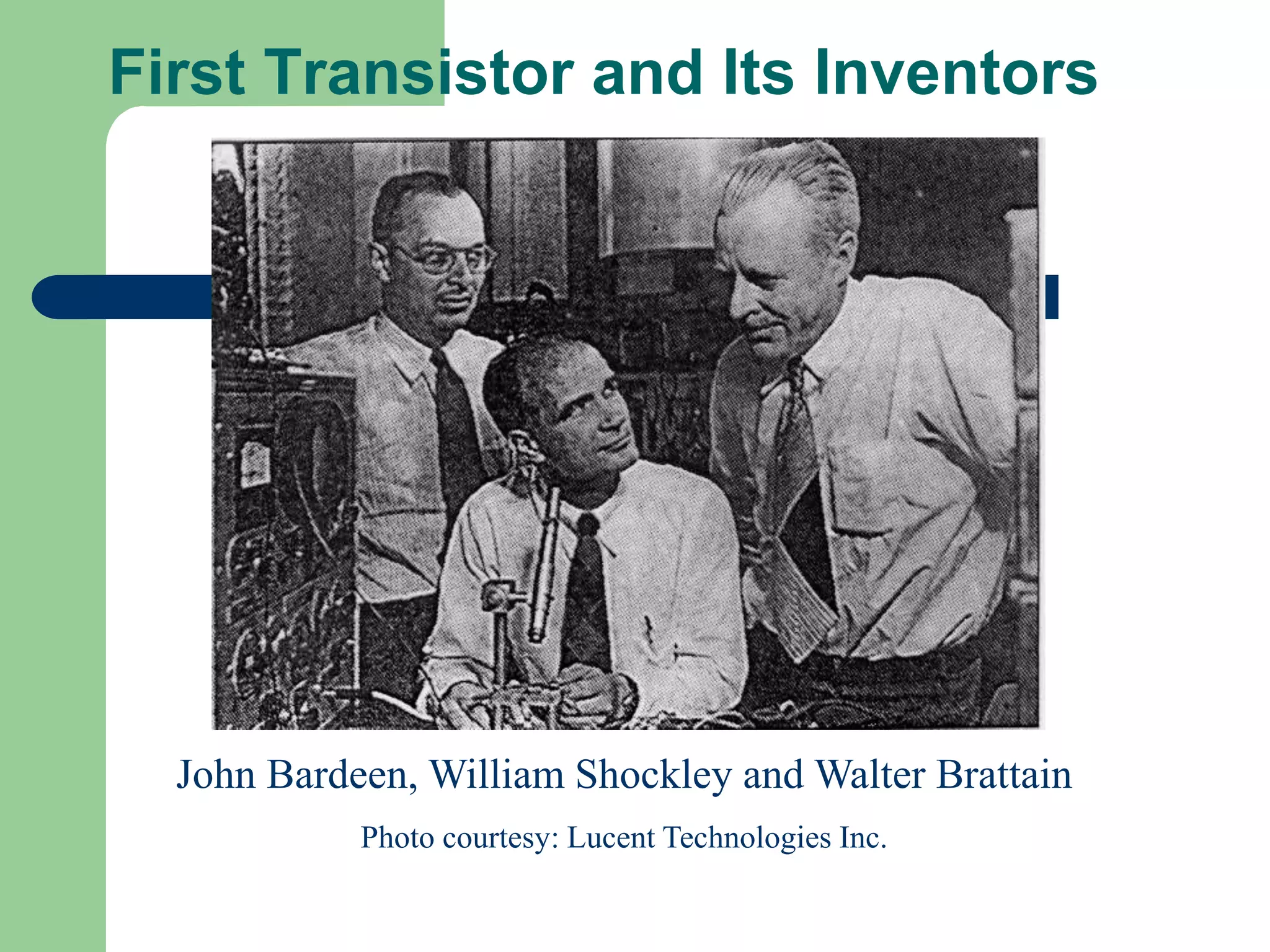
 First Transistor, AT&T Bell Lab, 1947 (William
Shockley, John Bardeen and Walter Brattain) (Ge)
 First Single Crystal Germanium, 1950
 First Single Crystal Silicon, 1952
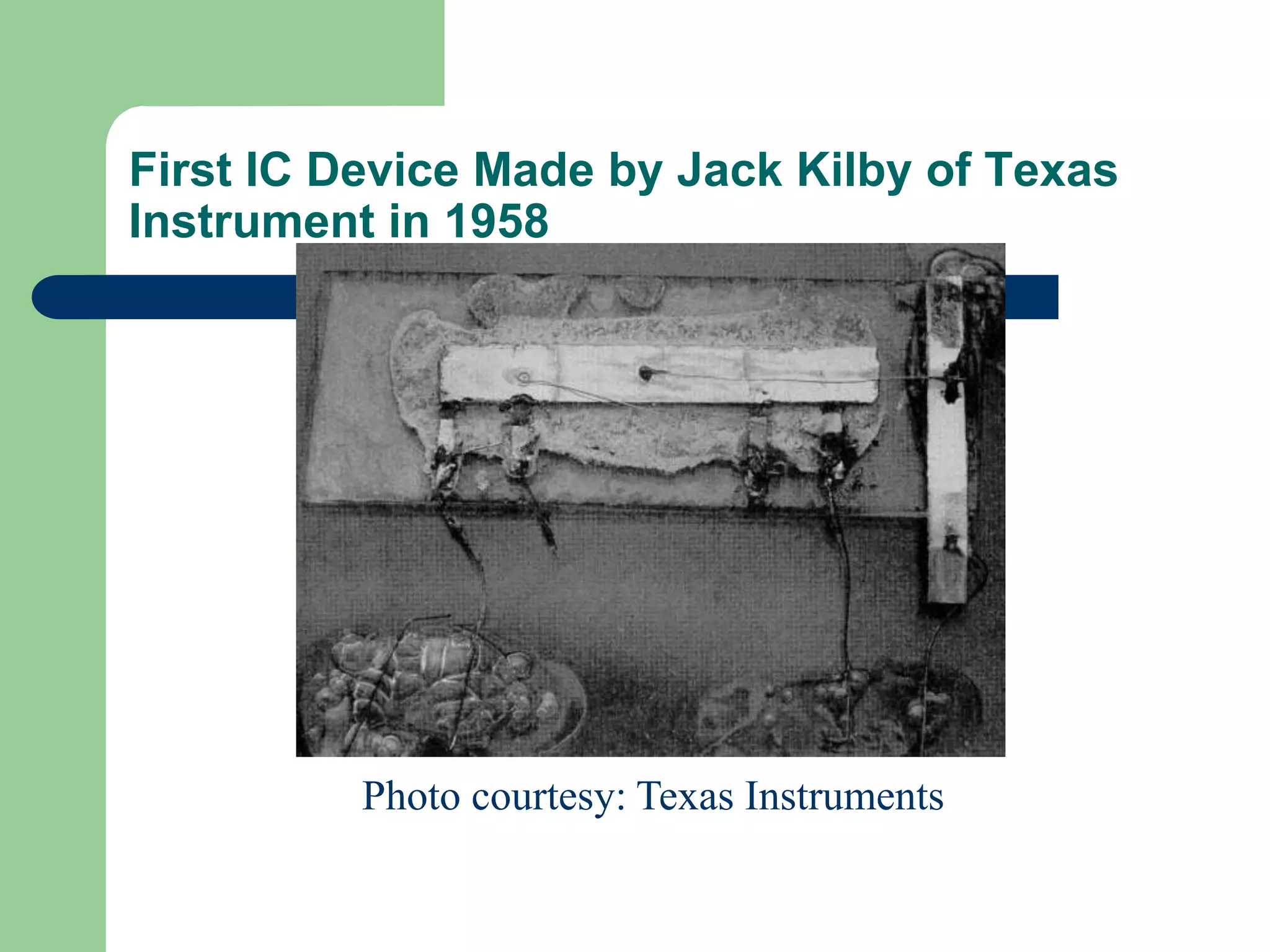
 First IC device, TI, 1958 (Jack Kilby)
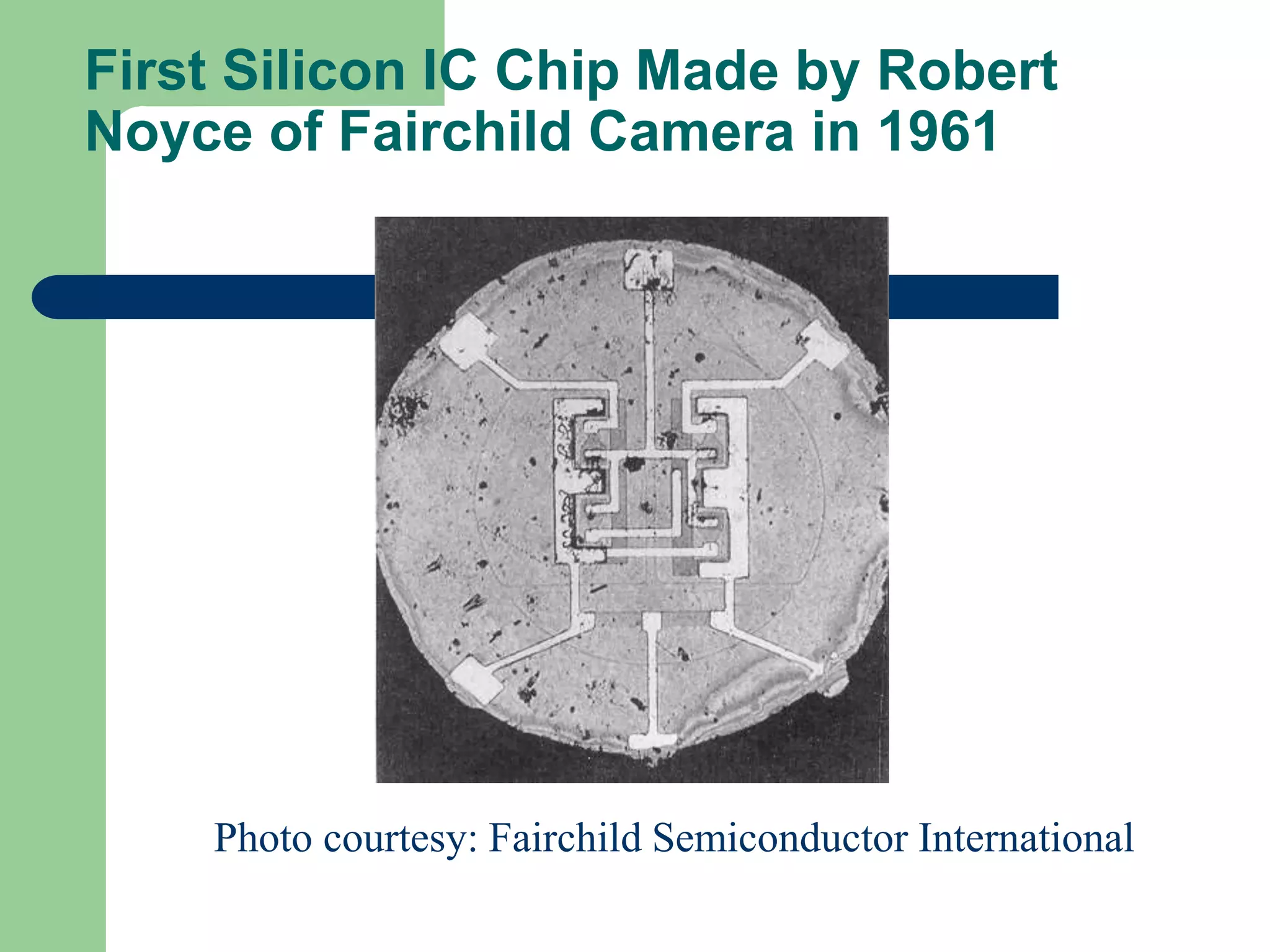
 First IC product, Fairchild Camera, 1961(Robert
Noyce)
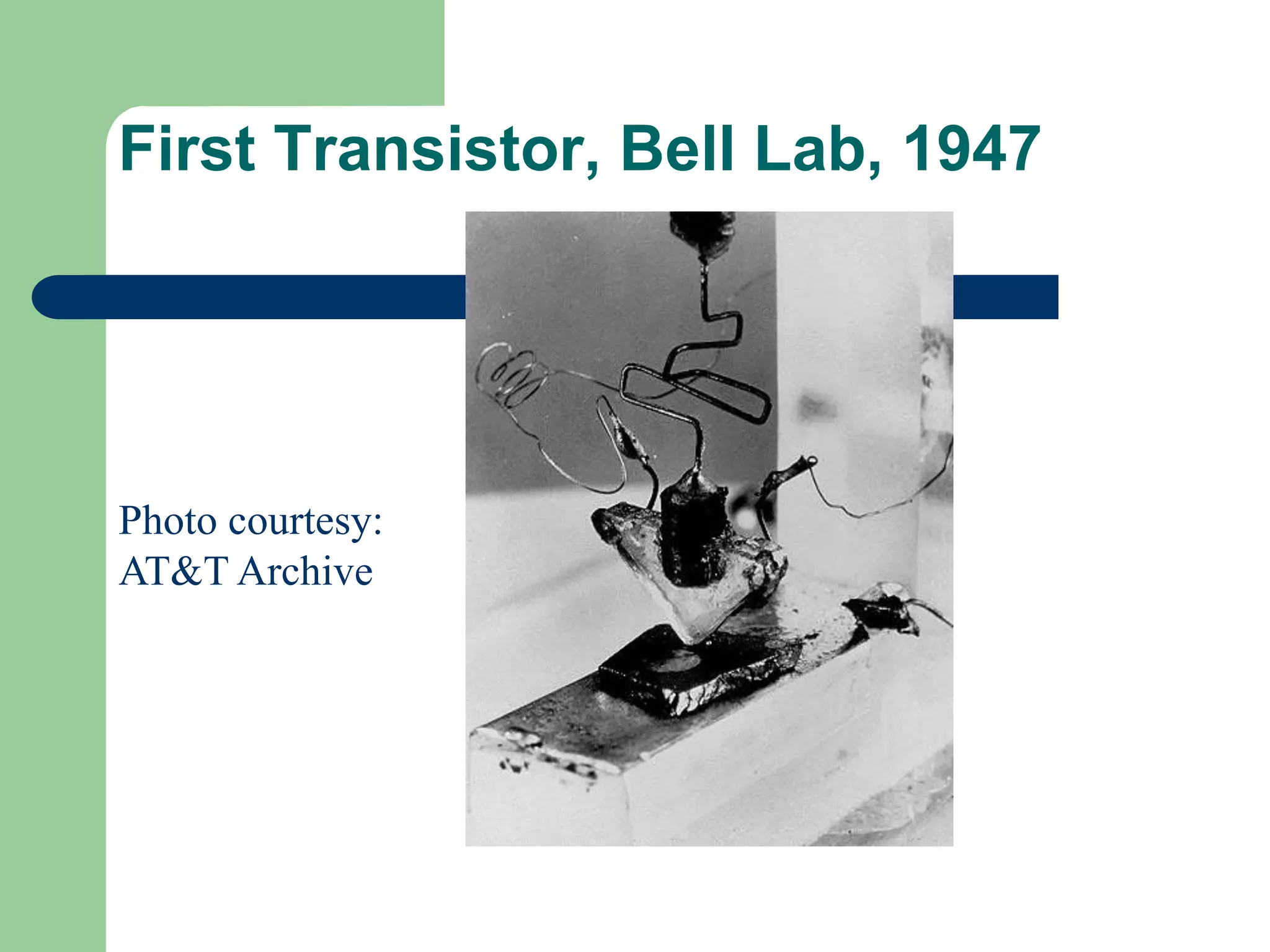
First Transistor, Bell Lab, 1947
Photo courtesy:
AT&T Archive
John Bardeen, William Shockley and Walter Brattain
Photo courtesy: Lucent Technologies Inc.
First Transistor and Its Inventors
First IC Device Made by Jack Kilby of Texas
Instrument in 1958
Photo courtesy: Texas Instruments
First Silicon IC Chip Made by Robert
Noyce of Fairchild Camera in 1961
Photo courtesy: Fairchild Semiconductor International
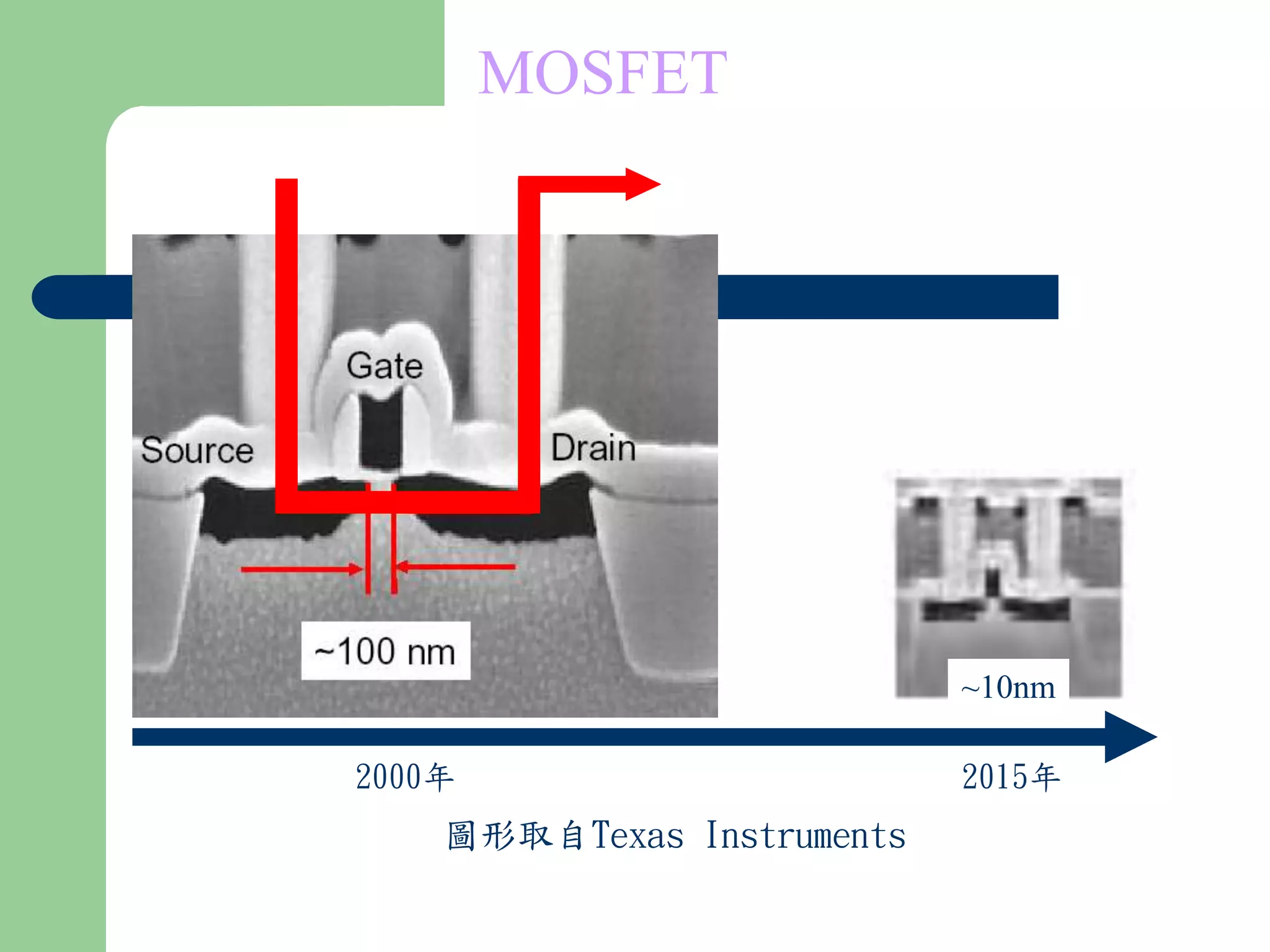
MOSFET
~10nm
2000年 2015年
圖形取自Texas Instruments
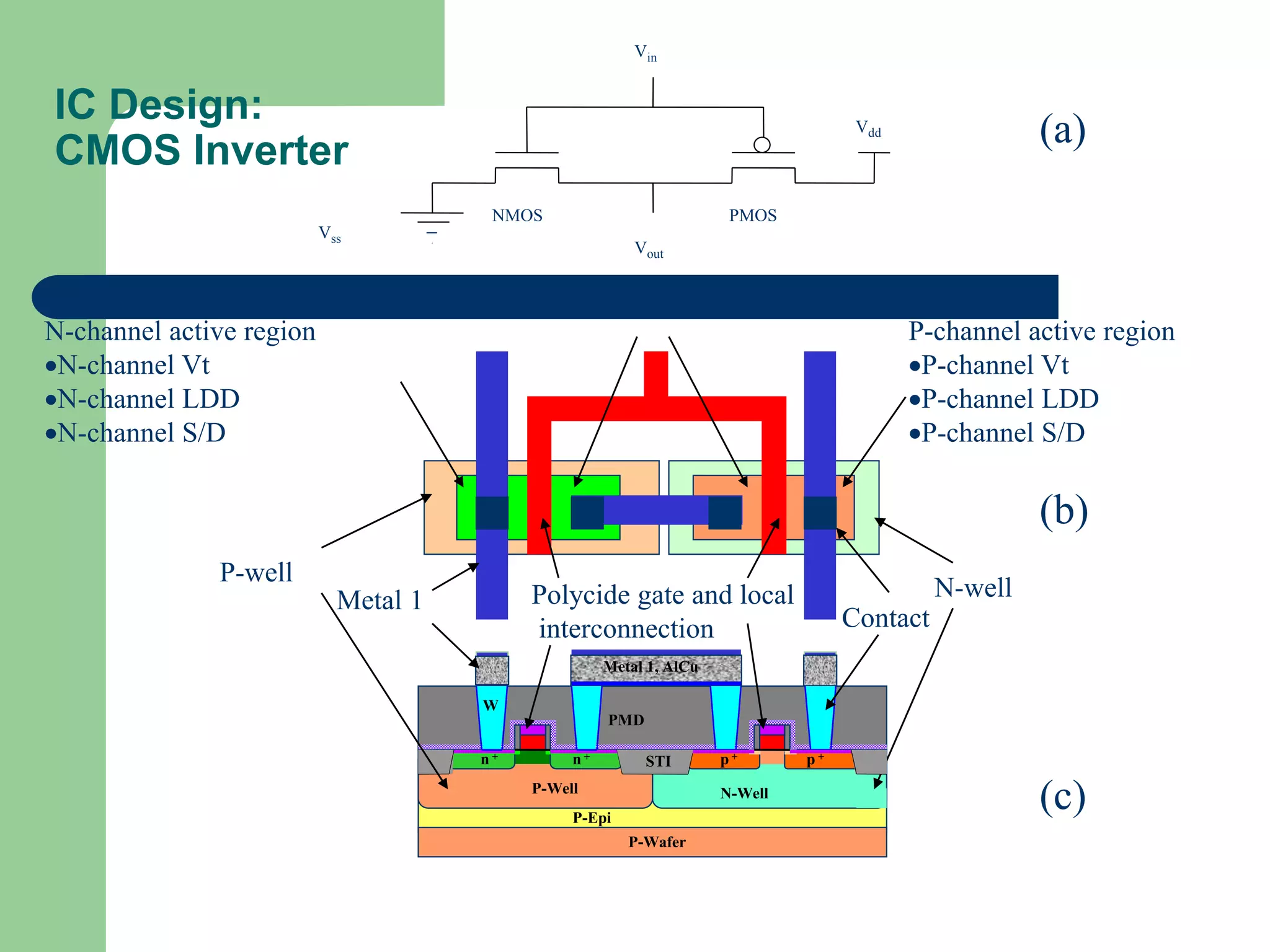
IC Design:
CMOS Inverter
Metal 1, AlCu
P-Epi
P-Wafer
N-WellP-Well
PMD
p + p +n +n +
W
Metal 1
Contact
P-well
N-wellPolycide gate and local
interconnection
N-channel active region
N-channel Vt
N-channel LDD
N-channel S/D
P-channel active region
P-channel Vt
P-channel LDD
P-channel S/D
Shallow trench isolation (STI)
Vss
Vdd
NMOS PMOS
Vin
Vout
STI
(a)
(b)
(c)
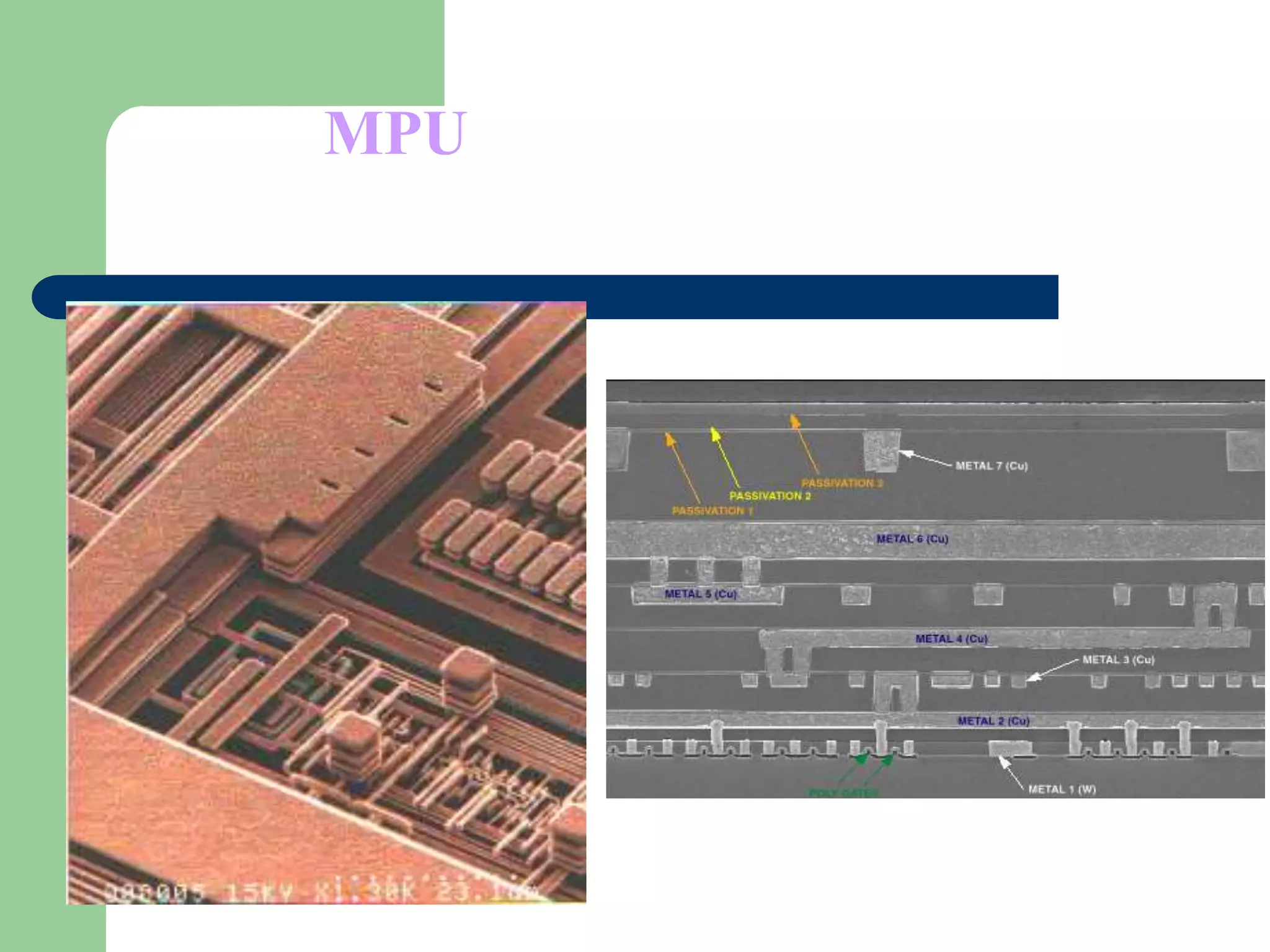
MPU
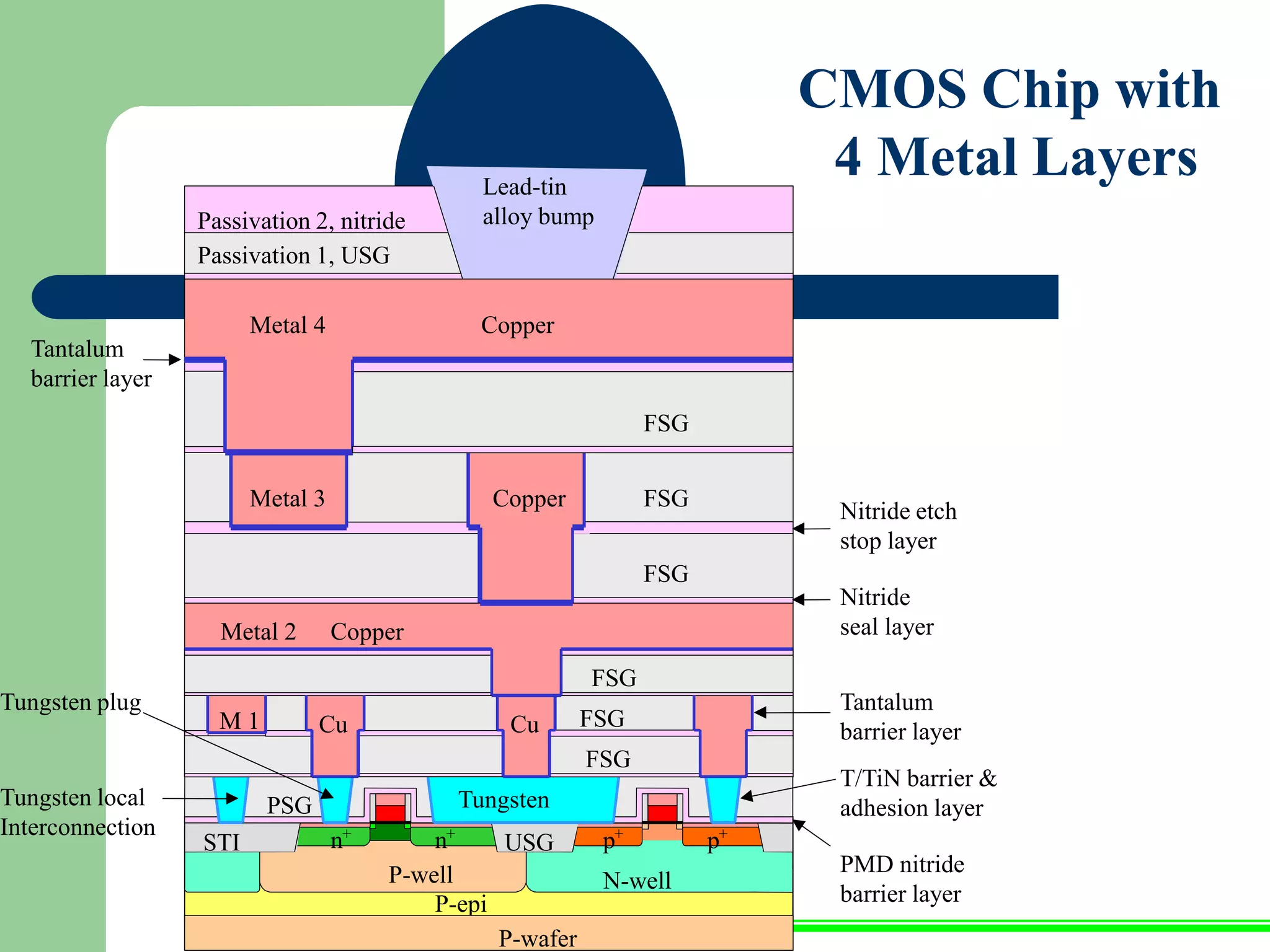
CMOS Chip with
4 Metal Layers
FSG
Metal 4 Copper
Passivation 1, USG
Passivation 2, nitride
Lead-tin
alloy bump
FSG
CopperMetal 2
FSG
FSG
CopperMetal 3
FSG
P-epi
P-wafer
N-wellP-well
n+
STI p+
p+
USGn+
PSG Tungsten
FSG
Cu Cu
Tantalum
barrier layer
Nitride etch
stop layer
Nitride
seal layer
M 1
Tungsten local
Interconnection
Tungsten plug
PMD nitride
barrier layer
T/TiN barrier &
adhesion layer
Tantalum
barrier layer

Vlsi circuit design

  • 1.
  • 2.
    IC Products  Processors –CPU, DSP, Controllers  Memory chips – RAM, ROM, EEPROM  Analog – Mobile communication, audio/video processing  Programmable – PLA, FPGA  Embedded systems – Used in cars, factories – Network cards  System-on-chip (SoC) Images: amazon.com
  • 3.
    VLSI:Very Large ScaleIntegration  Integration: Integrated Circuits – multiple devices on one substrate  How large is Very Large?  SSI (small scale integration) – Transistors<10  MSI (Medium scale integration) – 10<Transistors<100  LSI (Large scale integration) – 100<Transistors<1,000  VLSI (Very large scale integration) – 1,000<Transistors<10,000  ULSI/SLSI (Super Large Scale Integration) – 10,000<Transistors
  • 4.
    The First Computer TheBabbage Difference Engine (1832) 25,000 parts cost: £17,470
  • 5.
    ENIAC - Thefirst electronic computer (1946)
  • 6.
    Dual port RAM Fullcustom Standard cell ASIC with mixture of full custom,RAM and standard cells FIFO Single port RAM
  • 7.
  • 8.
    8 VLSI Trends: Moore’sLaw  In 1965, Gordon Moore predicted that transistors would continue to shrink, allowing: – Doubled transistor density every 18-24 months – Doubled performance every 18-24 months  History has proven Moore right  But, is the end is in sight? – Physical limitations – Economic limitations Gordon Moore Intel Co-Founder and Chairmain Emeritus Image source: Intel Corporation www.intel.com
  • 9.
    Moore’s Law (cont) Intel co-founder Gorden Moore notice in 1964  Number of transistors doubled every 12 months while price unchanged  Slowed down in the 1980s to every 18 months  Amazingly still correct, likely to keep until 2010.
  • 10.
    Moore’s Law, Intel’sVersion Transistors 10K 100K 1M 10M 1975 1980 1985 1990 1995 4040 8080 8086 80286 80386 80486 Pentium Pentium III 1K 2000
  • 11.
    IC Scales Integration levelAbbreviation Number of devices on a chip Small Scale Integration SSI 2 to 50 Medium Scale Integration MSI 50 to 5,000 Large Scale Integration LSI 5,000 to 100,000 Very Large Scale Integration VLSI 100,000 to 10,000,000 Ultra Large Scale Integration ULSI 10,000,000 to 1,000,000,000 Super Large Scale Integration SLSI over 1,000,000,000
  • 12.
    International Technology Roadmap forSemiconductors (ITRS) Progress of miniaturization and comparison of sizes of semiconductor manufacturing process nodes with some microscopic objects and visible light wavelengths
  • 13.
    International Technology Roadmap forSemiconductors (ITRS) 1995 1997 1999 2001 2004 2007 Minimum feature size (mm) 0.35 0.25 0.18 0.13 0.10 0.07 DRAM Bits/chip 64 M 256 M 1 G 4 G 16 G 64 G Cost/bits @ volume (millicents) 0.017 0.007 0.003 0.001 0.0005 0.0002 Microprocessor Transistors/cm2 4 M 7 M 13 M 25 M 50 M 90 M Cost/Transistor @ volume (millicents) 1 0.5 0.2 0.1 0.05 0.02 ASIC Transistors/cm2 2 M 4 M 7 M 13 M 25 M 40 M Cost/Transistor @ volume (millicents) 0.3 0.1 0.05 0.03 0.02 0.01 Wafer size (mm) 200 200 200 - 300 300 300 300 – 400 (?)
  • 14.
    Julius Edgar Lilienfeld (April18, 1882 – August 28, 1963) Julius Edgar Lilienfeld was an Austro-Hungarian physicist. He was born in Lemberg in Austria-Hungary (now called Lviv in Ukraine), moved to the United States in the early 1920s, originally in order to defend patents he possessed, and then made a scientific/industrial career there. He invented an "FET-like" transistor and the electrolytic capacitor in the 1920s.
  • 15.
    He filed severalpatents describing the construction and operation of transistors as well as many features of modern transistors. (US patent #1,745,175 for an FET-like transistor was granted January 28, 1930.) When Brattain, Bardeen, and Robert Gibney tried to get patents on their earliest devices, most of their claims were rejected due to the Lilienfeld patents. The optical radiation emitted when electrons are hitting a metal surface is named "Lilienfeld radiation" after he first discovered it close to X-ray tube anodes. Its origin is attributed to the excitation of plasmons in the metal surface. The American Physical Society has named one of its major prizes after Lilienfeld.
  • 16.
    Brief History  FET-like"transistor by Julius Edgar Lilienfeld, 1920  First Transistor, AT&T Bell Lab, 1947 (William Shockley, John Bardeen and Walter Brattain) (Ge)  First Single Crystal Germanium, 1950  First Single Crystal Silicon, 1952  First IC device, TI, 1958 (Jack Kilby)  First IC product, Fairchild Camera, 1961(Robert Noyce)
  • 17.
    First Transistor, BellLab, 1947 Photo courtesy: AT&T Archive
  • 18.
    John Bardeen, WilliamShockley and Walter Brattain Photo courtesy: Lucent Technologies Inc. First Transistor and Its Inventors
  • 19.
    First IC DeviceMade by Jack Kilby of Texas Instrument in 1958 Photo courtesy: Texas Instruments
  • 20.
    First Silicon ICChip Made by Robert Noyce of Fairchild Camera in 1961 Photo courtesy: Fairchild Semiconductor International
  • 21.
  • 22.
    IC Design: CMOS Inverter Metal1, AlCu P-Epi P-Wafer N-WellP-Well PMD p + p +n +n + W Metal 1 Contact P-well N-wellPolycide gate and local interconnection N-channel active region N-channel Vt N-channel LDD N-channel S/D P-channel active region P-channel Vt P-channel LDD P-channel S/D Shallow trench isolation (STI) Vss Vdd NMOS PMOS Vin Vout STI (a) (b) (c)
  • 23.
  • 24.
    CMOS Chip with 4Metal Layers FSG Metal 4 Copper Passivation 1, USG Passivation 2, nitride Lead-tin alloy bump FSG CopperMetal 2 FSG FSG CopperMetal 3 FSG P-epi P-wafer N-wellP-well n+ STI p+ p+ USGn+ PSG Tungsten FSG Cu Cu Tantalum barrier layer Nitride etch stop layer Nitride seal layer M 1 Tungsten local Interconnection Tungsten plug PMD nitride barrier layer T/TiN barrier & adhesion layer Tantalum barrier layer