Copyright © 2006 by The McGraw-Hill Companies, Inc. All rights reserved.McGraw-Hill Technology Education
Chapter 12A
The Basics of
Information Systems
12A-2
Purpose of Information Systems
• Information systems
– Collects, stores and organizes information
– Retrieves value from data
– Harness many types of data
– Computer’s reason for existence
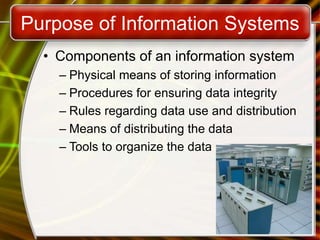
Purpose of Information Systems
• Components of an information system
– Physical means of storing information
– Procedures for ensuring data integrity
– Rules regarding data use and distribution
– Means of distributing the data
– Tools to organize the data
Types of Information Systems
• Office automation systems
– Performs various office tasks
– Allows users to efficiently handle data
– Tedious tasks become simple
– Built usually using off-the-shelf systems
– Allow seamless integration of data
Types of Information Systems
• Transaction processing systems (TPS)
– Transaction is a complete event
• Completed in a series of steps
– Tracks and processes transactions
– Each step is monitored
• Details sent to the appropriate person
– Errors must be remedied immediately
Types of Information Systems
• Management information systems (MIS)
– Tools for managers and decision makers
– Organizes and evaluates information
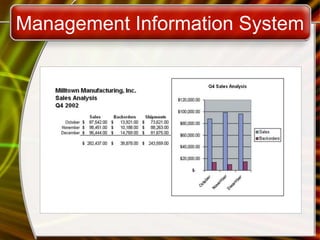
– Summarizes reports based on need
• Managers require different views of data
Management Information System
Types of Information Systems
• Decision support system
– Organizes information for better decisions
– Different data and criteria are evaluated
– Often based on spreadsheet software
– Provides tailored and structured reports
Types of Information Systems
• Expert systems
– Perform tasks done by a person
– Analyze data and suggest an action
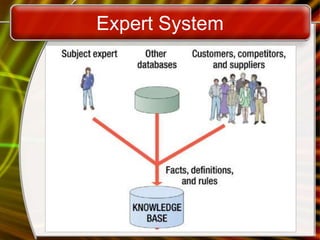
– Requires a large knowledge base
– Inference engines
• Analyze the data
• Make the decisions
Expert System
Information Systems Technology
• Intranets
– Private network using internet technology
– Employees use to access data
– Databases are stored on the Intranet
– Access to outside users is blocked
Information Systems Technology
• Extranets
– Outside access to an intranet
– Goal is to simplify a process
– Just-in-time inventory
• Manufacturer keeps little material in stock
• Arranges to have stock delivered daily
Information Systems Technology
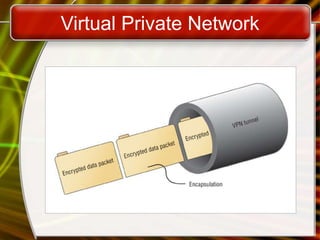
• Virtual Private Networks
– Secure connection over the Internet
– Tunneling provides security
• Data transmitted in an encrypted packet
– Employees use to work from home
– Networks use to connect securely
– Once established, the VPN is transparent
Virtual Private Network
Information Systems Technology
• Electronic data interchange (EDI)
– Electronic transfer of data
– Data transferred in a precise manner
– Networks often share an information
system
– Over time can save organizations money
Information Systems Department
• Integral part of any organization
• Maintains equipment, software and data
• Enables other employees to function
• Requires highly trained employees
• Various names
– Information Systems (IS)
– Information Technology (IT)
– Management Information Systems (MIS)
Copyright © 2006 by The McGraw-Hill Companies, Inc. All rights reserved.McGraw-Hill Technology Education
Chapter 12A
End of Chapter

The basics of information systems

  • 1.
    Copyright © 2006by The McGraw-Hill Companies, Inc. All rights reserved.McGraw-Hill Technology Education Chapter 12A The Basics of Information Systems
  • 2.
    12A-2 Purpose of InformationSystems • Information systems – Collects, stores and organizes information – Retrieves value from data – Harness many types of data – Computer’s reason for existence
  • 3.
    Purpose of InformationSystems • Components of an information system – Physical means of storing information – Procedures for ensuring data integrity – Rules regarding data use and distribution – Means of distributing the data – Tools to organize the data
  • 4.
    Types of InformationSystems • Office automation systems – Performs various office tasks – Allows users to efficiently handle data – Tedious tasks become simple – Built usually using off-the-shelf systems – Allow seamless integration of data
  • 5.
    Types of InformationSystems • Transaction processing systems (TPS) – Transaction is a complete event • Completed in a series of steps – Tracks and processes transactions – Each step is monitored • Details sent to the appropriate person – Errors must be remedied immediately
  • 6.
    Types of InformationSystems • Management information systems (MIS) – Tools for managers and decision makers – Organizes and evaluates information – Summarizes reports based on need • Managers require different views of data
  • 7.
  • 8.
    Types of InformationSystems • Decision support system – Organizes information for better decisions – Different data and criteria are evaluated – Often based on spreadsheet software – Provides tailored and structured reports
  • 9.
    Types of InformationSystems • Expert systems – Perform tasks done by a person – Analyze data and suggest an action – Requires a large knowledge base – Inference engines • Analyze the data • Make the decisions
  • 10.
  • 11.
    Information Systems Technology •Intranets – Private network using internet technology – Employees use to access data – Databases are stored on the Intranet – Access to outside users is blocked
  • 12.
    Information Systems Technology •Extranets – Outside access to an intranet – Goal is to simplify a process – Just-in-time inventory • Manufacturer keeps little material in stock • Arranges to have stock delivered daily
  • 13.
    Information Systems Technology •Virtual Private Networks – Secure connection over the Internet – Tunneling provides security • Data transmitted in an encrypted packet – Employees use to work from home – Networks use to connect securely – Once established, the VPN is transparent
  • 14.
  • 15.
    Information Systems Technology •Electronic data interchange (EDI) – Electronic transfer of data – Data transferred in a precise manner – Networks often share an information system – Over time can save organizations money
  • 16.
    Information Systems Department •Integral part of any organization • Maintains equipment, software and data • Enables other employees to function • Requires highly trained employees • Various names – Information Systems (IS) – Information Technology (IT) – Management Information Systems (MIS)
  • 17.
    Copyright © 2006by The McGraw-Hill Companies, Inc. All rights reserved.McGraw-Hill Technology Education Chapter 12A End of Chapter