1947
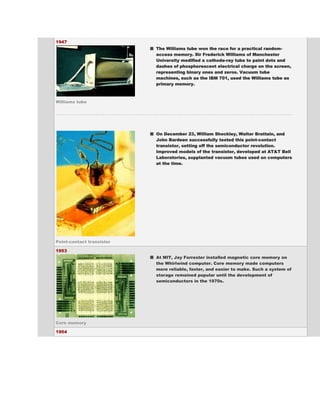
                           The Williams tube won the race for a practical random-
                           access memory. Sir Frederick Williams of Manchester
                           University modified a cathode-ray tube to paint dots and
                           dashes of phosphorescent electrical charge on the screen,
                           representing binary ones and zeros. Vacuum tube
                           machines, such as the IBM 701, used the Williams tube as
                           primary memory.


Williams tube


                           On December 23, William Shockley, Walter Brattain, and
                           John Bardeen successfully tested this point-contact
                           transistor, setting off the semiconductor revolution.
                           Improved models of the transistor, developed at AT&T Bell
                           Laboratories, supplanted vacuum tubes used on computers
                           at the time.


Point-contact transistor

1953
                           At MIT, Jay Forrester installed magnetic core memory on
                           the Whirlwind computer. Core memory made computers
                           more reliable, faster, and easier to make. Such a system of
                           storage remained popular until the development of
                           semiconductors in the 1970s.


Core memory

1954
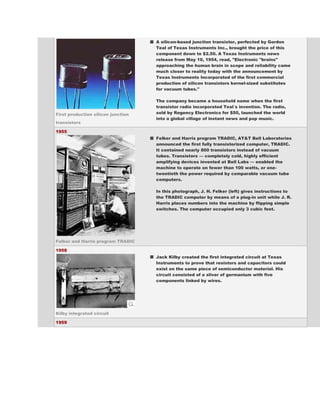
A silicon-based junction transistor, perfected by Gordon
                                    Teal of Texas Instruments Inc., brought the price of this
                                    component down to $2.50. A Texas Instruments news
                                    release from May 10, 1954, read, "Electronic "brains"
                                    approaching the human brain in scope and reliability came
                                    much closer to reality today with the announcement by
                                    Texas Instruments Incorporated of the first commercial
                                    production of silicon transistors kernel-sized substitutes
                                    for vacuum tubes."

                                    The company became a household name when the first
                                    transistor radio incorporated Teal´s invention. The radio,
First production silicon junction   sold by Regency Electronics for $50, launched the world
                                    into a global village of instant news and pop music.
transistors

1955
                                    Felker and Harris program TRADIC, AT&T Bell Laboratories
                                    announced the first fully transistorized computer, TRADIC.
                                    It contained nearly 800 transistors instead of vacuum
                                    tubes. Transistors — completely cold, highly efficient
                                    amplifying devices invented at Bell Labs — enabled the
                                    machine to operate on fewer than 100 watts, or one-
                                    twentieth the power required by comparable vacuum tube
                                    computers.

                                    In this photograph, J. H. Felker (left) gives instructions to
                                    the TRADIC computer by means of a plug-in unit while J. R.
                                    Harris places numbers into the machine by flipping simple
                                    switches. The computer occupied only 3 cubic feet.


Felker and Harris program TRADIC

1958
                                    Jack Kilby created the first integrated circuit at Texas
                                    Instruments to prove that resistors and capacitors could
                                    exist on the same piece of semiconductor material. His
                                    circuit consisted of a sliver of germanium with five
                                    components linked by wires.


Kilby integrated circuit

1959
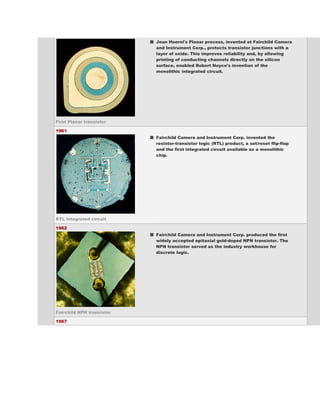
Jean Hoerni's Planar process, invented at Fairchild Camera
                           and Instrument Corp., protects transistor junctions with a
                           layer of oxide. This improves reliability and, by allowing
                           printing of conducting channels directly on the silicon
                           surface, enabled Robert Noyce's invention of the
                           monolithic integrated circuit.


First Planar transistor

1961
                           Fairchild Camera and Instrument Corp. invented the
                           resistor-transistor logic (RTL) product, a set/reset flip-flop
                           and the first integrated circuit available as a monolithic
                           chip.


RTL integrated circuit

1962
                           Fairchild Camera and Instrument Corp. produced the first
                           widely accepted epitaxial gold-doped NPN transistor. The
                           NPN transistor served as the industry workhouse for
                           discrete logic.


Fairchild NPN transistor

1967
Fairchild Camera and Instrument Corp. built the first
                    standard metal oxide semiconductor product for data
                    processing applications, an eight-bit arithmetic unit and
                    accumulator. In a MOS chip, engineers treat the
                    semiconductor material to produce either of two varieties
                    of transistors, called n-type and p-type.


MOS semiconductor


                    Using integrated circuits, Medtronics constructed the first
                    internal pacemaker.

1971
                    The first advertisement for a microprocessor, the Intel
                    4004, appeared in Electronic News. Developed for
                    Busicom, a Japanese calculator maker, the 4004 had 2250
                    transistors and could perform up to 90,000 operations per
                    second in four-bit chunks. Federico Faggin led the design
                    and Ted Hoff led the architecture.


Intel 4004

1972
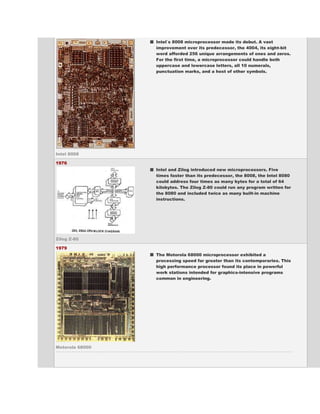
Intel´s 8008 microprocessor made its debut. A vast
                 improvement over its predecessor, the 4004, its eight-bit
                 word afforded 256 unique arrangements of ones and zeros.
                 For the first time, a microprocessor could handle both
                 uppercase and lowercase letters, all 10 numerals,
                 punctuation marks, and a host of other symbols.


Intel 8008

1976
                 Intel and Zilog introduced new microprocessors. Five
                 times faster than its predecessor, the 8008, the Intel 8080
                 could address four times as many bytes for a total of 64
                 kilobytes. The Zilog Z-80 could run any program written for
                 the 8080 and included twice as many built-in machine
                 instructions.


Zilog Z-80

1979
                 The Motorola 68000 microprocessor exhibited a
                 processing speed far greater than its contemporaries. This
                 high performance processor found its place in powerful
                 work stations intended for graphics-intensive programs
                 common in engineering.


Motorola 68000
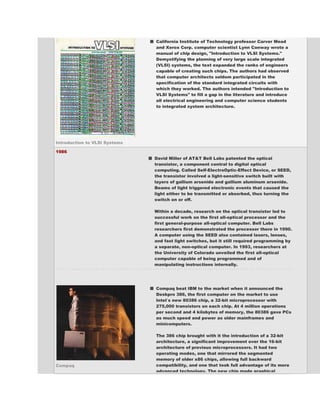
California Institute of Technology professor Carver Mead
                               and Xerox Corp. computer scientist Lynn Conway wrote a
                               manual of chip design, "Introduction to VLSI Systems."
                               Demystifying the planning of very large scale integrated
                               (VLSI) systems, the text expanded the ranks of engineers
                               capable of creating such chips. The authors had observed
                               that computer architects seldom participated in the
                               specification of the standard integrated circuits with
                               which they worked. The authors intended "Introduction to
                               VLSI Systems" to fill a gap in the literature and introduce
                               all electrical engineering and computer science students
                               to integrated system architecture.


Introduction to VLSI Systems

1986
                               David Miller of AT&T Bell Labs patented the optical
                               transistor, a component central to digital optical
                               computing. Called Self-ElectroOptic-Effect Device, or SEED,
                               the transistor involved a light-sensitive switch built with
                               layers of gallium arsenide and gallium aluminum arsenide.
                               Beams of light triggered electronic events that caused the
                               light either to be transmitted or absorbed, thus turning the
                               switch on or off.

                               Within a decade, research on the optical transistor led to
                               successful work on the first all-optical processor and the
                               first general-purpose all-optical computer. Bell Labs
                               researchers first demonstrated the processor there in 1990.
                               A computer using the SEED also contained lasers, lenses,
                               and fast light switches, but it still required programming by
                               a separate, non-optical computer. In 1993, researchers at
                               the University of Colorado unveiled the first all-optical
                               computer capable of being programmed and of
                               manipulating instructions internally.


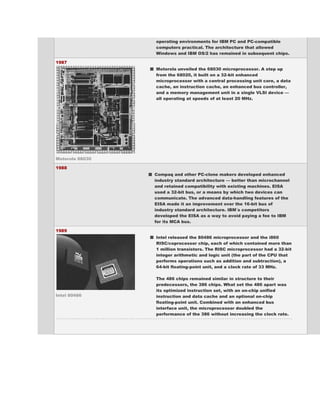
                               Compaq beat IBM to the market when it announced the
                               Deskpro 386, the first computer on the market to use
                               Intel´s new 80386 chip, a 32-bit microprocessor with
                               275,000 transistors on each chip. At 4 million operations
                               per second and 4 kilobytes of memory, the 80386 gave PCs
                               as much speed and power as older mainframes and
                               minicomputers.

                               The 386 chip brought with it the introduction of a 32-bit
                               architecture, a significant improvement over the 16-bit
                               architecture of previous microprocessors. It had two
                               operating modes, one that mirrored the segmented
                               memory of older x86 chips, allowing full backward
Compaq                         compatibility, and one that took full advantage of its more
                               advanced technology. The new chip made graphical
operating environments for IBM PC and PC-compatible
                 computers practical. The architecture that allowed
                 Windows and IBM OS/2 has remained in subsequent chips.

1987
                 Motorola unveiled the 68030 microprocessor. A step up
                 from the 68020, it built on a 32-bit enhanced
                 microprocessor with a central processing unit core, a data
                 cache, an instruction cache, an enhanced bus controller,
                 and a memory management unit in a single VLSI device —
                 all operating at speeds of at least 20 MHz.


Motorola 68030

1988
                 Compaq and other PC-clone makers developed enhanced
                 industry standard architecture — better than microchannel
                 and retained compatibility with existing machines. EISA
                 used a 32-bit bus, or a means by which two devices can
                 communicate. The advanced data-handling features of the
                 EISA made it an improvement over the 16-bit bus of
                 industry standard architecture. IBM´s competitors
                 developed the EISA as a way to avoid paying a fee to IBM
                 for its MCA bus.

1989
                 Intel released the 80486 microprocessor and the i860
                 RISC/coprocessor chip, each of which contained more than
                 1 million transistors. The RISC microprocessor had a 32-bit
                 integer arithmetic and logic unit (the part of the CPU that
                 performs operations such as addition and subtraction), a
                 64-bit floating-point unit, and a clock rate of 33 MHz.

                 The 486 chips remained similar in structure to their
                 predecessors, the 386 chips. What set the 486 apart was
                 its optimized instruction set, with an on-chip unified
Intel 80486      instruction and data cache and an optional on-chip
                 floating-point unit. Combined with an enhanced bus
                 interface unit, the microprocessor doubled the
                 performance of the 386 without increasing the clock rate.
Motorola announced the 68040 microprocessor, with about
                                  1.2 million transistors. Due to technical difficulties, it
                                  didn´t ship until 1991, although promised in January 1990.
                                  A 32-bit, 25-MHz microprocessor, the 68040 integrated a
                                  floating-point unit and included instruction and data
                                  caches. Apple used the third generation of 68000 chips in
                                  Macintosh Quadra computers.


Motorola 68040

1993
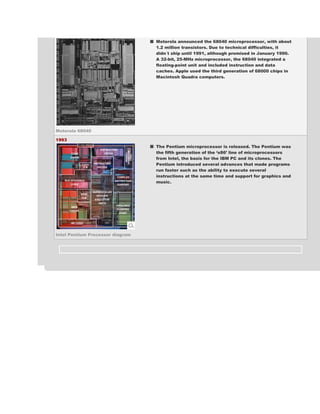
                                  The Pentium microprocessor is released. The Pentium was
                                  the fifth generation of the ‘x86’ line of microprocessors
                                  from Intel, the basis for the IBM PC and its clones. The
                                  Pentium introduced several advances that made programs
                                  run faster such as the ability to execute several
                                  instructions at the same time and support for graphics and
                                  music.


Intel Pentium Processor diagram

Ashutosh important detail

  • 1.
    1947 The Williams tube won the race for a practical random- access memory. Sir Frederick Williams of Manchester University modified a cathode-ray tube to paint dots and dashes of phosphorescent electrical charge on the screen, representing binary ones and zeros. Vacuum tube machines, such as the IBM 701, used the Williams tube as primary memory. Williams tube On December 23, William Shockley, Walter Brattain, and John Bardeen successfully tested this point-contact transistor, setting off the semiconductor revolution. Improved models of the transistor, developed at AT&T Bell Laboratories, supplanted vacuum tubes used on computers at the time. Point-contact transistor 1953 At MIT, Jay Forrester installed magnetic core memory on the Whirlwind computer. Core memory made computers more reliable, faster, and easier to make. Such a system of storage remained popular until the development of semiconductors in the 1970s. Core memory 1954
  • 2.
    A silicon-based junctiontransistor, perfected by Gordon Teal of Texas Instruments Inc., brought the price of this component down to $2.50. A Texas Instruments news release from May 10, 1954, read, "Electronic "brains" approaching the human brain in scope and reliability came much closer to reality today with the announcement by Texas Instruments Incorporated of the first commercial production of silicon transistors kernel-sized substitutes for vacuum tubes." The company became a household name when the first transistor radio incorporated Teal´s invention. The radio, First production silicon junction sold by Regency Electronics for $50, launched the world into a global village of instant news and pop music. transistors 1955 Felker and Harris program TRADIC, AT&T Bell Laboratories announced the first fully transistorized computer, TRADIC. It contained nearly 800 transistors instead of vacuum tubes. Transistors — completely cold, highly efficient amplifying devices invented at Bell Labs — enabled the machine to operate on fewer than 100 watts, or one- twentieth the power required by comparable vacuum tube computers. In this photograph, J. H. Felker (left) gives instructions to the TRADIC computer by means of a plug-in unit while J. R. Harris places numbers into the machine by flipping simple switches. The computer occupied only 3 cubic feet. Felker and Harris program TRADIC 1958 Jack Kilby created the first integrated circuit at Texas Instruments to prove that resistors and capacitors could exist on the same piece of semiconductor material. His circuit consisted of a sliver of germanium with five components linked by wires. Kilby integrated circuit 1959
  • 3.
    Jean Hoerni's Planarprocess, invented at Fairchild Camera and Instrument Corp., protects transistor junctions with a layer of oxide. This improves reliability and, by allowing printing of conducting channels directly on the silicon surface, enabled Robert Noyce's invention of the monolithic integrated circuit. First Planar transistor 1961 Fairchild Camera and Instrument Corp. invented the resistor-transistor logic (RTL) product, a set/reset flip-flop and the first integrated circuit available as a monolithic chip. RTL integrated circuit 1962 Fairchild Camera and Instrument Corp. produced the first widely accepted epitaxial gold-doped NPN transistor. The NPN transistor served as the industry workhouse for discrete logic. Fairchild NPN transistor 1967
  • 4.
    Fairchild Camera andInstrument Corp. built the first standard metal oxide semiconductor product for data processing applications, an eight-bit arithmetic unit and accumulator. In a MOS chip, engineers treat the semiconductor material to produce either of two varieties of transistors, called n-type and p-type. MOS semiconductor Using integrated circuits, Medtronics constructed the first internal pacemaker. 1971 The first advertisement for a microprocessor, the Intel 4004, appeared in Electronic News. Developed for Busicom, a Japanese calculator maker, the 4004 had 2250 transistors and could perform up to 90,000 operations per second in four-bit chunks. Federico Faggin led the design and Ted Hoff led the architecture. Intel 4004 1972
  • 5.
    Intel´s 8008 microprocessormade its debut. A vast improvement over its predecessor, the 4004, its eight-bit word afforded 256 unique arrangements of ones and zeros. For the first time, a microprocessor could handle both uppercase and lowercase letters, all 10 numerals, punctuation marks, and a host of other symbols. Intel 8008 1976 Intel and Zilog introduced new microprocessors. Five times faster than its predecessor, the 8008, the Intel 8080 could address four times as many bytes for a total of 64 kilobytes. The Zilog Z-80 could run any program written for the 8080 and included twice as many built-in machine instructions. Zilog Z-80 1979 The Motorola 68000 microprocessor exhibited a processing speed far greater than its contemporaries. This high performance processor found its place in powerful work stations intended for graphics-intensive programs common in engineering. Motorola 68000
  • 6.
    California Institute ofTechnology professor Carver Mead and Xerox Corp. computer scientist Lynn Conway wrote a manual of chip design, "Introduction to VLSI Systems." Demystifying the planning of very large scale integrated (VLSI) systems, the text expanded the ranks of engineers capable of creating such chips. The authors had observed that computer architects seldom participated in the specification of the standard integrated circuits with which they worked. The authors intended "Introduction to VLSI Systems" to fill a gap in the literature and introduce all electrical engineering and computer science students to integrated system architecture. Introduction to VLSI Systems 1986 David Miller of AT&T Bell Labs patented the optical transistor, a component central to digital optical computing. Called Self-ElectroOptic-Effect Device, or SEED, the transistor involved a light-sensitive switch built with layers of gallium arsenide and gallium aluminum arsenide. Beams of light triggered electronic events that caused the light either to be transmitted or absorbed, thus turning the switch on or off. Within a decade, research on the optical transistor led to successful work on the first all-optical processor and the first general-purpose all-optical computer. Bell Labs researchers first demonstrated the processor there in 1990. A computer using the SEED also contained lasers, lenses, and fast light switches, but it still required programming by a separate, non-optical computer. In 1993, researchers at the University of Colorado unveiled the first all-optical computer capable of being programmed and of manipulating instructions internally. Compaq beat IBM to the market when it announced the Deskpro 386, the first computer on the market to use Intel´s new 80386 chip, a 32-bit microprocessor with 275,000 transistors on each chip. At 4 million operations per second and 4 kilobytes of memory, the 80386 gave PCs as much speed and power as older mainframes and minicomputers. The 386 chip brought with it the introduction of a 32-bit architecture, a significant improvement over the 16-bit architecture of previous microprocessors. It had two operating modes, one that mirrored the segmented memory of older x86 chips, allowing full backward Compaq compatibility, and one that took full advantage of its more advanced technology. The new chip made graphical
  • 7.
    operating environments forIBM PC and PC-compatible computers practical. The architecture that allowed Windows and IBM OS/2 has remained in subsequent chips. 1987 Motorola unveiled the 68030 microprocessor. A step up from the 68020, it built on a 32-bit enhanced microprocessor with a central processing unit core, a data cache, an instruction cache, an enhanced bus controller, and a memory management unit in a single VLSI device — all operating at speeds of at least 20 MHz. Motorola 68030 1988 Compaq and other PC-clone makers developed enhanced industry standard architecture — better than microchannel and retained compatibility with existing machines. EISA used a 32-bit bus, or a means by which two devices can communicate. The advanced data-handling features of the EISA made it an improvement over the 16-bit bus of industry standard architecture. IBM´s competitors developed the EISA as a way to avoid paying a fee to IBM for its MCA bus. 1989 Intel released the 80486 microprocessor and the i860 RISC/coprocessor chip, each of which contained more than 1 million transistors. The RISC microprocessor had a 32-bit integer arithmetic and logic unit (the part of the CPU that performs operations such as addition and subtraction), a 64-bit floating-point unit, and a clock rate of 33 MHz. The 486 chips remained similar in structure to their predecessors, the 386 chips. What set the 486 apart was its optimized instruction set, with an on-chip unified Intel 80486 instruction and data cache and an optional on-chip floating-point unit. Combined with an enhanced bus interface unit, the microprocessor doubled the performance of the 386 without increasing the clock rate.
  • 8.
    Motorola announced the68040 microprocessor, with about 1.2 million transistors. Due to technical difficulties, it didn´t ship until 1991, although promised in January 1990. A 32-bit, 25-MHz microprocessor, the 68040 integrated a floating-point unit and included instruction and data caches. Apple used the third generation of 68000 chips in Macintosh Quadra computers. Motorola 68040 1993 The Pentium microprocessor is released. The Pentium was the fifth generation of the ‘x86’ line of microprocessors from Intel, the basis for the IBM PC and its clones. The Pentium introduced several advances that made programs run faster such as the ability to execute several instructions at the same time and support for graphics and music. Intel Pentium Processor diagram