



This document provides information on condition monitoring technology for machinery. It discusses vibration analysis, oil analysis, ultrasound analysis, and thermal analysis as the key condition monitoring technologies. It describes common machine problems that can be detected by vibration analysis like misalignment, unbalance, bearing defects, and gear problems. It provides details on vibration measurement, oil analysis tests, particle counting classifications, and wear debris analysis. The overall document is about condition monitoring techniques and technologies to monitor machine health and enable predictive maintenance.
Presentation on condition monitoring technologies affecting machinery health.
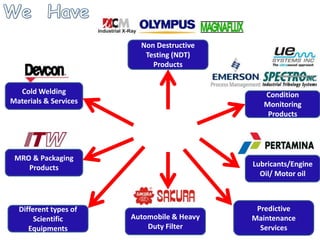
Different equipment types and condition monitoring services including non-destructive testing.
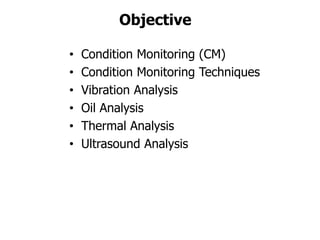
Understanding objectives of condition monitoring (CM) and its techniques like vibration and oil analysis.
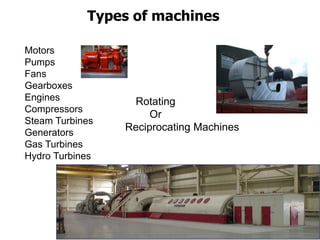
List of machines involved in condition monitoring; includes motors, pumps, gearboxes, turbines.
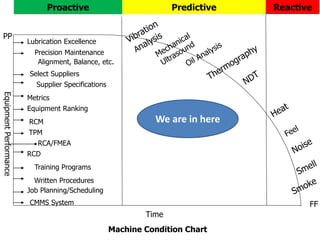
Metrics for assessing equipment performance and condition monitoring strategies in industrial settings.
Definition of condition monitoring and its significance in predictive maintenance for machinery.
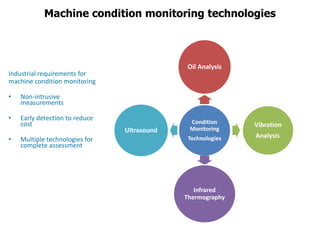
Various technologies used in condition monitoring such as oil analysis and vibration analysis.
Description of vibration in mechanisms and its importance as an indicator of machine health.
Common mechanical issues that cause unwanted vibration in machinery affecting operation.
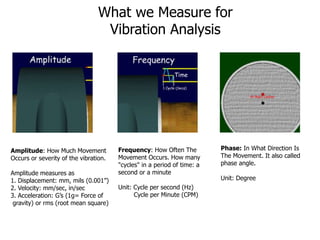
Key metrics for vibration analysis, including amplitude and frequency measurement methods.
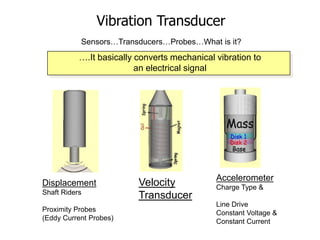
Types of transducers used to convert vibration into electrical signals for analysis.
Strategy for monitoring the health of machinery across various types and their criticality ratings.
Analogous relationship between medical ECGs and machinery health checks using technology.
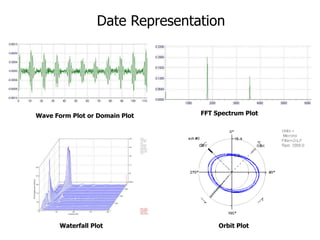
Different plots for vibration data representation, such as time-domain and spectrum plots.
Importance of oil analysis in predictive maintenance; mentions functions of lubricants.
Considerations and benefits of integrating oil analysis in maintenance routines and cost savings.
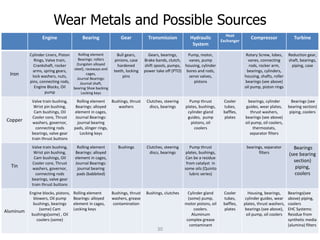
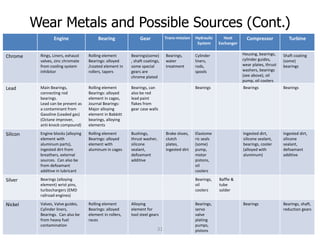
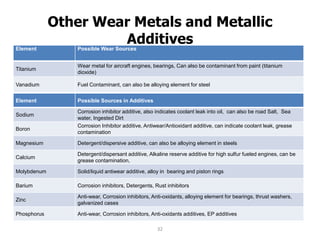
Various tests involved in oil analysis, focusing on wear metals and their sources.
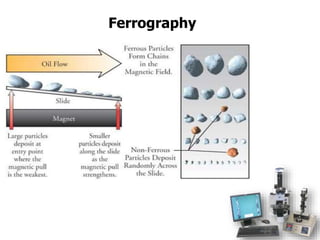
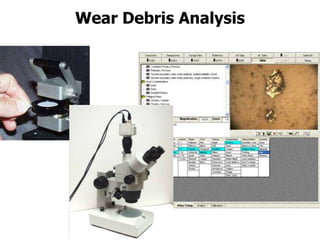
Ferrography techniques for analyzing wear debris in lubricants to assess machinery condition.
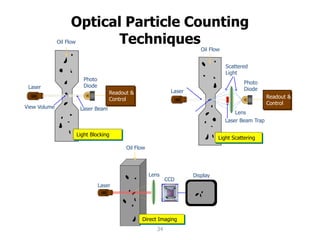
Methods and standards for particle counting in oil analysis to gauge contamination levels.
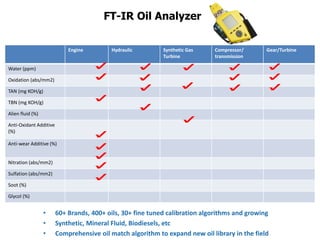
Introduction to oil analysis calibrations and types of fluids being analyzed.
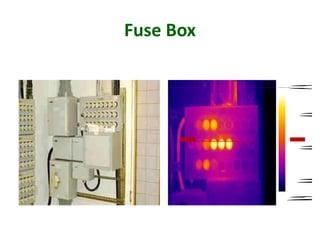
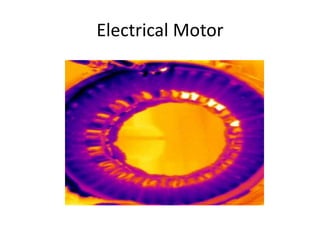
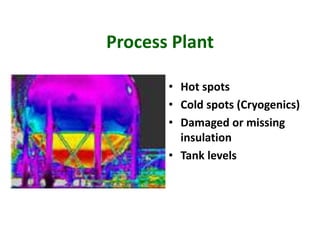
Explanation of thermography technology for detecting thermal abnormalities in machinery.
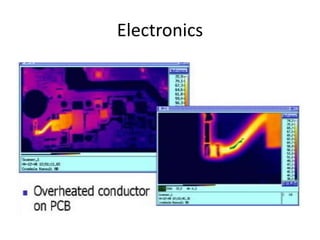
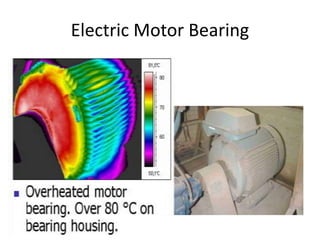
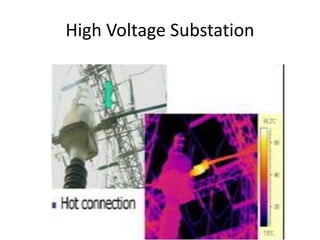
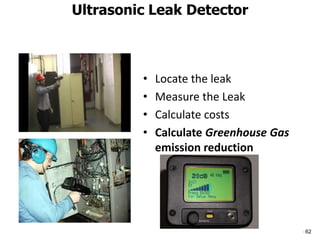
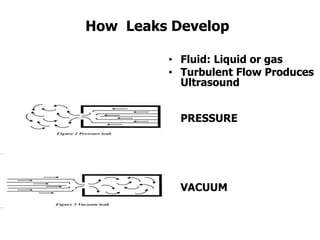
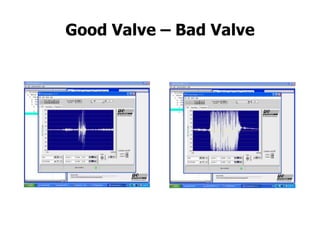
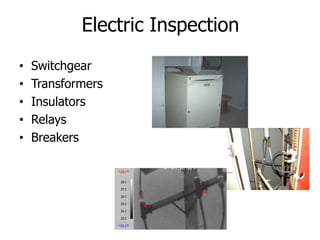
Applications of thermography in various contexts including electrical and mechanical inspections.Utilization of ultrasound technology for leak detection and mechanical inspections.
Importance of integrating various technologies in predictive maintenance for comprehensive monitoring.
Condition monitoring isthe process of monitoring a
parameter of condition in machinery, such that a
significant change is indicative of a developing failure. It
is a major component of Predictive Maintenance
(PdM). The use of conditional monitoring allows
maintenance to be scheduled, or other actions to be
taken to avoid the consequences of failure, before the
failure occurs.
Condition Monitoring
9.
Machine condition monitoringtechnologies
Industrial requirements for
machine condition monitoring
• Non-intrusive
measurements
• Early detection to reduce
cost
• Multiple technologies for
complete assessment
Condition
Monitoring
Technologies
Oil Analysis
Vibration
Analysis
Infrared
Thermography
Ultrasound
10.
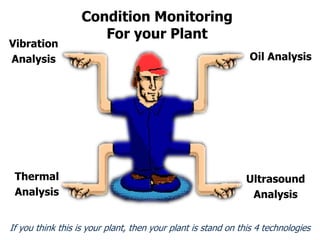
Condition Monitoring
For yourPlant
Vibration
Analysis Oil Analysis
Ultrasound
Analysis
Thermal
Analysis
If you think this is your plant, then your plant is stand on this 4 technologies
11.
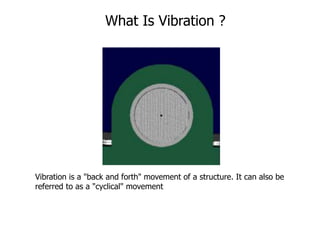
What Is Vibration?
Vibration is a "back and forth" movement of a structure. It can also be
referred to as a "cyclical" movement
12.
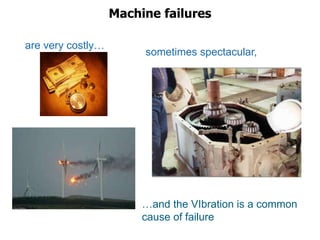
Machine failures
…and theVIbration is a common
cause of failure
are very costly…
sometimes spectacular,
13.
Vibration Analysis
More than20 years ago someone made the statement, “The
vibrations produced in a machine are the best indication of the
machine’s health.” This statement still holds true today. Of all the
predictive maintenance (PdM) technologies, vibration analysis
remains the best measure of machine health. This is true because
vibration monitoring can alert us to so many different conditions
that may indicate potential machine failures. Unbalance,
misalignment, bearing faults, resonance, looseness, cavitations and
electrical problems are just a few of the many problems that can be
detected with vibration monitoring.
What we Measurefor
Vibration Analysis
Amplitude: How Much Movement
Occurs or severity of the vibration.
Amplitude measures as
1. Displacement: mm, mils (0.001”)
2. Velocity: mm/sec, in/sec
3. Acceleration: G’s (1g= Force of
gravity) or rms (root mean square)
Frequency: How Often The
Movement Occurs. How many
"cycles" in a period of time: a
second or a minute
Unit: Cycle per second (Hz)
Cycle per Minute (CPM)
Phase: In What Direction Is
The Movement. It also called
phase angle.
Unit: Degree
16.
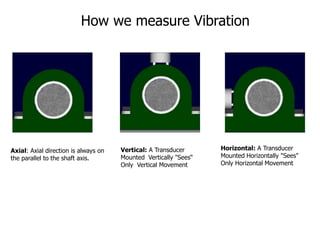
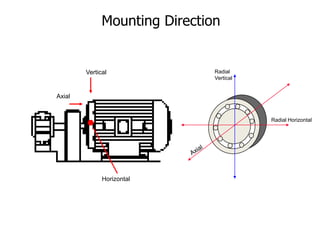
How we measureVibration
Axial: Axial direction is always on
the parallel to the shaft axis.
Vertical: A Transducer
Mounted Vertically "Sees“
Only Vertical Movement
Horizontal: A Transducer
Mounted Horizontally "Sees"
Only Horizontal Movement
17.
Vibration Transducer
Sensors…Transducers…Probes…What isit?
….It basically converts mechanical vibration to
an electrical signal
Accelerometer
Charge Type &
Line Drive
Constant Voltage &
Constant Current
Velocity
Transducer
Displacement
Shaft Riders
Proximity Probes
(Eddy Current Probes)
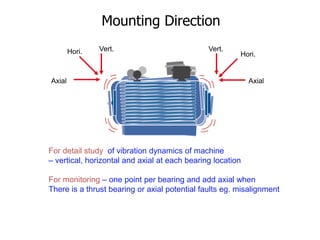
Mounting Direction
Vert.
Axial
Hori. Vert.
Axial
Hori.
Fordetail study of vibration dynamics of machine
– vertical, horizontal and axial at each bearing location
For monitoring – one point per bearing and add axial when
There is a thrust bearing or axial potential faults eg. misalignment
20.
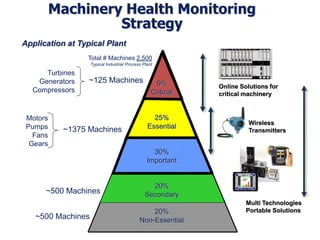
Machinery Health Monitoring
Strategy
~125Machines
~1375 Machines
~500 Machines
~500 Machines
Total # Machines 2,500
Typical Industrial Process Plant
5%
Critical
25%
Essential
30%
Important
20%
Secondary
20%
Non-Essential
Turbines
Generators
Compressors
Motors
Pumps
Fans
Gears
Application at Typical Plant
Online Solutions for
critical machinery
Wireless
Transmitters
Multi Technologies
Portable Solutions
21.
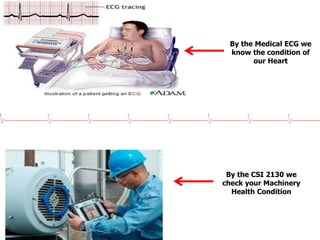
By the MedicalECG we
know the condition of
our Heart
By the CSI 2130 we
check your Machinery
Health Condition
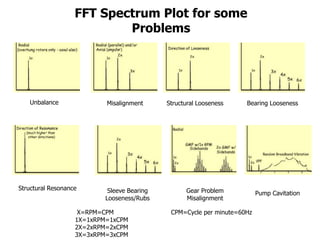
Unbalance Misalignment StructuralLooseness Bearing Looseness
Structural Resonance Sleeve Bearing
Looseness/Rubs
Gear Problem
Misalignment
Pump Cavitation
FFT Spectrum Plot for some
Problems
X=RPM=CPM CPM=Cycle per minute=60Hz
1X=1xRPM=1xCPM
2X=2xRPM=2xCPM
3X=3xRPM=3xCPM
24.
Oil Analysis
OIL .. . your engine’s lifeblood . . .
can reveal its internal condition……
25.
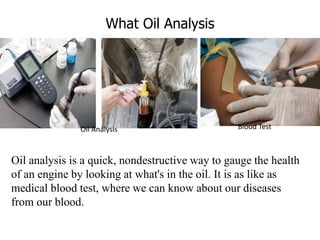
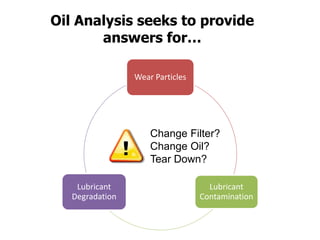
What Oil Analysis
Oilanalysis is a quick, nondestructive way to gauge the health
of an engine by looking at what's in the oil. It is as like as
medical blood test, where we can know about our diseases
from our blood.
Oil Analysis Blood Test
26.
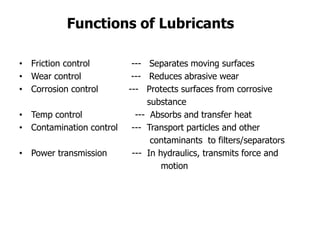
• Friction control--- Separates moving surfaces
• Wear control --- Reduces abrasive wear
• Corrosion control --- Protects surfaces from corrosive
substance
• Temp control --- Absorbs and transfer heat
• Contamination control --- Transport particles and other
contaminants to filters/separators
• Power transmission --- In hydraulics, transmits force and
motion
Functions of Lubricants
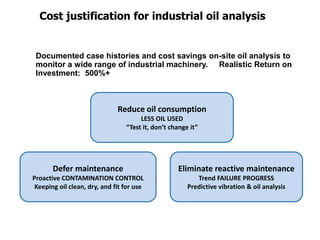
Cost justification forindustrial oil analysis
Documented case histories and cost savings on-site oil analysis to
monitor a wide range of industrial machinery. Realistic Return on
Investment: 500%+
Defer maintenance
Proactive CONTAMINATION CONTROL
Keeping oil clean, dry, and fit for use
Reduce oil consumption
LESS OIL USED
“Test it, don’t change it”
Eliminate reactive maintenance
Trend FAILURE PROGRESS
Predictive vibration & oil analysis
29.
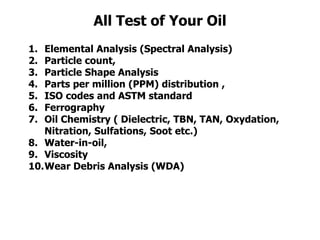
All Test ofYour Oil
1. Elemental Analysis (Spectral Analysis)
2. Particle count,
3. Particle Shape Analysis
4. Parts per million (PPM) distribution ,
5. ISO codes and ASTM standard
6. Ferrography
7. Oil Chemistry ( Dielectric, TBN, TAN, Oxydation,
Nitration, Sulfations, Soot etc.)
8. Water-in-oil,
9. Viscosity
10.Wear Debris Analysis (WDA)
30.
Wear Metals andPossible Sources
Engine Bearing Gear Transmission Hydraulic
System
Heat
Exchanger
Compressor Turbine
Iron
Cylinder Liners, Piston
Rings, Valve train,
Crankshaft, rocker
arms, spring gears,
lock washers, nuts,
pins, connecting rods,
Engine Blocks, Oil
pump
Rolling element
Bearings: rollers
(tungsten alloyed
steel), raceways and
cages,
Journal Bearings:
Journal shaft,
bearing Shoe backing
Locking keys
Bull gears,
pinions, case
hardened
teeth, locking
pins
Gears, bearings,
Brake bands, clutch,
shift spools, pumps,
power take off (PTO)
Pump, motor,
vanes, pump
housing, cylinder
bores and rods,
servo valves,
pistons
Rotary Screw, lobes,
vanes, connecting
rods, rocker arm,
bearings, cylinders,
housing, shafts, roller
bearings (see above)
oil pump, piston rings
Reduction gear,
shaft, bearings,
piping, case
Copper
Valve train bushing,
Wrist pin bushing,
Cam bushings, Oil
Cooler core, Thrust
washers, governor,
connecting rods
bearings, valve gear
train thrust buttons
Rolling element
Bearings: alloyed
element in cages,
Journal Bearings:
journal bearing
pads, slinger rings,
Locking keys
Bushings, thrust
washers
Clutches, steering
discs, bearings
Pump thrust
plates, bushings,
cylinder gland
guides, pump
pistons, oil
coolers
Cooler
tubes,
baffles,
plates
bearings, cylinder
guides, wear plates,
thrust washers,
bearings (see above)
oil pump, oil coolers,
thermostats,
separator filters
Bearings (see
bearing section)
piping, coolers
Tin
Valve train bushing,
Wrist pin bushing,
Cam bushings, Oil
Cooler core, Thrust
washers, governor,
connecting rods
bearings, valve gear
train thrust buttons
Rolling element
Bearings: alloyed
element in cages,
Journal Bearings:
journal bearing
pads (babbited)
Bushings Clutches, steering
discs, bearings
Pump thrust
plates, bushings,
Can be a residue
from catalyst in
some oils (Quinto
lubric series)
bearings, separator
filters
Bearings
(see bearing
section)
piping,
coolers
Aluminum
Engine blocks, pistons,
blowers, Oil pump
bushings, bearings
(some) Cam
bushings(some) , Oil
coolers (some)
Rolling element
Bearings: alloyed
element in cages,
Locking keys
Bushings, thrust
washers, grease
contamination
Bushings, clutches Cylinder gland
(some) pump,
motor pistons, oil
coolers.
Aluminum
complex grease
contaminant
Cooler
tubes,
baffles,
plates
Housing, bearings,
cylinder guides, wear
plates, thrust washers,
bearings (see above),
oil pump, oil coolers
Bearings(see
above) piping,
coolers
EHC Systems:
Residue from
synthetic media
(alumina) filters
30
31.
Wear Metals andPossible Sources (Cont.)
Engine Bearing Gear Trans-mission Hydraulic
System
Heat
Exchanger
Compressor Turbine
Chrome Rings, Liners, exhaust
valves, zinc chromate
from cooling system
inhibitor
Rolling element
Bearings: alloyed
/coated element in
rollers, tapers
Bearings(some)
, shaft coatings,
some special
gears are
chrome plated
Bearings,
water
treatment
Cylinder
liners,
rods,
spools
Housing, bearings,
cylinder guides,
wear plates, thrust
washers, bearings
(see above), oil
pump, oil coolers
Shaft coating
(some)
bearings
Lead Main Bearings,
connecting rod
bearings.
Lead can be present as
a contaminant from
Gasoline (Leaded gas)
(Octane improver,
anti-knock compound)
Rolling element
Bearings: alloyed
element in cages,
Journal Bearings:
Major alloying
element in Babbitt
bearings, alloying
elements
Bearings, can
also be red
lead paint
flakes from
gear case walls
Bearings Bearings Bearings
Silicon Engine blocks (alloying
element with
aluminum parts),
ingested dirt from
breathers, external
sources. Can also be
from defoamant
additive in lubricant
Rolling element
Bearings: alloyed
element with
aluminum in cages
Bushings,
thrust washer,
silicone
sealant,
defoamant
additive
Brake shoes,
clutch
plates,
ingested dirt
Elastome
ric seals
(some)
pump,
motor
pistons,
oil
coolers
Ingested dirt,
silicone sealant,
bearings, cooler
(alloyed with
aluminum)
Ingested dirt,
silicone
sealant,
defoamant
additive
Silver Bearings (alloying
element) wrist pins,
turbochargers (EMD
railroad engines)
Bearings,
oil
coolers
Baffle &
tube
solder
Nickel Valves, Valve guides,
Cylinder liners,
Bearings. Can also be
from heavy fuel
contamination
Rolling element
Bearings: alloyed
element in rollers,
races
Alloying
element for
tool steel gears
Bearings,
servo
valve
plating
pumps,
pistons
Bearings Bearings, shaft,
reduction gears
31
32.
Other Wear Metalsand Metallic
Additives
Element Possible Sources in Additives
Sodium
Corrosion inhibitor additive, also indicates coolant leak into oil, can also be road Salt, Sea
water, Ingested Dirt
Boron
Corrosion Inhibitor additive, Antiwear/Antioxidant additive, can indicate coolant leak, grease
contamination
Magnesium Detergent/dispersive additive, can also be alloying element in steels
Calcium
Detergent/dispersant additive, Alkaline reserve additive for high sulfur fueled engines, can be
grease contamination,
Molybdenum Solid/liquid antiwear additive, alloy in bearing and piston rings
Barium Corrosion inhibitors, Detergents, Rust inhibitors
Zinc
Anti-wear, Corrosion inhibitors, Anti-oxidants, alloying element for bearings, thrust washers,
galvanized cases
Phosphorus Anti-wear, Corrosion inhibitors, Anti-oxidants additives, EP additives
Element Possible Wear Sources
Titanium
Wear metal for aircraft engines, bearings, Can also be contaminant from paint (titanium
dioxide)
Vanadium Fuel Contaminant, can also be alloying element for steel
32
35
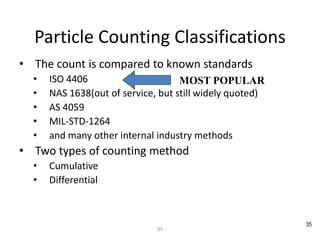
Particle Counting Classifications
•The count is compared to known standards
• ISO 4406
• NAS 1638(out of service, but still widely quoted)
• AS 4059
• MIL-STD-1264
• and many other internal industry methods
• Two types of counting method
• Cumulative
• Differential
MOST POPULAR
35
36.
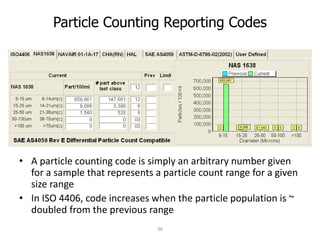
Particle Counting ReportingCodes
• A particle counting code is simply an arbitrary number given
for a sample that represents a particle count range for a given
size range
• In ISO 4406, code increases when the particle population is ~
doubled from the previous range
36
37.
• 60+ Brands,400+ oils, 30+ fine tuned calibration algorithms and growing
• Synthetic, Mineral Fluid, Biodiesels, etc
• Comprehensive oil match algorithm to expand new oil library in the field
Engine Hydraulic Synthetic Gas
Turbine
Compressor/
transmission
Gear/Turbine
Water (ppm)
Oxidation (abs/mm2)
TAN (mg KOH/g)
TBN (mg KOH/g)
Alien fluid (%)
Anti-Oxidant Additive
(%)
Anti-wear Additive (%)
Nitration (abs/mm2)
Sulfation (abs/mm2)
Soot (%)
Glycol (%)
FT-IR Oil Analyzer
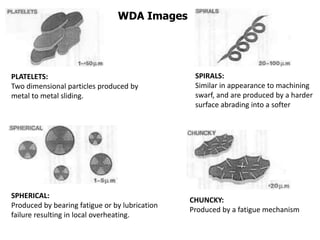
PLATELETS:
Two dimensional particlesproduced by
metal to metal sliding.
SPHERICAL:
Produced by bearing fatigue or by lubrication
failure resulting in local overheating.
SPIRALS:
Similar in appearance to machining
swarf, and are produced by a harder
surface abrading into a softer
CHUNCKY:
Produced by a fatigue mechanism
WDA Images
40.
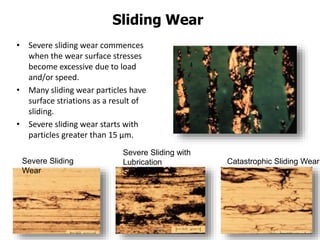
Sliding Wear
• Severesliding wear commences
when the wear surface stresses
become excessive due to load
and/or speed.
• Many sliding wear particles have
surface striations as a result of
sliding.
• Severe sliding wear starts with
particles greater than 15 µm.
Catastrophic Sliding Wear
Severe Sliding with
Lubrication
Starvation
Severe Sliding
Wear
40
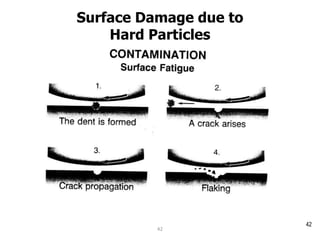
41.
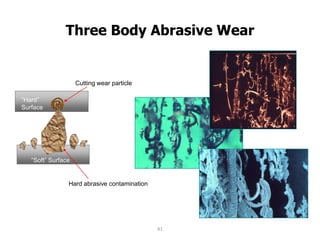
Three Body AbrasiveWear
“Soft” Surface
“Hard”
Surface
Hard abrasive contamination
Cutting wear particle
41
Spheres
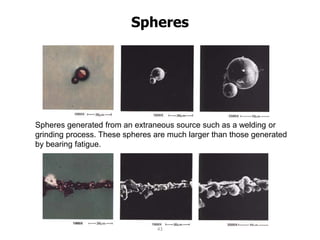
Spheres generated froman extraneous source such as a welding or
grinding process. These spheres are much larger than those generated
by bearing fatigue.
Spheres generated by a fatiguing bearing < 5 microns
43
44.
Thermography
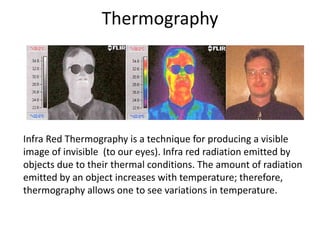
Infra Red Thermographyis a technique for producing a visible
image of invisible (to our eyes). Infra red radiation emitted by
objects due to their thermal conditions. The amount of radiation
emitted by an object increases with temperature; therefore,
thermography allows one to see variations in temperature.
45.
Why Thermography?
• NonContact
• Rapid Scanning
• Data can be recorded in differing formats
• Images produced are comprehensive & reliable
46.
Advantages
• Non Contact
•Non Intrusive
• Can work at a distance
• Fast and Reliable
• Portable
• Convincing Results
47.
SEE THE IMAGE,
SEETHE TEMPERATURE
SEE THE TEMPERATURE,
SEE THE PROBLEM
The Motto of Thermal Imaging
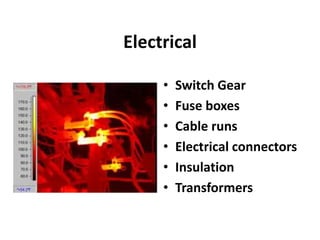
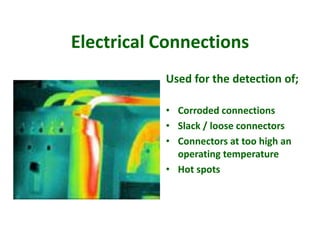
Electrical Connections
Used forthe detection of;
• Corroded connections
• Slack / loose connectors
• Connectors at too high an
operating temperature
• Hot spots
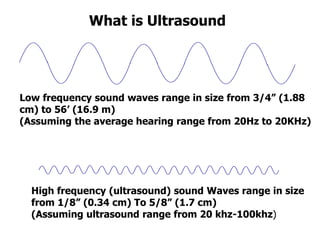
What is Ultrasound
Highfrequency (ultrasound) sound Waves range in size
from 1/8” (0.34 cm) To 5/8” (1.7 cm)
(Assuming ultrasound range from 20 khz-100khz)
Low frequency sound waves range in size from 3/4” (1.88
cm) to 56’ (16.9 m)
(Assuming the average hearing range from 20Hz to 20KHz)
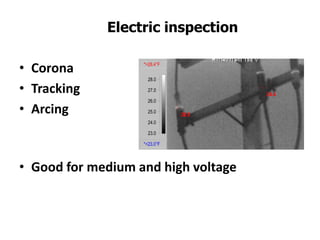
Electric inspection
• Corona
•Tracking
• Arcing
• Good for medium and high voltage
26.8
24.4
*>28.4°F
*<23.0°F
23.0
24.0
25.0
26.0
27.0
28.0
67.
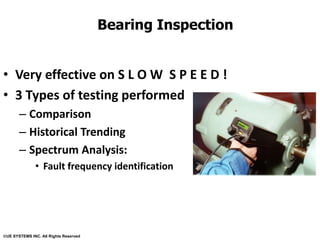
Bearing Inspection
• Veryeffective on S L O W S P E E D !
• 3 Types of testing performed
– Comparison
– Historical Trending
– Spectrum Analysis:
• Fault frequency identification
UE SYSTEMS INC. All Rights Reserved
68.
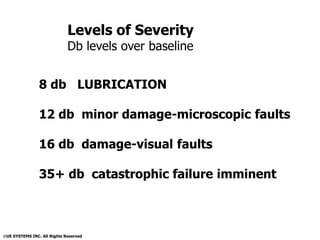
Levels of Severity
Dblevels over baseline
8 db LUBRICATION
12 db minor damage-microscopic faults
16 db damage-visual faults
35+ db catastrophic failure imminent
UE SYSTEMS INC. All Rights Reserved
69.
What’s In YourPDM Toolbox?
• One Technology CAN NOT do
Everything!!!!!!
• Successful Integration is the key to getting
the most out of your resources:
– Awareness
– Proper training
– Documentation
Editor's Notes
#42 Cutting wear particles are curved, forming loops and spirals, much like miniature machining swarf.
Another Scanning Electron Photomicrograph of Cutting Wear Particles. In this view some large, abrasive contaminant particles may also be seen.
#44 Metal spheres may be generated by welding and grinding. Fly ash from coal fired power plants contain large numbers of both ferrous (magnetic) spheres and glass (nonmetallic and transparent) spheres. Metal spheres are generated in large numbers at steel mills and foundries.
Scanning Electron Photomicrograph of Ferrous Spheres. On rare occasions, ferrous spheres may be generated by the surfaces of rolling element bearings as a precursor to fatigue spalling. Spheres generated by this wear mode are all of the same approximate size and are small, less than 5 µm.