Copyright © 2006 by The McGraw-Hill Companies, Inc. All rights reserved.McGraw-Hill Technology Education
Chapter 1A
Introducing Computer
Systems
1A-2
The Computer Defined
• Electronic device
• Converts data into information
• Modern computers are digital
– Two digits combine to make data
• Older computers were analog
– A range of values made data
1A-3
Computers For Individual Use
• Desktop computers
– The most common type of computer
– Sits on the desk or floor
– Performs a variety of tasks
• Workstations
– Specialized computers
– Optimized for science or graphics
– More powerful than a desktop
1A-4
Computers For Individual Use
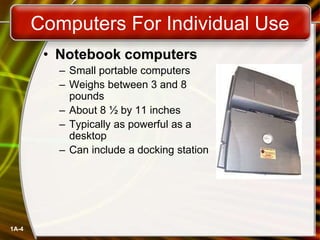
• Notebook computers
– Small portable computers
– Weighs between 3 and 8
pounds
– About 8 ½ by 11 inches
– Typically as powerful as a
desktop
– Can include a docking station
1A-5
Computers For Individual Use
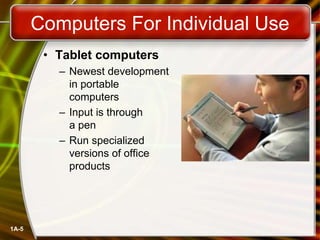
• Tablet computers
– Newest development
in portable
computers
– Input is through
a pen
– Run specialized
versions of office
products
1A-6
• Handheld computers
– Very small computers
– Personal Digital Assistants (PDA)
– Note taking or contact management
– Data can synchronize with a desktop
• Smart phones
– Hybrid of cell phone and PDA
– Web surfing, e-mail access
Computers For Individual Use
1A-7
Computers in Network
• Network servers
– Centralized computer
– All other computers connect
– Provides access to network resources
– Multiple servers are called server farms
– Often simply a powerful desktop
• Network clients
– Connected to Centralized computer
– Gain access to network resources through
servers
– Often simple desktop
1A-8
Computers by POWER
• Mainframes
– Used in large
organizations
– Handle thousands
of users
– Users access
through a terminal
1A-9
Computers by POWER
• Microcomputers
– Personal Computer/ Desktop
– Single processor
– Meant for single user
1A-10
Computers by POWER
• Minicomputers
– Called midrange computers
– Power between mainframe and desktop
– Usually has multiple processors
– Handle hundreds of users
– Used in smaller organizations
– Users may access through a terminal
– Used for servers
1A-11
Computers by POWER
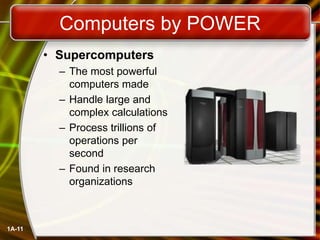
• Supercomputers
– The most powerful
computers made
– Handle large and
complex calculations
– Process trillions of
operations per
second
– Found in research
organizations
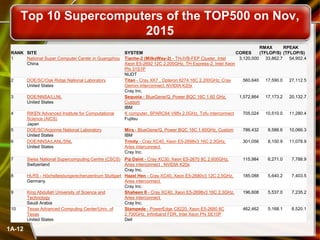
Top 10 Supercomputers of the TOP500 on Nov,
2015
RANK SITE SYSTEM CORES
RMAX
(TFLOP/S)
RPEAK
(TFLOP/S)
1 National Super Computer Center in Guangzhou
China
Tianhe-2 (MilkyWay-2) - TH-IVB-FEP Cluster, Intel
Xeon E5-2692 12C 2.200GHz, TH Express-2, Intel Xeon
Phi 31S1P
NUDT
3,120,000 33,862.7 54,902.4
2 DOE/SC/Oak Ridge National Laboratory
United States
Titan - Cray XK7 , Opteron 6274 16C 2.200GHz, Cray
Gemini interconnect, NVIDIA K20x
Cray Inc.
560,640 17,590.0 27,112.5
3 DOE/NNSA/LLNL
United States
Sequoia - BlueGene/Q, Power BQC 16C 1.60 GHz,
Custom
IBM
1,572,864 17,173.2 20,132.7
4 RIKEN Advanced Institute for Computational
Science (AICS)
Japan
K computer, SPARC64 VIIIfx 2.0GHz, Tofu interconnect
Fujitsu
705,024 10,510.0 11,280.4
5 DOE/SC/Argonne National Laboratory
United States
Mira - BlueGene/Q, Power BQC 16C 1.60GHz, Custom
IBM
786,432 8,586.6 10,066.3
6 DOE/NNSA/LANL/SNL
United States
Trinity - Cray XC40, Xeon E5-2698v3 16C 2.3GHz,
Aries interconnect
Cray Inc.
301,056 8,100.9 11,078.9
7 Swiss National Supercomputing Centre (CSCS)
Switzerland
Piz Daint - Cray XC30, Xeon E5-2670 8C 2.600GHz,
Aries interconnect , NVIDIA K20x
Cray Inc.
115,984 6,271.0 7,788.9
8 HLRS - Höchstleistungsrechenzentrum Stuttgart
Germany
Hazel Hen - Cray XC40, Xeon E5-2680v3 12C 2.5GHz,
Aries interconnect
Cray Inc.
185,088 5,640.2 7,403.5
9 King Abdullah University of Science and
Technology
Saudi Arabia
Shaheen II - Cray XC40, Xeon E5-2698v3 16C 2.3GHz,
Aries interconnect
Cray Inc.
196,608 5,537.0 7,235.2
10 Texas Advanced Computing Center/Univ. of
Texas
United States
Stampede - PowerEdge C8220, Xeon E5-2680 8C
2.700GHz, Infiniband FDR, Intel Xeon Phi SE10P
Dell
462,462 5,168.1 8,520.1
1A-12
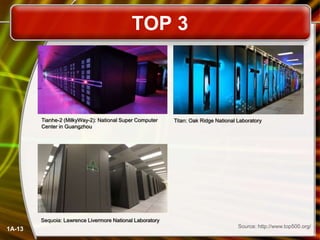
TOP 3
1A-13 Source: http://www.top500.org/
Tianhe-2 (MilkyWay-2): National Super Computer
Center in Guangzhou
Titan: Oak Ridge National Laboratory
Sequoia: Lawrence Livermore National Laboratory
1A-14
Mainframes vs. Supercomputers
• Supercomputers are optimized for complicated
computations that take place largely in memory, while
mainframes are optimized for comparatively simple
computations involving huge amounts of external
data.
• For example, weather forecasting is suited to
supercomputers, and insurance business or payroll
processing applications are more suited to
mainframes.
• Supercomputers are often purpose-built for one or a
very few specific institutional tasks (e.g. simulation
and modeling). Mainframes typically handle a wider
variety of tasks (e.g. data processing, warehousing).
Copyright © 2006 by The McGraw-Hill Companies, Inc. All rights reserved.McGraw-Hill Technology Education
Chapter 1A
End of Chapter

Introducing computer systems

  • 1.
    Copyright © 2006by The McGraw-Hill Companies, Inc. All rights reserved.McGraw-Hill Technology Education Chapter 1A Introducing Computer Systems
  • 2.
    1A-2 The Computer Defined •Electronic device • Converts data into information • Modern computers are digital – Two digits combine to make data • Older computers were analog – A range of values made data
  • 3.
    1A-3 Computers For IndividualUse • Desktop computers – The most common type of computer – Sits on the desk or floor – Performs a variety of tasks • Workstations – Specialized computers – Optimized for science or graphics – More powerful than a desktop
  • 4.
    1A-4 Computers For IndividualUse • Notebook computers – Small portable computers – Weighs between 3 and 8 pounds – About 8 ½ by 11 inches – Typically as powerful as a desktop – Can include a docking station
  • 5.
    1A-5 Computers For IndividualUse • Tablet computers – Newest development in portable computers – Input is through a pen – Run specialized versions of office products
  • 6.
    1A-6 • Handheld computers –Very small computers – Personal Digital Assistants (PDA) – Note taking or contact management – Data can synchronize with a desktop • Smart phones – Hybrid of cell phone and PDA – Web surfing, e-mail access Computers For Individual Use
  • 7.
    1A-7 Computers in Network •Network servers – Centralized computer – All other computers connect – Provides access to network resources – Multiple servers are called server farms – Often simply a powerful desktop • Network clients – Connected to Centralized computer – Gain access to network resources through servers – Often simple desktop
  • 8.
    1A-8 Computers by POWER •Mainframes – Used in large organizations – Handle thousands of users – Users access through a terminal
  • 9.
    1A-9 Computers by POWER •Microcomputers – Personal Computer/ Desktop – Single processor – Meant for single user
  • 10.
    1A-10 Computers by POWER •Minicomputers – Called midrange computers – Power between mainframe and desktop – Usually has multiple processors – Handle hundreds of users – Used in smaller organizations – Users may access through a terminal – Used for servers
  • 11.
    1A-11 Computers by POWER •Supercomputers – The most powerful computers made – Handle large and complex calculations – Process trillions of operations per second – Found in research organizations
  • 12.
    Top 10 Supercomputersof the TOP500 on Nov, 2015 RANK SITE SYSTEM CORES RMAX (TFLOP/S) RPEAK (TFLOP/S) 1 National Super Computer Center in Guangzhou China Tianhe-2 (MilkyWay-2) - TH-IVB-FEP Cluster, Intel Xeon E5-2692 12C 2.200GHz, TH Express-2, Intel Xeon Phi 31S1P NUDT 3,120,000 33,862.7 54,902.4 2 DOE/SC/Oak Ridge National Laboratory United States Titan - Cray XK7 , Opteron 6274 16C 2.200GHz, Cray Gemini interconnect, NVIDIA K20x Cray Inc. 560,640 17,590.0 27,112.5 3 DOE/NNSA/LLNL United States Sequoia - BlueGene/Q, Power BQC 16C 1.60 GHz, Custom IBM 1,572,864 17,173.2 20,132.7 4 RIKEN Advanced Institute for Computational Science (AICS) Japan K computer, SPARC64 VIIIfx 2.0GHz, Tofu interconnect Fujitsu 705,024 10,510.0 11,280.4 5 DOE/SC/Argonne National Laboratory United States Mira - BlueGene/Q, Power BQC 16C 1.60GHz, Custom IBM 786,432 8,586.6 10,066.3 6 DOE/NNSA/LANL/SNL United States Trinity - Cray XC40, Xeon E5-2698v3 16C 2.3GHz, Aries interconnect Cray Inc. 301,056 8,100.9 11,078.9 7 Swiss National Supercomputing Centre (CSCS) Switzerland Piz Daint - Cray XC30, Xeon E5-2670 8C 2.600GHz, Aries interconnect , NVIDIA K20x Cray Inc. 115,984 6,271.0 7,788.9 8 HLRS - Höchstleistungsrechenzentrum Stuttgart Germany Hazel Hen - Cray XC40, Xeon E5-2680v3 12C 2.5GHz, Aries interconnect Cray Inc. 185,088 5,640.2 7,403.5 9 King Abdullah University of Science and Technology Saudi Arabia Shaheen II - Cray XC40, Xeon E5-2698v3 16C 2.3GHz, Aries interconnect Cray Inc. 196,608 5,537.0 7,235.2 10 Texas Advanced Computing Center/Univ. of Texas United States Stampede - PowerEdge C8220, Xeon E5-2680 8C 2.700GHz, Infiniband FDR, Intel Xeon Phi SE10P Dell 462,462 5,168.1 8,520.1 1A-12
  • 13.
    TOP 3 1A-13 Source:http://www.top500.org/ Tianhe-2 (MilkyWay-2): National Super Computer Center in Guangzhou Titan: Oak Ridge National Laboratory Sequoia: Lawrence Livermore National Laboratory
  • 14.
    1A-14 Mainframes vs. Supercomputers •Supercomputers are optimized for complicated computations that take place largely in memory, while mainframes are optimized for comparatively simple computations involving huge amounts of external data. • For example, weather forecasting is suited to supercomputers, and insurance business or payroll processing applications are more suited to mainframes. • Supercomputers are often purpose-built for one or a very few specific institutional tasks (e.g. simulation and modeling). Mainframes typically handle a wider variety of tasks (e.g. data processing, warehousing).
  • 15.
    Copyright © 2006by The McGraw-Hill Companies, Inc. All rights reserved.McGraw-Hill Technology Education Chapter 1A End of Chapter