COENZYME Q10
PRATHAMESH KUDALKAR
13FET1011
INTRODUCTION
 Coenzyme Q10, also known as ubiquinone, ubidecarenone, coenzyme Q, and abbreviated at
times to CoQ10.
 It is oil soluble in nature.
 CoQ10 is similar to vitamin K in its chemical structure but it is not considered a vitamin
because it is synthesized in the body.
 CoQ10 has a fundamental role in cellular bioenergetics as a cofactor in the mitochondrial
electron transport chain (respiratory chain) and is therefore essential for the production of
ATP.
 CoQ10 functions as a mobile redox agent shuttling electrons and also protons in the electron
transport chain.
 CoQ10 in its reduced form as the hydroquinone (called ubiquinol) is a potent lipophilic
antioxidant and is capable of recycling and regenerating other antioxidants
STRUCTURE
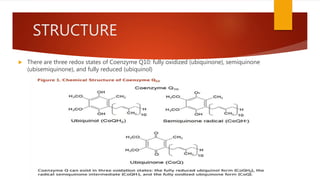
 There are three redox states of Coenzyme Q10: fully oxidized (ubiquinone), semiquinone
(ubisemiquinone), and fully reduced (ubiquinol)
SOURCES
SOURCES AMOUNT
(ug/g)
Beef- Heart 113
Beef- Muscle 26-40
Pork- Heart 11.8-128.2
Pork- Muscle 13.8-45
Chicken 14
Sardine 5-64
Mackerel-Red Flesh 43-67
Mackerel- White Flesh 11-16
Salmon 4-8
SOURCES AMOUNT (ug/g)
Soybean Oil 54-280
Olive 4-160
Sunflower 4-15
Peanuts 27
Walnuts 19
Broccoli 6-9
Spinach Up to 10
Avocado 10
Yogurt 2.4
HEALTH BENEFITS
CoQ10 and Diseases
 Significantly decreased levels of CoQ10 have been noted in a wide variety of
diseases in both animal and human studies.
 CoQ10 deficiency may be caused by an insufficient dietary CoQ10 intake, the
impairment in CoQ10 biosynthesis, excessive utilization of CoQ10 by the
body, or any combination of the three.
 During many diseases CoQ10 is taken up in large doses by all tissues
including the heart and brain mitochondria.
 It has been found to show beneficial effects in cardiovascular and
neurodegenerative diseases
CoQ10 and Cardiovascular Diseases.
 CoQ10 is known to be highly concentrated in the heart muscle cells due to the high energy
requirements of this type of cells.
 One clinical study found that people who took daily CoQ10 supplements within 3 days of a
heart attack were less likely to have subsequent heart attacks and chest pain.
 There is evidence that CoQ10 may help treat heart failure when combined with conventional
medications.
 Persons with congestive heart failure aren’t able to pump blood. This can cause blood to pool
in different parts of body, like lungs and legs. CoQ10 helps in reducing the accumulated fluid,
thus reducing swelling and making breathing easier.
 It has not been yet proved that low levels of CoQ10 cause heart failure. However, it can
definitely be used in the treatment for heart failure.
CoQ10 and Hypertension
 Several clinical studies involving small numbers of people suggest that
CoQ10 may lower blood pressure. However, it may take 4-12 weeks to see
any change.
 Researchers have concluded that CoQ10 has the potential to reduce the
systolic blood pressure by 17 mm and diastolic blood pressure by 10 mm,
without significant side effects.
CoQ10 and Cholesterol
 Higher Cholesterol levels have always been associated with low CoQ10 levels.
 CoQ10 does not directly work against high cholesterol but reduces the
intensity of the side effects of the drugs administered for high cholesterol.
 Cholesterol lowering statin drugs reduce the levels of CoQ10 in the body.
Hence, CoQ10 supplements need to be taken.
 Studies show that CoQ10 decreases the pain associated with Statin drugs.
CoQ10 and Peridontal Disease
 Gum disease is a common problem that causes swelling, bleeding, pain,
and redness of the gums.
 Clinical studies show that people with gum disease tend to have low
levels of CoQ10 in their gums.
 Studies found that CoQ10 supplements led to faster healing and tissue
repair, but more research is needed
OTHER BENEFITS
 Helps to prevent migraine
 Improves immune function in people with HIV
 Improves ability to exercise
 Anti cancer
 Anti ageing and longetivity
 Anti inflammatory (when taken with Vitamin E)
 Prevents against cataract
 Fatigue reduction
ABSORPTION
 Being a lipophilic substance the absorption of CoQ10 follows the same
process as that of lipids in the gastrointestinal tract.
 The uptake mechanism for CoQ10 appears to be similar to that of vitamin E,
another lipid-soluble nutrient.
 The absorption of CoQ10 is enhanced in the presence of lipids.
 The absorption of supplemental CoQ10 can be improved if ingested with a
fatty meal.
ABSORPTION
 Digestion helps in the release of dietary CoQ10 from the food matrix but for
supplemental CoQ10 products that are based on pure CoQ10, gastric
digestion does not appear to an important factor.
 No specific site along the small intestine has been identified for the absorption
of CoQ10.
 The efficiency of absorption of orally administered CoQ10 is poor because of
its insolubility in water, limited solubility in lipids, and relatively large molecular
weight.
 In one study with rats it was reported that only about 2–3% of orally-
administered CoQ10 was absorbed
COMMERCIAL SYNTHESIS
Yeast Containing
CoQ10
Extraction Purification
CrystallisationDryingPurified CoQ10
COMMERCIAL SYNTHESIS
NUTRIENT INTERACTION
DRUG INTERACTIONS
 Warfarin
 Warfarin is a blood thinning drug.
 Simultaneous use of warfarin (Coumadin) and coenzyme Q10 supplements has been reported to
decrease the anticoagulant effect of warfarin.
 Anthracyclines
 They are excellent anticancer drugs but they are also cardiotoxic. They cause irreversible damage
to myocardial mitochondria,
 This can be prevented by CoQ10 administration during cancer chemotherapy without
compromising their action
DRUG INTERACTIONS
 Statins
 Statins are HMG-CoA reductase inhibitors.
 Used for controlling high cholesterol levels.
 But due to same biosynthetic pathway,
production of CoQ10 is also affected.
DOSAGE
 CoQ10 is available as a dietary supplement in strengths generally ranging
from 15 to 100 mg.
 In cardiovascular disease patients CoQ10 dosages generally range from 100
to 200mg a day.
 Dosages of up to 15mg/kg/day are being employed in the case of
mitochondrial cytopathy patients
 A dosage of 600 mg a day was used in the Huntington’s disease trial
 Dosage of up to 1200 mg a day was employed in the Parkinson’s disease trial.
SAFETY
 CoQ10 has an excellent safety record.
 There have been no reports of significant adverse side effects of oral coenzyme Q10
supplementation at doses as high as 1,200 mg/day for up to 16 months and 600 mg/day
for up to 30 months.
 1,200 mg/day has recently been proposed as the observed safe level (OSL) for coenzyme
Q10.
 At doses as high as 3000mg a day, limited to mild gastrointestinal symptoms such as
nausea and stomach upset were seen in a small number of subjects.
PRODUCTS
Nature’s Bounty
50mg Softgels- 75nos.
Rs. 1274
Per Softgel: Rs.17
Schwarzkopf
Hair Lotion
Rs. 850
Vitamin Shoppe
200mg Capsules- 60nos
Rs. 2762
Per Capsule: Rs.46
PRODUCTS
REFERENCES
 Coenzyme Q10- Linus Pauling Institute
 Coenzyme Q10- University of Maryland Medical Centre
 Coenzyme Q10: Absorption, tissue uptake, metabolism andpharmacokinetics- HEMMI N.
BHAGAVAN & RAJ K. CHOPRA
 Nourishing and Health Benefits of Coenzyme Q10 – a Review Martina BOREKOVÁ1, Jarmila
HOJEROVÁ, Vasiľ KOPRDA and Katarína BAUEROVÁ
 Improvement of Coenzyme Q10 Production: Mutagenesis Induced by High Hydrostatic Pressure
Treatment and Optimization of Fermentation Conditions- Yahong Yuan, Yuting Tian, and Tianli
Yue
THANKS!

Coenzyme Q10

  • 1.
  • 2.
    INTRODUCTION  Coenzyme Q10,also known as ubiquinone, ubidecarenone, coenzyme Q, and abbreviated at times to CoQ10.  It is oil soluble in nature.  CoQ10 is similar to vitamin K in its chemical structure but it is not considered a vitamin because it is synthesized in the body.  CoQ10 has a fundamental role in cellular bioenergetics as a cofactor in the mitochondrial electron transport chain (respiratory chain) and is therefore essential for the production of ATP.  CoQ10 functions as a mobile redox agent shuttling electrons and also protons in the electron transport chain.  CoQ10 in its reduced form as the hydroquinone (called ubiquinol) is a potent lipophilic antioxidant and is capable of recycling and regenerating other antioxidants
  • 3.
    STRUCTURE  There arethree redox states of Coenzyme Q10: fully oxidized (ubiquinone), semiquinone (ubisemiquinone), and fully reduced (ubiquinol)
  • 6.
    SOURCES SOURCES AMOUNT (ug/g) Beef- Heart113 Beef- Muscle 26-40 Pork- Heart 11.8-128.2 Pork- Muscle 13.8-45 Chicken 14 Sardine 5-64 Mackerel-Red Flesh 43-67 Mackerel- White Flesh 11-16 Salmon 4-8 SOURCES AMOUNT (ug/g) Soybean Oil 54-280 Olive 4-160 Sunflower 4-15 Peanuts 27 Walnuts 19 Broccoli 6-9 Spinach Up to 10 Avocado 10 Yogurt 2.4
  • 7.
  • 8.
    CoQ10 and Diseases Significantly decreased levels of CoQ10 have been noted in a wide variety of diseases in both animal and human studies.  CoQ10 deficiency may be caused by an insufficient dietary CoQ10 intake, the impairment in CoQ10 biosynthesis, excessive utilization of CoQ10 by the body, or any combination of the three.  During many diseases CoQ10 is taken up in large doses by all tissues including the heart and brain mitochondria.  It has been found to show beneficial effects in cardiovascular and neurodegenerative diseases
  • 9.
    CoQ10 and CardiovascularDiseases.  CoQ10 is known to be highly concentrated in the heart muscle cells due to the high energy requirements of this type of cells.  One clinical study found that people who took daily CoQ10 supplements within 3 days of a heart attack were less likely to have subsequent heart attacks and chest pain.  There is evidence that CoQ10 may help treat heart failure when combined with conventional medications.  Persons with congestive heart failure aren’t able to pump blood. This can cause blood to pool in different parts of body, like lungs and legs. CoQ10 helps in reducing the accumulated fluid, thus reducing swelling and making breathing easier.  It has not been yet proved that low levels of CoQ10 cause heart failure. However, it can definitely be used in the treatment for heart failure.
  • 10.
    CoQ10 and Hypertension Several clinical studies involving small numbers of people suggest that CoQ10 may lower blood pressure. However, it may take 4-12 weeks to see any change.  Researchers have concluded that CoQ10 has the potential to reduce the systolic blood pressure by 17 mm and diastolic blood pressure by 10 mm, without significant side effects.
  • 11.
    CoQ10 and Cholesterol Higher Cholesterol levels have always been associated with low CoQ10 levels.  CoQ10 does not directly work against high cholesterol but reduces the intensity of the side effects of the drugs administered for high cholesterol.  Cholesterol lowering statin drugs reduce the levels of CoQ10 in the body. Hence, CoQ10 supplements need to be taken.  Studies show that CoQ10 decreases the pain associated with Statin drugs.
  • 12.
    CoQ10 and PeridontalDisease  Gum disease is a common problem that causes swelling, bleeding, pain, and redness of the gums.  Clinical studies show that people with gum disease tend to have low levels of CoQ10 in their gums.  Studies found that CoQ10 supplements led to faster healing and tissue repair, but more research is needed
  • 13.
    OTHER BENEFITS  Helpsto prevent migraine  Improves immune function in people with HIV  Improves ability to exercise  Anti cancer  Anti ageing and longetivity  Anti inflammatory (when taken with Vitamin E)  Prevents against cataract  Fatigue reduction
  • 14.
    ABSORPTION  Being alipophilic substance the absorption of CoQ10 follows the same process as that of lipids in the gastrointestinal tract.  The uptake mechanism for CoQ10 appears to be similar to that of vitamin E, another lipid-soluble nutrient.  The absorption of CoQ10 is enhanced in the presence of lipids.  The absorption of supplemental CoQ10 can be improved if ingested with a fatty meal.
  • 15.
    ABSORPTION  Digestion helpsin the release of dietary CoQ10 from the food matrix but for supplemental CoQ10 products that are based on pure CoQ10, gastric digestion does not appear to an important factor.  No specific site along the small intestine has been identified for the absorption of CoQ10.  The efficiency of absorption of orally administered CoQ10 is poor because of its insolubility in water, limited solubility in lipids, and relatively large molecular weight.  In one study with rats it was reported that only about 2–3% of orally- administered CoQ10 was absorbed
  • 16.
    COMMERCIAL SYNTHESIS Yeast Containing CoQ10 ExtractionPurification CrystallisationDryingPurified CoQ10
  • 17.
  • 18.
  • 19.
    DRUG INTERACTIONS  Warfarin Warfarin is a blood thinning drug.  Simultaneous use of warfarin (Coumadin) and coenzyme Q10 supplements has been reported to decrease the anticoagulant effect of warfarin.  Anthracyclines  They are excellent anticancer drugs but they are also cardiotoxic. They cause irreversible damage to myocardial mitochondria,  This can be prevented by CoQ10 administration during cancer chemotherapy without compromising their action
  • 20.
    DRUG INTERACTIONS  Statins Statins are HMG-CoA reductase inhibitors.  Used for controlling high cholesterol levels.  But due to same biosynthetic pathway, production of CoQ10 is also affected.
  • 21.
    DOSAGE  CoQ10 isavailable as a dietary supplement in strengths generally ranging from 15 to 100 mg.  In cardiovascular disease patients CoQ10 dosages generally range from 100 to 200mg a day.  Dosages of up to 15mg/kg/day are being employed in the case of mitochondrial cytopathy patients  A dosage of 600 mg a day was used in the Huntington’s disease trial  Dosage of up to 1200 mg a day was employed in the Parkinson’s disease trial.
  • 22.
    SAFETY  CoQ10 hasan excellent safety record.  There have been no reports of significant adverse side effects of oral coenzyme Q10 supplementation at doses as high as 1,200 mg/day for up to 16 months and 600 mg/day for up to 30 months.  1,200 mg/day has recently been proposed as the observed safe level (OSL) for coenzyme Q10.  At doses as high as 3000mg a day, limited to mild gastrointestinal symptoms such as nausea and stomach upset were seen in a small number of subjects.
  • 23.
    PRODUCTS Nature’s Bounty 50mg Softgels-75nos. Rs. 1274 Per Softgel: Rs.17 Schwarzkopf Hair Lotion Rs. 850 Vitamin Shoppe 200mg Capsules- 60nos Rs. 2762 Per Capsule: Rs.46
  • 24.
  • 25.
    REFERENCES  Coenzyme Q10-Linus Pauling Institute  Coenzyme Q10- University of Maryland Medical Centre  Coenzyme Q10: Absorption, tissue uptake, metabolism andpharmacokinetics- HEMMI N. BHAGAVAN & RAJ K. CHOPRA  Nourishing and Health Benefits of Coenzyme Q10 – a Review Martina BOREKOVÁ1, Jarmila HOJEROVÁ, Vasiľ KOPRDA and Katarína BAUEROVÁ  Improvement of Coenzyme Q10 Production: Mutagenesis Induced by High Hydrostatic Pressure Treatment and Optimization of Fermentation Conditions- Yahong Yuan, Yuting Tian, and Tianli Yue
  • 26.

Editor's Notes

  • #5 The “Coenzyme Q cycle” (also called the “Q Cycle.”) The CoQ10 cycle begins with ubiquinone (leftmost compound) accepting electrons (e-) and protons (H+) from complexes I and II (succinate and NADH) of the electron-transport chain. There is no CoQ10 activity without ubiquinone to start the transfer of electrons and protons.  In doing so, the basic quinone structure absorbs them and becomes first, ubisemiquinone, then ubiquinol. Ubiquinol can not receive electrons or protons. Instead, ubiquinol delivers electrons and protons to complex III (cytochromes a and b). In doing so, ubiquinol reverts back to ubisemiquinone and then to ubiquinone. This cycle repeats itself over and over like members of a bucket brigade carrying electrons and protons along the electron-transport system. Each component is as important as the others. Drawing adapted from Alberts et al., Molecular Biology of the Cell, Garland Publ., 1994.