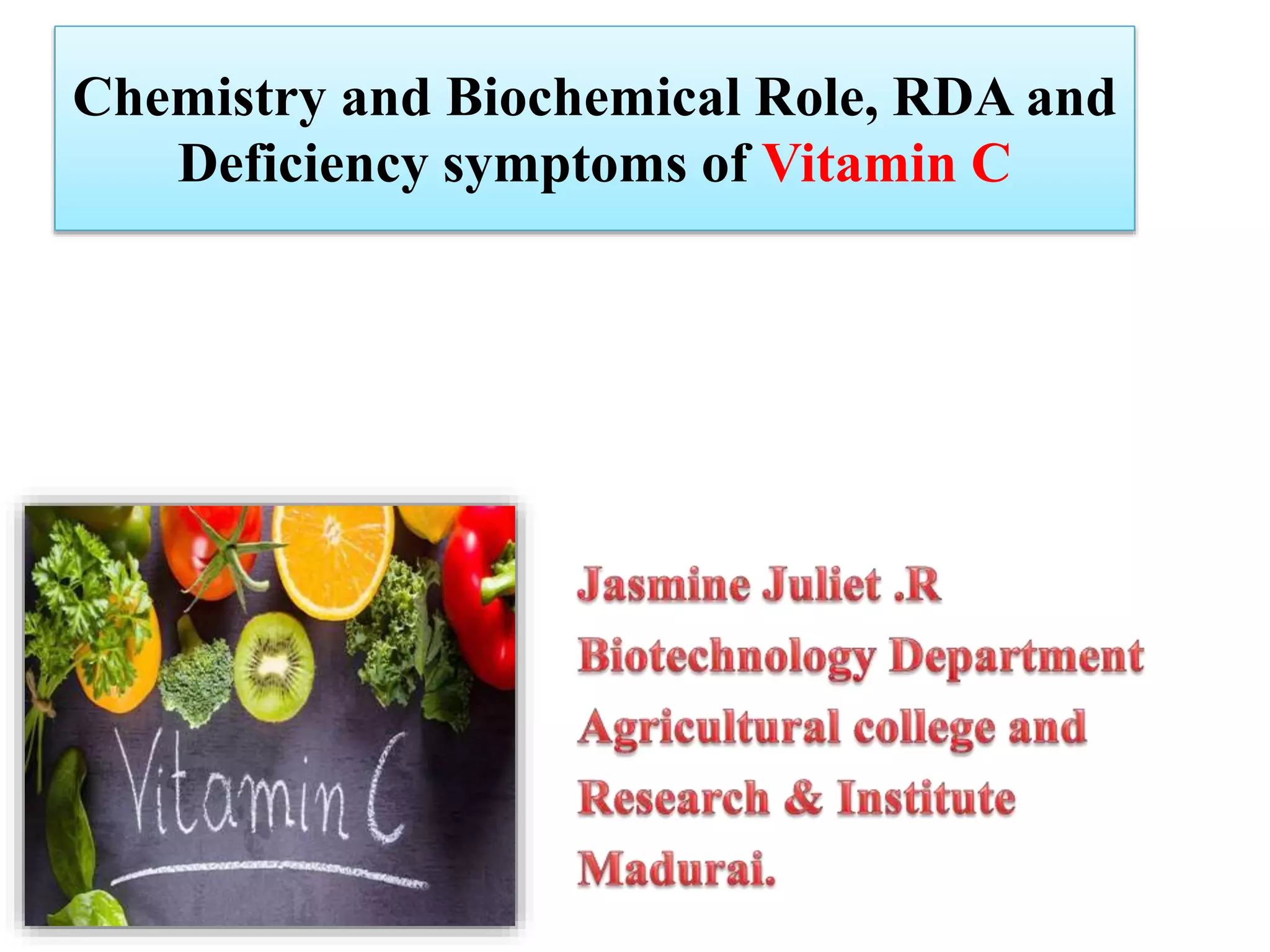
Chemistry and Biochemical Role, RDA and
Deficiency symptoms of Vitamin C
Vitamin C - Introduction
• Vitamin C is a water soluble versatile
vitamin.
• It plays an important role in human health
and disease.
Vitamin C - Chemistry
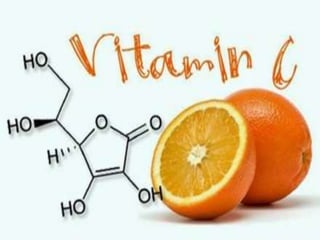
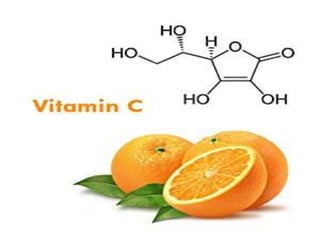
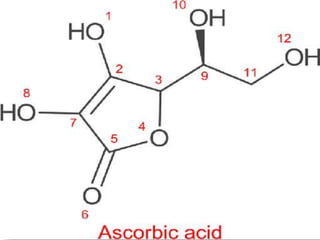
• Ascorbic acid is a hexose (6 carbon ) derivative and
closely resembles monosaccharides in structure.
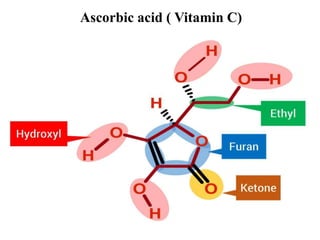
• The acidic property of vitamin C is due to the enolic
hydroxyl groups.
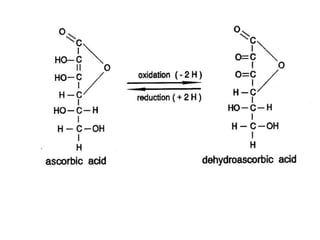
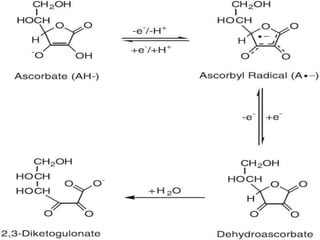
• It is a storing reducing agent, L-Ascorbic acid
undergoes oxidation to form dehydroascorbic acid and
this reaction is reversible.
Vitamin C - Chemistry
• On hydration, dehydroascorbic acid is irreversibly
converted to 2, 3-diketogulonic acid which is inactive.
• Oxidation of Ascorbic acid is rapid in the presence of
copper.
• Hence vitamin C becomes inactive if the foods are
prepared in copper vessels
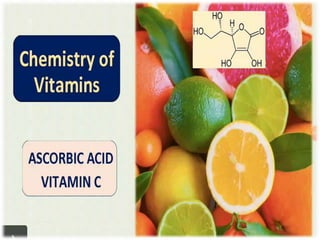
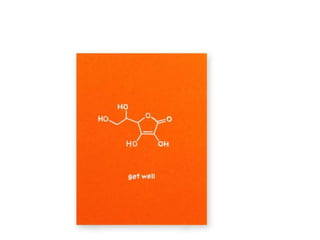
Ascorbic acid ( Vitamin C)
Vitamin C – Biosynthesis and
Metabolism
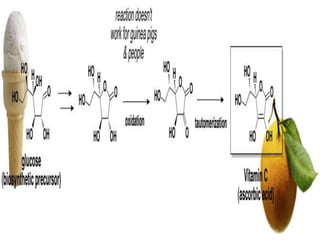
• Many animals can synthesise ascorbic acid
from glucose via uronic acid pathway.
• However, man, other primates, guinea pigs and
bats cannot synthesis ascorbic acid due to the
deficiency of a single enzyme namely
L-gluconolactone oxidase.
Vitamin C – Biochemical Functions
• Most of the functions of vitamin C are related
to its property to undergo reversible oxidation
-reduction i.e., interconversion of ascorbic
acid and dehydroascorbic acid.
Vitamin C – Biochemical Functions
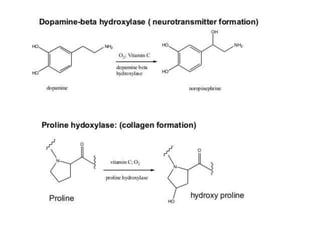
I. Collagen formation: Vitamin C plays the role of a
coenzyme in hydroxylation of proline and lysine while
protocollagen is converted to collagen (i.e., Post
translational modification).
• Hydroxyproline and hydroxylysine are essential for the
collagen cross-linking and the strength of the fiber.
• In this way, vitamin C is necessary for maintenance of
normal connective tissue and wound healing process.
Vitamin C – Biochemical Functions
II. Bone formation: Bone tissues possess an organic
matrix, collagen and the inorganic calcium, phosphate,
etc. Vitamin C is required for bone formation.
III. Iron and Hemoglobin metabolism: Ascorbic acid
enhances iron absorption by keeping it in the ferrous
form. This is due to the reducing property of vitamin C.
Vitamin C – Biochemical Functions
IV. Tryptophan metabolism: Vitamin C is
essential for the hydroxylation of tryptophan
(enzyme hydroxylase) to hydroxy tryptophan
in the synthesis of serotonin.
Vitamin C – Biochemical Functions
V. Synthesis of corticosteroid hormones:
Adrenal gland possess high levels of ascorbic
acid, particularly in periods of stress, it is
believed that vitamin C is necessary for the
hydroxylation reactions in the synthesis of
corticosteroid hormones.
Vitamin C – Biochemical Functions
VI. Sparing action of other vitamins: Ascorbic
acid is a strong antioxidant. It spares Vitamin A
and Vitamin E, and some B complex vitamins
from oxidation.
VII. Immunological function: Vitamin C enhances
the synthesis of immunoglobulins (antibodies)
and increases the phagocytic action of leucocytes.
Vitamin C – Biochemical Functions
VIII. Preventive action on chronic diseases: Free radicals are
constantly produced in the normal metabolism.
 They cause serious damage to proteins, lipids, DNA
and the cell membranes.
 The free radicals are implicated in the development of
cancer, heart diseases and also ageing.
 Vitamin C is a strong biological antioxidant, besides
vitamin E and β-carotene.
Vitamin C - RDA
• About 60-70mg vitamin C in take per day will
meet the adult requirement.
• Additional intakes (20-40% increase) are
recommended for women during pregnancy
and lactation.
Vitamin C – Dietary Sources
• Citrus fruits, gooseberry (amla), guava, green
vegetables (cabbage, spinach), tomatoes, potatoes
(particularly skin) are rich in ascorbic acid.
• High content of vitamin C is found in adrenal
gland and gonads.
• Milk is a poor source of ascorbic acid.
Vitamin C – Deficiency symptoms
• The deficiency of ascorbic acid results in scurvy.
• This disease is characterized by:
• spongy and sore gums,
• loose teeth,
• anemia,
• swollen joints,
• decreased immunocompetence,
• delayed wound healing,
• haemorrhage,
• osteoporosis, etc.
Vitamin c
Vitamin c

Vitamin c

  • 1.
    Chemistry and BiochemicalRole, RDA and Deficiency symptoms of Vitamin C
  • 3.
    Vitamin C -Introduction • Vitamin C is a water soluble versatile vitamin. • It plays an important role in human health and disease.
  • 5.
    Vitamin C -Chemistry • Ascorbic acid is a hexose (6 carbon ) derivative and closely resembles monosaccharides in structure. • The acidic property of vitamin C is due to the enolic hydroxyl groups. • It is a storing reducing agent, L-Ascorbic acid undergoes oxidation to form dehydroascorbic acid and this reaction is reversible.
  • 7.
    Vitamin C -Chemistry • On hydration, dehydroascorbic acid is irreversibly converted to 2, 3-diketogulonic acid which is inactive. • Oxidation of Ascorbic acid is rapid in the presence of copper. • Hence vitamin C becomes inactive if the foods are prepared in copper vessels
  • 11.
    Ascorbic acid (Vitamin C)
  • 13.
    Vitamin C –Biosynthesis and Metabolism • Many animals can synthesise ascorbic acid from glucose via uronic acid pathway. • However, man, other primates, guinea pigs and bats cannot synthesis ascorbic acid due to the deficiency of a single enzyme namely L-gluconolactone oxidase.
  • 15.
    Vitamin C –Biochemical Functions • Most of the functions of vitamin C are related to its property to undergo reversible oxidation -reduction i.e., interconversion of ascorbic acid and dehydroascorbic acid.
  • 16.
    Vitamin C –Biochemical Functions I. Collagen formation: Vitamin C plays the role of a coenzyme in hydroxylation of proline and lysine while protocollagen is converted to collagen (i.e., Post translational modification). • Hydroxyproline and hydroxylysine are essential for the collagen cross-linking and the strength of the fiber. • In this way, vitamin C is necessary for maintenance of normal connective tissue and wound healing process.
  • 18.
    Vitamin C –Biochemical Functions II. Bone formation: Bone tissues possess an organic matrix, collagen and the inorganic calcium, phosphate, etc. Vitamin C is required for bone formation. III. Iron and Hemoglobin metabolism: Ascorbic acid enhances iron absorption by keeping it in the ferrous form. This is due to the reducing property of vitamin C.
  • 19.
    Vitamin C –Biochemical Functions IV. Tryptophan metabolism: Vitamin C is essential for the hydroxylation of tryptophan (enzyme hydroxylase) to hydroxy tryptophan in the synthesis of serotonin.
  • 20.
    Vitamin C –Biochemical Functions V. Synthesis of corticosteroid hormones: Adrenal gland possess high levels of ascorbic acid, particularly in periods of stress, it is believed that vitamin C is necessary for the hydroxylation reactions in the synthesis of corticosteroid hormones.
  • 21.
    Vitamin C –Biochemical Functions VI. Sparing action of other vitamins: Ascorbic acid is a strong antioxidant. It spares Vitamin A and Vitamin E, and some B complex vitamins from oxidation. VII. Immunological function: Vitamin C enhances the synthesis of immunoglobulins (antibodies) and increases the phagocytic action of leucocytes.
  • 22.
    Vitamin C –Biochemical Functions VIII. Preventive action on chronic diseases: Free radicals are constantly produced in the normal metabolism.  They cause serious damage to proteins, lipids, DNA and the cell membranes.  The free radicals are implicated in the development of cancer, heart diseases and also ageing.  Vitamin C is a strong biological antioxidant, besides vitamin E and β-carotene.
  • 23.
    Vitamin C -RDA • About 60-70mg vitamin C in take per day will meet the adult requirement. • Additional intakes (20-40% increase) are recommended for women during pregnancy and lactation.
  • 24.
    Vitamin C –Dietary Sources • Citrus fruits, gooseberry (amla), guava, green vegetables (cabbage, spinach), tomatoes, potatoes (particularly skin) are rich in ascorbic acid. • High content of vitamin C is found in adrenal gland and gonads. • Milk is a poor source of ascorbic acid.
  • 25.
    Vitamin C –Deficiency symptoms • The deficiency of ascorbic acid results in scurvy. • This disease is characterized by: • spongy and sore gums, • loose teeth, • anemia, • swollen joints, • decreased immunocompetence, • delayed wound healing, • haemorrhage, • osteoporosis, etc.