Co-Enzymes
Co-Enzymes
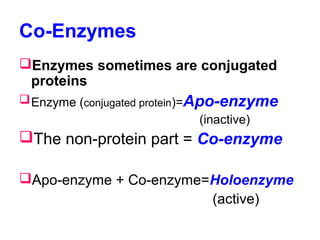
Enzymes sometimes are conjugated
proteins
Enzyme (conjugated protein)=Apo-enzyme
(inactive)
The non-protein part = Co-enzyme
Apo-enzyme + Co-enzyme=Holoenzyme
(active)
Apo-Enzyme and Co-Enzyme
Some enzymes have two parts
The protein part is called
Apoenzyme
The non-protein part is called Co-
enzyme
When tightly bound the Co-enzyme is
called Prosthetic-Group
Classification of Co-Enzymes
Coenzymes can be classified by
two ways
( I ) Classification based on
functional characteristics
(II )  Classification based on
structure
(I) Classification based on functional
characteristics
A. Transfer of group other than H
1. Sugar Phosphates
2. Thiamine pyro-phosphates
3. Pyridoxal Phosphate
4. Folate co-enzyme
5. Co-enzyme A
6.Biotin
7.Cobamide co-enzyme B12
8.Lipoic Acid
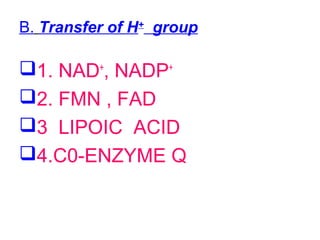
B. Transfer of H+
group
1. NAD+
, NADP+
2. FMN , FAD
3 LIPOIC ACID
4.C0-ENZYME Q
(II) Classification based on
structure
Presence of Adenine ring
joined to Ribose
Many Co-enzymes may
therefore be regarded as
derivatives of Adenosine
mono phosphate .They are:-
Co-enzymes as Adenosine Derivatives
1. Active Methionine
2.Amino Acid Adenylate
3.Active Sulphate
4. 3’ 5’ Cyclic AMP
5. NAD, NADP
6. FAD
7.Co.A
Characteristics Of Co-Enzymes
 Co-Enzymes are :-
 Thermo stable
Dialyzable
Non- colloidal
Non-protein
Are altered at the end of a reaction and
sometimes may be changed
They usually belong to the Vitamin ‘B’
complex group
Co-Enzyme Vitamin
Derivative
Enzyme
Requiring
TPP
Co-Decarboxylase Vitamin B1
Thiamine
Pyruvate Dehydrogenase
α.Keto Glutarate
Dehydrogenase
Transketolase
FAD
FMN
Vitamin B2
(Riboflavin)
D-amino acid Oxidase
L-amino acid Oxidase
Pyridoxal PO4
Co-Transaminase
Vitamin B6
Pyridoxine Transaminase
Co-Enzyme Vitamin
Derivative
Enzyme
Requiring
Co-Enzyme A
Co-Acylase
Vitamin
Pantothenic Acid
Thiokinases
Thiolases
NAD+
NADP+
Vitamin
Nicotinic Acid
LDH,Alcohol
Dehydrogenase
G-6-P Dehydrogenase
Tetra Hydro Folate
(FH4)
Folic acid
One Carbon
Transfers
Thymidilate Synthase
Serine Trans Hydroxy
methylase
Cobamide
Co-enzyme
Vitamin B12
Homocysteine methyl
Transferase
Co-Enzyme Vitamin
Derivative
Enzyme
Requiring
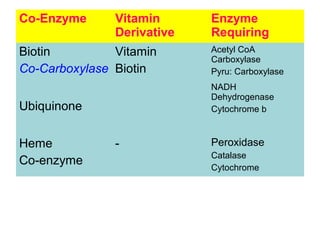
Biotin
Co-Carboxylase
Vitamin
Biotin
Acetyl CoA
Carboxylase
Pyru: Carboxylase
Ubiquinone
NADH
Dehydrogenase
Cytochrome b
Heme
Co-enzyme
- Peroxidase
Catalase
Cytochrome
Function of Co-enzymes
They accept atom or group from a
substrate and transfer it to the other
molecule.
Eg: Transaminases
R─NH2 + R1─ C ═ O + PyPO4
PyPO4─NH2
R1─ NH2 + R─ C═ O + PyPO4
NAD and NADP act as hydrogen
acceptors in dehydrogenating
reactions
T.P.P functions in oxidative
decarboxylations.
CoA in Acyl group carrier
Tetrahydrofolate as formate
carrier in the synthesis of Purines
and Pyrimidines.
PROENZYMES
Some enzymes, particularly
the Proteolytic enzyme ,
may be secreted as inactive
proenzymes or zymogen.
 At the active site ,one or more specific
covalent peptide bonds of each such pro-
enzymes are hydrolyzed either
enzymatically or by pH changes to yield
the active enzyme and some inactive
peptides called masking substances
Hydrolysis makes the active site of the
enzyme free and available to catalytic
action.
PROENZYME ACTIVATOR PRODUCTS
Pro-
Enzyme
Activator Active
Enzyme
Masking
Substances
Pepsinogen
HCl
or Pepsin
Pepsin Inactive
peptide
Trypsinoge
n
Enterokina
se
Trypsin Inactive
Hexapeptide
Chymotryps
inogen
Trypsin,Ch
ymotrypsin
α-
Chymotrpsin
α-Inactive
Peptide
PROENZYME ACTIVATOR PRODUCTS
Pro-Enzyme Activator Active
Enzyme
Masking
Substances
Pro-
Carboxypept
idase A
Trypsin Carboxype
ptidase A
Inactive
Peptide
Prothrombin Prothromb
inase
Thrombin Inactive
polypeptide
Pro-
Fibrinolysine
Fibrino
lyso
Kinase
Fibrino
Lysine
Inactive
Peptide
Co enz

Co enz

  • 1.
  • 2.
    Co-Enzymes Enzymes sometimes areconjugated proteins Enzyme (conjugated protein)=Apo-enzyme (inactive) The non-protein part = Co-enzyme Apo-enzyme + Co-enzyme=Holoenzyme (active)
  • 3.
    Apo-Enzyme and Co-Enzyme Someenzymes have two parts The protein part is called Apoenzyme The non-protein part is called Co- enzyme When tightly bound the Co-enzyme is called Prosthetic-Group
  • 4.
    Classification of Co-Enzymes Coenzymescan be classified by two ways ( I ) Classification based on functional characteristics (II )  Classification based on structure
  • 5.
    (I) Classification basedon functional characteristics A. Transfer of group other than H 1. Sugar Phosphates 2. Thiamine pyro-phosphates 3. Pyridoxal Phosphate 4. Folate co-enzyme 5. Co-enzyme A 6.Biotin 7.Cobamide co-enzyme B12 8.Lipoic Acid
  • 6.
    B. Transfer ofH+ group 1. NAD+ , NADP+ 2. FMN , FAD 3 LIPOIC ACID 4.C0-ENZYME Q
  • 7.
    (II) Classification basedon structure Presence of Adenine ring joined to Ribose Many Co-enzymes may therefore be regarded as derivatives of Adenosine mono phosphate .They are:-
  • 8.
    Co-enzymes as AdenosineDerivatives 1. Active Methionine 2.Amino Acid Adenylate 3.Active Sulphate 4. 3’ 5’ Cyclic AMP 5. NAD, NADP 6. FAD 7.Co.A
  • 9.
    Characteristics Of Co-Enzymes Co-Enzymes are :-  Thermo stable Dialyzable Non- colloidal Non-protein Are altered at the end of a reaction and sometimes may be changed They usually belong to the Vitamin ‘B’ complex group
  • 10.
    Co-Enzyme Vitamin Derivative Enzyme Requiring TPP Co-Decarboxylase VitaminB1 Thiamine Pyruvate Dehydrogenase α.Keto Glutarate Dehydrogenase Transketolase FAD FMN Vitamin B2 (Riboflavin) D-amino acid Oxidase L-amino acid Oxidase Pyridoxal PO4 Co-Transaminase Vitamin B6 Pyridoxine Transaminase
  • 11.
    Co-Enzyme Vitamin Derivative Enzyme Requiring Co-Enzyme A Co-Acylase Vitamin PantothenicAcid Thiokinases Thiolases NAD+ NADP+ Vitamin Nicotinic Acid LDH,Alcohol Dehydrogenase G-6-P Dehydrogenase Tetra Hydro Folate (FH4) Folic acid One Carbon Transfers Thymidilate Synthase Serine Trans Hydroxy methylase Cobamide Co-enzyme Vitamin B12 Homocysteine methyl Transferase
  • 12.
    Co-Enzyme Vitamin Derivative Enzyme Requiring Biotin Co-Carboxylase Vitamin Biotin Acetyl CoA Carboxylase Pyru:Carboxylase Ubiquinone NADH Dehydrogenase Cytochrome b Heme Co-enzyme - Peroxidase Catalase Cytochrome
  • 13.
    Function of Co-enzymes Theyaccept atom or group from a substrate and transfer it to the other molecule. Eg: Transaminases R─NH2 + R1─ C ═ O + PyPO4 PyPO4─NH2 R1─ NH2 + R─ C═ O + PyPO4
  • 14.
    NAD and NADPact as hydrogen acceptors in dehydrogenating reactions T.P.P functions in oxidative decarboxylations. CoA in Acyl group carrier Tetrahydrofolate as formate carrier in the synthesis of Purines and Pyrimidines.
  • 15.
    PROENZYMES Some enzymes, particularly theProteolytic enzyme , may be secreted as inactive proenzymes or zymogen.
  • 16.
     At theactive site ,one or more specific covalent peptide bonds of each such pro- enzymes are hydrolyzed either enzymatically or by pH changes to yield the active enzyme and some inactive peptides called masking substances Hydrolysis makes the active site of the enzyme free and available to catalytic action.
  • 17.
    PROENZYME ACTIVATOR PRODUCTS Pro- Enzyme ActivatorActive Enzyme Masking Substances Pepsinogen HCl or Pepsin Pepsin Inactive peptide Trypsinoge n Enterokina se Trypsin Inactive Hexapeptide Chymotryps inogen Trypsin,Ch ymotrypsin α- Chymotrpsin α-Inactive Peptide
  • 18.
    PROENZYME ACTIVATOR PRODUCTS Pro-EnzymeActivator Active Enzyme Masking Substances Pro- Carboxypept idase A Trypsin Carboxype ptidase A Inactive Peptide Prothrombin Prothromb inase Thrombin Inactive polypeptide Pro- Fibrinolysine Fibrino lyso Kinase Fibrino Lysine Inactive Peptide