HIGH THROUGHPUT
SCREENING
Ogbadu Jeremiah
M. Pharm 2nd Semester
(Pharmacology)
ISFCP Moga
TABLE OF CONTENTS
 INTRODUCTION AND SHORT HISTORY
 DEFINITION AND SCOPE OF HIGH THROUGHPUT SCREENING
 INSTRUMENTATION
 TECHNIQUE AND PROCEDURE
 IMPORTANCE AND APPLICATIONS OF HTS
 LIMITATIONS OF HTS
 REFERENCE
INTRODUCTION AND SHORT HISTORY
 In order to learn about high throughput screening, we should have a general
understanding of the drug discovery process.
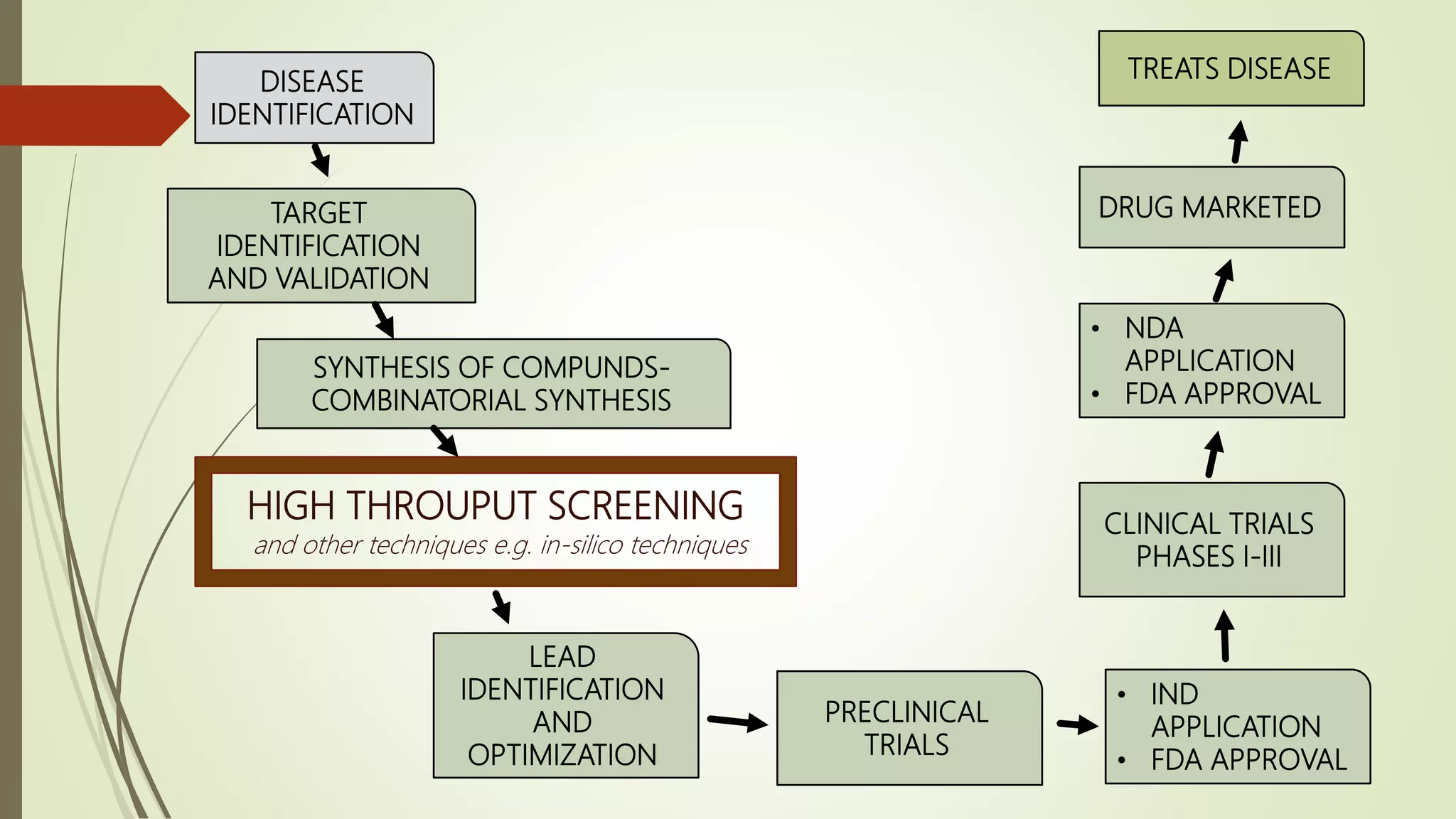
 Drug discovery is the process by which new medications or drugs are discovered.
 It involves the various steps from disease identification, identification and validation of
related target(s), development of a lead that can interact with the target and be effective in
treating the disease, preclinical and clinical trials and then finally marketing.
INTRODUCTION AND SHORT HISTORY
 High throughput Screening was invented by Dr. Gyula Takatsky in 1951; he made the first
microtiter plate using Lucite and creating 6 rows of 12 wells in it.
 High Throughput Screening is useful in the processes that lead to lead identification.
DISEASE
IDENTIFICATION
TARGET
IDENTIFICATION
AND VALIDATION
LEAD
IDENTIFICATION
AND
OPTIMIZATION
• IND
APPLICATION
• FDA APPROVAL
CLINICAL TRIALS
PHASES I-III
PRECLINICAL
TRIALS
• NDA
APPLICATION
• FDA APPROVAL
DRUG MARKETED
TREATS DISEASE
HIGH THROUPUT SCREENING
and other techniques e.g. in-silico techniques
SYNTHESIS OF COMPUNDS-
COMBINATORIAL SYNTHESIS
https://www.quora.com/In-the-drug-development-process-what-is-a-lead-compound
DEFINITION
 High throughput screening (HTS) is an experimental process or tool that employs a
group of techniques to quickly conduct a very vast number of chemical,
pharmacological, genetic, biological tests to identify biomolecular pathways or
pharmacological actions.
 10,000 – 100,000 compounds can be screened daily.
 Very vital to drug design and drug discovery process, vital to general scientific
and medical research
 Very valuable to early drug discovery
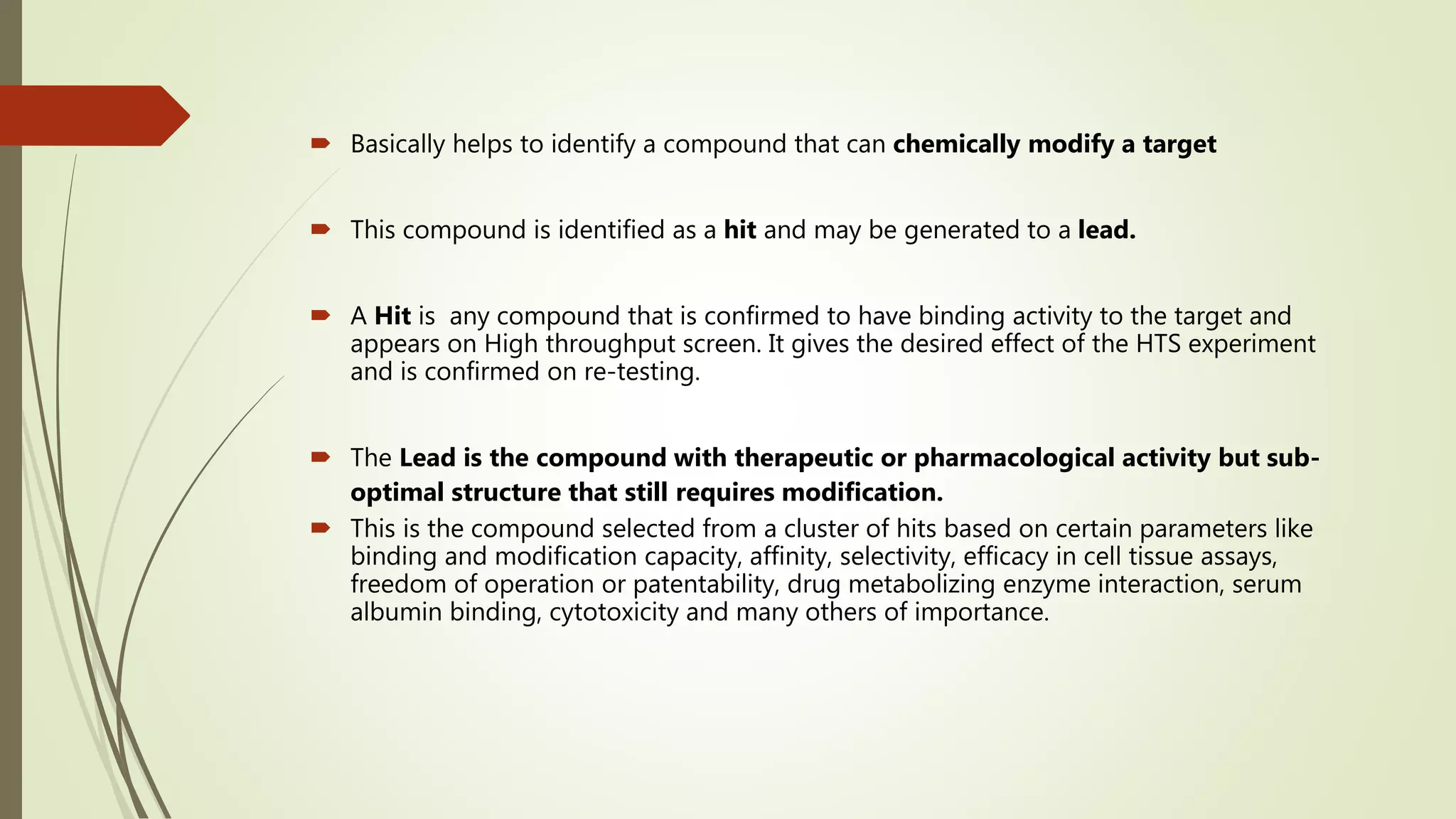
 Basically helps to identify a compound that can chemically modify a target
 This compound is identified as a hit and may be generated to a lead.
 A Hit is any compound that is confirmed to have binding activity to the target and
appears on High throughput screen. It gives the desired effect of the HTS experiment
and is confirmed on re-testing.
 The Lead is the compound with therapeutic or pharmacological activity but sub-
optimal structure that still requires modification.
 This is the compound selected from a cluster of hits based on certain parameters like
binding and modification capacity, affinity, selectivity, efficacy in cell tissue assays,
freedom of operation or patentability, drug metabolizing enzyme interaction, serum
albumin binding, cytotoxicity and many others of importance.
 This process is commonly referred as lead generation or hit to lead (H2L).
 The lead is further optimized and thus can then go through preclinical and clinical
trials and if approved gets marketed.
 The general procedure of HTS involves testing a solution of different compounds in
assay plates called microtiter plates having wells.
 The ligand or protein or embryo of interest is introduced into these wells
containing test solution
 They are incubated for a short time period.
 Analysis is done microscopically or by analytical techniques like spectrometry.
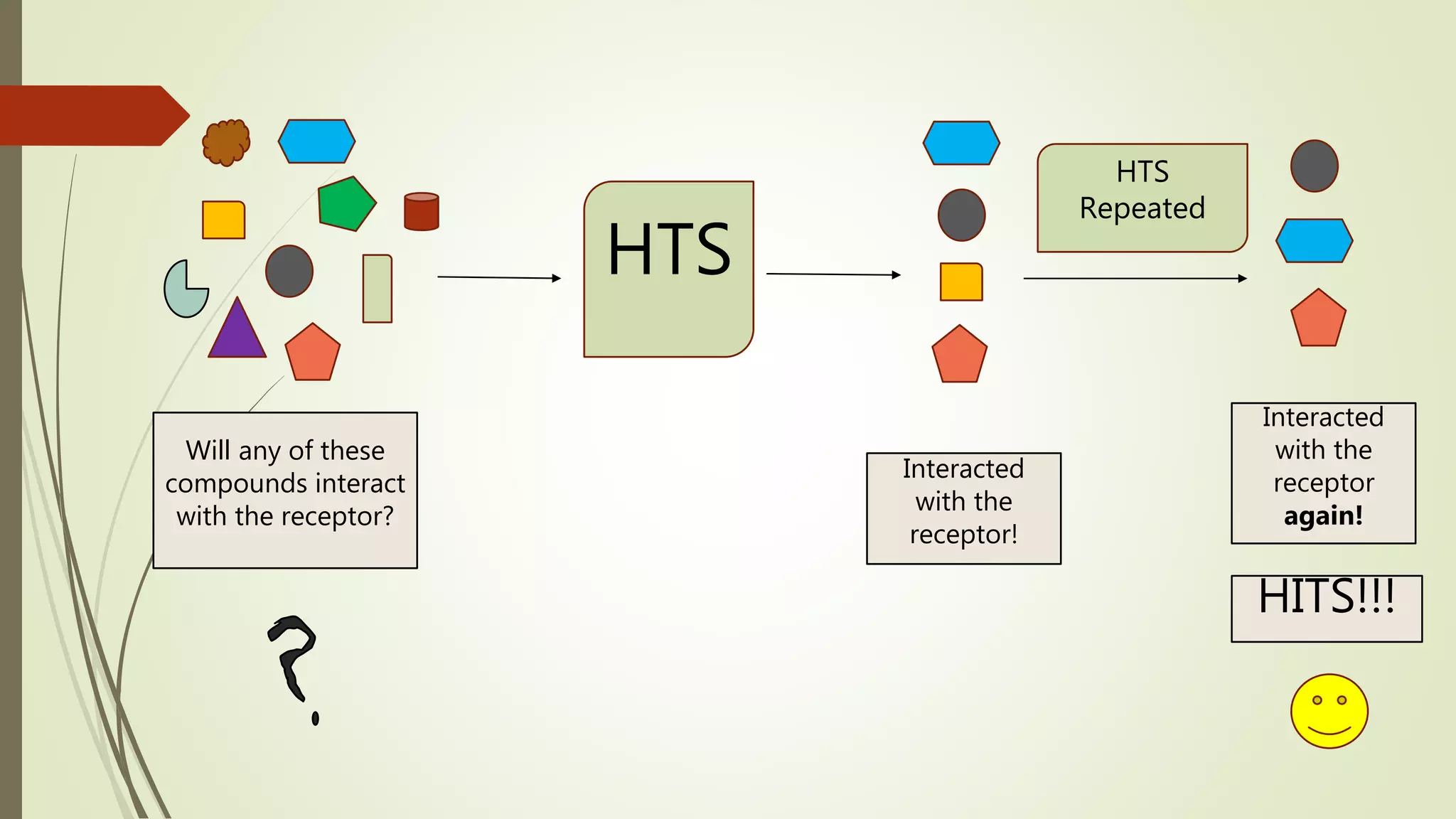
 Compounds showing desired effects are hits.
HTS
Will any of these
compounds interact
with the receptor?
Interacted
with the
receptor!
HITS!!!
Interacted
with the
receptor
again!
HTS
Repeated
INSTRUMENTATION
 MICROTITER PLATES (ASSAY PLATES)
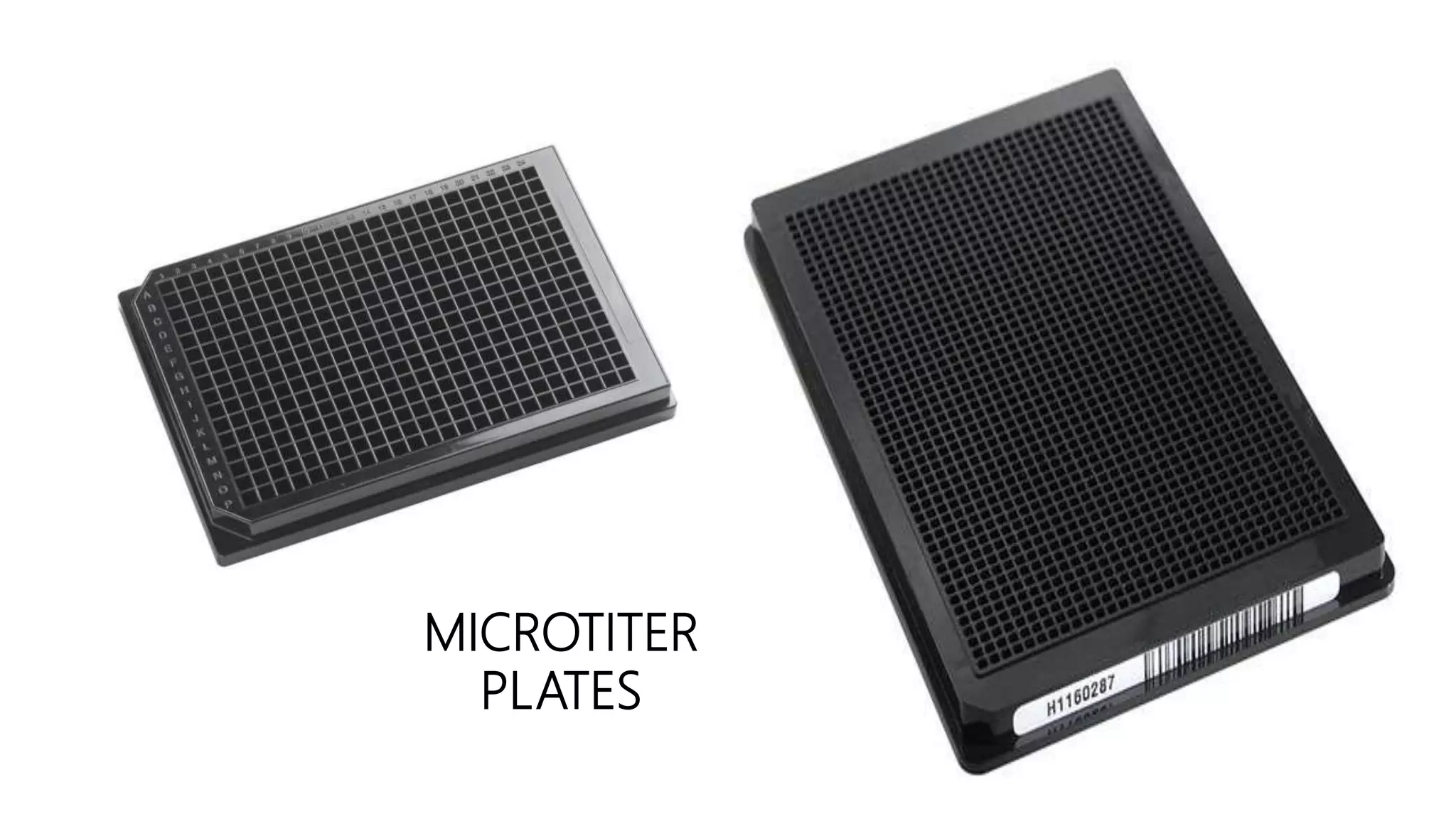
• Plates/containers made of plastic, having spaced wells – up to 384, 1536 or 3456
wells.
• They would contain solvents (e.g. DMSO + test compounds)
• They would also contain proteins, cells, etc. to be analysed.
• Some might be kept empty or contain pure solvents to serve as controls.
 DETECTORS
 Diverse spectrometers (fluorescence, mass, NMR, FTIR, etc.), Chromatography
(Gas, Liquid, Ion exchange, etc.) and Microscopy (Scanning tunnelling microscopy,
atomic force microscopy, confocal microscopy) and Calorimeters.
MICROTITER
PLATES
https://southernresearch.org/news/nih-contract-high-throughput-screening-for-zika/
TECHNIQUES AND PROCEDURE
 TYPES OF HTS: Functional and Non-functional.
 Functional: Study exactly how the compound interacts with target
 Non-functional: To find out if the compound interacts with target or not.
 PROCEDURE
DMSO or any other
solvent in microtiter
plate wells and label
them
Add test solution in
some, leave others to
serve as control
Test should be labelled
with fluorophores or
dyes e.g. alamar blue
Observe
microscopically
Incubate for a period
of time
Detect change in
fluorescence and view
on screen
http://journals.plos.org/plosone/article?id
=10.1371/journal.pone.0091173
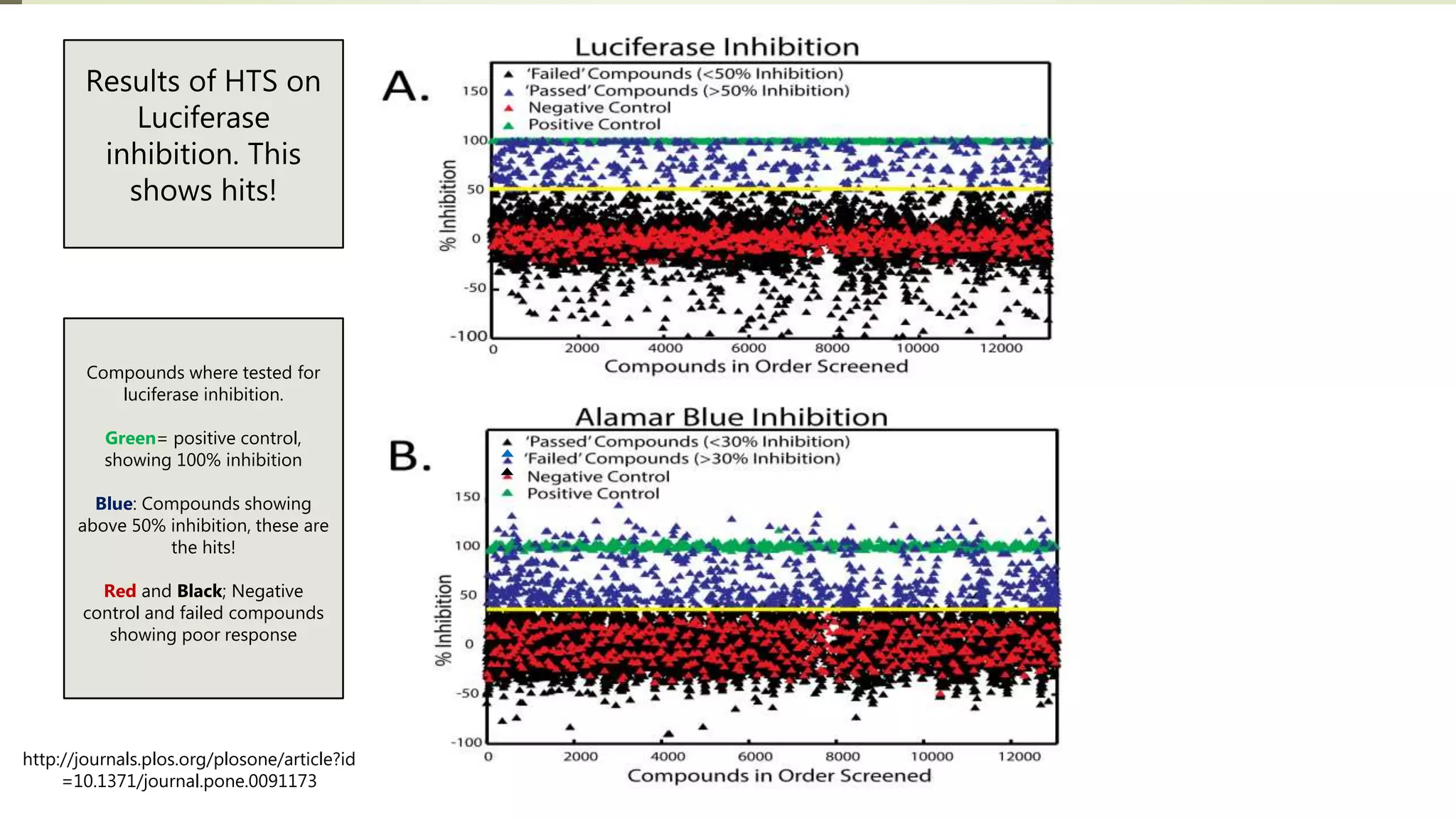
Results of HTS on
Luciferase
inhibition. This
shows hits!
Compounds where tested for
luciferase inhibition.
Green= positive control,
showing 100% inhibition
Blue: Compounds showing
above 50% inhibition, these are
the hits!
Red and Black; Negative
control and failed compounds
showing poor response
Use of robotics
 Robotics and automated systems are and impotent component of HTS.
 They optimize the process and save manpower.
 Robot arms can be used effectively to transfer microtiter plates to and fro the
sampling, incubation and analysing spots.
https://en.wikipedia.org/wiki/High-throughput_screening#/media/File:Chemical_Genomics_Robot.jpg
IMPORTANCE AND APPLICATIONS OF
HTS
 Selection of compounds from a vast number synthesized by combinatorial
chemistry and other methods.
 For lead generation for the treatment of a disease.
 It is an efficient tool in studying biomolecular interactions and pathways.
 It is highly efficient, fast, accurate and dependable in compound screening
 Useful in DNA sequencing
IMPORTANCE AND APPLICATIONS OF
HTS
 Useful in toxicology, to study mechanism of action of various drugs and toxins.
 Study drug-drug interactions and the effects of drugs on metabolizing enzymes.
 Useful in cytotoxicity assays
 Useful in genotoxicity assays
IMPORTANCE AND APPLICATIONS OF
HTS
 RECENT ADVANCEMENTS
• Use of living organisms in HTS to study drug action and identify lead molecules e.g.
in Zebra fish and Caenorhabditis elegans.
• Ultra HTS where above 100,000 compounds are screened at a time; up to 300,000.
LIMITATIONS OF HTS
 High cost
 Contamination of samples is possible.
 Analysis of data and selection of relevant data from large moulds of data requires
patience, professionalism, dedication and true expertise.
REFERENCES
 https://www.singerinstruments.com/resource/what-is-high-throughput-screening/
 https://southernresearch.org/news/nih-contract-high-throughput-screening-for-zika/
 Szymański P, Markowicz M, Mikiciuk-Olasik E. Adaptation of high-throughput screening in
drug discovery—toxicological screening tests. International journal of molecular sciences.
2011 Dec 29;13(1):427-52.
 Walters BJ, Lin W, Diao S, Brimble M, Iconaru LI, Dearman J, Goktug A, Chen T, Zuo J.
High-throughput screening reveals alsterpaullone, 2-cyanoethyl as a potent p27Kip1
transcriptional inhibitor. PloS one. 2014 Mar 19;9(3):e91173.
 Hagemeyer A, Strasser P, Volpe Jr AF, editors. High-Throughput Screening in Chemical
Catalysis: Technologies, Strategies and Applications. John Wiley & Sons; 2006 Mar 6.
 O'reilly LP, Luke CJ, Perlmutter DH, Silverman GA, Pak SC. C. elegans in high-throughput
drug discovery. Advanced drug delivery reviews. 2014 Apr 20;69:247-53.

High throughput screening

  • 1.
    HIGH THROUGHPUT SCREENING Ogbadu Jeremiah M.Pharm 2nd Semester (Pharmacology) ISFCP Moga
  • 2.
    TABLE OF CONTENTS INTRODUCTION AND SHORT HISTORY  DEFINITION AND SCOPE OF HIGH THROUGHPUT SCREENING  INSTRUMENTATION  TECHNIQUE AND PROCEDURE  IMPORTANCE AND APPLICATIONS OF HTS  LIMITATIONS OF HTS  REFERENCE
  • 3.
    INTRODUCTION AND SHORTHISTORY  In order to learn about high throughput screening, we should have a general understanding of the drug discovery process.  Drug discovery is the process by which new medications or drugs are discovered.  It involves the various steps from disease identification, identification and validation of related target(s), development of a lead that can interact with the target and be effective in treating the disease, preclinical and clinical trials and then finally marketing.
  • 4.
    INTRODUCTION AND SHORTHISTORY  High throughput Screening was invented by Dr. Gyula Takatsky in 1951; he made the first microtiter plate using Lucite and creating 6 rows of 12 wells in it.  High Throughput Screening is useful in the processes that lead to lead identification.
  • 5.
    DISEASE IDENTIFICATION TARGET IDENTIFICATION AND VALIDATION LEAD IDENTIFICATION AND OPTIMIZATION • IND APPLICATION •FDA APPROVAL CLINICAL TRIALS PHASES I-III PRECLINICAL TRIALS • NDA APPLICATION • FDA APPROVAL DRUG MARKETED TREATS DISEASE HIGH THROUPUT SCREENING and other techniques e.g. in-silico techniques SYNTHESIS OF COMPUNDS- COMBINATORIAL SYNTHESIS
  • 6.
  • 7.
    DEFINITION  High throughputscreening (HTS) is an experimental process or tool that employs a group of techniques to quickly conduct a very vast number of chemical, pharmacological, genetic, biological tests to identify biomolecular pathways or pharmacological actions.  10,000 – 100,000 compounds can be screened daily.  Very vital to drug design and drug discovery process, vital to general scientific and medical research  Very valuable to early drug discovery
  • 8.
     Basically helpsto identify a compound that can chemically modify a target  This compound is identified as a hit and may be generated to a lead.  A Hit is any compound that is confirmed to have binding activity to the target and appears on High throughput screen. It gives the desired effect of the HTS experiment and is confirmed on re-testing.  The Lead is the compound with therapeutic or pharmacological activity but sub- optimal structure that still requires modification.  This is the compound selected from a cluster of hits based on certain parameters like binding and modification capacity, affinity, selectivity, efficacy in cell tissue assays, freedom of operation or patentability, drug metabolizing enzyme interaction, serum albumin binding, cytotoxicity and many others of importance.
  • 9.
     This processis commonly referred as lead generation or hit to lead (H2L).  The lead is further optimized and thus can then go through preclinical and clinical trials and if approved gets marketed.  The general procedure of HTS involves testing a solution of different compounds in assay plates called microtiter plates having wells.  The ligand or protein or embryo of interest is introduced into these wells containing test solution
  • 10.
     They areincubated for a short time period.  Analysis is done microscopically or by analytical techniques like spectrometry.  Compounds showing desired effects are hits.
  • 11.
    HTS Will any ofthese compounds interact with the receptor? Interacted with the receptor! HITS!!! Interacted with the receptor again! HTS Repeated
  • 12.
    INSTRUMENTATION  MICROTITER PLATES(ASSAY PLATES) • Plates/containers made of plastic, having spaced wells – up to 384, 1536 or 3456 wells. • They would contain solvents (e.g. DMSO + test compounds) • They would also contain proteins, cells, etc. to be analysed. • Some might be kept empty or contain pure solvents to serve as controls.  DETECTORS  Diverse spectrometers (fluorescence, mass, NMR, FTIR, etc.), Chromatography (Gas, Liquid, Ion exchange, etc.) and Microscopy (Scanning tunnelling microscopy, atomic force microscopy, confocal microscopy) and Calorimeters.
  • 13.
  • 14.
  • 15.
    TECHNIQUES AND PROCEDURE TYPES OF HTS: Functional and Non-functional.  Functional: Study exactly how the compound interacts with target  Non-functional: To find out if the compound interacts with target or not.
  • 16.
     PROCEDURE DMSO orany other solvent in microtiter plate wells and label them Add test solution in some, leave others to serve as control Test should be labelled with fluorophores or dyes e.g. alamar blue Observe microscopically Incubate for a period of time Detect change in fluorescence and view on screen
  • 17.
    http://journals.plos.org/plosone/article?id =10.1371/journal.pone.0091173 Results of HTSon Luciferase inhibition. This shows hits! Compounds where tested for luciferase inhibition. Green= positive control, showing 100% inhibition Blue: Compounds showing above 50% inhibition, these are the hits! Red and Black; Negative control and failed compounds showing poor response
  • 18.
    Use of robotics Robotics and automated systems are and impotent component of HTS.  They optimize the process and save manpower.  Robot arms can be used effectively to transfer microtiter plates to and fro the sampling, incubation and analysing spots.
  • 19.
  • 20.
    IMPORTANCE AND APPLICATIONSOF HTS  Selection of compounds from a vast number synthesized by combinatorial chemistry and other methods.  For lead generation for the treatment of a disease.  It is an efficient tool in studying biomolecular interactions and pathways.  It is highly efficient, fast, accurate and dependable in compound screening  Useful in DNA sequencing
  • 21.
    IMPORTANCE AND APPLICATIONSOF HTS  Useful in toxicology, to study mechanism of action of various drugs and toxins.  Study drug-drug interactions and the effects of drugs on metabolizing enzymes.  Useful in cytotoxicity assays  Useful in genotoxicity assays
  • 22.
    IMPORTANCE AND APPLICATIONSOF HTS  RECENT ADVANCEMENTS • Use of living organisms in HTS to study drug action and identify lead molecules e.g. in Zebra fish and Caenorhabditis elegans. • Ultra HTS where above 100,000 compounds are screened at a time; up to 300,000.
  • 23.
    LIMITATIONS OF HTS High cost  Contamination of samples is possible.  Analysis of data and selection of relevant data from large moulds of data requires patience, professionalism, dedication and true expertise.
  • 24.
    REFERENCES  https://www.singerinstruments.com/resource/what-is-high-throughput-screening/  https://southernresearch.org/news/nih-contract-high-throughput-screening-for-zika/ Szymański P, Markowicz M, Mikiciuk-Olasik E. Adaptation of high-throughput screening in drug discovery—toxicological screening tests. International journal of molecular sciences. 2011 Dec 29;13(1):427-52.  Walters BJ, Lin W, Diao S, Brimble M, Iconaru LI, Dearman J, Goktug A, Chen T, Zuo J. High-throughput screening reveals alsterpaullone, 2-cyanoethyl as a potent p27Kip1 transcriptional inhibitor. PloS one. 2014 Mar 19;9(3):e91173.  Hagemeyer A, Strasser P, Volpe Jr AF, editors. High-Throughput Screening in Chemical Catalysis: Technologies, Strategies and Applications. John Wiley & Sons; 2006 Mar 6.  O'reilly LP, Luke CJ, Perlmutter DH, Silverman GA, Pak SC. C. elegans in high-throughput drug discovery. Advanced drug delivery reviews. 2014 Apr 20;69:247-53.