Fay Ali AlBuainain
Respiratory Care Department
University of Dammam
Introduction
Indications
Contraindications
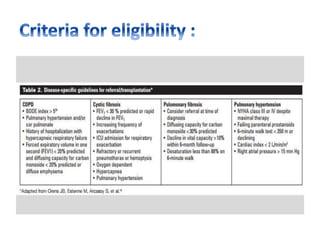
Criteria for eligibility
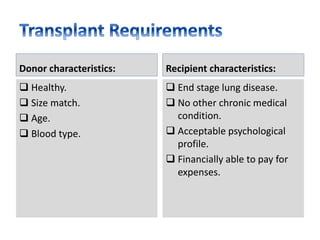
Requirements for donors and recipients
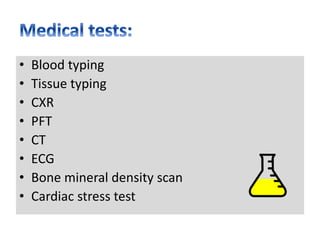
Medical tests
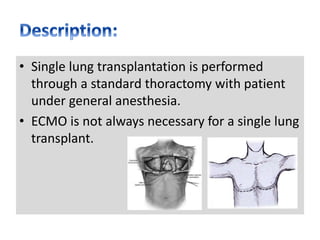
Description of procedure
Management
Follow up
Lung transplantation in Saudi Arabia
• lung transplantation has become an available
treatment option for patients with end-stage
lung diseases.
• In 1981, the first successful heart-lung
transplantation was performed for idiopathic
pulmonary arterial hypertension performed
by Dr. Bruce Reitz of Stanford University.
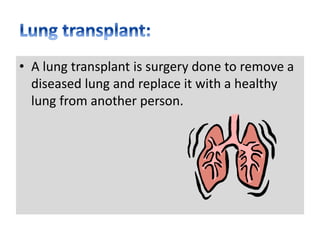
• A lung transplant is surgery done to remove a
diseased lung and replace it with a healthy
lung from another person.
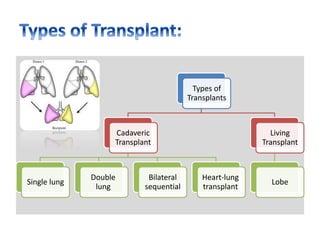
Types of
Transplants
Cadaveric
Transplant
Single lung
Double
lung
Bilateral
sequential
Heart-lung
transplant
Living
Transplant
Lobe
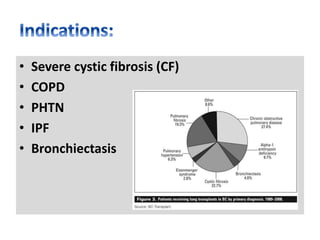
• Severe cystic fibrosis (CF)
• COPD
• PHTN
• IPF
• Bronchiectasis
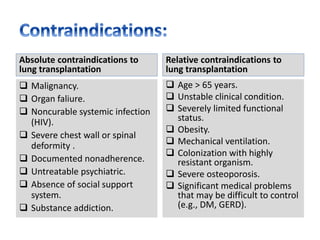
Absolute contraindications to
lung transplantation
 Malignancy.
 Organ faliure.
 Noncurable systemic infection
(HIV).
 Severe chest wall or spinal
deformity .
 Documented nonadherence.
 Untreatable psychiatric.
 Absence of social support
system.
 Substance addiction.
Relative contraindications to
lung transplantation
 Age > 65 years.
 Unstable clinical condition.
 Severely limited functional
status.
 Obesity.
 Mechanical ventilation.
 Colonization with highly
resistant organism.
 Severe osteoporosis.
 Significant medical problems
that may be difficult to control
(e.g., DM, GERD).
Donor characteristics:
 Healthy.
 Size match.
 Age.
 Blood type.
Recipient characteristics:
 End stage lung disease.
 No other chronic medical
condition.
 Acceptable psychological
profile.
 Financially able to pay for
expenses.
• Blood typing
• Tissue typing
• CXR
• PFT
• CT
• ECG
• Bone mineral density scan
• Cardiac stress test
• Single lung transplantation is performed
through a standard thoractomy with patient
under general anesthesia.
• ECMO is not always necessary for a single lung
transplant.
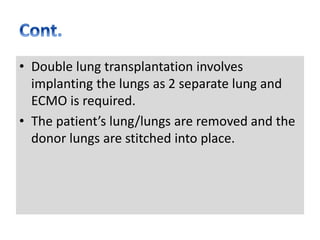
• Double lung transplantation involves
implanting the lungs as 2 separate lung and
ECMO is required.
• The patient’s lung/lungs are removed and the
donor lungs are stitched into place.
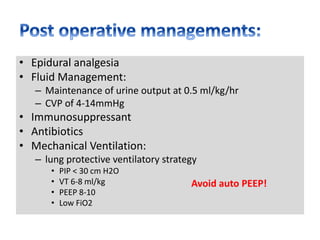
• Epidural analgesia
• Fluid Management:
– Maintenance of urine output at 0.5 ml/kg/hr
– CVP of 4-14mmHg
• Immunosuppressant
• Antibiotics
• Mechanical Ventilation:
– lung protective ventilatory strategy
• PIP < 30 cm H2O
• VT 6-8 ml/kg
• PEEP 8-10
• Low FiO2
Avoid auto PEEP!
• primary graft dysfunction “24/72hrs”
• Rejection and Infection “24hrs”
Long term:
• Rejection after few months - 1year.
How it can be detected?
10% - 15%
PFT CXR
Bronchoalveolar lavage
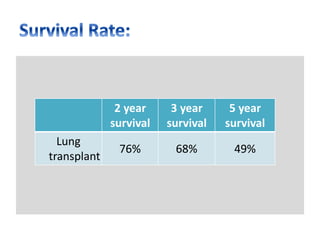
5 year
survival
3 year
survival
2 year
survival
49%68%76%
Lung
transplant
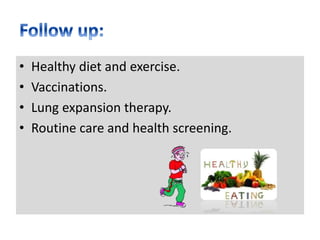
• Healthy diet and exercise.
• Vaccinations.
• Lung expansion therapy.
• Routine care and health screening.
• Since 2003 King Faisal Specialist Hospital and
Research Center has a program for lung
transplantation.
• From 2003-2014 more than 70 lung
transplantation were done ether single,
double or lobe transplant.
• lack of organ donors!
• Limited number of donor organs suitable
for transplant.
Donate Now It
Won’t Take Your
Time, But If You
Don’t It May
Take Their Lives
• UpToDate
• Johns Hopkins medicine library
• vine, S.M. and Angel, L.F. (no date) ‘The patient who has undergone lung
transplantation: Implications for respiratory care introduction indications for lung
transplantation evaluation outcomes management after the Postoperative period
complications following lung transplantation Postoperativ’, .
• Jennifer M. Wilson, MD, FRCPC, John Yee, MD, FRCSC, Robert D. Levy, MD, FRCPC.
Lung transplantation in British Columbia: A breath of fresh air; 2010.
• J. W. Awori Hayang and Jonathan D’Cunha. The surgical technique of bilateral
sequential lung transplantation; 2014.
• Survival statistics from SRTR (Scientific Registry of Transplant Recipients) for Dec
2015
• A Guide to the Care of Lung Transplant Recipients at Brigham and Women’s
Hospital; 2016.
• King Faisal Specialist Hospital and Research Center.
• Saudi Center for Organ Transplantation.
Lung Transplantation

Lung Transplantation

  • 1.
    Fay Ali AlBuainain RespiratoryCare Department University of Dammam
  • 2.
    Introduction Indications Contraindications Criteria for eligibility Requirementsfor donors and recipients Medical tests Description of procedure Management Follow up Lung transplantation in Saudi Arabia
  • 3.
    • lung transplantationhas become an available treatment option for patients with end-stage lung diseases. • In 1981, the first successful heart-lung transplantation was performed for idiopathic pulmonary arterial hypertension performed by Dr. Bruce Reitz of Stanford University.
  • 4.
    • A lungtransplant is surgery done to remove a diseased lung and replace it with a healthy lung from another person.
  • 5.
  • 6.
    • Severe cysticfibrosis (CF) • COPD • PHTN • IPF • Bronchiectasis
  • 7.
    Absolute contraindications to lungtransplantation  Malignancy.  Organ faliure.  Noncurable systemic infection (HIV).  Severe chest wall or spinal deformity .  Documented nonadherence.  Untreatable psychiatric.  Absence of social support system.  Substance addiction. Relative contraindications to lung transplantation  Age > 65 years.  Unstable clinical condition.  Severely limited functional status.  Obesity.  Mechanical ventilation.  Colonization with highly resistant organism.  Severe osteoporosis.  Significant medical problems that may be difficult to control (e.g., DM, GERD).
  • 9.
    Donor characteristics:  Healthy. Size match.  Age.  Blood type. Recipient characteristics:  End stage lung disease.  No other chronic medical condition.  Acceptable psychological profile.  Financially able to pay for expenses.
  • 10.
    • Blood typing •Tissue typing • CXR • PFT • CT • ECG • Bone mineral density scan • Cardiac stress test
  • 11.
    • Single lungtransplantation is performed through a standard thoractomy with patient under general anesthesia. • ECMO is not always necessary for a single lung transplant.
  • 12.
    • Double lungtransplantation involves implanting the lungs as 2 separate lung and ECMO is required. • The patient’s lung/lungs are removed and the donor lungs are stitched into place.
  • 14.
    • Epidural analgesia •Fluid Management: – Maintenance of urine output at 0.5 ml/kg/hr – CVP of 4-14mmHg • Immunosuppressant • Antibiotics • Mechanical Ventilation: – lung protective ventilatory strategy • PIP < 30 cm H2O • VT 6-8 ml/kg • PEEP 8-10 • Low FiO2 Avoid auto PEEP!
  • 15.
    • primary graftdysfunction “24/72hrs” • Rejection and Infection “24hrs” Long term: • Rejection after few months - 1year. How it can be detected? 10% - 15% PFT CXR Bronchoalveolar lavage
  • 16.
    5 year survival 3 year survival 2year survival 49%68%76% Lung transplant
  • 17.
    • Healthy dietand exercise. • Vaccinations. • Lung expansion therapy. • Routine care and health screening.
  • 18.
    • Since 2003King Faisal Specialist Hospital and Research Center has a program for lung transplantation. • From 2003-2014 more than 70 lung transplantation were done ether single, double or lobe transplant.
  • 20.
    • lack oforgan donors! • Limited number of donor organs suitable for transplant.
  • 21.
    Donate Now It Won’tTake Your Time, But If You Don’t It May Take Their Lives
  • 22.
    • UpToDate • JohnsHopkins medicine library • vine, S.M. and Angel, L.F. (no date) ‘The patient who has undergone lung transplantation: Implications for respiratory care introduction indications for lung transplantation evaluation outcomes management after the Postoperative period complications following lung transplantation Postoperativ’, . • Jennifer M. Wilson, MD, FRCPC, John Yee, MD, FRCSC, Robert D. Levy, MD, FRCPC. Lung transplantation in British Columbia: A breath of fresh air; 2010. • J. W. Awori Hayang and Jonathan D’Cunha. The surgical technique of bilateral sequential lung transplantation; 2014. • Survival statistics from SRTR (Scientific Registry of Transplant Recipients) for Dec 2015 • A Guide to the Care of Lung Transplant Recipients at Brigham and Women’s Hospital; 2016. • King Faisal Specialist Hospital and Research Center. • Saudi Center for Organ Transplantation.

Editor's Notes

  • #15 High PEEP because Typically transplanted lungs demonstrate decreased compliance due to ischemic injury and generalized edema and help in grafting and stop bleeding ower FiO2 which in theory lowers the risk of ischemia-reperfusion injury
  • #16 Rejection: y treatable with changes in the immunosuppressive regimen Infection: Bacterial infections are most common