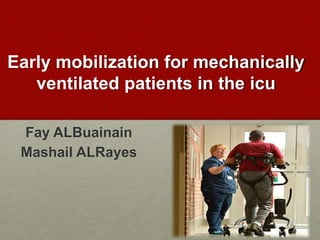
Early mobilization for mechanically
ventilated patients in the icu
Fay ALBuainain
Mashail ALRayes
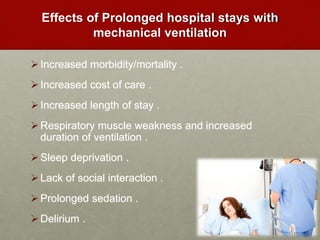
Effects of Prolonged hospital stays with
mechanical ventilation
Increased morbidity/mortality .
Increased cost of care .
Increased length of stay .
Respiratory muscle weakness and increased
duration of ventilation .
Sleep deprivation .
Lack of social interaction .
Prolonged sedation .
Delirium .
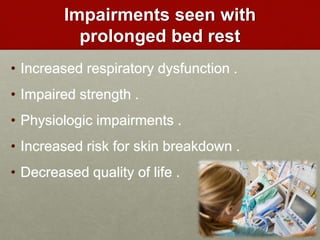
Impairments seen with
prolonged bed rest
• Increased respiratory dysfunction .
• Impaired strength .
• Physiologic impairments .
• Increased risk for skin breakdown .
• Decreased quality of life .
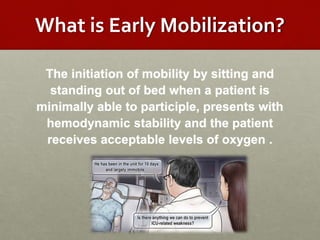
What is Early Mobilization?
The initiation of mobility by sitting and
standing out of bed when a patient is
minimally able to participle, presents with
hemodynamic stability and the patient
receives acceptable levels of oxygen .
Benefits of Early Mobilization
• Improve respiratory function .
• Reduce adverse effects of immobility .
• Increase levels of consciousness .
• Increase functional independence .
• Improve cardiovascular fitness .
• Increase psychological well-being .
• Reduce the risk for delirium .
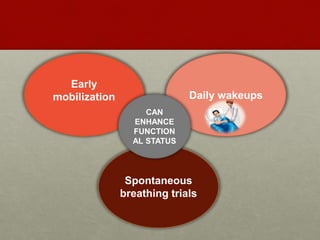
Early
mobilization Daily wakeups
Spontaneous
breathing trials
CAN
ENHANCE
FUNCTION
AL STATUS
Spontaneous Breathing
Trials
The best way to determine suitability for
discontinuation of mechanical ventilation is to
perform a spontaneous breathing trial :
• putting the patient on a minimum pressure
support .
• PEEP ( 5cmH2O PEEP ) .
• performing mechanics and extubating .
• using CPAP alone or using a T-piece .
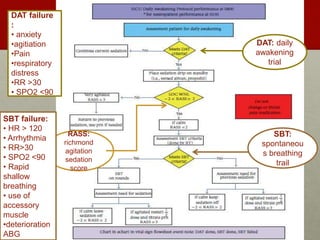
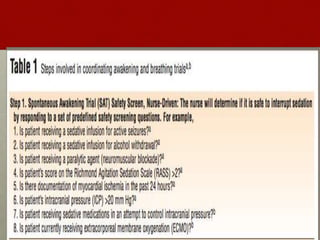
DAT: daily
awakening
trial
RASS:
richmond
agitation
sedation
score
SBT:
spontaneou
s breathing
trail
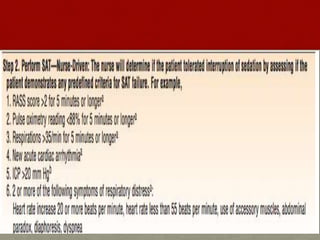
DAT failure
:
• anxiety
•agitiation
•Pain
•respiratory
distress
•RR >30
• SPO2 <90
SBT failure:
• HR > 120
• Arrhythmia
• RR>30
• SPO2 <90
• Rapid
shallow
breathing
• use of
accessory
muscle
•deterioration
ABG
RISK FACTORS for
immobility
• > 4 days in an ICU
• mechanically ventilated
• confined to the bed
• Sedated
• acute illness
lose up to
25%
peripheral
muscle
weakness
within 4 days
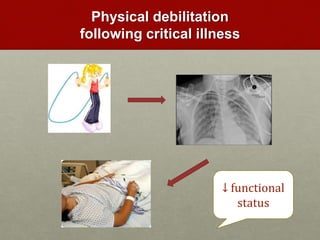
Physical debilitation
following critical illness
↓ functional
status
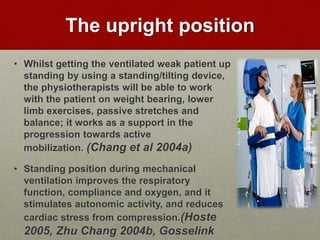
The upright position
• Whilst getting the ventilated weak patient up
standing by using a standing/tilting device,
the physiotherapists will be able to work
with the patient on weight bearing, lower
limb exercises, passive stretches and
balance; it works as a support in the
progression towards active
mobilization. (Chang et al 2004a)
• Standing position during mechanical
ventilation improves the respiratory
function, compliance and oxygen, and it
stimulates autonomic activity, and reduces
cardiac stress from compression.(Hoste
2005, Zhu Chang 2004b, Gosselink
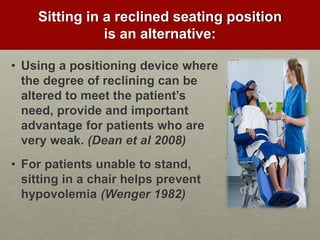
Sitting in a reclined seating position
is an alternative:
• Using a positioning device where
the degree of reclining can be
altered to meet the patient’s
need, provide and important
advantage for patients who are
very weak. (Dean et al 2008)
• For patients unable to stand,
sitting in a chair helps prevent
hypovolemia (Wenger 1982)
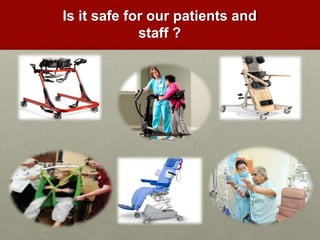
Is it safe for our patients and
staff ?
If the patient is awake why can’t she
sit on the side of the bed, stand by
the bed, pivot or walk to a chair, or
walk in the hall? And if she’s not
awake, why not?
What are true physical and
physiologic barriers
• Didn’t walk before admission .
• Trauma/surgical constraints .
• Hemodynamic “instability” :
• Hypoxia .
• PEEP .
• Additional exclusions:
• Active ischemia .
• Active bleeding .
• Therapeutic sedation :
• Status epilepticus .
• Devices IABP .
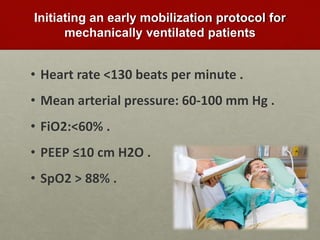
Initiating an early mobilization protocol for
mechanically ventilated patients
• Heart rate <130 beats per minute .
• Mean arterial pressure: 60-100 mm Hg .
• FiO2:<60% .
• PEEP ≤10 cm H2O .
• SpO2 > 88% .
When should an Early Mobilization
Intervention be deferred/stopped ?
HR <40 or >130 bpm .
RR <5 or >35 bpm .
SpO2 <88% for <1 minute .
SBP <90 mm Hg or >180 mm Hg .
Elevated ICPs .
Changes in patient presentation occur
.
New medical findings occur .
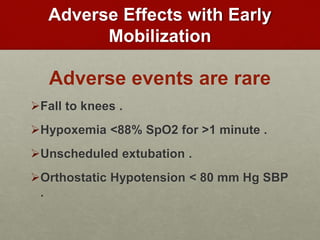
Adverse Effects with Early
Mobilization
Adverse events are rare
Fall to knees .
Hypoxemia <88% SpO2 for >1 minute .
Unscheduled extubation .
Orthostatic Hypotension < 80 mm Hg SBP
.
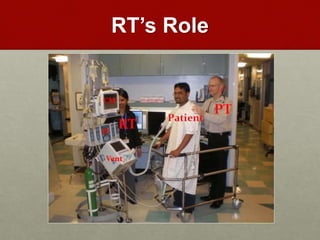
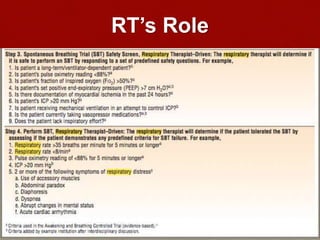
RT’s Role
RT’s Role
What is the Evidence
Supporting
Early ICU Mobilization
Early activity is feasible and
safe in respiratory failure
patients
Bailey P , Thomsen GE , Spuhler VJ , et al. Department of
Medicine, Pulmonary and Critical Care Division, LDS Hospital,
Salt Lake City, UT, USA.2007
Purpose :To determine whether early
activity is feasible and safe in
respiratory failure patients .
• This descriptive prospective cohort study
evaluated a consecutive group of patients
with respiratory failure admitted to the
respiratory ICU at LDS Hospital in Salt Lake
City, Utah.
• Patients were mechanically ventilated for > 4
days and were cared for in a respiratory ICU.
• Patients had typically been cared for in
another ICU for an average of 10 days prior
to transfer to the respiratory ICU.
• In order to initiate
mobilization, patients
were required to be:
• responsive to verbal
stimulation
• have both respiratory
and cardiovascular
“stability”
• FiO2 <0.6,
• PEEP < 10 cm H2O
• Absence of orthostatic
hypotension
• Absence of
catecholamine
• Mobilization occurred
under the direction of
:
• physical therapist
• respiratory therapist
• nurse
• critical care technician
ACTIVITIES :
• sitting on the edge of the bed
• sitting in a chair after bed transfer
• and ambulating.
• The investigators studied 103 patients
undergoing 1,449 activity events
• More than one-half of the activity events
were actual ambulation
• 40% occurred in intubated, mechanically
ventilated patients.
RESULT :
• 85% of 103 patients survived to hospital
discharge;
• their median ambulation distance was 200 feet.
• Adverse events were extremely rare.
• There were five falls to knees without injury,
• four systolic BP decreases below 90 mm Hg,
• one systolic BP increase above 200 mm Hg,
• three decreases in oxygen saturation as
measured by pulse oximetry below 80%
• one enteral feeding tube removal.
• There were no unplanned extubations.
CONCLUSIONS :
• We conclude that early activity is feasible
and safe in respiratory failure patients.
• A majority of survivors (69%) were able to
ambulate >100 feet at RICU discharge.
• Early activity is a candidate therapy to
prevent or treat the neuromuscular
complications of critical illness.
Patients with respiratory failure
increase ambulation after transfer
to an intensive care unit where
early activity is a priority
Thomsen GE , Snow GL , Rodriguez L , Hopkins RO .
Department of Medicine, LDS Hospital, Salt Lake City,
UT, USA. Crit Care Med . 2008
One year later ,
• The same group of investigators sought to
determine whether mobilization was
improved upon transfer to their respiratory
ICU, where a culture of early ambulation had
been established.
RESULT :
• Ambulation was noted to be more likely in
females (P , .019),
• in those who were less sick (ie, lower
APACHE
P , .017),
• in those who did not receive sedation (P ,
.009)
• in those who were transferred to the
respiratory ICU from another location (P ,
.0001)
CONCLUSIONS :
• Transfer of acute respiratory failure patients
to the respiratory intensive care unit
substantially improved ambulation,
independent of the underlying
pathophysiology.
• The intensive care environment may
contribute unnecessary immobilization
throughout the course of acute respiratory
failure.
• Sedatives, even given intermittently,
substantially reduce the likelihood of
References
• Developing a Mobility Protocol for Early Mobilization of
Patients in a Surgical/Trauma ICU , Meg Zomorodi, Darla
Topley, andMaireMcAnaw, 11 July 2012.
• Clinical review: Early patient mobilization in the ICU,Carol L
Hodgson*1,2, Sue Berney3,4, Megan Harrold5,6, Manoj
Saxena7,8,9 and Rinaldo Bellomo1
• Bailey P , Thomsen GE , Spuhler VJ , et al . Early activity is
feasible and safe in respiratory failure patients . Crit Care
Med . 2007 ; 35 ( 1 ): 139 - 145 .
• Thomsen GE , Snow GL , Rodriguez L , Hopkins RO . Patients
with respiratory failure increase ambulation after transfer to
an intensive care unit where early activity is a priority . Crit
Care Med . 2008 ; 36 ( 4 ): 1119 - 1124 .

Early Mobilization

  • 1.
    Early mobilization formechanically ventilated patients in the icu Fay ALBuainain Mashail ALRayes
  • 2.
    Effects of Prolongedhospital stays with mechanical ventilation Increased morbidity/mortality . Increased cost of care . Increased length of stay . Respiratory muscle weakness and increased duration of ventilation . Sleep deprivation . Lack of social interaction . Prolonged sedation . Delirium .
  • 3.
    Impairments seen with prolongedbed rest • Increased respiratory dysfunction . • Impaired strength . • Physiologic impairments . • Increased risk for skin breakdown . • Decreased quality of life .
  • 4.
    What is EarlyMobilization? The initiation of mobility by sitting and standing out of bed when a patient is minimally able to participle, presents with hemodynamic stability and the patient receives acceptable levels of oxygen .
  • 5.
    Benefits of EarlyMobilization • Improve respiratory function . • Reduce adverse effects of immobility . • Increase levels of consciousness . • Increase functional independence . • Improve cardiovascular fitness . • Increase psychological well-being . • Reduce the risk for delirium .
  • 6.
    Early mobilization Daily wakeups Spontaneous breathingtrials CAN ENHANCE FUNCTION AL STATUS
  • 7.
    Spontaneous Breathing Trials The bestway to determine suitability for discontinuation of mechanical ventilation is to perform a spontaneous breathing trial : • putting the patient on a minimum pressure support . • PEEP ( 5cmH2O PEEP ) . • performing mechanics and extubating . • using CPAP alone or using a T-piece .
  • 8.
    DAT: daily awakening trial RASS: richmond agitation sedation score SBT: spontaneou s breathing trail DATfailure : • anxiety •agitiation •Pain •respiratory distress •RR >30 • SPO2 <90 SBT failure: • HR > 120 • Arrhythmia • RR>30 • SPO2 <90 • Rapid shallow breathing • use of accessory muscle •deterioration ABG
  • 9.
    RISK FACTORS for immobility •> 4 days in an ICU • mechanically ventilated • confined to the bed • Sedated • acute illness lose up to 25% peripheral muscle weakness within 4 days
  • 10.
    Physical debilitation following criticalillness ↓ functional status
  • 11.
    The upright position •Whilst getting the ventilated weak patient up standing by using a standing/tilting device, the physiotherapists will be able to work with the patient on weight bearing, lower limb exercises, passive stretches and balance; it works as a support in the progression towards active mobilization. (Chang et al 2004a) • Standing position during mechanical ventilation improves the respiratory function, compliance and oxygen, and it stimulates autonomic activity, and reduces cardiac stress from compression.(Hoste 2005, Zhu Chang 2004b, Gosselink
  • 12.
    Sitting in areclined seating position is an alternative: • Using a positioning device where the degree of reclining can be altered to meet the patient’s need, provide and important advantage for patients who are very weak. (Dean et al 2008) • For patients unable to stand, sitting in a chair helps prevent hypovolemia (Wenger 1982)
  • 13.
    Is it safefor our patients and staff ?
  • 14.
    If the patientis awake why can’t she sit on the side of the bed, stand by the bed, pivot or walk to a chair, or walk in the hall? And if she’s not awake, why not?
  • 15.
    What are truephysical and physiologic barriers • Didn’t walk before admission . • Trauma/surgical constraints . • Hemodynamic “instability” : • Hypoxia . • PEEP . • Additional exclusions: • Active ischemia . • Active bleeding . • Therapeutic sedation : • Status epilepticus . • Devices IABP .
  • 16.
    Initiating an earlymobilization protocol for mechanically ventilated patients • Heart rate <130 beats per minute . • Mean arterial pressure: 60-100 mm Hg . • FiO2:<60% . • PEEP ≤10 cm H2O . • SpO2 > 88% .
  • 17.
    When should anEarly Mobilization Intervention be deferred/stopped ? HR <40 or >130 bpm . RR <5 or >35 bpm . SpO2 <88% for <1 minute . SBP <90 mm Hg or >180 mm Hg . Elevated ICPs . Changes in patient presentation occur . New medical findings occur .
  • 18.
    Adverse Effects withEarly Mobilization Adverse events are rare Fall to knees . Hypoxemia <88% SpO2 for >1 minute . Unscheduled extubation . Orthostatic Hypotension < 80 mm Hg SBP .
  • 19.
  • 22.
  • 23.
    What is theEvidence Supporting Early ICU Mobilization
  • 24.
    Early activity isfeasible and safe in respiratory failure patients Bailey P , Thomsen GE , Spuhler VJ , et al. Department of Medicine, Pulmonary and Critical Care Division, LDS Hospital, Salt Lake City, UT, USA.2007
  • 25.
    Purpose :To determinewhether early activity is feasible and safe in respiratory failure patients .
  • 26.
    • This descriptiveprospective cohort study evaluated a consecutive group of patients with respiratory failure admitted to the respiratory ICU at LDS Hospital in Salt Lake City, Utah. • Patients were mechanically ventilated for > 4 days and were cared for in a respiratory ICU. • Patients had typically been cared for in another ICU for an average of 10 days prior to transfer to the respiratory ICU.
  • 27.
    • In orderto initiate mobilization, patients were required to be: • responsive to verbal stimulation • have both respiratory and cardiovascular “stability” • FiO2 <0.6, • PEEP < 10 cm H2O • Absence of orthostatic hypotension • Absence of catecholamine • Mobilization occurred under the direction of : • physical therapist • respiratory therapist • nurse • critical care technician
  • 28.
    ACTIVITIES : • sittingon the edge of the bed • sitting in a chair after bed transfer • and ambulating.
  • 29.
    • The investigatorsstudied 103 patients undergoing 1,449 activity events • More than one-half of the activity events were actual ambulation • 40% occurred in intubated, mechanically ventilated patients.
  • 30.
    RESULT : • 85%of 103 patients survived to hospital discharge; • their median ambulation distance was 200 feet. • Adverse events were extremely rare. • There were five falls to knees without injury, • four systolic BP decreases below 90 mm Hg, • one systolic BP increase above 200 mm Hg, • three decreases in oxygen saturation as measured by pulse oximetry below 80% • one enteral feeding tube removal. • There were no unplanned extubations.
  • 31.
    CONCLUSIONS : • Weconclude that early activity is feasible and safe in respiratory failure patients. • A majority of survivors (69%) were able to ambulate >100 feet at RICU discharge. • Early activity is a candidate therapy to prevent or treat the neuromuscular complications of critical illness.
  • 32.
    Patients with respiratoryfailure increase ambulation after transfer to an intensive care unit where early activity is a priority Thomsen GE , Snow GL , Rodriguez L , Hopkins RO . Department of Medicine, LDS Hospital, Salt Lake City, UT, USA. Crit Care Med . 2008
  • 33.
    One year later, • The same group of investigators sought to determine whether mobilization was improved upon transfer to their respiratory ICU, where a culture of early ambulation had been established.
  • 34.
    RESULT : • Ambulationwas noted to be more likely in females (P , .019), • in those who were less sick (ie, lower APACHE P , .017), • in those who did not receive sedation (P , .009) • in those who were transferred to the respiratory ICU from another location (P , .0001)
  • 35.
    CONCLUSIONS : • Transferof acute respiratory failure patients to the respiratory intensive care unit substantially improved ambulation, independent of the underlying pathophysiology. • The intensive care environment may contribute unnecessary immobilization throughout the course of acute respiratory failure. • Sedatives, even given intermittently, substantially reduce the likelihood of
  • 37.
    References • Developing aMobility Protocol for Early Mobilization of Patients in a Surgical/Trauma ICU , Meg Zomorodi, Darla Topley, andMaireMcAnaw, 11 July 2012. • Clinical review: Early patient mobilization in the ICU,Carol L Hodgson*1,2, Sue Berney3,4, Megan Harrold5,6, Manoj Saxena7,8,9 and Rinaldo Bellomo1 • Bailey P , Thomsen GE , Spuhler VJ , et al . Early activity is feasible and safe in respiratory failure patients . Crit Care Med . 2007 ; 35 ( 1 ): 139 - 145 . • Thomsen GE , Snow GL , Rodriguez L , Hopkins RO . Patients with respiratory failure increase ambulation after transfer to an intensive care unit where early activity is a priority . Crit Care Med . 2008 ; 36 ( 4 ): 1119 - 1124 .

Editor's Notes

  • #16 PEEP > 10 = barrier Hypoxia because FiO2 > 0.6 = barrier
  • #27 prospective cohort study watches for outcomes over a long period.