MECHANICAL VENTILATOR –
SETTINGS & MODES
DR.ASHUTOSH KUMAR SINGH
Introduction
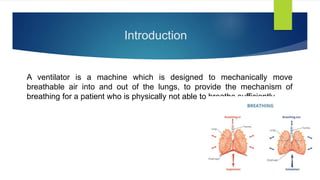
A ventilator is a machine which is designed to mechanically move
breathable air into and out of the lungs, to provide the mechanism of
breathing for a patient who is physically not able to breathe sufficiently.
3
4
Indication for ventilation
5
1. Acute lung injury
2. Acute severe asthma, requiring intubation
3. Chronic Obstructive Pulmonary Disease.
4. Apnoea with respiratory arrest.
5. Hypoxemia.
6. Acute respiratory acidosis.
7. Respiratory distress addressing increased work of breathing.
8. Hypotension including sepsis, shock, CHF.
9. Neurological conditions such as Muscular Dystrophy, Amyotrophic Lateral
Sclerosis.
Application & duration of ventilation
6
• It can be used as a short-term measure, for e.g., during an
operation,procedure.
• Long-term ventilatory assistance are required in chronic illness, and may
be used at home care.
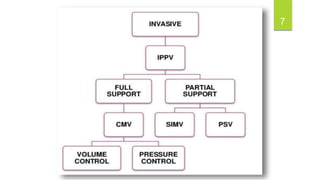
• In positive pressure ventilator, The common employed method is
intubation which provides clear route for the air.
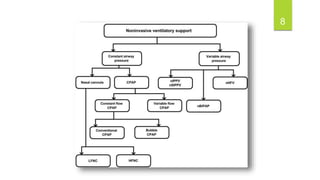
• Where as, In negative pressure or non-invasive ventilator, there is no
need to use any adjunct.
7
8
9
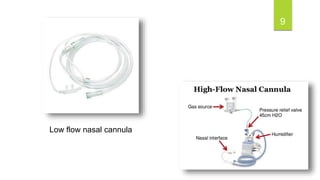
Low flow nasal cannula
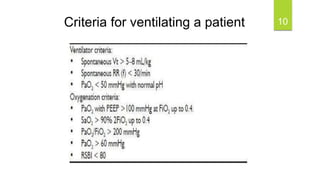
10Criteria for ventilating a patient
Factors that should be observed in
case of ventilation
11
• Vital Signs.
• Oxygen Saturation in the blood.
• Consciousness of the Patient.
• Checks alarm function of the ventilator.
• Secretions should be removed periodically.
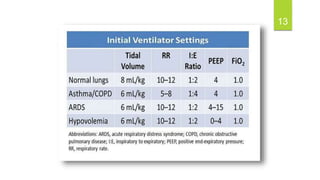
Setting up a ventilator
12
• Vital signs- Pulse, Blood Pressure, Respiratory Rate, Heart Rate.
• Ensure adequate sedations, opioids and muscle relaxants.
• Tidal volume- 6-8 ml/kg body weight.
• Fraction of inspired oxygen: Usually 100% oxygen to start there
decreases slow. Ensure the airway is secure.
13
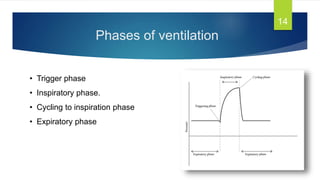
Phases of ventilation
14
• Trigger phase
• Inspiratory phase.
• Cycling to inspiration phase
• Expiratory phase
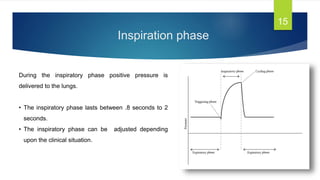
Inspiration phase
15
During the inspiratory phase positive pressure is
delivered to the lungs.
• The inspiratory phase lasts between .8 seconds to 2
seconds.
• The inspiratory phase can be adjusted depending
upon the clinical situation.
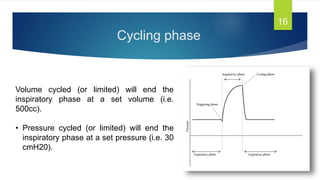
Cycling phase
16
Volume cycled (or limited) will end the
inspiratory phase at a set volume (i.e.
500cc).
• Pressure cycled (or limited) will end the
inspiratory phase at a set pressure (i.e. 30
cmH20).
Expiratory phase
17
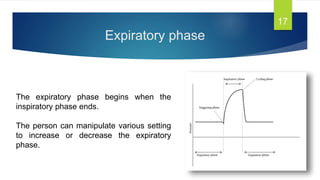
The expiratory phase begins when the
inspiratory phase ends.
The person can manipulate various setting
to increase or decrease the expiratory
phase.
Respiration cycle
18
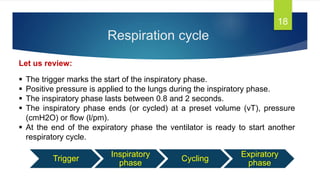
Let us review:
 The trigger marks the start of the inspiratory phase.
 Positive pressure is applied to the lungs during the inspiratory phase.
 The inspiratory phase lasts between 0.8 and 2 seconds.
 The inspiratory phase ends (or cycled) at a preset volume (vT), pressure
(cmH2O) or flow (l/pm).
 At the end of the expiratory phase the ventilator is ready to start another
respiratory cycle.
Trigger
Inspiratory
phase
Cycling
Expiratory
phase
MODES OF MECHANICAL
VENTILATOR
19
Introduction
20
Ventilator mode is a set of operating characteristics that controls how the
ventilator functions.
An operating mode describes the way a ventilator is-
• triggered into inspiration
• cycled into exhalation
• what variables are limited during inspiration
• allowing mandatory or spontaneous breaths or both
Controlled mode ventilation
volume control
21
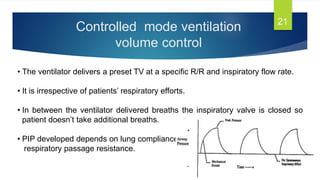
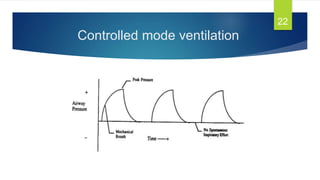
• The ventilator delivers a preset TV at a specific R/R and inspiratory flow rate.
• It is irrespective of patients’ respiratory efforts.
• In between the ventilator delivered breaths the inspiratory valve is closed so
patient doesn’t take additional breaths.
• PIP developed depends on lung compliance and
respiratory passage resistance.
Controlled mode ventilation
22
Volume controlled CMV
23
Indications-
• In initial stage when patients “fighting” or “bucking” with the ventilator
• Tetanus or other seizure activity
• Crushed chest injury
Disadvantages-
• Asynchrony
• Barotrauma d/t high PAW & dec. lung compliance
• Hemodynamic disturbances
• V/Q mismatch
• Total dependence on ventilator
Pressure controlled CMV
24
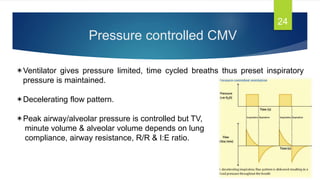
Ventilator gives pressure limited, time cycled breaths thus preset inspiratory
pressure is maintained.
Decelerating flow pattern.
Peak airway/alveolar pressure is controlled but TV,
minute volume & alveolar volume depends on lung
compliance, airway resistance, R/R & I:E ratio.
PC-CMV
25
Advantages
• Less PAW, thus chances of Barotrauma and hemodynamic disturbances are
less.
• Even distribution of gases in alveoli
• In case of leakage, compensation for loss of ventilation is better as gaseous
flow increases to maintain preset pressure.
Disadvantages
• Asynchrony
• TV dec. if there is dec. lung compliance or inc. airway resistance, thus causes
hypoventilation and alveolar collapse.
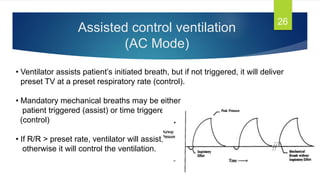
Assisted control ventilation
(AC Mode)
26
• Ventilator assists patient’s initiated breath, but if not triggered, it will deliver
preset TV at a preset respiratory rate (control).
• Mandatory mechanical breaths may be either
patient triggered (assist) or time triggered
(control)
• If R/R > preset rate, ventilator will assist,
otherwise it will control the ventilation.
AC mode ventilation
27
Advantages
• Dec. patients work of breathing.
• Better patient ventilator synchrony.
• Less V/Q mismatch.
• Prevents disuse atrophy of diaphragmatic muscle.
Disadvantages
• Alveolar hyperventilation
• Development of high intrinsic PEEP in pts with obstructive ds.
• Inc . mean airway pressure causes hemodynamic disturbances.
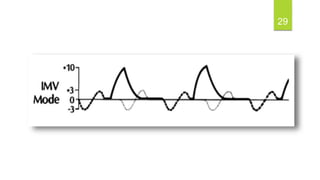
Intermittent mandatory ventilation
28
Ventilator delivers preset number of time cycled mandatory breaths & allows
patient to breath spontaneously at any tidal volume in between.
Advantages
• Lesser sedation
• Lesser V/Q mismatch
• Lesser hemodynamic disturbances
Disadvantage
• Breath stacking- lung volume and pressure could increase significantly, causing
Barotrauma
29
Synchronized intermittent
mandatory ventilation (SIMV)
30
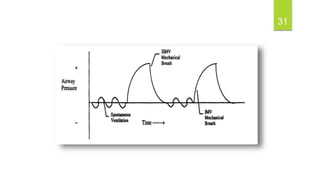
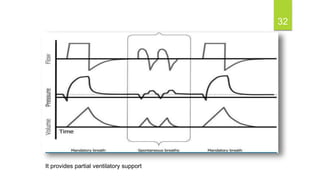
Ventilator delivers either assisted breaths to the patient at the beginning of a
spontaneous breath or time triggered mandatory breaths.
Synchronization window- time interval just prior to time triggering.
Breath stacking is avoided as mandatory breaths are synchronized with
spontaneous breaths.
In between mandatory breaths patient is allowed to take spontaneous breath at
any TV.
31
32
It provides partial ventilatory support
SIMV mode
33
Advantages
• Maintain respiratory muscle strength and avoid atrophy.
• Reduce V/Q mismatch d/t spontaneous ventilation.
• Decreases mean airway pressure d/t lower PIP & inspiratory time
• Facilitates weaning.
Disadvantages
• Desire to wean too rapidly results in high work of spontaneous breathing &
muscle fatigue & thus weaning failure.
Positive End expiratory pressure
mode
(PEEP)
34
An airway pressure strategy in ventilation that increases the end expiratory or
baseline
airway pressure greater than atmospheric pressure.
 Used to treat refractory hypoxemia caused by intrapulmonary shunting.
 Not a stand-alone mode, used in conjugation with other modes.
Indications
• Refractory hypoxemia d/t intrapulmonary shunting.
35
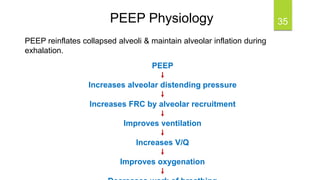
PEEP reinflates collapsed alveoli & maintain alveolar inflation during
exhalation.
PEEP

Increases alveolar distending pressure

Increases FRC by alveolar recruitment

Improves ventilation

Increases V/Q

Improves oxygenation

PEEP Physiology
PEEP Complications
36
Complications
• Dec. venous return and cardiac output.
• Barotrauma
•  ICP d/t impedance of venous return from head.
• Alteration of renal function & water imbalance.
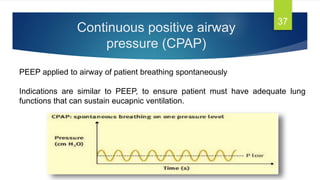
Continuous positive airway
pressure (CPAP)
37
PEEP applied to airway of patient breathing spontaneously
Indications are similar to PEEP, to ensure patient must have adequate lung
functions that can sustain eucapnic ventilation.
Pressure support ventilation
38
• Supports spontaneous breathing of the patients.
• Each inspiratory effort is augmented by ventilator at a preset level of
inspiratory pressure.
• Applies pressure plateau to patient airway during spontaneous br.
• Can be used in conjugation with spontaneous breathing in any ventilator
mode.
PSV
39
Commonly applied to SIMV mode during spontaneous ventilation to
facilitate weaning
With SIMV, PS Inc.
• patient’s spontaneous tidal volume.
• Dec. spontaneous respiratory rate.
• Decreases work of breathing.
• Addition of extrinsic PEEP to PS increases its efficacy.
PSV
40
Disadvantages
• Not suitable for patients with central apnea. (hypoventilation)
• Development of high airway pressure. (hemodynamic disturbances)
• Hypoventilation, if inspiratory time is short.
Inverse ratio ventilation
41
Used to promote oxygenation esp. in ARDS.
Normal I:E ratio is 1:1.5 – 1:3, in IRV I:E is 2:1 – 4:1
Improves oxygenation by
• Reducing intrapulmonary shunting.
• Improving V/Q mismatch.
• Decreasing dead space ventilation.
• Increasing mean airway pressure.
• Presence of auto PEEP.
Criteria for weaning from
ventilation
42
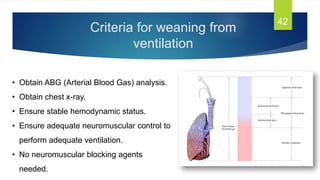
• Obtain ABG (Arterial Blood Gas) analysis.
• Obtain chest x-ray.
• Ensure stable hemodynamic status.
• Ensure adequate neuromuscular control to
perform adequate ventilation.
• No neuromuscular blocking agents
needed.
43

Mechanical ventilator basic setting and modes

  • 1.
    MECHANICAL VENTILATOR – SETTINGS& MODES DR.ASHUTOSH KUMAR SINGH
  • 2.
    Introduction A ventilator isa machine which is designed to mechanically move breathable air into and out of the lungs, to provide the mechanism of breathing for a patient who is physically not able to breathe sufficiently.
  • 3.
  • 4.
  • 5.
    Indication for ventilation 5 1.Acute lung injury 2. Acute severe asthma, requiring intubation 3. Chronic Obstructive Pulmonary Disease. 4. Apnoea with respiratory arrest. 5. Hypoxemia. 6. Acute respiratory acidosis. 7. Respiratory distress addressing increased work of breathing. 8. Hypotension including sepsis, shock, CHF. 9. Neurological conditions such as Muscular Dystrophy, Amyotrophic Lateral Sclerosis.
  • 6.
    Application & durationof ventilation 6 • It can be used as a short-term measure, for e.g., during an operation,procedure. • Long-term ventilatory assistance are required in chronic illness, and may be used at home care. • In positive pressure ventilator, The common employed method is intubation which provides clear route for the air. • Where as, In negative pressure or non-invasive ventilator, there is no need to use any adjunct.
  • 7.
  • 8.
  • 9.
  • 10.
  • 11.
    Factors that shouldbe observed in case of ventilation 11 • Vital Signs. • Oxygen Saturation in the blood. • Consciousness of the Patient. • Checks alarm function of the ventilator. • Secretions should be removed periodically.
  • 12.
    Setting up aventilator 12 • Vital signs- Pulse, Blood Pressure, Respiratory Rate, Heart Rate. • Ensure adequate sedations, opioids and muscle relaxants. • Tidal volume- 6-8 ml/kg body weight. • Fraction of inspired oxygen: Usually 100% oxygen to start there decreases slow. Ensure the airway is secure.
  • 13.
  • 14.
    Phases of ventilation 14 •Trigger phase • Inspiratory phase. • Cycling to inspiration phase • Expiratory phase
  • 15.
    Inspiration phase 15 During theinspiratory phase positive pressure is delivered to the lungs. • The inspiratory phase lasts between .8 seconds to 2 seconds. • The inspiratory phase can be adjusted depending upon the clinical situation.
  • 16.
    Cycling phase 16 Volume cycled(or limited) will end the inspiratory phase at a set volume (i.e. 500cc). • Pressure cycled (or limited) will end the inspiratory phase at a set pressure (i.e. 30 cmH20).
  • 17.
    Expiratory phase 17 The expiratoryphase begins when the inspiratory phase ends. The person can manipulate various setting to increase or decrease the expiratory phase.
  • 18.
    Respiration cycle 18 Let usreview:  The trigger marks the start of the inspiratory phase.  Positive pressure is applied to the lungs during the inspiratory phase.  The inspiratory phase lasts between 0.8 and 2 seconds.  The inspiratory phase ends (or cycled) at a preset volume (vT), pressure (cmH2O) or flow (l/pm).  At the end of the expiratory phase the ventilator is ready to start another respiratory cycle. Trigger Inspiratory phase Cycling Expiratory phase
  • 19.
  • 20.
    Introduction 20 Ventilator mode isa set of operating characteristics that controls how the ventilator functions. An operating mode describes the way a ventilator is- • triggered into inspiration • cycled into exhalation • what variables are limited during inspiration • allowing mandatory or spontaneous breaths or both
  • 21.
    Controlled mode ventilation volumecontrol 21 • The ventilator delivers a preset TV at a specific R/R and inspiratory flow rate. • It is irrespective of patients’ respiratory efforts. • In between the ventilator delivered breaths the inspiratory valve is closed so patient doesn’t take additional breaths. • PIP developed depends on lung compliance and respiratory passage resistance.
  • 22.
  • 23.
    Volume controlled CMV 23 Indications- •In initial stage when patients “fighting” or “bucking” with the ventilator • Tetanus or other seizure activity • Crushed chest injury Disadvantages- • Asynchrony • Barotrauma d/t high PAW & dec. lung compliance • Hemodynamic disturbances • V/Q mismatch • Total dependence on ventilator
  • 24.
    Pressure controlled CMV 24 Ventilatorgives pressure limited, time cycled breaths thus preset inspiratory pressure is maintained. Decelerating flow pattern. Peak airway/alveolar pressure is controlled but TV, minute volume & alveolar volume depends on lung compliance, airway resistance, R/R & I:E ratio.
  • 25.
    PC-CMV 25 Advantages • Less PAW,thus chances of Barotrauma and hemodynamic disturbances are less. • Even distribution of gases in alveoli • In case of leakage, compensation for loss of ventilation is better as gaseous flow increases to maintain preset pressure. Disadvantages • Asynchrony • TV dec. if there is dec. lung compliance or inc. airway resistance, thus causes hypoventilation and alveolar collapse.
  • 26.
    Assisted control ventilation (ACMode) 26 • Ventilator assists patient’s initiated breath, but if not triggered, it will deliver preset TV at a preset respiratory rate (control). • Mandatory mechanical breaths may be either patient triggered (assist) or time triggered (control) • If R/R > preset rate, ventilator will assist, otherwise it will control the ventilation.
  • 27.
    AC mode ventilation 27 Advantages •Dec. patients work of breathing. • Better patient ventilator synchrony. • Less V/Q mismatch. • Prevents disuse atrophy of diaphragmatic muscle. Disadvantages • Alveolar hyperventilation • Development of high intrinsic PEEP in pts with obstructive ds. • Inc . mean airway pressure causes hemodynamic disturbances.
  • 28.
    Intermittent mandatory ventilation 28 Ventilatordelivers preset number of time cycled mandatory breaths & allows patient to breath spontaneously at any tidal volume in between. Advantages • Lesser sedation • Lesser V/Q mismatch • Lesser hemodynamic disturbances Disadvantage • Breath stacking- lung volume and pressure could increase significantly, causing Barotrauma
  • 29.
  • 30.
    Synchronized intermittent mandatory ventilation(SIMV) 30 Ventilator delivers either assisted breaths to the patient at the beginning of a spontaneous breath or time triggered mandatory breaths. Synchronization window- time interval just prior to time triggering. Breath stacking is avoided as mandatory breaths are synchronized with spontaneous breaths. In between mandatory breaths patient is allowed to take spontaneous breath at any TV.
  • 31.
  • 32.
    32 It provides partialventilatory support
  • 33.
    SIMV mode 33 Advantages • Maintainrespiratory muscle strength and avoid atrophy. • Reduce V/Q mismatch d/t spontaneous ventilation. • Decreases mean airway pressure d/t lower PIP & inspiratory time • Facilitates weaning. Disadvantages • Desire to wean too rapidly results in high work of spontaneous breathing & muscle fatigue & thus weaning failure.
  • 34.
    Positive End expiratorypressure mode (PEEP) 34 An airway pressure strategy in ventilation that increases the end expiratory or baseline airway pressure greater than atmospheric pressure.  Used to treat refractory hypoxemia caused by intrapulmonary shunting.  Not a stand-alone mode, used in conjugation with other modes. Indications • Refractory hypoxemia d/t intrapulmonary shunting.
  • 35.
    35 PEEP reinflates collapsedalveoli & maintain alveolar inflation during exhalation. PEEP  Increases alveolar distending pressure  Increases FRC by alveolar recruitment  Improves ventilation  Increases V/Q  Improves oxygenation  PEEP Physiology
  • 36.
    PEEP Complications 36 Complications • Dec.venous return and cardiac output. • Barotrauma •  ICP d/t impedance of venous return from head. • Alteration of renal function & water imbalance.
  • 37.
    Continuous positive airway pressure(CPAP) 37 PEEP applied to airway of patient breathing spontaneously Indications are similar to PEEP, to ensure patient must have adequate lung functions that can sustain eucapnic ventilation.
  • 38.
    Pressure support ventilation 38 •Supports spontaneous breathing of the patients. • Each inspiratory effort is augmented by ventilator at a preset level of inspiratory pressure. • Applies pressure plateau to patient airway during spontaneous br. • Can be used in conjugation with spontaneous breathing in any ventilator mode.
  • 39.
    PSV 39 Commonly applied toSIMV mode during spontaneous ventilation to facilitate weaning With SIMV, PS Inc. • patient’s spontaneous tidal volume. • Dec. spontaneous respiratory rate. • Decreases work of breathing. • Addition of extrinsic PEEP to PS increases its efficacy.
  • 40.
    PSV 40 Disadvantages • Not suitablefor patients with central apnea. (hypoventilation) • Development of high airway pressure. (hemodynamic disturbances) • Hypoventilation, if inspiratory time is short.
  • 41.
    Inverse ratio ventilation 41 Usedto promote oxygenation esp. in ARDS. Normal I:E ratio is 1:1.5 – 1:3, in IRV I:E is 2:1 – 4:1 Improves oxygenation by • Reducing intrapulmonary shunting. • Improving V/Q mismatch. • Decreasing dead space ventilation. • Increasing mean airway pressure. • Presence of auto PEEP.
  • 42.
    Criteria for weaningfrom ventilation 42 • Obtain ABG (Arterial Blood Gas) analysis. • Obtain chest x-ray. • Ensure stable hemodynamic status. • Ensure adequate neuromuscular control to perform adequate ventilation. • No neuromuscular blocking agents needed.
  • 43.