PHENOMENOLOGY:
moving from philosophical underpinnings to
a practical way of doing
Dr Jamie Ranse RN PhD
Research Fellow, Emergency Care
www.jamieranse.com
twitter.com/jamieranse
youtube.com/jamieranse
linkedin.com/in/jamieranse
• Phenomenologies
• Hermeneutics and phenomenologies
• Research question(ing)
• Doing phenomenology
overview
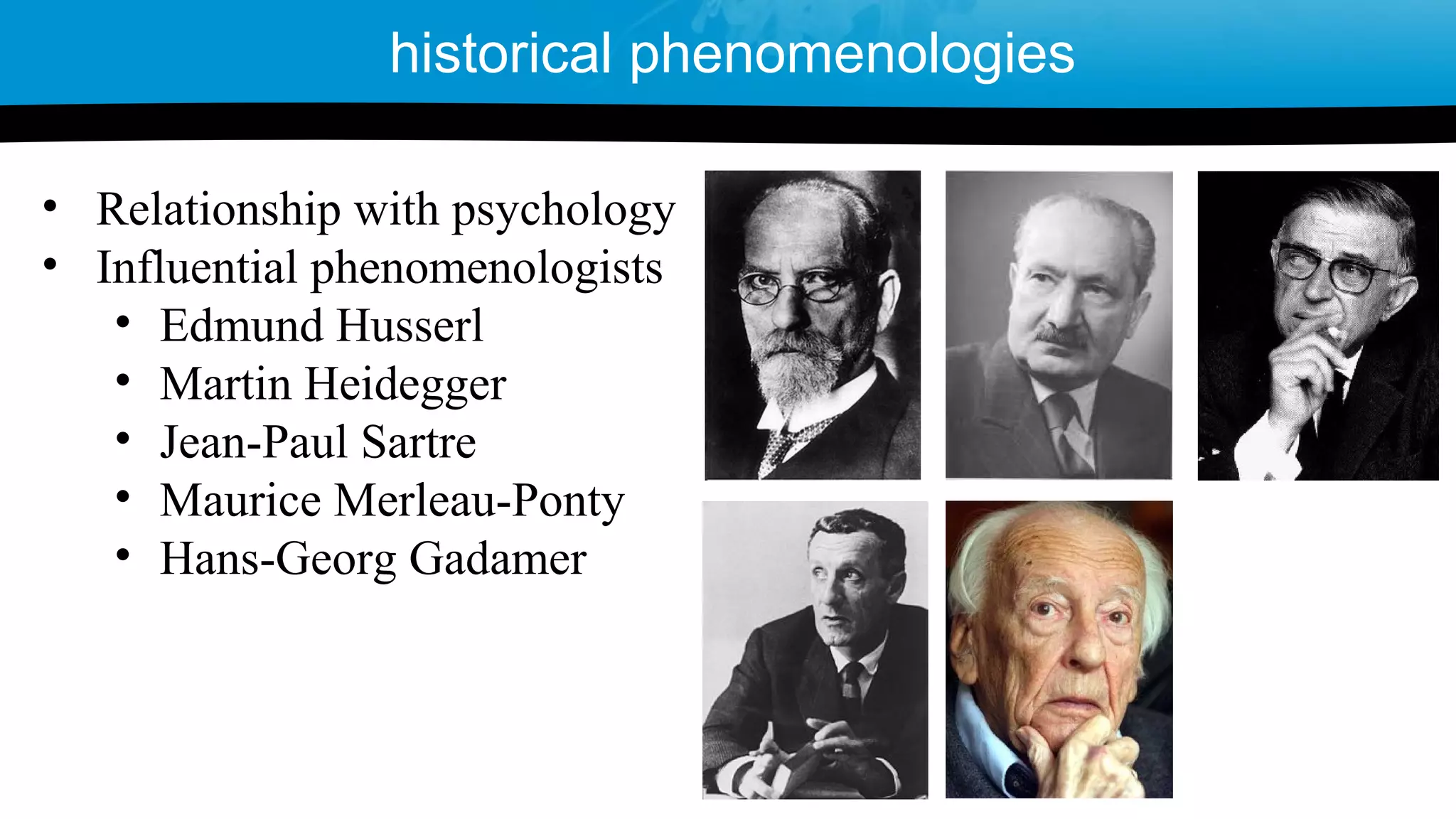
• Relationship with psychology
• Influential phenomenologists
• Edmund Husserl
• Martin Heidegger
• Jean-Paul Sartre
• Maurice Merleau-Ponty
• Hans-Georg Gadamer
historical phenomenologies
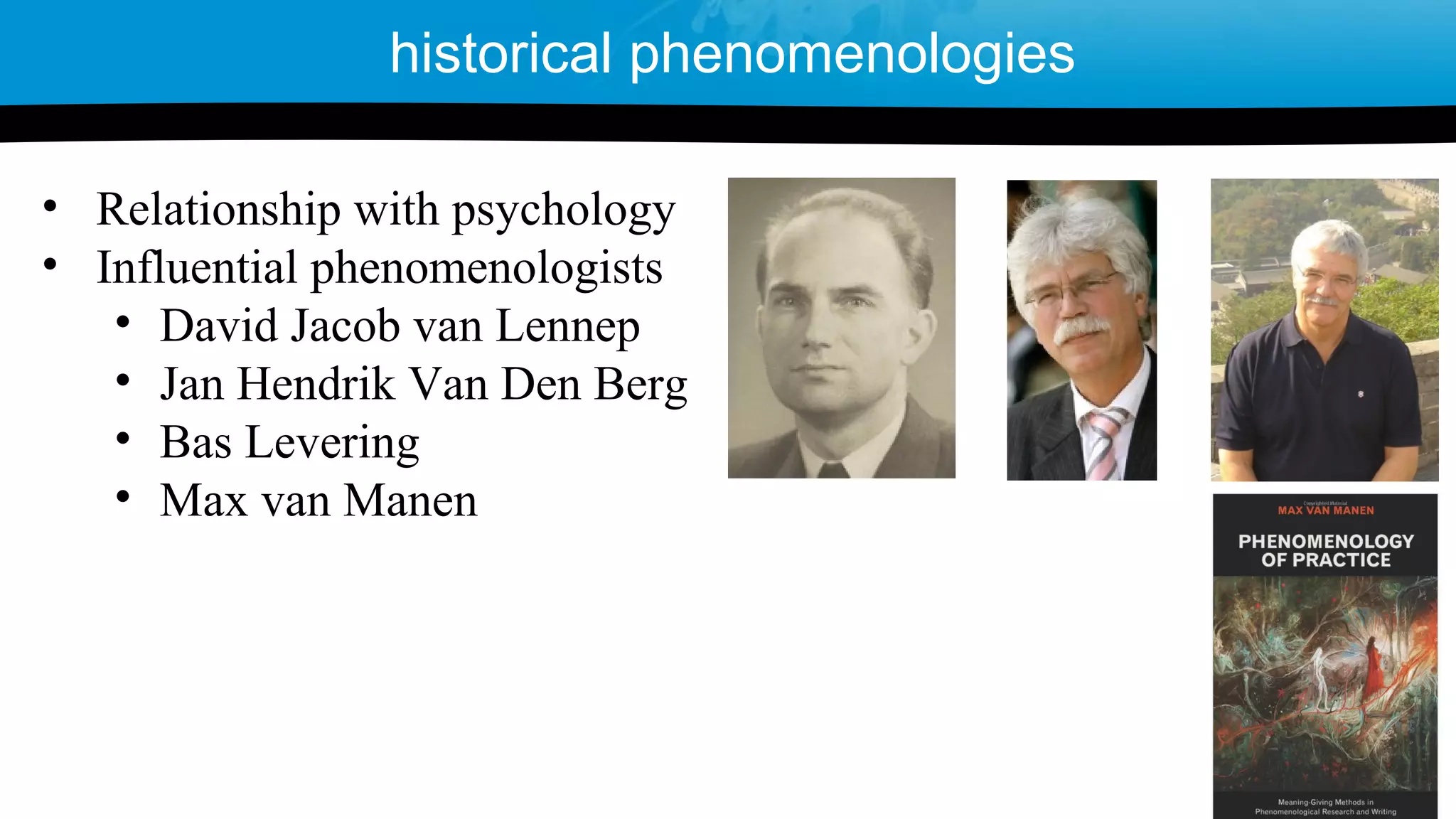
• Relationship with psychology
• Influential phenomenologists
• David Jacob van Lennep
• Jan Hendrik Van Den Berg
• Bas Levering
• Max van Manen
historical phenomenologies
Essence of things as they are appearing in the conscious awareness
of the first person
•Properties
•Uniqueness and singularity
•Thingness of a thing
phenomenologies
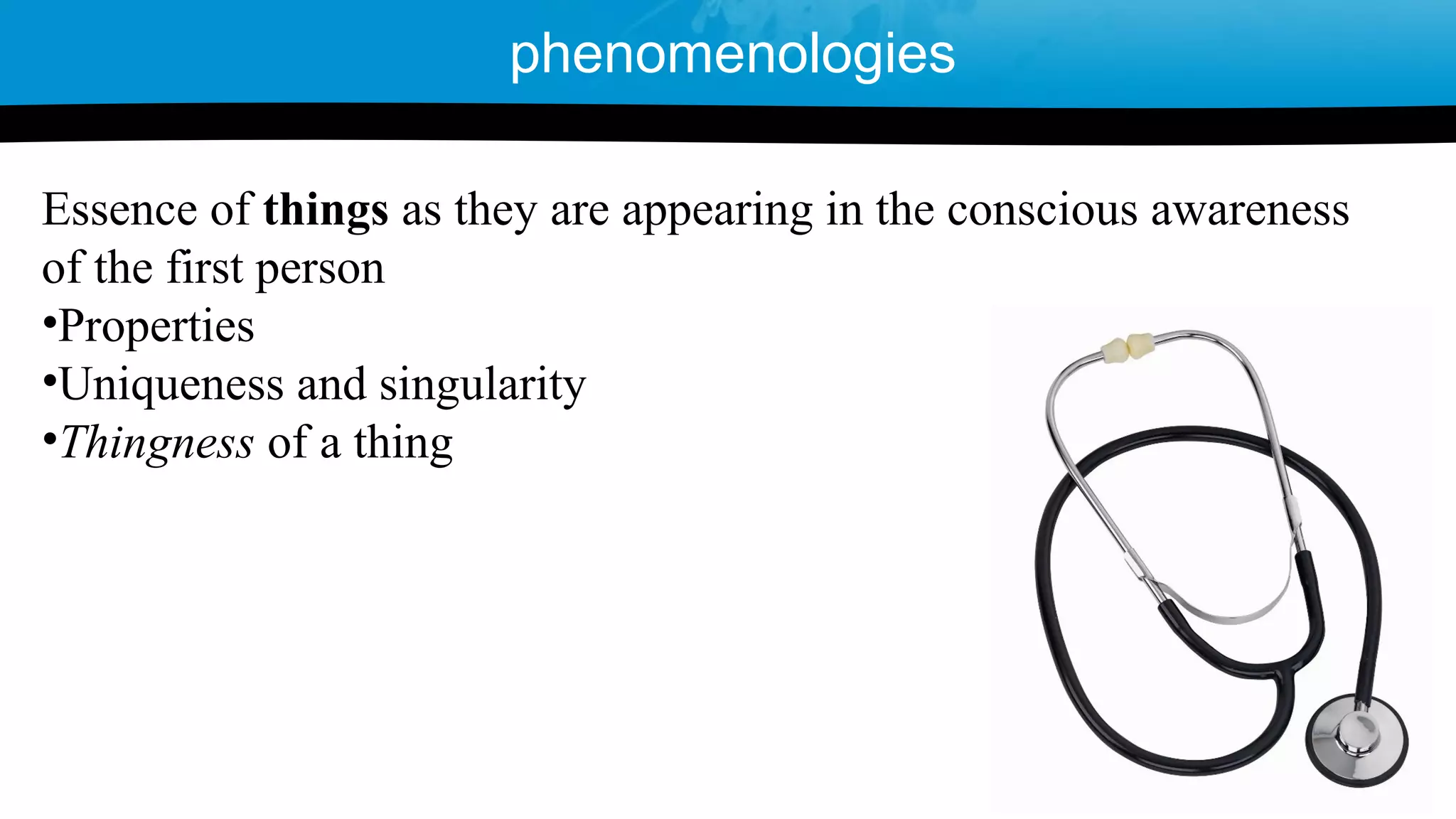
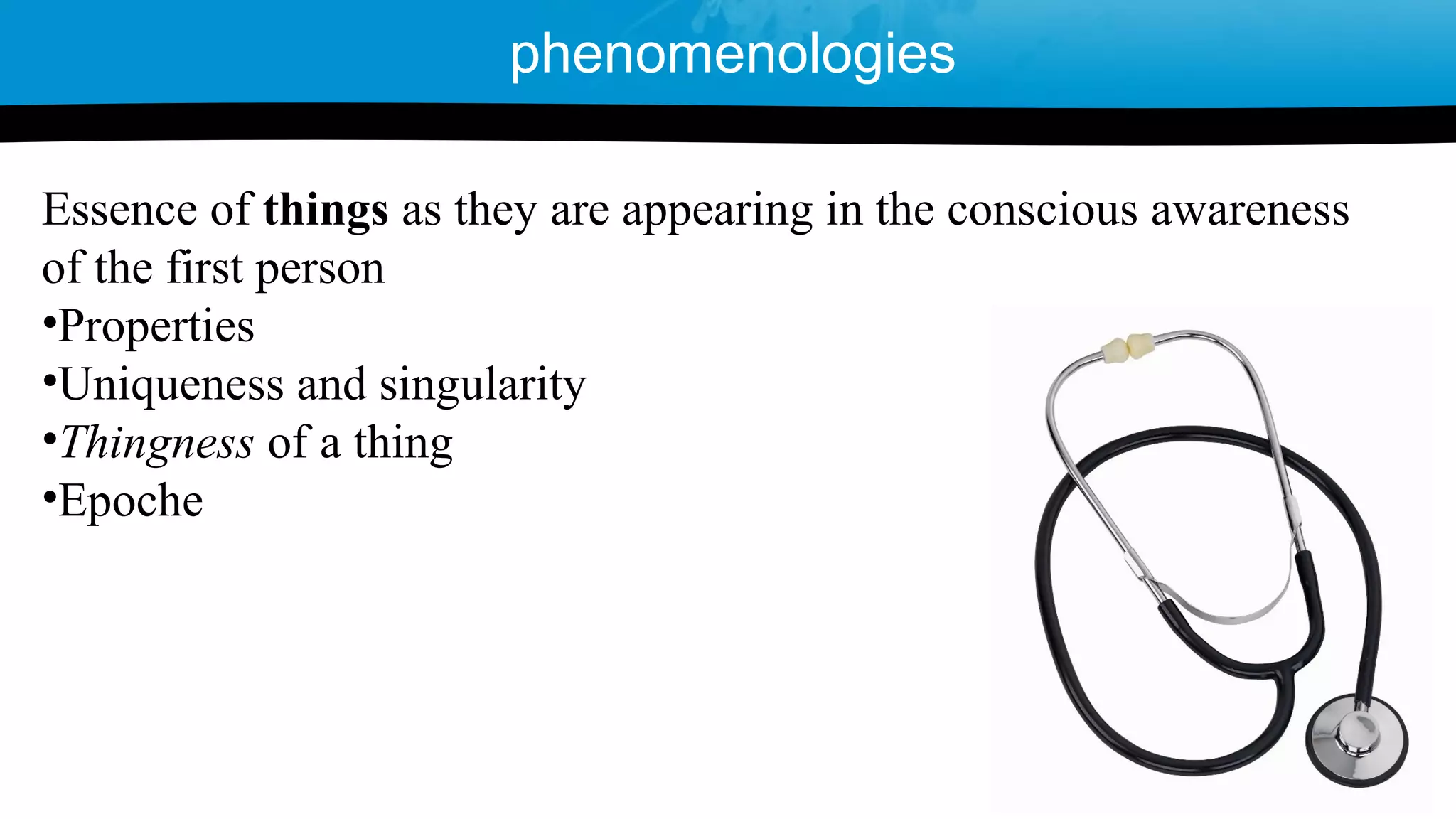
The stethoscope transforms me from a layperson into a nurse, with tools ready-at-
hand. My stethoscope is ready to be used for a particular purpose, auscultation.
When I use my stethoscope I am interested in the patient as a whole, but I am
concentrating on the sound that is reverberating through the tubing of the
stethoscope. I am concentrating on the intricacies of the sound that is being listened
to, such as the lub-dub of a heartbeat. Whilst the stethoscope amplifies a sound of
interest, I find it difficult to hear the conversations of those nearby or the sound of
monitors alarming in the distance. External sounds are reduced to a muffle. I need
to concentrate, I need to listen. The stethoscope allows for the unheard to be heard.
The unheard provides insight into the patient’s condition. I hear what the patient
themselves do not hear; I know what the patient themselves do not know. My
auditory insight provides knowledge about the patient’s condition for the sake of
planning and evaluating care.
phenomenologies
Essence of things as they are appearing in the conscious awareness
of the first person
•Properties
•Uniqueness and singularity
•Thingness of a thing
•Epoche
phenomenologies
Essence of things as they are appearing in the conscious awareness
of the first person
•Past
•The now
•The future
phenomenologies
Essence of things as they are appearing in the conscious awareness
of the first person
•Backdrop to the world
•Intentionality
phenomenologies
Essence of things as they are appearing in the conscious awareness
of the first person
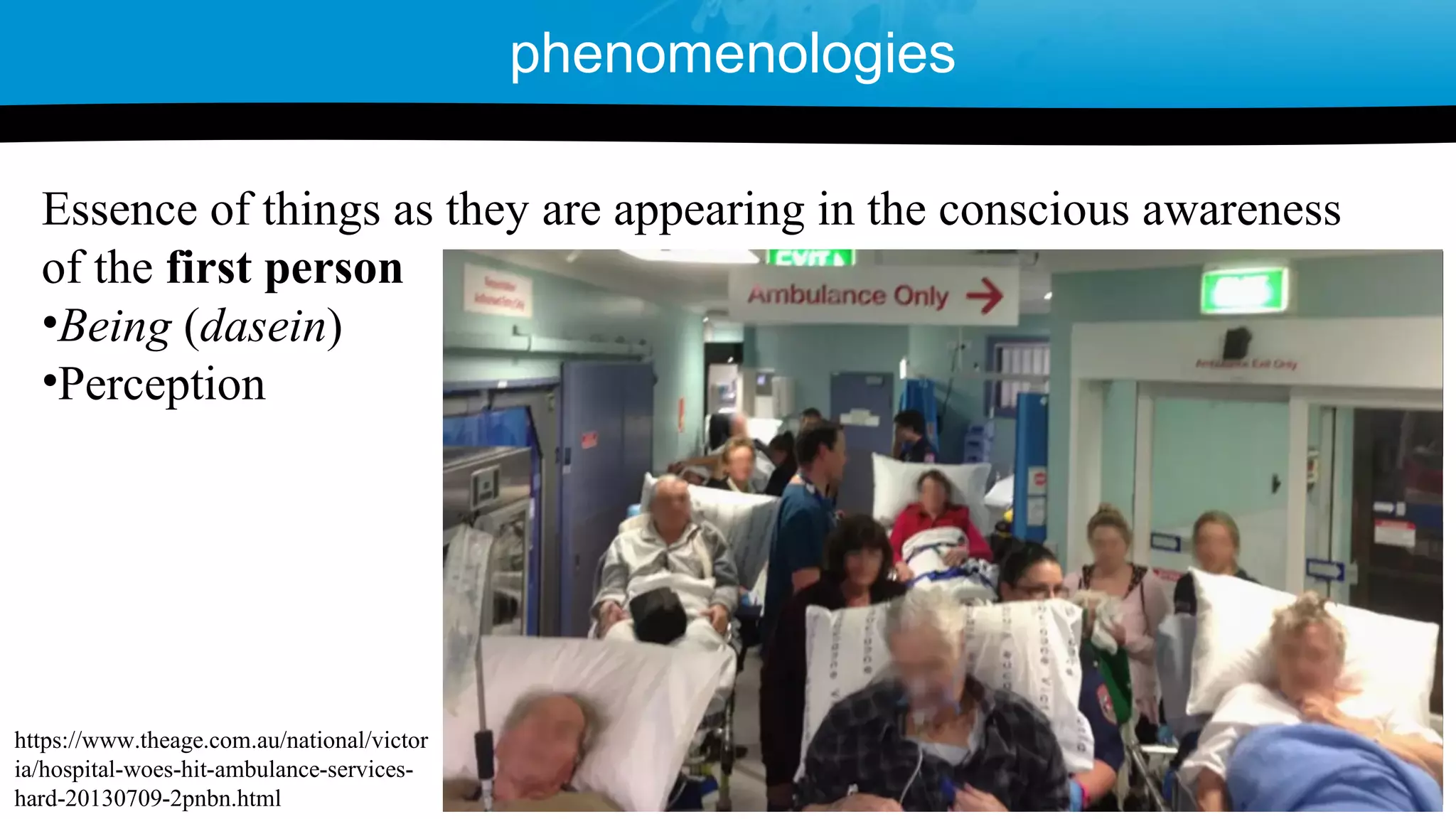
•Being (dasein)
•Perception
phenomenologies
https://www.theage.com.au/national/victor
ia/hospital-woes-hit-ambulance-services-
hard-20130709-2pnbn.html
• Hermeneutics / phenomenology relationship
• Texts
• Hermeneutic circle
• Historical horizons
• Co-create
hermeneutics and phenomenology
. . . being in a hotel room
. . . being at home sick
. . . sharing a secret
. . . caring for someone at end-of-life
• What may it be like . . .
research question(ing)
Ranse, J. & Arbon, P. (2008). Graduate nurses’ lived experience of in-hospital resuscitation: A hermeneutic phenomenological approach.
Australian Critical Care, 21(1), 38–47.
Ranse, J. (2017). Australian civilian hospital nurses’ lived experience of an out-of-hospital environment following a disaster. Doctorate of
Philosophy, Flinders University, South Australia.
Ranse K, Ranse J, Pelkowitz M. (2018). Third year nursing students’ lived experience of caring for the dying: A Hermeneutic Phenomenological
approach. Contemporary Nurse. 19:1-11.
Langeveld, M. J. (1944). The stillness of the secret place. Phenomenology and Pedagogy, 1(1), 11–17.
Van Den Berg, J. H. (1972). The psychology of the sickbed. Pittsburgh: Duquesne University Press.
Van Lennep, D. (1987). The hotel room. Phenomenological Psychology (Vol. 103, pp. 209–215). Dordrecht: Springer Netherlands.
. . . being a nurse following a disaster
. . . being a graduate nurse in a resuscitation
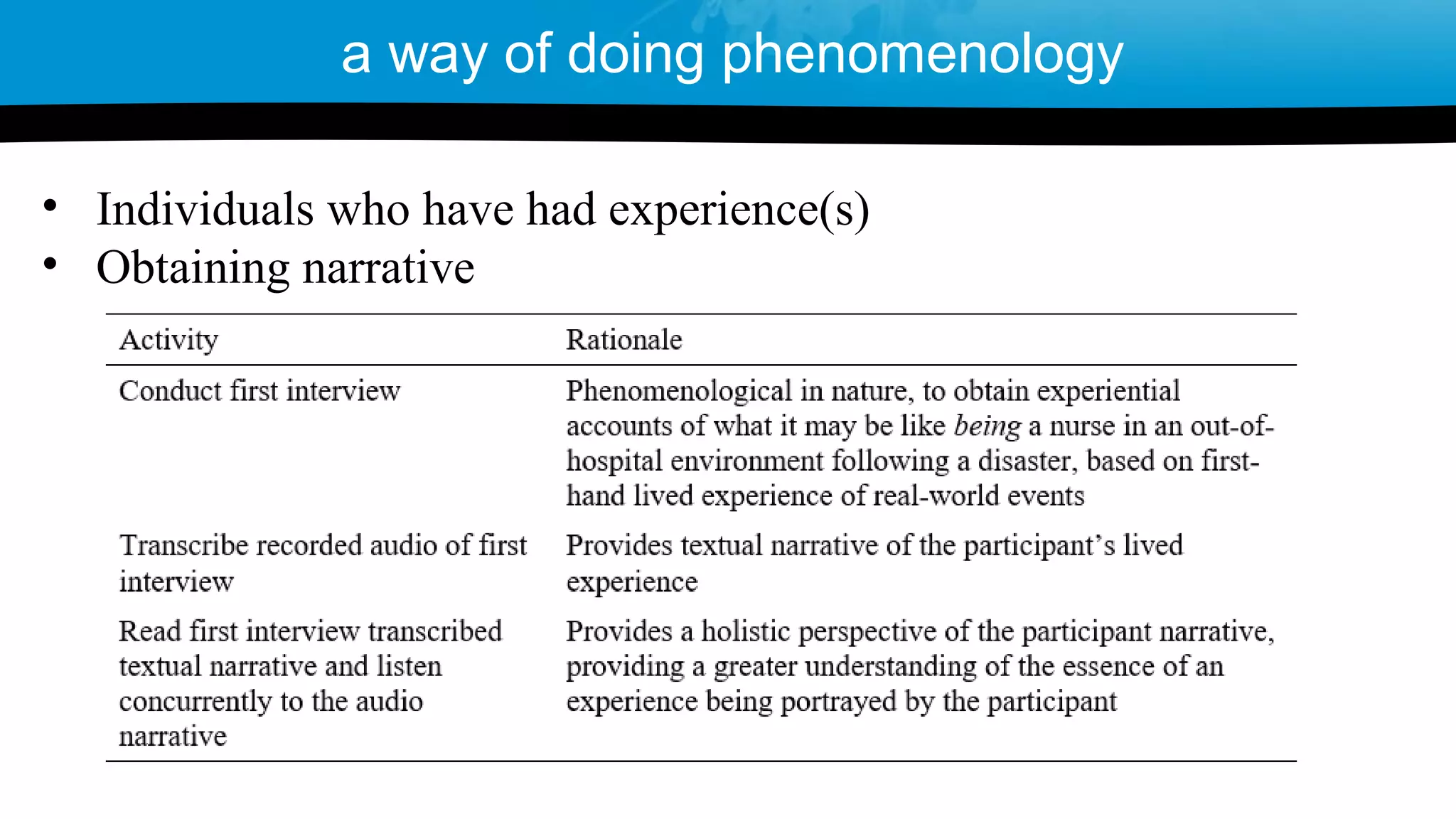
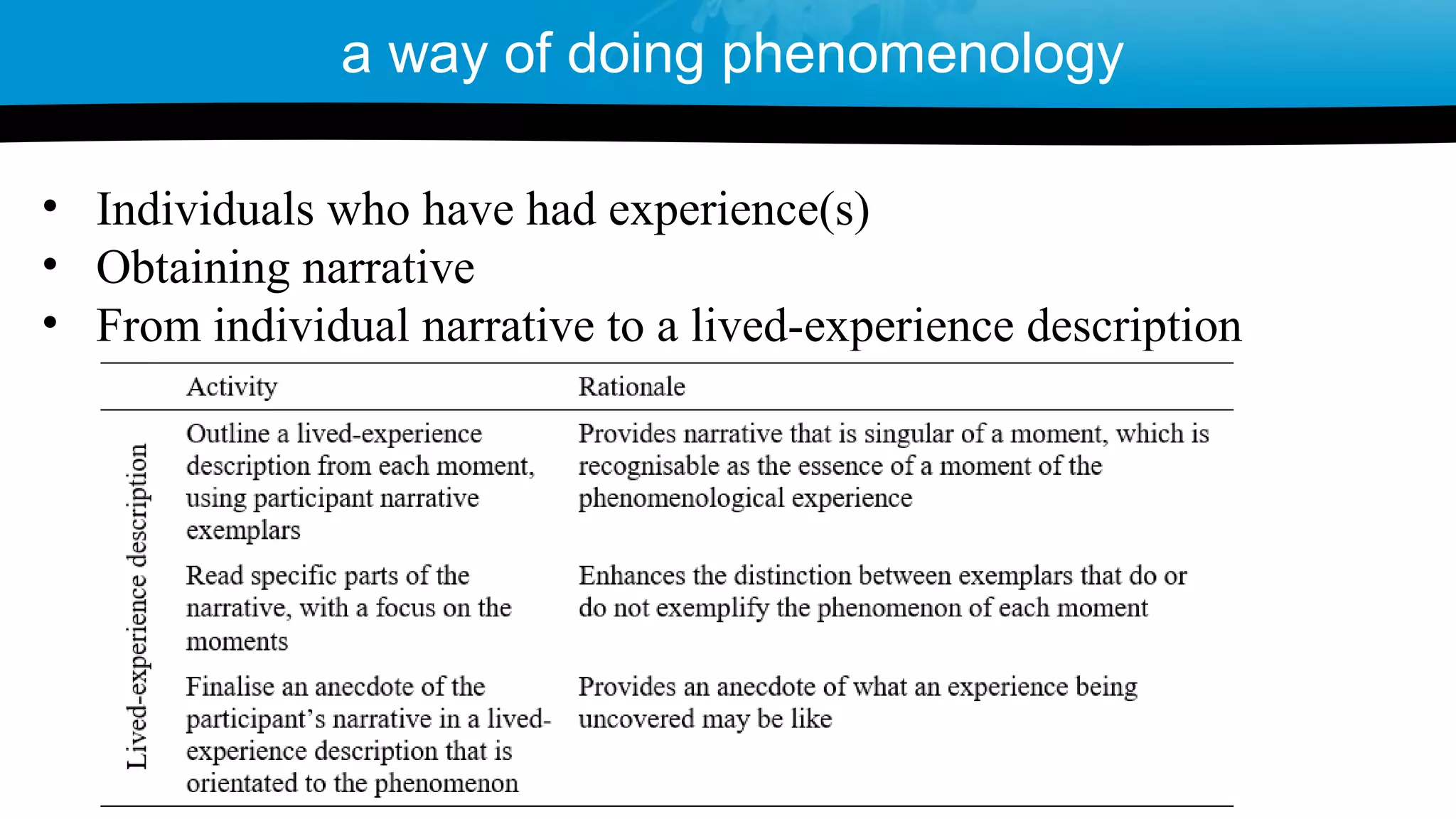
• Individuals who have had experience(s)
• Obtaining narrative
a way of doing phenomenology
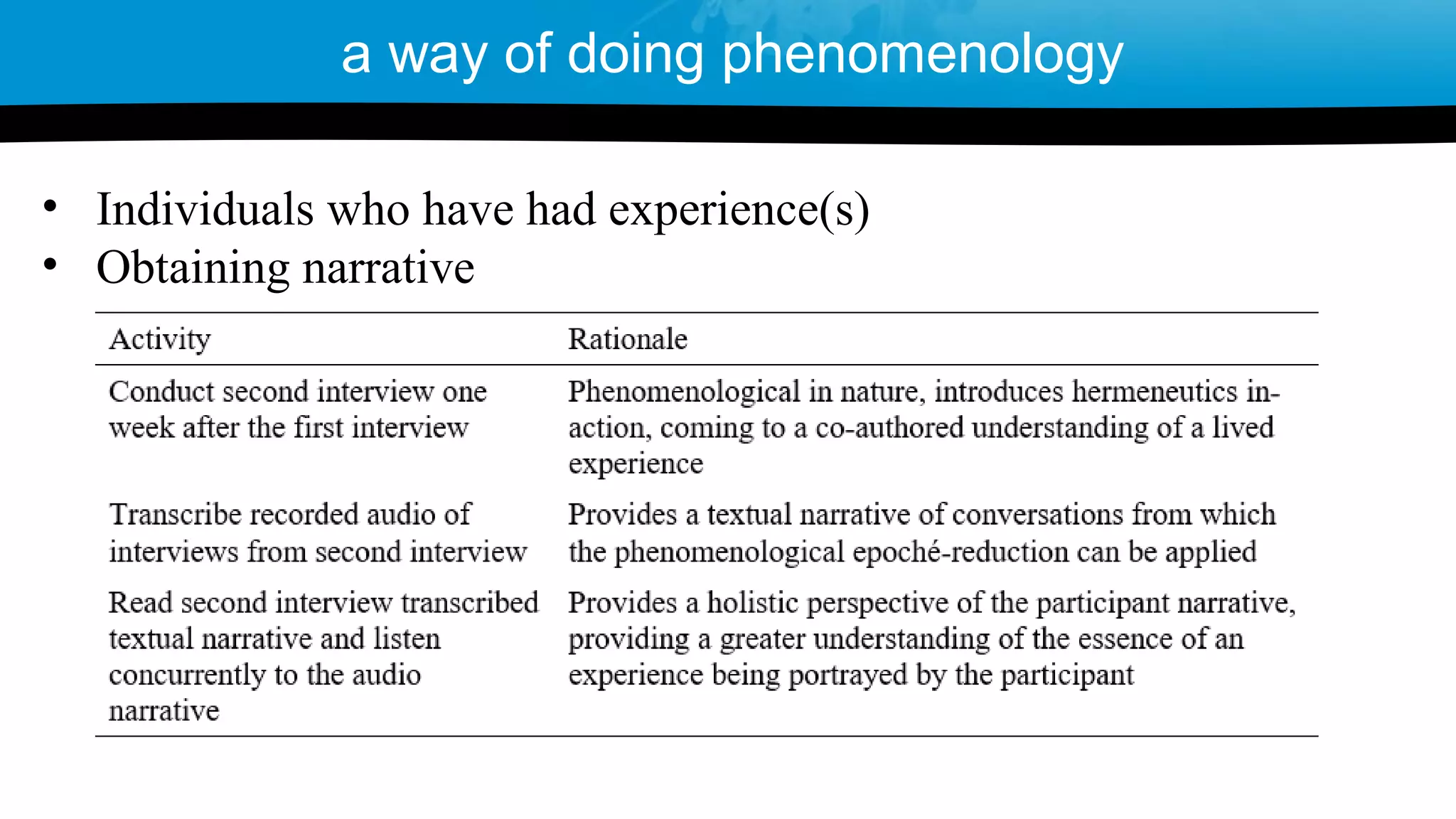
• Individuals who have had experience(s)
• Obtaining narrative
a way of doing phenomenology
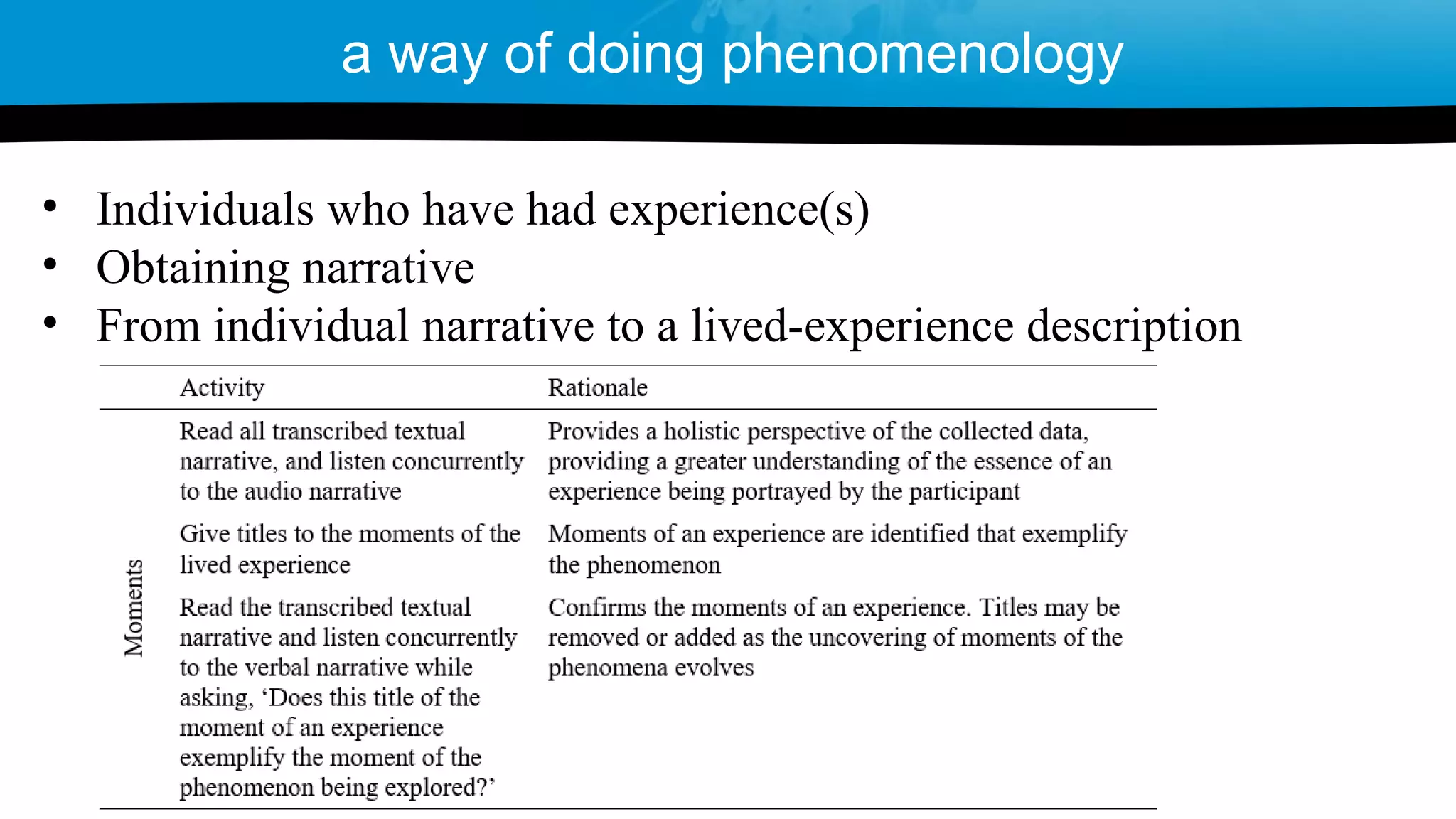
• Individuals who have had experience(s)
• Obtaining narrative
• From individual narrative to a lived-experience description
a way of doing phenomenology
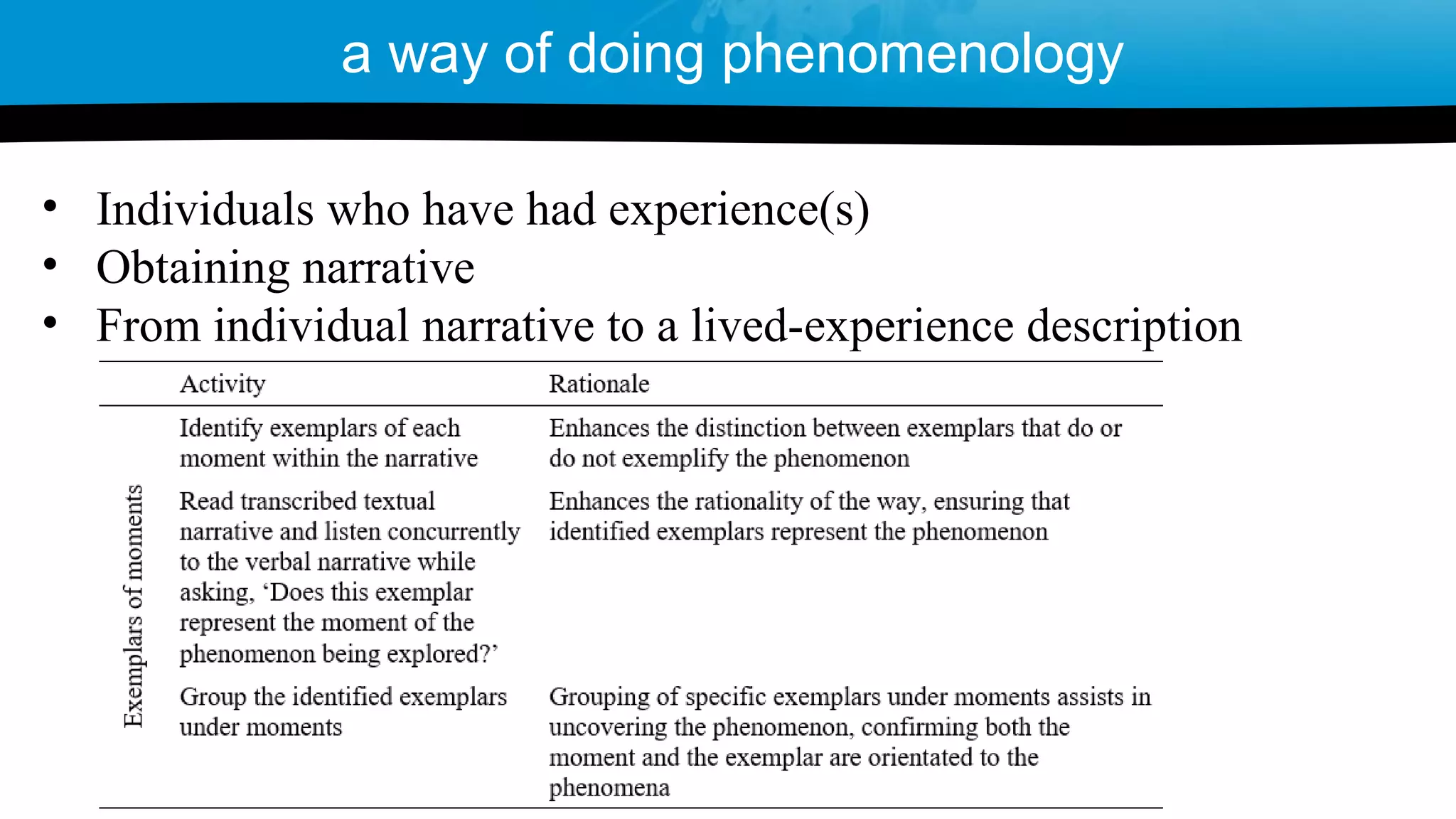
• Individuals who have had experience(s)
• Obtaining narrative
• From individual narrative to a lived-experience description
a way of doing phenomenology
• Individuals who have had experience(s)
• Obtaining narrative
• From individual narrative to a lived-experience description
a way of doing phenomenology
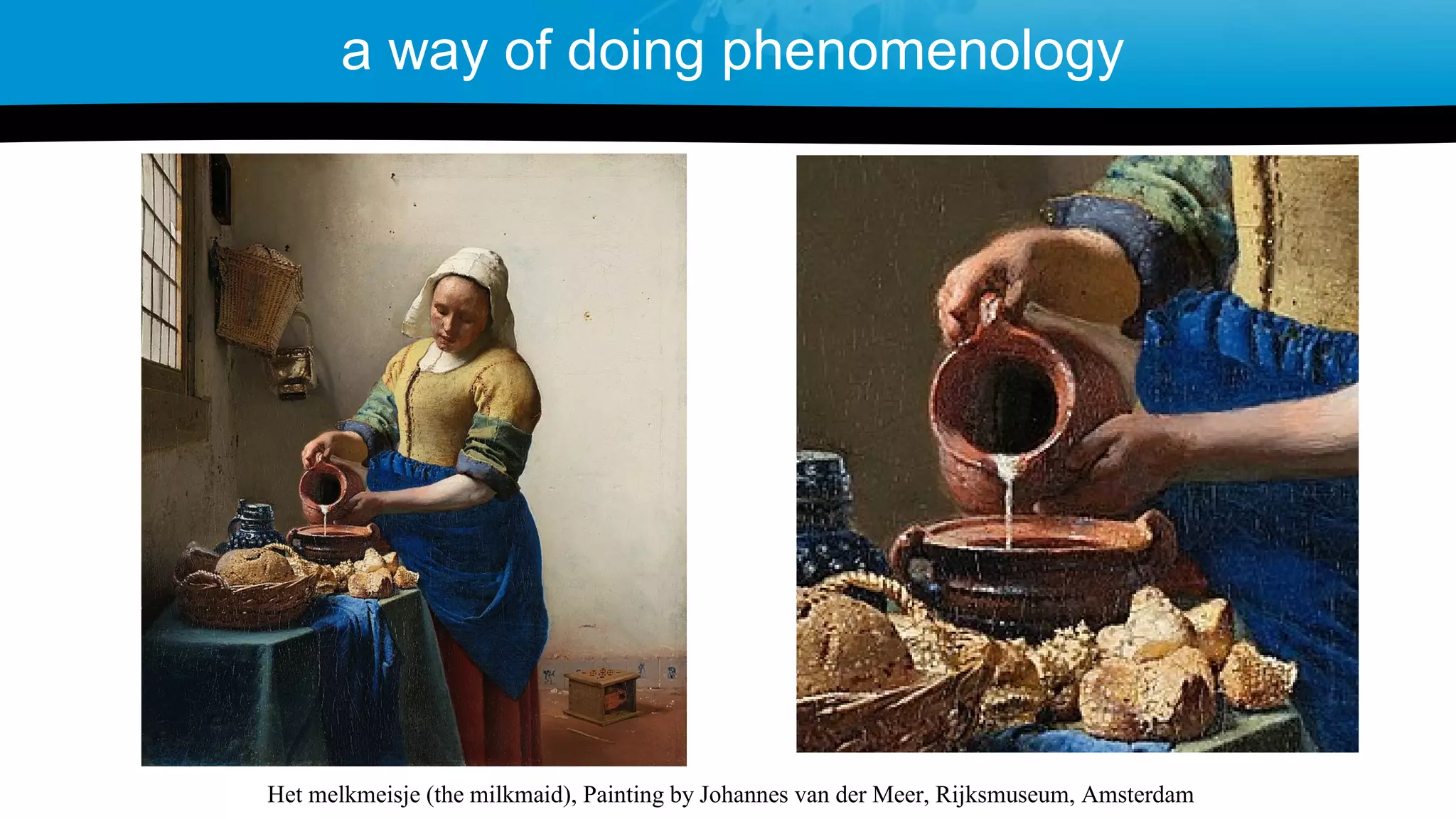
Het melkmeisje (the milkmaid), Painting by Johannes van der Meer, Rijksmuseum, Amsterdam
a way of doing phenomenology
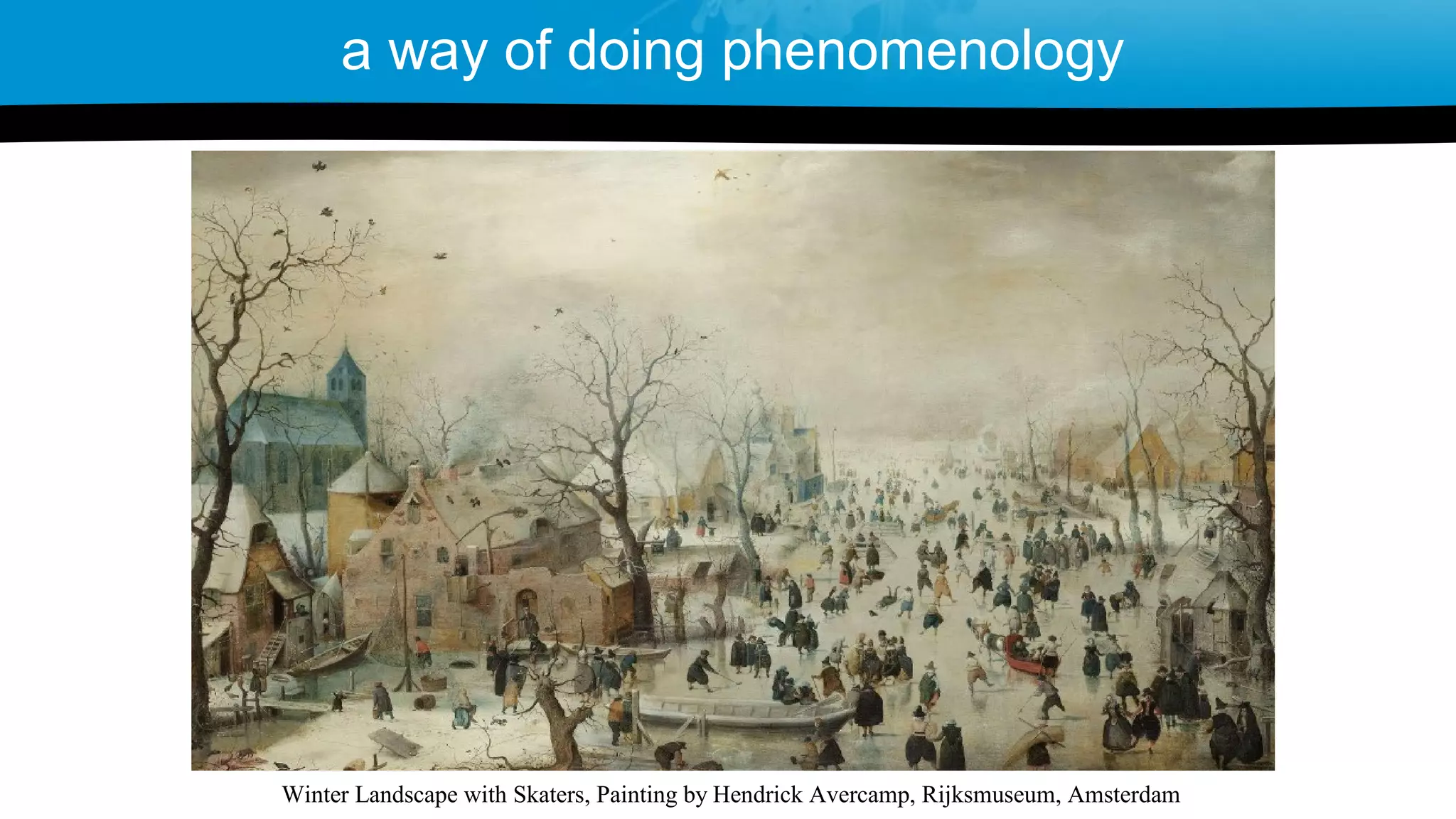
Winter Landscape with Skaters, Painting by Hendrick Avercamp, Rijksmuseum, Amsterdam
a way of doing phenomenology
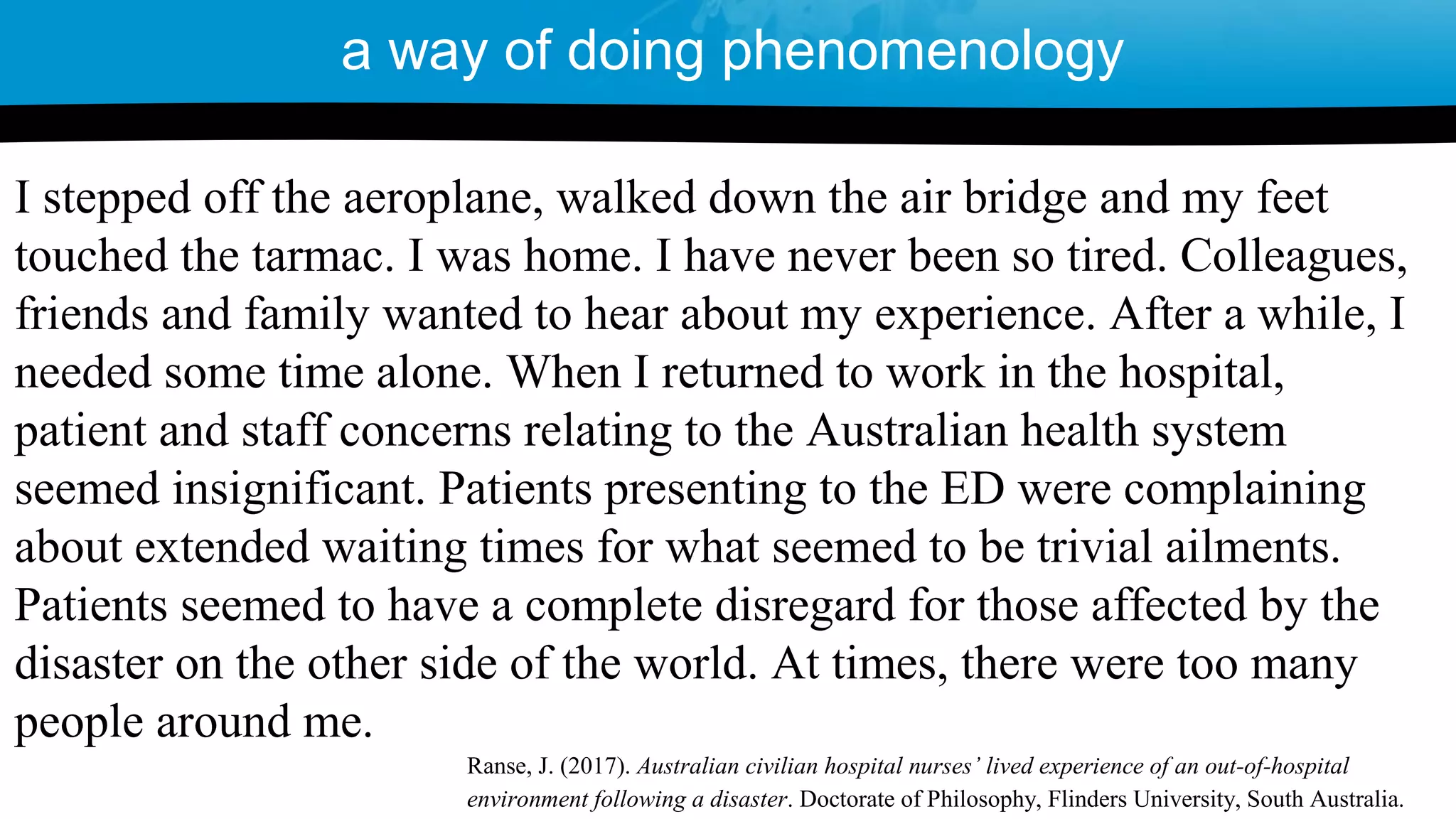
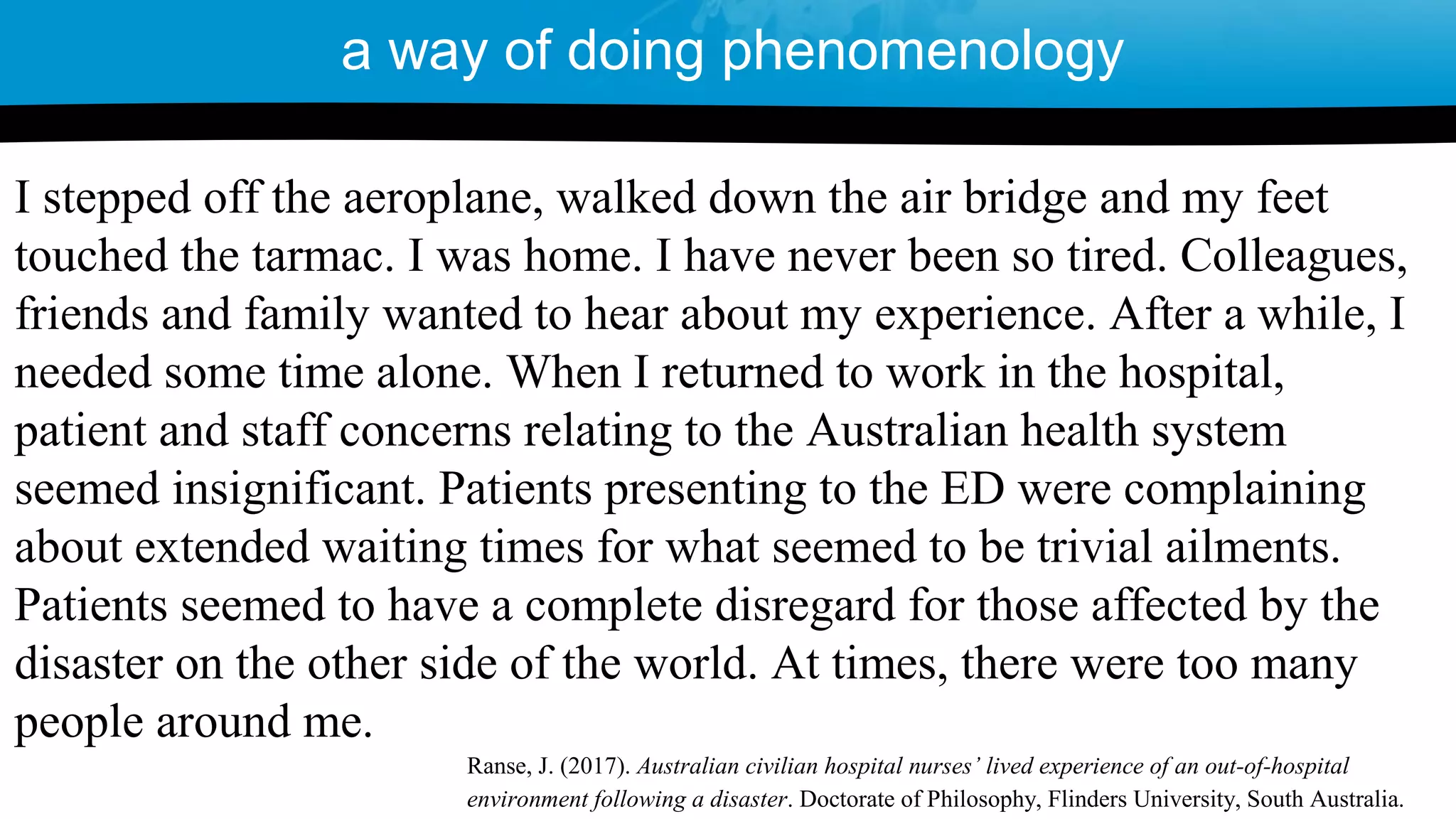
I stepped off the aeroplane, walked down the air bridge and my feet
touched the tarmac. I was home. I have never been so tired. Colleagues,
friends and family wanted to hear about my experience. After a while, I
needed some time alone. When I returned to work in the hospital,
patient and staff concerns relating to the Australian health system
seemed insignificant. Patients presenting to the ED were complaining
about extended waiting times for what seemed to be trivial ailments.
Patients seemed to have a complete disregard for those affected by the
disaster on the other side of the world. At times, there were too many
people around me.
Ranse, J. (2017). Australian civilian hospital nurses’ lived experience of an out-of-hospital
environment following a disaster. Doctorate of Philosophy, Flinders University, South Australia.
a way of doing phenomenology
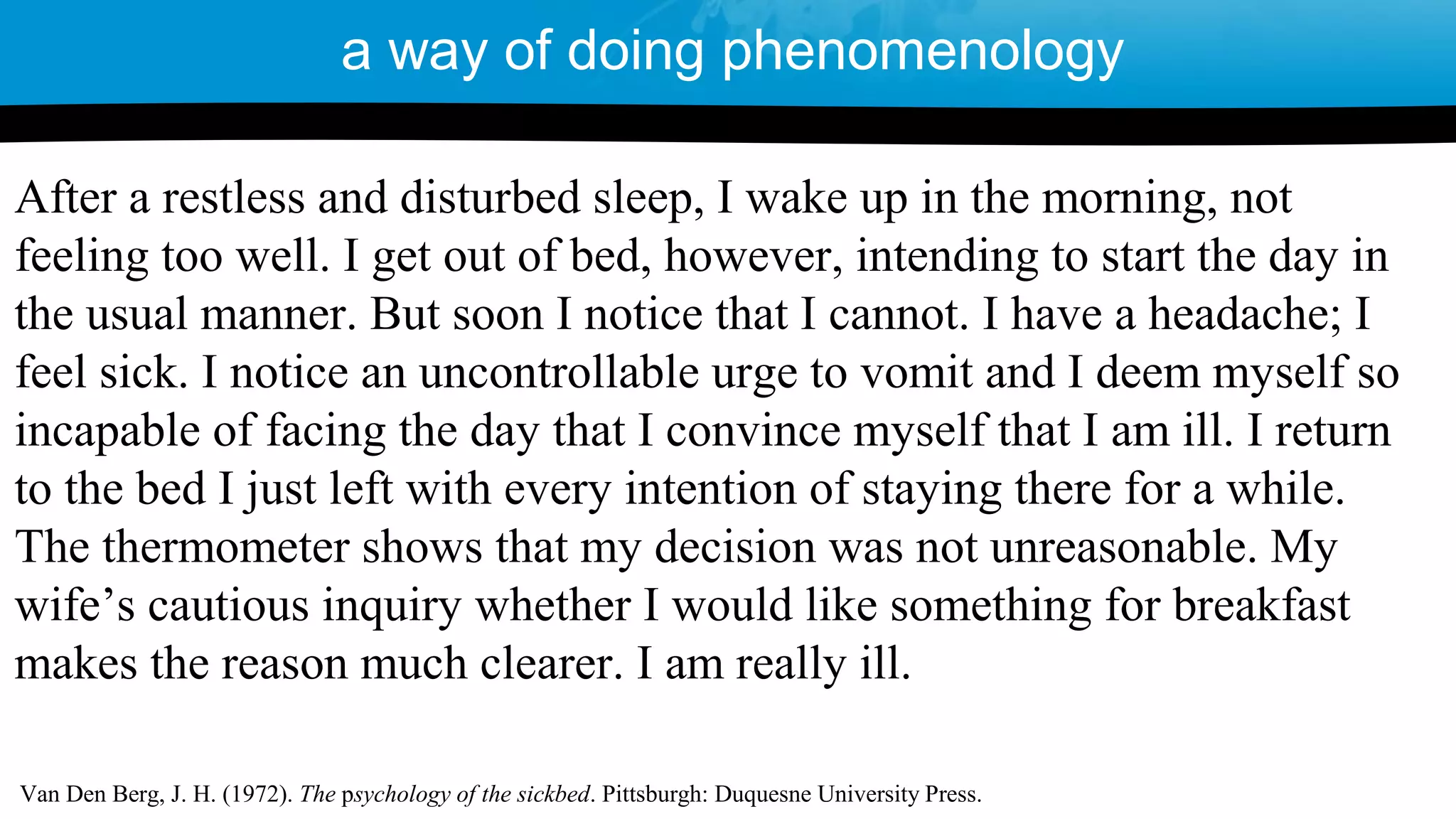
After a restless and disturbed sleep, I wake up in the morning, not
feeling too well. I get out of bed, however, intending to start the day in
the usual manner. But soon I notice that I cannot. I have a headache; I
feel sick. I notice an uncontrollable urge to vomit and I deem myself so
incapable of facing the day that I convince myself that I am ill. I return
to the bed I just left with every intention of staying there for a while.
The thermometer shows that my decision was not unreasonable. My
wife’s cautious inquiry whether I would like something for breakfast
makes the reason much clearer. I am really ill.
Van Den Berg, J. H. (1972). The psychology of the sickbed. Pittsburgh: Duquesne University Press.
• Individuals who have had experience(s)
• Obtaining narrative
• From individual narrative to a lived-experience description
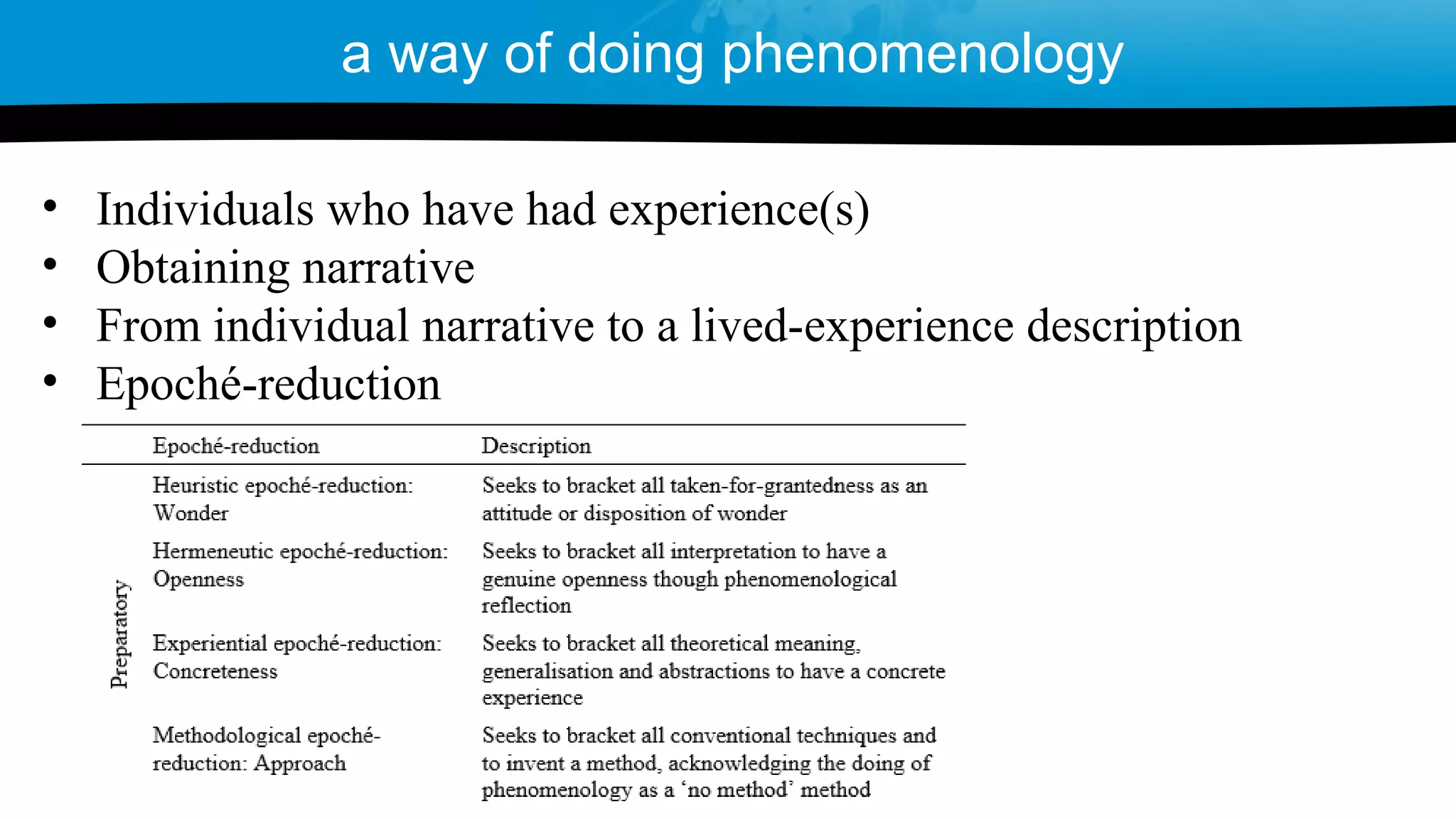
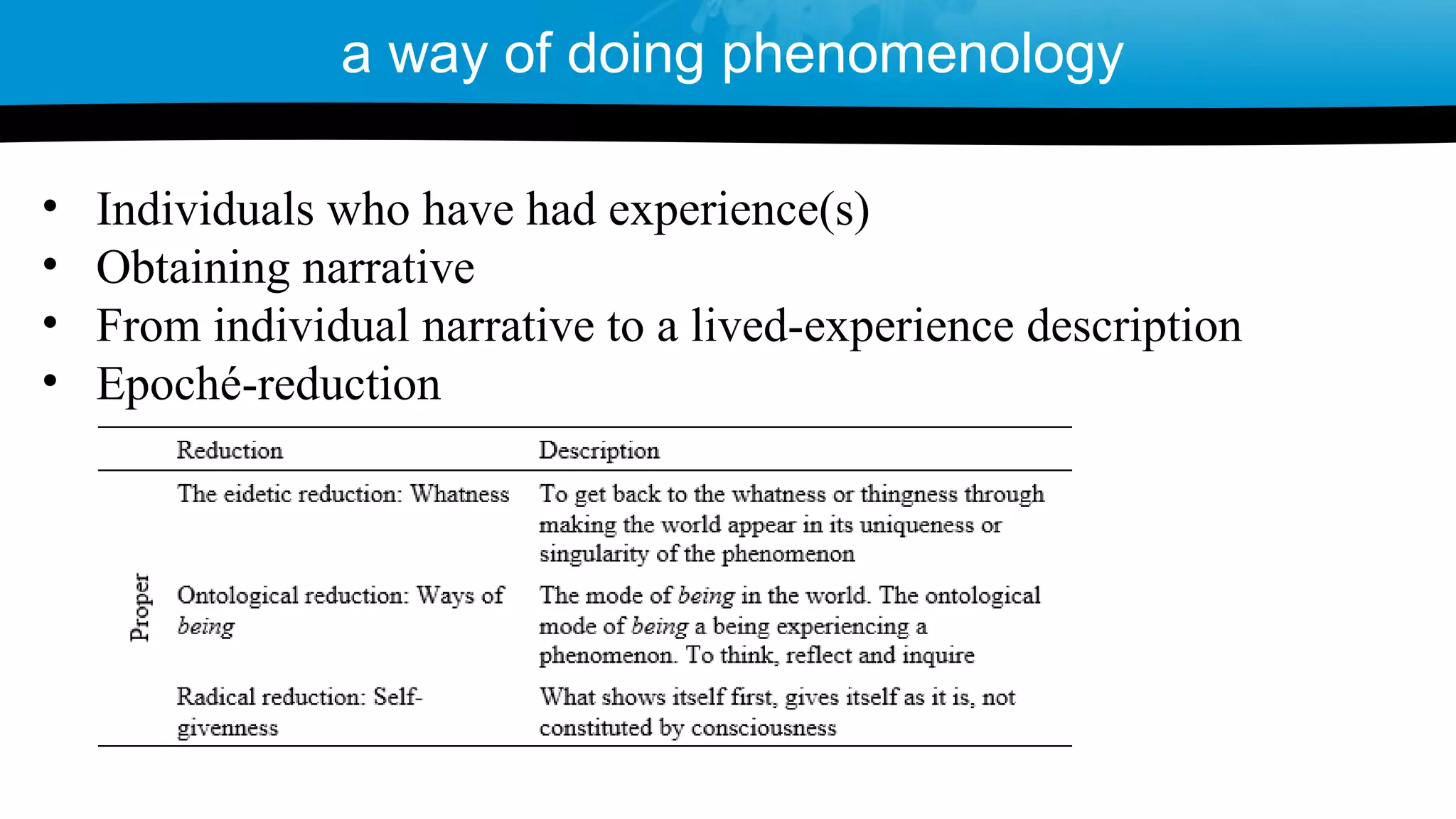
• Epoché-reduction
a way of doing phenomenology
• Individuals who have had experience(s)
• Obtaining narrative
• From individual narrative to a lived-experience description
• Epoché-reduction
a way of doing phenomenology
• Individuals who have had experience(s)
• Obtaining narrative
• From individual narrative to a lived-experience description
• Epoché-reduction
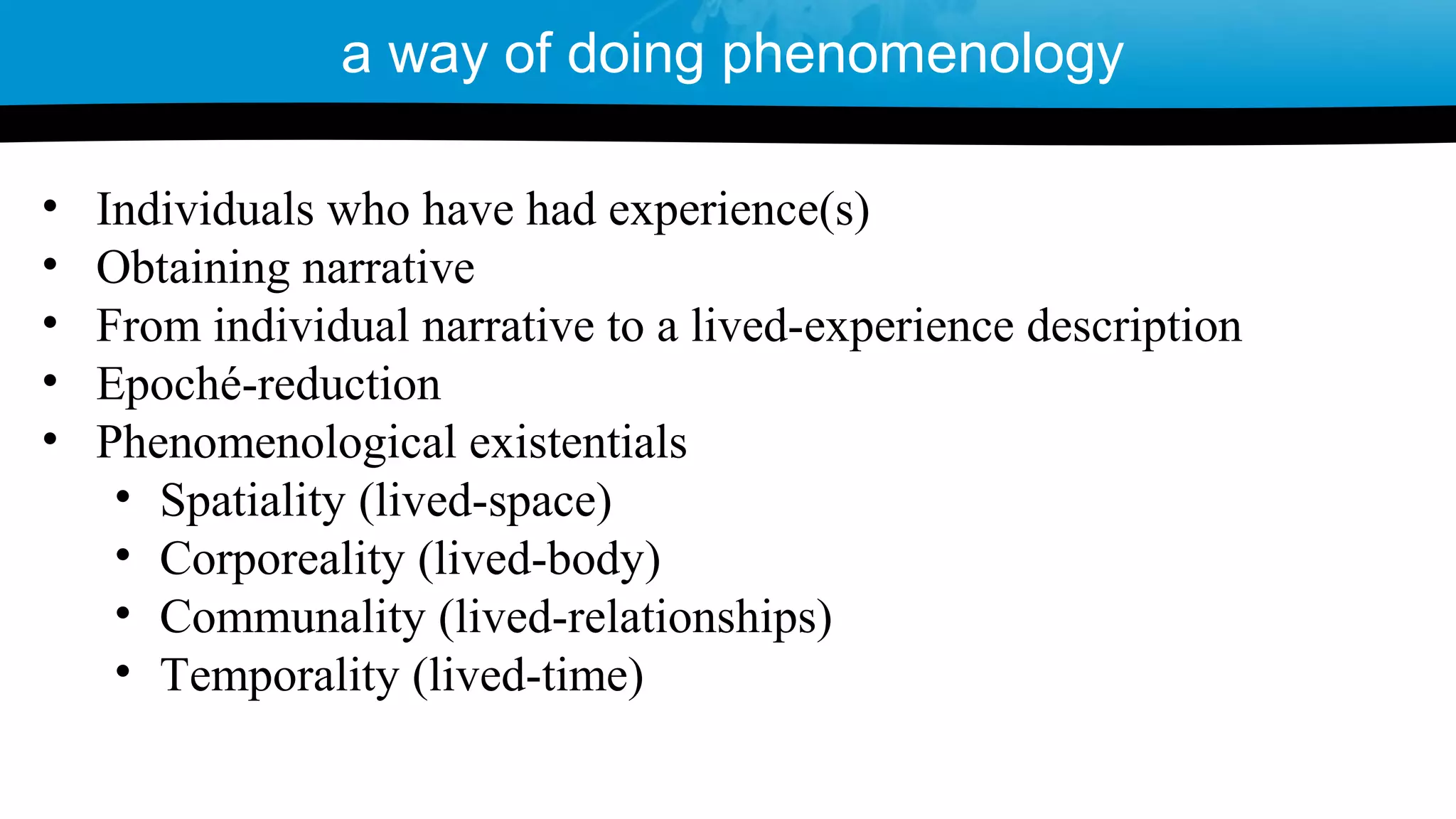
• Phenomenological existentials
• Spatiality (lived-space)
• Corporeality (lived-body)
• Communality (lived-relationships)
• Temporality (lived-time)
a way of doing phenomenology
• Individuals who have had experience(s)
• Obtaining narrative
• From individual narrative to a lived-experience description
• Epoché-reduction
• Phenomenological existentials
• Protection of human participants
a way of doing phenomenology
I stepped off the aeroplane, walked down the air bridge and my feet
touched the tarmac. I was home. I have never been so tired. Colleagues,
friends and family wanted to hear about my experience. After a while, I
needed some time alone. When I returned to work in the hospital,
patient and staff concerns relating to the Australian health system
seemed insignificant. Patients presenting to the ED were complaining
about extended waiting times for what seemed to be trivial ailments.
Patients seemed to have a complete disregard for those affected by the
disaster on the other side of the world. At times, there were too many
people around me.
Ranse, J. (2017). Australian civilian hospital nurses’ lived experience of an out-of-hospital
environment following a disaster. Doctorate of Philosophy, Flinders University, South Australia.
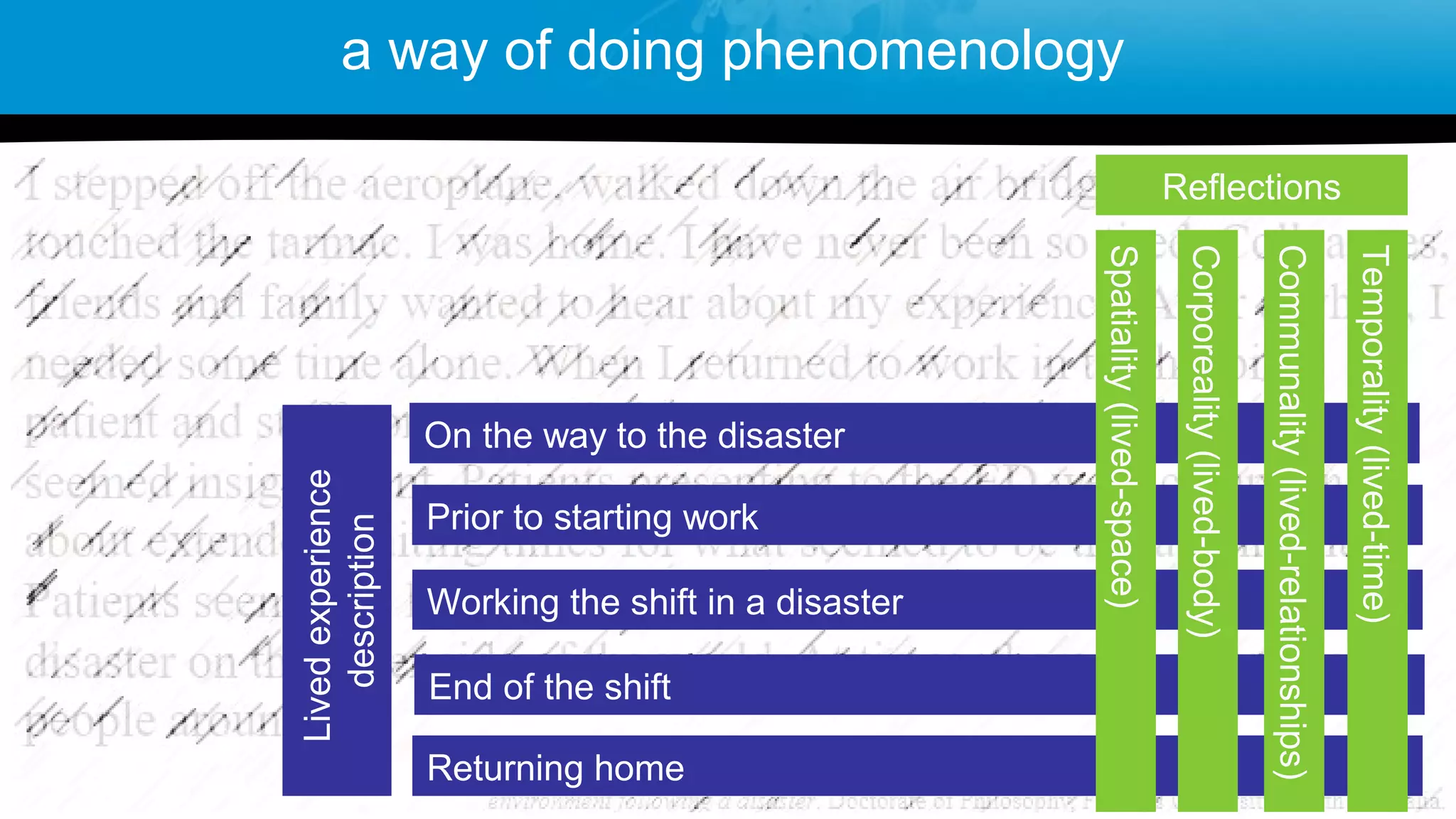
On the way to the disaster
Prior to starting work
Working the shift in a disaster
End of the shift
Returning home
Temporality(lived-time)
Communality(lived-relationships)
Corporeality(lived-body)
Spatiality(lived-space)
Livedexperience
description
Reflections
a way of doing phenomenology
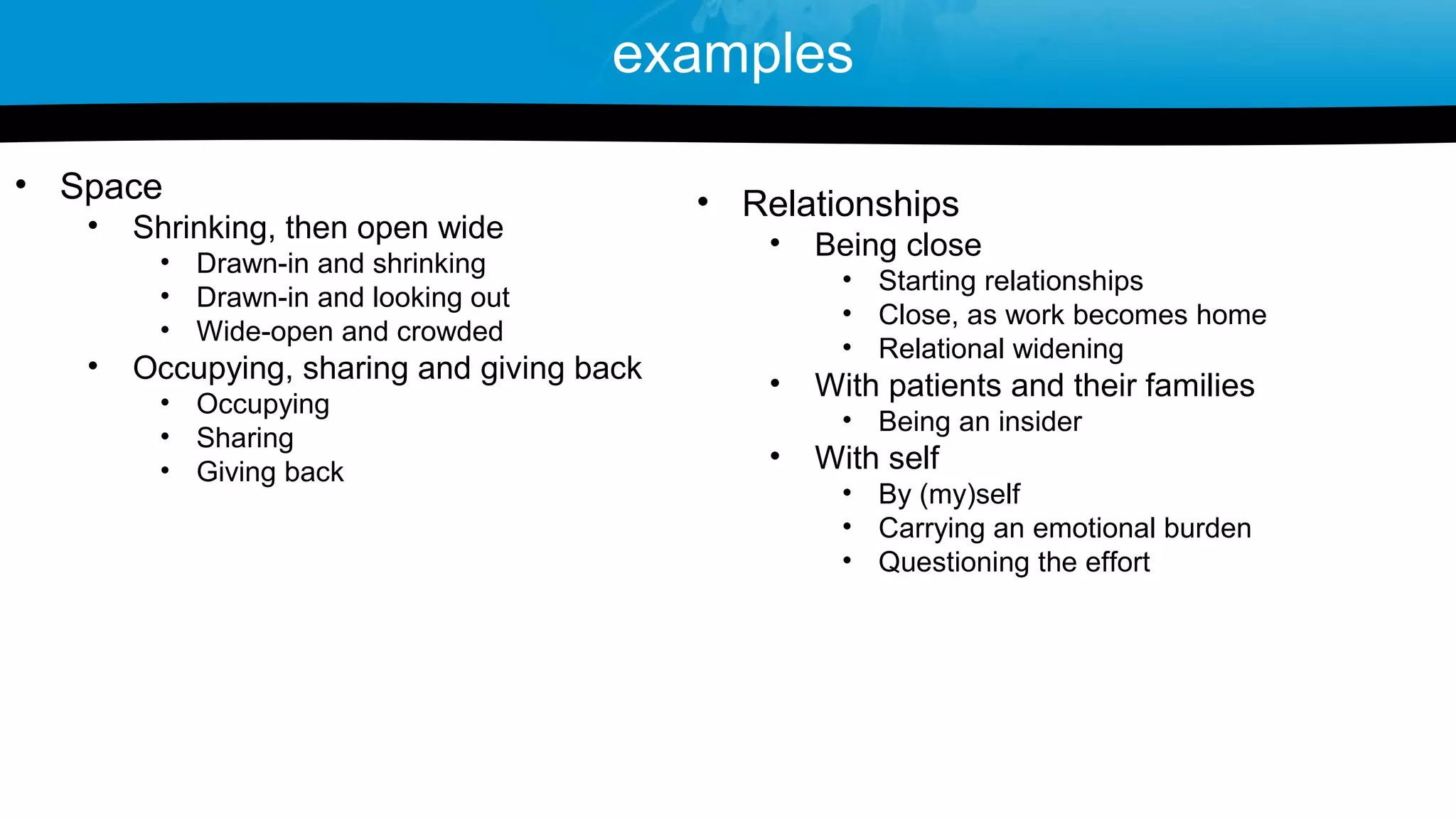
• Space
• Shrinking, then open wide
• Drawn-in and shrinking
• Drawn-in and looking out
• Wide-open and crowded
• Occupying, sharing and giving back
• Occupying
• Sharing
• Giving back
• Relationships
• Being close
• Starting relationships
• Close, as work becomes home
• Relational widening
• With patients and their families
• Being an insider
• With self
• By (my)self
• Carrying an emotional burden
• Questioning the effort
examples
Body
•When nursing following a disaster
• Without technology
• Being autonomous
•For patients following a disaster
• Endless bodies
• Injured and ill
• Death
• Psychosocial well-being
• Returning to the hospital patient
Time
•Speeding up
•Slowing down
examples
• Individuals who have had experience(s)
• Obtaining narrative
• From individual narrative to a lived-experience description
• Epoché-reduction
• Phenomenological existentials
• Protection of human participants
• Phenomenological appraisal
doing phenomenology
PHENOMENOLOGY:
moving from philosophical underpinnings to
a practical way of doing
Dr Jamie Ranse RN PhD
Research Fellow, Emergency Care
www.jamieranse.com
twitter.com/jamieranse
youtube.com/jamieranse
linkedin.com/in/jamieranse

Phenomenology: Moving from philosophical underpinnings to a practical way of doing

  • 1.
    PHENOMENOLOGY: moving from philosophicalunderpinnings to a practical way of doing Dr Jamie Ranse RN PhD Research Fellow, Emergency Care www.jamieranse.com twitter.com/jamieranse youtube.com/jamieranse linkedin.com/in/jamieranse
  • 2.
    • Phenomenologies • Hermeneuticsand phenomenologies • Research question(ing) • Doing phenomenology overview
  • 3.
    • Relationship withpsychology • Influential phenomenologists • Edmund Husserl • Martin Heidegger • Jean-Paul Sartre • Maurice Merleau-Ponty • Hans-Georg Gadamer historical phenomenologies
  • 4.
    • Relationship withpsychology • Influential phenomenologists • David Jacob van Lennep • Jan Hendrik Van Den Berg • Bas Levering • Max van Manen historical phenomenologies
  • 5.
    Essence of thingsas they are appearing in the conscious awareness of the first person •Properties •Uniqueness and singularity •Thingness of a thing phenomenologies
  • 6.
    The stethoscope transformsme from a layperson into a nurse, with tools ready-at- hand. My stethoscope is ready to be used for a particular purpose, auscultation. When I use my stethoscope I am interested in the patient as a whole, but I am concentrating on the sound that is reverberating through the tubing of the stethoscope. I am concentrating on the intricacies of the sound that is being listened to, such as the lub-dub of a heartbeat. Whilst the stethoscope amplifies a sound of interest, I find it difficult to hear the conversations of those nearby or the sound of monitors alarming in the distance. External sounds are reduced to a muffle. I need to concentrate, I need to listen. The stethoscope allows for the unheard to be heard. The unheard provides insight into the patient’s condition. I hear what the patient themselves do not hear; I know what the patient themselves do not know. My auditory insight provides knowledge about the patient’s condition for the sake of planning and evaluating care. phenomenologies
  • 7.
    Essence of thingsas they are appearing in the conscious awareness of the first person •Properties •Uniqueness and singularity •Thingness of a thing •Epoche phenomenologies
  • 8.
    Essence of thingsas they are appearing in the conscious awareness of the first person •Past •The now •The future phenomenologies
  • 9.
    Essence of thingsas they are appearing in the conscious awareness of the first person •Backdrop to the world •Intentionality phenomenologies
  • 10.
    Essence of thingsas they are appearing in the conscious awareness of the first person •Being (dasein) •Perception phenomenologies https://www.theage.com.au/national/victor ia/hospital-woes-hit-ambulance-services- hard-20130709-2pnbn.html
  • 11.
    • Hermeneutics /phenomenology relationship • Texts • Hermeneutic circle • Historical horizons • Co-create hermeneutics and phenomenology
  • 12.
    . . .being in a hotel room . . . being at home sick . . . sharing a secret . . . caring for someone at end-of-life • What may it be like . . . research question(ing) Ranse, J. & Arbon, P. (2008). Graduate nurses’ lived experience of in-hospital resuscitation: A hermeneutic phenomenological approach. Australian Critical Care, 21(1), 38–47. Ranse, J. (2017). Australian civilian hospital nurses’ lived experience of an out-of-hospital environment following a disaster. Doctorate of Philosophy, Flinders University, South Australia. Ranse K, Ranse J, Pelkowitz M. (2018). Third year nursing students’ lived experience of caring for the dying: A Hermeneutic Phenomenological approach. Contemporary Nurse. 19:1-11. Langeveld, M. J. (1944). The stillness of the secret place. Phenomenology and Pedagogy, 1(1), 11–17. Van Den Berg, J. H. (1972). The psychology of the sickbed. Pittsburgh: Duquesne University Press. Van Lennep, D. (1987). The hotel room. Phenomenological Psychology (Vol. 103, pp. 209–215). Dordrecht: Springer Netherlands. . . . being a nurse following a disaster . . . being a graduate nurse in a resuscitation
  • 13.
    • Individuals whohave had experience(s) • Obtaining narrative a way of doing phenomenology
  • 14.
    • Individuals whohave had experience(s) • Obtaining narrative a way of doing phenomenology
  • 15.
    • Individuals whohave had experience(s) • Obtaining narrative • From individual narrative to a lived-experience description a way of doing phenomenology
  • 16.
    • Individuals whohave had experience(s) • Obtaining narrative • From individual narrative to a lived-experience description a way of doing phenomenology
  • 17.
    • Individuals whohave had experience(s) • Obtaining narrative • From individual narrative to a lived-experience description a way of doing phenomenology
  • 18.
    a way ofdoing phenomenology Het melkmeisje (the milkmaid), Painting by Johannes van der Meer, Rijksmuseum, Amsterdam
  • 19.
    a way ofdoing phenomenology Winter Landscape with Skaters, Painting by Hendrick Avercamp, Rijksmuseum, Amsterdam
  • 20.
    a way ofdoing phenomenology I stepped off the aeroplane, walked down the air bridge and my feet touched the tarmac. I was home. I have never been so tired. Colleagues, friends and family wanted to hear about my experience. After a while, I needed some time alone. When I returned to work in the hospital, patient and staff concerns relating to the Australian health system seemed insignificant. Patients presenting to the ED were complaining about extended waiting times for what seemed to be trivial ailments. Patients seemed to have a complete disregard for those affected by the disaster on the other side of the world. At times, there were too many people around me. Ranse, J. (2017). Australian civilian hospital nurses’ lived experience of an out-of-hospital environment following a disaster. Doctorate of Philosophy, Flinders University, South Australia.
  • 21.
    a way ofdoing phenomenology After a restless and disturbed sleep, I wake up in the morning, not feeling too well. I get out of bed, however, intending to start the day in the usual manner. But soon I notice that I cannot. I have a headache; I feel sick. I notice an uncontrollable urge to vomit and I deem myself so incapable of facing the day that I convince myself that I am ill. I return to the bed I just left with every intention of staying there for a while. The thermometer shows that my decision was not unreasonable. My wife’s cautious inquiry whether I would like something for breakfast makes the reason much clearer. I am really ill. Van Den Berg, J. H. (1972). The psychology of the sickbed. Pittsburgh: Duquesne University Press.
  • 22.
    • Individuals whohave had experience(s) • Obtaining narrative • From individual narrative to a lived-experience description • Epoché-reduction a way of doing phenomenology
  • 23.
    • Individuals whohave had experience(s) • Obtaining narrative • From individual narrative to a lived-experience description • Epoché-reduction a way of doing phenomenology
  • 24.
    • Individuals whohave had experience(s) • Obtaining narrative • From individual narrative to a lived-experience description • Epoché-reduction • Phenomenological existentials • Spatiality (lived-space) • Corporeality (lived-body) • Communality (lived-relationships) • Temporality (lived-time) a way of doing phenomenology
  • 25.
    • Individuals whohave had experience(s) • Obtaining narrative • From individual narrative to a lived-experience description • Epoché-reduction • Phenomenological existentials • Protection of human participants a way of doing phenomenology
  • 26.
    a way ofdoing phenomenology I stepped off the aeroplane, walked down the air bridge and my feet touched the tarmac. I was home. I have never been so tired. Colleagues, friends and family wanted to hear about my experience. After a while, I needed some time alone. When I returned to work in the hospital, patient and staff concerns relating to the Australian health system seemed insignificant. Patients presenting to the ED were complaining about extended waiting times for what seemed to be trivial ailments. Patients seemed to have a complete disregard for those affected by the disaster on the other side of the world. At times, there were too many people around me. Ranse, J. (2017). Australian civilian hospital nurses’ lived experience of an out-of-hospital environment following a disaster. Doctorate of Philosophy, Flinders University, South Australia.
  • 27.
    On the wayto the disaster Prior to starting work Working the shift in a disaster End of the shift Returning home Temporality(lived-time) Communality(lived-relationships) Corporeality(lived-body) Spatiality(lived-space) Livedexperience description Reflections a way of doing phenomenology
  • 28.
    • Space • Shrinking,then open wide • Drawn-in and shrinking • Drawn-in and looking out • Wide-open and crowded • Occupying, sharing and giving back • Occupying • Sharing • Giving back • Relationships • Being close • Starting relationships • Close, as work becomes home • Relational widening • With patients and their families • Being an insider • With self • By (my)self • Carrying an emotional burden • Questioning the effort examples
  • 29.
    Body •When nursing followinga disaster • Without technology • Being autonomous •For patients following a disaster • Endless bodies • Injured and ill • Death • Psychosocial well-being • Returning to the hospital patient Time •Speeding up •Slowing down examples
  • 30.
    • Individuals whohave had experience(s) • Obtaining narrative • From individual narrative to a lived-experience description • Epoché-reduction • Phenomenological existentials • Protection of human participants • Phenomenological appraisal doing phenomenology
  • 31.
    PHENOMENOLOGY: moving from philosophicalunderpinnings to a practical way of doing Dr Jamie Ranse RN PhD Research Fellow, Emergency Care www.jamieranse.com twitter.com/jamieranse youtube.com/jamieranse linkedin.com/in/jamieranse