Presented by : Dr. Himanshu Jangid
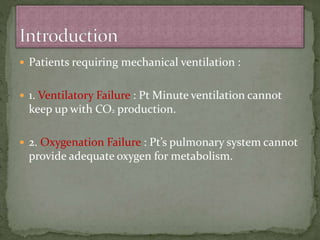
 Patients requiring mechanical ventilation :
 1. Ventilatory Failure : Pt Minute ventilation cannot
keep up with CO2 production.
 2. Oxygenation Failure : Pt’s pulmonary system cannot
provide adequate oxygen for metabolism.
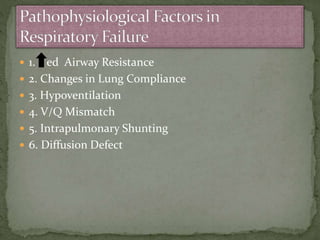
 1. ed Airway Resistance
 2. Changes in Lung Compliance
 3. Hypoventilation
 4. V/Q Mismatch
 5. Intrapulmonary Shunting
 6. Diffusion Defect
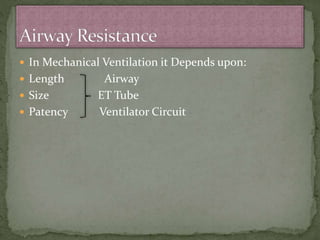
 In Mechanical Ventilation it Depends upon:
 Length Airway
 Size ET Tube
 Patency Ventilator Circuit
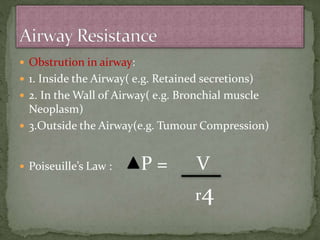
 Obstrution in airway:
 1. Inside the Airway( e.g. Retained secretions)
 2. In the Wall of Airway( e.g. Bronchial muscle
Neoplasm)
 3.Outside the Airway(e.g. Tumour Compression)
 Poiseuille’s Law : P = V
r4
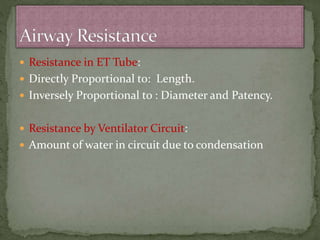
 Resistance in ET Tube:
 Directly Proportional to: Length.
 Inversely Proportional to : Diameter and Patency.
 Resistance by Ventilator Circuit:
 Amount of water in circuit due to condensation
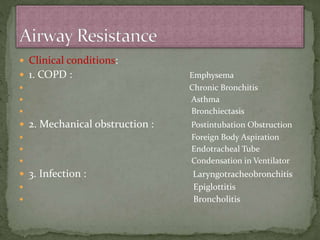
 Clinical conditions:
 1. COPD : Emphysema
 Chronic Bronchitis
 Asthma
 Bronchiectasis
 2. Mechanical obstruction : Postintubation Obstruction
 Foreign Body Aspiration
 Endotracheal Tube
 Condensation in Ventilator
 3. Infection : Laryngotracheobronchitis
 Epiglottitis
 Broncholitis
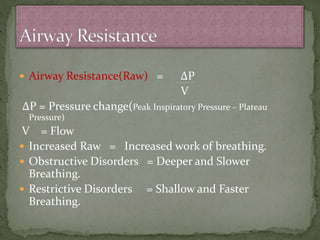
 Airway Resistance(Raw) = ∆P
V
∆P = Pressure change(Peak Inspiratory Pressure – Plateau
Pressure)
V = Flow
 Increased Raw = Increased work of breathing.
 Obstructive Disorders = Deeper and Slower
Breathing.
 Restrictive Disorders = Shallow and Faster
Breathing.
 Defination: Degree of lung expansion per unit pressure
change.
 C = ∆P
∆V
 Low Compliance(high elastance) :
 Stiff or Noncompliant lungs.
 High amount of work of breathing.
 Can be responsible for Refractory Hypoxemia.
 Occurs in Restrictive Lung diseases.
 Low lung volumes and Low minute ventilation.
 Increased Respiratory Rate.
 High Compliance :
 Increased FRC.
 Occurs in Obstructive Lung diseases.
 Incomplete Exhalation.
 Lack of elastic recoil.
 Emphysema: Chronic air trapping
Destruction of lung tissue
Enlargement of terminal and respiratory bronchioles
Impaired gas exchange
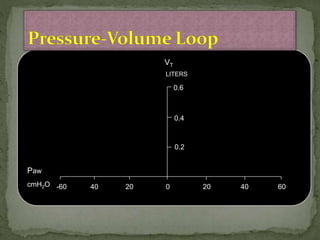
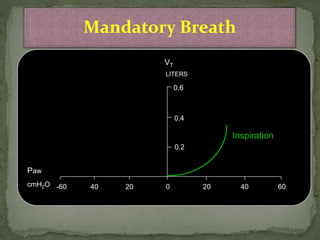
0 20 40 602040-60
0.2
LITERS
0.4
0.6
Paw
cmH2O
VT
Mandatory Breath
Inspiration
0 20 40 602040-60
0.2
LITERS
0.4
0.6
Paw
cmH2O
VT
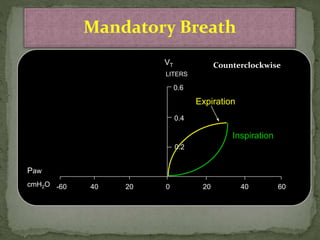
Mandatory Breath
Expiration
0 20 40 602040-60
0.2
LITERS
0.4
0.6
Paw
cmH2O
Inspiration
VT Counterclockwise
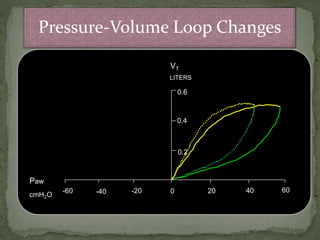
Pressure-Volume Loop Changes
0 20 40 60-20-40-60
0.2
0.4
0.6
LITERS
Paw
cmH2O
VT
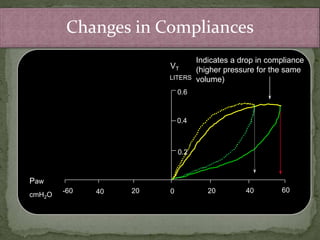
Changes in Compliances
Indicates a drop in compliance
(higher pressure for the same
volume)
0 20 40 602040-60
0.2
0.4
0.6
LITERS
Paw
cmH2O
VT
 Static Compliance:
 Measured when there is no air flow.
 Airway resistance is not a determing factor.
 Reflects the elastic resistance of lungs and chest wall.
 Dynamic Compliance:
 Measured when air flow is present.
 Airway resistance is a critical factor.
 Shows both the airway resistance and elastic
resistance.
 1.Obtain corrected expired tidal volume.
 2.Obtain Plateau Pressure by applying inspiratory hold
or occluding the Exhalation port at end expiration.
 3.Obtain Peak Inspiratory Pressure.
 4.Obtain Positive End Expiratory Pressure(PEEP) level.
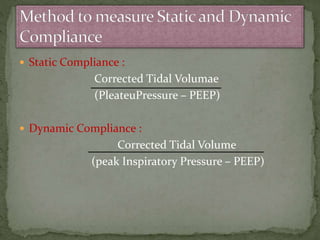
 Static Compliance :
Corrected Tidal Volumae
(PleateuPressure – PEEP)
 Dynamic Compliance :
Corrected Tidal Volume
(peak Inspiratory Pressure – PEEP)
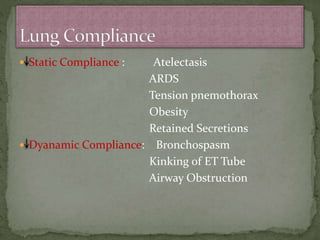
 Static Compliance : Atelectasis
ARDS
Tension pnemothorax
Obesity
Retained Secretions
 Dyanamic Compliance: Bronchospasm
Kinking of ET Tube
Airway Obstruction
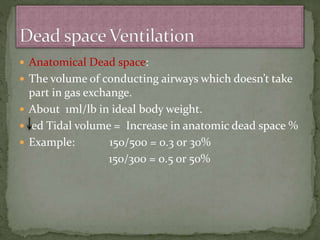
 Anatomical Dead space:
 The volume of conducting airways which doesn’t take
part in gas exchange.
 About 1ml/lb in ideal body weight.
 ed Tidal volume = Increase in anatomic dead space %
 Example: 150/500 = 0.3 or 30%
150/300 = 0.5 or 50%
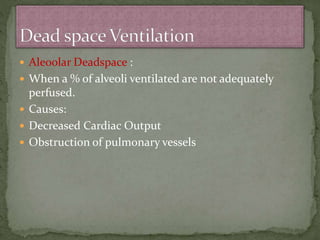
 Aleoolar Deadspace :
 When a % of alveoli ventilated are not adequately
perfused.
 Causes:
 Decreased Cardiac Output
 Obstruction of pulmonary vessels
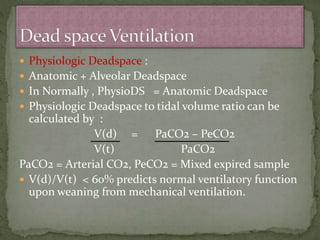
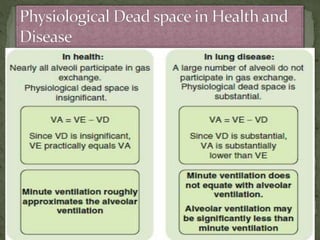
 Physiologic Deadspace :
 Anatomic + Alveolar Deadspace
 In Normally , PhysioDS = Anatomic Deadspace
 Physiologic Deadspace to tidal volume ratio can be
calculated by :
V(d) = PaCO2 – PeCO2
V(t) PaCO2
PaCO2 = Arterial CO2, PeCO2 = Mixed expired sample
 V(d)/V(t) < 60% predicts normal ventilatory function
upon weaning from mechanical ventilation.
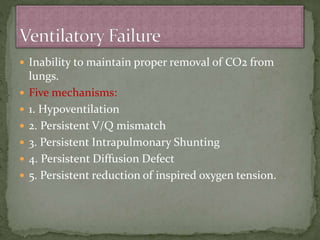
 Inability to maintain proper removal of CO2 from
lungs.
 Five mechanisms:
 1. Hypoventilation
 2. Persistent V/Q mismatch
 3. Persistent Intrapulmonary Shunting
 4. Persistent Diffusion Defect
 5. Persistent reduction of inspired oxygen tension.
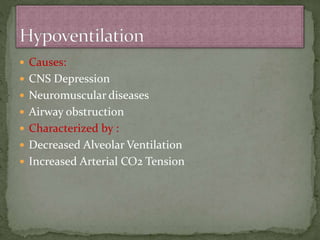
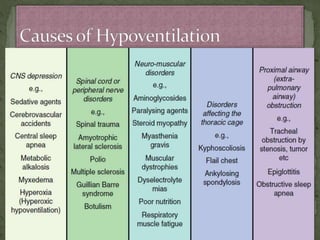
 Causes:
 CNS Depression
 Neuromuscular diseases
 Airway obstruction
 Characterized by :
 Decreased Alveolar Ventilation
 Increased Arterial CO2 Tension
 Alveolar Volume:
 Volume of tidal volume that takes part in gas
exchange.
 Va = V(t) – V(d)
 Proportional to Tidal volume
 Inversely proportional to Deadspace volume
 Minute Alveolar Ventilation:
Va = (Vt – Vd) x RR
 Amount of Ventilation
 Amount of Perfusion
 V/Q Ratio = 0.4 ( in lower lung zone) Because of Gravity
 = 0.3 ( in upper lung zone)
 V/Q Ratio Pulmonary Embolism
 V/Q Ratio Airway Obstruction
 ILD
 Hypoxemia due to mismatch can be corrected by :
 Increasing the Rate , Tidal volume and FiO2 on ventilator.
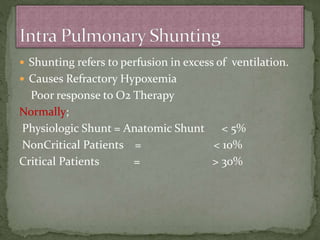
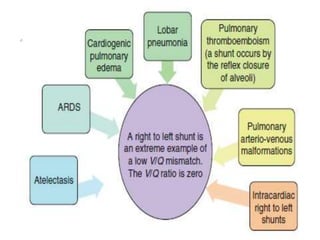
 Shunting refers to perfusion in excess of ventilation.
 Causes Refractory Hypoxemia
Poor response to O2 Therapy
Normally;
Physiologic Shunt = Anatomic Shunt < 5%
NonCritical Patients = < 10%
Critical Patients = > 30%
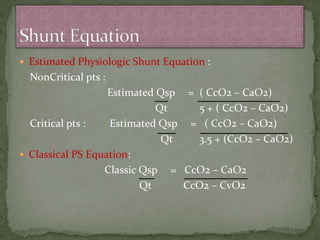
 Estimated Physiologic Shunt Equation :
NonCritical pts :
Estimated Qsp = ( CcO2 – CaO2)
Qt 5 + ( CcO2 – CaO2)
Critical pts : Estimated Qsp = ( CcO2 – CaO2)
Qt 3.5 + (CcO2 – CaO2)
 Classical PS Equation:
Classic Qsp = CcO2 – CaO2
Qt CcO2 – CvO2
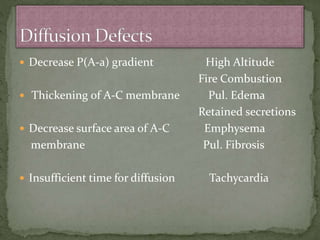
 Decrease P(A-a) gradient High Altitude
Fire Combustion
 Thickening of A-C membrane Pul. Edema
Retained secretions
 Decrease surface area of A-C Emphysema
membrane Pul. Fibrosis
 Insufficient time for diffusion Tachycardia
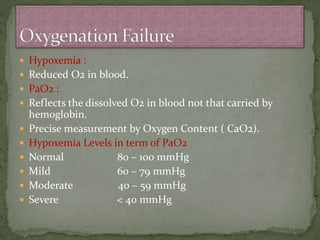
 Hypoxemia :
 Reduced O2 in blood.
 PaO2 :
 Reflects the dissolved O2 in blood not that carried by
hemoglobin.
 Precise measurement by Oxygen Content ( CaO2).
 Hypoxemia Levels in term of PaO2
 Normal 80 – 100 mmHg
 Mild 60 – 79 mmHg
 Moderate 40 – 59 mmHg
 Severe < 40 mmHg
 Hypoxia :
 Reduced O2 in Organs and tissues.
 Can occur with a normal PaO2.
 Four types :
 1. Hypoxic Hypoxia
 2. Histotoxic Hypoxia
 3. Stagnant Hypoxia
 4. Anemic Hypoxia
 Three Distinct Groups:
 1.Depressed Respiratory Drive
 2.Excessive Ventilatory Work load
 3.Failure of Ventilatory pump
 Depressed Respiratory Drive :
 Drug Overdose
 Acute Spinal cord injury
 Head trauma
 Neurological Dysfunction
 Sleep Disorders
 Metabolic Alkalosis
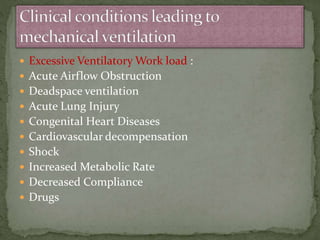
 Excessive Ventilatory Work load :
 Acute Airflow Obstruction
 Deadspace ventilation
 Acute Lung Injury
 Congenital Heart Diseases
 Cardiovascular decompensation
 Shock
 Increased Metabolic Rate
 Decreased Compliance
 Drugs
 Failure of Ventilatory pump:
 Chest Trauma
 Premature Birth
 Electrolyte Imbalance
 Geriatric Patients
Thank You

Principles of mechanical ventilation

  • 1.
    Presented by :Dr. Himanshu Jangid
  • 2.
     Patients requiringmechanical ventilation :  1. Ventilatory Failure : Pt Minute ventilation cannot keep up with CO2 production.  2. Oxygenation Failure : Pt’s pulmonary system cannot provide adequate oxygen for metabolism.
  • 3.
     1. edAirway Resistance  2. Changes in Lung Compliance  3. Hypoventilation  4. V/Q Mismatch  5. Intrapulmonary Shunting  6. Diffusion Defect
  • 4.
     In MechanicalVentilation it Depends upon:  Length Airway  Size ET Tube  Patency Ventilator Circuit
  • 5.
     Obstrution inairway:  1. Inside the Airway( e.g. Retained secretions)  2. In the Wall of Airway( e.g. Bronchial muscle Neoplasm)  3.Outside the Airway(e.g. Tumour Compression)  Poiseuille’s Law : P = V r4
  • 6.
     Resistance inET Tube:  Directly Proportional to: Length.  Inversely Proportional to : Diameter and Patency.  Resistance by Ventilator Circuit:  Amount of water in circuit due to condensation
  • 7.
     Clinical conditions: 1. COPD : Emphysema  Chronic Bronchitis  Asthma  Bronchiectasis  2. Mechanical obstruction : Postintubation Obstruction  Foreign Body Aspiration  Endotracheal Tube  Condensation in Ventilator  3. Infection : Laryngotracheobronchitis  Epiglottitis  Broncholitis
  • 8.
     Airway Resistance(Raw)= ∆P V ∆P = Pressure change(Peak Inspiratory Pressure – Plateau Pressure) V = Flow  Increased Raw = Increased work of breathing.  Obstructive Disorders = Deeper and Slower Breathing.  Restrictive Disorders = Shallow and Faster Breathing.
  • 9.
     Defination: Degreeof lung expansion per unit pressure change.  C = ∆P ∆V
  • 10.
     Low Compliance(highelastance) :  Stiff or Noncompliant lungs.  High amount of work of breathing.  Can be responsible for Refractory Hypoxemia.  Occurs in Restrictive Lung diseases.  Low lung volumes and Low minute ventilation.  Increased Respiratory Rate.
  • 11.
     High Compliance:  Increased FRC.  Occurs in Obstructive Lung diseases.  Incomplete Exhalation.  Lack of elastic recoil.  Emphysema: Chronic air trapping Destruction of lung tissue Enlargement of terminal and respiratory bronchioles Impaired gas exchange
  • 12.
    0 20 40602040-60 0.2 LITERS 0.4 0.6 Paw cmH2O VT
  • 13.
    Mandatory Breath Inspiration 0 2040 602040-60 0.2 LITERS 0.4 0.6 Paw cmH2O VT
  • 14.
    Mandatory Breath Expiration 0 2040 602040-60 0.2 LITERS 0.4 0.6 Paw cmH2O Inspiration VT Counterclockwise
  • 15.
    Pressure-Volume Loop Changes 020 40 60-20-40-60 0.2 0.4 0.6 LITERS Paw cmH2O VT
  • 16.
    Changes in Compliances Indicatesa drop in compliance (higher pressure for the same volume) 0 20 40 602040-60 0.2 0.4 0.6 LITERS Paw cmH2O VT
  • 17.
     Static Compliance: Measured when there is no air flow.  Airway resistance is not a determing factor.  Reflects the elastic resistance of lungs and chest wall.
  • 18.
     Dynamic Compliance: Measured when air flow is present.  Airway resistance is a critical factor.  Shows both the airway resistance and elastic resistance.
  • 19.
     1.Obtain correctedexpired tidal volume.  2.Obtain Plateau Pressure by applying inspiratory hold or occluding the Exhalation port at end expiration.  3.Obtain Peak Inspiratory Pressure.  4.Obtain Positive End Expiratory Pressure(PEEP) level.
  • 20.
     Static Compliance: Corrected Tidal Volumae (PleateuPressure – PEEP)  Dynamic Compliance : Corrected Tidal Volume (peak Inspiratory Pressure – PEEP)
  • 21.
     Static Compliance: Atelectasis ARDS Tension pnemothorax Obesity Retained Secretions  Dyanamic Compliance: Bronchospasm Kinking of ET Tube Airway Obstruction
  • 22.
     Anatomical Deadspace:  The volume of conducting airways which doesn’t take part in gas exchange.  About 1ml/lb in ideal body weight.  ed Tidal volume = Increase in anatomic dead space %  Example: 150/500 = 0.3 or 30% 150/300 = 0.5 or 50%
  • 23.
     Aleoolar Deadspace:  When a % of alveoli ventilated are not adequately perfused.  Causes:  Decreased Cardiac Output  Obstruction of pulmonary vessels
  • 24.
     Physiologic Deadspace:  Anatomic + Alveolar Deadspace  In Normally , PhysioDS = Anatomic Deadspace  Physiologic Deadspace to tidal volume ratio can be calculated by : V(d) = PaCO2 – PeCO2 V(t) PaCO2 PaCO2 = Arterial CO2, PeCO2 = Mixed expired sample  V(d)/V(t) < 60% predicts normal ventilatory function upon weaning from mechanical ventilation.
  • 26.
     Inability tomaintain proper removal of CO2 from lungs.  Five mechanisms:  1. Hypoventilation  2. Persistent V/Q mismatch  3. Persistent Intrapulmonary Shunting  4. Persistent Diffusion Defect  5. Persistent reduction of inspired oxygen tension.
  • 27.
     Causes:  CNSDepression  Neuromuscular diseases  Airway obstruction  Characterized by :  Decreased Alveolar Ventilation  Increased Arterial CO2 Tension
  • 29.
     Alveolar Volume: Volume of tidal volume that takes part in gas exchange.  Va = V(t) – V(d)  Proportional to Tidal volume  Inversely proportional to Deadspace volume  Minute Alveolar Ventilation: Va = (Vt – Vd) x RR
  • 30.
     Amount ofVentilation  Amount of Perfusion  V/Q Ratio = 0.4 ( in lower lung zone) Because of Gravity  = 0.3 ( in upper lung zone)  V/Q Ratio Pulmonary Embolism  V/Q Ratio Airway Obstruction  ILD  Hypoxemia due to mismatch can be corrected by :  Increasing the Rate , Tidal volume and FiO2 on ventilator.
  • 31.
     Shunting refersto perfusion in excess of ventilation.  Causes Refractory Hypoxemia Poor response to O2 Therapy Normally; Physiologic Shunt = Anatomic Shunt < 5% NonCritical Patients = < 10% Critical Patients = > 30%
  • 33.
     Estimated PhysiologicShunt Equation : NonCritical pts : Estimated Qsp = ( CcO2 – CaO2) Qt 5 + ( CcO2 – CaO2) Critical pts : Estimated Qsp = ( CcO2 – CaO2) Qt 3.5 + (CcO2 – CaO2)  Classical PS Equation: Classic Qsp = CcO2 – CaO2 Qt CcO2 – CvO2
  • 34.
     Decrease P(A-a)gradient High Altitude Fire Combustion  Thickening of A-C membrane Pul. Edema Retained secretions  Decrease surface area of A-C Emphysema membrane Pul. Fibrosis  Insufficient time for diffusion Tachycardia
  • 35.
     Hypoxemia : Reduced O2 in blood.  PaO2 :  Reflects the dissolved O2 in blood not that carried by hemoglobin.  Precise measurement by Oxygen Content ( CaO2).  Hypoxemia Levels in term of PaO2  Normal 80 – 100 mmHg  Mild 60 – 79 mmHg  Moderate 40 – 59 mmHg  Severe < 40 mmHg
  • 36.
     Hypoxia : Reduced O2 in Organs and tissues.  Can occur with a normal PaO2.  Four types :  1. Hypoxic Hypoxia  2. Histotoxic Hypoxia  3. Stagnant Hypoxia  4. Anemic Hypoxia
  • 37.
     Three DistinctGroups:  1.Depressed Respiratory Drive  2.Excessive Ventilatory Work load  3.Failure of Ventilatory pump
  • 38.
     Depressed RespiratoryDrive :  Drug Overdose  Acute Spinal cord injury  Head trauma  Neurological Dysfunction  Sleep Disorders  Metabolic Alkalosis
  • 39.
     Excessive VentilatoryWork load :  Acute Airflow Obstruction  Deadspace ventilation  Acute Lung Injury  Congenital Heart Diseases  Cardiovascular decompensation  Shock  Increased Metabolic Rate  Decreased Compliance  Drugs
  • 40.
     Failure ofVentilatory pump:  Chest Trauma  Premature Birth  Electrolyte Imbalance  Geriatric Patients
  • 41.