MECHNICAL
VENTILATION
DR MANISH SHARMA
Additional Superintendent
JK Lon Hospital
(
PAEDIATRIC INTENSIVIST
)
In Charge Accident/Emergency, JK Lon
Hospital, Jaipur
SMS MEDICAL COLLEGE , JAIPUR
• Mechanical Ventilation is ventilation
of the lungs by artificial means
usually by a ventilator.
• A ventilator delivers gas to the lungs
with either negative or positive
pressure.
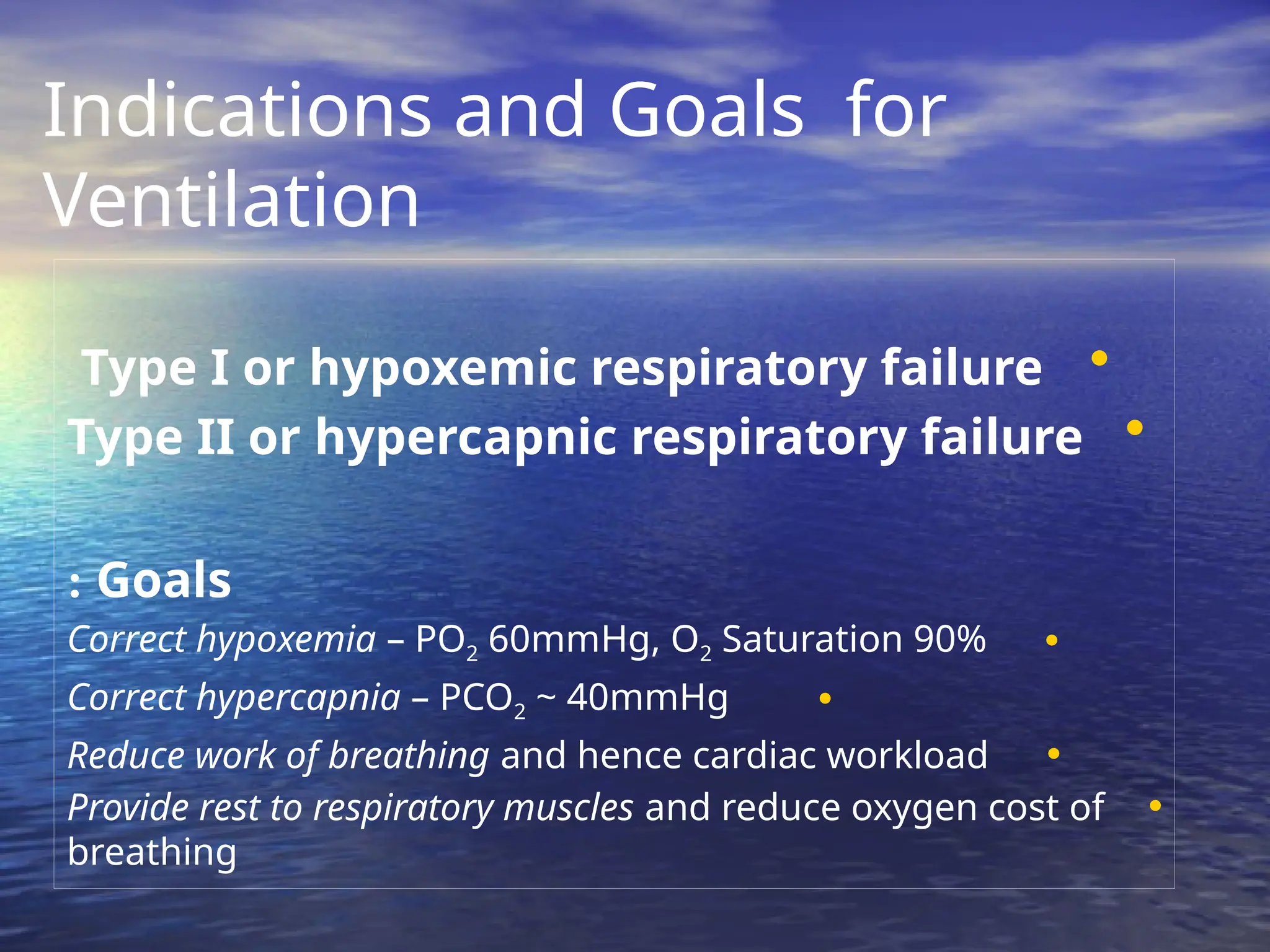
Indications and Goals for
Ventilation
•
Type I or hypoxemic respiratory failure
•
Type II or hypercapnic respiratory failure
Goals
:
•
Correct hypoxemia – PO2 60mmHg, O2 Saturation 90%
•
Correct hypercapnia – PCO2 ~ 40mmHg
•
Reduce work of breathing and hence cardiac workload
•
Provide rest to respiratory muscles and reduce oxygen cost of
breathing
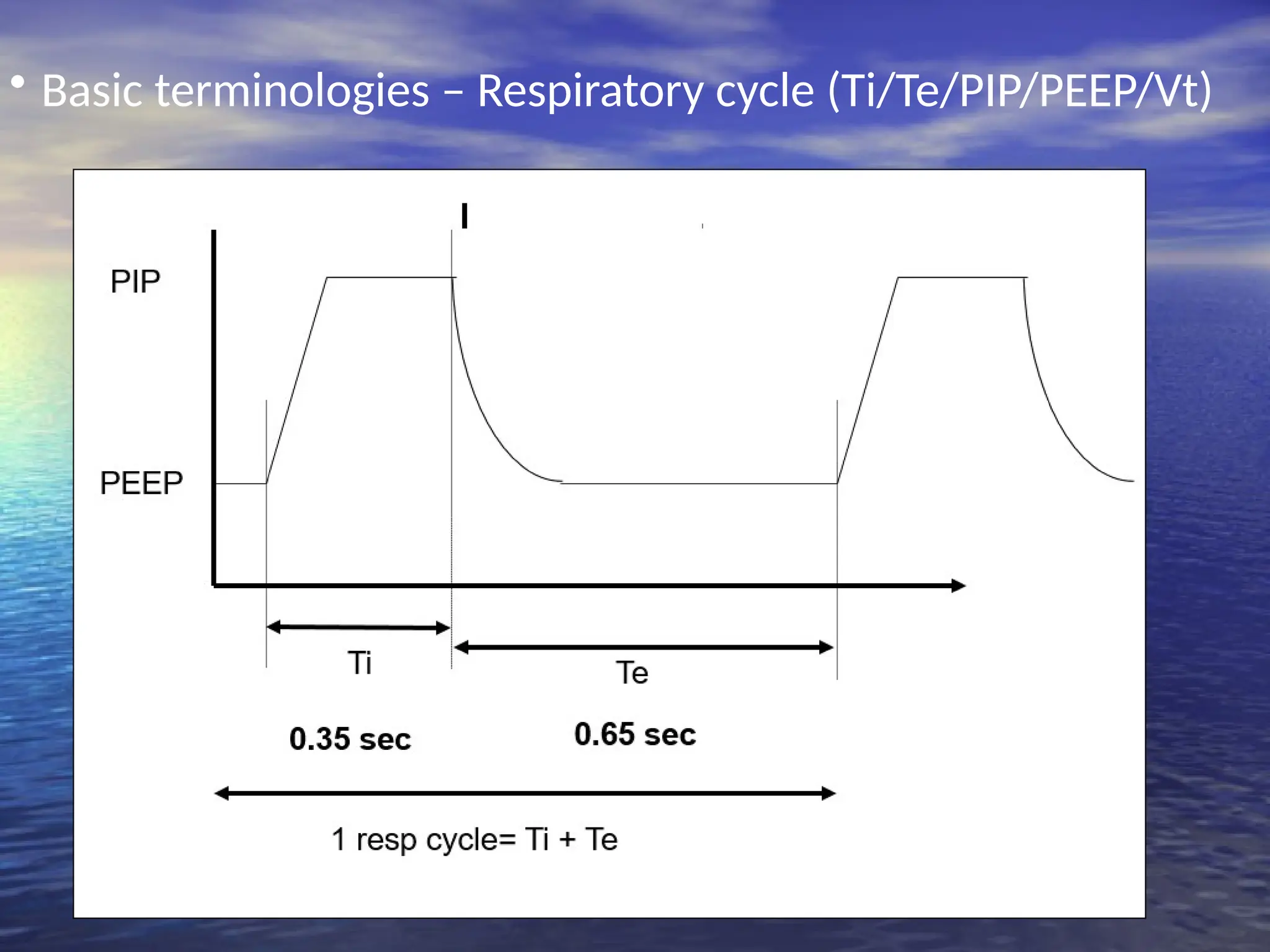
• Basic terminologies – Respiratory cycle (Ti/Te/PIP/PEEP/Vt)
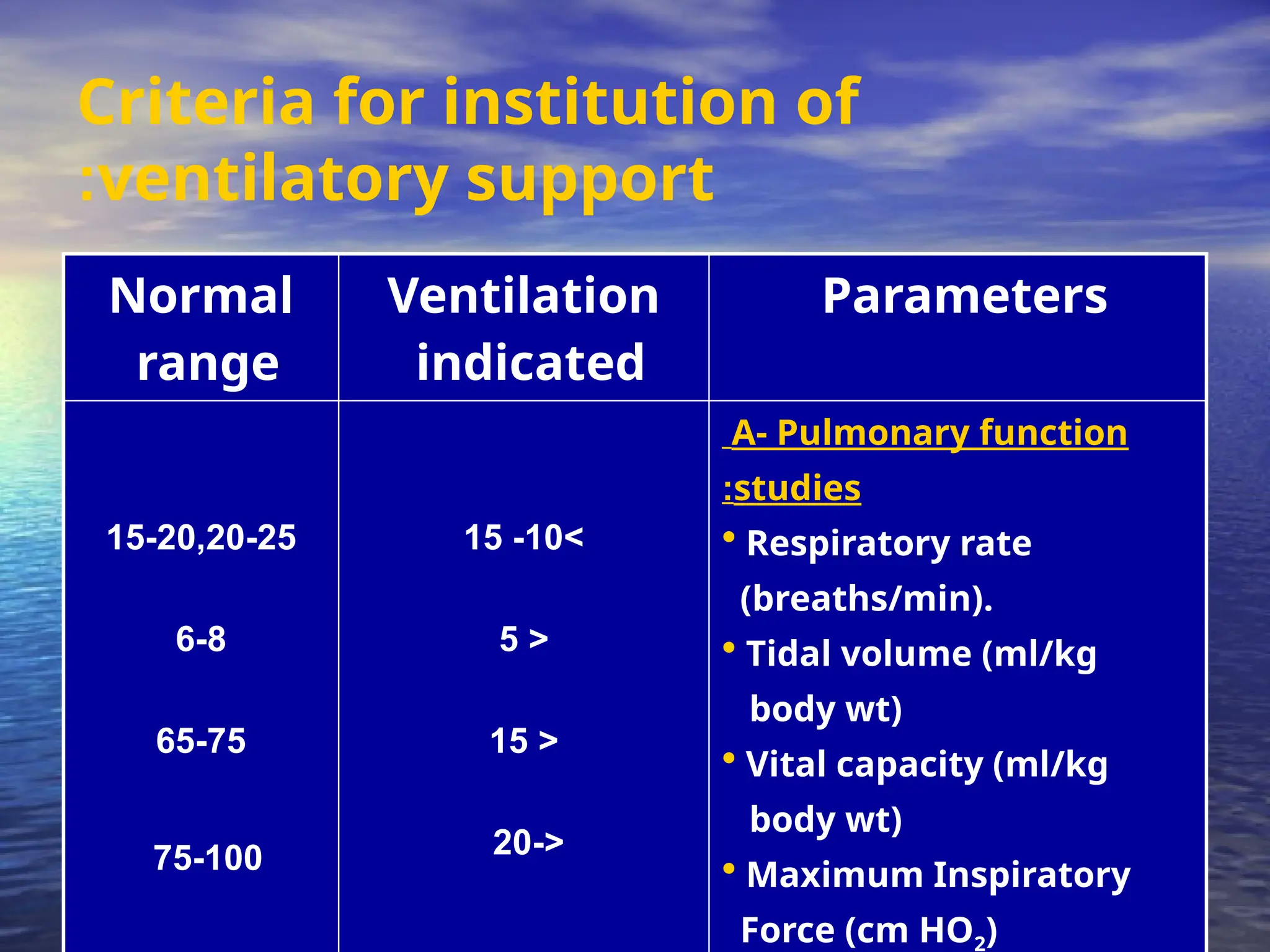
Criteria for institution of
ventilatory support
:
Normal
range
Ventilation
indicated
Parameters
15-20,20-25
6-8
65-75
75-100
>
10
-
15
<
5
<
15
-<
20
A- Pulmonary function
studies
:
• Respiratory rate
(breaths/min).
• Tidal volume (ml/kg
body wt)
• Vital capacity (ml/kg
body wt)
• Maximum Inspiratory
Force (cm HO2)
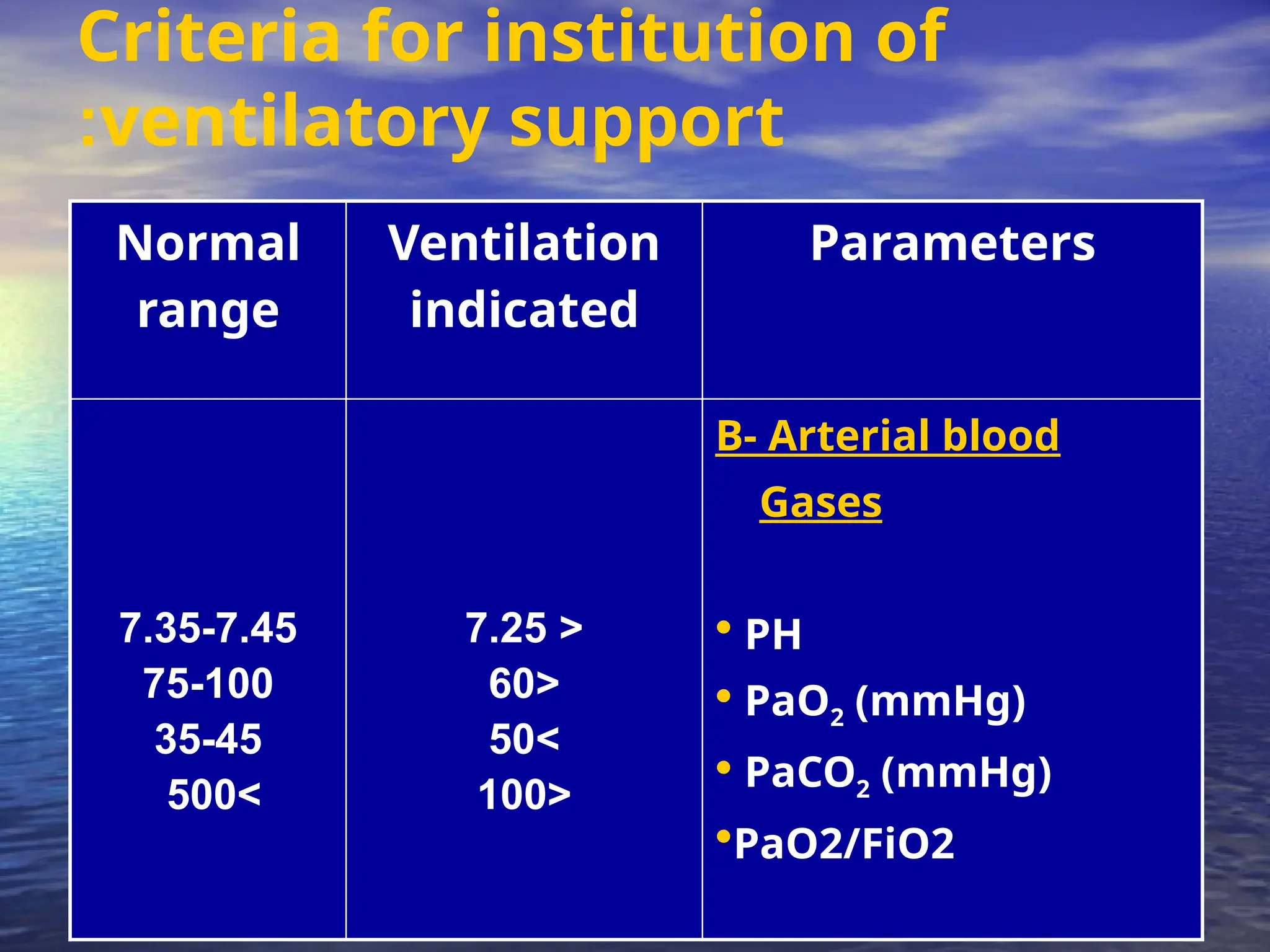
Criteria for institution of
ventilatory support
:
Normal
range
Ventilation
indicated
Parameters
7.35-7.45
75-100
35-45
>
500
<
7.25
<
60
>
50
<
100
B- Arterial blood
Gases
• PH
• PaO2 (mmHg)
• PaCO2 (mmHg)
•PaO2/FiO2
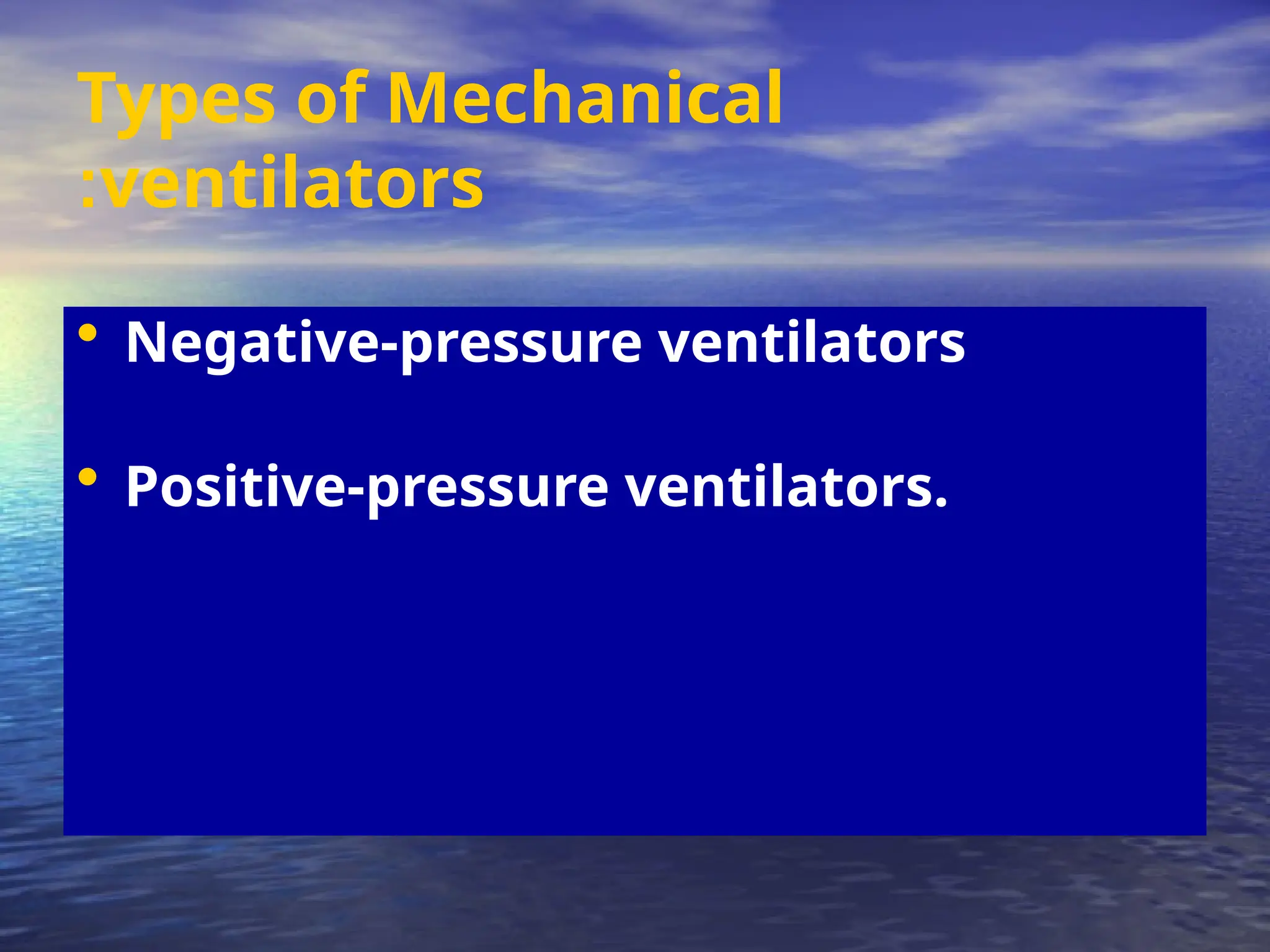
Types of Mechanical
ventilators
:
• Negative-pressure ventilators
• Positive-pressure ventilators.
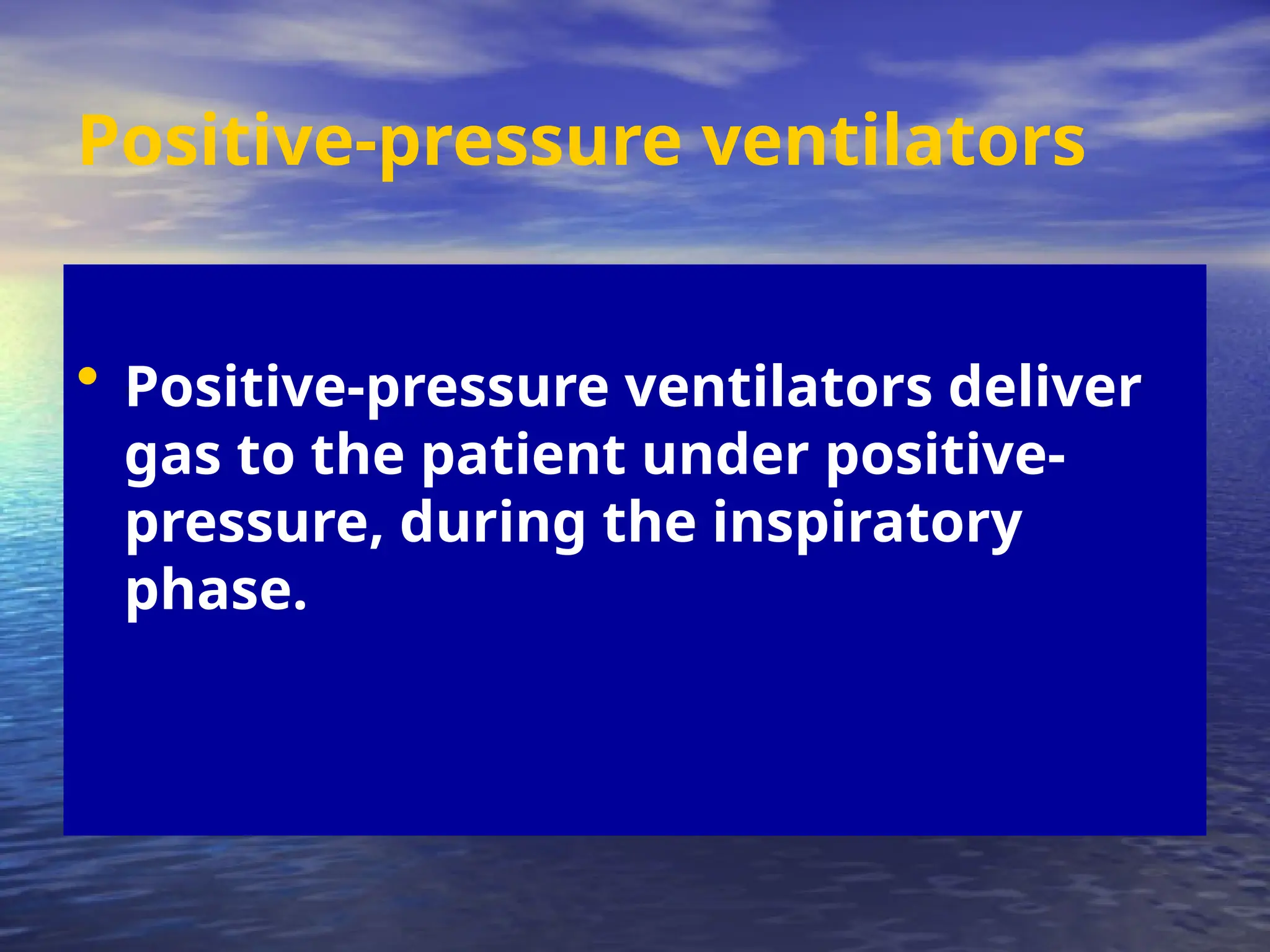
Positive-pressure ventilators
• Positive-pressure ventilators deliver
gas to the patient under positive-
pressure, during the inspiratory
phase.
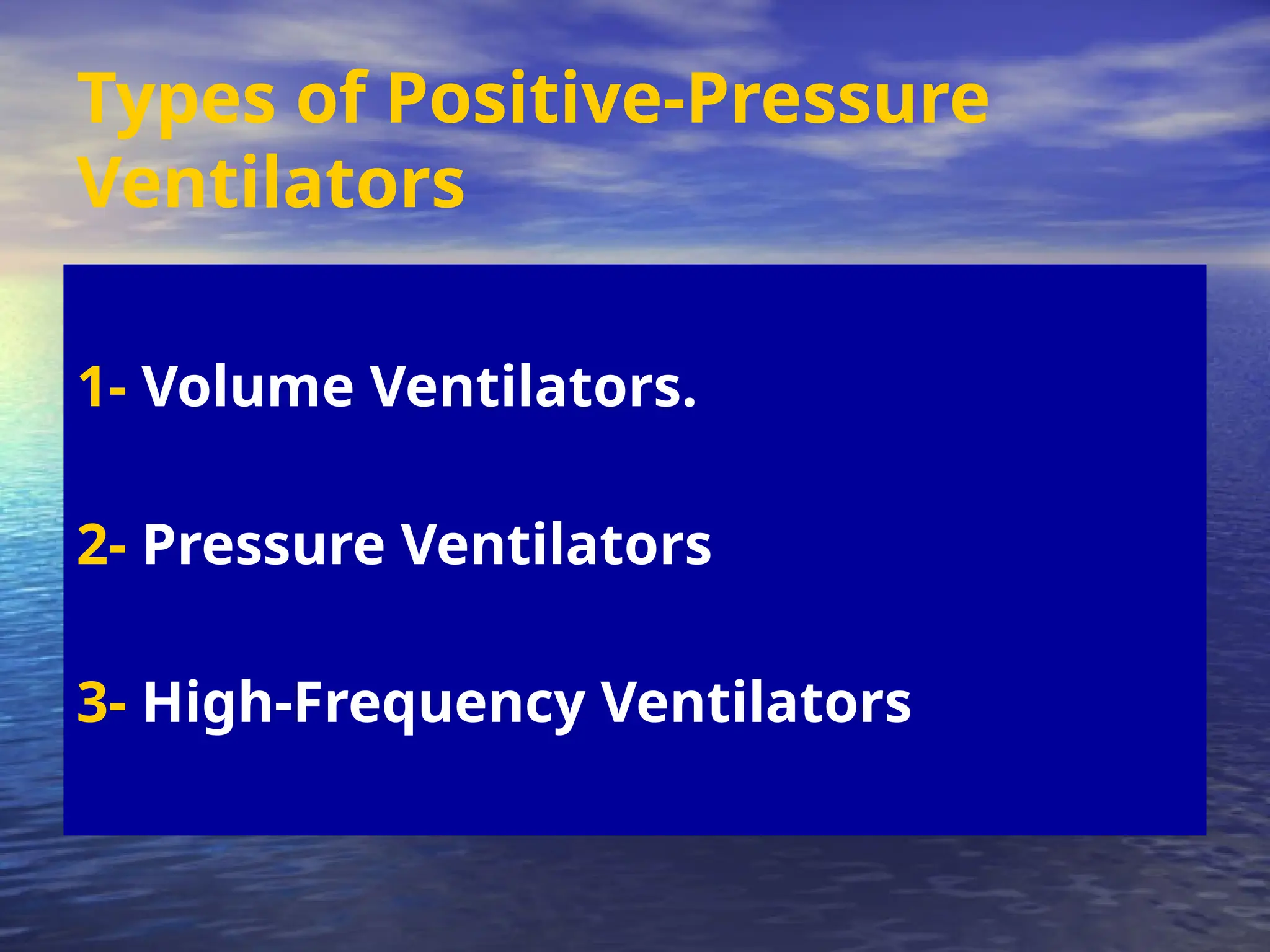
Types of Positive-Pressure
Ventilators
1- Volume Ventilators.
2- Pressure Ventilators
3- High-Frequency Ventilators
• The volume ventilator is commonly used in
critical care settings.
• The basic principle of this ventilator is that
a designated volume of air is delivered
with each breath.
• The amount of pressure required to deliver
the set volume depends on :-
- Patient’s lung compliance
- Patient–ventilator resistance factors.
1- Volume Ventilators
• Therefore, peak inspiratory pressure
(PIP ) must be monitored in volume
modes because it varies from breath
to breath.
• With this mode of ventilation, a
respiratory rate, inspiratory time,
and tidal volume are selected for the
mechanical breaths.
• The use of pressure ventilators is
increasing in critical care units.
• A typical pressure mode delivers a selected
gas pressure to the patient early in
inspiration, and sustains the pressure
throughout the inspiratory phase.
• By meeting the patient’s inspiratory flow
demand throughout inspiration, patient
effort is reduced and comfort increased.
2- Pressure Ventilators
• Although pressure is consistent with these
modes, volume is not.
• Volume will change with changes in
resistance or compliance,
• Therefore, exhaled tidal volume is the
variable to monitor closely.
• With pressure modes, the pressure level to
be delivered is selected, and with some
mode options (i.e., pressure controlled [PC],
described later), rate and inspiratory time
are preset as well.
3
-
High-Frequency Ventilators
• High-frequency ventilators use small
tidal volumes (1 to 3 mL/kg) at
frequencies greater than 100
breaths/minute.
• The high-frequency ventilator
accomplishes oxygenation by the
diffusion of oxygen and carbon
dioxide from high to low gradients of
concentration.
• This diffusion movement is increased
if the kinetic energy of the gas
molecules is increased.
• A high-frequency ventilator would be
used to achieve lower peak ventilator
pressures, thereby lowering the risk
of barotrauma.
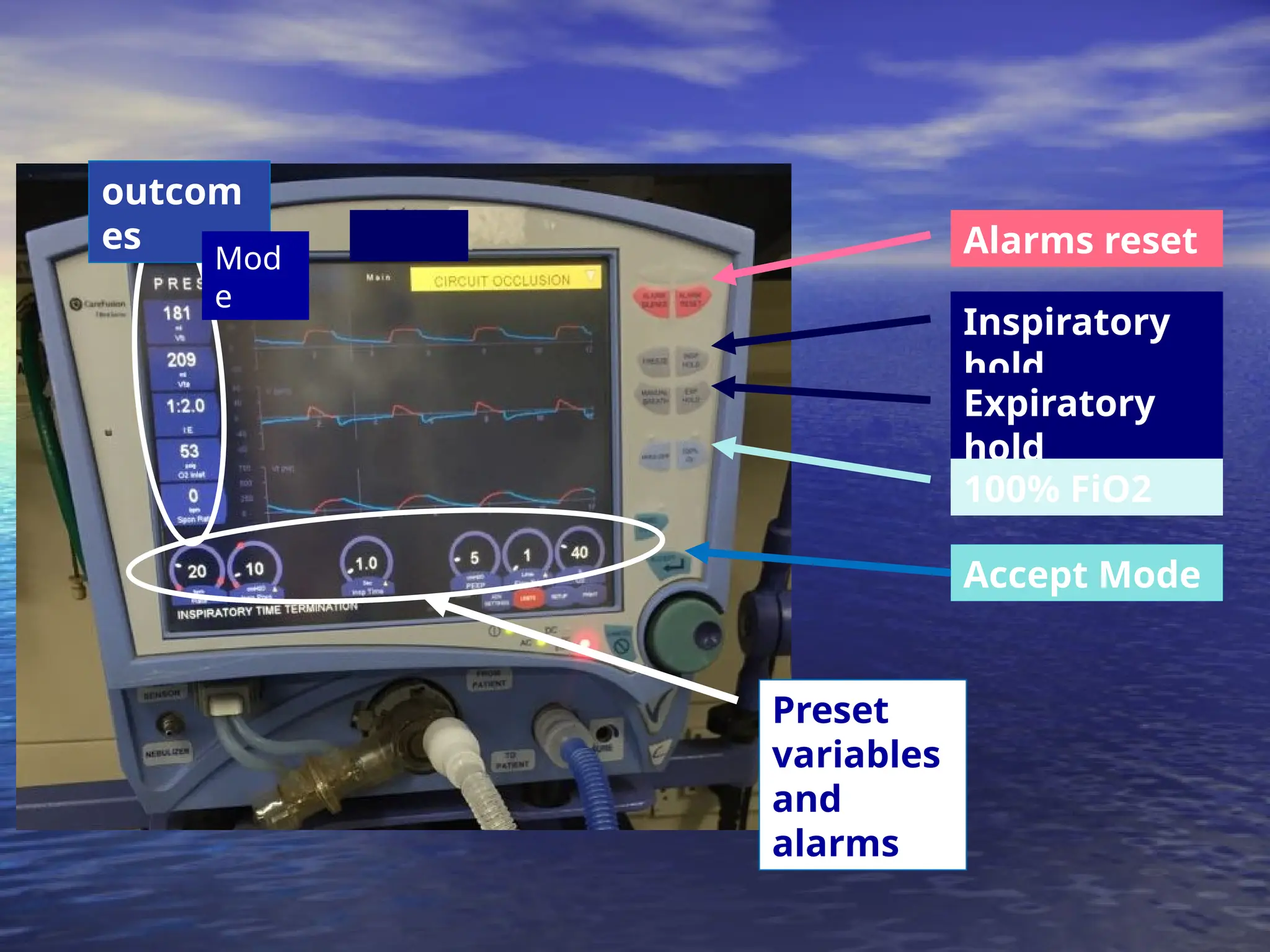
Inspiratory
hold
Expiratory
hold
100% FiO2
Accept Mode
Alarms reset
Preset
variables
and
alarms
outcom
es
Mod
e
Ventilator mode
• The way the machine ventilates the
patient
• How much the patient will participate
in his own ventilatory pattern.
• Each mode is different in determining
how much work of breathing the
patient has to do.
Modes of Mechanical Ventilation
A- Volume Modes
B- Pressure Modes
A- Volume Modes
1- Assist-control (A/C)
2- Synchronized intermittent
mandatory ventilation (SIMV)
1- Assist Control Mode A/C
• The ventilator provides the patient with a
pre-set tidal volume at a pre-set rate .
• The patient may initiate a breath on his
own, but the ventilator assists by delivering
a specified tidal volume to the patient.
• Patient can initiate breaths that are
delivered at the preset tidal volume.
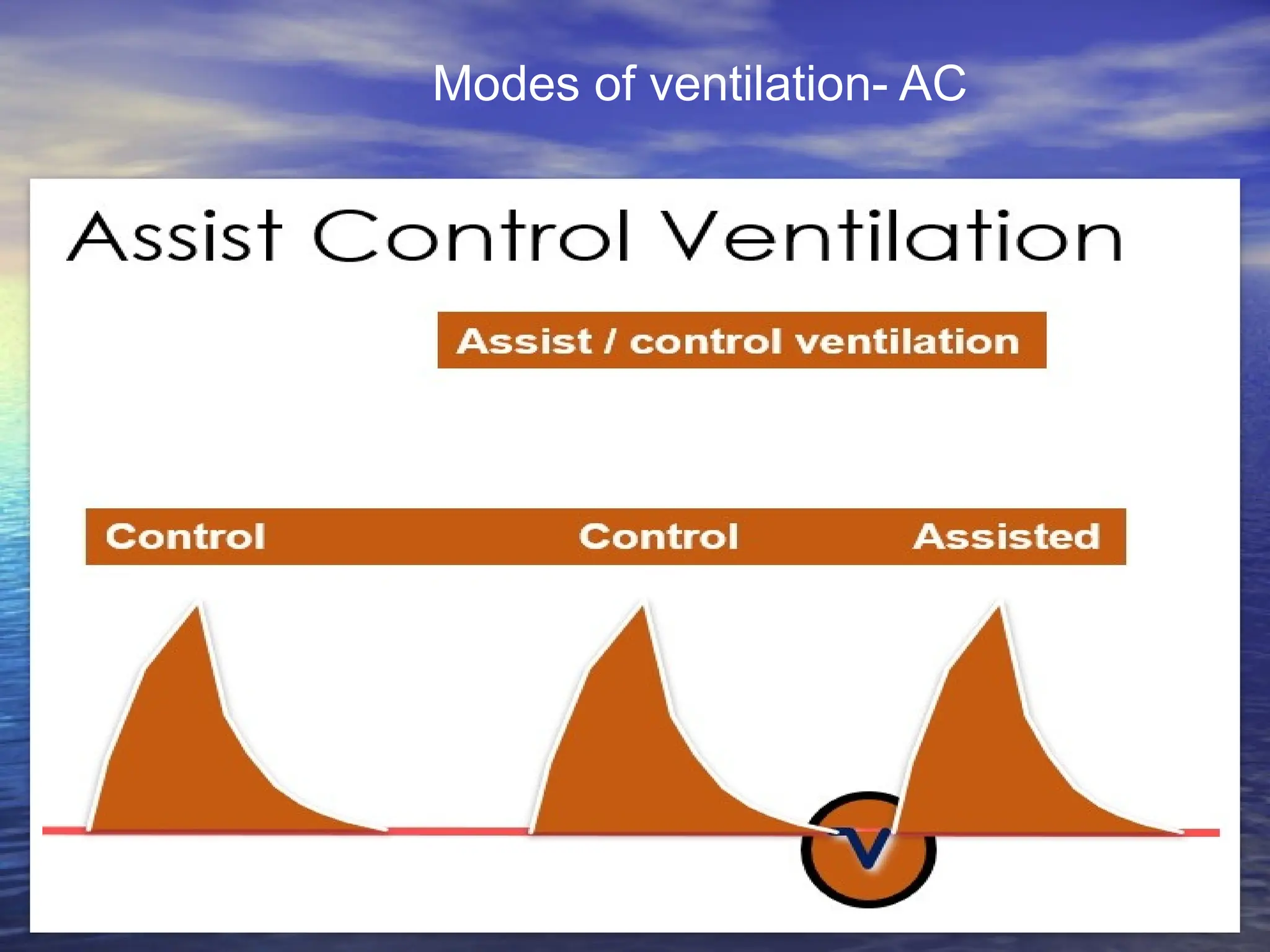
Modes of ventilation- AC
• The total respiratory rate is determined by
the number of spontaneous inspiration
initiated by the patient plus the number of
breaths set on the ventilator.
• In A/C mode, a mandatory (or “control”)
rate is selected.
• If the patient wishes to breathe faster, he
or she can trigger the ventilator and
receive a full-volume breath.
• Often used as initial mode of
ventilation
• When the patient is too weak to
perform the work of breathing (e.g.,
when emerging from anesthesia).
Disadvantages:
• Hyperventilation,
2
-
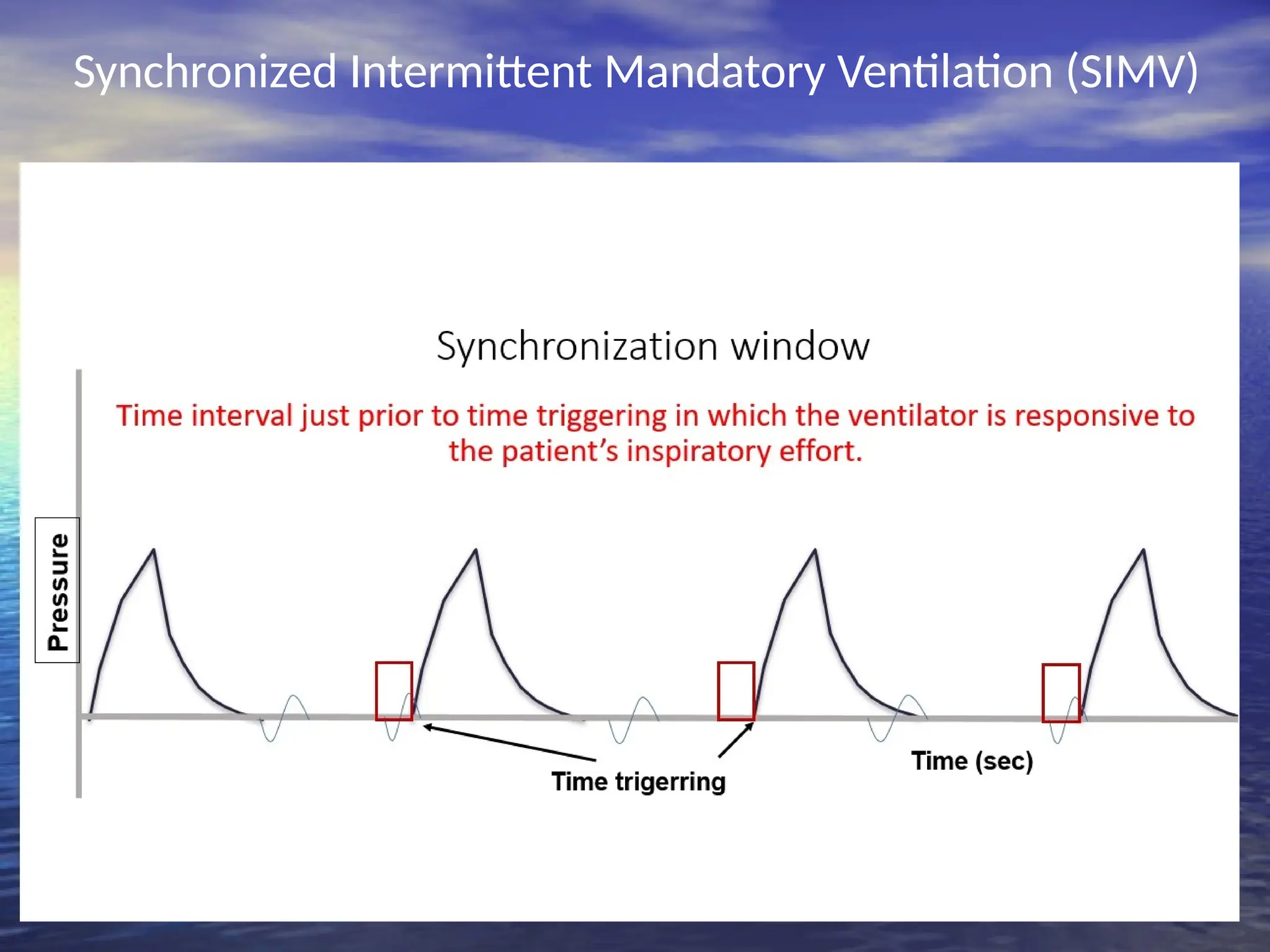
Synchronized Intermittent
Mandatory Ventilation (SIMV)
• The ventilator provides the patient with a pre-set
number of breaths/minute at a specified tidal
volume and FiO2.
• In between the ventilator-delivered breaths, the
patient is able to breathe spontaneously at his
own tidal volume and rate with no assistance
from the ventilator.
• However, unlike the A/C mode, any breaths taken
above the set rate are spontaneous breaths taken
through the ventilator circuit.
Synchronized Intermittent Mandatory Ventilation (SIMV)
• The tidal volume of these breaths can vary
drastically from the tidal volume set on the
ventilator, because the tidal volume is
determined by the patient’s spontaneous
effort.
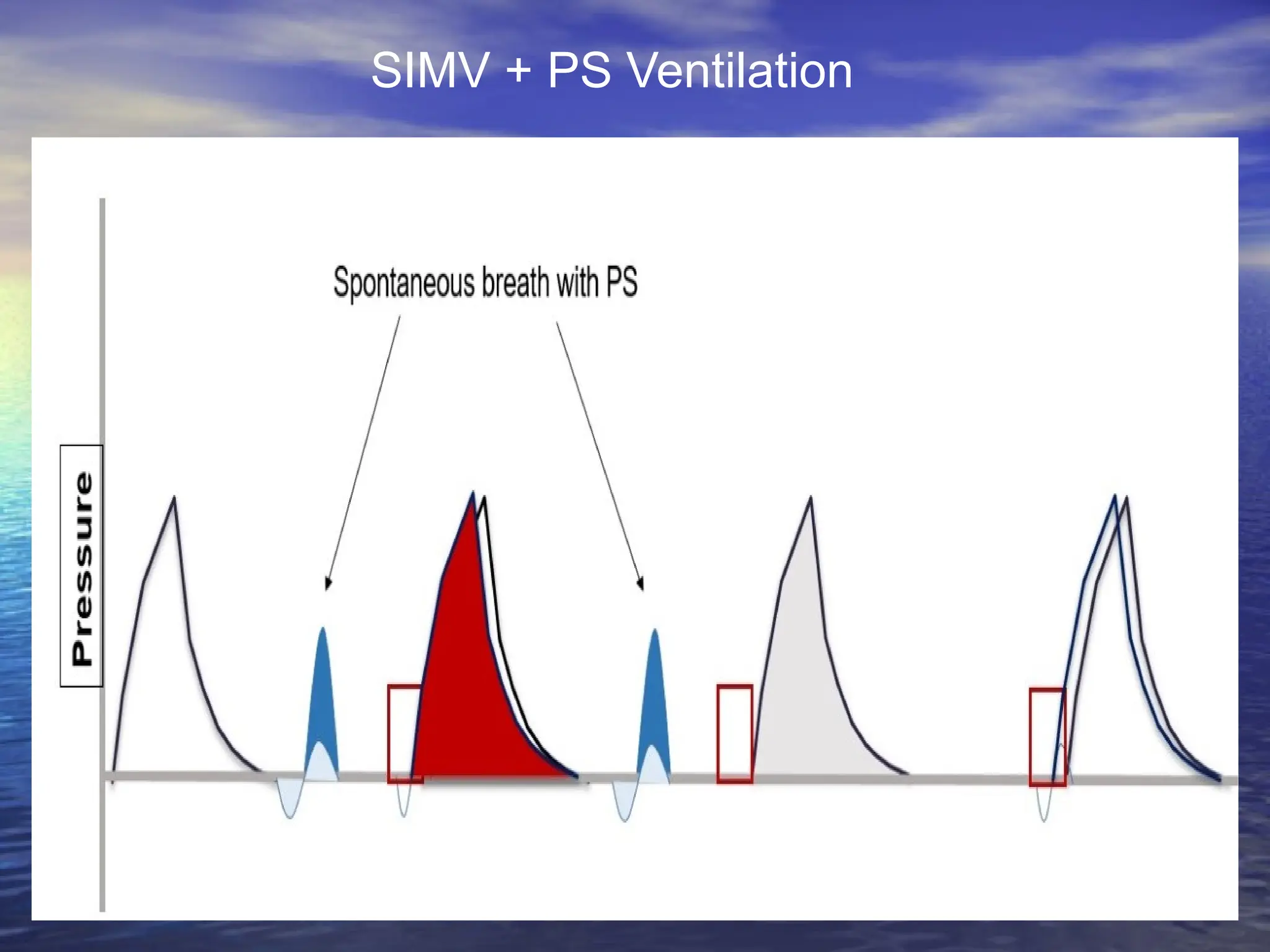
• Adding pressure support during
spontaneous breaths can minimize the risk
of increased work of breathing.
• Ventilators breaths are synchronized with
the patient spontaneous breathe.
( no fighting)
SIMV + PS Ventilation
B- Pressure Modes
1- Pressure-controlled ventilation (PCV)
2- Pressure-support ventilation (PSV)
3- Continuous positive airway pressure
(CPAP)
4- Positive end expiratory pressure (PEEP)
5- Noninvasive bilevel positive airway
pressure ventilation (BiPAP)
• Inverse ratio ventilation (IRV) mode
reverses this ratio so that inspiratory time
is equal to, or longer than, expiratory time
(1:1 to 4:1).
• Inverse I:E ratios are used in conjunction
with pressure control to improve
oxygenation by expanding stiff alveoli by
using longer distending times, thereby
providing more opportunity for gas
exchange and preventing alveolar collapse.
• Constant positive airway pressure during
spontaneous breathing
• CPAP allows the nurse to observe the
ability of the patient to breathe
spontaneously while still on the ventilator.
• CPAP can be used for intubated and
nonintubated patients.
• It may be used as a weaning mode and for
self breathing patients (nasal or mask
CPAP)
4
-
Continuous Positive Airway
Pressure (CPAP)
5
-
Positive end expiratory
pressure (PEEP)
• Positive pressure applied at the end
of expiration during mandatory 
ventilator breath
• positive end-expiratory pressure with
positive-pressure (machine) breaths.
Uses of CPAP & PEEP
• Prevent atelactasis or collapse of alveoli
• Treat atelactasis or collapse of alveoli
• Improve gas exchange & oxygenation
• Treat hypoxemia refractory to oxygen
therapy.(prevent oxygen toxicity
• Treat pulmonary edema ( pressure help
expulsion of fluids from alveoli
Common Ventilator Settings
parameters/ controls
• Fraction of inspired oxygen (FIO2)
• Tidal Volume (VT)
• Peak Flow/ Flow Rate
• Respiratory Rate/ Breath Rate /
Frequency ( F)
• Minute Volume (VE)
• I:E Ratio (Inspiration to Expiration
Ratio)
• Sigh
●
Fraction of inspired oxygen
(FIO2)
• The percent of oxygen concentration that
the patient is receiving from the ventilator.
(Between 21% & 100%)
(room air has 21% oxygen content).
• Initially a patient is placed on a high level
of FIO2 (60% or higher).
• Subsequent changes in FIO2 are based on
ABGs and the SaO2.
• In adult patients the initial FiO2 may be set at
100% until arterial blood gases can document
adequate oxygenation.
• An FiO2 of 100% for an extended period of time can
be dangerous ( oxygen toxicity) but it can protect
against hypoxemia
• For infants, and especially in premature infants,
high levels of FiO2 (>60%) should be avoided.
• Usually the FIO2 is adjusted to maintain an SaO2 of
greater than 90% (roughly equivalent to a PaO2
>60 mm Hg).
• Oxygen toxicity is a concern when an FIO2 of
greater than 60% is required for more than 25
hours
●
Tidal Volume (VT)
• The volume of air delivered to a patient
during a ventilator breath.
• The amount of air inspired and expired
with each breath.
• Usual volume selected is between 5 to 15
ml/ kg body weight)
●
Peak Flow/ Flow Rate
• The speed of delivering air per unit of
time, and is expressed in liters per
minute.
• The higher the flow rate, the faster
peak airway pressure is reached and
the shorter the inspiration;
• The lower the flow rate, the longer
the inspiration.
●
Respiratory Rate/ Breath
Rate / Frequency ( F)
• The number of breaths the ventilator will
deliver/minute (10-16 b/m).
• Total respiratory rate equals patient rate
plus ventilator rate.
• The nurse double-checks the functioning of
the ventilator by observing the patient’s
respiratory rate.
For adult patients and older children:-
With COPD
• A reduced tidal volume
• A reduced respiratory rate
For infants and younger children:-
• A small tidal volume
• Higher respiratory rate
●
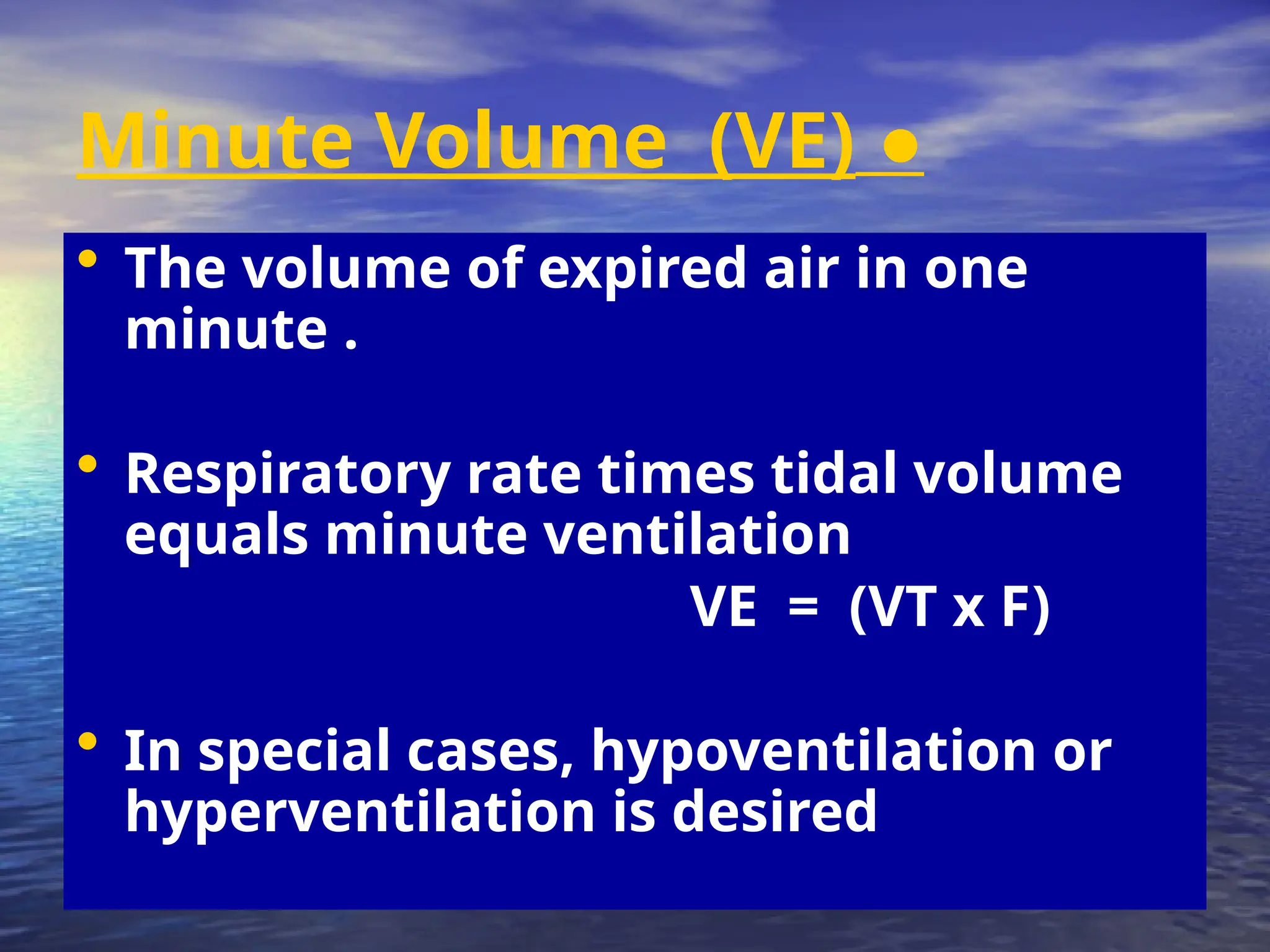
Minute Volume (VE)
• The volume of expired air in one
minute .
• Respiratory rate times tidal volume
equals minute ventilation
VE = (VT x F)
• In special cases, hypoventilation or
hyperventilation is desired
●
I:E Ratio (Inspiration to
Expiration Ratio)
-:
• The ratio of inspiratory time to
expiratory time during a breath
(Usually = 1:2)
●
Sensitivity(trigger Sensitivity)
• The sensitivity function controls the
amount of patient effort needed to initiate
an inspiration
• Increasing the sensitivity (requiring less
negative force) decreases the amount of
work the patient must do to initiate a
ventilator breath.
• Decreasing the sensitivity increases the
amount of negative pressure that the
patient needs to initiate inspiration and
increases the work of breathing.
Ensuring humidification and
thermoregulation
• All air delivered by the ventilator passes through
the water in the humidifier, where it is warmed
and saturated.
• Humidifier temperatures should be kept close to
body temperature 35 ºC- 37ºC.
• In some rare instances (severe hypothermia), the
air temperatures can be increased.
• The humidifier should be checked for adequate
water levels
Complications
of Mechanical Ventilation:-
I- Airway Complications,
II- Mechanical complications,
III- Physiological Complications,
IV- Artificial Airway Complications.
Nursing care of patients on
mechanical ventilation
Assessment:
1- Assess the patient
2- Assess the artificial airway (tracheostomy
or endotracheal tube)
3- Assess the ventilator
Nursing Interventions
1-Maintain airway patency &
oxygenation
2- Promote comfort
3- Maintain fluid & electrolytes balance
4- Maintain nutritional state
5- Maintain urinary & bowel
elimination
6- Maintain eye , mouth and cleanliness
and integrity:-
7- Maintain mobility/ musculoskeletal
function:-
Nursing Interventions
8- Maintain safety:-
9- Provide psychological support
10- Facilitate communication
11- Provide psychological support &
information to family
12- Responding to ventilator alarms
/Troublshooting
ventilator alarms
13- Prevent nosocomial infection
14- Documentation
Noninvasive Bilateral Positive
Airway Pressure Ventilation (BiPAP)
• BiPAP is a noninvasive form of mechanical
ventilation provided by means of a nasal
mask or nasal prongs, or a full-face mask.
• The system allows the clinician to select
two levels of positive-pressure support:
• An inspiratory pressure support level
(referred to as IPAP)
• An expiratory pressure called EPAP
(PEEP/CPAP level).
Criteria for Using of CPAP or
BiPAP
:
•
Patients who are candidates for CPAP or
BiPAP should meet the following general
criteria
:
•
Awake
•
Able to follow basic commands
•
Protect their airway
•
Not actively vomiting
•
Not having seizures
Initial BiPAP Settings
:
•
Common initial inspiratory positive airway pressure (IPAP) is
10 cm H20 (larger patients may need 15 cm H20)
•
Expiratory positive airway pressure (EPAP) is 5 cm H20
•
Adjust from there usually by 2-5 cm H20
•
Rate of 10-12 breaths per minute (can increase rate if needing
to get rid of more CO2)
•
FiO2 initially is set at 100% and then titrated down once
stabilized
High airway pressure
•
-
in addition to providing alarm breath should be
pressure limited and thus patient will only receive
part of the preset tidal volume
- if pressure limit is repeatedly exceeded patient
should be disconnected and manually ventilated
while problem diagnosed. Initial steps are to check
for ETT blockage and ventilator malfunction. Other
factors to consider are airway resistance,
pneumothorax, endobronchial intubation
- causes of high airway pressures include
:
High airway pressure
•
Asynchronous breathing
•
Low compliance (high peak and plateau pressures):
- endobronchial intubation
- pulmonary pathology
pneumothorax
- hyperinflation: dynamic, obstructed PEEP valve or
expiratory port, excessive PEEP
- ascites
•
Increased system resistance (high peak pressures
only):
- obstruction to flow in circuit, tracheal tube
- malplaced ETT
-bronchospasm
- aspiration/secretions
Tidal volume
•
Causes of low tidal volume in pressure
preset modes
:
•
Asynchronous breathing
•
Decreased compliance
•
Increased system resistance
•
Inadequate preset pressure
•
Gas leak
Thanks

Mechanical Ventilation , principle of MV

  • 1.
    MECHNICAL VENTILATION DR MANISH SHARMA AdditionalSuperintendent JK Lon Hospital ( PAEDIATRIC INTENSIVIST ) In Charge Accident/Emergency, JK Lon Hospital, Jaipur SMS MEDICAL COLLEGE , JAIPUR
  • 2.
    • Mechanical Ventilationis ventilation of the lungs by artificial means usually by a ventilator. • A ventilator delivers gas to the lungs with either negative or positive pressure.
  • 3.
    Indications and Goalsfor Ventilation • Type I or hypoxemic respiratory failure • Type II or hypercapnic respiratory failure Goals : • Correct hypoxemia – PO2 60mmHg, O2 Saturation 90% • Correct hypercapnia – PCO2 ~ 40mmHg • Reduce work of breathing and hence cardiac workload • Provide rest to respiratory muscles and reduce oxygen cost of breathing
  • 5.
    • Basic terminologies– Respiratory cycle (Ti/Te/PIP/PEEP/Vt)
  • 6.
    Criteria for institutionof ventilatory support : Normal range Ventilation indicated Parameters 15-20,20-25 6-8 65-75 75-100 > 10 - 15 < 5 < 15 -< 20 A- Pulmonary function studies : • Respiratory rate (breaths/min). • Tidal volume (ml/kg body wt) • Vital capacity (ml/kg body wt) • Maximum Inspiratory Force (cm HO2)
  • 7.
    Criteria for institutionof ventilatory support : Normal range Ventilation indicated Parameters 7.35-7.45 75-100 35-45 > 500 < 7.25 < 60 > 50 < 100 B- Arterial blood Gases • PH • PaO2 (mmHg) • PaCO2 (mmHg) •PaO2/FiO2
  • 8.
    Types of Mechanical ventilators : •Negative-pressure ventilators • Positive-pressure ventilators.
  • 9.
    Positive-pressure ventilators • Positive-pressureventilators deliver gas to the patient under positive- pressure, during the inspiratory phase.
  • 10.
    Types of Positive-Pressure Ventilators 1-Volume Ventilators. 2- Pressure Ventilators 3- High-Frequency Ventilators
  • 11.
    • The volumeventilator is commonly used in critical care settings. • The basic principle of this ventilator is that a designated volume of air is delivered with each breath. • The amount of pressure required to deliver the set volume depends on :- - Patient’s lung compliance - Patient–ventilator resistance factors. 1- Volume Ventilators
  • 12.
    • Therefore, peakinspiratory pressure (PIP ) must be monitored in volume modes because it varies from breath to breath. • With this mode of ventilation, a respiratory rate, inspiratory time, and tidal volume are selected for the mechanical breaths.
  • 13.
    • The useof pressure ventilators is increasing in critical care units. • A typical pressure mode delivers a selected gas pressure to the patient early in inspiration, and sustains the pressure throughout the inspiratory phase. • By meeting the patient’s inspiratory flow demand throughout inspiration, patient effort is reduced and comfort increased. 2- Pressure Ventilators
  • 14.
    • Although pressureis consistent with these modes, volume is not. • Volume will change with changes in resistance or compliance, • Therefore, exhaled tidal volume is the variable to monitor closely. • With pressure modes, the pressure level to be delivered is selected, and with some mode options (i.e., pressure controlled [PC], described later), rate and inspiratory time are preset as well.
  • 15.
    3 - High-Frequency Ventilators • High-frequencyventilators use small tidal volumes (1 to 3 mL/kg) at frequencies greater than 100 breaths/minute. • The high-frequency ventilator accomplishes oxygenation by the diffusion of oxygen and carbon dioxide from high to low gradients of concentration.
  • 16.
    • This diffusionmovement is increased if the kinetic energy of the gas molecules is increased. • A high-frequency ventilator would be used to achieve lower peak ventilator pressures, thereby lowering the risk of barotrauma.
  • 17.
    Inspiratory hold Expiratory hold 100% FiO2 Accept Mode Alarmsreset Preset variables and alarms outcom es Mod e
  • 18.
    Ventilator mode • Theway the machine ventilates the patient • How much the patient will participate in his own ventilatory pattern. • Each mode is different in determining how much work of breathing the patient has to do.
  • 19.
    Modes of MechanicalVentilation A- Volume Modes B- Pressure Modes
  • 20.
    A- Volume Modes 1-Assist-control (A/C) 2- Synchronized intermittent mandatory ventilation (SIMV)
  • 21.
    1- Assist ControlMode A/C • The ventilator provides the patient with a pre-set tidal volume at a pre-set rate . • The patient may initiate a breath on his own, but the ventilator assists by delivering a specified tidal volume to the patient. • Patient can initiate breaths that are delivered at the preset tidal volume.
  • 22.
  • 23.
    • The totalrespiratory rate is determined by the number of spontaneous inspiration initiated by the patient plus the number of breaths set on the ventilator. • In A/C mode, a mandatory (or “control”) rate is selected. • If the patient wishes to breathe faster, he or she can trigger the ventilator and receive a full-volume breath.
  • 24.
    • Often usedas initial mode of ventilation • When the patient is too weak to perform the work of breathing (e.g., when emerging from anesthesia). Disadvantages: • Hyperventilation,
  • 25.
    2 - Synchronized Intermittent Mandatory Ventilation(SIMV) • The ventilator provides the patient with a pre-set number of breaths/minute at a specified tidal volume and FiO2. • In between the ventilator-delivered breaths, the patient is able to breathe spontaneously at his own tidal volume and rate with no assistance from the ventilator. • However, unlike the A/C mode, any breaths taken above the set rate are spontaneous breaths taken through the ventilator circuit.
  • 26.
  • 27.
    • The tidalvolume of these breaths can vary drastically from the tidal volume set on the ventilator, because the tidal volume is determined by the patient’s spontaneous effort. • Adding pressure support during spontaneous breaths can minimize the risk of increased work of breathing. • Ventilators breaths are synchronized with the patient spontaneous breathe. ( no fighting)
  • 28.
    SIMV + PSVentilation
  • 29.
    B- Pressure Modes 1-Pressure-controlled ventilation (PCV) 2- Pressure-support ventilation (PSV) 3- Continuous positive airway pressure (CPAP) 4- Positive end expiratory pressure (PEEP) 5- Noninvasive bilevel positive airway pressure ventilation (BiPAP)
  • 30.
    • Inverse ratioventilation (IRV) mode reverses this ratio so that inspiratory time is equal to, or longer than, expiratory time (1:1 to 4:1). • Inverse I:E ratios are used in conjunction with pressure control to improve oxygenation by expanding stiff alveoli by using longer distending times, thereby providing more opportunity for gas exchange and preventing alveolar collapse.
  • 31.
    • Constant positiveairway pressure during spontaneous breathing • CPAP allows the nurse to observe the ability of the patient to breathe spontaneously while still on the ventilator. • CPAP can be used for intubated and nonintubated patients. • It may be used as a weaning mode and for self breathing patients (nasal or mask CPAP) 4 - Continuous Positive Airway Pressure (CPAP)
  • 32.
    5 - Positive end expiratory pressure(PEEP) • Positive pressure applied at the end of expiration during mandatory ventilator breath • positive end-expiratory pressure with positive-pressure (machine) breaths.
  • 33.
    Uses of CPAP& PEEP • Prevent atelactasis or collapse of alveoli • Treat atelactasis or collapse of alveoli • Improve gas exchange & oxygenation • Treat hypoxemia refractory to oxygen therapy.(prevent oxygen toxicity • Treat pulmonary edema ( pressure help expulsion of fluids from alveoli
  • 34.
    Common Ventilator Settings parameters/controls • Fraction of inspired oxygen (FIO2) • Tidal Volume (VT) • Peak Flow/ Flow Rate • Respiratory Rate/ Breath Rate / Frequency ( F) • Minute Volume (VE) • I:E Ratio (Inspiration to Expiration Ratio) • Sigh
  • 35.
    ● Fraction of inspiredoxygen (FIO2) • The percent of oxygen concentration that the patient is receiving from the ventilator. (Between 21% & 100%) (room air has 21% oxygen content). • Initially a patient is placed on a high level of FIO2 (60% or higher). • Subsequent changes in FIO2 are based on ABGs and the SaO2.
  • 36.
    • In adultpatients the initial FiO2 may be set at 100% until arterial blood gases can document adequate oxygenation. • An FiO2 of 100% for an extended period of time can be dangerous ( oxygen toxicity) but it can protect against hypoxemia • For infants, and especially in premature infants, high levels of FiO2 (>60%) should be avoided. • Usually the FIO2 is adjusted to maintain an SaO2 of greater than 90% (roughly equivalent to a PaO2 >60 mm Hg). • Oxygen toxicity is a concern when an FIO2 of greater than 60% is required for more than 25 hours
  • 37.
    ● Tidal Volume (VT) •The volume of air delivered to a patient during a ventilator breath. • The amount of air inspired and expired with each breath. • Usual volume selected is between 5 to 15 ml/ kg body weight)
  • 38.
    ● Peak Flow/ FlowRate • The speed of delivering air per unit of time, and is expressed in liters per minute. • The higher the flow rate, the faster peak airway pressure is reached and the shorter the inspiration; • The lower the flow rate, the longer the inspiration.
  • 39.
    ● Respiratory Rate/ Breath Rate/ Frequency ( F) • The number of breaths the ventilator will deliver/minute (10-16 b/m). • Total respiratory rate equals patient rate plus ventilator rate. • The nurse double-checks the functioning of the ventilator by observing the patient’s respiratory rate.
  • 40.
    For adult patientsand older children:- With COPD • A reduced tidal volume • A reduced respiratory rate For infants and younger children:- • A small tidal volume • Higher respiratory rate
  • 41.
    ● Minute Volume (VE) •The volume of expired air in one minute . • Respiratory rate times tidal volume equals minute ventilation VE = (VT x F) • In special cases, hypoventilation or hyperventilation is desired
  • 42.
    ● I:E Ratio (Inspirationto Expiration Ratio) -: • The ratio of inspiratory time to expiratory time during a breath (Usually = 1:2)
  • 43.
    ● Sensitivity(trigger Sensitivity) • Thesensitivity function controls the amount of patient effort needed to initiate an inspiration • Increasing the sensitivity (requiring less negative force) decreases the amount of work the patient must do to initiate a ventilator breath. • Decreasing the sensitivity increases the amount of negative pressure that the patient needs to initiate inspiration and increases the work of breathing.
  • 44.
    Ensuring humidification and thermoregulation •All air delivered by the ventilator passes through the water in the humidifier, where it is warmed and saturated. • Humidifier temperatures should be kept close to body temperature 35 ºC- 37ºC. • In some rare instances (severe hypothermia), the air temperatures can be increased. • The humidifier should be checked for adequate water levels
  • 45.
    Complications of Mechanical Ventilation:- I-Airway Complications, II- Mechanical complications, III- Physiological Complications, IV- Artificial Airway Complications.
  • 46.
    Nursing care ofpatients on mechanical ventilation Assessment: 1- Assess the patient 2- Assess the artificial airway (tracheostomy or endotracheal tube) 3- Assess the ventilator
  • 47.
    Nursing Interventions 1-Maintain airwaypatency & oxygenation 2- Promote comfort 3- Maintain fluid & electrolytes balance 4- Maintain nutritional state 5- Maintain urinary & bowel elimination 6- Maintain eye , mouth and cleanliness and integrity:- 7- Maintain mobility/ musculoskeletal function:-
  • 48.
    Nursing Interventions 8- Maintainsafety:- 9- Provide psychological support 10- Facilitate communication 11- Provide psychological support & information to family 12- Responding to ventilator alarms /Troublshooting ventilator alarms 13- Prevent nosocomial infection 14- Documentation
  • 49.
    Noninvasive Bilateral Positive AirwayPressure Ventilation (BiPAP) • BiPAP is a noninvasive form of mechanical ventilation provided by means of a nasal mask or nasal prongs, or a full-face mask. • The system allows the clinician to select two levels of positive-pressure support: • An inspiratory pressure support level (referred to as IPAP) • An expiratory pressure called EPAP (PEEP/CPAP level).
  • 50.
    Criteria for Usingof CPAP or BiPAP : • Patients who are candidates for CPAP or BiPAP should meet the following general criteria : • Awake • Able to follow basic commands • Protect their airway • Not actively vomiting • Not having seizures
  • 51.
    Initial BiPAP Settings : • Commoninitial inspiratory positive airway pressure (IPAP) is 10 cm H20 (larger patients may need 15 cm H20) • Expiratory positive airway pressure (EPAP) is 5 cm H20 • Adjust from there usually by 2-5 cm H20 • Rate of 10-12 breaths per minute (can increase rate if needing to get rid of more CO2) • FiO2 initially is set at 100% and then titrated down once stabilized
  • 52.
    High airway pressure • - inaddition to providing alarm breath should be pressure limited and thus patient will only receive part of the preset tidal volume - if pressure limit is repeatedly exceeded patient should be disconnected and manually ventilated while problem diagnosed. Initial steps are to check for ETT blockage and ventilator malfunction. Other factors to consider are airway resistance, pneumothorax, endobronchial intubation - causes of high airway pressures include :
  • 53.
    High airway pressure • Asynchronousbreathing • Low compliance (high peak and plateau pressures): - endobronchial intubation - pulmonary pathology pneumothorax - hyperinflation: dynamic, obstructed PEEP valve or expiratory port, excessive PEEP - ascites • Increased system resistance (high peak pressures only): - obstruction to flow in circuit, tracheal tube - malplaced ETT -bronchospasm - aspiration/secretions
  • 54.
    Tidal volume • Causes oflow tidal volume in pressure preset modes : • Asynchronous breathing • Decreased compliance • Increased system resistance • Inadequate preset pressure • Gas leak
  • 55.

Editor's Notes

  • #17 Touch screen – select mode - then variables like rate / pressure / volume/ FiO2 all displayed … go on selecting. Tthese are preset.