Dr Jamie Ranse, RN PhD
Senior Research Fellow, Emergency Care | Menzies Health Institute Queensland, Griffith University
Founder, Mass Gathering Collaboration | Griffith University, Queensland
Visiting Research Fellow | Department of Emergency Medicine, Gold Coast Health
Novel respiratory viruses in the context of mass gathering events:
A systematic review to inform event planning from a health perspective
Jamie Ranse1,2,3; Deborah Beckwith1,2; Anas Khan4,5; Saber Yezli4;
Attila Hertelendy6,7,8; Alison Hutton9; Peta-Anne Zimmerman2,10
1. Menzies Health Institute Queensland, Griffith University, Gold Coast, Queensland, Australia
2. School of Nursing and Midwifery, Griffith University, Gold Coast, Queensland, Australia
3. Department of Emergency Medicine, Gold Coast Health, Gold Coast, Queensland, Australia
4. Global Center for Mass Gathering Medicine, Ministry of Health, Riyadh, Saudi Arabia
5. Department of Emergency Medicine, College of Medicine, King Saud University, Saudi Arabia
6. Fellowship in Disaster Medicine, Department of Emergency Medicine, Beth Israel Deaconess Medical Centre, Boston,
Massachusetts, USA
7. Department of Emergency Medicine, Harvard Medical School, Boston, Massachusetts, USA
8. College of Business, Florida International University, Miami, Florida, United States of America
9. School of Nursing and Midwifery, The University of Newcastle, Newcastle, New South Wales, Australia
10. Department of Infection Control, Gold Coast Health, Gold Coast, Queensland, Australia
RESEARCH TEAM
• Mass gathering events occur regularly throughout the world
• May strain the health resources of the host community, state or
nation
• May result in an increased transmission of communicable
diseases
• Several novel respiratory viruses of global concern have emerged
over the past two decades
• SARS-CoV-1; H1N1pdm09; MERS-CoV; SARS-CoV-2.
INTRODUCTION
• To identify papers relating to novel respiratory viruses with
pandemic potential and mass gathering events.
• To analyze these papers for infection prevention and control
strategies to inform planning before, during, and following MGEs
to limit the transmission of these viruses.
AIM
Design
• This systematic literature review was guided by the Preferred
Reporting Items of Systematic reviews and Meta-Analysis
(PRISMA) Guidelines.
Data Collection
• Healthcare databases
• Different combinations of Medical Subject Headings (MeSH) terms
and keywords
METHOD
Data Collection (cont.)
Included:
• Real-world events
• Novel respiratory viruses
Excluded:
• Theory, discussion,
abstracts only (e.g.,
modelling or prediction)
METHOD
Data Analysis
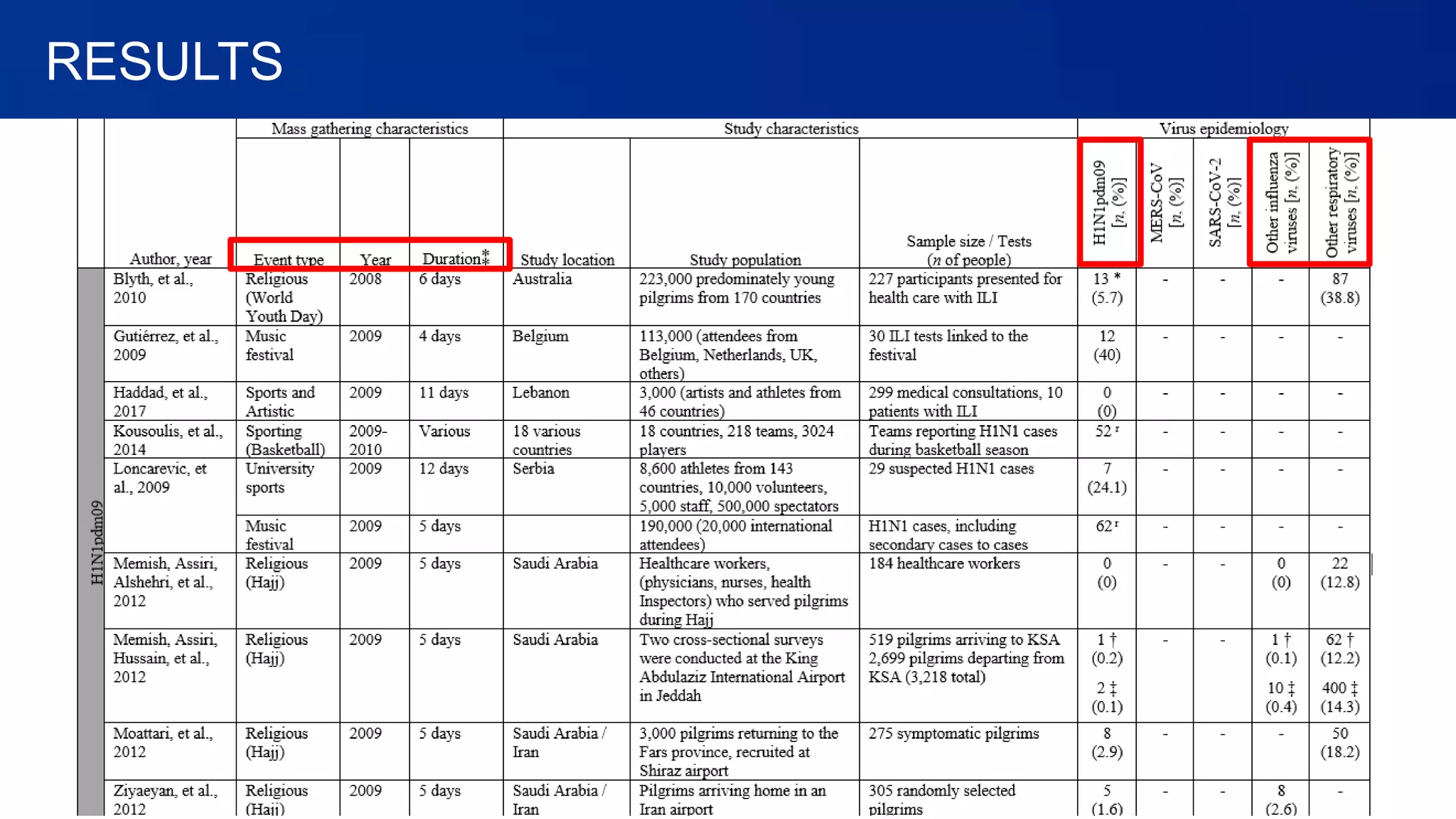
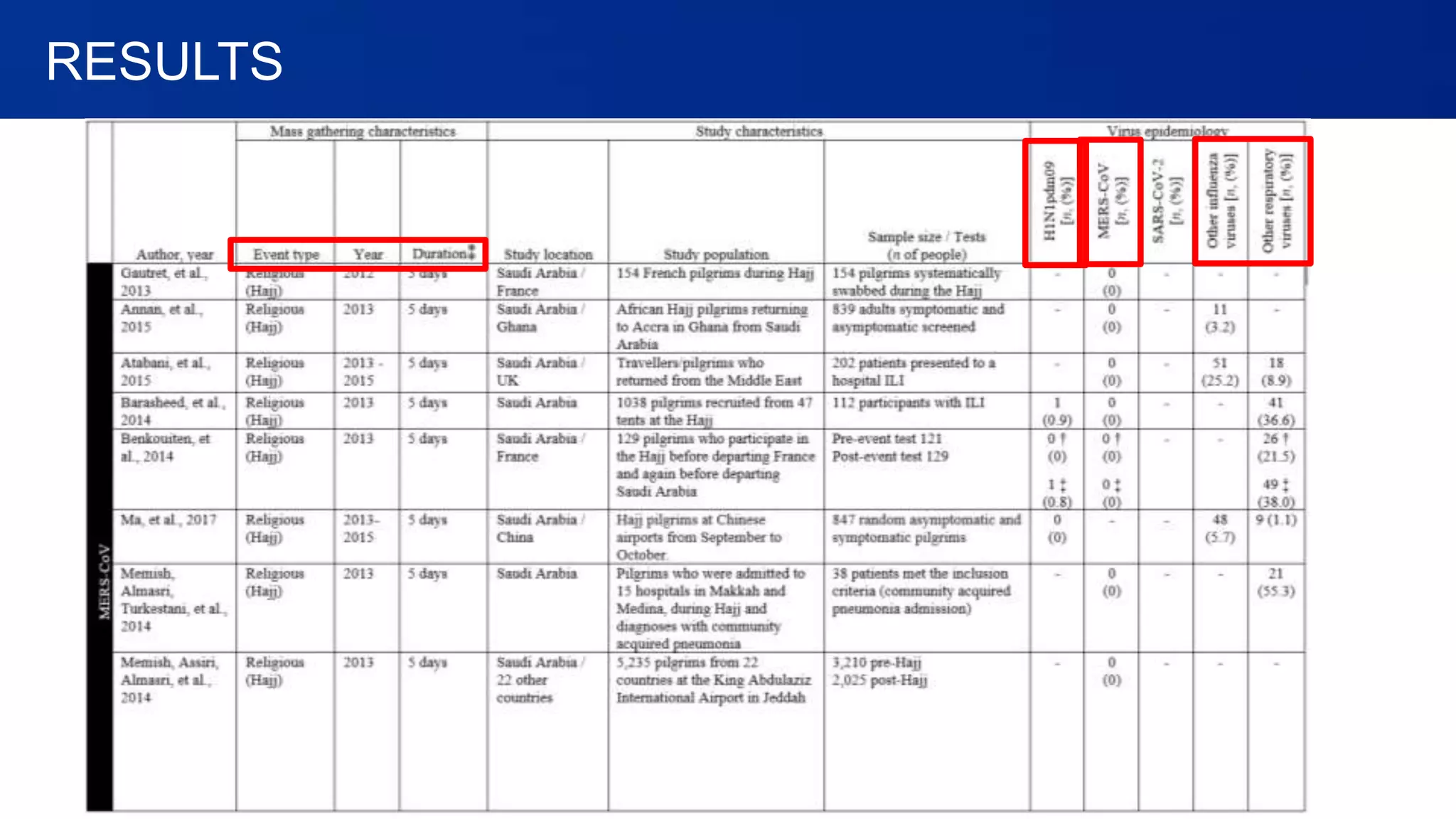
• Study characteristics, mass gathering characteristics, and
novel respiratory virus epidemiology
METHOD
Data Analysis
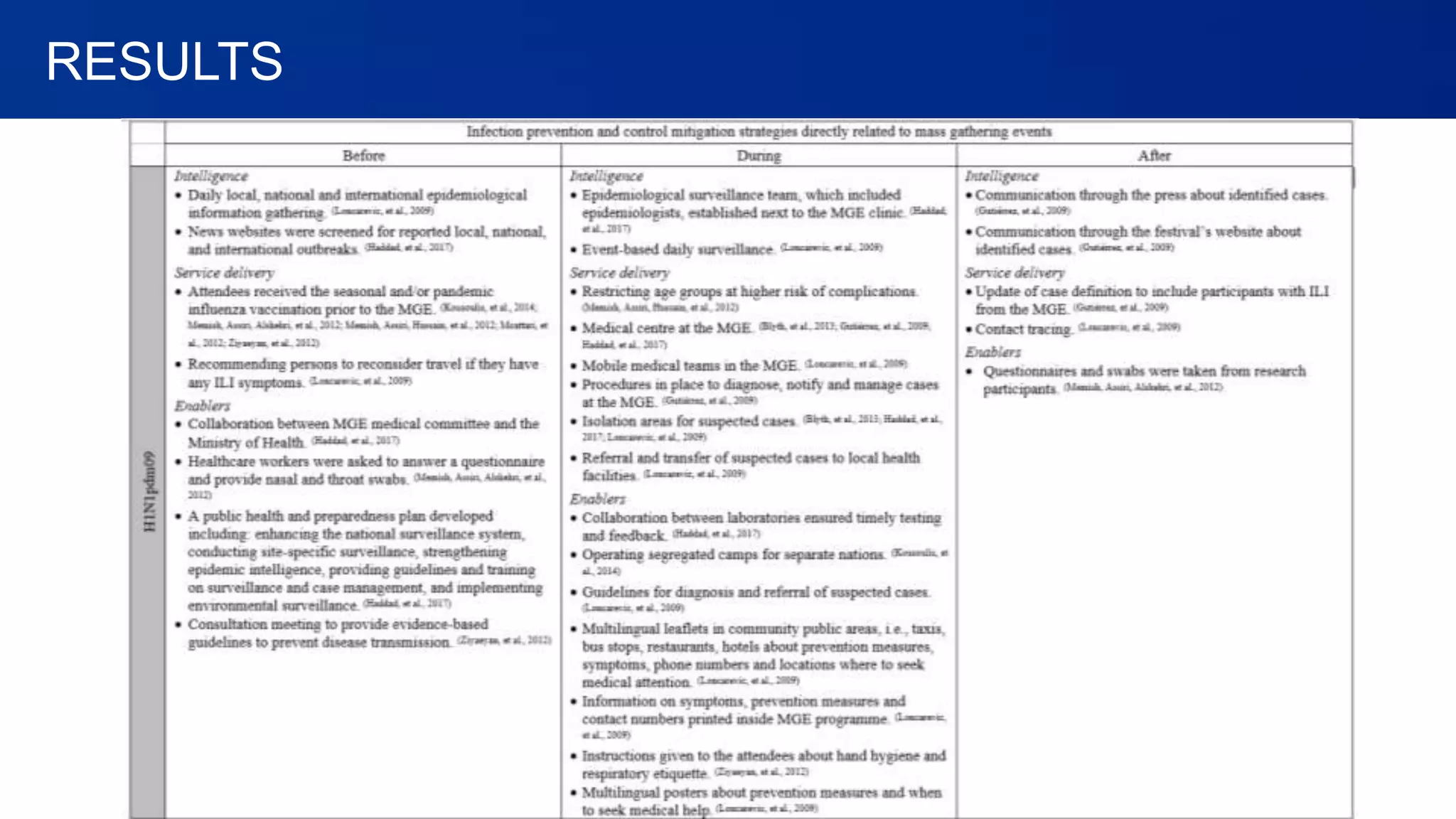
• Haddon Matrix
• Public health operations to deliver public health services.
METHOD
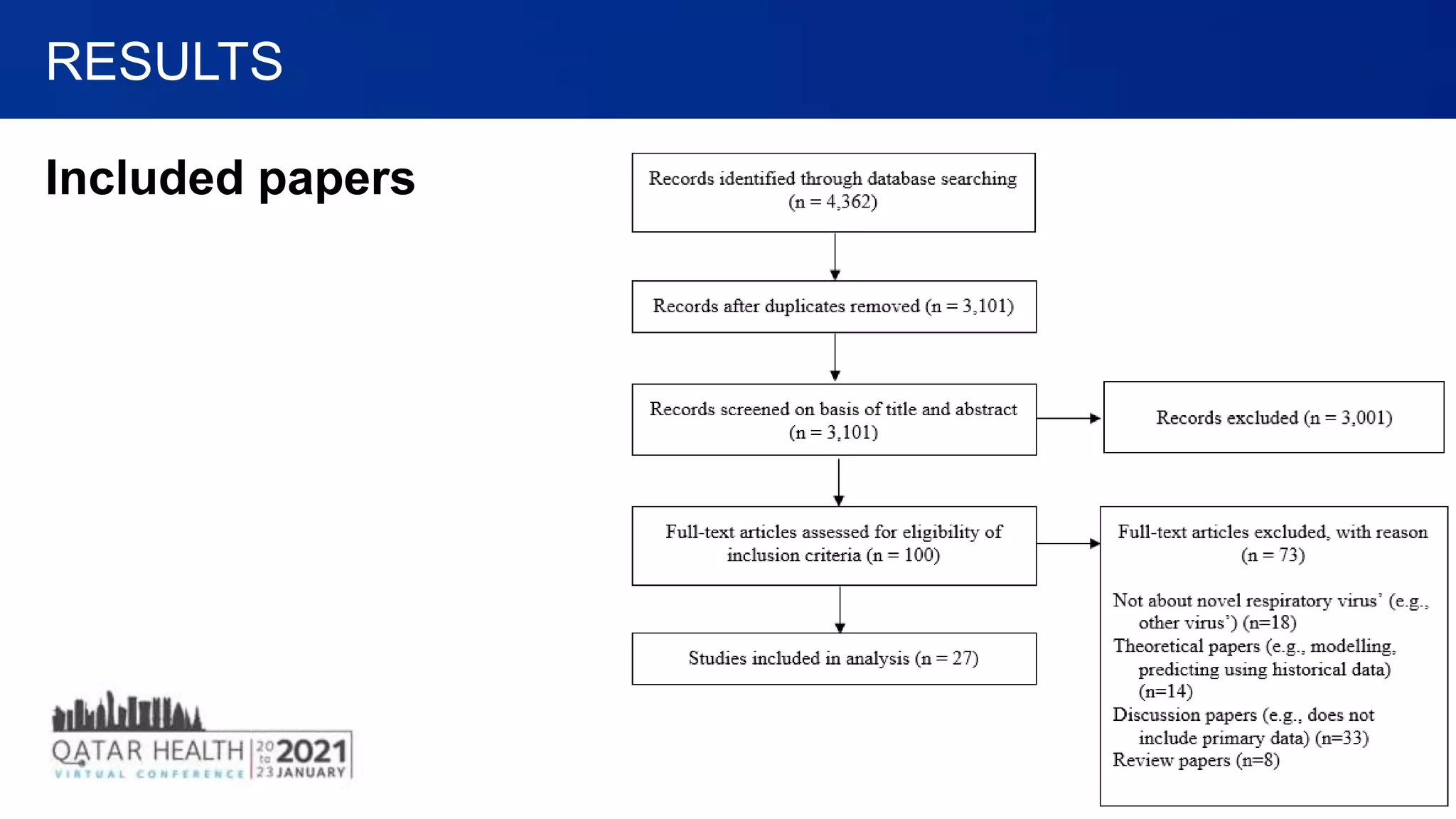
Included papers
RESULTS
RESULTS
RESULTS
RESULTS
RESULTS
RESULTS
RESULTS
RESULTS
• Early evolution of a novel respiratory viruses
• Cancel or postpone mass gathering events
• Modifying mass gathering events
• Legacy of events
DISCUSSION
Novel respiratory viruses in the context of mass gathering events: A systematic review to inform event planning from a health perspective

Novel respiratory viruses in the context of mass gathering events: A systematic review to inform event planning from a health perspective

  • 1.
    Dr Jamie Ranse,RN PhD Senior Research Fellow, Emergency Care | Menzies Health Institute Queensland, Griffith University Founder, Mass Gathering Collaboration | Griffith University, Queensland Visiting Research Fellow | Department of Emergency Medicine, Gold Coast Health Novel respiratory viruses in the context of mass gathering events: A systematic review to inform event planning from a health perspective
  • 2.
    Jamie Ranse1,2,3; DeborahBeckwith1,2; Anas Khan4,5; Saber Yezli4; Attila Hertelendy6,7,8; Alison Hutton9; Peta-Anne Zimmerman2,10 1. Menzies Health Institute Queensland, Griffith University, Gold Coast, Queensland, Australia 2. School of Nursing and Midwifery, Griffith University, Gold Coast, Queensland, Australia 3. Department of Emergency Medicine, Gold Coast Health, Gold Coast, Queensland, Australia 4. Global Center for Mass Gathering Medicine, Ministry of Health, Riyadh, Saudi Arabia 5. Department of Emergency Medicine, College of Medicine, King Saud University, Saudi Arabia 6. Fellowship in Disaster Medicine, Department of Emergency Medicine, Beth Israel Deaconess Medical Centre, Boston, Massachusetts, USA 7. Department of Emergency Medicine, Harvard Medical School, Boston, Massachusetts, USA 8. College of Business, Florida International University, Miami, Florida, United States of America 9. School of Nursing and Midwifery, The University of Newcastle, Newcastle, New South Wales, Australia 10. Department of Infection Control, Gold Coast Health, Gold Coast, Queensland, Australia RESEARCH TEAM
  • 3.
    • Mass gatheringevents occur regularly throughout the world • May strain the health resources of the host community, state or nation • May result in an increased transmission of communicable diseases • Several novel respiratory viruses of global concern have emerged over the past two decades • SARS-CoV-1; H1N1pdm09; MERS-CoV; SARS-CoV-2. INTRODUCTION
  • 4.
    • To identifypapers relating to novel respiratory viruses with pandemic potential and mass gathering events. • To analyze these papers for infection prevention and control strategies to inform planning before, during, and following MGEs to limit the transmission of these viruses. AIM
  • 5.
    Design • This systematicliterature review was guided by the Preferred Reporting Items of Systematic reviews and Meta-Analysis (PRISMA) Guidelines. Data Collection • Healthcare databases • Different combinations of Medical Subject Headings (MeSH) terms and keywords METHOD
  • 6.
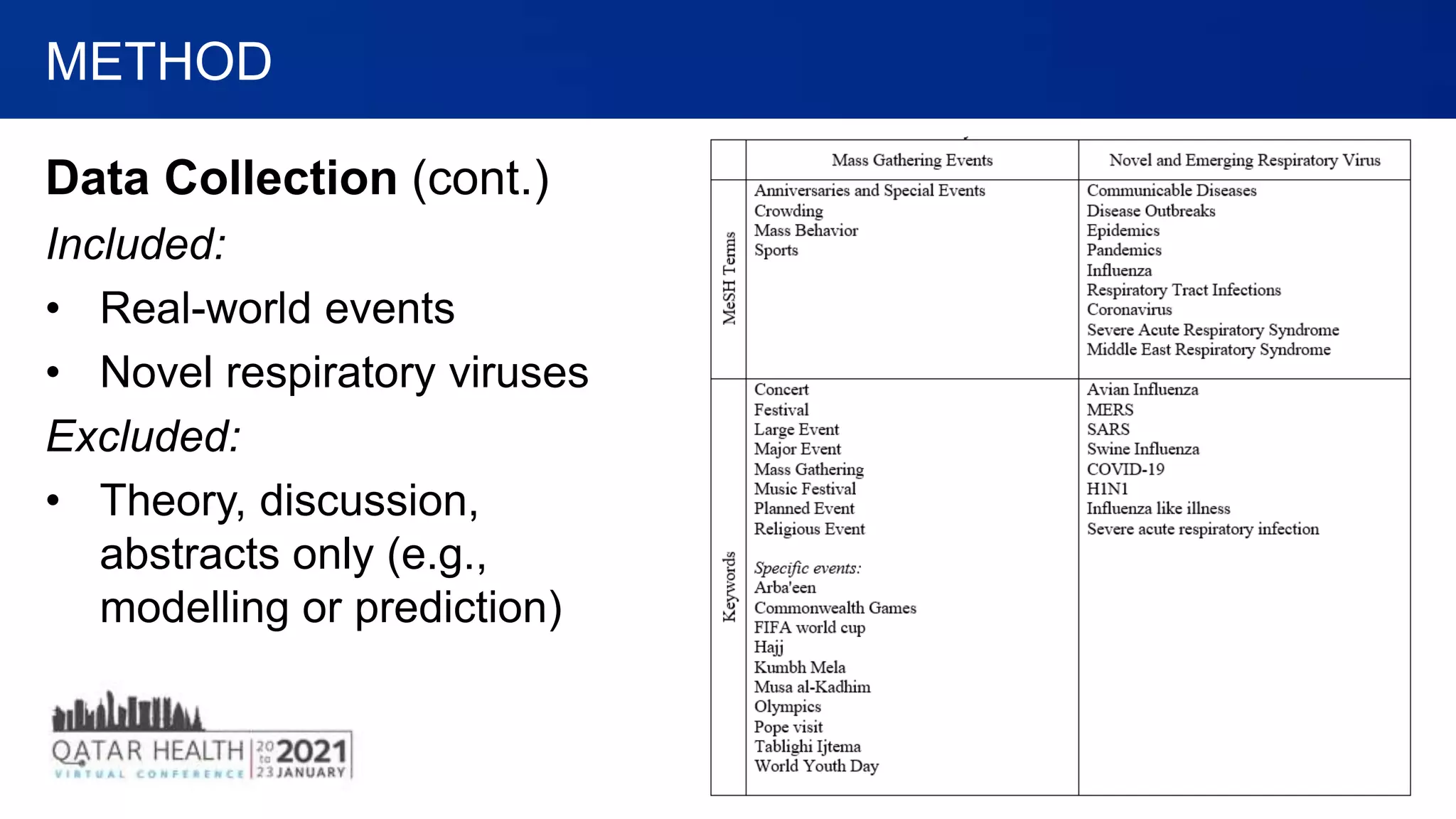
    Data Collection (cont.) Included: •Real-world events • Novel respiratory viruses Excluded: • Theory, discussion, abstracts only (e.g., modelling or prediction) METHOD
  • 7.
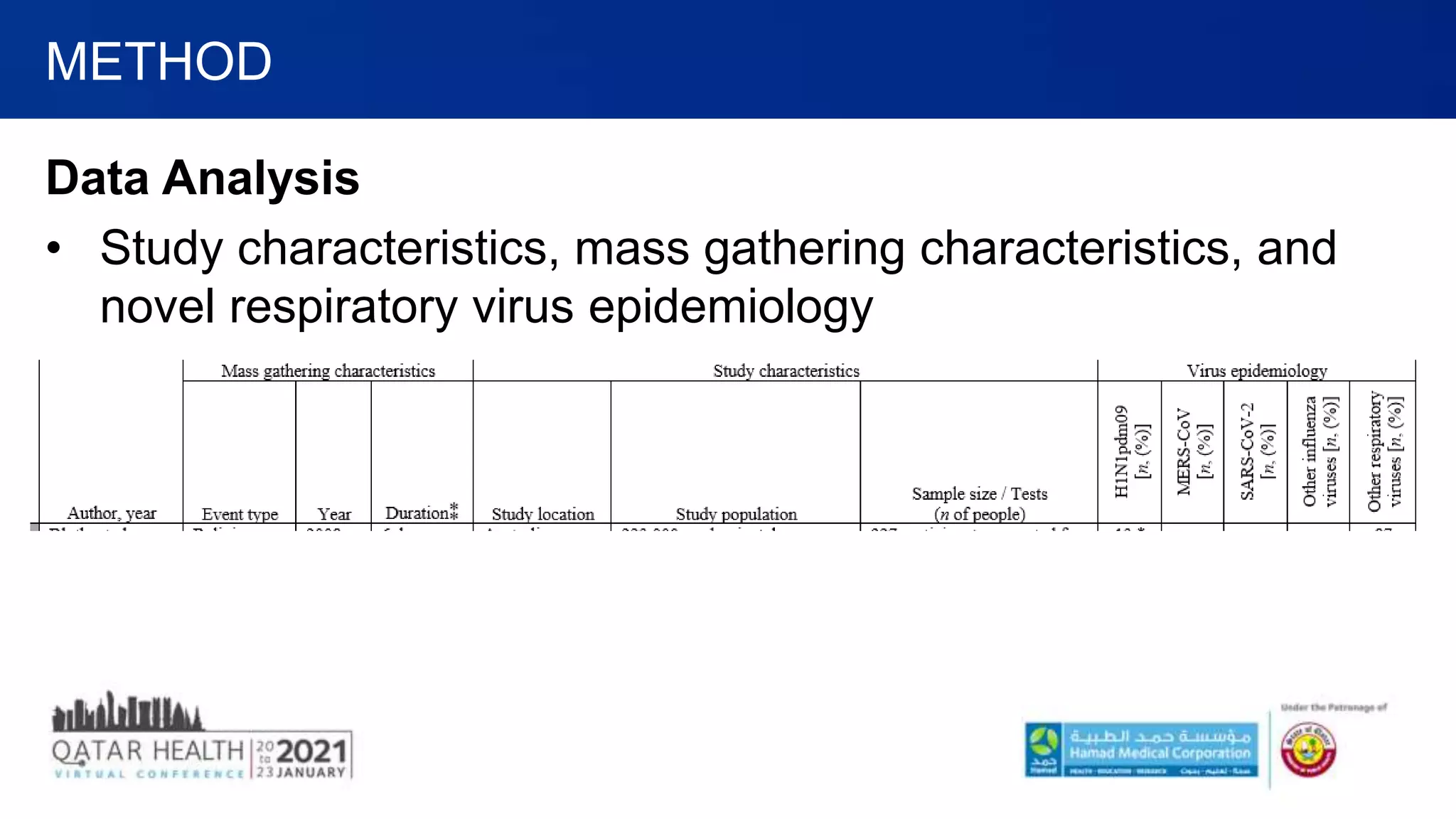
    Data Analysis • Studycharacteristics, mass gathering characteristics, and novel respiratory virus epidemiology METHOD
  • 8.
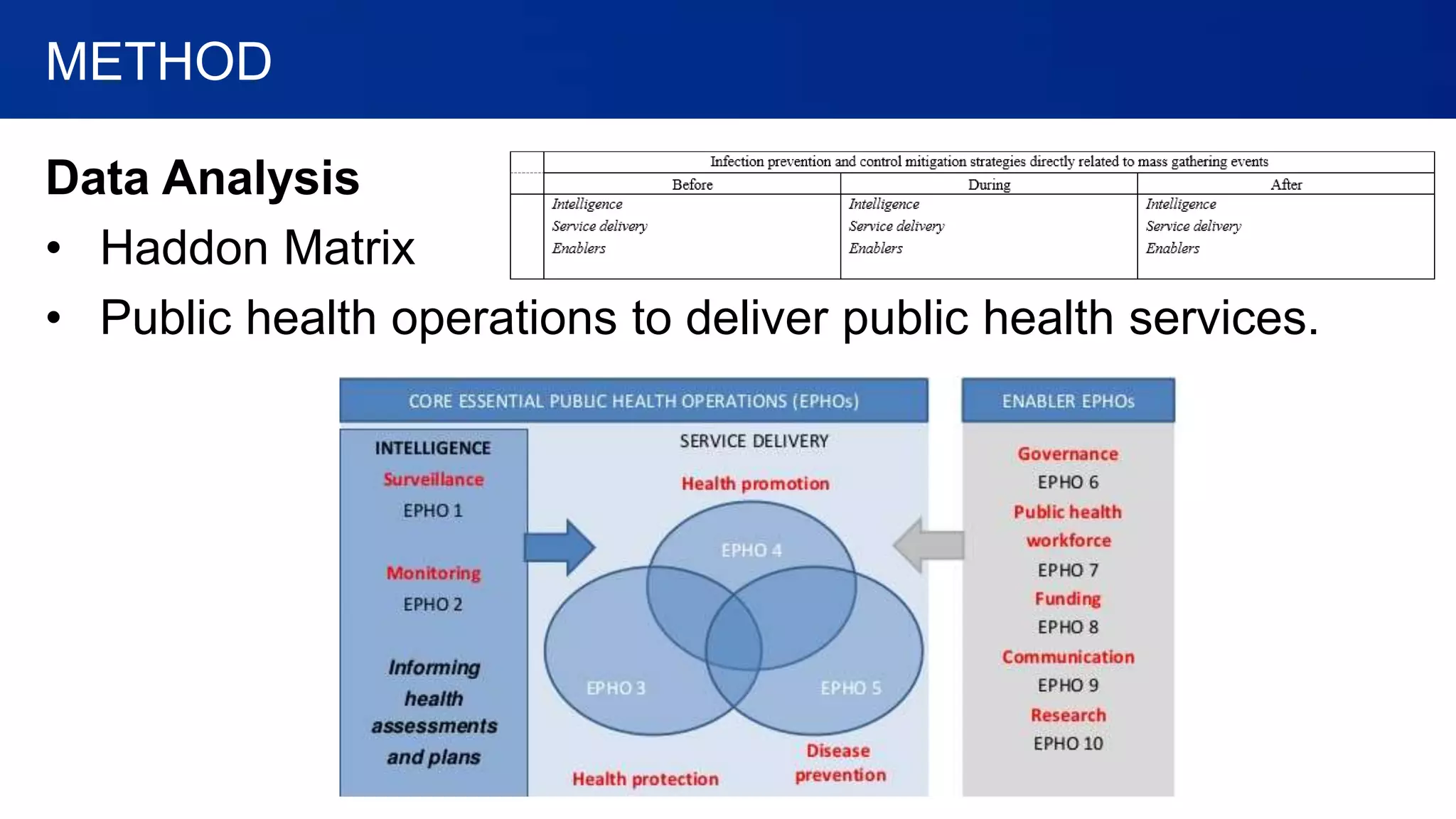
    Data Analysis • HaddonMatrix • Public health operations to deliver public health services. METHOD
  • 9.
  • 10.
  • 11.
  • 12.
  • 13.
  • 14.
  • 15.
  • 16.
  • 17.
    • Early evolutionof a novel respiratory viruses • Cancel or postpone mass gathering events • Modifying mass gathering events • Legacy of events DISCUSSION