BASICS……?????
 Respiration-Ventilation 3D Medical
Animation.avi
 Mechanics of Breathing - 1 2.avi
 Intubation and Mechanical
Ventilation.avi
MEANING
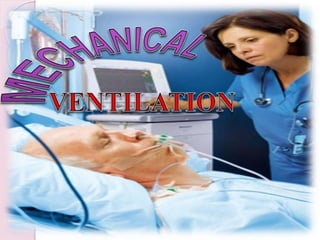
 A mechanical ventilator is a
positive- or negative-pressure
breathing device that can maintain
ventilation and oxygen delivery for
a prolonged period
INDICATIONS
 Protection of airway
 Respiratory arrest or rate < 8/min
 Tachypnoea > 35/min
 Inability to tolerate oxygen
mask/CPAP/NIV, e.g.
agitation,confusion
 Removal of secretions
 Hypoxaemia (Pa O2 < 8 kPa (< 60
mmHg); Sp O2 < 90%),despite CPAP
with F iO2 > 0.6
 Hypercapnia if conscious level
impaired or risk of raised intracranial
pressure
 Worsening respiratory acidosis
 Vital capacity falling below 1.2 L in
patients with neuromuscular disease
 Removing the work of breathing in
exhausted patients
CLINICAL CONDITIONS
 Post-operative
• e.g. After major abdominal or cardiac
surgery
 Respiratory failure
 ARDS
 Acute severe asthma
 Pneumonia
 Aspiration
 COPD
 Smoke inhalation, burns
 Circulatory failure
 Low cardiac output: cardiogenic
shock
 Following cardiac arrest
Pulmonary oedema
 Neurological disease
Coma of any cause
 Status epilepticus
 Drug overdose
Respiratory muscle failure (e.g. Guillain–
Barré syndrome, poliomyelitis, myasthenia
gravis)
 Head injury: to avoid hypoxaemia and
hypercapnia, and reduce intracranial
pressure
 Bulbar abnormalities causing risk of
aspiration (e.g. cerebrovascular accident,
myasthenia gravis)
TERMINOLOGY
 TRIGGER
 TIDAL VOLUME
 RESPIRATORY RATE
 POSITIVE END EXPIRATORY
PRESSURE
 FLOW RATE
 INSPIRATORY TIME EXPIRATION
INVASIVE
IPPV
FULL
SUPPORT
CMV
VOLUME
CONTROL
PRESSURE
CONTROL
PARTIAL
SUPPORT
SIMV PSV
NON
INVASIVE
+ve pressure
via nasal or face
mask
NIPPV BiPAP
-ve
pressur
e
CURAS
S TANK
IRON
LUNG
Intermittent positive pressure
ventilation (IPPV)
Controlled mandatory
ventilation (CMV)
Synchronised intermittent
mandatory ventilation (SIMV)
Pressure-controlled ventilation
(PCV)
Pressure support ventilation
(PSV)/Assisted spontaneous
breathing (ASB)
Positive end-expiratory
pressure (PEEP)
Continuous positive airways
pressure (CPAP)
Bi-level positive airway
pressure (BiPAP/BIPAP)
Non-invasive positive
pressure ventilation
(NIPPV/NIV)
Inverse ratio ventilation
High-frequency ventilation
(hfv)
Liquid ventilation
INITIAL VENTILATOR
SETTINGS
 Assess the mode
 Tidal volume and rate
 Patient or time triggered
MINUTE VENTILATION=RATE X TIDAL
VOLUME
IMV AND SIMV
TOTAL MINUTE VENTILATION= MINUTE
VOLUME MACHINE+ MINUTE
VOLUME SPONTANEOUS
TOTAL MINUTEVOLUME= (MACHINE TIDAL
VOLUME X MACHINE RATE )+ AVERAGE
SPONATANEOUS TIDAL VOLUME X
SPONATNEOUS RATE)
INSPIRATORY FLOW RATE= SET MINUTE
VENTILATION/PERCENTAGE INSPIRATORY
TIME X 0.01
AIRWAY RESISTANCE = INCREASING
PEAK PRESSURE- PLATEAU
PRESSURE/ INSPIRATORY FLOW(L/S)
 FIO2 REQUIRED =
 PaO2 DESIRED
PaO2 /PAO2 PaCO2 X 12.5)
1
PB- PH2O
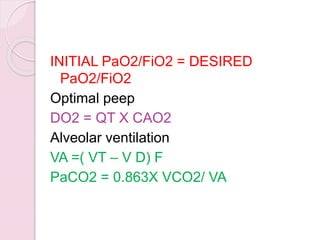
INITIAL PaO2/FiO2 = DESIRED
PaO2/FiO2
Optimal peep
DO2 = QT X CAO2
Alveolar ventilation
VA =( VT – V D) F
PaCO2 = 0.863X VCO2/ VA
INITIAL PaCO2 X VA= DESIRED PaCO2
X VA
INITIAL PACO2 X F = DESIRED PaCO2
X
F
INITIAL PACO2 X VT = DESIRED PaCO2
X VT
ASSESSING THE
EQUIPMENT
COMPLICATIONS
MANAGEMENT
WEANING
 Vital capacity:10 to 15 mL/kg
 Maximum inspiratory pressure (MIP)
at least –20 cm H2O
 Tidal volume: 7 to 9 mL/kg
 Minute ventilation: 6 L/min
 Rapid/shallow breathing index: below
100 breaths/minute/L; PaO2 _60 mm
Hg with FiO2 less than 40%
NURSE WHAT YOU DO..???
REFERENCES
 Mason R.J, Braaddus V.C.Murray and Nadel`s :Textbook of
Respiratory Medicine. 5th edn. Philadelphia:Saunders;2010.
 George R.B,Light R.W. Chestmedicine:Essentials of
Pulmonary and Critical Care Medicine. 4th edn .
Philadelphia:Lippincott;2000.
 Fauci AS, Braunwald E, Kasper DL, Hauser SL, Longo DL,
Jameson JL, et al., editors. Harrison’s principles of internal
medicine. 17th ed. New York: McGraw Hill; 2008
 Johnson J.Y.Brunner anD Suddharth`s:Textbook of Medical
Surgical Nursing. 11th edn. Philadelphia:Lippincott;2008.
 Black M.J, Hawks H.K. Medical Surgical Nursing. 7th edn.
Missouri: Saunders;2005
mechanical ventilation

mechanical ventilation