Mechanical Ventilation (101)
1st Respiratory Care Comprehensive Review Course 1
Mastering Mechanical Ventilation
1st Respiratory Care Comprehensive Review Course 2
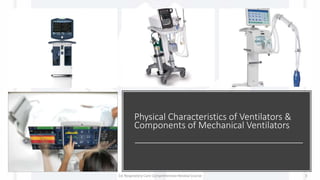
Physical Characteristics of Ventilators & Components of
Mechanical Ventilators
Normal Physiology of Ventilation & Spont. Breathing and Lung Mechanics
Basic Component of Breath Delivery
Classification of Modes of Ventilation
Initiation MonitoringManagement
Clinical
Application
Physical Characteristics of Ventilators &
Components of Mechanical Ventilators
1st Respiratory Care Comprehensive Review Course 3
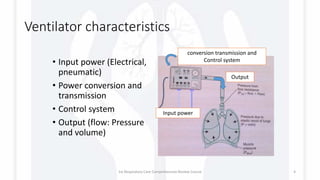
Ventilator characteristics
• Input power (Electrical,
pneumatic)
• Power conversion and
transmission
• Control system
• Output (flow: Pressure
and volume)
conversion transmission and
Control system
Input power
Output
1st Respiratory Care Comprehensive Review Course 4
Components of a Ventilator
Those components are:
• User interface
• Breath Delivery [Patient]
Unit
• Backup power supply
[Rechargeable batteries]
• Air compressor.
 Physical characteristics
 Ventilator power source
• Electrically powered ventilator
• Pneumatically powered ventilator
• Combined Power Ventilators
 Positive or negative pressure
 Control systems and circuits
 Open- and closed-loop systems
 Control panel: user interface
 Pneumatic circuit (internal and
patient circuit)
 Drive mechanism
 Compressor or Blowers
 displacement
 Flow control valves
 Output
 Pressure, volumes, and flow
scalars
1st Respiratory Care Comprehensive Review Course 5
Power Source
• Ventilator power source
• Electrically powered ventilator
• Pneumatically powered ventilator
• Combined Power Ventilators
• Current ICU ventilators use microprocessor control and 50 psi sources
of oxygen and air and are Combined Power Ventilators
• Current ICU ventilators are classified as Electrically Powered-
Pneumatically Driven-Microprocessor Controlled Ventilators
1st Respiratory Care Comprehensive Review Course 6
Pressure Delivery
• Negative-pressure ventilators
• Iron lung
• Chest cuirass
• Positive-pressure ventilators
• Most ventilators used today are positive-pressure ventilators
• Examples include: Puritan Bennett 840, Servoi, and Hamilton G-5
• Combined Pressure Devices
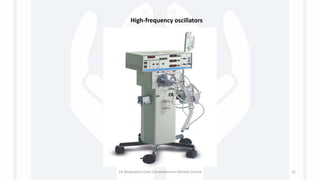
• High-frequency oscillators
1st Respiratory Care Comprehensive Review Course 7
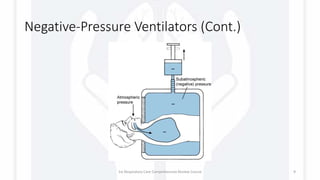
Negative-Pressure Ventilators
• Attempt to mimic normal spontaneous ventilation
• When negative pressure is applied, thoracic volume is increased and
air enters lungs
• During exhalation, negative pressure is removed and air leaves lungs
1st Respiratory Care Comprehensive Review Course 8
Negative-Pressure Ventilators (Cont.)
1st Respiratory Care Comprehensive Review Course 9
Negative-Pressure Ventilators (Cont.)
• Types of negative-pressure ventilators:
• Chest cuirass: chest shell applies negative pressure only to chest
• Tank ventilator: applies negative pressure to entire body
• Negative-pressure ventilators rarely used in ICU
• Sometimes used in home care setting
1st Respiratory Care Comprehensive Review Course 10
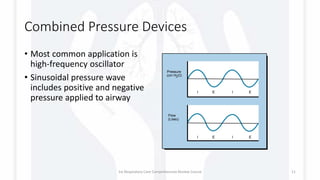
Combined Pressure Devices
• Most common application is
high-frequency oscillator
• Sinusoidal pressure wave
includes positive and negative
pressure applied to airway
1st Respiratory Care Comprehensive Review Course 11
High-frequency oscillators
1st Respiratory Care Comprehensive Review Course 12
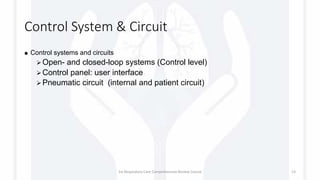
Control System & Circuit
 Control systems and circuits
Open- and closed-loop systems (Control level)
Control panel: user interface
Pneumatic circuit (internal and patient circuit)
1st Respiratory Care Comprehensive Review Course 13
Control Type (level of control)
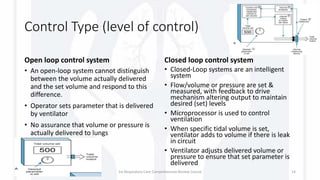
Open loop control system
• An open-loop system cannot distinguish
between the volume actually delivered
and the set volume and respond to this
difference.
• Operator sets parameter that is delivered
by ventilator
• No assurance that volume or pressure is
actually delivered to lungs
Closed loop control system
• Closed-Loop systems are an intelligent
system
• Flow/volume or pressure are set &
measured, with feedback to drive
mechanism altering output to maintain
desired (set) levels
• Microprocessor is used to control
ventilation
• When specific tidal volume is set,
ventilator adds to volume if there is leak
in circuit
• Ventilator adjusts delivered volume or
pressure to ensure that set parameter is
delivered
1st Respiratory Care Comprehensive Review Course 14
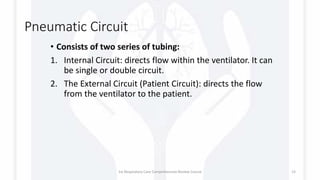
Pneumatic Circuit
• Consists of two series of tubing:
1. Internal Circuit: directs flow within the ventilator. It can
be single or double circuit.
2. The External Circuit (Patient Circuit): directs the flow
from the ventilator to the patient.
1st Respiratory Care Comprehensive Review Course 15
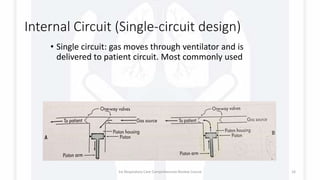
Internal Circuit (Single-circuit design)
• Single circuit: gas moves through ventilator and is
delivered to patient circuit. Most commonly used
1st Respiratory Care Comprehensive Review Course 16
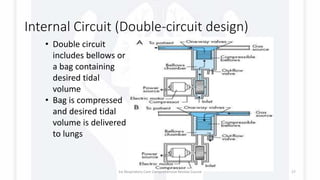
Internal Circuit (Double-circuit design)
• Double circuit
includes bellows or
a bag containing
desired tidal
volume
• Bag is compressed
and desired tidal
volume is delivered
to lungs
1st Respiratory Care Comprehensive Review Course 17
The External Circuit (Patient Circuit)
1st Respiratory Care Comprehensive Review Course 18
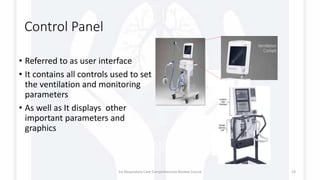
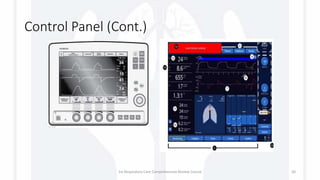
Control Panel
• Referred to as user interface
• It contains all controls used to set
the ventilation and monitoring
parameters
• As well as It displays other
important parameters and
graphics
1st Respiratory Care Comprehensive Review Course 19
Control Panel (Cont.)
1st Respiratory Care Comprehensive Review Course 20
Drive mechanism (Power Transmission
System)
• Drive mechanism is part of the breath delivery unit.
• Responsible for breath delivery to the patient
• Develop and control pressure gradient between ventilator and patient
• It contains pneumatic and electronic modules that control the breath
delivery to the patient
• Electrically powered ventilators use compressors, blowers, or other
volume displacement devices
• Pneumatic systems use compressed gas from wall to deliver volume
to lung
1st Respiratory Care Comprehensive Review Course 21
Compressors or Blowers
• Can be driven by pistons, rotating blades, moving diaphragms, or
bellows
• Most common type of compressor: rotary compressor
• Examples:
• Viasys Avea
• LTV ventilators
1st Respiratory Care Comprehensive Review Course 22
Volume Displacement
Designs
• Use displacement devices to deliver specific volume
• Includes pistons, bellows, or bag in chamber mechanisms
• Spring-Loaded Bellows
• Operator adjusts tension on spring that is used to compress
bellows
• Not commonly used
1st Respiratory Care Comprehensive Review Course23
Flow-Control Valves
• Three types of flow controlling valves
1. Proportional solenoid valve
2. Stepper motors with valve
3. Digital valves with on/off configuration
• Current ICU ventilators use Proportional
solenoid valve.
1st Respiratory Care Comprehensive Review Course 24
Fluidic Ventilators
• Use fluidics to deliver gas to patient
• Do not use moving parts or electricity to function
• Used on Bio-Med MVP 10
• Compatible with use during MRI
• Two basic principles:
• Beam deflection
• Wall attachment (Coanda effect)
1st Respiratory Care Comprehensive Review Course 25
Expiratory
Valves
1st Respiratory Care Comprehensive Review Course 26
Expiratory Valves
• Close during inspiration to direct gas flow to patient
• Open during exhalation allowing patient to exhale gas into
atmosphere
• PEEP is used to improve oxygenation
• PEEP is provided by threshold resistor or flow resistance
• Both valves prevent complete exhalation of expired tidal volume
1st Respiratory Care Comprehensive Review Course 27
Spring-Loaded Valves
• Can be used to provide PEEP
• Spring is used to adjust amount
of pressure applied against
exhalation valve to prevent
complete exhalation
1st Respiratory Care Comprehensive Review Course 28
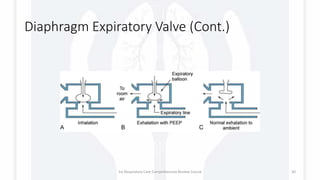
Diaphragm Expiratory Valve
• Diaphragm over exhalation valve closes during inspiration
• During exhalation, pressure on diaphragm is released
• When PEEP is used, pressure against diaphragm is maintained thus
preventing complete exhalation
1st Respiratory Care Comprehensive Review Course 29
Diaphragm Expiratory Valve (Cont.)
1st Respiratory Care Comprehensive Review Course 30
Electromagnetic Valves
• Amount of electrical current is adjusted to regulate amount of force
applied to expiratory flow
• The higher the level of current, the more force applied to exhaled gas
• Increases PEEP level
1st Respiratory Care Comprehensive Review Course 31
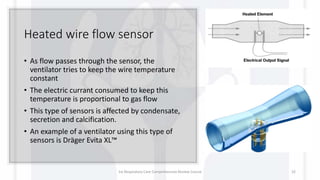
Heated wire flow sensor
• As flow passes through the sensor, the
ventilator tries to keep the wire temperature
constant
• The electric currant consumed to keep this
temperature is proportional to gas flow
• This type of sensors is affected by condensate,
secretion and calcification.
• An example of a ventilator using this type of
sensors is Dräger Evita XL™
1st Respiratory Care Comprehensive Review Course 32
Differential pressure flow
sensor
• As flow passes through the sensor’s resistive
element a pressure deference develop
• Using Boyle’s Law [P1V1 = P2V2] the gas flow
can be calculated
• This type of sensors can be affected by
condensate, secretion and calcification.
• An example of a ventilator using this type of
sensors is Hamilton G5 & S1
1st Respiratory Care Comprehensive Review Course 33
Ultrasonic Flow Sensor
1st Respiratory Care Comprehensive Review Course 34
Ultrasonic transducer technology:
T2 - T1 = Tdiff
Tdiff is proportional to the gas flow
New measurement every 4 ms
CPAP Devices
• FIO2 is regulated with blender
• Inspired gas is warmed and humidified
• Threshold resistor prevents complete
exhalation to maintain positive pressure in
airway
• Problems with CPAP Systems
• Inadequate gas flow to patient
• Leaks in system
• Loss of source gas flow
• Jamming or obstruction of expiratory flow
resistor
1st Respiratory Care Comprehensive Review Course
Basic Component of Breath Delivery
1st Respiratory Care Comprehensive Review Course 36
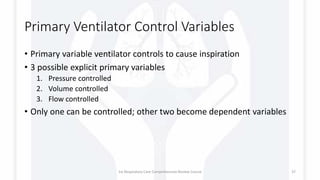
Primary Ventilator Control Variables
• Primary variable ventilator controls to cause inspiration
• 3 possible explicit primary variables
1. Pressure controlled
2. Volume controlled
3. Flow controlled
• Only one can be controlled; other two become dependent variables
1st Respiratory Care Comprehensive Review Course 37
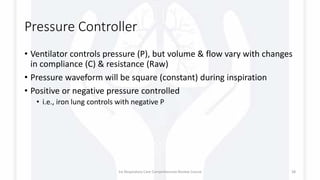
Pressure Controller
• Ventilator controls pressure (P), but volume & flow vary with changes
in compliance (C) & resistance (Raw)
• Pressure waveform will be square (constant) during inspiration
• Positive or negative pressure controlled
• i.e., iron lung controls with negative P
1st Respiratory Care Comprehensive Review Course 38
Volume & Flow Controllers
• Volume controller
• Ventilator controls volume so will be constant
• Flow is volume/time, so flow is also constant
• Pressure will vary with changes in C & Raw
• Flow controller
• As above, flow & thus volume constant
• Pressure varies with changes in C and Raw
• Old neonatal ventilators used flow interruption to deliver
volume during inspiration
1st Respiratory Care Comprehensive Review Course 39
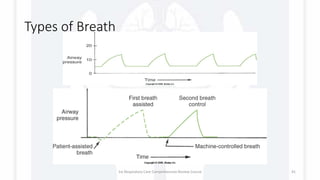
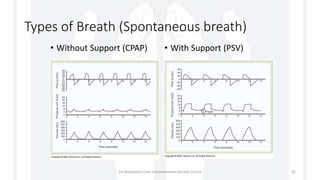
Two Breath Types
• Spontaneous
• Patient triggers & cycles the breath
• Patient effort may be supported by manual or mechanical ventilator
• Mechanical
• Mandatory breath: breath is initiated by ventilator
• Assisted breath: breath is triggered by patient but is delivered by ventilator
1st Respiratory Care Comprehensive Review Course 40
Types of Breath
1st Respiratory Care Comprehensive Review Course 41
Types of Breath (Spontaneous breath)
• Without Support (CPAP) • With Support (PSV)
1st Respiratory Care Comprehensive Review Course 42
Primary Breath Control Variable
• Volume control: VT/flow set, while P depends on
those settings & pulmonary mechanics
• Pressure control: P set, VT /flow depend on P setting
& pulmonary mechanics
• Dual control: Mixture of volume & pressure
• Either starts breath in volume control & ends with pressure
control or the reverse
1st Respiratory Care Comprehensive Review Course 43
Components (phases) of Breath Delivery
• End of expiration and beginning of inspiration
• Delivery of inspiration
• End of inspiration and beginning of exhalation
• Expiratory phase
1st Respiratory Care Comprehensive Review Course 44
Phase Variables
• Ventilator uses variables to initiate or limit each phase of ventilation
• Initiation of inspiration (E to I)
• Inspiration
• End of inspiration (I to E)
• Expiration
1st Respiratory Care Comprehensive Review Course 45
Initiation of Inspiration
• Trigger variable
• Machine triggered
• Time: determined by rate control
• Patient triggered
• Pressure
• Flow (least work for patient to trigger)
• Volume (rare)
• Most ventilators provide a manual breath button that operator activates
• Patient triggering: breath is triggered because of patient effort
• Trigger sensitivity: amount of effort required by patient to initiate machine
breath
1st Respiratory Care Comprehensive Review Course 46
Time Triggering
• Ventilator triggers breath at preset intervals
• Time for mandatory breath is based on cycle time
• Cycle time is calculated by dividing 60 by set rate
• Example: Set rate is 12 breaths/min
• Cycle time = 60/12
• Cycle time = 5 seconds
1st Respiratory Care Comprehensive Review Course 47
Pressure Triggering
• Ventilator breath is triggered by decrease in pressure below baseline
• Sensitivity is usually set at –0.5 to 1.5 cm H2O
• Common locations for pressure sensor:
• Internal ventilator circuit where main gas flow leaves ventilator
• Where expired gas flow returns from patient to ventilator
• At proximal airway (near wye connector)
1st Respiratory Care Comprehensive Review Course 48
Flow Triggering
• Base or bias flow, present during exhalation,
is set
• Common level is 5 to 10 L/min
• Flow trigger is set at 1 to 5 L/min
• When patient decreases flow to set level of
flow trigger, an assisted breath is delivered
1st Respiratory Care Comprehensive Review Course 49
Other Triggering Methods
• Manual triggering: operator triggers ventilator breath
• Neural triggering: monitors electrical activity of diaphragm
• Method is used with neurally adjusted ventilatory assist (NAVA)
1st Respiratory Care Comprehensive Review Course 50
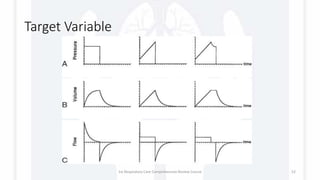
Inspiration: Target (Limit) Variable
• Limits inspiration but does not terminate the phase
• Pressure limited
• Limits peak inspiratory pressure (PIP) during inspiration
• Volume limited
• Limits amount of tidal volume (VT) delivered during inspiration to set amount
• Flow limited
• Limits the amount of flow during inspiration
1st Respiratory Care Comprehensive Review Course 51
Target Variable
1st Respiratory Care Comprehensive Review Course 52
Inspiratory Phase (Cont.)
• Sloping or ramping
• Ability to adjust how quickly flow is delivered during set inspiratory time
• This feature is referred to as:
• Ramping
• Inspiratory rise time
• Flow acceleration
• Slope adjustment
• Sloping
1st Respiratory Care Comprehensive Review Course 53
Maximum Safety Pressure
• Sets maximum pressure that can be delivered during inspiration
• Upper pressure limit is set 10 cm H2O above peak inspiratory pressure
(PIP)
• Terms for this setting:
• Pressure limit
• Upper pressure limit
• Normal pressure limit
• High pressure limit
• Peak/maximum pressure
1st Respiratory Care Comprehensive Review Course 54
Maximum Safety Pressure (Cont.)
• Events that occur with activation of upper pressure limit:
• Activation of visible and/or audible alarm
• Termination of delivery of inspiratory breath
• Decrease in inspiratory time
1st Respiratory Care Comprehensive Review Course 55
End of Inspiration
• Cycle variables terminate inspiratory phase
• Pressure cycled
• Inspiration terminates as preset pressure reached (hit alarm
level)
• Volume cycled
• Inspiration terminates at preset VT
• Flow cycled
• Inspiration terminates when flow drops to preset value (PSV)
• Time cycled
• Inspiration terminates when set inspiratory time is reached
• Includes any inspiratory holds
1st Respiratory Care Comprehensive Review Course 56
Pressure Cycling
• When preset pressure is reached, inspiratory flow ends and
expiratory flow begins
• In pressure control ventilation, preset pressure is maintained for set
inspiratory time
• Only application of pressure cycled ventilation is administration of
intermittent positive-pressure breathing (IPPB)
• Pressure cycling also occurs if upper pressure limit is reached in
volume- or pressure-targeted ventilation
1st Respiratory Care Comprehensive Review Course 57
Time Cycling
• Length of inspiration is set by operator; then followed by ventilator
ending inspiration and beginning expiration
• If inspiratory time is decreased, expiratory time is increased and I:E
ratio is increased
• If inspiratory time is increased, expiratory time is decreased and I:E
ratio is decreased
1st Respiratory Care Comprehensive Review Course 58
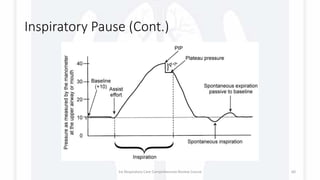
Inspiratory Pause
• Extension of inspiratory time by exhalation valve remaining closed
after set tidal volume has been delivered
• Also referred to as:
• Inflation hold
• Inspiratory plateau
• Can be used with pressure or volume ventilation
• Common application is to obtain plateau pressure to calculate
effective static compliance in VCV.
• In pressure-controlled ventilation, inspiratory time is long enough for
pressure to equilibrate within lungs
1st Respiratory Care Comprehensive Review Course 59
Inspiratory Pause (Cont.)
1st Respiratory Care Comprehensive Review Course 60
Volume Cycling
• When preset volume is delivered, ventilator ends inspiration and
begins expiration
• Most ventilators accomplish this by calculation of the amount of flow
to deliver a set volume during the set inspiratory time
• Amount of volume actually delivered to patient may be less because
of volume lost due to tubing compression
1st Respiratory Care Comprehensive Review Course 61
Tubing Compression
• During inspiration, tubing is distended and returns to normal size
during exhalation
• Most adult ventilator circuits have tubing compression factor of 1 to 3
cm H2O
• Many current ventilators calculate volume lost to tubing compression
and add this to delivered tidal volume
1st Respiratory Care Comprehensive Review Course 62
Flow Cycled
• Inspiration ends when preset flow is reached
• Pressure support ventilation (PSV) is most common
application of flow cycling
• In PSV, breaths end when inspiratory flow decreases to set
percentage of initial flow rate
• When PSV was first developed, breaths ended when flow
dropped to 25% of initial flow
• In current ventilators, pressure support breaths can be
ended at percentages of expiratory flow ranging from 5%
to 80% of initial inspiratory flow rate
1st Respiratory Care Comprehensive Review Course 63
Expiration: Baseline Variable
• Defined by how baseline or end expiratory pressure (EEP) relates to
atmospheric pressure
• PEEP Positive or supra- atmospheric EEP
• NEEP Negative or sub-atmospheric EEP
• ZEEP Zero EEP equals sub-atmospheric pressure
1st Respiratory Care Comprehensive Review Course 64
Baseline Pressure
• Pressure at which inspiration begins
• Zero baseline pressure is equal to atmospheric
pressure
• PEEP: resistance applied during exhalation preventing
complete exhalation
• Applications of PEEP:
• Increases FRC
• Increases mean airway pressure
• Improves lung recruitment
• Improves oxygenation
1st Respiratory Care Comprehensive Review Course 65
Baseline Pressure (Cont.)
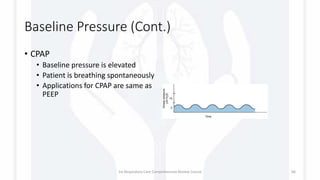
• CPAP
• Baseline pressure is elevated
• Patient is breathing spontaneously
• Applications for CPAP are same as
PEEP
1st Respiratory Care Comprehensive Review Course 66
Negative End-Expiratory Pressure
• Developed to minimize effects of positive pressure on blood flow
• Used during expiration during high-frequency oscillation
1st Respiratory Care Comprehensive Review Course 67
Continuous Gas Flow
During Exhalation
• Referred to as “base flow” or “bias flow”
• Provides flow to patient during last portion of exhalation to the
beginning of inspiratory effort
• Most current ventilators use bias flow to provide flow triggering
1st Respiratory Care Comprehensive Review Course 68
Expiratory Hold/End Expiratory Pressure
• Used to estimate amount of pressure in lungs caused by trapped air
• Pressure of trapped air is referred to as “auto-PEEP”
• Conditions increasing risk of developing auto-PEEP:
• High minute volumes (>10 L/minute)
• Patients with high airway resistance
• Patients with active exhalation
1st Respiratory Care Comprehensive Review Course 69
Waveforms and Graphics
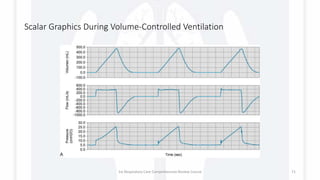
• Scalar graphics
• Pressure-time
• Volume-time
• Flow-time
• Loop graphics
• Flow-volume
• Pressure-volume
1st Respiratory Care Comprehensive Review Course 70
Scalar Graphics During Volume-Controlled Ventilation
1st Respiratory Care Comprehensive Review Course 71
Scalar Graphics During
Pressure-Controlled Ventilation
1st Respiratory Care Comprehensive Review Course 72
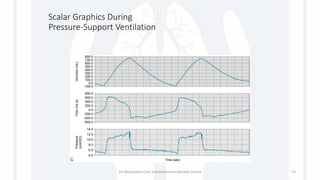
Scalar Graphics During
Pressure-Support Ventilation
1st Respiratory Care Comprehensive Review Course 73
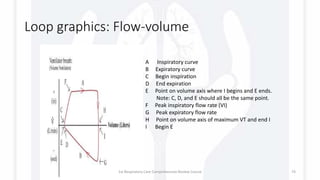
Loop graphics: Flow-volume
A Inspiratory curve
B Expiratory curve
C Begin inspiration
D End expiration
E Point on volume axis where I begins and E ends.
Note: C, D, and E should all be the same point.
F Peak inspiratory flow rate (VI)
G Peak expiratory flow rate
H Point on volume axis of maximum VT and end I
I Begin E
1st Respiratory Care Comprehensive Review Course 74
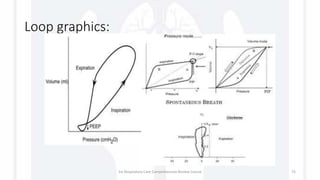
Loop graphics:
1st Respiratory Care Comprehensive Review Course 75
Mechanical Ventilation (2)
1st Respiratory Care Comprehensive Review Course 76
Classification of Modes of Ventilation
1st Respiratory Care Comprehensive Review Course 77
History
• Control variable
• Volume
• Pressure
• Breath sequence
• Continuous mandatory ventilation (CMV)
• Intermittent mandatory ventilation (IMV)
• Continuous spontaneous ventilation (CSV)
1st Respiratory Care Comprehensive Review Course 78
• PCV or VCV
• A/C VC or PC
• SIMV VC or PC
• PSV
Basic Modes
of Ventilation
• PRVC
• CMV Autoflow
• VSV
• ASV
• PAV
• VC+
Advanced
Modes of
Ventilation
Chatburn’s Classification of Ventilator Modes
• Breathing pattern
• Control variable
• Volume
• Pressure
• Breath sequence
• Continuous mandatory ventilation (CMV)
• Intermittent mandatory ventilation (IMV)
• Continuous spontaneous ventilation (CSV)
1st Respiratory Care Comprehensive Review Course 79
Chatburn’s Classification of Ventilator Modes
(Cont.)
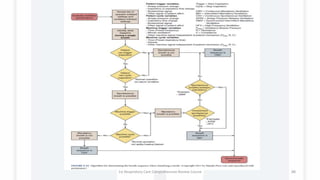
• Targeting scheme: Described as feedback control function of
ventilator
• Set-point
• Dual
• Servo
• Adaptive
• Optimal
• Intelligent
1st Respiratory Care Comprehensive Review Course 80
Types of Targeting
• Set-point: operator sets target parameter, such as a tidal volume;
ventilator delivers that volume
• Dual targeting: operator sets pressure and volume target. If desired
volume is not reached with pressure; ventilator will increase pressure
to reach volume target
1st Respiratory Care Comprehensive Review Course 81
Types of Targeting (Cont.)
• Servo targeting: output of ventilator is adjusted based on input
• Examples:
• Proportional assist ventilation
• Automatic tubing compensation
• Neutrally adjusted ventilatory assist
1st Respiratory Care Comprehensive Review Course 82
Types of Targeting (Cont.)
• Adaptive Targeting: One target is adjusted automatically to achieve
another target
• Examples:
• Pressure-Regulated Volume Control (PRVC): pressure is adjusted to obtain desired tidal
volume
• Mandatory minute ventilation
1st Respiratory Care Comprehensive Review Course 83
Types of Targeting (Cont.)
• Optimal Targeting: Target of ventilator is adjusted automatically to
optimize target following predetermined model
• Used with adaptive support ventilation on Hamilton ventilators
1st Respiratory Care Comprehensive Review Course 84
Types of Targeting (Cont.)
• Intelligent Targeting: Modes and targets are adjusted according to
patient needs
• SmartCare found on Dräger ventilators
• Monitors patient’s PetCO2, spontaneous tidal volume, and
spontaneous respiratory rate
• Ventilator automatically adjusts ventilator parameters to maintain
above parameters at acceptable levels
1st Respiratory Care Comprehensive Review Course 85
1st Respiratory Care Comprehensive Review Course 86
Modes Used in
Ventilator Classification
• VC-CMV
• PC-CMV
• VC-IMV
• PC-IMV
• CSV
1st Respiratory Care Comprehensive Review Course 87
1st Respiratory Care Comprehensive Review Course 88
Continuous Mandatory Ventilation with Set-
Point Targeting
• Use of time triggered volume-targeted or pressure-targeted breaths
• All breaths are time triggered or patient triggered
• Patient guaranteed minimum respiratory rate
• Sensitivity determines amount of effort required to trigger assisted
breath
1st Respiratory Care Comprehensive Review Course 89
Pressure-Controlled Inverse
Ratio Ventilation
• Inspiratory time exceeds expiratory time
• All breaths are pressure targeted
• Inverse ratios are used to increase mean airway pressure and improve
oxygenation
• Increases risk of developing auto-PEEP
• Alveolar pressure (plateau pressure) should not exceed 30 cm H2O to
prevent lung injury
1st Respiratory Care Comprehensive Review Course 90
Intermittent Mandatory Ventilation with Set-
Point Targeting
• Can be volume or pressure targeted
• Patient is allowed to breathe spontaneously between assisted breaths
• Volume-targeted IMV
• Set target tidal volume, flow or inspiratory time, and mandatory rate
• Pressure-targeted IMV
• Set pressure above PEEP, mandatory rate, and inspiratory time
1st Respiratory Care Comprehensive Review Course 91
Airway Pressure
Release Ventilation
• Form of PC-IMV
• Uses two levels of CPAP, allowing spontaneous breathing at both levels
• Airway pressure release ventilation (APRV) is used to control mean airway
pressure and improve oxygenation in patients with significant lung injury
• High level CPAP (PHIGH) is usually set at a level close to mean airway pressure (20
to 25 cm H2O)
• Pressure is allowed to decrease low level CPAP (PLOW) for a brief period of time
(0.2 to 1.0 seconds)
• Allows ventilation to occur
1st Respiratory Care Comprehensive Review Course 92
Settings Used in APRV
• CPAP High (PHIGH)
• CPAP Low (PLOW)
• Time High (THIGH)
• Time Low (TLOW)
1st Respiratory Care Comprehensive Review Course 93
Dual Targeting
• Ventilator delivers pressure-targeted breath with decelerating flow
curve; inspiratory time is preset
• Exhaled volume is monitored
• If volume does not meet minimum volume, pressure is increased or
decreased in increments so desired tidal volume is delivered
1st Respiratory Care Comprehensive Review Course 94
CMV with Adaptive Targeting
• Also referred to as “dual control mode”
• Pressure is adjusted up or down to achieve target tidal volume
• Pressure is adjusted up or down in increments of 1 to 3 cm H2O
• Maximum safety pressure is determined and pressure is not allowed
to exceed this level
• This level is 5 cm H2O below upper pressure limit
1st Respiratory Care Comprehensive Review Course 95
Pressure-Controlled CSV with Intelligent
Targeting
• Used with SmartCare found on Dräger ventilators
• Spontaneous VT, spontaneous rate, and PetCO2 are monitored
• Ventilation is adjusted to patient needs based on these values
• Used as a weaning mode
• Found to be as effective as weaning done by experienced providers in CCU
1st Respiratory Care Comprehensive Review Course 96
Volume-Controlled IMV with Adaptive
Targeting
• Described as “mandatory minute ventilation”
• Rate or pressure support level is adjusted automatically to ensure
preset minute volume
• If patient reaches volume target, no support is provided
• Available on Dräger ventilators
1st Respiratory Care Comprehensive Review Course 97
Pressure-Controlled IMV with Adaptive
Targeting
• Examples:
• Maquet PRVC-IMV
• Dräger SIMV + Autoflow
• Hamilton PC-SIMV + Adaptive Pressure Ventilation
• CareFusion PRVC SIMV
• GE Engstrom Care Station SIMV
1st Respiratory Care Comprehensive Review Course 98
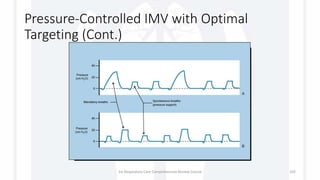
Pressure-Controlled IMV with Optimal
Targeting
• Example: adaptive support ventilation
• Mandatory rate and tidal volume are adjusted to minimize patient’s
work of breathing
• Mandatory and spontaneous breaths are pressure limited
• Ventilator determines dynamic compliance
1st Respiratory Care Comprehensive Review Course 99
Pressure-Controlled IMV with Optimal
Targeting (Cont.)
• Following parameters are set:
• Patient’s IBW and percentage of minute volume operator wants ventilator to
provide
• Maximum pressure limit and PEEP level
• Pressure or flow trigger
• Rise time
1st Respiratory Care Comprehensive Review Course 100
Pressure-Controlled IMV with Optimal
Targeting (Cont.)
• When patient is spontaneously breathing, ventilator adjusts pressure
to keep rate and VT in optimum range
1st Respiratory Care Comprehensive Review Course 101
Pressure-Controlled IMV with Optimal
Targeting (Cont.)
1st Respiratory Care Comprehensive Review Course 102
Pressure-Controlled CSV
• Patient is breathing spontaneously and support is adjusted to control
work of breathing
• All breaths are patient triggered, pressure limited, and flow cycled
• Commonly referred to as “BiPAP”
1st Respiratory Care Comprehensive Review Course 103
Volume Delivered in
Pressure Support
• Affected by three factors:
• Set pressure
• Patients’ compliance and resistance
• Patients’ inspiratory efforts
1st Respiratory Care Comprehensive Review Course 104
Applications of Pressure Support
• Decreasing imposed work of breathing associated with artificial
airway and ventilator circuit
• Supplementing patients’ spontaneous tidal volume to decrease work
of breathing
1st Respiratory Care Comprehensive Review Course 105
Types of Patients Who Are Candidates for PSV
• Patients with artificial airway and any of the following conditions:
• Artificial airways smaller than optimal size
• Spontaneous respiratory rates greater than 20 breaths/min (adults)
• Minute volumes greater than 10 L/min
1st Respiratory Care Comprehensive Review Course 106
Types of Patients Who Are Candidates for PSV
(Cont.)
• Patients supported with IMV/SIMV or CPAP and any of the following
conditions:
• History of chronic obstructive pulmonary disease (COPD)
• Evidence of ventilatory muscle weakness requiring ventilatory support
1st Respiratory Care Comprehensive Review Course 107
Volume Support Ventilation
• Breaths are patient triggered, pressure limited, and flow cycled
• Level of pressure support is adjusted to ensure delivery of mandatory
tidal volume
• If patient becomes apneic, ventilator changes to pressure-regulated
volume control (PRVC)
• Found on Maquet Servoi
1st Respiratory Care Comprehensive Review Course 108
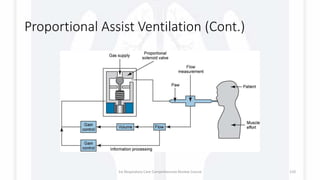
Proportional Assist Ventilation
• Amount of work of breathing assumed by ventilator is adjusted
• Found on Covidien PB 840 ventilator
• Pressure, flow, and volume are automatically adjusted to ensure
ventilator provides percentage of work of breathing
1st Respiratory Care Comprehensive Review Course 109
Proportional Assist Ventilation (Cont.)
1st Respiratory Care Comprehensive Review Course 110
Automatic Tubing Compensation
• Use of pressure support to overcome resistance of endotracheal tube
• Amount of pressure support necessary is calculated by measuring
pressure at distal end of endotracheal tube
• Found on Dräger and Covidien PB 840 ventilators
1st Respiratory Care Comprehensive Review Course 111
Neurally Adjusted Ventilatory Assist
• Electrical activity of diaphragm is measured, determining amount of
support necessary
• Specialized nasogastric tube is used to monitor electrical activity of
diaphragm
• Ventilator begins inspiration as soon as diaphragm begins
depolarization
• Depth of ventilation and length of breath are determined by electrical
activity of diaphragm
1st Respiratory Care Comprehensive Review Course 112
Benefits of NAVA
• Reduced work of breathing
• Fewer trigger efforts missed
• Intrinsic PEEP does not affect triggering
• Improved synchrony and oxygenation
• Reduced need for sedation and paralysis
• Improved ventilation
1st Respiratory Care Comprehensive Review Course 113
Clinical Application
1st Respiratory Care Comprehensive Review Course 114
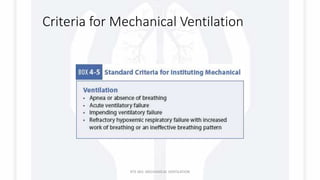
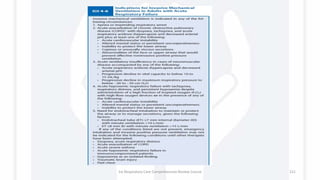
Criteria for Mechanical Ventilation
RTS 363: MECHANICAL VENTILATION
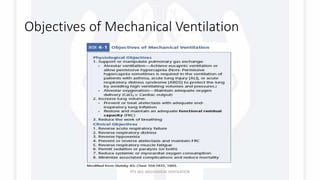
Objectives of Mechanical Ventilation
RTS 363: MECHANICAL VENTILATION
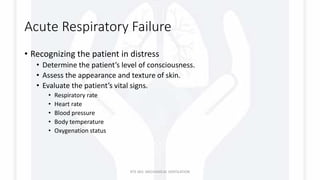
Acute Respiratory Failure
• Recognizing the patient in distress
• Determine the patient’s level of consciousness.
• Assess the appearance and texture of skin.
• Evaluate the patient’s vital signs.
• Respiratory rate
• Heart rate
• Blood pressure
• Body temperature
• Oxygenation status
RTS 363: MECHANICAL VENTILATION
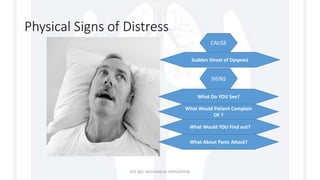
Physical Signs of Distress
RTS 363: MECHANICAL VENTILATION
CAUSE
Sudden Onset of Dyspnea
SIGNS
What Do YOU See?
What Would Patient Complain
OF ?
What Would YOU Find out?
What About Panic Attack?
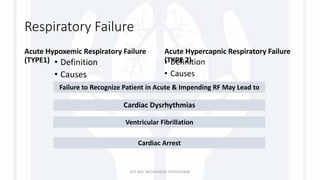
Respiratory Failure
Acute Hypoxemic Respiratory Failure
(TYPE1) • Definition
• Causes
Acute Hypercapnic Respiratory Failure
(TYPE 2)• Definition
• Causes
RTS 363: MECHANICAL VENTILATION
Failure to Recognize Patient in Acute & Impending RF May Lead to
Cardiac Dysrhythmias
Ventricular Fibrillation
Cardiac Arrest
1st Respiratory Care Comprehensive Review Course 120
1st Respiratory Care Comprehensive Review Course 121
Physiologic Measurements
• Bedside measurements
• MIP
• VC
• PEFR
• FEV1
• Respiratory frequency (fb)
• Expired volume per minute
(VE)
• (VE = VT  fb)
RTS 363: MECHANICAL VENTILATION
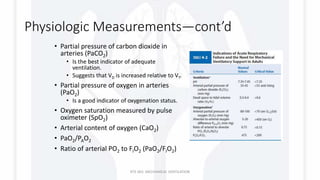
Physiologic Measurements—cont’d
• Partial pressure of carbon dioxide in
arteries (PaCO2)
• Is the best indicator of adequate
ventilation.
• Suggests that VD is increased relative to VT.
• Partial pressure of oxygen in arteries
(PaO2)
• Is a good indicator of oxygenation status.
• Oxygen saturation measured by pulse
oximeter (SpO2)
• Arterial content of oxygen (CaO2)
• PaO2/PAO2
• Ratio of arterial PO2 to FIO2 (PaO2/FIO2)
RTS 363: MECHANICAL VENTILATION
Selecting the Patient Interfaces
• NIPPV
• CPAP
• NIV
• Pressure-triggered, pressure-limited, flow-cycled devices
• Critical-care ventilators
• Invasive positive-pressure ventilation
RTS 363: MECHANICAL VENTILATION
Full and Partial
Ventilatory Support
• Full ventilatory support
• Partial ventilatory support
• Intermittent mandatory ventilation (IMV)
• PSV
• PAV
• MMV
RTS 363: MECHANICAL VENTILATION
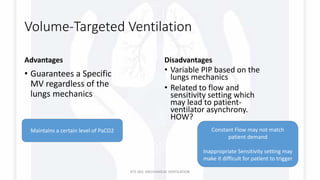
Volume-Targeted Ventilation
Advantages
• Guarantees a Specific
MV regardless of the
lungs mechanics
Disadvantages
• Variable PIP based on the
lungs mechanics
• Related to flow and
sensitivity setting which
may lead to patient-
ventilator asynchrony.
HOW?
RTS 363: MECHANICAL VENTILATION
Maintains a certain level of PaCO2 Constant Flow may not match
patient demand
Inappropriate Sensitivity setting may
make it difficult for patient to trigger
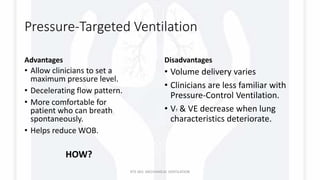
Pressure-Targeted Ventilation
Advantages
• Allow clinicians to set a
maximum pressure level.
• Decelerating flow pattern.
• More comfortable for
patient who can breath
spontaneously.
• Helps reduce WOB.
HOW?
Disadvantages
• Volume delivery varies
• Clinicians are less familiar with
Pressure-Control Ventilation.
• VT & VE decrease when lung
characteristics deteriorate.
RTS 363: MECHANICAL VENTILATION
1st Respiratory Care Comprehensive Review Course 128
To select initial ventilator settings you should take the following steps:
1. Identify the patient’s underline acute condition, history, gender, and height.
2. Identify or calculate the patient’s IBW or use the BSA if given.
IBW male = 106 + 6 (H – 60)
IBW female = 105 + 5 (H – 60)
Height in inches and weight will be in lb to convert to Kg divide by 2.2
3. Calculate the appropriate MV based on IBW or BSA and gender
IBW X 100 ml/Kg (male and female)
BSA X 4 male
BSA X 3.5 female
Note: Correct the MV based on body temperature and respiratory acid/base
status
4. Calculate the appropriate TV based on IBW and gender, and patient condition
5. Then from the MV and the TV you can calculate the appropriate Rate
6. PEEP is generally accepted to start with 3 to 5 cm H2O for optimal PEEP
settings go to your reference book
7. Desired FiO2 you can start with the same FiO2 which patient was receiving if
PaO2 and SaO2 are acceptable or higher if not. You can also use the following
formula for estimated Desired FiO2 = Known FiO2 X Known PaO2 / Desired
PaO2
8. For the initial PC settings can be estimated by given VC breathes to patient
with same baseline pressure then use the plateau pressure as an initial
pressure on PC ventilation. Or to start with 10 to 15 cm H2O then assess the
exhaled TV to adjust the PC level to achieve the optimal TV.
9. For PSV is well accepted way is to use the difference (PIP – Pplat) then assess
the exhaled TV to 4 to 8 ml/Kg IBW
10. Mode can be selected based on the patient condition or what therapist is
more confidant with.
Selecting Ventilator
Initial Settings
1st Respiratory Care Comprehensive Review Course 129
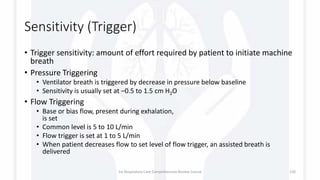
Sensitivity (Trigger)
• Trigger sensitivity: amount of effort required by patient to initiate machine
breath
• Pressure Triggering
• Ventilator breath is triggered by decrease in pressure below baseline
• Sensitivity is usually set at –0.5 to 1.5 cm H2O
• Flow Triggering
• Base or bias flow, present during exhalation,
is set
• Common level is 5 to 10 L/min
• Flow trigger is set at 1 to 5 L/min
• When patient decreases flow to set level of flow trigger, an assisted breath is
delivered
1st Respiratory Care Comprehensive Review Course 130
1st Respiratory Care Comprehensive Review Course 131
Humidification
• HMEs
• Active Humidification
1st Respiratory Care Comprehensive Review Course 132
ALARMS
• Low-pressure alarms are usually set about 5 to 10 cm H2O below
PIP.
• High-pressure alarms are set about 10 cm H2O above PIP.
• Total Respiratory Rate alarm set about : high 10 Breaths above the
patient total rate; low as low as 6 to 8 BPM
• Low PEEP/continuous positive airway pressure (CPAP) alarms are
usually set about 2 to 5 cm H2O below the PEEP level.
• Apnea alarms are used to monitor mandatory or spontaneous
breaths. An apnea period of 20 seconds is the highest accepted
maximum. In some situations, apnea alarms are set so the patient
will not miss two consecutive machine breaths (apnea time > total
cycle time [TCT] and < [TCT × 2]).
• Low exhaled VT: 10% to 15% below set VT.
• Low exhaled minute volume: 10% to 15% below average minute
volume.
• FIO2: 5% above and below set oxygen percentage.
1st Respiratory Care Comprehensive Review Course 133
1st Respiratory Care Comprehensive Review Course 134
Monitoring
• Mode
• Sensitivity
• Tidal Volume, Rate, and Minute Ventilation
• Monitoring Airway Pressures
• Peak Inspiratory Pressure
• Plateau Pressure
• Set Pressure
• Transairway Pressure: PIP Minus
Pplateau
• Mean Airway Pressure
• End-Expiratory Pressure
• Pressure Limit
• Checking the Circuit: Checking for Leaks
• Vital Signs, Blood Pressure, and Physical
Examination of the Chest
• Heart Rate
• Temperature
• Systemic Arterial Blood Pressure
• Central Venous Pressure
• Pulmonary Artery Pressure
• Physical Examination of the Chest
• Management of Endotracheal Tube and
Tracheostomy Tube Cuffs
• Cuff Pressure Measurement
• Tube and Mouth Care
• Monitoring Compliance and Airway Resistance
• Static Compliance
• Dynamic Characteristic (Dynamic Compliance)
• Airway Resistance
1st Respiratory Care Comprehensive Review Course 135
1st Respiratory Care Comprehensive Review Course 136
1st Respiratory Care Comprehensive Review Course 137
1st Respiratory Care Comprehensive Review Course 138
1st Respiratory Care Comprehensive Review Course 139
1st Respiratory Care Comprehensive Review Course 140
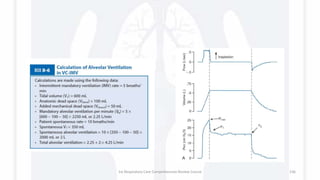
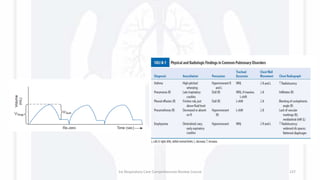
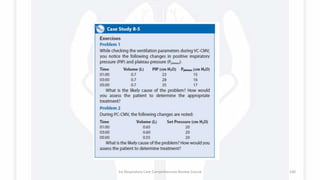
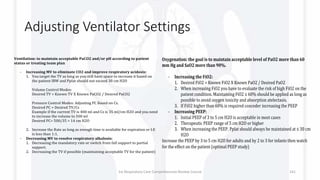
Adjusting Ventilator Settings
Ventilation: to maintain acceptable PaCO2 and/or pH according to patient
status or treating team plan
- Increasing MV to eliminate CO2 and improve respiratory acidosis:
1. You target the TV as long as you still have space to increase it based on
the patient IBW and Pplat should not exceed 30 cm H2O
Volume Control Modes:
Desired TV = Known TV X Known PaCO2 / Desired PaCO2
Pressure Control Modes: Adjusting PC Based on Cs.
Desired PC = Desired TV/Cs
Example if the current TV is 400 ml and Cs is 35 ml/cm H2O and you need
to increase the volume to 500 ml
Desired PC= 500/35 = 14 cm H2O
2. Increase the Rate as long as enough time is available for expiration or I:E
is less than 1:1.
- Decreasing MV to resolve respiratory alkalosis:
1. Decreasing the mandatory rate or switch from full support to partial
support.
2. Decreasing the TV if possible (maintaining acceptable TV for the patient)
Oxygenation: the goal is to maintain acceptable level of PaO2 more than 60
mm Hg and SaO2 more than 90%.
- Increasing the FiO2:
1. Desired FiO2 = Known FiO2 X Known PaO2 / Desired PaO2
2. When increasing FiO2 you have to evaluate the risk of high FiO2 on the
patient condition. Maintaining FiO2 ≤ 60% should be applied as long as
possible to avoid oxygen toxicity and absorption atelectasis.
3. If FiO2 higher than 60% is required conceder increasing the PEEP
- Increasing PEEP:
1. Initial PEEP of 3 to 5 cm H2O is acceptable in most cases
2. Therapeutic PEEP range of 5 cm H2O or higher
3. When increasing the PEEP, Pplat should always be maintained at ≤ 30 cm
H2O
Increase the PEEP by 3 to 5 cm H2O for adults and by 2 to 3 for infants then watch
for the effect on the patient (optimal PEEP study)
1st Respiratory Care Comprehensive Review Course 141
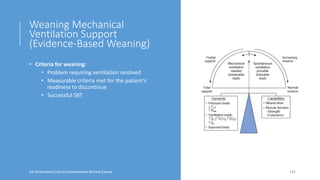
Weaning Mechanical
Ventilation Support
(Evidence-Based Weaning)
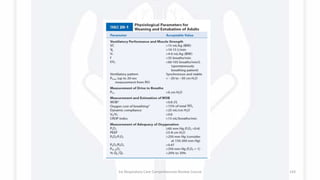
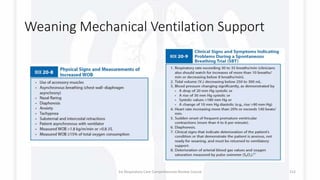
• Criteria for weaning:
• Problem requiring ventilation resolved
• Measurable criteria met for the patient’s
readiness to discontinue
• Successful SBT
1st Respiratory Care Comprehensive Review Course 142
1st Respiratory Care Comprehensive Review Course 143
Facts to Consider
• Patients may require support during weaning
• Supplemental O2 and PEEP may be required
• Require an artificial airway
• Extubation is different from discontinuation of support
• May require one or all of the above
Methods of Titrating Ventilator Support
During Weaning
• Three approaches
1. Intermittent mandatory ventilation (IMV)
2. Pressure-support ventilation (PSV)
3. T-piece weaning
Intermittent Mandatory Ventilation
(IMV)
• Theory is that the patient’s respiratory muscles work during
spontaneous breaths and rest during mandatory breaths
• Common practice
• Reduce the mandatory rate at a pace that matches the patient’s
improvement
• Usually in steps of 1 or 2 breaths/min
• PSV can be added
• 5-10 cm H2O
• PEEP of 3 to 5 cm H2O
Pressure-Support Ventilation (PSV)
• Patient controls the rate, timing, and depth of
each breath
• Patient triggered, pressure limited, and flow cycled
• ICU ventilators allow form monitoring and alarm
systems
• Establishing the level of PSV
• Pressure support levels of 5-15 cm H2O
• Attempt to re-establish the patient’s baseline RR (15-25
breaths/min) and VT (300-600 mL)
Pressure-Support Ventilation (PSV)—cont’d
• During weaning
• Clinician gradually reduces level of support
• Usually until about 5 cm H2O
• Need to monitor patient for signs of distress
T-Piece Weaning
• Oldest technique
• Humidified gas source connected to a T-piece (Briggs adapter) with
large-bore tubing
• Then attached to ET tube
• Another piece of large-bore tubing attached to the exhalation side of
T-piece
• Requires high level of staff attention
• When T-piece is used through a ventilator, CPAP is used
T-Piece Weaning—cont’d
• Not tolerated well in patient with
• Underlying heart disease
• Severe muscle weakness
• Inclined to panic
• Preexisting chronic lung conditions
Closed-Loop Control Modes for Ventilator
Discontinuation
• Automatic tube compensation (ATC)
• Volume-targeted pressure-support ventilation
• Automode and variable pressure support/variable pressure control
• Mandatory minute ventilation (MVV)
• Adaptive support ventilation
• Artificial intelligence systems
Weaning Mechanical Ventilation Support
1st Respiratory Care Comprehensive Review Course 152
1st Respiratory Care Comprehensive Review Course 153
Weaning Mechanical Ventilation Support
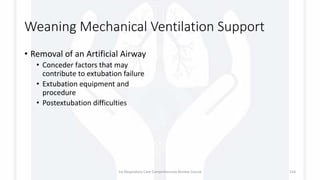
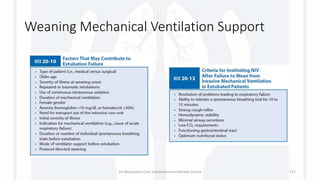
• Removal of an Artificial Airway
• Conceder factors that may
contribute to extubation failure
• Extubation equipment and
procedure
• Postextubation difficulties
1st Respiratory Care Comprehensive Review Course 154
Weaning Mechanical Ventilation Support
1st Respiratory Care Comprehensive Review Course 155
1st Respiratory Care Comprehensive Review Course 156
1. Pilbeam’s mechanical ventilation : physiological and clinical applications / J.M. Cairo.— 6th edition, 2016.
2. Egan's Fundamentals of Respiratory Care / Robert M. Kacmarek, James K. Stoller, and Al Heuer. – 10th Edition, 2013
3. A Taxonomy for Mechanical Ventilation: 10 Fundamental Maxims / Robert L Chatburn MHHS RRT-NPS FAARC, Mohamad El Khatib PhD MD RRT FAARC, and Eduardo
Mireles-Cabodevila MD / RESPIRATORY CARE • NOVEMBER 2014 VOL 59 NO 11
4. Principles And Practice of Mechanical Ventilation / Martin J. Tobin, 3rd Edition / 2013
5. Mosby, 2013
1st Respiratory Care Comprehensive Review Course 157

Mechanical Ventilation (101)

  • 1.
    Mechanical Ventilation (101) 1stRespiratory Care Comprehensive Review Course 1
  • 2.
    Mastering Mechanical Ventilation 1stRespiratory Care Comprehensive Review Course 2 Physical Characteristics of Ventilators & Components of Mechanical Ventilators Normal Physiology of Ventilation & Spont. Breathing and Lung Mechanics Basic Component of Breath Delivery Classification of Modes of Ventilation Initiation MonitoringManagement Clinical Application
  • 3.
    Physical Characteristics ofVentilators & Components of Mechanical Ventilators 1st Respiratory Care Comprehensive Review Course 3
  • 4.
    Ventilator characteristics • Inputpower (Electrical, pneumatic) • Power conversion and transmission • Control system • Output (flow: Pressure and volume) conversion transmission and Control system Input power Output 1st Respiratory Care Comprehensive Review Course 4
  • 5.
    Components of aVentilator Those components are: • User interface • Breath Delivery [Patient] Unit • Backup power supply [Rechargeable batteries] • Air compressor.  Physical characteristics  Ventilator power source • Electrically powered ventilator • Pneumatically powered ventilator • Combined Power Ventilators  Positive or negative pressure  Control systems and circuits  Open- and closed-loop systems  Control panel: user interface  Pneumatic circuit (internal and patient circuit)  Drive mechanism  Compressor or Blowers  displacement  Flow control valves  Output  Pressure, volumes, and flow scalars 1st Respiratory Care Comprehensive Review Course 5
  • 6.
    Power Source • Ventilatorpower source • Electrically powered ventilator • Pneumatically powered ventilator • Combined Power Ventilators • Combined Power Ventilators • Current ICU ventilators use microprocessor control and 50 psi sources of oxygen and air and are Combined Power Ventilators • Current ICU ventilators are classified as Electrically Powered- Pneumatically Driven-Microprocessor Controlled Ventilators 1st Respiratory Care Comprehensive Review Course 6
  • 7.
    Pressure Delivery • Negative-pressureventilators • Iron lung • Chest cuirass • Positive-pressure ventilators • Most ventilators used today are positive-pressure ventilators • Examples include: Puritan Bennett 840, Servoi, and Hamilton G-5 • Combined Pressure Devices • High-frequency oscillators 1st Respiratory Care Comprehensive Review Course 7
  • 8.
    Negative-Pressure Ventilators • Attemptto mimic normal spontaneous ventilation • When negative pressure is applied, thoracic volume is increased and air enters lungs • During exhalation, negative pressure is removed and air leaves lungs 1st Respiratory Care Comprehensive Review Course 8
  • 9.
    Negative-Pressure Ventilators (Cont.) 1stRespiratory Care Comprehensive Review Course 9
  • 10.
    Negative-Pressure Ventilators (Cont.) •Types of negative-pressure ventilators: • Chest cuirass: chest shell applies negative pressure only to chest • Tank ventilator: applies negative pressure to entire body • Negative-pressure ventilators rarely used in ICU • Sometimes used in home care setting 1st Respiratory Care Comprehensive Review Course 10
  • 11.
    Combined Pressure Devices •Most common application is high-frequency oscillator • Sinusoidal pressure wave includes positive and negative pressure applied to airway 1st Respiratory Care Comprehensive Review Course 11
  • 12.
    High-frequency oscillators 1st RespiratoryCare Comprehensive Review Course 12
  • 13.
    Control System &Circuit  Control systems and circuits Open- and closed-loop systems (Control level) Control panel: user interface Pneumatic circuit (internal and patient circuit) 1st Respiratory Care Comprehensive Review Course 13
  • 14.
    Control Type (levelof control) Open loop control system • An open-loop system cannot distinguish between the volume actually delivered and the set volume and respond to this difference. • Operator sets parameter that is delivered by ventilator • No assurance that volume or pressure is actually delivered to lungs Closed loop control system • Closed-Loop systems are an intelligent system • Flow/volume or pressure are set & measured, with feedback to drive mechanism altering output to maintain desired (set) levels • Microprocessor is used to control ventilation • When specific tidal volume is set, ventilator adds to volume if there is leak in circuit • Ventilator adjusts delivered volume or pressure to ensure that set parameter is delivered 1st Respiratory Care Comprehensive Review Course 14
  • 15.
    Pneumatic Circuit • Consistsof two series of tubing: 1. Internal Circuit: directs flow within the ventilator. It can be single or double circuit. 2. The External Circuit (Patient Circuit): directs the flow from the ventilator to the patient. 1st Respiratory Care Comprehensive Review Course 15
  • 16.
    Internal Circuit (Single-circuitdesign) • Single circuit: gas moves through ventilator and is delivered to patient circuit. Most commonly used 1st Respiratory Care Comprehensive Review Course 16
  • 17.
    Internal Circuit (Double-circuitdesign) • Double circuit includes bellows or a bag containing desired tidal volume • Bag is compressed and desired tidal volume is delivered to lungs 1st Respiratory Care Comprehensive Review Course 17
  • 18.
    The External Circuit(Patient Circuit) 1st Respiratory Care Comprehensive Review Course 18
  • 19.
    Control Panel • Referredto as user interface • It contains all controls used to set the ventilation and monitoring parameters • As well as It displays other important parameters and graphics 1st Respiratory Care Comprehensive Review Course 19
  • 20.
    Control Panel (Cont.) 1stRespiratory Care Comprehensive Review Course 20
  • 21.
    Drive mechanism (PowerTransmission System) • Drive mechanism is part of the breath delivery unit. • Responsible for breath delivery to the patient • Develop and control pressure gradient between ventilator and patient • It contains pneumatic and electronic modules that control the breath delivery to the patient • Electrically powered ventilators use compressors, blowers, or other volume displacement devices • Pneumatic systems use compressed gas from wall to deliver volume to lung 1st Respiratory Care Comprehensive Review Course 21
  • 22.
    Compressors or Blowers •Can be driven by pistons, rotating blades, moving diaphragms, or bellows • Most common type of compressor: rotary compressor • Examples: • Viasys Avea • LTV ventilators 1st Respiratory Care Comprehensive Review Course 22
  • 23.
    Volume Displacement Designs • Usedisplacement devices to deliver specific volume • Includes pistons, bellows, or bag in chamber mechanisms • Spring-Loaded Bellows • Operator adjusts tension on spring that is used to compress bellows • Not commonly used 1st Respiratory Care Comprehensive Review Course23
  • 24.
    Flow-Control Valves • Threetypes of flow controlling valves 1. Proportional solenoid valve 2. Stepper motors with valve 3. Digital valves with on/off configuration • Current ICU ventilators use Proportional solenoid valve. 1st Respiratory Care Comprehensive Review Course 24
  • 25.
    Fluidic Ventilators • Usefluidics to deliver gas to patient • Do not use moving parts or electricity to function • Used on Bio-Med MVP 10 • Compatible with use during MRI • Two basic principles: • Beam deflection • Wall attachment (Coanda effect) 1st Respiratory Care Comprehensive Review Course 25
  • 26.
    Expiratory Valves 1st Respiratory CareComprehensive Review Course 26
  • 27.
    Expiratory Valves • Closeduring inspiration to direct gas flow to patient • Open during exhalation allowing patient to exhale gas into atmosphere • PEEP is used to improve oxygenation • PEEP is provided by threshold resistor or flow resistance • Both valves prevent complete exhalation of expired tidal volume 1st Respiratory Care Comprehensive Review Course 27
  • 28.
    Spring-Loaded Valves • Canbe used to provide PEEP • Spring is used to adjust amount of pressure applied against exhalation valve to prevent complete exhalation 1st Respiratory Care Comprehensive Review Course 28
  • 29.
    Diaphragm Expiratory Valve •Diaphragm over exhalation valve closes during inspiration • During exhalation, pressure on diaphragm is released • When PEEP is used, pressure against diaphragm is maintained thus preventing complete exhalation 1st Respiratory Care Comprehensive Review Course 29
  • 30.
    Diaphragm Expiratory Valve(Cont.) 1st Respiratory Care Comprehensive Review Course 30
  • 31.
    Electromagnetic Valves • Amountof electrical current is adjusted to regulate amount of force applied to expiratory flow • The higher the level of current, the more force applied to exhaled gas • Increases PEEP level 1st Respiratory Care Comprehensive Review Course 31
  • 32.
    Heated wire flowsensor • As flow passes through the sensor, the ventilator tries to keep the wire temperature constant • The electric currant consumed to keep this temperature is proportional to gas flow • This type of sensors is affected by condensate, secretion and calcification. • An example of a ventilator using this type of sensors is Dräger Evita XL™ 1st Respiratory Care Comprehensive Review Course 32
  • 33.
    Differential pressure flow sensor •As flow passes through the sensor’s resistive element a pressure deference develop • Using Boyle’s Law [P1V1 = P2V2] the gas flow can be calculated • This type of sensors can be affected by condensate, secretion and calcification. • An example of a ventilator using this type of sensors is Hamilton G5 & S1 1st Respiratory Care Comprehensive Review Course 33
  • 34.
    Ultrasonic Flow Sensor 1stRespiratory Care Comprehensive Review Course 34 Ultrasonic transducer technology: T2 - T1 = Tdiff Tdiff is proportional to the gas flow New measurement every 4 ms
  • 35.
    CPAP Devices • FIO2is regulated with blender • Inspired gas is warmed and humidified • Threshold resistor prevents complete exhalation to maintain positive pressure in airway • Problems with CPAP Systems • Inadequate gas flow to patient • Leaks in system • Loss of source gas flow • Jamming or obstruction of expiratory flow resistor 1st Respiratory Care Comprehensive Review Course
  • 36.
    Basic Component ofBreath Delivery 1st Respiratory Care Comprehensive Review Course 36
  • 37.
    Primary Ventilator ControlVariables • Primary variable ventilator controls to cause inspiration • 3 possible explicit primary variables 1. Pressure controlled 2. Volume controlled 3. Flow controlled • Only one can be controlled; other two become dependent variables 1st Respiratory Care Comprehensive Review Course 37
  • 38.
    Pressure Controller • Ventilatorcontrols pressure (P), but volume & flow vary with changes in compliance (C) & resistance (Raw) • Pressure waveform will be square (constant) during inspiration • Positive or negative pressure controlled • i.e., iron lung controls with negative P 1st Respiratory Care Comprehensive Review Course 38
  • 39.
    Volume & FlowControllers • Volume controller • Ventilator controls volume so will be constant • Flow is volume/time, so flow is also constant • Pressure will vary with changes in C & Raw • Flow controller • As above, flow & thus volume constant • Pressure varies with changes in C and Raw • Old neonatal ventilators used flow interruption to deliver volume during inspiration 1st Respiratory Care Comprehensive Review Course 39
  • 40.
    Two Breath Types •Spontaneous • Patient triggers & cycles the breath • Patient effort may be supported by manual or mechanical ventilator • Mechanical • Mandatory breath: breath is initiated by ventilator • Assisted breath: breath is triggered by patient but is delivered by ventilator 1st Respiratory Care Comprehensive Review Course 40
  • 41.
    Types of Breath 1stRespiratory Care Comprehensive Review Course 41
  • 42.
    Types of Breath(Spontaneous breath) • Without Support (CPAP) • With Support (PSV) 1st Respiratory Care Comprehensive Review Course 42
  • 43.
    Primary Breath ControlVariable • Volume control: VT/flow set, while P depends on those settings & pulmonary mechanics • Pressure control: P set, VT /flow depend on P setting & pulmonary mechanics • Dual control: Mixture of volume & pressure • Either starts breath in volume control & ends with pressure control or the reverse 1st Respiratory Care Comprehensive Review Course 43
  • 44.
    Components (phases) ofBreath Delivery • End of expiration and beginning of inspiration • Delivery of inspiration • End of inspiration and beginning of exhalation • Expiratory phase 1st Respiratory Care Comprehensive Review Course 44
  • 45.
    Phase Variables • Ventilatoruses variables to initiate or limit each phase of ventilation • Initiation of inspiration (E to I) • Inspiration • End of inspiration (I to E) • Expiration 1st Respiratory Care Comprehensive Review Course 45
  • 46.
    Initiation of Inspiration •Trigger variable • Machine triggered • Time: determined by rate control • Patient triggered • Pressure • Flow (least work for patient to trigger) • Volume (rare) • Most ventilators provide a manual breath button that operator activates • Patient triggering: breath is triggered because of patient effort • Trigger sensitivity: amount of effort required by patient to initiate machine breath 1st Respiratory Care Comprehensive Review Course 46
  • 47.
    Time Triggering • Ventilatortriggers breath at preset intervals • Time for mandatory breath is based on cycle time • Cycle time is calculated by dividing 60 by set rate • Example: Set rate is 12 breaths/min • Cycle time = 60/12 • Cycle time = 5 seconds 1st Respiratory Care Comprehensive Review Course 47
  • 48.
    Pressure Triggering • Ventilatorbreath is triggered by decrease in pressure below baseline • Sensitivity is usually set at –0.5 to 1.5 cm H2O • Common locations for pressure sensor: • Internal ventilator circuit where main gas flow leaves ventilator • Where expired gas flow returns from patient to ventilator • At proximal airway (near wye connector) 1st Respiratory Care Comprehensive Review Course 48
  • 49.
    Flow Triggering • Baseor bias flow, present during exhalation, is set • Common level is 5 to 10 L/min • Flow trigger is set at 1 to 5 L/min • When patient decreases flow to set level of flow trigger, an assisted breath is delivered 1st Respiratory Care Comprehensive Review Course 49
  • 50.
    Other Triggering Methods •Manual triggering: operator triggers ventilator breath • Neural triggering: monitors electrical activity of diaphragm • Method is used with neurally adjusted ventilatory assist (NAVA) 1st Respiratory Care Comprehensive Review Course 50
  • 51.
    Inspiration: Target (Limit)Variable • Limits inspiration but does not terminate the phase • Pressure limited • Limits peak inspiratory pressure (PIP) during inspiration • Volume limited • Limits amount of tidal volume (VT) delivered during inspiration to set amount • Flow limited • Limits the amount of flow during inspiration 1st Respiratory Care Comprehensive Review Course 51
  • 52.
    Target Variable 1st RespiratoryCare Comprehensive Review Course 52
  • 53.
    Inspiratory Phase (Cont.) •Sloping or ramping • Ability to adjust how quickly flow is delivered during set inspiratory time • This feature is referred to as: • Ramping • Inspiratory rise time • Flow acceleration • Slope adjustment • Sloping 1st Respiratory Care Comprehensive Review Course 53
  • 54.
    Maximum Safety Pressure •Sets maximum pressure that can be delivered during inspiration • Upper pressure limit is set 10 cm H2O above peak inspiratory pressure (PIP) • Terms for this setting: • Pressure limit • Upper pressure limit • Normal pressure limit • High pressure limit • Peak/maximum pressure 1st Respiratory Care Comprehensive Review Course 54
  • 55.
    Maximum Safety Pressure(Cont.) • Events that occur with activation of upper pressure limit: • Activation of visible and/or audible alarm • Termination of delivery of inspiratory breath • Decrease in inspiratory time 1st Respiratory Care Comprehensive Review Course 55
  • 56.
    End of Inspiration •Cycle variables terminate inspiratory phase • Pressure cycled • Inspiration terminates as preset pressure reached (hit alarm level) • Volume cycled • Inspiration terminates at preset VT • Flow cycled • Inspiration terminates when flow drops to preset value (PSV) • Time cycled • Inspiration terminates when set inspiratory time is reached • Includes any inspiratory holds 1st Respiratory Care Comprehensive Review Course 56
  • 57.
    Pressure Cycling • Whenpreset pressure is reached, inspiratory flow ends and expiratory flow begins • In pressure control ventilation, preset pressure is maintained for set inspiratory time • Only application of pressure cycled ventilation is administration of intermittent positive-pressure breathing (IPPB) • Pressure cycling also occurs if upper pressure limit is reached in volume- or pressure-targeted ventilation 1st Respiratory Care Comprehensive Review Course 57
  • 58.
    Time Cycling • Lengthof inspiration is set by operator; then followed by ventilator ending inspiration and beginning expiration • If inspiratory time is decreased, expiratory time is increased and I:E ratio is increased • If inspiratory time is increased, expiratory time is decreased and I:E ratio is decreased 1st Respiratory Care Comprehensive Review Course 58
  • 59.
    Inspiratory Pause • Extensionof inspiratory time by exhalation valve remaining closed after set tidal volume has been delivered • Also referred to as: • Inflation hold • Inspiratory plateau • Can be used with pressure or volume ventilation • Common application is to obtain plateau pressure to calculate effective static compliance in VCV. • In pressure-controlled ventilation, inspiratory time is long enough for pressure to equilibrate within lungs 1st Respiratory Care Comprehensive Review Course 59
  • 60.
    Inspiratory Pause (Cont.) 1stRespiratory Care Comprehensive Review Course 60
  • 61.
    Volume Cycling • Whenpreset volume is delivered, ventilator ends inspiration and begins expiration • Most ventilators accomplish this by calculation of the amount of flow to deliver a set volume during the set inspiratory time • Amount of volume actually delivered to patient may be less because of volume lost due to tubing compression 1st Respiratory Care Comprehensive Review Course 61
  • 62.
    Tubing Compression • Duringinspiration, tubing is distended and returns to normal size during exhalation • Most adult ventilator circuits have tubing compression factor of 1 to 3 cm H2O • Many current ventilators calculate volume lost to tubing compression and add this to delivered tidal volume 1st Respiratory Care Comprehensive Review Course 62
  • 63.
    Flow Cycled • Inspirationends when preset flow is reached • Pressure support ventilation (PSV) is most common application of flow cycling • In PSV, breaths end when inspiratory flow decreases to set percentage of initial flow rate • When PSV was first developed, breaths ended when flow dropped to 25% of initial flow • In current ventilators, pressure support breaths can be ended at percentages of expiratory flow ranging from 5% to 80% of initial inspiratory flow rate 1st Respiratory Care Comprehensive Review Course 63
  • 64.
    Expiration: Baseline Variable •Defined by how baseline or end expiratory pressure (EEP) relates to atmospheric pressure • PEEP Positive or supra- atmospheric EEP • NEEP Negative or sub-atmospheric EEP • ZEEP Zero EEP equals sub-atmospheric pressure 1st Respiratory Care Comprehensive Review Course 64
  • 65.
    Baseline Pressure • Pressureat which inspiration begins • Zero baseline pressure is equal to atmospheric pressure • PEEP: resistance applied during exhalation preventing complete exhalation • Applications of PEEP: • Increases FRC • Increases mean airway pressure • Improves lung recruitment • Improves oxygenation 1st Respiratory Care Comprehensive Review Course 65
  • 66.
    Baseline Pressure (Cont.) •CPAP • Baseline pressure is elevated • Patient is breathing spontaneously • Applications for CPAP are same as PEEP 1st Respiratory Care Comprehensive Review Course 66
  • 67.
    Negative End-Expiratory Pressure •Developed to minimize effects of positive pressure on blood flow • Used during expiration during high-frequency oscillation 1st Respiratory Care Comprehensive Review Course 67
  • 68.
    Continuous Gas Flow DuringExhalation • Referred to as “base flow” or “bias flow” • Provides flow to patient during last portion of exhalation to the beginning of inspiratory effort • Most current ventilators use bias flow to provide flow triggering 1st Respiratory Care Comprehensive Review Course 68
  • 69.
    Expiratory Hold/End ExpiratoryPressure • Used to estimate amount of pressure in lungs caused by trapped air • Pressure of trapped air is referred to as “auto-PEEP” • Conditions increasing risk of developing auto-PEEP: • High minute volumes (>10 L/minute) • Patients with high airway resistance • Patients with active exhalation 1st Respiratory Care Comprehensive Review Course 69
  • 70.
    Waveforms and Graphics •Scalar graphics • Pressure-time • Volume-time • Flow-time • Loop graphics • Flow-volume • Pressure-volume 1st Respiratory Care Comprehensive Review Course 70
  • 71.
    Scalar Graphics DuringVolume-Controlled Ventilation 1st Respiratory Care Comprehensive Review Course 71
  • 72.
    Scalar Graphics During Pressure-ControlledVentilation 1st Respiratory Care Comprehensive Review Course 72
  • 73.
    Scalar Graphics During Pressure-SupportVentilation 1st Respiratory Care Comprehensive Review Course 73
  • 74.
    Loop graphics: Flow-volume AInspiratory curve B Expiratory curve C Begin inspiration D End expiration E Point on volume axis where I begins and E ends. Note: C, D, and E should all be the same point. F Peak inspiratory flow rate (VI) G Peak expiratory flow rate H Point on volume axis of maximum VT and end I I Begin E 1st Respiratory Care Comprehensive Review Course 74
  • 75.
    Loop graphics: 1st RespiratoryCare Comprehensive Review Course 75
  • 76.
    Mechanical Ventilation (2) 1stRespiratory Care Comprehensive Review Course 76
  • 77.
    Classification of Modesof Ventilation 1st Respiratory Care Comprehensive Review Course 77
  • 78.
    History • Control variable •Volume • Pressure • Breath sequence • Continuous mandatory ventilation (CMV) • Intermittent mandatory ventilation (IMV) • Continuous spontaneous ventilation (CSV) 1st Respiratory Care Comprehensive Review Course 78 • PCV or VCV • A/C VC or PC • SIMV VC or PC • PSV Basic Modes of Ventilation • PRVC • CMV Autoflow • VSV • ASV • PAV • VC+ Advanced Modes of Ventilation
  • 79.
    Chatburn’s Classification ofVentilator Modes • Breathing pattern • Control variable • Volume • Pressure • Breath sequence • Continuous mandatory ventilation (CMV) • Intermittent mandatory ventilation (IMV) • Continuous spontaneous ventilation (CSV) 1st Respiratory Care Comprehensive Review Course 79
  • 80.
    Chatburn’s Classification ofVentilator Modes (Cont.) • Targeting scheme: Described as feedback control function of ventilator • Set-point • Dual • Servo • Adaptive • Optimal • Intelligent 1st Respiratory Care Comprehensive Review Course 80
  • 81.
    Types of Targeting •Set-point: operator sets target parameter, such as a tidal volume; ventilator delivers that volume • Dual targeting: operator sets pressure and volume target. If desired volume is not reached with pressure; ventilator will increase pressure to reach volume target 1st Respiratory Care Comprehensive Review Course 81
  • 82.
    Types of Targeting(Cont.) • Servo targeting: output of ventilator is adjusted based on input • Examples: • Proportional assist ventilation • Automatic tubing compensation • Neutrally adjusted ventilatory assist 1st Respiratory Care Comprehensive Review Course 82
  • 83.
    Types of Targeting(Cont.) • Adaptive Targeting: One target is adjusted automatically to achieve another target • Examples: • Pressure-Regulated Volume Control (PRVC): pressure is adjusted to obtain desired tidal volume • Mandatory minute ventilation 1st Respiratory Care Comprehensive Review Course 83
  • 84.
    Types of Targeting(Cont.) • Optimal Targeting: Target of ventilator is adjusted automatically to optimize target following predetermined model • Used with adaptive support ventilation on Hamilton ventilators 1st Respiratory Care Comprehensive Review Course 84
  • 85.
    Types of Targeting(Cont.) • Intelligent Targeting: Modes and targets are adjusted according to patient needs • SmartCare found on Dräger ventilators • Monitors patient’s PetCO2, spontaneous tidal volume, and spontaneous respiratory rate • Ventilator automatically adjusts ventilator parameters to maintain above parameters at acceptable levels 1st Respiratory Care Comprehensive Review Course 85
  • 86.
    1st Respiratory CareComprehensive Review Course 86
  • 87.
    Modes Used in VentilatorClassification • VC-CMV • PC-CMV • VC-IMV • PC-IMV • CSV 1st Respiratory Care Comprehensive Review Course 87
  • 88.
    1st Respiratory CareComprehensive Review Course 88
  • 89.
    Continuous Mandatory Ventilationwith Set- Point Targeting • Use of time triggered volume-targeted or pressure-targeted breaths • All breaths are time triggered or patient triggered • Patient guaranteed minimum respiratory rate • Sensitivity determines amount of effort required to trigger assisted breath 1st Respiratory Care Comprehensive Review Course 89
  • 90.
    Pressure-Controlled Inverse Ratio Ventilation •Inspiratory time exceeds expiratory time • All breaths are pressure targeted • Inverse ratios are used to increase mean airway pressure and improve oxygenation • Increases risk of developing auto-PEEP • Alveolar pressure (plateau pressure) should not exceed 30 cm H2O to prevent lung injury 1st Respiratory Care Comprehensive Review Course 90
  • 91.
    Intermittent Mandatory Ventilationwith Set- Point Targeting • Can be volume or pressure targeted • Patient is allowed to breathe spontaneously between assisted breaths • Volume-targeted IMV • Set target tidal volume, flow or inspiratory time, and mandatory rate • Pressure-targeted IMV • Set pressure above PEEP, mandatory rate, and inspiratory time 1st Respiratory Care Comprehensive Review Course 91
  • 92.
    Airway Pressure Release Ventilation •Form of PC-IMV • Uses two levels of CPAP, allowing spontaneous breathing at both levels • Airway pressure release ventilation (APRV) is used to control mean airway pressure and improve oxygenation in patients with significant lung injury • High level CPAP (PHIGH) is usually set at a level close to mean airway pressure (20 to 25 cm H2O) • Pressure is allowed to decrease low level CPAP (PLOW) for a brief period of time (0.2 to 1.0 seconds) • Allows ventilation to occur 1st Respiratory Care Comprehensive Review Course 92
  • 93.
    Settings Used inAPRV • CPAP High (PHIGH) • CPAP Low (PLOW) • Time High (THIGH) • Time Low (TLOW) 1st Respiratory Care Comprehensive Review Course 93
  • 94.
    Dual Targeting • Ventilatordelivers pressure-targeted breath with decelerating flow curve; inspiratory time is preset • Exhaled volume is monitored • If volume does not meet minimum volume, pressure is increased or decreased in increments so desired tidal volume is delivered 1st Respiratory Care Comprehensive Review Course 94
  • 95.
    CMV with AdaptiveTargeting • Also referred to as “dual control mode” • Pressure is adjusted up or down to achieve target tidal volume • Pressure is adjusted up or down in increments of 1 to 3 cm H2O • Maximum safety pressure is determined and pressure is not allowed to exceed this level • This level is 5 cm H2O below upper pressure limit 1st Respiratory Care Comprehensive Review Course 95
  • 96.
    Pressure-Controlled CSV withIntelligent Targeting • Used with SmartCare found on Dräger ventilators • Spontaneous VT, spontaneous rate, and PetCO2 are monitored • Ventilation is adjusted to patient needs based on these values • Used as a weaning mode • Found to be as effective as weaning done by experienced providers in CCU 1st Respiratory Care Comprehensive Review Course 96
  • 97.
    Volume-Controlled IMV withAdaptive Targeting • Described as “mandatory minute ventilation” • Rate or pressure support level is adjusted automatically to ensure preset minute volume • If patient reaches volume target, no support is provided • Available on Dräger ventilators 1st Respiratory Care Comprehensive Review Course 97
  • 98.
    Pressure-Controlled IMV withAdaptive Targeting • Examples: • Maquet PRVC-IMV • Dräger SIMV + Autoflow • Hamilton PC-SIMV + Adaptive Pressure Ventilation • CareFusion PRVC SIMV • GE Engstrom Care Station SIMV 1st Respiratory Care Comprehensive Review Course 98
  • 99.
    Pressure-Controlled IMV withOptimal Targeting • Example: adaptive support ventilation • Mandatory rate and tidal volume are adjusted to minimize patient’s work of breathing • Mandatory and spontaneous breaths are pressure limited • Ventilator determines dynamic compliance 1st Respiratory Care Comprehensive Review Course 99
  • 100.
    Pressure-Controlled IMV withOptimal Targeting (Cont.) • Following parameters are set: • Patient’s IBW and percentage of minute volume operator wants ventilator to provide • Maximum pressure limit and PEEP level • Pressure or flow trigger • Rise time 1st Respiratory Care Comprehensive Review Course 100
  • 101.
    Pressure-Controlled IMV withOptimal Targeting (Cont.) • When patient is spontaneously breathing, ventilator adjusts pressure to keep rate and VT in optimum range 1st Respiratory Care Comprehensive Review Course 101
  • 102.
    Pressure-Controlled IMV withOptimal Targeting (Cont.) 1st Respiratory Care Comprehensive Review Course 102
  • 103.
    Pressure-Controlled CSV • Patientis breathing spontaneously and support is adjusted to control work of breathing • All breaths are patient triggered, pressure limited, and flow cycled • Commonly referred to as “BiPAP” 1st Respiratory Care Comprehensive Review Course 103
  • 104.
    Volume Delivered in PressureSupport • Affected by three factors: • Set pressure • Patients’ compliance and resistance • Patients’ inspiratory efforts 1st Respiratory Care Comprehensive Review Course 104
  • 105.
    Applications of PressureSupport • Decreasing imposed work of breathing associated with artificial airway and ventilator circuit • Supplementing patients’ spontaneous tidal volume to decrease work of breathing 1st Respiratory Care Comprehensive Review Course 105
  • 106.
    Types of PatientsWho Are Candidates for PSV • Patients with artificial airway and any of the following conditions: • Artificial airways smaller than optimal size • Spontaneous respiratory rates greater than 20 breaths/min (adults) • Minute volumes greater than 10 L/min 1st Respiratory Care Comprehensive Review Course 106
  • 107.
    Types of PatientsWho Are Candidates for PSV (Cont.) • Patients supported with IMV/SIMV or CPAP and any of the following conditions: • History of chronic obstructive pulmonary disease (COPD) • Evidence of ventilatory muscle weakness requiring ventilatory support 1st Respiratory Care Comprehensive Review Course 107
  • 108.
    Volume Support Ventilation •Breaths are patient triggered, pressure limited, and flow cycled • Level of pressure support is adjusted to ensure delivery of mandatory tidal volume • If patient becomes apneic, ventilator changes to pressure-regulated volume control (PRVC) • Found on Maquet Servoi 1st Respiratory Care Comprehensive Review Course 108
  • 109.
    Proportional Assist Ventilation •Amount of work of breathing assumed by ventilator is adjusted • Found on Covidien PB 840 ventilator • Pressure, flow, and volume are automatically adjusted to ensure ventilator provides percentage of work of breathing 1st Respiratory Care Comprehensive Review Course 109
  • 110.
    Proportional Assist Ventilation(Cont.) 1st Respiratory Care Comprehensive Review Course 110
  • 111.
    Automatic Tubing Compensation •Use of pressure support to overcome resistance of endotracheal tube • Amount of pressure support necessary is calculated by measuring pressure at distal end of endotracheal tube • Found on Dräger and Covidien PB 840 ventilators 1st Respiratory Care Comprehensive Review Course 111
  • 112.
    Neurally Adjusted VentilatoryAssist • Electrical activity of diaphragm is measured, determining amount of support necessary • Specialized nasogastric tube is used to monitor electrical activity of diaphragm • Ventilator begins inspiration as soon as diaphragm begins depolarization • Depth of ventilation and length of breath are determined by electrical activity of diaphragm 1st Respiratory Care Comprehensive Review Course 112
  • 113.
    Benefits of NAVA •Reduced work of breathing • Fewer trigger efforts missed • Intrinsic PEEP does not affect triggering • Improved synchrony and oxygenation • Reduced need for sedation and paralysis • Improved ventilation 1st Respiratory Care Comprehensive Review Course 113
  • 114.
    Clinical Application 1st RespiratoryCare Comprehensive Review Course 114
  • 115.
    Criteria for MechanicalVentilation RTS 363: MECHANICAL VENTILATION
  • 116.
    Objectives of MechanicalVentilation RTS 363: MECHANICAL VENTILATION
  • 117.
    Acute Respiratory Failure •Recognizing the patient in distress • Determine the patient’s level of consciousness. • Assess the appearance and texture of skin. • Evaluate the patient’s vital signs. • Respiratory rate • Heart rate • Blood pressure • Body temperature • Oxygenation status RTS 363: MECHANICAL VENTILATION
  • 118.
    Physical Signs ofDistress RTS 363: MECHANICAL VENTILATION CAUSE Sudden Onset of Dyspnea SIGNS What Do YOU See? What Would Patient Complain OF ? What Would YOU Find out? What About Panic Attack?
  • 119.
    Respiratory Failure Acute HypoxemicRespiratory Failure (TYPE1) • Definition • Causes Acute Hypercapnic Respiratory Failure (TYPE 2)• Definition • Causes RTS 363: MECHANICAL VENTILATION Failure to Recognize Patient in Acute & Impending RF May Lead to Cardiac Dysrhythmias Ventricular Fibrillation Cardiac Arrest
  • 120.
    1st Respiratory CareComprehensive Review Course 120
  • 121.
    1st Respiratory CareComprehensive Review Course 121
  • 122.
    Physiologic Measurements • Bedsidemeasurements • MIP • VC • PEFR • FEV1 • Respiratory frequency (fb) • Expired volume per minute (VE) • (VE = VT  fb) RTS 363: MECHANICAL VENTILATION
  • 123.
    Physiologic Measurements—cont’d • Partialpressure of carbon dioxide in arteries (PaCO2) • Is the best indicator of adequate ventilation. • Suggests that VD is increased relative to VT. • Partial pressure of oxygen in arteries (PaO2) • Is a good indicator of oxygenation status. • Oxygen saturation measured by pulse oximeter (SpO2) • Arterial content of oxygen (CaO2) • PaO2/PAO2 • Ratio of arterial PO2 to FIO2 (PaO2/FIO2) RTS 363: MECHANICAL VENTILATION
  • 124.
    Selecting the PatientInterfaces • NIPPV • CPAP • NIV • Pressure-triggered, pressure-limited, flow-cycled devices • Critical-care ventilators • Invasive positive-pressure ventilation RTS 363: MECHANICAL VENTILATION
  • 125.
    Full and Partial VentilatorySupport • Full ventilatory support • Partial ventilatory support • Intermittent mandatory ventilation (IMV) • PSV • PAV • MMV RTS 363: MECHANICAL VENTILATION
  • 126.
    Volume-Targeted Ventilation Advantages • Guaranteesa Specific MV regardless of the lungs mechanics Disadvantages • Variable PIP based on the lungs mechanics • Related to flow and sensitivity setting which may lead to patient- ventilator asynchrony. HOW? RTS 363: MECHANICAL VENTILATION Maintains a certain level of PaCO2 Constant Flow may not match patient demand Inappropriate Sensitivity setting may make it difficult for patient to trigger
  • 127.
    Pressure-Targeted Ventilation Advantages • Allowclinicians to set a maximum pressure level. • Decelerating flow pattern. • More comfortable for patient who can breath spontaneously. • Helps reduce WOB. HOW? Disadvantages • Volume delivery varies • Clinicians are less familiar with Pressure-Control Ventilation. • VT & VE decrease when lung characteristics deteriorate. RTS 363: MECHANICAL VENTILATION
  • 128.
    1st Respiratory CareComprehensive Review Course 128
  • 129.
    To select initialventilator settings you should take the following steps: 1. Identify the patient’s underline acute condition, history, gender, and height. 2. Identify or calculate the patient’s IBW or use the BSA if given. IBW male = 106 + 6 (H – 60) IBW female = 105 + 5 (H – 60) Height in inches and weight will be in lb to convert to Kg divide by 2.2 3. Calculate the appropriate MV based on IBW or BSA and gender IBW X 100 ml/Kg (male and female) BSA X 4 male BSA X 3.5 female Note: Correct the MV based on body temperature and respiratory acid/base status 4. Calculate the appropriate TV based on IBW and gender, and patient condition 5. Then from the MV and the TV you can calculate the appropriate Rate 6. PEEP is generally accepted to start with 3 to 5 cm H2O for optimal PEEP settings go to your reference book 7. Desired FiO2 you can start with the same FiO2 which patient was receiving if PaO2 and SaO2 are acceptable or higher if not. You can also use the following formula for estimated Desired FiO2 = Known FiO2 X Known PaO2 / Desired PaO2 8. For the initial PC settings can be estimated by given VC breathes to patient with same baseline pressure then use the plateau pressure as an initial pressure on PC ventilation. Or to start with 10 to 15 cm H2O then assess the exhaled TV to adjust the PC level to achieve the optimal TV. 9. For PSV is well accepted way is to use the difference (PIP – Pplat) then assess the exhaled TV to 4 to 8 ml/Kg IBW 10. Mode can be selected based on the patient condition or what therapist is more confidant with. Selecting Ventilator Initial Settings 1st Respiratory Care Comprehensive Review Course 129
  • 130.
    Sensitivity (Trigger) • Triggersensitivity: amount of effort required by patient to initiate machine breath • Pressure Triggering • Ventilator breath is triggered by decrease in pressure below baseline • Sensitivity is usually set at –0.5 to 1.5 cm H2O • Flow Triggering • Base or bias flow, present during exhalation, is set • Common level is 5 to 10 L/min • Flow trigger is set at 1 to 5 L/min • When patient decreases flow to set level of flow trigger, an assisted breath is delivered 1st Respiratory Care Comprehensive Review Course 130
  • 131.
    1st Respiratory CareComprehensive Review Course 131
  • 132.
    Humidification • HMEs • ActiveHumidification 1st Respiratory Care Comprehensive Review Course 132
  • 133.
    ALARMS • Low-pressure alarmsare usually set about 5 to 10 cm H2O below PIP. • High-pressure alarms are set about 10 cm H2O above PIP. • Total Respiratory Rate alarm set about : high 10 Breaths above the patient total rate; low as low as 6 to 8 BPM • Low PEEP/continuous positive airway pressure (CPAP) alarms are usually set about 2 to 5 cm H2O below the PEEP level. • Apnea alarms are used to monitor mandatory or spontaneous breaths. An apnea period of 20 seconds is the highest accepted maximum. In some situations, apnea alarms are set so the patient will not miss two consecutive machine breaths (apnea time > total cycle time [TCT] and < [TCT × 2]). • Low exhaled VT: 10% to 15% below set VT. • Low exhaled minute volume: 10% to 15% below average minute volume. • FIO2: 5% above and below set oxygen percentage. 1st Respiratory Care Comprehensive Review Course 133
  • 134.
    1st Respiratory CareComprehensive Review Course 134
  • 135.
    Monitoring • Mode • Sensitivity •Tidal Volume, Rate, and Minute Ventilation • Monitoring Airway Pressures • Peak Inspiratory Pressure • Plateau Pressure • Set Pressure • Transairway Pressure: PIP Minus Pplateau • Mean Airway Pressure • End-Expiratory Pressure • Pressure Limit • Checking the Circuit: Checking for Leaks • Vital Signs, Blood Pressure, and Physical Examination of the Chest • Heart Rate • Temperature • Systemic Arterial Blood Pressure • Central Venous Pressure • Pulmonary Artery Pressure • Physical Examination of the Chest • Management of Endotracheal Tube and Tracheostomy Tube Cuffs • Cuff Pressure Measurement • Tube and Mouth Care • Monitoring Compliance and Airway Resistance • Static Compliance • Dynamic Characteristic (Dynamic Compliance) • Airway Resistance 1st Respiratory Care Comprehensive Review Course 135
  • 136.
    1st Respiratory CareComprehensive Review Course 136
  • 137.
    1st Respiratory CareComprehensive Review Course 137
  • 138.
    1st Respiratory CareComprehensive Review Course 138
  • 139.
    1st Respiratory CareComprehensive Review Course 139
  • 140.
    1st Respiratory CareComprehensive Review Course 140
  • 141.
    Adjusting Ventilator Settings Ventilation:to maintain acceptable PaCO2 and/or pH according to patient status or treating team plan - Increasing MV to eliminate CO2 and improve respiratory acidosis: 1. You target the TV as long as you still have space to increase it based on the patient IBW and Pplat should not exceed 30 cm H2O Volume Control Modes: Desired TV = Known TV X Known PaCO2 / Desired PaCO2 Pressure Control Modes: Adjusting PC Based on Cs. Desired PC = Desired TV/Cs Example if the current TV is 400 ml and Cs is 35 ml/cm H2O and you need to increase the volume to 500 ml Desired PC= 500/35 = 14 cm H2O 2. Increase the Rate as long as enough time is available for expiration or I:E is less than 1:1. - Decreasing MV to resolve respiratory alkalosis: 1. Decreasing the mandatory rate or switch from full support to partial support. 2. Decreasing the TV if possible (maintaining acceptable TV for the patient) Oxygenation: the goal is to maintain acceptable level of PaO2 more than 60 mm Hg and SaO2 more than 90%. - Increasing the FiO2: 1. Desired FiO2 = Known FiO2 X Known PaO2 / Desired PaO2 2. When increasing FiO2 you have to evaluate the risk of high FiO2 on the patient condition. Maintaining FiO2 ≤ 60% should be applied as long as possible to avoid oxygen toxicity and absorption atelectasis. 3. If FiO2 higher than 60% is required conceder increasing the PEEP - Increasing PEEP: 1. Initial PEEP of 3 to 5 cm H2O is acceptable in most cases 2. Therapeutic PEEP range of 5 cm H2O or higher 3. When increasing the PEEP, Pplat should always be maintained at ≤ 30 cm H2O Increase the PEEP by 3 to 5 cm H2O for adults and by 2 to 3 for infants then watch for the effect on the patient (optimal PEEP study) 1st Respiratory Care Comprehensive Review Course 141
  • 142.
    Weaning Mechanical Ventilation Support (Evidence-BasedWeaning) • Criteria for weaning: • Problem requiring ventilation resolved • Measurable criteria met for the patient’s readiness to discontinue • Successful SBT 1st Respiratory Care Comprehensive Review Course 142
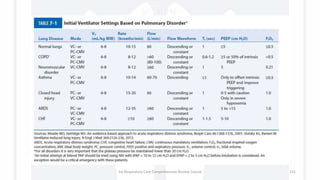
  • 143.
    1st Respiratory CareComprehensive Review Course 143
  • 144.
    Facts to Consider •Patients may require support during weaning • Supplemental O2 and PEEP may be required • Require an artificial airway • Extubation is different from discontinuation of support • May require one or all of the above
  • 145.
    Methods of TitratingVentilator Support During Weaning • Three approaches 1. Intermittent mandatory ventilation (IMV) 2. Pressure-support ventilation (PSV) 3. T-piece weaning
  • 146.
    Intermittent Mandatory Ventilation (IMV) •Theory is that the patient’s respiratory muscles work during spontaneous breaths and rest during mandatory breaths • Common practice • Reduce the mandatory rate at a pace that matches the patient’s improvement • Usually in steps of 1 or 2 breaths/min • PSV can be added • 5-10 cm H2O • PEEP of 3 to 5 cm H2O
  • 147.
    Pressure-Support Ventilation (PSV) •Patient controls the rate, timing, and depth of each breath • Patient triggered, pressure limited, and flow cycled • ICU ventilators allow form monitoring and alarm systems • Establishing the level of PSV • Pressure support levels of 5-15 cm H2O • Attempt to re-establish the patient’s baseline RR (15-25 breaths/min) and VT (300-600 mL)
  • 148.
    Pressure-Support Ventilation (PSV)—cont’d •During weaning • Clinician gradually reduces level of support • Usually until about 5 cm H2O • Need to monitor patient for signs of distress
  • 149.
    T-Piece Weaning • Oldesttechnique • Humidified gas source connected to a T-piece (Briggs adapter) with large-bore tubing • Then attached to ET tube • Another piece of large-bore tubing attached to the exhalation side of T-piece • Requires high level of staff attention • When T-piece is used through a ventilator, CPAP is used
  • 150.
    T-Piece Weaning—cont’d • Nottolerated well in patient with • Underlying heart disease • Severe muscle weakness • Inclined to panic • Preexisting chronic lung conditions
  • 151.
    Closed-Loop Control Modesfor Ventilator Discontinuation • Automatic tube compensation (ATC) • Volume-targeted pressure-support ventilation • Automode and variable pressure support/variable pressure control • Mandatory minute ventilation (MVV) • Adaptive support ventilation • Artificial intelligence systems
  • 152.
    Weaning Mechanical VentilationSupport 1st Respiratory Care Comprehensive Review Course 152
  • 153.
    1st Respiratory CareComprehensive Review Course 153
  • 154.
    Weaning Mechanical VentilationSupport • Removal of an Artificial Airway • Conceder factors that may contribute to extubation failure • Extubation equipment and procedure • Postextubation difficulties 1st Respiratory Care Comprehensive Review Course 154
  • 155.
    Weaning Mechanical VentilationSupport 1st Respiratory Care Comprehensive Review Course 155
  • 156.
    1st Respiratory CareComprehensive Review Course 156
  • 157.
    1. Pilbeam’s mechanicalventilation : physiological and clinical applications / J.M. Cairo.— 6th edition, 2016. 2. Egan's Fundamentals of Respiratory Care / Robert M. Kacmarek, James K. Stoller, and Al Heuer. – 10th Edition, 2013 3. A Taxonomy for Mechanical Ventilation: 10 Fundamental Maxims / Robert L Chatburn MHHS RRT-NPS FAARC, Mohamad El Khatib PhD MD RRT FAARC, and Eduardo Mireles-Cabodevila MD / RESPIRATORY CARE • NOVEMBER 2014 VOL 59 NO 11 4. Principles And Practice of Mechanical Ventilation / Martin J. Tobin, 3rd Edition / 2013 5. Mosby, 2013 1st Respiratory Care Comprehensive Review Course 157