Non Invasive VentilationNon Invasive Ventilation
Shibu ChackoShibu Chacko
Non Invasive VentilationNon Invasive Ventilation
 NIV – term favoured, bi levelNIV – term favoured, bi level
 IPAP = acts as pressure support andIPAP = acts as pressure support and
increases patients respiratory effort byincreases patients respiratory effort by
improving tidal volume and minuteimproving tidal volume and minute
ventilation.ventilation.
 EPAP = used to splint airways open thusEPAP = used to splint airways open thus
improving gas exchange.improving gas exchange.
Aims of NIV treatmentAims of NIV treatment
 To improve gas exchangeTo improve gas exchange
 To reduce the work of breathing.To reduce the work of breathing.
 To reduce shortness of breathTo reduce shortness of breath
 To avoid the need for invasive ventilation.To avoid the need for invasive ventilation.
 To reduce length of stayTo reduce length of stay
CriteriaCriteria
 NIV is indicated in patients with -NIV is indicated in patients with -
Type II Respiratory failure with aType II Respiratory failure with a
pH 7.25 – 7.35pH 7.25 – 7.35
 Patients with pH < 7.25 respond less wellPatients with pH < 7.25 respond less well
and ideally managed in an ICU/HDU.and ideally managed in an ICU/HDU.
 Patients who are severely hypoxic may bePatients who are severely hypoxic may be
more appropriately managed in ICU.more appropriately managed in ICU.
Clinical stateClinical state
 Able to protect airwayAble to protect airway
 Conscious and cooperativeConscious and cooperative
 Haemodynamically stableHaemodynamically stable
 Able to cough and clear secretionsAble to cough and clear secretions
Contra-indicationsContra-indications
 Facial burns/ trauma/ recent facial orFacial burns/ trauma/ recent facial or
upper airways surgeryupper airways surgery
 Vomiting/Copious respiratory secretionsVomiting/Copious respiratory secretions
 Fixed upper airways obstructionFixed upper airways obstruction
 Undrained pneumothoraxUndrained pneumothorax
 Impaired level of consciousnessImpaired level of consciousness
 Unable to protect own airwayUnable to protect own airway
Factors to considerFactors to consider
 Quality of life pre admissionQuality of life pre admission
 Patient agreeable to trialling NIVPatient agreeable to trialling NIV
 Ideally discussion with patient thisIdeally discussion with patient this
treatment may not work.treatment may not work.
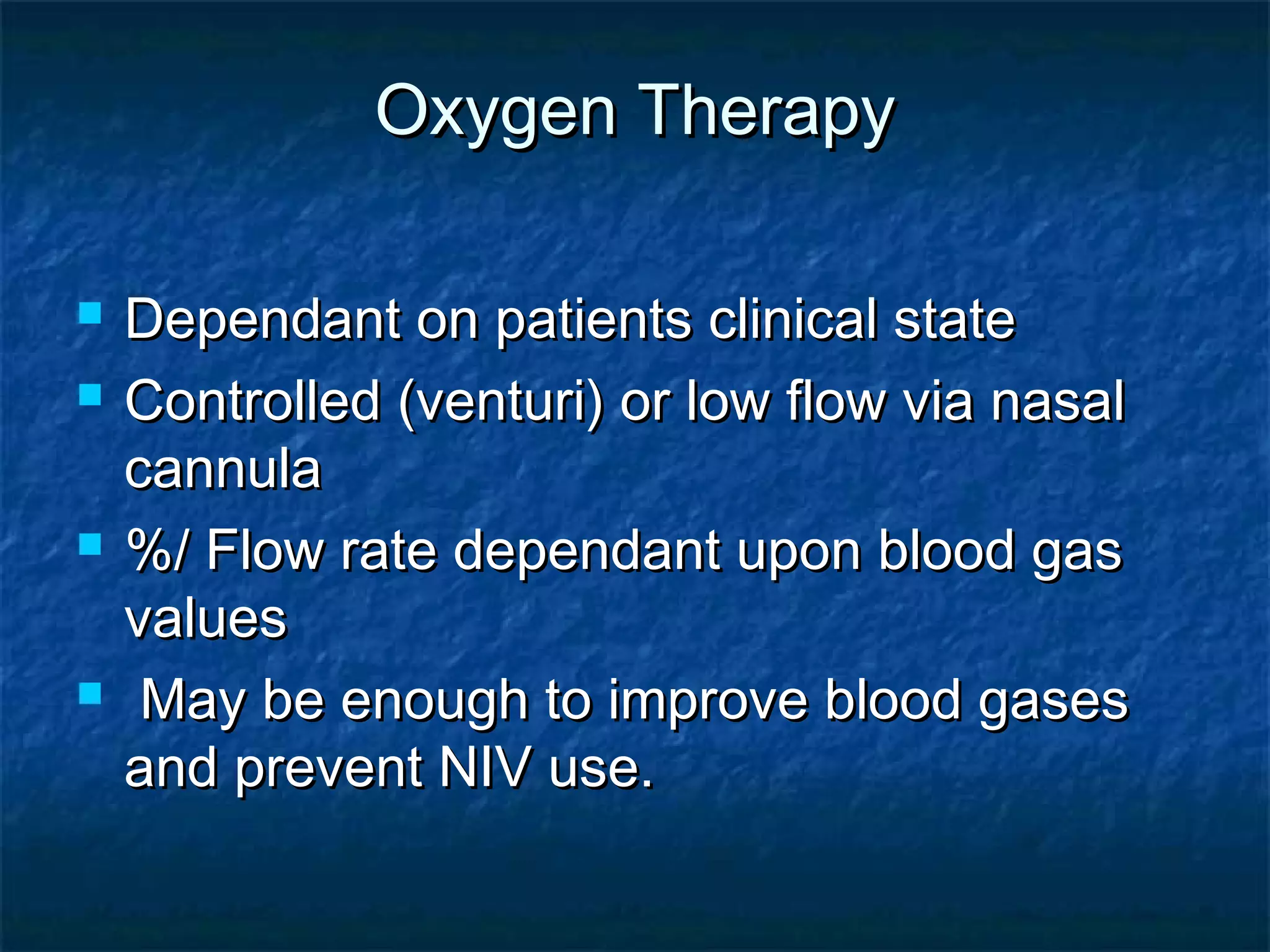
Oxygen TherapyOxygen Therapy
 Dependant on patients clinical stateDependant on patients clinical state
 Controlled (venturi) or low flow via nasalControlled (venturi) or low flow via nasal
cannulacannula
 %/ Flow rate dependant upon blood gas%/ Flow rate dependant upon blood gas
valuesvalues
 May be enough to improve blood gasesMay be enough to improve blood gases
and prevent NIV use.and prevent NIV use.
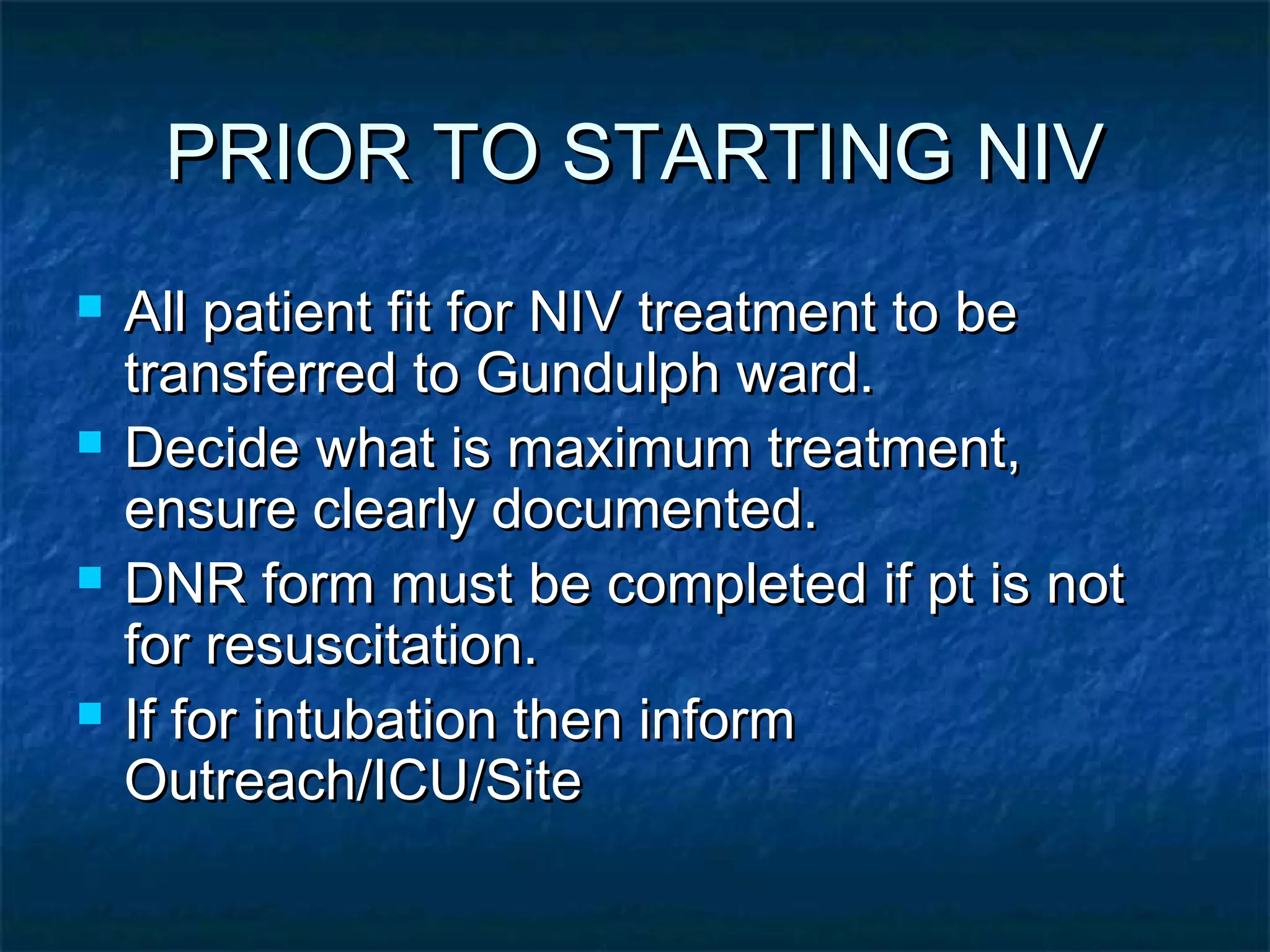
PRIOR TO STARTING NIVPRIOR TO STARTING NIV
 All patient fit for NIV treatment to beAll patient fit for NIV treatment to be
transferred to Gundulph ward.transferred to Gundulph ward.
 Decide what is maximum treatment,Decide what is maximum treatment,
ensure clearly documented.ensure clearly documented.
 DNR form must be completed if pt is notDNR form must be completed if pt is not
for resuscitation.for resuscitation.
 If for intubation then informIf for intubation then inform
Outreach/ICU/SiteOutreach/ICU/Site
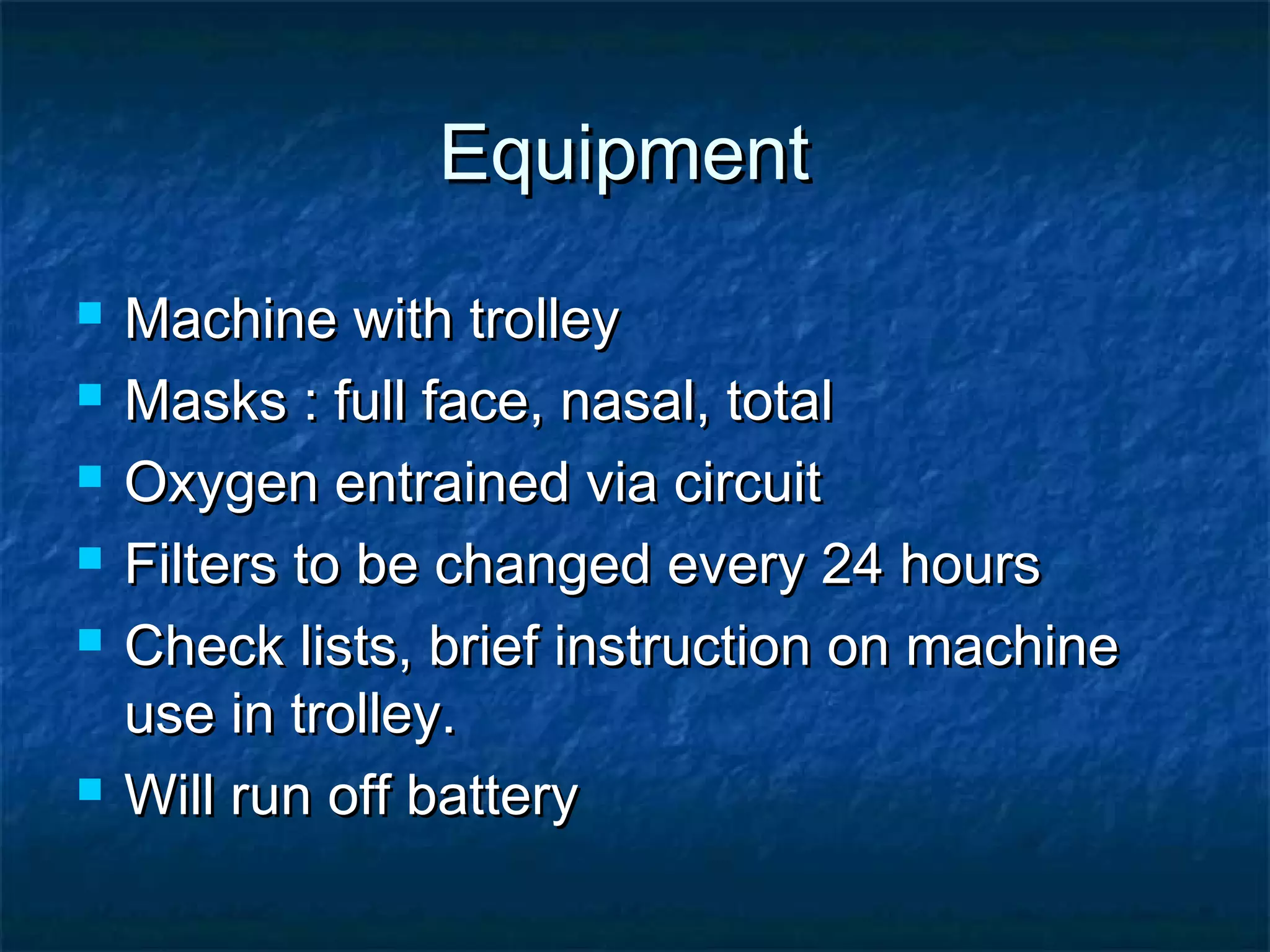
EquipmentEquipment
 Machine with trolleyMachine with trolley
 Masks : full face, nasal, totalMasks : full face, nasal, total
 Oxygen entrained via circuitOxygen entrained via circuit
 Filters to be changed every 24 hoursFilters to be changed every 24 hours
 Check lists, brief instruction on machineCheck lists, brief instruction on machine
use in trolley.use in trolley.
 Will run off batteryWill run off battery
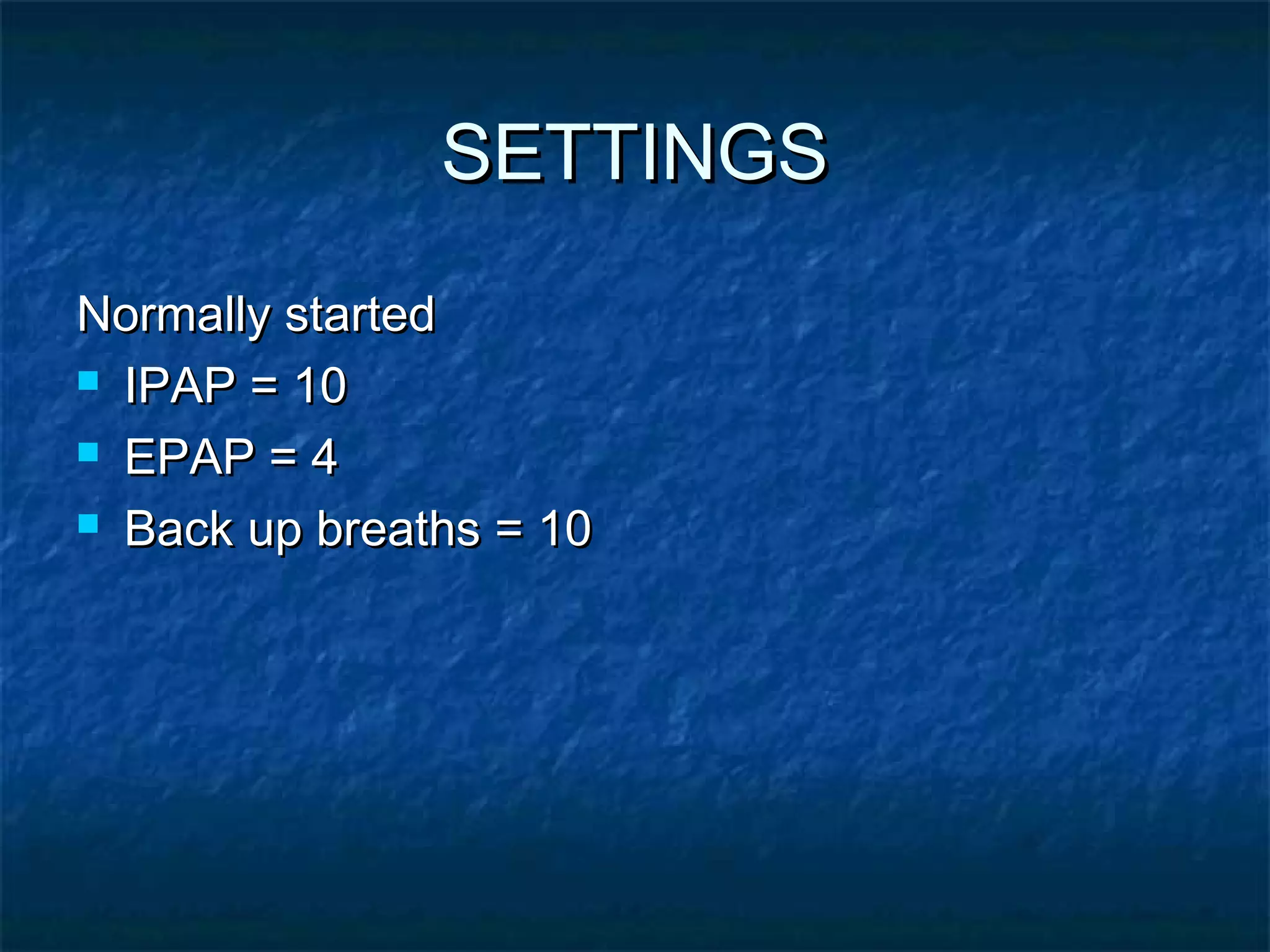
SETTINGSSETTINGS
Normally startedNormally started
 IPAP = 10IPAP = 10
 EPAP = 4EPAP = 4
 Back up breaths = 10Back up breaths = 10
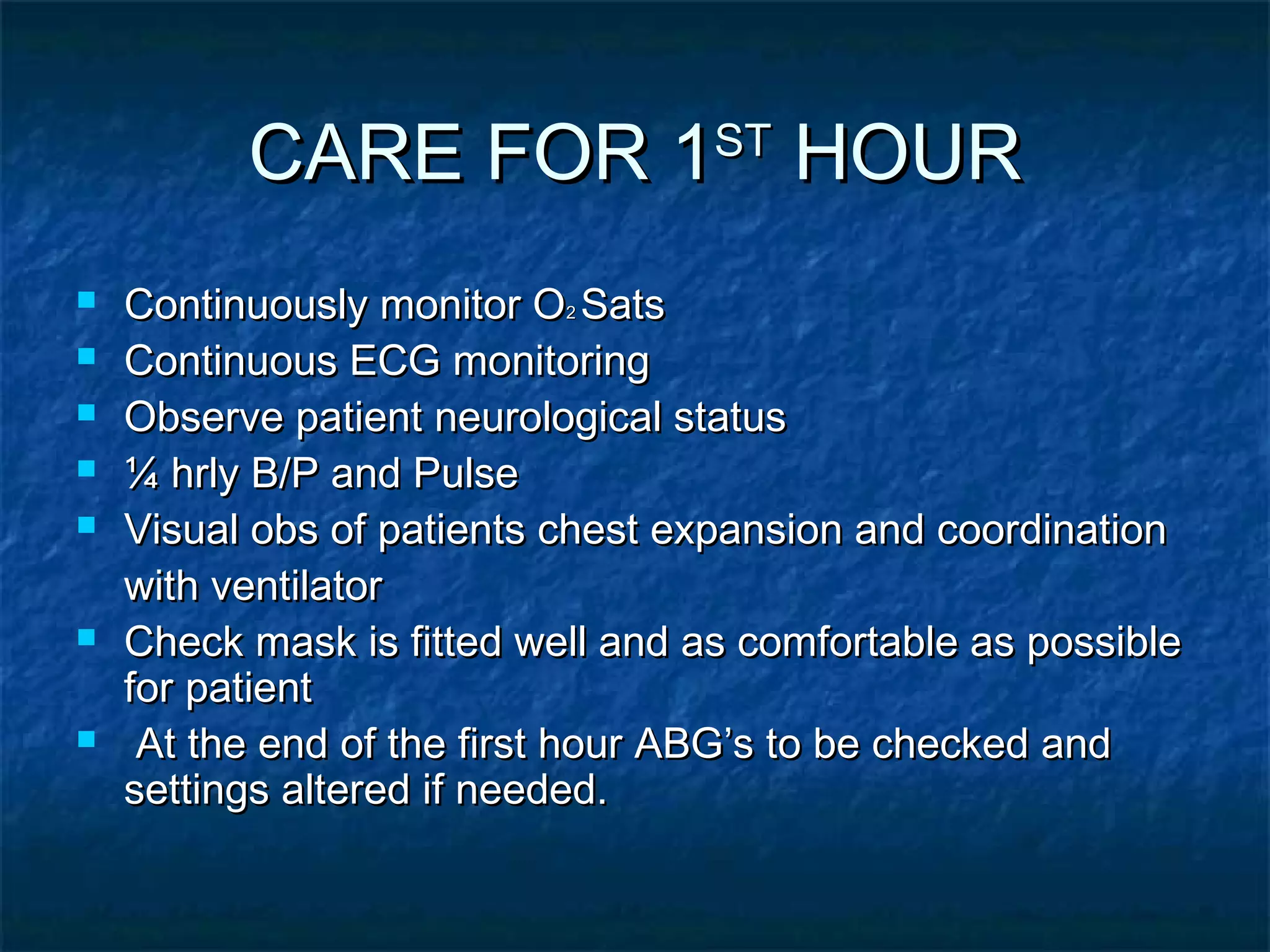
CARE FOR 1CARE FOR 1STST
HOURHOUR
 Continuously monitor OContinuously monitor O22 SatsSats
 Continuous ECG monitoringContinuous ECG monitoring
 Observe patient neurological statusObserve patient neurological status
 ¼ hrly B/P and Pulse¼ hrly B/P and Pulse
 Visual obs of patients chest expansion and coordinationVisual obs of patients chest expansion and coordination
with ventilatorwith ventilator
 Check mask is fitted well and as comfortable as possibleCheck mask is fitted well and as comfortable as possible
for patientfor patient
 At the end of the first hour ABG’s to be checked andAt the end of the first hour ABG’s to be checked and
settings altered if needed.settings altered if needed.
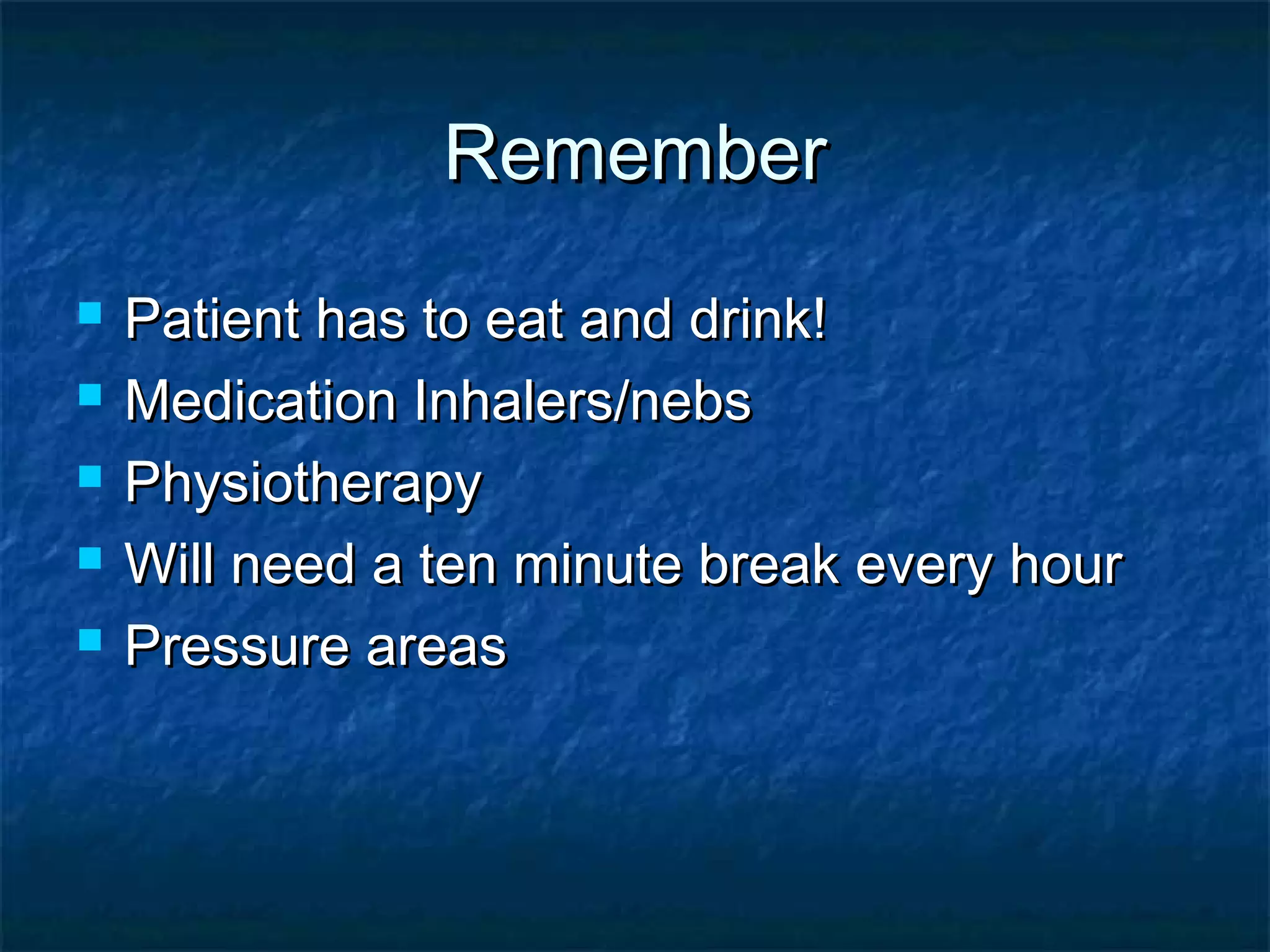
RememberRemember
 Patient has to eat and drink!Patient has to eat and drink!
 Medication Inhalers/nebsMedication Inhalers/nebs
 PhysiotherapyPhysiotherapy
 Will need a ten minute break every hourWill need a ten minute break every hour
 Pressure areasPressure areas
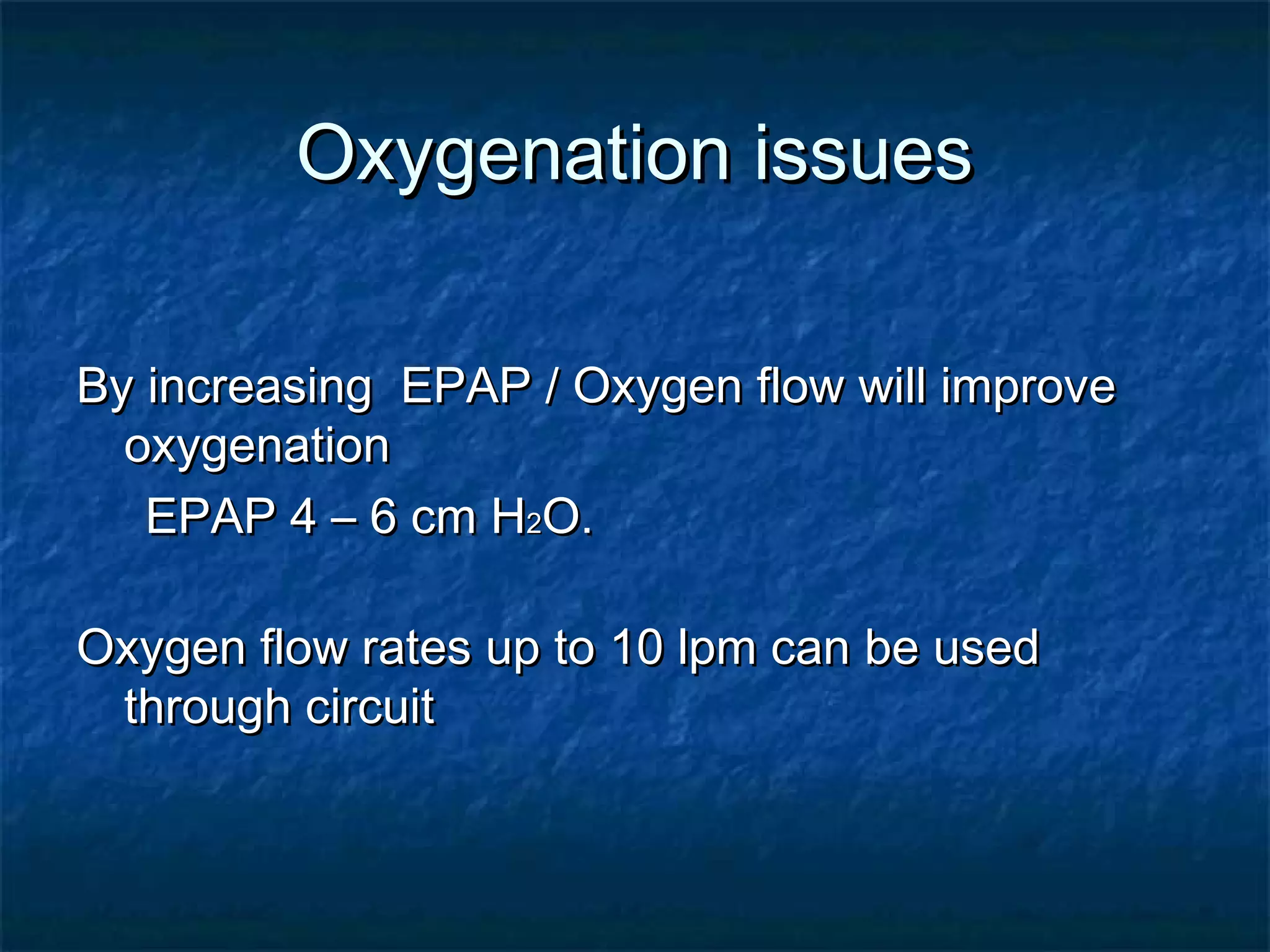
Oxygenation issuesOxygenation issues
By increasing EPAP / Oxygen flow will improveBy increasing EPAP / Oxygen flow will improve
oxygenationoxygenation
EPAP 4 – 6 cm HEPAP 4 – 6 cm H22O.O.
Oxygen flow rates up to 10 lpm can be usedOxygen flow rates up to 10 lpm can be used
through circuitthrough circuit
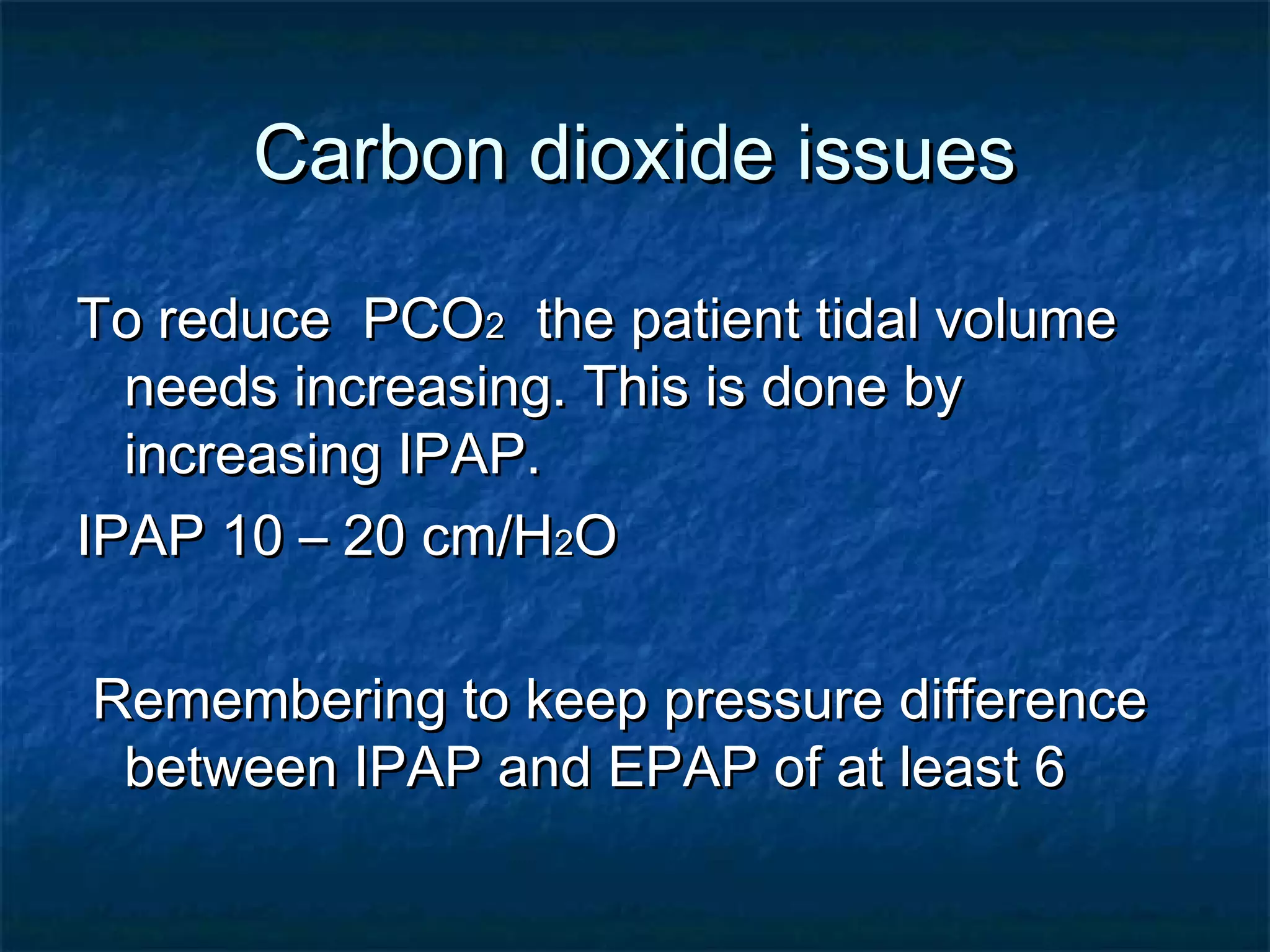
Carbon dioxide issuesCarbon dioxide issues
To reduce PCOTo reduce PCO22 the patient tidal volumethe patient tidal volume
needs increasing. This is done byneeds increasing. This is done by
increasing IPAP.increasing IPAP.
IPAP 10 – 20 cm/HIPAP 10 – 20 cm/H22OO
Remembering to keep pressure differenceRemembering to keep pressure difference
between IPAP and EPAP of at least 6between IPAP and EPAP of at least 6
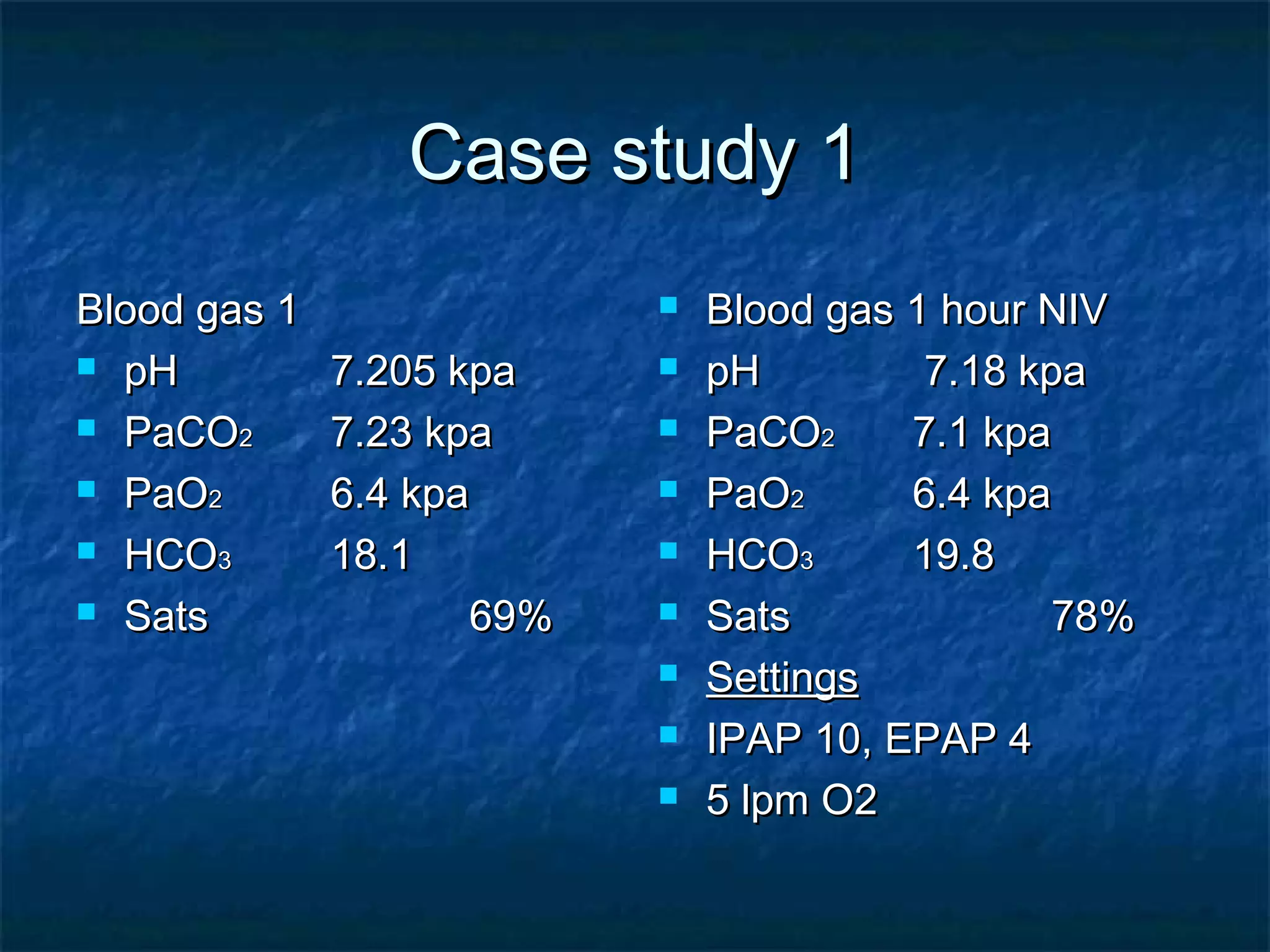
Case study 1Case study 1
Blood gas 1Blood gas 1
 pHpH 7.205 kpa7.205 kpa
 PaCOPaCO22 7.23 kpa7.23 kpa
 PaOPaO22 6.4 kpa6.4 kpa
 HCOHCO33 18.118.1
 SatsSats 69%69%
 Blood gas 1 hour NIVBlood gas 1 hour NIV
 pHpH 7.18 kpa7.18 kpa
 PaCOPaCO22 7.1 kpa7.1 kpa
 PaOPaO22 6.4 kpa6.4 kpa
 HCOHCO33 19.819.8
 SatsSats 78%78%
 SettingsSettings
 IPAP 10, EPAP 4IPAP 10, EPAP 4
 5 lpm O25 lpm O2
No changes were madeNo changes were made
 14 hours later abg !14 hours later abg !
 pHpH 7.307 kpa7.307 kpa
 PaCO2PaCO2 5.25 kpa5.25 kpa
 PaO2PaO2 7.91 kpa7.91 kpa
 HCO3HCO3 1919
 Sats 90%Sats 90%
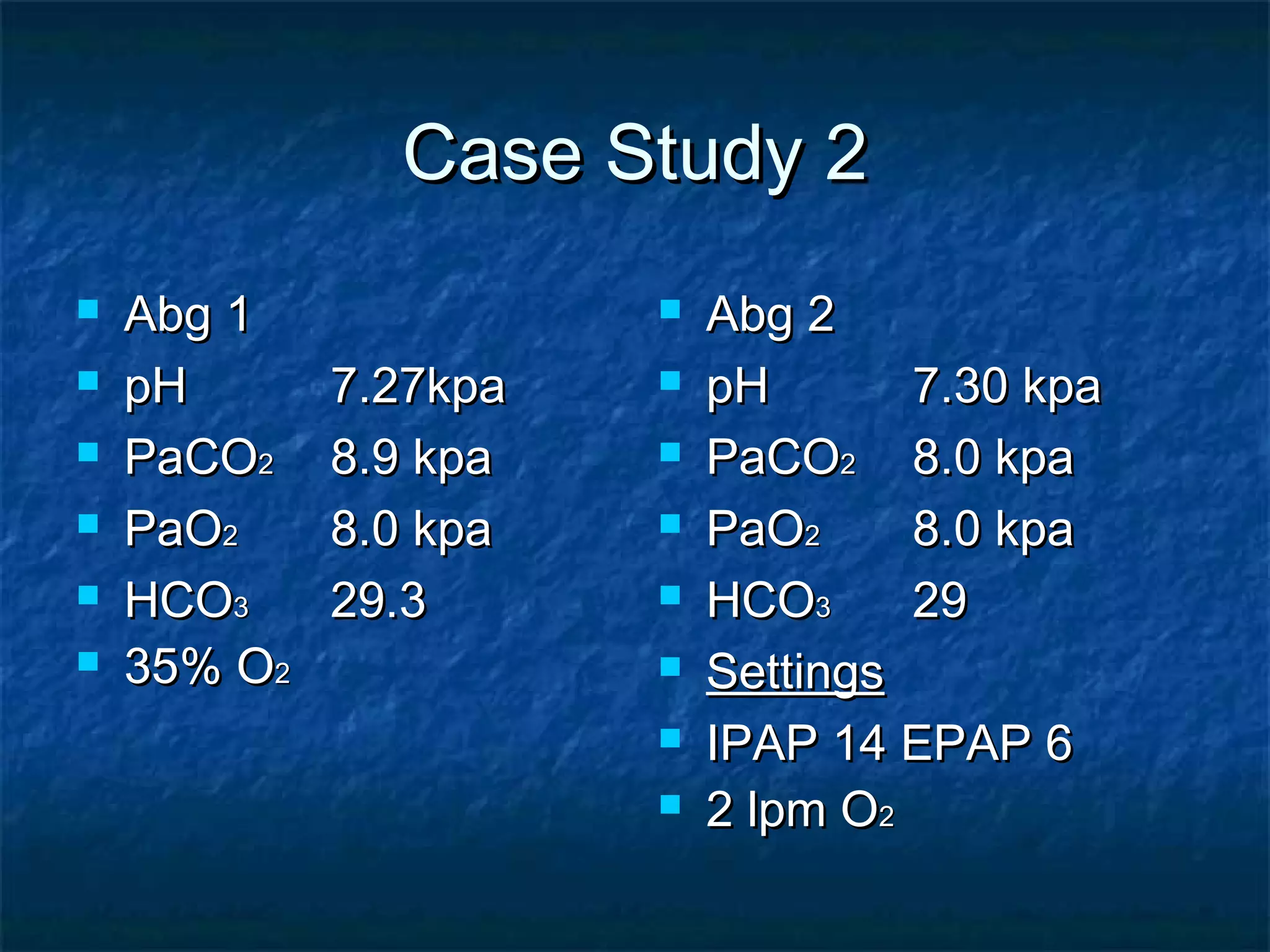
Case Study 2Case Study 2
 Abg 1Abg 1
 pHpH 7.27kpa7.27kpa
 PaCOPaCO22 8.9 kpa8.9 kpa
 PaOPaO22 8.0 kpa8.0 kpa
 HCOHCO33 29.329.3
 35% O35% O22
 Abg 2Abg 2
 pHpH 7.30 kpa7.30 kpa
 PaCOPaCO22 8.0 kpa8.0 kpa
 PaOPaO22 8.0 kpa8.0 kpa
 HCOHCO33 2929
 SettingsSettings
 IPAP 14 EPAP 6IPAP 14 EPAP 6
 2 lpm O2 lpm O22
 Could increase or leave settingsCould increase or leave settings
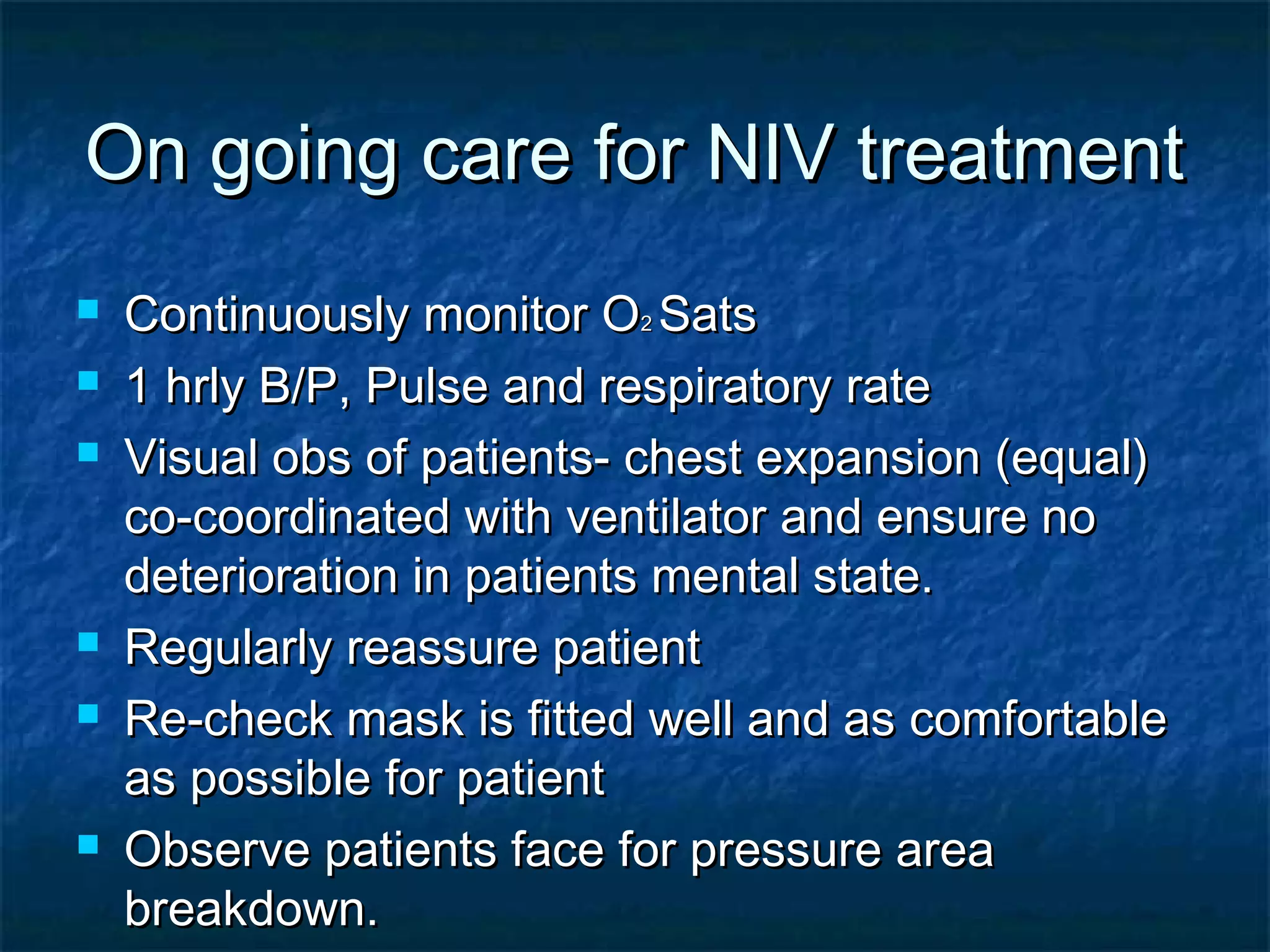
On going care for NIV treatmentOn going care for NIV treatment
 Continuously monitor OContinuously monitor O22 SatsSats
 1 hrly B/P, Pulse and respiratory rate1 hrly B/P, Pulse and respiratory rate
 Visual obs of patients- chest expansion (equal)Visual obs of patients- chest expansion (equal)
co-coordinated with ventilator and ensure noco-coordinated with ventilator and ensure no
deterioration in patients mental state.deterioration in patients mental state.
 Regularly reassure patientRegularly reassure patient
 Re-check mask is fitted well and as comfortableRe-check mask is fitted well and as comfortable
as possible for patientas possible for patient
 Observe patients face for pressure areaObserve patients face for pressure area
breakdown.breakdown.
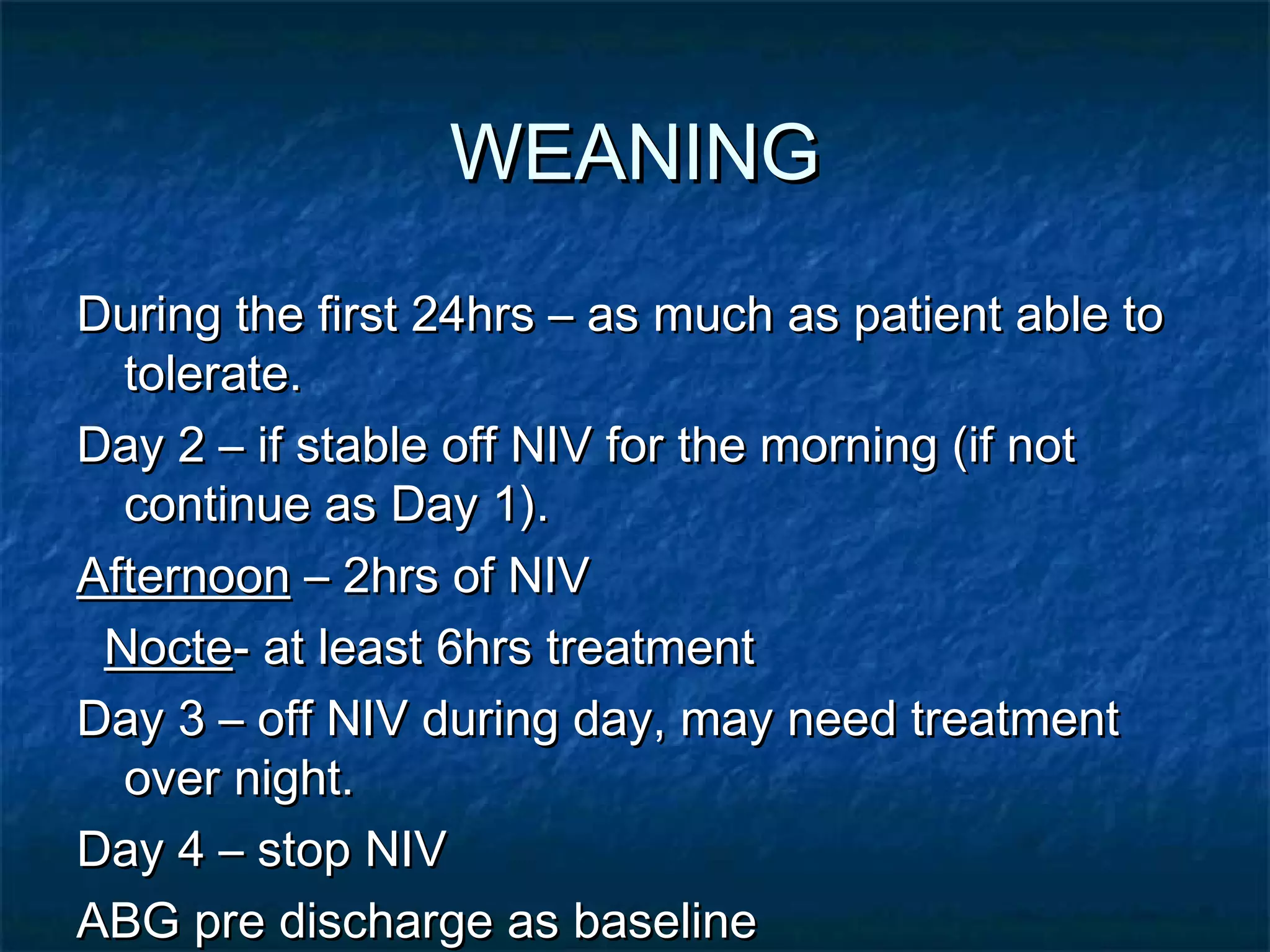
WEANINGWEANING
During the first 24hrs – as much as patient able toDuring the first 24hrs – as much as patient able to
tolerate.tolerate.
Day 2 – if stable off NIV for the morning (if notDay 2 – if stable off NIV for the morning (if not
continue as Day 1).continue as Day 1).
AfternoonAfternoon – 2hrs of NIV– 2hrs of NIV
NocteNocte- at least 6hrs treatment- at least 6hrs treatment
Day 3 – off NIV during day, may need treatmentDay 3 – off NIV during day, may need treatment
over night.over night.
Day 4 – stop NIVDay 4 – stop NIV
ABG pre discharge as baselineABG pre discharge as baseline
WHAT IF NIV FAILSWHAT IF NIV FAILS
 If after 6hrs of NIV treatment and adjusting settings thereIf after 6hrs of NIV treatment and adjusting settings there
is no improvement in the patients condition then theis no improvement in the patients condition then the
following should be considered.following should be considered.
 Review by ICUReview by ICU as per management plan.as per management plan.
 If not appropriate for ICUIf not appropriate for ICU
- stop NIV- stop NIV
- keep patient comfortable- keep patient comfortable
- consider, morphine, sedative such as- consider, morphine, sedative such as
Midazolam.Midazolam.
Allow the patient to die with dignity.Allow the patient to die with dignity.
Any QuestionsAny Questions
??

Non Invasive Ventilation - BiPAP & CPAP

  • 1.
    Non Invasive VentilationNonInvasive Ventilation Shibu ChackoShibu Chacko
  • 2.
    Non Invasive VentilationNonInvasive Ventilation  NIV – term favoured, bi levelNIV – term favoured, bi level  IPAP = acts as pressure support andIPAP = acts as pressure support and increases patients respiratory effort byincreases patients respiratory effort by improving tidal volume and minuteimproving tidal volume and minute ventilation.ventilation.  EPAP = used to splint airways open thusEPAP = used to splint airways open thus improving gas exchange.improving gas exchange.
  • 3.
    Aims of NIVtreatmentAims of NIV treatment  To improve gas exchangeTo improve gas exchange  To reduce the work of breathing.To reduce the work of breathing.  To reduce shortness of breathTo reduce shortness of breath  To avoid the need for invasive ventilation.To avoid the need for invasive ventilation.  To reduce length of stayTo reduce length of stay
  • 4.
    CriteriaCriteria  NIV isindicated in patients with -NIV is indicated in patients with - Type II Respiratory failure with aType II Respiratory failure with a pH 7.25 – 7.35pH 7.25 – 7.35  Patients with pH < 7.25 respond less wellPatients with pH < 7.25 respond less well and ideally managed in an ICU/HDU.and ideally managed in an ICU/HDU.  Patients who are severely hypoxic may bePatients who are severely hypoxic may be more appropriately managed in ICU.more appropriately managed in ICU.
  • 5.
    Clinical stateClinical state Able to protect airwayAble to protect airway  Conscious and cooperativeConscious and cooperative  Haemodynamically stableHaemodynamically stable  Able to cough and clear secretionsAble to cough and clear secretions
  • 6.
    Contra-indicationsContra-indications  Facial burns/trauma/ recent facial orFacial burns/ trauma/ recent facial or upper airways surgeryupper airways surgery  Vomiting/Copious respiratory secretionsVomiting/Copious respiratory secretions  Fixed upper airways obstructionFixed upper airways obstruction  Undrained pneumothoraxUndrained pneumothorax  Impaired level of consciousnessImpaired level of consciousness  Unable to protect own airwayUnable to protect own airway
  • 7.
    Factors to considerFactorsto consider  Quality of life pre admissionQuality of life pre admission  Patient agreeable to trialling NIVPatient agreeable to trialling NIV  Ideally discussion with patient thisIdeally discussion with patient this treatment may not work.treatment may not work.
  • 8.
    Oxygen TherapyOxygen Therapy Dependant on patients clinical stateDependant on patients clinical state  Controlled (venturi) or low flow via nasalControlled (venturi) or low flow via nasal cannulacannula  %/ Flow rate dependant upon blood gas%/ Flow rate dependant upon blood gas valuesvalues  May be enough to improve blood gasesMay be enough to improve blood gases and prevent NIV use.and prevent NIV use.
  • 9.
    PRIOR TO STARTINGNIVPRIOR TO STARTING NIV  All patient fit for NIV treatment to beAll patient fit for NIV treatment to be transferred to Gundulph ward.transferred to Gundulph ward.  Decide what is maximum treatment,Decide what is maximum treatment, ensure clearly documented.ensure clearly documented.  DNR form must be completed if pt is notDNR form must be completed if pt is not for resuscitation.for resuscitation.  If for intubation then informIf for intubation then inform Outreach/ICU/SiteOutreach/ICU/Site
  • 10.
    EquipmentEquipment  Machine withtrolleyMachine with trolley  Masks : full face, nasal, totalMasks : full face, nasal, total  Oxygen entrained via circuitOxygen entrained via circuit  Filters to be changed every 24 hoursFilters to be changed every 24 hours  Check lists, brief instruction on machineCheck lists, brief instruction on machine use in trolley.use in trolley.  Will run off batteryWill run off battery
  • 11.
    SETTINGSSETTINGS Normally startedNormally started IPAP = 10IPAP = 10  EPAP = 4EPAP = 4  Back up breaths = 10Back up breaths = 10
  • 12.
    CARE FOR 1CAREFOR 1STST HOURHOUR  Continuously monitor OContinuously monitor O22 SatsSats  Continuous ECG monitoringContinuous ECG monitoring  Observe patient neurological statusObserve patient neurological status  ¼ hrly B/P and Pulse¼ hrly B/P and Pulse  Visual obs of patients chest expansion and coordinationVisual obs of patients chest expansion and coordination with ventilatorwith ventilator  Check mask is fitted well and as comfortable as possibleCheck mask is fitted well and as comfortable as possible for patientfor patient  At the end of the first hour ABG’s to be checked andAt the end of the first hour ABG’s to be checked and settings altered if needed.settings altered if needed.
  • 13.
    RememberRemember  Patient hasto eat and drink!Patient has to eat and drink!  Medication Inhalers/nebsMedication Inhalers/nebs  PhysiotherapyPhysiotherapy  Will need a ten minute break every hourWill need a ten minute break every hour  Pressure areasPressure areas
  • 14.
    Oxygenation issuesOxygenation issues Byincreasing EPAP / Oxygen flow will improveBy increasing EPAP / Oxygen flow will improve oxygenationoxygenation EPAP 4 – 6 cm HEPAP 4 – 6 cm H22O.O. Oxygen flow rates up to 10 lpm can be usedOxygen flow rates up to 10 lpm can be used through circuitthrough circuit
  • 15.
    Carbon dioxide issuesCarbondioxide issues To reduce PCOTo reduce PCO22 the patient tidal volumethe patient tidal volume needs increasing. This is done byneeds increasing. This is done by increasing IPAP.increasing IPAP. IPAP 10 – 20 cm/HIPAP 10 – 20 cm/H22OO Remembering to keep pressure differenceRemembering to keep pressure difference between IPAP and EPAP of at least 6between IPAP and EPAP of at least 6
  • 16.
    Case study 1Casestudy 1 Blood gas 1Blood gas 1  pHpH 7.205 kpa7.205 kpa  PaCOPaCO22 7.23 kpa7.23 kpa  PaOPaO22 6.4 kpa6.4 kpa  HCOHCO33 18.118.1  SatsSats 69%69%  Blood gas 1 hour NIVBlood gas 1 hour NIV  pHpH 7.18 kpa7.18 kpa  PaCOPaCO22 7.1 kpa7.1 kpa  PaOPaO22 6.4 kpa6.4 kpa  HCOHCO33 19.819.8  SatsSats 78%78%  SettingsSettings  IPAP 10, EPAP 4IPAP 10, EPAP 4  5 lpm O25 lpm O2
  • 17.
    No changes weremadeNo changes were made  14 hours later abg !14 hours later abg !  pHpH 7.307 kpa7.307 kpa  PaCO2PaCO2 5.25 kpa5.25 kpa  PaO2PaO2 7.91 kpa7.91 kpa  HCO3HCO3 1919  Sats 90%Sats 90%
  • 18.
    Case Study 2CaseStudy 2  Abg 1Abg 1  pHpH 7.27kpa7.27kpa  PaCOPaCO22 8.9 kpa8.9 kpa  PaOPaO22 8.0 kpa8.0 kpa  HCOHCO33 29.329.3  35% O35% O22  Abg 2Abg 2  pHpH 7.30 kpa7.30 kpa  PaCOPaCO22 8.0 kpa8.0 kpa  PaOPaO22 8.0 kpa8.0 kpa  HCOHCO33 2929  SettingsSettings  IPAP 14 EPAP 6IPAP 14 EPAP 6  2 lpm O2 lpm O22
  • 19.
     Could increaseor leave settingsCould increase or leave settings
  • 20.
    On going carefor NIV treatmentOn going care for NIV treatment  Continuously monitor OContinuously monitor O22 SatsSats  1 hrly B/P, Pulse and respiratory rate1 hrly B/P, Pulse and respiratory rate  Visual obs of patients- chest expansion (equal)Visual obs of patients- chest expansion (equal) co-coordinated with ventilator and ensure noco-coordinated with ventilator and ensure no deterioration in patients mental state.deterioration in patients mental state.  Regularly reassure patientRegularly reassure patient  Re-check mask is fitted well and as comfortableRe-check mask is fitted well and as comfortable as possible for patientas possible for patient  Observe patients face for pressure areaObserve patients face for pressure area breakdown.breakdown.
  • 21.
    WEANINGWEANING During the first24hrs – as much as patient able toDuring the first 24hrs – as much as patient able to tolerate.tolerate. Day 2 – if stable off NIV for the morning (if notDay 2 – if stable off NIV for the morning (if not continue as Day 1).continue as Day 1). AfternoonAfternoon – 2hrs of NIV– 2hrs of NIV NocteNocte- at least 6hrs treatment- at least 6hrs treatment Day 3 – off NIV during day, may need treatmentDay 3 – off NIV during day, may need treatment over night.over night. Day 4 – stop NIVDay 4 – stop NIV ABG pre discharge as baselineABG pre discharge as baseline
  • 22.
    WHAT IF NIVFAILSWHAT IF NIV FAILS  If after 6hrs of NIV treatment and adjusting settings thereIf after 6hrs of NIV treatment and adjusting settings there is no improvement in the patients condition then theis no improvement in the patients condition then the following should be considered.following should be considered.  Review by ICUReview by ICU as per management plan.as per management plan.  If not appropriate for ICUIf not appropriate for ICU - stop NIV- stop NIV - keep patient comfortable- keep patient comfortable - consider, morphine, sedative such as- consider, morphine, sedative such as Midazolam.Midazolam. Allow the patient to die with dignity.Allow the patient to die with dignity.
  • 23.