Vector Calculus
Vector Calculus

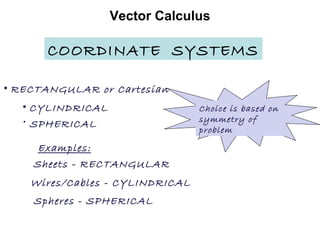
      COORDINATE SYSTEMS

• RECTANGULAR or Cartesian
  • CYLINDRICAL                  Choice is based on
  • SPHERICAL                    symmetry of
                                 problem

     Examples:
    Sheets - RECTANGULAR
    Wires/Cables - CYLINDRICAL
    Spheres - SPHERICAL
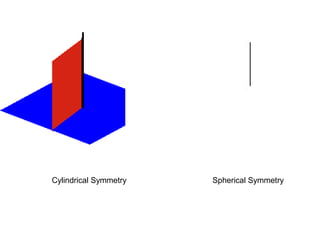
Cylindrical Symmetry   Spherical Symmetry
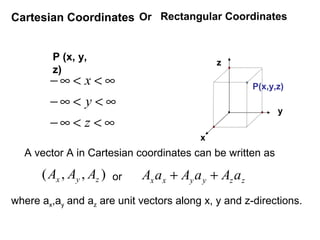
Cartesian Coordinates Or Rectangular Coordinates


         P (x, y,                              z
         z)
        −∞ < x < ∞                                       P(x,y,z)
        −∞ < y < ∞
                                                               y
        −∞ < z < ∞
                                           x
  A vector A in Cartesian coordinates can be written as

      ( Ax , Ay , Az )   or   Ax a x + Ay a y + Az a z
where ax,ay and az are unit vectors along x, y and z-directions.
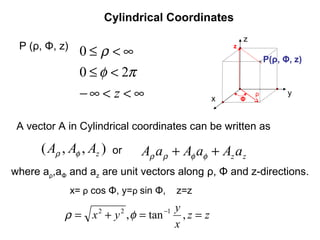
Cylindrical Coordinates
                                                            z
 P (ρ, Φ, z)
                 0≤ρ <∞
                                                        z

                                                                    P(ρ, Φ, z)
                 0 ≤ φ < 2π
                 −∞ < z < ∞                         x       Φ
                                                                ρ         y


 A vector A in Cylindrical coordinates can be written as

      ( Aρ , Aφ , Az )    or   Aρ aρ + Aφ aφ + Az a z
where aρ,aΦ and az are unit vectors along ρ, Φ and z-directions.
               x= ρ cos Φ, y=ρ sin Φ,    z=z
                                         y
           ρ = x + y , φ = tan
                     2     2        −1
                                           ,z = z
                                         x
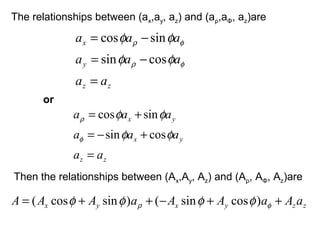
The relationships between (ax,ay, az) and (aρ,aΦ, az)are

              a x = cos φaρ − sin φaφ
              a y = sin φaρ − cos φaφ
              az = az
       or
              aρ = cos φa x + sin φa y
              aφ = − sin φa x + cos φa y
              az = az
Then the relationships between (Ax,Ay, Az) and (Aρ, AΦ, Az)are

A = ( Ax cos φ + Ay sin φ )aρ + (− Ax sin φ + Ay cos φ )aφ + Az a z
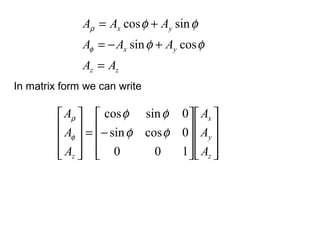
Aρ = Ax cos φ + Ay sin φ
              Aφ = − Ax sin φ + Ay cos φ
              Az = Az
In matrix form we can write

          Aρ   cos φ       sin φ   0  Ax 
          A  = − sin φ     cos φ   0  Ay 
          φ                          
          Az   0
                             0     1  Az 
                                        
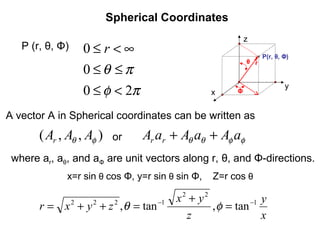
Spherical Coordinates
                                                            z
   P (r, θ, Φ)    0≤r <∞                                          P(r, θ, Φ)
                                                            θ r
                  0 ≤θ ≤π
                  0 ≤ φ < 2π                      x     Φ
                                                                          y


A vector A in Spherical coordinates can be written as
       ( Ar , Aθ , Aφ )    or    Ar ar + Aθ aθ + Aφ aφ
 where ar, aθ, and aΦ are unit vectors along r, θ, and Φ-directions.
              x=r sin θ cos Φ, y=r sin θ sin Φ,   Z=r cos θ

                                          x2 + y2           −1 y
       r = x 2 + y 2 + z 2 , θ = tan −1           , φ = tan
                                            z                  x
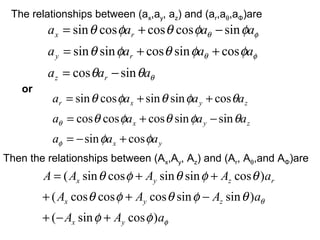
The relationships between (ax,ay, az) and (ar,aθ,aΦ)are
         a x = sin θ cos φar + cos θ cos φaθ − sin φaφ
         a y = sin θ sin φar + cos θ sin φaθ + cos φaφ
         a z = cos θar − sin θaθ
   or
          ar = sin θ cos φa x + sin θ sin φa y + cos θa z
          aθ = cos θ cos φa x + cos θ sin φa y − sin θa z
          aφ = − sin φa x + cos φa y
Then the relationships between (Ax,Ay, Az) and (Ar, Aθ,and AΦ)are
        A = ( Ax sin θ cos φ + Ay sin θ sin φ + Az cos θ )ar
        + ( Ax cos θ cos φ + Ay cos θ sin φ − Az sin θ )aθ
        + (− Ax sin φ + Ay cos φ )aφ
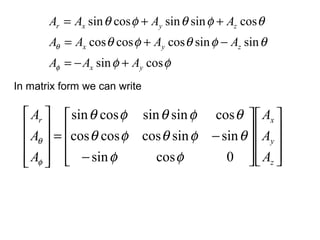
Ar = Ax sin θ cos φ + Ay sin θ sin φ + Az cos θ
       Aθ = Ax cos θ cos φ + Ay cos θ sin φ − Az sin θ
       Aφ = − Ax sin φ + Ay cos φ
In matrix form we can write

   Ar   sin θ cos φ        sin θ sin φ   cos θ   Ax 
    
   Aθ  = cos θ cos φ       cos θ sin φ   − sin θ   Ay 
                                                     
   Aφ   − sin φ               cos φ         0   Az 
                                                  
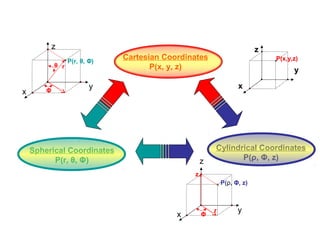
z                                                            z
                  P(r, θ, Φ)
                               Cartesian Coordinates                         P(x,y,z)
            θ r                       P(x, y, z)                                   y

                          y                                       x
x       Φ


    Spherical Coordinates                               Cylindrical Coordinates
          P(r, θ, Φ)                                z          P(ρ, Φ, z)

                                                z
                                                            P(ρ, Φ, z)


                                                        r         y
                                            x       Φ
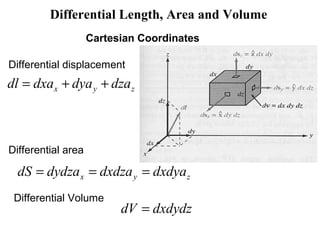
Differential Length, Area and Volume
                    Cartesian Coordinates

Differential displacement
dl = dxa x + dya y + dza z


Differential area

  dS = dydza x = dxdza y = dxdya z
 Differential Volume
                          dV = dxdydz
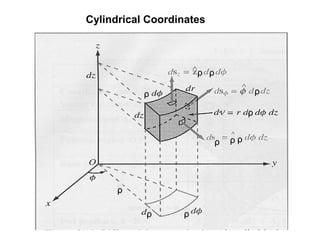
Cylindrical Coordinates


                      ρ ρ

           ρ                             ρ

                                     ρ


                            ρ   ρρ


      ρ

           ρ      ρ
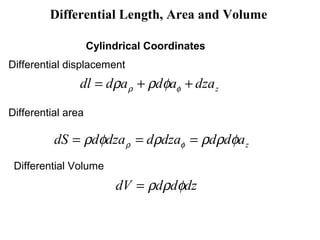
Differential Length, Area and Volume

                    Cylindrical Coordinates
Differential displacement
                dl = dρa ρ + ρdφaφ + dza z

Differential area

          dS = ρdφdza ρ = dρdzaφ = ρdρdφa z
 Differential Volume
                         dV = ρdρdφdz
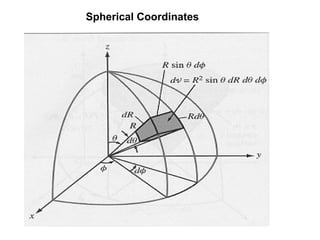
Spherical Coordinates
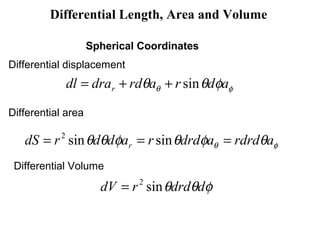
Differential Length, Area and Volume

                    Spherical Coordinates
Differential displacement
               dl = drar + rdθaθ + r sin θdφaφ

Differential area

   dS = r sin θdθdφar = r sin θdrdφaθ = rdrdθaφ
           2


 Differential Volume

                      dV = r sin θdrdθdφ
                             2
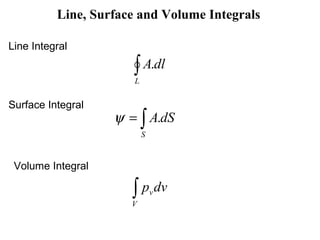
Line, Surface and Volume Integrals

Line Integral

                      ∫ A.dl
                       L


Surface Integral
                   ψ = ∫ A.dS
                           S


 Volume Integral

                      ∫ p dv
                      V
                               v
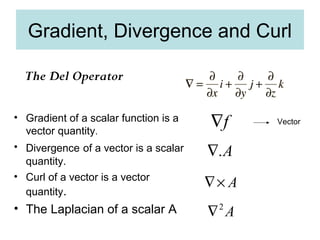
Gradient, Divergence and Curl

  The Del Operator

• Gradient of a scalar function is a
  vector quantity.
                                       ∇f     Vector


• Divergence of a vector is a scalar
                                       ∇. A
  quantity.
• Curl of a vector is a vector
                                       ∇× A
  quantity.
• The Laplacian of a scalar A          ∇ A
                                        2
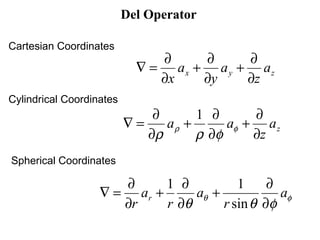
Del Operator

Cartesian Coordinates
                               ∂    ∂     ∂
                            ∇ = ax + a y + az
                               ∂x   ∂y    ∂z
Cylindrical Coordinates
                              ∂      1 ∂      ∂
                          ∇=    aρ +      aφ + a z
                             ∂ρ      ρ ∂φ     ∂z
Spherical Coordinates

                      ∂     1 ∂          1     ∂
                   ∇ = ar +      aθ +            aφ
                      ∂r    r ∂θ      r sin θ ∂φ
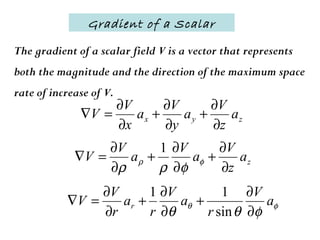
Gradient of a Scalar

The gradient of a scalar field V is a vector that represents
both the magnitude and the direction of the maximum space
rate of increase of V.
                   ∂V      ∂V      ∂V
              ∇V =    ax +    ay +    az
                   ∂x      ∂y      ∂z
                  ∂V      1 ∂V      ∂V
             ∇V =    aρ +      aφ +    az
                  ∂ρ      ρ ∂φ      ∂z
                ∂V      1 ∂V         1 ∂V
           ∇V =    ar +      aθ +            aφ
                ∂r      r ∂θ      r sin θ ∂φ
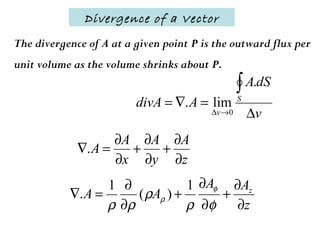
Divergence of a Vector
The divergence of A at a given point P is the outward flux per
unit volume as the volume shrinks about P.
                                                 ∫ A.dS
                         divA = ∇. A = lim       S
                                         ∆v →0       ∆v
                    ∂A ∂A ∂A
             ∇. A =   +  +
                    ∂x ∂y ∂z
                  1 ∂            1 ∂Aφ ∂Az
           ∇. A =      ( ρAρ ) +      +
                  ρ ∂ρ           ρ ∂φ   ∂z
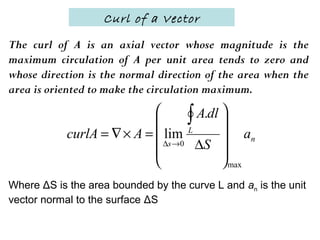
Curl of a Vector

The curl of A is an axial vector whose magnitude is the
maximum circulation of A per unit area tends to zero and
whose direction is the normal direction of the area when the
area is oriented to make the circulation maximum.
                                   A.dl 
                                  ∫ 
            curlA = ∇ × A =  lim L       an
                             ∆s →0 ∆S 
                                        
                                         max
Where ΔS is the area bounded by the curve L and an is the unit
vector normal to the surface ΔS
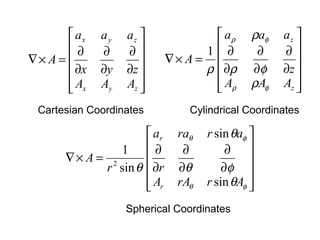
 ax   ay   az               aρ      ρaφ   az 
       ∂     ∂    ∂             1∂          ∂    ∂
∇× A =                    ∇× A =                    
        ∂x   ∂y   ∂z            ρ  ∂ρ      ∂φ    ∂z 
        Ax
             Ay   Az 
                                    Aρ
                                             ρAφ   Az 
                                                       
 Cartesian Coordinates          Cylindrical Coordinates

                      ar     raθ   r sin θaφ 
                1 ∂           ∂         ∂ 
       ∇× A = 2                              
             r sin θ  ∂r     ∂θ        ∂φ 
                      Ar
                             rAθ   r sin θAφ 
                                              
                   Spherical Coordinates
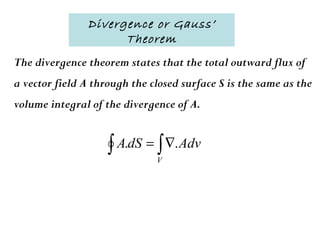
Divergence or Gauss’
                     Theorem
The divergence theorem states that the total outward flux of
a vector field A through the closed surface S is the same as the
volume integral of the divergence of A.


                    ∫ A.dS = ∫ ∇. Adv
                              V
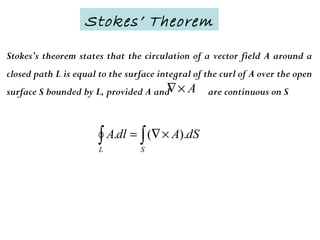
Stokes’ Theorem

Stokes’s theorem states that the circulation of a vector field A around a
closed path L is equal to the surface integral of the curl of A over the open
surface S bounded by L, provided A and × A
                                     ∇            are continuous on S


                       ∫ A.dl = ∫ (∇ × A).dS
                       L         S

Vector calculus

  • 1.
  • 2.
    Vector Calculus COORDINATE SYSTEMS • RECTANGULAR or Cartesian • CYLINDRICAL Choice is based on • SPHERICAL symmetry of problem Examples: Sheets - RECTANGULAR Wires/Cables - CYLINDRICAL Spheres - SPHERICAL
  • 3.
    Cylindrical Symmetry Spherical Symmetry
  • 4.
    Cartesian Coordinates OrRectangular Coordinates P (x, y, z z) −∞ < x < ∞ P(x,y,z) −∞ < y < ∞ y −∞ < z < ∞ x A vector A in Cartesian coordinates can be written as ( Ax , Ay , Az ) or Ax a x + Ay a y + Az a z where ax,ay and az are unit vectors along x, y and z-directions.
  • 5.
    Cylindrical Coordinates z P (ρ, Φ, z) 0≤ρ <∞ z P(ρ, Φ, z) 0 ≤ φ < 2π −∞ < z < ∞ x Φ ρ y A vector A in Cylindrical coordinates can be written as ( Aρ , Aφ , Az ) or Aρ aρ + Aφ aφ + Az a z where aρ,aΦ and az are unit vectors along ρ, Φ and z-directions. x= ρ cos Φ, y=ρ sin Φ, z=z y ρ = x + y , φ = tan 2 2 −1 ,z = z x
  • 6.
    The relationships between(ax,ay, az) and (aρ,aΦ, az)are a x = cos φaρ − sin φaφ a y = sin φaρ − cos φaφ az = az or aρ = cos φa x + sin φa y aφ = − sin φa x + cos φa y az = az Then the relationships between (Ax,Ay, Az) and (Aρ, AΦ, Az)are A = ( Ax cos φ + Ay sin φ )aρ + (− Ax sin φ + Ay cos φ )aφ + Az a z
  • 7.
    Aρ = Axcos φ + Ay sin φ Aφ = − Ax sin φ + Ay cos φ Az = Az In matrix form we can write  Aρ   cos φ sin φ 0  Ax   A  = − sin φ cos φ 0  Ay   φ     Az   0    0 1  Az   
  • 8.
    Spherical Coordinates z P (r, θ, Φ) 0≤r <∞ P(r, θ, Φ) θ r 0 ≤θ ≤π 0 ≤ φ < 2π x Φ y A vector A in Spherical coordinates can be written as ( Ar , Aθ , Aφ ) or Ar ar + Aθ aθ + Aφ aφ where ar, aθ, and aΦ are unit vectors along r, θ, and Φ-directions. x=r sin θ cos Φ, y=r sin θ sin Φ, Z=r cos θ x2 + y2 −1 y r = x 2 + y 2 + z 2 , θ = tan −1 , φ = tan z x
  • 9.
    The relationships between(ax,ay, az) and (ar,aθ,aΦ)are a x = sin θ cos φar + cos θ cos φaθ − sin φaφ a y = sin θ sin φar + cos θ sin φaθ + cos φaφ a z = cos θar − sin θaθ or ar = sin θ cos φa x + sin θ sin φa y + cos θa z aθ = cos θ cos φa x + cos θ sin φa y − sin θa z aφ = − sin φa x + cos φa y Then the relationships between (Ax,Ay, Az) and (Ar, Aθ,and AΦ)are A = ( Ax sin θ cos φ + Ay sin θ sin φ + Az cos θ )ar + ( Ax cos θ cos φ + Ay cos θ sin φ − Az sin θ )aθ + (− Ax sin φ + Ay cos φ )aφ
  • 10.
    Ar = Axsin θ cos φ + Ay sin θ sin φ + Az cos θ Aθ = Ax cos θ cos φ + Ay cos θ sin φ − Az sin θ Aφ = − Ax sin φ + Ay cos φ In matrix form we can write  Ar   sin θ cos φ sin θ sin φ cos θ   Ax      Aθ  = cos θ cos φ cos θ sin φ − sin θ   Ay     Aφ   − sin φ cos φ 0   Az      
  • 11.
    z z P(r, θ, Φ) Cartesian Coordinates P(x,y,z) θ r P(x, y, z) y y x x Φ Spherical Coordinates Cylindrical Coordinates P(r, θ, Φ) z P(ρ, Φ, z) z P(ρ, Φ, z) r y x Φ
  • 12.
    Differential Length, Areaand Volume Cartesian Coordinates Differential displacement dl = dxa x + dya y + dza z Differential area dS = dydza x = dxdza y = dxdya z Differential Volume dV = dxdydz
  • 13.
    Cylindrical Coordinates ρ ρ ρ ρ ρ ρ ρρ ρ ρ ρ
  • 14.
    Differential Length, Areaand Volume Cylindrical Coordinates Differential displacement dl = dρa ρ + ρdφaφ + dza z Differential area dS = ρdφdza ρ = dρdzaφ = ρdρdφa z Differential Volume dV = ρdρdφdz
  • 15.
  • 16.
    Differential Length, Areaand Volume Spherical Coordinates Differential displacement dl = drar + rdθaθ + r sin θdφaφ Differential area dS = r sin θdθdφar = r sin θdrdφaθ = rdrdθaφ 2 Differential Volume dV = r sin θdrdθdφ 2
  • 17.
    Line, Surface andVolume Integrals Line Integral ∫ A.dl L Surface Integral ψ = ∫ A.dS S Volume Integral ∫ p dv V v
  • 18.
    Gradient, Divergence andCurl The Del Operator • Gradient of a scalar function is a vector quantity. ∇f Vector • Divergence of a vector is a scalar ∇. A quantity. • Curl of a vector is a vector ∇× A quantity. • The Laplacian of a scalar A ∇ A 2
  • 19.
    Del Operator Cartesian Coordinates ∂ ∂ ∂ ∇ = ax + a y + az ∂x ∂y ∂z Cylindrical Coordinates ∂ 1 ∂ ∂ ∇= aρ + aφ + a z ∂ρ ρ ∂φ ∂z Spherical Coordinates ∂ 1 ∂ 1 ∂ ∇ = ar + aθ + aφ ∂r r ∂θ r sin θ ∂φ
  • 20.
    Gradient of aScalar The gradient of a scalar field V is a vector that represents both the magnitude and the direction of the maximum space rate of increase of V. ∂V ∂V ∂V ∇V = ax + ay + az ∂x ∂y ∂z ∂V 1 ∂V ∂V ∇V = aρ + aφ + az ∂ρ ρ ∂φ ∂z ∂V 1 ∂V 1 ∂V ∇V = ar + aθ + aφ ∂r r ∂θ r sin θ ∂φ
  • 21.
    Divergence of aVector The divergence of A at a given point P is the outward flux per unit volume as the volume shrinks about P. ∫ A.dS divA = ∇. A = lim S ∆v →0 ∆v ∂A ∂A ∂A ∇. A = + + ∂x ∂y ∂z 1 ∂ 1 ∂Aφ ∂Az ∇. A = ( ρAρ ) + + ρ ∂ρ ρ ∂φ ∂z
  • 22.
    Curl of aVector The curl of A is an axial vector whose magnitude is the maximum circulation of A per unit area tends to zero and whose direction is the normal direction of the area when the area is oriented to make the circulation maximum.  A.dl   ∫  curlA = ∇ × A =  lim L  an  ∆s →0 ∆S      max Where ΔS is the area bounded by the curve L and an is the unit vector normal to the surface ΔS
  • 23.
     ax ay az   aρ ρaφ az  ∂ ∂ ∂ 1∂ ∂ ∂ ∇× A =   ∇× A =    ∂x ∂y ∂z  ρ  ∂ρ ∂φ ∂z   Ax  Ay Az    Aρ  ρAφ Az   Cartesian Coordinates Cylindrical Coordinates  ar raθ r sin θaφ  1 ∂ ∂ ∂  ∇× A = 2   r sin θ  ∂r ∂θ ∂φ   Ar  rAθ r sin θAφ   Spherical Coordinates
  • 24.
    Divergence or Gauss’ Theorem The divergence theorem states that the total outward flux of a vector field A through the closed surface S is the same as the volume integral of the divergence of A. ∫ A.dS = ∫ ∇. Adv V
  • 25.
    Stokes’ Theorem Stokes’s theoremstates that the circulation of a vector field A around a closed path L is equal to the surface integral of the curl of A over the open surface S bounded by L, provided A and × A ∇ are continuous on S ∫ A.dl = ∫ (∇ × A).dS L S