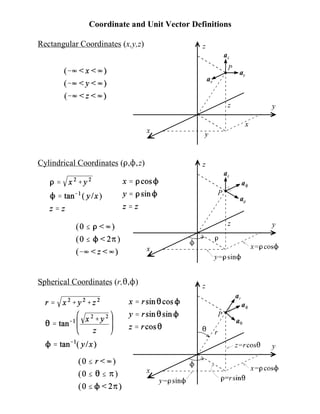
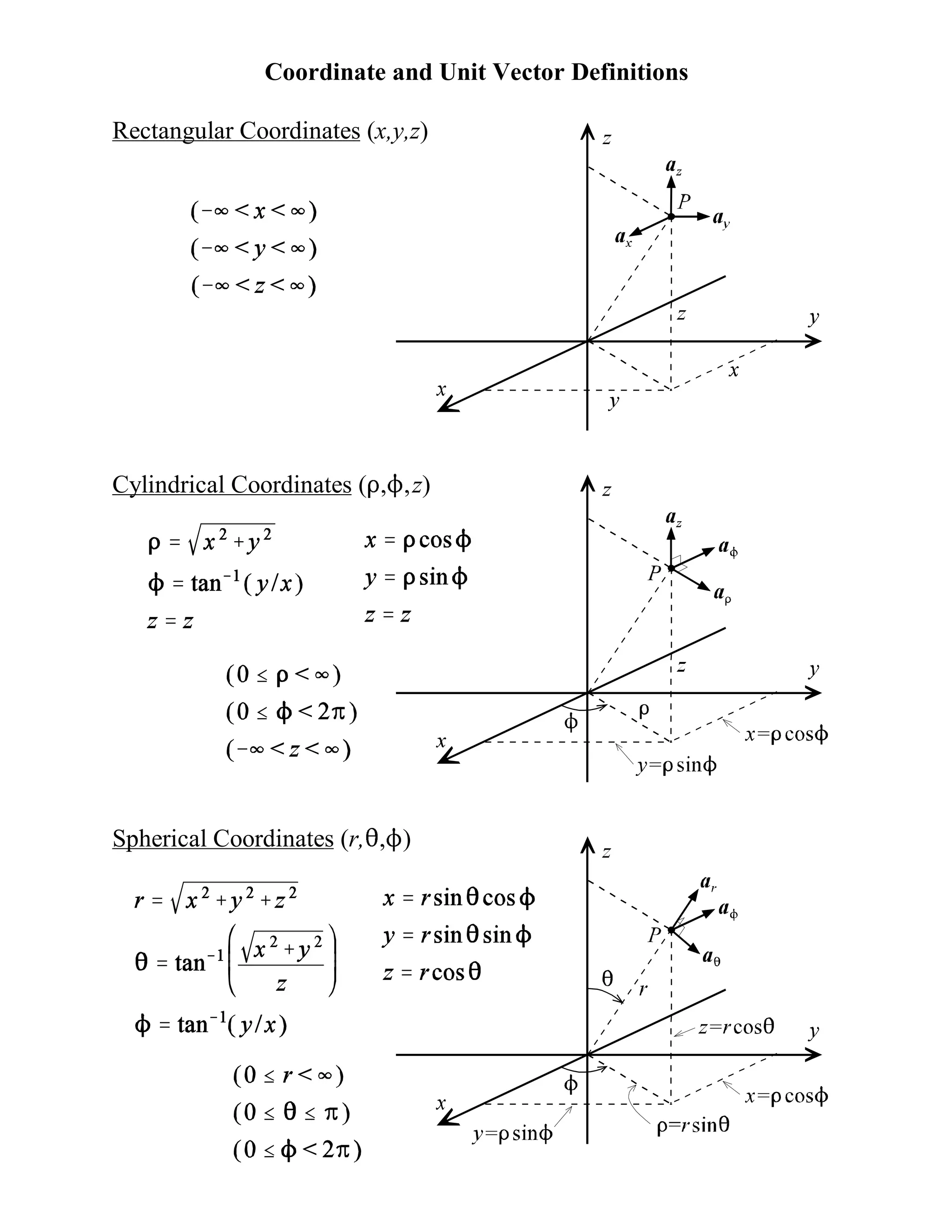
Coordinate and Unit Vector Definitions
Rectangular Coordinates (x,y,z)
Cylindrical Coordinates (D,N,z)
Spherical Coordinates (r,2,N)
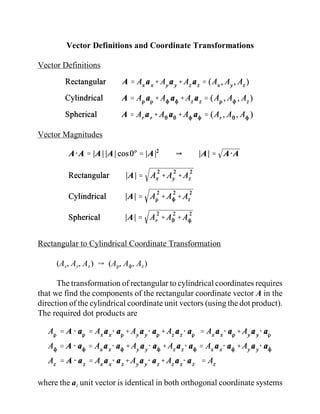
Vector Definitions and Coordinate Transformations
Vector Definitions
Vector Magnitudes
Rectangular to Cylindrical Coordinate Transformation
(Ax, Ay, Az) Y (AD, AN, Az)
The transformation of rectangular to cylindrical coordinates requires
that we find the components of the rectangular coordinate vector A in the
direction of the cylindrical coordinate unit vectors (using the dot product).
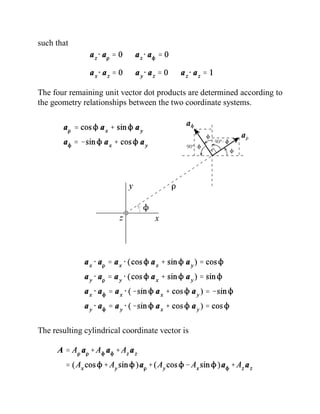
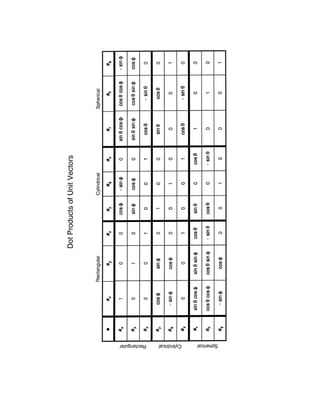
The required dot products are
where the az unit vector is identical in both orthogonal coordinate systems
such that
The four remaining unit vector dot products are determined according to
the geometry relationships between the two coordinate systems.
The resulting cylindrical coordinate vector is
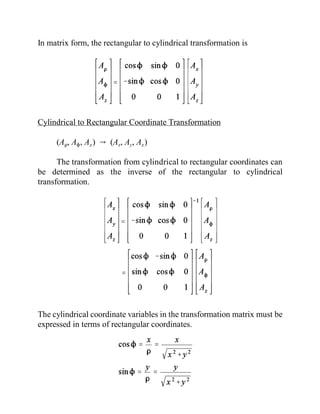
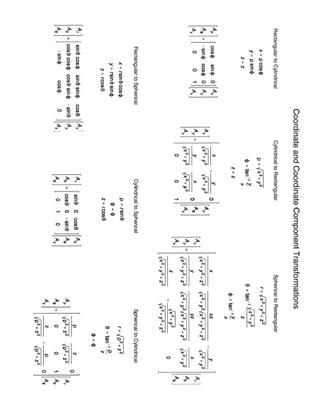
In matrix form, the rectangular to cylindrical transformation is
Cylindrical to Rectangular Coordinate Transformation
(AD, AN, Az) Y (Ax, Ay, Az)
The transformation from cylindrical to rectangular coordinates can
be determined as the inverse of the rectangular to cylindrical
transformation.
The cylindrical coordinate variables in the transformation matrix must be
expressed in terms of rectangular coordinates.
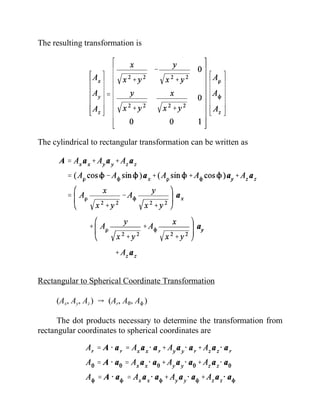
The resulting transformation is
The cylindrical to rectangular transformation can be written as
Rectangular to Spherical Coordinate Transformation
(Ax, Ay, Az ) Y (Ar, A2, AN)
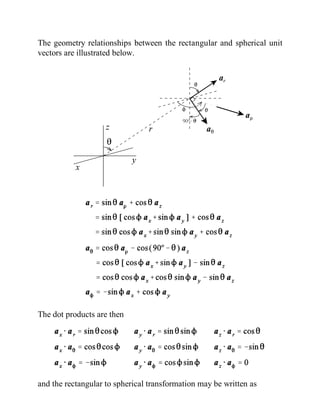
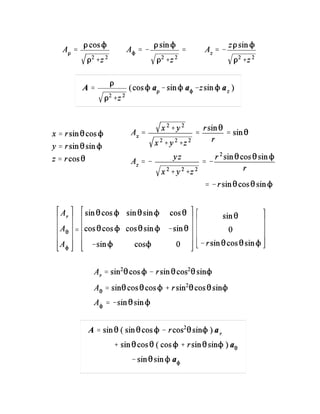
The dot products necessary to determine the transformation from
rectangular coordinates to spherical coordinates are
The geometry relationships between the rectangular and spherical unit
vectors are illustrated below.
The dot products are then
and the rectangular to spherical transformation may be written as
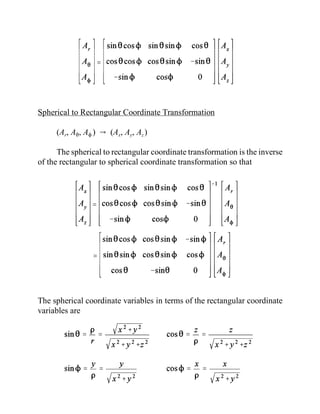
Spherical to Rectangular Coordinate Transformation
(Ar, A2, AN) Y (Ax, Ay, Az )
The spherical to rectangular coordinate transformation is the inverse
of the rectangular to spherical coordinate transformation so that
The spherical coordinate variables in terms of the rectangular coordinate
variables are
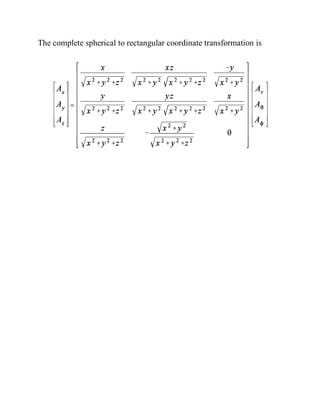
The complete spherical to rectangular coordinate transformation is
Coordinate Transformation Procedure
(1) Transform the component scalars into the new coordinate
system.
(2) Insert the component scalarsintothecoordinatetransformation
matrix and evaluate.
Steps (1) and (2) can be performed in either order.
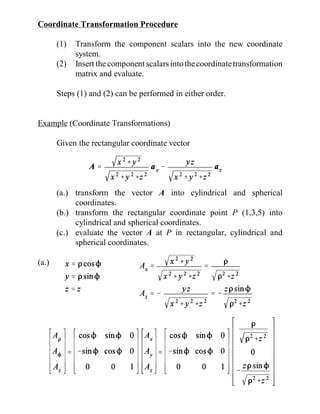
Example (Coordinate Transformations)
Given the rectangular coordinate vector
(a.) transform the vector A into cylindrical and spherical
coordinates.
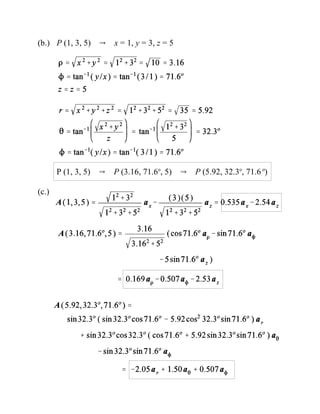
(b.) transform the rectangular coordinate point P (1,3,5) into
cylindrical and spherical coordinates.
(c.) evaluate the vector A at P in rectangular, cylindrical and
spherical coordinates.
(a.)
(b.) P (1, 3, 5) Y x = 1, y = 3, z = 5
P (1, 3, 5) Y P (3.16, 71.6o
, 5) Y P (5.92, 32.3o
, 71.6 o
)
(c.)
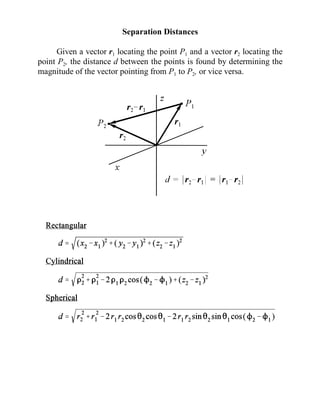
Separation Distances
Given a vector r1 locating the point P1 and a vector r2 locating the
point P2, the distance d between the points is found by determining the
magnitude of the vector pointing from P1 to P2, or vice versa.
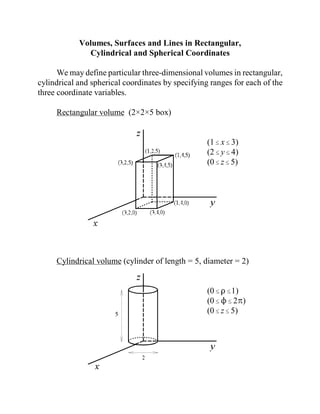
Volumes, Surfaces and Lines in Rectangular,
Cylindrical and Spherical Coordinates
We may define particular three-dimensional volumes in rectangular,
cylindrical and spherical coordinates by specifying ranges for each of the
three coordinate variables.
Rectangular volume (2×2×5 box)
(1#x#3)
(2#y#4)
(0#z#5)
Cylindrical volume (cylinder of length = 5, diameter = 2)
(0#D#1)
(0#N#2B)
(0#z#5)
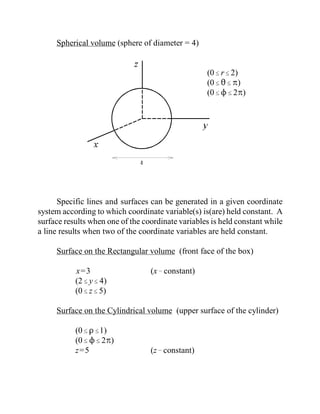
Spherical volume (sphere of diameter = 4)
(0#r#2)
(0#2#B)
(0#N#2B)
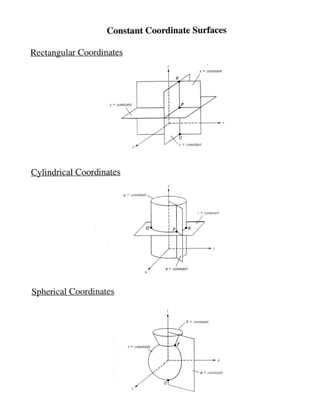
Specific lines and surfaces can be generated in a given coordinate
system according to which coordinate variable(s) is(are) held constant. A
surface results when one of the coordinate variables is held constant while
a line results when two of the coordinate variables are held constant.
Surface on the Rectangular volume (front face of the box)
x=3 (x!constant)
(2#y#4)
(0#z#5)
Surface on the Cylindrical volume (upper surface of the cylinder)
(0#D#1)
(0#N#2B)
z=5 (z!constant)
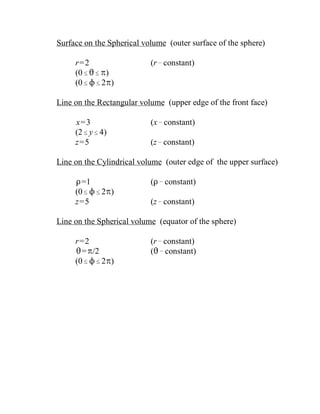
Surface on the Spherical volume (outer surface of the sphere)
r=2 (r!constant)
(0#2#B)
(0#N#2B)
Line on the Rectangular volume (upper edge of the front face)
x=3 (x!constant)
(2#y#4)
z=5 (z!constant)
Line on the Cylindrical volume (outer edge of the upper surface)
D=1 (D!constant)
(0#N#2B)
z=5 (z!constant)
Line on the Spherical volume (equator of the sphere)
r=2 (r!constant)
2=B/2 (2!constant)
(0#N#2B)
Coordinate and unit vector

Coordinate and unit vector

  • 1.
    Coordinate and UnitVector Definitions Rectangular Coordinates (x,y,z) Cylindrical Coordinates (D,N,z) Spherical Coordinates (r,2,N)
  • 2.
    Vector Definitions andCoordinate Transformations Vector Definitions Vector Magnitudes Rectangular to Cylindrical Coordinate Transformation (Ax, Ay, Az) Y (AD, AN, Az) The transformation of rectangular to cylindrical coordinates requires that we find the components of the rectangular coordinate vector A in the direction of the cylindrical coordinate unit vectors (using the dot product). The required dot products are where the az unit vector is identical in both orthogonal coordinate systems
  • 3.
    such that The fourremaining unit vector dot products are determined according to the geometry relationships between the two coordinate systems. The resulting cylindrical coordinate vector is
  • 4.
    In matrix form,the rectangular to cylindrical transformation is Cylindrical to Rectangular Coordinate Transformation (AD, AN, Az) Y (Ax, Ay, Az) The transformation from cylindrical to rectangular coordinates can be determined as the inverse of the rectangular to cylindrical transformation. The cylindrical coordinate variables in the transformation matrix must be expressed in terms of rectangular coordinates.
  • 5.
    The resulting transformationis The cylindrical to rectangular transformation can be written as Rectangular to Spherical Coordinate Transformation (Ax, Ay, Az ) Y (Ar, A2, AN) The dot products necessary to determine the transformation from rectangular coordinates to spherical coordinates are
  • 6.
    The geometry relationshipsbetween the rectangular and spherical unit vectors are illustrated below. The dot products are then and the rectangular to spherical transformation may be written as
  • 7.
    Spherical to RectangularCoordinate Transformation (Ar, A2, AN) Y (Ax, Ay, Az ) The spherical to rectangular coordinate transformation is the inverse of the rectangular to spherical coordinate transformation so that The spherical coordinate variables in terms of the rectangular coordinate variables are
  • 8.
    The complete sphericalto rectangular coordinate transformation is
  • 11.
    Coordinate Transformation Procedure (1)Transform the component scalars into the new coordinate system. (2) Insert the component scalarsintothecoordinatetransformation matrix and evaluate. Steps (1) and (2) can be performed in either order. Example (Coordinate Transformations) Given the rectangular coordinate vector (a.) transform the vector A into cylindrical and spherical coordinates. (b.) transform the rectangular coordinate point P (1,3,5) into cylindrical and spherical coordinates. (c.) evaluate the vector A at P in rectangular, cylindrical and spherical coordinates. (a.)
  • 13.
    (b.) P (1,3, 5) Y x = 1, y = 3, z = 5 P (1, 3, 5) Y P (3.16, 71.6o , 5) Y P (5.92, 32.3o , 71.6 o ) (c.)
  • 14.
    Separation Distances Given avector r1 locating the point P1 and a vector r2 locating the point P2, the distance d between the points is found by determining the magnitude of the vector pointing from P1 to P2, or vice versa.
  • 15.
    Volumes, Surfaces andLines in Rectangular, Cylindrical and Spherical Coordinates We may define particular three-dimensional volumes in rectangular, cylindrical and spherical coordinates by specifying ranges for each of the three coordinate variables. Rectangular volume (2×2×5 box) (1#x#3) (2#y#4) (0#z#5) Cylindrical volume (cylinder of length = 5, diameter = 2) (0#D#1) (0#N#2B) (0#z#5)
  • 16.
    Spherical volume (sphereof diameter = 4) (0#r#2) (0#2#B) (0#N#2B) Specific lines and surfaces can be generated in a given coordinate system according to which coordinate variable(s) is(are) held constant. A surface results when one of the coordinate variables is held constant while a line results when two of the coordinate variables are held constant. Surface on the Rectangular volume (front face of the box) x=3 (x!constant) (2#y#4) (0#z#5) Surface on the Cylindrical volume (upper surface of the cylinder) (0#D#1) (0#N#2B) z=5 (z!constant)
  • 17.
    Surface on theSpherical volume (outer surface of the sphere) r=2 (r!constant) (0#2#B) (0#N#2B) Line on the Rectangular volume (upper edge of the front face) x=3 (x!constant) (2#y#4) z=5 (z!constant) Line on the Cylindrical volume (outer edge of the upper surface) D=1 (D!constant) (0#N#2B) z=5 (z!constant) Line on the Spherical volume (equator of the sphere) r=2 (r!constant) 2=B/2 (2!constant) (0#N#2B)