FORCE
VECTORS


 Mechanical Engineering   1
Previous lecture
• How to add two or more forces using Parallelogram Law
• How to resolve the resultant force into components in x- and
  y- axes.
                     F = Fx i + Fy j

•   How to express force and position in Cartesian vector form
•   How to add force using Cartesian vector
•   How to determine the vector’s magnitude and direction
•   That three steps:
    a) Resolve the forces in their x-y components.
    b) Add the respective components to get the resultant vector.
    c) Find magnitude and angle from the resultant components.
                                                                    2
Feedback from the examples in the
            previous lecture
• Show (i) and (j) in every step of calculation to represent
  the direction of the vectors (in x- and y- axes).
• Show the unit (N) in every step of your calculation
• Show the degree in graphic with regards to x- and y-
  axes
• Remember the basic of trigonometry (sin, cosine,
  tangent)
• Show the steps for the examiner/others to understand
• Check you answer!! Some of the wrong answers are
  because you make a careless mistake when putting the
  values in your calculator.
                                                               3
Today’s objectives

We are able to:
a) Represent a 3-D vector in a Cartesian
  coordinate system.
b) Find the magnitude and coordinate
  angles of a 3-D vector
c) Add vectors (forces) in 3-D space


                                           4
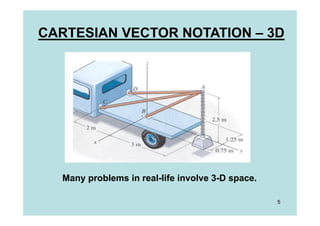
CARTESIAN VECTOR NOTATION – 3D


  Many problems in real-life involve 3-D space.

                                                  5
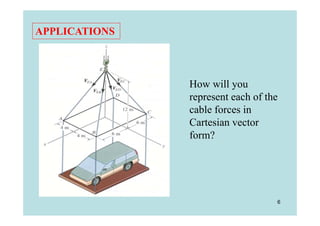
APPLICATIONS


               How will you
               represent each of the
               cable forces in
               Cartesian vector
               form?


                                   6
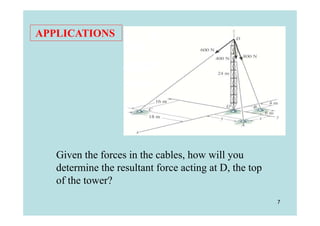
APPLICATIONS


   Given the forces in the cables, how will you
   determine the resultant force acting at D, the top
   of the tower?
                                                        7
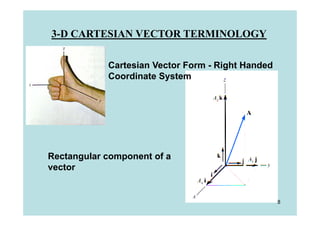
3-D CARTESIAN VECTOR TERMINOLOGY

            Cartesian Vector Form - Right Handed
            Coordinate System


Rectangular component of a
vector


                                                   8
3-D CARTESIAN VECTOR TERMINOLOGY


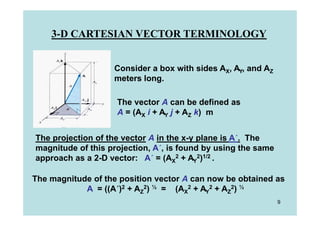
                   Consider a box with sides AX, AY, and AZ
                   meters long.

                    The vector A can be defined as
                    A = (AX i + AY j + AZ k) m


The projection of the vector A in the x-y plane is A´. The
magnitude of this projection, A´, is found by using the same
approach as a 2-D vector: A´ = (AX2 + AY2)1/2 .

The magnitude of the position vector A can now be obtained as
            A = ((A´)2 + AZ2) ½ = (AX2 + AY2 + AZ2) ½
                                                               9
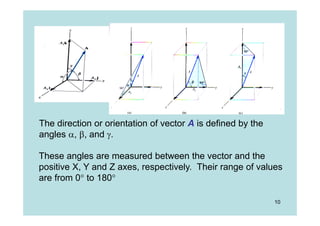
The direction or orientation of vector A is defined by the
angles , , and .

These angles are measured between the vector and the
positive X, Y and Z axes, respectively. Their range of values
are from 0° to 180°

                                                             10
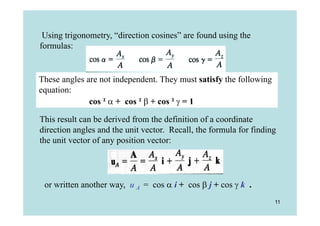
Using trigonometry, “direction cosines” are found using the
formulas:


These angles are not independent. They must satisfy the following
equation:
              cos ²  + cos ²  + cos ²  = 1

This result can be derived from the definition of a coordinate
direction angles and the unit vector. Recall, the formula for finding
the unit vector of any position vector:


 or written another way, u A = cos  i + cos  j + cos  k .
                                                                    11
ADDITION/SUBTRACTION OF VECTORS

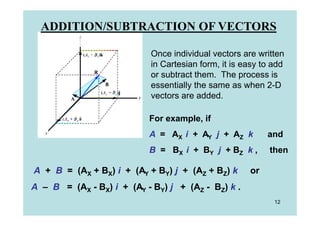
                            Once individual vectors are written
                            in Cartesian form, it is easy to add
                            or subtract them. The process is
                            essentially the same as when 2-D
                            vectors are added.

                           For example, if
                           A = AX i + AY j + AZ k          and
                           B = B X i + B Y j + BZ k ,       then

A + B = (AX + BX) i + (AY + BY) j + (AZ + BZ) k       or
A – B = (AX - BX) i + (AY - BY) j + (AZ - BZ) k .
                                                             12
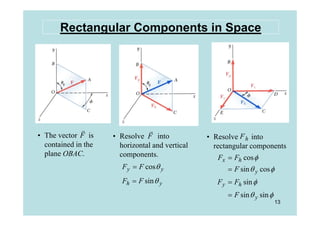
Rectangular Components in Space


                                
• The vector F is    • Resolve F into            • Resolve F h into
  contained in the     horizontal and vertical     rectangular components
  plane OBAC.          components.                  Fx  Fh cos 
                        Fy  F cos y                   F sin  y cos 
                        Fh  F sin  y              Fy  Fh sin 
                                                        F sin  y sin 
                                                                           13
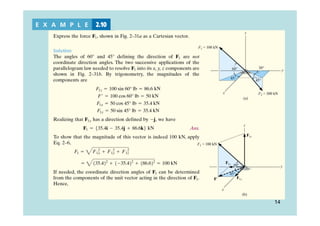
14
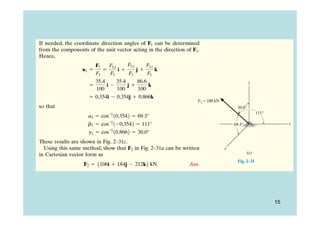
15
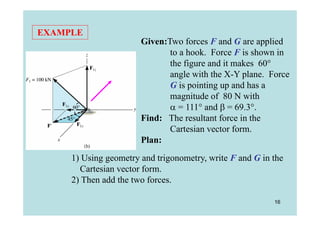
EXAMPLE
                       Given:Two forces F and G are applied
                              to a hook. Force F is shown in
                              the figure and it makes 60°
                G
                              angle with the X-Y plane. Force
                              G is pointing up and has a
                              magnitude of 80 N with
                               = 111° and  = 69.3°.
                       Find: The resultant force in the
                              Cartesian vector form.
                       Plan:
     1) Using geometry and trigonometry, write F and G in the
       Cartesian vector form.
     2) Then add the two forces.

                                                          16
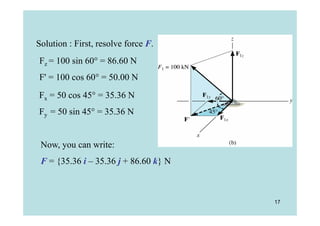
Solution : First, resolve force F.
Fz = 100 sin 60° = 86.60 N
F' = 100 cos 60° = 50.00 N
Fx = 50 cos 45° = 35.36 N
Fy = 50 sin 45° = 35.36 N


 Now, you can write:
 F = {35.36 i – 35.36 j + 86.60 k} N


                                       17
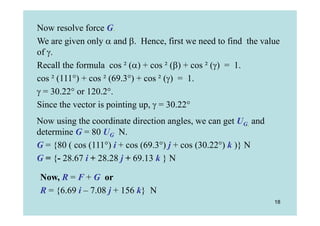
Now resolve force G.
We are given only  and . Hence, first we need to find the value
of .
Recall the formula cos ² () + cos ² () + cos ² () = 1.
cos ² (111°) + cos ² (69.3°) + cos ² () = 1.
 = 30.22° or 120.2°.
Since the vector is pointing up,  = 30.22°
Now using the coordinate direction angles, we can get UG, and
determine G = 80 UG N.
G = {80 ( cos (111°) i + cos (69.3°) j + cos (30.22°) k )} N
G = {- 28.67 i + 28.28 j + 69.13 k } N

Now, R = F + G or
R = {6.69 i – 7.08 j + 156 k} N
                                                                18
EXAMPLE


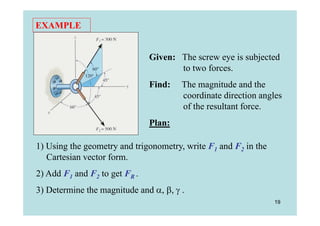
                               Given: The screw eye is subjected
                                      to two forces.
                               Find:   The magnitude and the
                                       coordinate direction angles
                                       of the resultant force.
                               Plan:

1) Using the geometry and trigonometry, write F1 and F2 in the
   Cartesian vector form.
2) Add F1 and F2 to get FR .
3) Determine the magnitude and , ,  .
                                                                 19
EXAMPLE (continued)

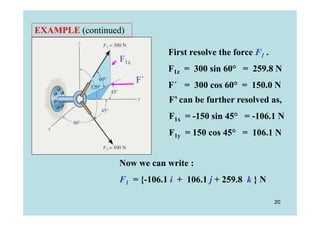
                             First resolve the force F1 .
                 F1z
                             F1z = 300 sin 60° = 259.8 N
                       F´
                             F´ = 300 cos 60° = 150.0 N
                             F’ can be further resolved as,
                             F1x = -150 sin 45° = -106.1 N
                             F1y = 150 cos 45° = 106.1 N


                 Now we can write :
                 F1 = {-106.1 i + 106.1 j + 259.8 k } N

                                                            20
EXAMPLE (continued)

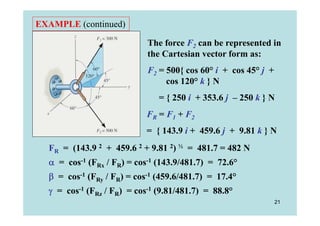
                            The force F2 can be represented in
                            the Cartesian vector form as:
                            F2 = 500{ cos 60° i + cos 45° j +
                                 cos 120° k } N
                               = { 250 i + 353.6 j – 250 k } N
                            FR = F1 + F2
                            = { 143.9 i + 459.6 j + 9.81 k } N
  FR = (143.9 2 + 459.6 2 + 9.81 2) ½ = 481.7 = 482 N
   = cos-1 (FRx / FR) = cos-1 (143.9/481.7) = 72.6°
   = cos-1 (FRy / FR) = cos-1 (459.6/481.7) = 17.4°
   = cos-1 (FRz / FR) = cos-1 (9.81/481.7) = 88.8°
                                                                21
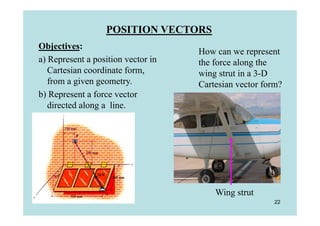
POSITION VECTORS
Objectives:
                                    How can we represent
a) Represent a position vector in   the force along the
   Cartesian coordinate form,       wing strut in a 3-D
   from a given geometry.           Cartesian vector form?
b) Represent a force vector
   directed along a line.


                                        Wing strut
                                                        22
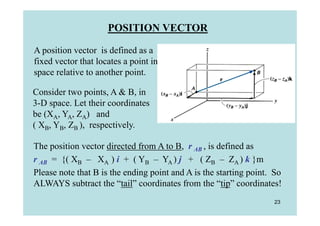
POSITION VECTOR

A position vector is defined as a
fixed vector that locates a point in
space relative to another point.

Consider two points, A & B, in
3-D space. Let their coordinates
be (XA, YA, ZA) and
( XB, YB, ZB ), respectively.

The position vector directed from A to B, r AB , is defined as
r AB = {( XB – XA ) i + ( YB – YA ) j + ( ZB – ZA ) k }m
Please note that B is the ending point and A is the starting point. So
ALWAYS subtract the “tail” coordinates from the “tip” coordinates!
                                                                   23
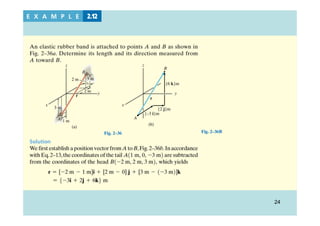
24
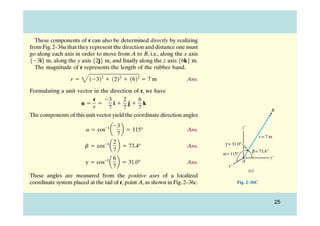
25
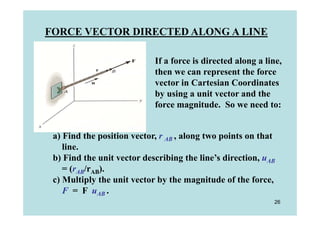
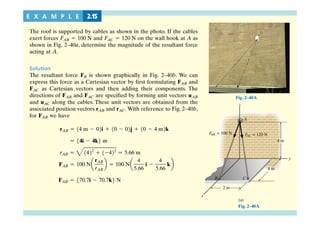
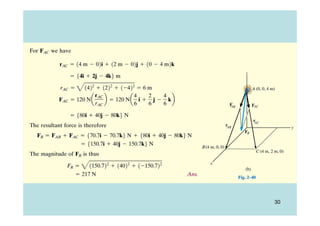
FORCE VECTOR DIRECTED ALONG A LINE

                            If a force is directed along a line,
                            then we can represent the force
                            vector in Cartesian Coordinates
                            by using a unit vector and the
                            force magnitude. So we need to:


 a) Find the position vector, r AB , along two points on that
    line.
 b) Find the unit vector describing the line’s direction, uAB
    = (rAB/rAB).
 c) Multiply the unit vector by the magnitude of the force,
    F = F uAB .
                                                             26
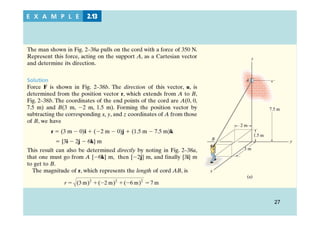
27
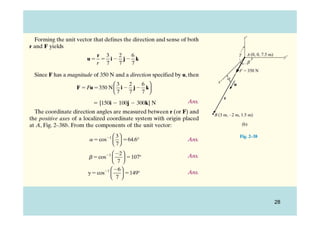
28
Mechanical Engineering 2011   29
30
2.


     31

Chapter2 part2

  • 1.
  • 2.
    Previous lecture • Howto add two or more forces using Parallelogram Law • How to resolve the resultant force into components in x- and y- axes. F = Fx i + Fy j • How to express force and position in Cartesian vector form • How to add force using Cartesian vector • How to determine the vector’s magnitude and direction • That three steps: a) Resolve the forces in their x-y components. b) Add the respective components to get the resultant vector. c) Find magnitude and angle from the resultant components. 2
  • 3.
    Feedback from theexamples in the previous lecture • Show (i) and (j) in every step of calculation to represent the direction of the vectors (in x- and y- axes). • Show the unit (N) in every step of your calculation • Show the degree in graphic with regards to x- and y- axes • Remember the basic of trigonometry (sin, cosine, tangent) • Show the steps for the examiner/others to understand • Check you answer!! Some of the wrong answers are because you make a careless mistake when putting the values in your calculator. 3
  • 4.
    Today’s objectives We areable to: a) Represent a 3-D vector in a Cartesian coordinate system. b) Find the magnitude and coordinate angles of a 3-D vector c) Add vectors (forces) in 3-D space 4
  • 5.
    CARTESIAN VECTOR NOTATION– 3D Many problems in real-life involve 3-D space. 5
  • 6.
    APPLICATIONS How will you represent each of the cable forces in Cartesian vector form? 6
  • 7.
    APPLICATIONS Given the forces in the cables, how will you determine the resultant force acting at D, the top of the tower? 7
  • 8.
    3-D CARTESIAN VECTORTERMINOLOGY Cartesian Vector Form - Right Handed Coordinate System Rectangular component of a vector 8
  • 9.
    3-D CARTESIAN VECTORTERMINOLOGY Consider a box with sides AX, AY, and AZ meters long. The vector A can be defined as A = (AX i + AY j + AZ k) m The projection of the vector A in the x-y plane is A´. The magnitude of this projection, A´, is found by using the same approach as a 2-D vector: A´ = (AX2 + AY2)1/2 . The magnitude of the position vector A can now be obtained as A = ((A´)2 + AZ2) ½ = (AX2 + AY2 + AZ2) ½ 9
  • 10.
    The direction ororientation of vector A is defined by the angles , , and . These angles are measured between the vector and the positive X, Y and Z axes, respectively. Their range of values are from 0° to 180° 10
  • 11.
    Using trigonometry, “directioncosines” are found using the formulas: These angles are not independent. They must satisfy the following equation: cos ²  + cos ²  + cos ²  = 1 This result can be derived from the definition of a coordinate direction angles and the unit vector. Recall, the formula for finding the unit vector of any position vector: or written another way, u A = cos  i + cos  j + cos  k . 11
  • 12.
    ADDITION/SUBTRACTION OF VECTORS Once individual vectors are written in Cartesian form, it is easy to add or subtract them. The process is essentially the same as when 2-D vectors are added. For example, if A = AX i + AY j + AZ k and B = B X i + B Y j + BZ k , then A + B = (AX + BX) i + (AY + BY) j + (AZ + BZ) k or A – B = (AX - BX) i + (AY - BY) j + (AZ - BZ) k . 12
  • 13.
    Rectangular Components inSpace   • The vector F is • Resolve F into • Resolve F h into contained in the horizontal and vertical rectangular components plane OBAC. components. Fx  Fh cos  Fy  F cos y  F sin  y cos  Fh  F sin  y Fy  Fh sin   F sin  y sin  13
  • 14.
  • 15.
  • 16.
    EXAMPLE Given:Two forces F and G are applied to a hook. Force F is shown in the figure and it makes 60° G angle with the X-Y plane. Force G is pointing up and has a magnitude of 80 N with  = 111° and  = 69.3°. Find: The resultant force in the Cartesian vector form. Plan: 1) Using geometry and trigonometry, write F and G in the Cartesian vector form. 2) Then add the two forces. 16
  • 17.
    Solution : First,resolve force F. Fz = 100 sin 60° = 86.60 N F' = 100 cos 60° = 50.00 N Fx = 50 cos 45° = 35.36 N Fy = 50 sin 45° = 35.36 N Now, you can write: F = {35.36 i – 35.36 j + 86.60 k} N 17
  • 18.
    Now resolve forceG. We are given only  and . Hence, first we need to find the value of . Recall the formula cos ² () + cos ² () + cos ² () = 1. cos ² (111°) + cos ² (69.3°) + cos ² () = 1.  = 30.22° or 120.2°. Since the vector is pointing up,  = 30.22° Now using the coordinate direction angles, we can get UG, and determine G = 80 UG N. G = {80 ( cos (111°) i + cos (69.3°) j + cos (30.22°) k )} N G = {- 28.67 i + 28.28 j + 69.13 k } N Now, R = F + G or R = {6.69 i – 7.08 j + 156 k} N 18
  • 19.
    EXAMPLE Given: The screw eye is subjected to two forces. Find: The magnitude and the coordinate direction angles of the resultant force. Plan: 1) Using the geometry and trigonometry, write F1 and F2 in the Cartesian vector form. 2) Add F1 and F2 to get FR . 3) Determine the magnitude and , ,  . 19
  • 20.
    EXAMPLE (continued) First resolve the force F1 . F1z F1z = 300 sin 60° = 259.8 N F´ F´ = 300 cos 60° = 150.0 N F’ can be further resolved as, F1x = -150 sin 45° = -106.1 N F1y = 150 cos 45° = 106.1 N Now we can write : F1 = {-106.1 i + 106.1 j + 259.8 k } N 20
  • 21.
    EXAMPLE (continued) The force F2 can be represented in the Cartesian vector form as: F2 = 500{ cos 60° i + cos 45° j + cos 120° k } N = { 250 i + 353.6 j – 250 k } N FR = F1 + F2 = { 143.9 i + 459.6 j + 9.81 k } N FR = (143.9 2 + 459.6 2 + 9.81 2) ½ = 481.7 = 482 N  = cos-1 (FRx / FR) = cos-1 (143.9/481.7) = 72.6°  = cos-1 (FRy / FR) = cos-1 (459.6/481.7) = 17.4°  = cos-1 (FRz / FR) = cos-1 (9.81/481.7) = 88.8° 21
  • 22.
    POSITION VECTORS Objectives: How can we represent a) Represent a position vector in the force along the Cartesian coordinate form, wing strut in a 3-D from a given geometry. Cartesian vector form? b) Represent a force vector directed along a line. Wing strut 22
  • 23.
    POSITION VECTOR A positionvector is defined as a fixed vector that locates a point in space relative to another point. Consider two points, A & B, in 3-D space. Let their coordinates be (XA, YA, ZA) and ( XB, YB, ZB ), respectively. The position vector directed from A to B, r AB , is defined as r AB = {( XB – XA ) i + ( YB – YA ) j + ( ZB – ZA ) k }m Please note that B is the ending point and A is the starting point. So ALWAYS subtract the “tail” coordinates from the “tip” coordinates! 23
  • 24.
  • 25.
  • 26.
    FORCE VECTOR DIRECTEDALONG A LINE If a force is directed along a line, then we can represent the force vector in Cartesian Coordinates by using a unit vector and the force magnitude. So we need to: a) Find the position vector, r AB , along two points on that line. b) Find the unit vector describing the line’s direction, uAB = (rAB/rAB). c) Multiply the unit vector by the magnitude of the force, F = F uAB . 26
  • 27.
  • 28.
  • 29.
  • 30.
  • 31.
    2. 31