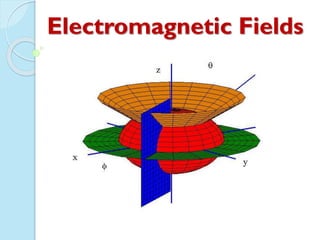
Electromagnetic Fields
About Me
Aatif Saeed
Education
 M.Sc Electronics
 M.Sc Systems Engineering
 MS Project Management
Experience
 16+ Years Teaching
 14+ Years Industry Projects
Email
 aatifsaeed@gmail.com
Course Outline
Chapter 1 – 12 (5 & 7 exclusive)
Marks Distribution
 Assignments – 10%
 Quizzes – 10%
 Class Participation – 5%
 Mid Term – 25%
 Final – 50%
Final Examination Question Paper
 8 Review Questions out of 12
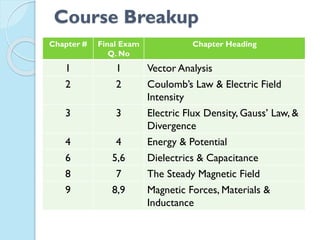
Course Breakup
Chapter # Final Exam
Q. No
Chapter Heading
1 1 Vector Analysis
2 2 Coulomb’s Law & Electric Field
Intensity
3 3 Electric Flux Density, Gauss’ Law, &
Divergence
4 4 Energy & Potential
6 5,6 Dielectrics & Capacitance
8 7 The Steady Magnetic Field
9 8,9 Magnetic Forces, Materials &
Inductance
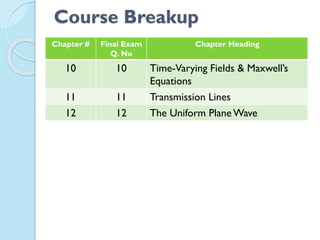
Course Breakup
Chapter # Final Exam
Q. No
Chapter Heading
10 10 Time-Varying Fields & Maxwell’s
Equations
11 11 Transmission Lines
12 12 The Uniform Plane Wave
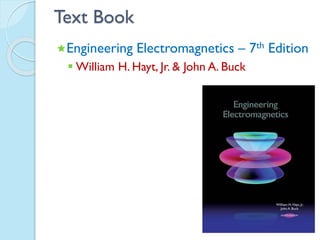
Text Book
Engineering Electromagnetics – 7th Edition
 William H. Hayt, Jr. & John A. Buck
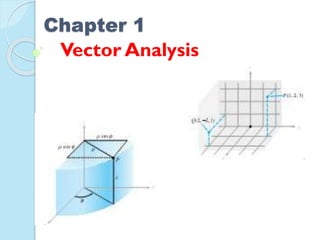
Chapter 1
Vector Analysis
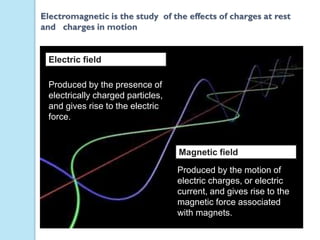
Electric field
Magnetic field
Produced by the motion of
electric charges, or electric
current, and gives rise to the
magnetic force associated
with magnets.
Electromagnetic is the study of the effects of charges at rest
and charges in motion
Produced by the presence of
electrically charged particles,
and gives rise to the electric
force.
Scalars &Vectors
Scalar
 Refers to a Quantity whose value may be
represented by a Single (Positive/Negative)
real number.
 Body falling a distance L in Time t
 TemperatureT at any point in a bowl of soup
whose co-ordinates are x, y, z
 L, t,T, z, y & z are all scalars
 Mass, Density, Pressure,Volume,Volume
resistivity,Voltage
Scalars &Vectors
Vector
 A quantity who has both a magnitude and
direction in space.
 Force,Velocity,Acceleration & a straight line
from positive to negative terminal of a storage
battery
Vector Algebra
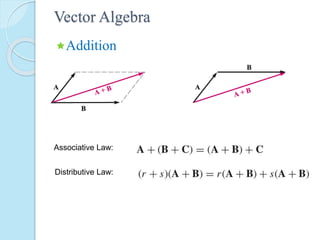
Addition
Associative Law:
Distributive Law:
Vector Algebra
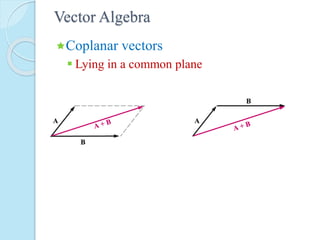
Coplanar vectors
 Lying in a common plane
Vector Algebra
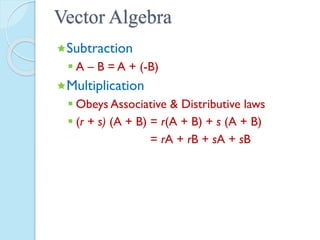
Subtraction
 A – B = A + (-B)
Multiplication
 Obeys Associative & Distributive laws
 (r + s) (A + B) = r(A + B) + s (A + B)
= rA + rB + sA + sB
Orthogonal Coordinate
Systems
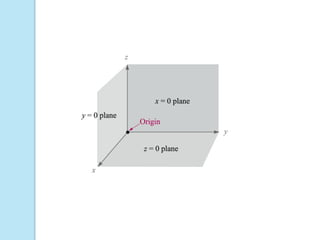
A coordinate system defines a set of reference
directions. In a 3D space, a coordinate system can
be specified by the intersection of 3 surfaces at
each and every point in space.
The origin of the coordinate system is the
reference point relative to which we locate every
other point in space.
Orthogonal Coordinate
Systems
A position vector defines the position of a point
in space relative to the origin.
These three reference directions are referred to
as coordinate directions or base vectors, and
are usually taken to be mutually perpendicular
(orthogonal) . In this class, we use three coordinate
systems:
 Cartesian
 cylindrical
 Spherical
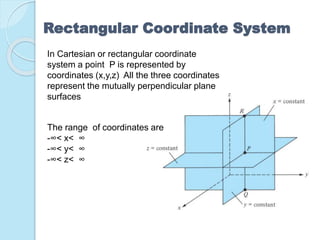
Rectangular Coordinate System
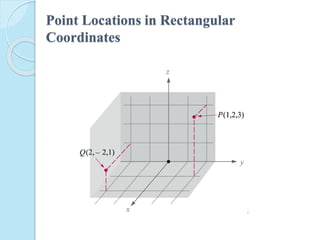
In Cartesian or rectangular coordinate
system a point P is represented by
coordinates (x,y,z) All the three coordinates
represent the mutually perpendicular plane
surfaces
The range of coordinates are
-∞< x< ∞
-∞< y< ∞
-∞< z< ∞
Point Locations in Rectangular
Coordinates
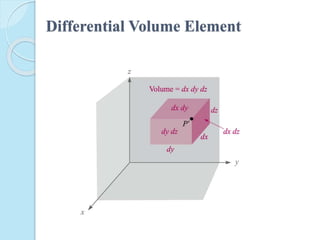
Differential Volume Element
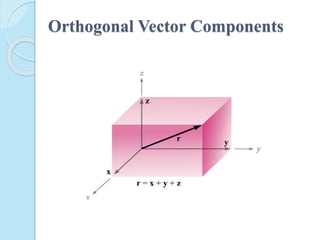
Orthogonal Vector Components
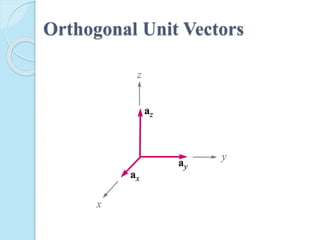
Orthogonal Unit Vectors
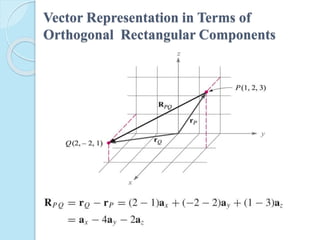
Vector Representation in Terms of
Orthogonal Rectangular Components
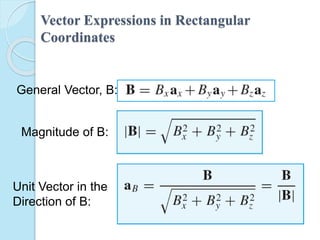
Vector Expressions in Rectangular
Coordinates
General Vector, B:
Magnitude of B:
Unit Vector in the
Direction of B:
Example
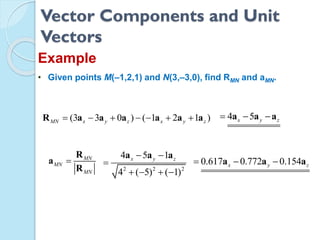
Vector Components and Unit
Vectors
Example
• Given points M(–1,2,1) and N(3,–3,0), find RMN and aMN.
(3 3 0 ) ( 1 2 1 )MN x y z x y z      R a a a a a a 4 5x y z  a a a
MN
MN
MN

R
a
R 2 2 2
4 5 1
4 ( 5) ( 1)
x y z 

   
a a a
0.617 0.772 0.154x y z  a a a
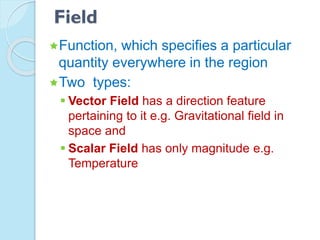
Field
Function, which specifies a particular
quantity everywhere in the region
Two types:
 Vector Field has a direction feature
pertaining to it e.g. Gravitational field in
space and
 Scalar Field has only magnitude e.g.
Temperature
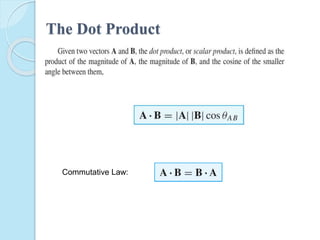
The Dot Product
Commutative Law:
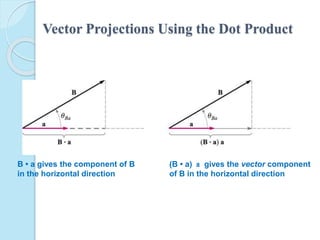
Vector Projections Using the Dot Product
B • a gives the component of B
in the horizontal direction
(B • a) a gives the vector component
of B in the horizontal direction
Operational Use of the Dot Product
Given
Find
where we have used:
Note also:
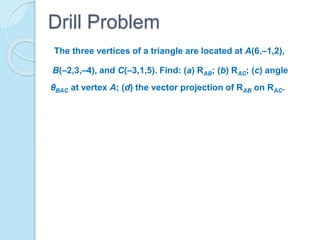
The three vertices of a triangle are located at A(6,–1,2),
B(–2,3,–4), and C(–3,1,5). Find: (a) RAB; (b) RAC; (c) angle
θBAC at vertex A; (d) the vector projection of RAB on RAC.
Drill Problem
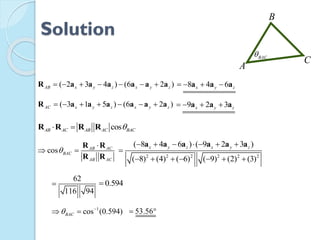
Solution
( 2 3 4 ) (6 2 )AB x y z x y z      R a a a a a a 8 4 6x y z   a a a
( 3 1 5 ) (6 2 )AC x y z x y z      R a a a a a a 9 2 3x y z   a a a
A
B
CBAC
cosAB AC AB AC BAC R R R R
cos AB AC
BAC
AB AC


 
R R
R R 2 2 2 2 2 2
( 8 4 6 ) ( 9 2 3 )
( 8) (4) ( 6) ( 9) (2) (3)
x y z x y z      

      
a a a a a a
62
116 94

1
cos (0.594)BAC 
  53.56 
0.594
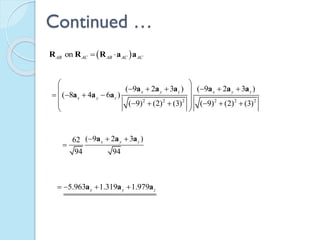
Continued …
 onAB AC AB AC AC R R R a a
2 2 2 2 2 2
( 9 2 3 ) ( 9 2 3 )
( 8 4 6 )
( 9) (2) (3) ( 9) (2) (3)
x y z x y z
x y z
 
          
      
 
a a a a a a
a a a
( 9 2 3 )62
94 94
x y z  

a a a
5.963 1.319 1.979x y z   a a a
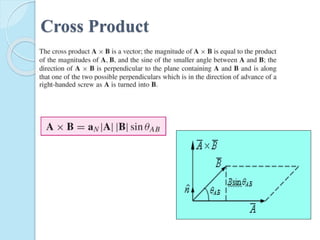
Cross Product
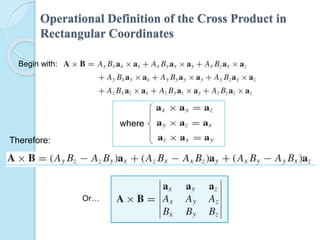
Operational Definition of the Cross Product in
Rectangular Coordinates
Therefore:
Or…
Begin with:
where
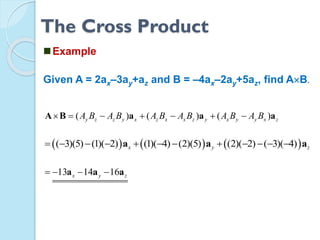
The Cross Product
Example
Given A = 2ax–3ay+az and B = –4ax–2ay+5az, find AB.
( ) ( ) ( )y z z y x z x x z y x y y x zA B A B A B A B A B A B      A B a a a
     ( 3)(5) (1)( 2) (1)( 4) (2)(5) (2)( 2) ( 3)( 4)x y z           a a a
13 14 16x y z   a a a
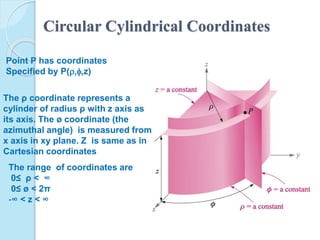
Circular Cylindrical Coordinates
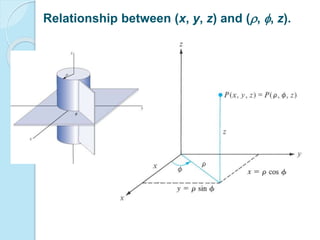
Point P has coordinates
Specified by P(z)
The ρ coordinate represents a
cylinder of radius ρ with z axis as
its axis. The ø coordinate (the
azimuthal angle) is measured from
x axis in xy plane. Z is same as in
Cartesian coordinates
The range of coordinates are
0≤ ρ < ∞
0≤ ø < 2π
-∞ < z < ∞
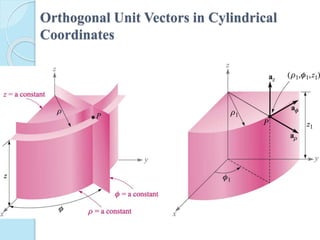
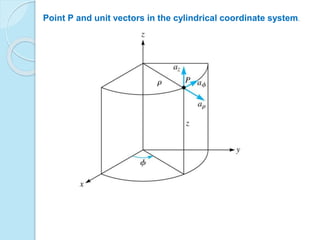
Orthogonal Unit Vectors in Cylindrical
Coordinates
Relationship between (x, y, z) and (, , z).
Point P and unit vectors in the cylindrical coordinate system.
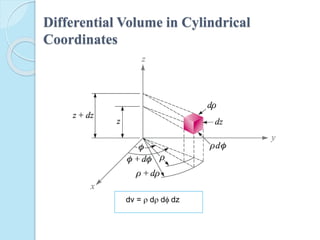
Differential Volume in Cylindrical
Coordinates
dv = dddz
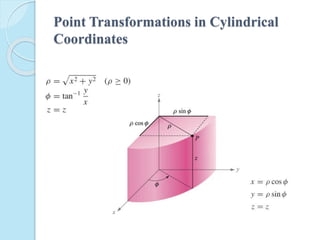
Point Transformations in Cylindrical
Coordinates
a
za
a
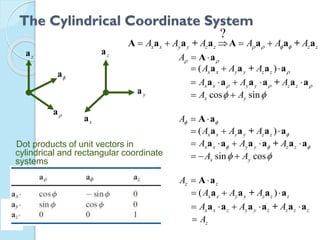
The Cylindrical Coordinate System
Dot products of unit vectors in
cylindrical and rectangular coordinate
systems
ya
za
xa
A  A a
( )x x y y z zA A A   a a + a a
x x y y z zA A A      a a a a + a a
cos sinx yA A  
A  A a
( )x x y y z zA A A   a a + a a
x x y y z zA A A      a a a a + a a
sin cosx yA A   
z zA  A a
( )x x y y z z zA A A  a a + a a
x x z y y z z z zA A A    a a a a + a a
zA
?
x x y y z z z zA A A A A A       A a a + a A a a + a
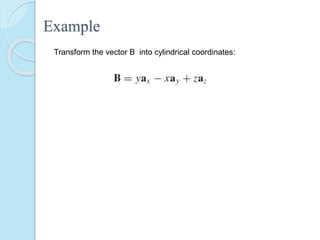
Transform the vector B into cylindrical coordinates:
Example
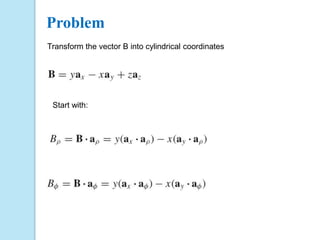
Transform the vector B into cylindrical coordinates
Start with:
Problem
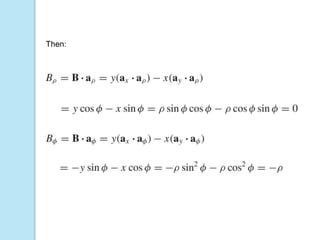
Then:
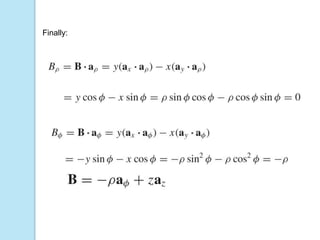
Finally:
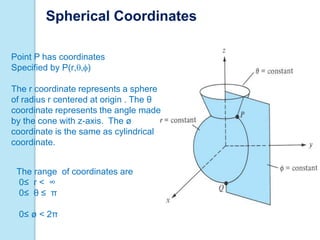
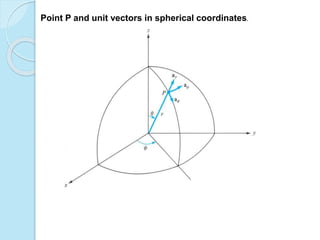
The r coordinate represents a sphere
of radius r centered at origin . The θ
coordinate represents the angle made
by the cone with z-axis. The ø
coordinate is the same as cylindrical
coordinate.
The range of coordinates are
0≤ r < ∞
0≤ θ ≤ π
0≤ ø < 2π
Point P has coordinates
Specified by P(r)
Spherical Coordinates
1-61
1-62
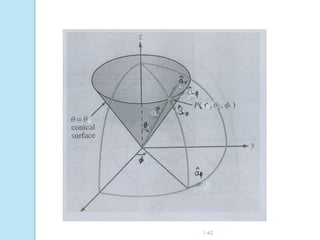
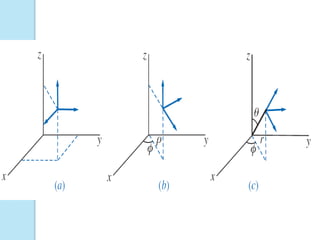
Point P and unit vectors in spherical coordinates.
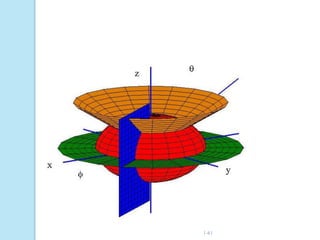
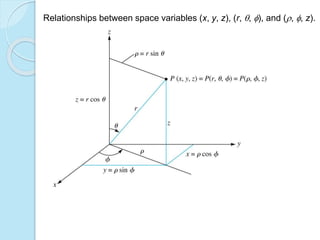
Relationships between space variables (x, y, z), (r, , ), and (, , z).
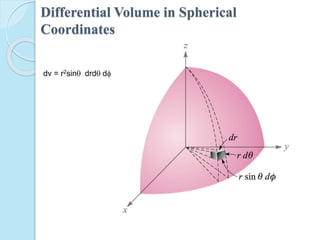
Differential Volume in Spherical
Coordinates
dv = r2sindrdd
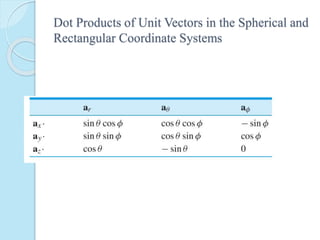
Dot Products of Unit Vectors in the Spherical and
Rectangular Coordinate Systems
The Spherical Coordinate System
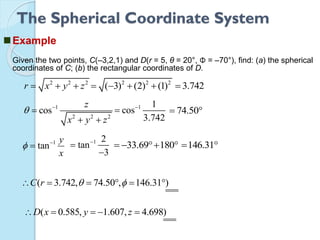
Example
Given the two points, C(–3,2,1) and D(r = 5, θ = 20°, Φ = –70°), find: (a) the spherical
coordinates of C; (b) the rectangular coordinates of D.
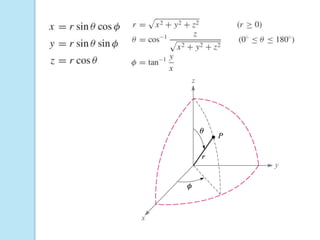
2 2 2
r x y z  
1
2 2 2
cos
z
x y z
 

 
1
tan
y
x
 

2 2 2
( 3) (2) (1)    3.742
1 1
cos
3.742

 74.50 
1 2
tan
3



33.69 180    146.31 
( 3.742, 74.50 , 146.31 )C r       
( 0.585, 1.607, 4.698)D x y z    
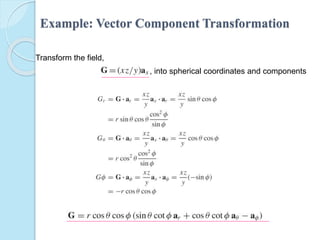
Example: Vector Component Transformation
Transform the field,
, into spherical coordinates and components

Electromagnetic theory Chapter 1

Electromagnetic theory Chapter 1

  • 2.
  • 3.
    About Me Aatif Saeed Education M.Sc Electronics  M.Sc Systems Engineering  MS Project Management Experience  16+ Years Teaching  14+ Years Industry Projects Email  aatifsaeed@gmail.com
  • 4.
    Course Outline Chapter 1– 12 (5 & 7 exclusive) Marks Distribution  Assignments – 10%  Quizzes – 10%  Class Participation – 5%  Mid Term – 25%  Final – 50% Final Examination Question Paper  8 Review Questions out of 12
  • 5.
    Course Breakup Chapter #Final Exam Q. No Chapter Heading 1 1 Vector Analysis 2 2 Coulomb’s Law & Electric Field Intensity 3 3 Electric Flux Density, Gauss’ Law, & Divergence 4 4 Energy & Potential 6 5,6 Dielectrics & Capacitance 8 7 The Steady Magnetic Field 9 8,9 Magnetic Forces, Materials & Inductance
  • 6.
    Course Breakup Chapter #Final Exam Q. No Chapter Heading 10 10 Time-Varying Fields & Maxwell’s Equations 11 11 Transmission Lines 12 12 The Uniform Plane Wave
  • 7.
    Text Book Engineering Electromagnetics– 7th Edition  William H. Hayt, Jr. & John A. Buck
  • 20.
  • 21.
    Electric field Magnetic field Producedby the motion of electric charges, or electric current, and gives rise to the magnetic force associated with magnets. Electromagnetic is the study of the effects of charges at rest and charges in motion Produced by the presence of electrically charged particles, and gives rise to the electric force.
  • 22.
    Scalars &Vectors Scalar  Refersto a Quantity whose value may be represented by a Single (Positive/Negative) real number.  Body falling a distance L in Time t  TemperatureT at any point in a bowl of soup whose co-ordinates are x, y, z  L, t,T, z, y & z are all scalars  Mass, Density, Pressure,Volume,Volume resistivity,Voltage
  • 23.
    Scalars &Vectors Vector  Aquantity who has both a magnitude and direction in space.  Force,Velocity,Acceleration & a straight line from positive to negative terminal of a storage battery
  • 24.
  • 25.
  • 26.
    Vector Algebra Subtraction  A– B = A + (-B) Multiplication  Obeys Associative & Distributive laws  (r + s) (A + B) = r(A + B) + s (A + B) = rA + rB + sA + sB
  • 27.
    Orthogonal Coordinate Systems A coordinatesystem defines a set of reference directions. In a 3D space, a coordinate system can be specified by the intersection of 3 surfaces at each and every point in space. The origin of the coordinate system is the reference point relative to which we locate every other point in space.
  • 28.
    Orthogonal Coordinate Systems A positionvector defines the position of a point in space relative to the origin. These three reference directions are referred to as coordinate directions or base vectors, and are usually taken to be mutually perpendicular (orthogonal) . In this class, we use three coordinate systems:  Cartesian  cylindrical  Spherical
  • 29.
    Rectangular Coordinate System InCartesian or rectangular coordinate system a point P is represented by coordinates (x,y,z) All the three coordinates represent the mutually perpendicular plane surfaces The range of coordinates are -∞< x< ∞ -∞< y< ∞ -∞< z< ∞
  • 31.
    Point Locations inRectangular Coordinates
  • 32.
  • 33.
  • 34.
  • 35.
    Vector Representation inTerms of Orthogonal Rectangular Components
  • 36.
    Vector Expressions inRectangular Coordinates General Vector, B: Magnitude of B: Unit Vector in the Direction of B:
  • 37.
  • 38.
    Vector Components andUnit Vectors Example • Given points M(–1,2,1) and N(3,–3,0), find RMN and aMN. (3 3 0 ) ( 1 2 1 )MN x y z x y z      R a a a a a a 4 5x y z  a a a MN MN MN  R a R 2 2 2 4 5 1 4 ( 5) ( 1) x y z       a a a 0.617 0.772 0.154x y z  a a a
  • 39.
    Field Function, which specifiesa particular quantity everywhere in the region Two types:  Vector Field has a direction feature pertaining to it e.g. Gravitational field in space and  Scalar Field has only magnitude e.g. Temperature
  • 40.
  • 41.
    Vector Projections Usingthe Dot Product B • a gives the component of B in the horizontal direction (B • a) a gives the vector component of B in the horizontal direction
  • 42.
    Operational Use ofthe Dot Product Given Find where we have used: Note also:
  • 43.
    The three verticesof a triangle are located at A(6,–1,2), B(–2,3,–4), and C(–3,1,5). Find: (a) RAB; (b) RAC; (c) angle θBAC at vertex A; (d) the vector projection of RAB on RAC. Drill Problem
  • 44.
    Solution ( 2 34 ) (6 2 )AB x y z x y z      R a a a a a a 8 4 6x y z   a a a ( 3 1 5 ) (6 2 )AC x y z x y z      R a a a a a a 9 2 3x y z   a a a A B CBAC cosAB AC AB AC BAC R R R R cos AB AC BAC AB AC     R R R R 2 2 2 2 2 2 ( 8 4 6 ) ( 9 2 3 ) ( 8) (4) ( 6) ( 9) (2) (3) x y z x y z               a a a a a a 62 116 94  1 cos (0.594)BAC    53.56  0.594
  • 45.
    Continued …  onABAC AB AC AC R R R a a 2 2 2 2 2 2 ( 9 2 3 ) ( 9 2 3 ) ( 8 4 6 ) ( 9) (2) (3) ( 9) (2) (3) x y z x y z x y z                       a a a a a a a a a ( 9 2 3 )62 94 94 x y z    a a a 5.963 1.319 1.979x y z   a a a
  • 46.
  • 47.
    Operational Definition ofthe Cross Product in Rectangular Coordinates Therefore: Or… Begin with: where
  • 48.
    The Cross Product Example GivenA = 2ax–3ay+az and B = –4ax–2ay+5az, find AB. ( ) ( ) ( )y z z y x z x x z y x y y x zA B A B A B A B A B A B      A B a a a      ( 3)(5) (1)( 2) (1)( 4) (2)(5) (2)( 2) ( 3)( 4)x y z           a a a 13 14 16x y z   a a a
  • 49.
    Circular Cylindrical Coordinates PointP has coordinates Specified by P(z) The ρ coordinate represents a cylinder of radius ρ with z axis as its axis. The ø coordinate (the azimuthal angle) is measured from x axis in xy plane. Z is same as in Cartesian coordinates The range of coordinates are 0≤ ρ < ∞ 0≤ ø < 2π -∞ < z < ∞
  • 50.
    Orthogonal Unit Vectorsin Cylindrical Coordinates
  • 51.
    Relationship between (x,y, z) and (, , z).
  • 52.
    Point P andunit vectors in the cylindrical coordinate system.
  • 53.
    Differential Volume inCylindrical Coordinates dv = dddz
  • 54.
    Point Transformations inCylindrical Coordinates
  • 55.
    a za a The Cylindrical CoordinateSystem Dot products of unit vectors in cylindrical and rectangular coordinate systems ya za xa A  A a ( )x x y y z zA A A   a a + a a x x y y z zA A A      a a a a + a a cos sinx yA A   A  A a ( )x x y y z zA A A   a a + a a x x y y z zA A A      a a a a + a a sin cosx yA A    z zA  A a ( )x x y y z z zA A A  a a + a a x x z y y z z z zA A A    a a a a + a a zA ? x x y y z z z zA A A A A A       A a a + a A a a + a
  • 56.
    Transform the vectorB into cylindrical coordinates: Example
  • 57.
    Transform the vectorB into cylindrical coordinates Start with: Problem
  • 58.
  • 59.
  • 60.
    The r coordinaterepresents a sphere of radius r centered at origin . The θ coordinate represents the angle made by the cone with z-axis. The ø coordinate is the same as cylindrical coordinate. The range of coordinates are 0≤ r < ∞ 0≤ θ ≤ π 0≤ ø < 2π Point P has coordinates Specified by P(r) Spherical Coordinates
  • 61.
  • 62.
  • 63.
    Point P andunit vectors in spherical coordinates.
  • 64.
    Relationships between spacevariables (x, y, z), (r, , ), and (, , z).
  • 66.
    Differential Volume inSpherical Coordinates dv = r2sindrdd
  • 67.
    Dot Products ofUnit Vectors in the Spherical and Rectangular Coordinate Systems
  • 68.
    The Spherical CoordinateSystem Example Given the two points, C(–3,2,1) and D(r = 5, θ = 20°, Φ = –70°), find: (a) the spherical coordinates of C; (b) the rectangular coordinates of D. 2 2 2 r x y z   1 2 2 2 cos z x y z      1 tan y x    2 2 2 ( 3) (2) (1)    3.742 1 1 cos 3.742   74.50  1 2 tan 3    33.69 180    146.31  ( 3.742, 74.50 , 146.31 )C r        ( 0.585, 1.607, 4.698)D x y z    
  • 69.
    Example: Vector ComponentTransformation Transform the field, , into spherical coordinates and components