2
of
60
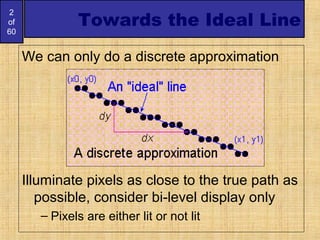
Towards the Ideal Line
We can only do a discrete approximation
Illuminate pixels as close to the true path as
possible, consider bi-level display only
– Pixels are either lit or not lit
3
of
60
What is an ideal line
Must appear straight and continuous
– Only possible axis-aligned and 45o
lines
Must interpolate both defining end points
Must have uniform density and intensity
– Consistent within a line and over all lines
– What about antialiasing?
Must be efficient, drawn quickly
– Lots of them are required!!!
UPES-Graphics
4
of
60
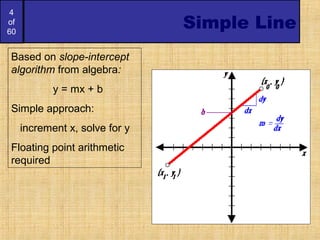
Simple Line
Based on slope-intercept
algorithm from algebra:
y = mx + b
Simple approach:
increment x, solve for y
Floating point arithmetic
required
5
of
60
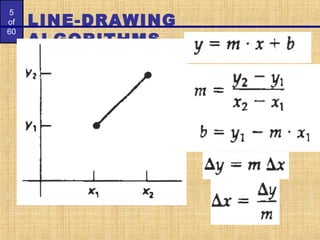
LINE-DRAWING
ALGORITHMS
6
of
60
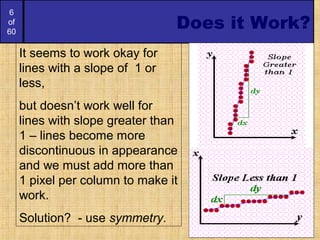
Does it Work?
It seems to work okay for
lines with a slope of 1 or
less,
but doesn’t work well for
lines with slope greater than
1 – lines become more
discontinuous in appearance
and we must add more than
1 pixel per column to make it
work.
Solution? - use symmetry.
7
of
60
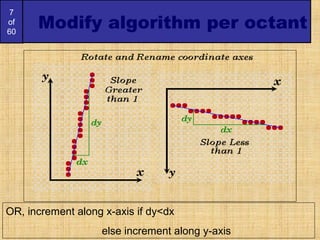
Modify algorithm per octant
OR, increment along x-axis if dy<dx
else increment along y-axis
8
of
60
DDA algorithm
DDA = Digital Differential Analyser
– finite differences
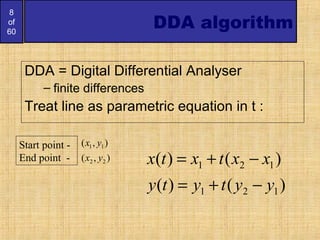
Treat line as parametric equation in t :
)()(
)()(
121
121
yytyty
xxtxtx
−+=
−+=),(
),(
22
11
yx
yxStart point -
End point -
9
of
60
DDA Algorithm
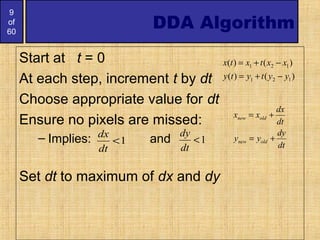
Start at t = 0
At each step, increment t by dt
Choose appropriate value for dt
Ensure no pixels are missed:
– Implies: and
Set dt to maximum of dx and dy
)()(
)()(
121
121
yytyty
xxtxtx
−+=
−+=
dt
dy
yy
dt
dx
xx
oldnew
oldnew
+=
+=
1<
dt
dx
1<
dt
dy
10
of
60
DDA Algorithm
The digital differential analyzer (DDA)
myyxm kk +=⇒=∆⇒≤< +110.10.0 myyxm kk +=⇒=∆⇒≤< +110.10.0
m
xxym kk
1
10.1 1 +=⇒=∆⇒< +
m
xxym kk
1
10.1 1 −=⇒=∆⇒>− +
myyxm kk −=⇒=∆⇒−≥> +110.10.0
Equations are based on the assumption that lines are to be processed from
the left endpoint to the right endpoint.
11
of
60
#include 'device. h"
void lineDDA (int xa, int ya, int xb, int yb)
{ int dx = xb - xa, dy = yb - ya, steps, k;
float xIncrement, yIncrement, x = xa, y = ya;
if ( abs(dx) > abs(dy) ) steps = abs (dx) ;
else steps = abs dy);
xIncrement = dx / (float) steps;
yIncrement = dy / (float) steps;
setpixel (ROUNDlxl, ROUND(y) ) :
for (k=O; k<steps; k++) {
x += xIncrment;
y += yIncrement;
setpixel (ROUND(x), ROUND(y));
DDA Algorithm
12
of
60
DDA algorithm
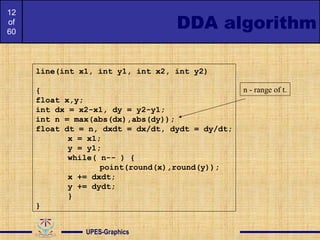
line(int x1, int y1, int x2, int y2)
{
float x,y;
int dx = x2-x1, dy = y2-y1;
int n = max(abs(dx),abs(dy));
float dt = n, dxdt = dx/dt, dydt = dy/dt;
x = x1;
y = y1;
while( n-- ) {
point(round(x),round(y));
x += dxdt;
y += dydt;
}
}
n - range of t.
UPES-Graphics
13
of
60
DDA algorithm
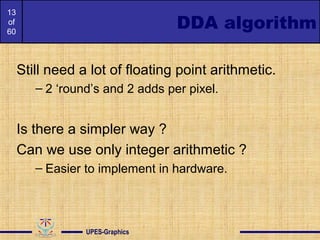
Still need a lot of floating point arithmetic.
– 2 ‘round’s and 2 adds per pixel.
Is there a simpler way ?
Can we use only integer arithmetic ?
– Easier to implement in hardware.
UPES-Graphics
14
of
60
Raster Scan System Random Scan System
Resolution It has poor or less Resolution because picture definition is
stored as a intensity value.
It has High Resolution because it stores picture definition as a
set of line commands.
Electron-Beam Electron Beam is directed from top to bottom and one row at a
time on screen, but electron beam is directed to whole screen.
Electron Beam is directed to only that part of screen where
picture is required to be drawn, one line at a time so also
called Vector Display.
Cost It is less expensive than Random Scan System. It is Costlier than Raster Scan System.
Refresh Rate Refresh rate is 60 to 80 frame per second. Refresh Rate depends on the number of lines to be displayed
i.e 30 to 60 times per second.
Picture Definition It Stores picture definition in Refresh Bufferalso
called Frame Buffer.
It Stores picture definition as a set of line
commandscalled Refresh Display File.
Line Drawing Zig – Zag line is produced because plotted value are discrete. Smooth line is produced because directly the line path is
followed by electron beam .
Realism in display It contains shadow, advance shading and hidden surface
technique so gives the realistic display of scenes.
It does not contain shadow and hidden surface technique so it
can not give realistic display of scenes.
Image Drawing It uses Pixels along scan lines for drawing an image. It is designed for line drawing applications and uses various
mathematical function to draw.
Difference Between Raster Scan ystem and Random Scan System.
15
of
60
The Bresenham Line Algorithm
The Bresenham algorithm is
another incremental scan
conversion algorithm
The big advantage of this
algorithm is that it uses only
integer calculations
Jack Bresenham
worked for 27 years at
IBM before entering
academia. Bresenham
developed his famous
algorithms at IBM in
the early 1960s
16
of
60
The Big Idea
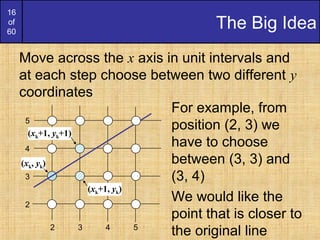
Move across the x axis in unit intervals and
at each step choose between two different y
coordinates
2 3 4 5
2
4
3
5
For example, from
position (2, 3) we
have to choose
between (3, 3) and
(3, 4)
We would like the
point that is closer to
the original line
(xk, yk)
(xk+1, yk)
(xk+1, yk+1)
17
of
60
The y coordinate on the mathematical line at
xk+1 is:
Deriving The Bresenham Line Algorithm
At sample position xk+1
the vertical separations
from the mathematical
line are labelled dupper
and dlower
bxmy k ++= )1(
y
yk
yk+1
xk+1
dlower
dupper
18
of
60
So, dupper and dlower are given as follows:
and:
We can use these to make a simple decision
about which pixel is closer to the mathematical
line
Deriving The Bresenham Line Algorithm
(cont…)
klower yyd −=
kk ybxm −++= )1(
yyd kupper −+= )1(
bxmy kk −+−+= )1(1
19
of
60
This simple decision is based on the difference
between the two pixel positions:
Let’s substitute m with ∆y/∆x where ∆x and
∆y are the differences between the end-points:
Deriving The Bresenham Line Algorithm
(cont…)
122)1(2 −+−+=− byxmdd kkupperlower
)122)1(2()( −+−+
∆
∆
∆=−∆ byx
x
y
xddx kkupperlower
)12(222 −∆+∆+⋅∆−⋅∆= bxyyxxy kk
cyxxy kk +⋅∆−⋅∆= 22
20
of
60
So, a decision parameter pk for the kth step
along a line is given by:
The sign of the decision parameter pk is the
same as that of dlower – dupper
If pk is negative, then we choose the lower
pixel, otherwise we choose the upper pixel
Deriving The Bresenham Line Algorithm
(cont…)
cyxxy
ddxp
kk
upperlowerk
+⋅∆−⋅∆=
−∆=
22
)(
21
of
60
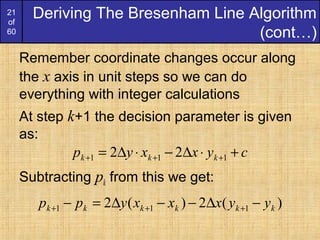
Remember coordinate changes occur along
the x axis in unit steps so we can do
everything with integer calculations
At step k+1 the decision parameter is given
as:
Subtracting pk from this we get:
Deriving The Bresenham Line Algorithm
(cont…)
cyxxyp kkk +⋅∆−⋅∆= +++ 111 22
)(2)(2 111 kkkkkk yyxxxypp −∆−−∆=− +++
22
of
60
But, xk+1 is the same as xk+1 so:
where yk+1 - yk is either 0 or 1 depending on
the sign of pk
The first decision parameter p0 is evaluated
at (x0, y0) is given as:
Deriving The Bresenham Line Algorithm
(cont…)
)(22 11 kkkk yyxypp −∆−∆+= ++
xyp ∆−∆= 20
23
of
60
The Bresenham Line Algorithm
BRESENHAM’S LINE DRAWING ALGORITHM
(for |m| < 1.0)
1. Input the two line end-points, storing the left end-point
in (x0, y0)
2. Plot the point (x0, y0)
3. Calculate the constants Δx, Δy, 2Δy, and (2Δy - 2Δx)
and get the first value for the decision parameter as:
4. At each xk along the line, starting at k = 0, perform the
following test. If pk < 0, the next point to plot is
(xk+1, yk) and:
xyp ∆−∆= 20
ypp kk ∆+=+ 21
24
of
60
The Bresenham Line Algorithm (cont…)
ACHTUNG! The algorithm and derivation
above assumes slopes are less than 1. for
other slopes we need to adjust the algorithm
slightly
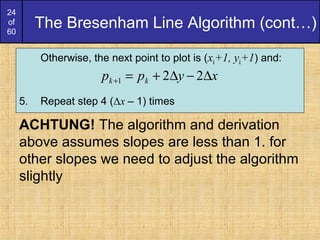
Otherwise, the next point to plot is (xk+1, yk+1) and:
5. Repeat step 4 (Δx – 1) times
xypp kk ∆−∆+=+ 221
25
of
60
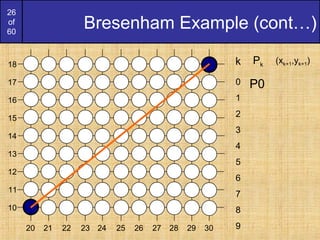
Bresenham Example
Let’s have a go at this
Let’s plot the line from (20, 10) to (30, 18)
First off calculate all of the constants:
– Δx: 10
– Δy: 8
– 2Δy: 16
– 2Δy - 2Δx: -4
Calculate the initial decision parameter p0:
– p0 = 2Δy – Δx = 6
26
of
60
Bresenham Example (cont…)
17
16
15
14
13
12
11
10
18
292726252423222120 28 30
k Pk
(xk+1,yk+1)
0
1
2
3
4
5
6
7
8
9
P0
27
of
60
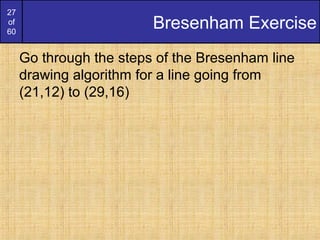
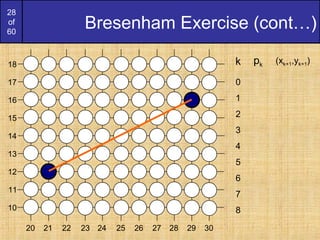
Bresenham Exercise
Go through the steps of the Bresenham line
drawing algorithm for a line going from
(21,12) to (29,16)
28
of
60
Bresenham Exercise (cont…)
17
16
15
14
13
12
11
10
18
292726252423222120 28 30
k pk
(xk+1,yk+1)
0
1
2
3
4
5
6
7
8
29
of
60
Bresenham Line Algorithm Summary
The Bresenham line algorithm has the
following advantages:
– An fast incremental algorithm
– Uses only integer calculations
Comparing this to the DDA algorithm, DDA
has the following problems:
– Accumulation of round-off errors can make
the pixelated line drift away from what was
intended
– The rounding operations and floating point
arithmetic involved are time consuming
30
of
60
A Simple Circle Drawing Algorithm
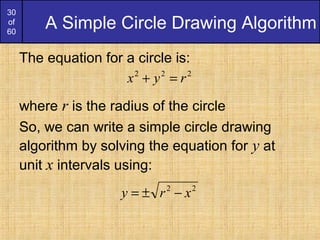
The equation for a circle is:
where r is the radius of the circle
So, we can write a simple circle drawing
algorithm by solving the equation for y at
unit x intervals using:
222
ryx =+
22
xry −±=
31
of
60
A Simple Circle Drawing Algorithm
(cont…)
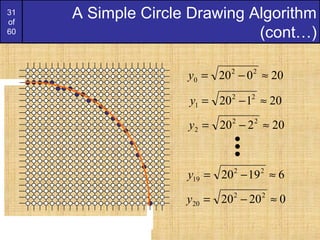
20020 22
0 ≈−=y
20120 22
1 ≈−=y
20220 22
2 ≈−=y
61920 22
19 ≈−=y
02020 22
20 ≈−=y
32
of
60
A Simple Circle Drawing Algorithm
(cont…)
However, unsurprisingly this is not a brilliant
solution!
Firstly, the resulting circle has large gaps
where the slope approaches the vertical
Secondly, the calculations are not very
efficient
– The square (multiply) operations
– The square root operation – try really hard to
avoid these!
We need a more efficient, more accurate
solution
33
of
60
Eight-Way Symmetry
The first thing we can notice to make our circle
drawing algorithm more efficient is that circles
centred at (0, 0) have eight-way symmetry
(x, y)
(y, x)
(y, -x)
(x, -y)(-x, -y)
(-y, -x)
(-y, x)
(-x, y)
2
R
34
of
60
Mid-Point Circle Algorithm
Similarly to the case with lines,
there is an incremental
algorithm for drawing circles –
the mid-point circle algorithm
In the mid-point circle algorithm
we use eight-way symmetry so
only ever calculate the points
for the top right eighth of a
circle, and then use symmetry
to get the rest of the points
The mid-point circle
algorithm was
developed by Jack
Bresenham, who we
heard about earlier.
Bresenham’s patent
for the algorithm can
be viewed here.
35
of
60
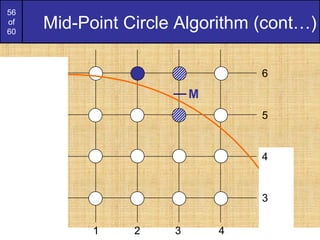
Mid-Point Circle Algorithm (cont…)
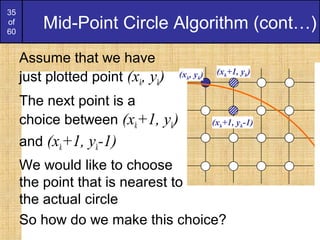
(xk+1, yk)
(xk+1, yk-1)
(xk, yk)
Assume that we have
just plotted point (xk, yk)
The next point is a
choice between (xk+1, yk)
and (xk+1, yk-1)
We would like to choose
the point that is nearest to
the actual circle
So how do we make this choice?
36
of
60
Mid-Point Circle Algorithm (cont…)
the equation of the circle slightly to give us:
The equation evaluates as follows:
By evaluating this function at the midpoint
between the candidate pixels we can make
our decision
222
),( ryxyxfcirc −+=





>
=
<
,0
,0
,0
),( yxfcirc
boundarycircletheinsideis),(if yx
boundarycircleon theis),(if yx
boundarycircletheoutsideis),(if yx
37
of
60
Mid-Point Circle Algorithm (cont…)
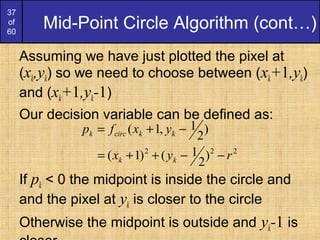
Assuming we have just plotted the pixel at
(xk,yk) so we need to choose between (xk+1,yk)
and (xk+1,yk-1)
Our decision variable can be defined as:
If pk < 0 the midpoint is inside the circle and
and the pixel at yk is closer to the circle
Otherwise the midpoint is outside and yk-1 is
222
)
2
1()1(
)
2
1,1(
ryx
yxfp
kk
kkcirck
−−++=
−+=
38
of
60
Mid-Point Circle Algorithm (cont…)
To ensure things are as efficient as possible
we can do all of our calculations
incrementally
First consider:
or:
where yk+1 is either yk or yk-1 depending on
the sign of p
( )
( ) 2
2
1
2
111
2
1]1)1[(
2
1,1
ryx
yxfp
kk
kkcirck
−−+++=
−+=
+
+++
1)()()1(2 1
22
11 +−−−+++= +++ kkkkkkk yyyyxpp
39
of
60
Mid-Point Circle Algorithm (cont…)
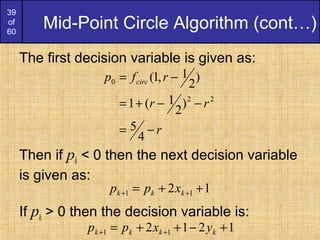
The first decision variable is given as:
Then if pk < 0 then the next decision variable
is given as:
If pk > 0 then the decision variable is:
r
rr
rfp circ
−=
−−+=
−=
4
5
)
2
1(1
)
2
1,1(
22
0
12 11 ++= ++ kkk xpp
1212 11 +−++= ++ kkkk yxpp
40
of
60
The Mid-Point Circle Algorithm
MID-POINT CIRCLE ALGORITHM
• Input radius r and circle centre (xc, yc), then set the
coordinates for the first point on the circumference of a
circle centred on the origin as:
• Calculate the initial value of the decision parameter as:
• Starting with k = 0 at each position xk, perform the
following test. If pk< 0, the next point along the circle
centred on (0, 0) is (xk+1, yk) and:
),0(),( 00 ryx =
rp −=
4
5
0
12 11 ++= ++ kkk xpp
41
of
60
The Mid-Point Circle Algorithm (cont…)
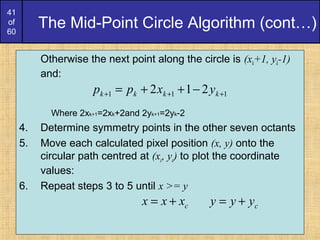
Otherwise the next point along the circle is (xk+1, yk-1)
and:
Where 2xk+1=2xk+2and 2yk+1=2yk-2
4. Determine symmetry points in the other seven octants
5. Move each calculated pixel position (x, y) onto the
circular path centred at (xc, yc) to plot the coordinate
values:
6. Repeat steps 3 to 5 until x >= y
111 212 +++ −++= kkkk yxpp
cxxx += cyyy +=
42
of
60
Mid-Point Circle Algorithm Example
To see the mid-point circle algorithm in
action lets use it to draw a circle centred at
(0,0) with radius 10
43
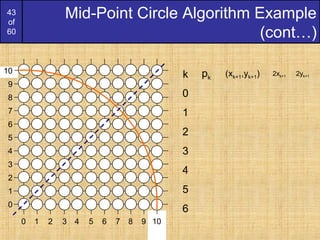
of
60
Mid-Point Circle Algorithm Example
(cont…)
9
7
6
5
4
3
2
1
0
8
976543210 8 10
10
k pk
(xk+1,yk+1) 2xk+1 2yk+1
0
1
2
3
4
5
6
44
of
60
Mid-Point Circle Algorithm Exercise
Use the mid-point circle algorithm to draw
the circle centred at (0,0) with radius 15
45
of
60
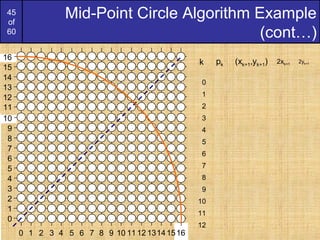
Mid-Point Circle Algorithm Example
(cont…)
k pk (xk+1,yk+1) 2xk+1
2yk+1
0
1
2
3
4
5
6
7
8
9
10
11
12
9
7
6
5
4
3
2
1
0
8
976543210 8 10
10
131211 14
15
13
12
14
11
16
1516
46
of
60
Mid-Point Circle Algorithm Summary
The key insights in the mid-point circle
algorithm are:
– Eight-way symmetry can hugely reduce the
work in drawing a circle
– Moving in unit steps along the x axis at each
point along the circle’s edge we need to
choose between two possible y coordinates
47
of
60
Filling Polygons
So we can figure out how to draw lines and
circles
How do we go about drawing polygons?
We use an incremental algorithm known as
the scan-line algorithm
48
of
60
Scan-Line Polygon Fill Algorithm
2
4
6
8
10 Scan Line
0
2 4 6 8 10 12 14 16
49
of
60
Scan-Line Polygon Fill Algorithm
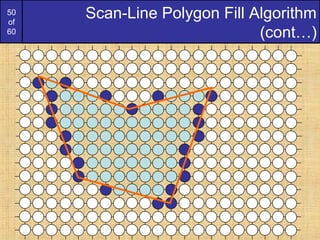
The basic scan-line algorithm is as follows:
– Find the intersections of the scan line with all
edges of the polygon
– Sort the intersections by increasing x
coordinate
– Fill in all pixels between pairs of intersections
that lie interior to the polygon
50
of
60
Scan-Line Polygon Fill Algorithm
(cont…)
51
of
60
Line Drawing Summary
Over the last couple of lectures we have
looked at the idea of scan converting lines
The key thing to remember is this has to be
FAST
For lines we have either DDA or Bresenham
For circles the mid-point algorithm
52
of
60
Anti-Aliasing
53
of
60
Summary Of Drawing Algorithms
54
of
60
Mid-Point Circle Algorithm (cont…)
6
2 3 41
5
4
3
55
of
60
Mid-Point Circle Algorithm (cont…)
M
6
2 3 41
5
4
3
56
of
60
Mid-Point Circle Algorithm (cont…)
M
6
2 3 41
5
4
3
57
of
60
Blank Grid
58
of
60
Blank Grid
59
of
60
Blank Grid
9
7
6
5
4
3
2
1
0
8
976543210 8 10
10
60
of
60
Blank Grid

Bresenham circles and polygons derication

  • 1.
    2 of 60 Towards the IdealLine We can only do a discrete approximation Illuminate pixels as close to the true path as possible, consider bi-level display only – Pixels are either lit or not lit
  • 2.
    3 of 60 What is anideal line Must appear straight and continuous – Only possible axis-aligned and 45o lines Must interpolate both defining end points Must have uniform density and intensity – Consistent within a line and over all lines – What about antialiasing? Must be efficient, drawn quickly – Lots of them are required!!! UPES-Graphics
  • 3.
    4 of 60 Simple Line Based onslope-intercept algorithm from algebra: y = mx + b Simple approach: increment x, solve for y Floating point arithmetic required
  • 4.
  • 5.
    6 of 60 Does it Work? Itseems to work okay for lines with a slope of 1 or less, but doesn’t work well for lines with slope greater than 1 – lines become more discontinuous in appearance and we must add more than 1 pixel per column to make it work. Solution? - use symmetry.
  • 6.
    7 of 60 Modify algorithm peroctant OR, increment along x-axis if dy<dx else increment along y-axis
  • 7.
    8 of 60 DDA algorithm DDA =Digital Differential Analyser – finite differences Treat line as parametric equation in t : )()( )()( 121 121 yytyty xxtxtx −+= −+=),( ),( 22 11 yx yxStart point - End point -
  • 8.
    9 of 60 DDA Algorithm Start att = 0 At each step, increment t by dt Choose appropriate value for dt Ensure no pixels are missed: – Implies: and Set dt to maximum of dx and dy )()( )()( 121 121 yytyty xxtxtx −+= −+= dt dy yy dt dx xx oldnew oldnew += += 1< dt dx 1< dt dy
  • 9.
    10 of 60 DDA Algorithm The digitaldifferential analyzer (DDA) myyxm kk +=⇒=∆⇒≤< +110.10.0 myyxm kk +=⇒=∆⇒≤< +110.10.0 m xxym kk 1 10.1 1 +=⇒=∆⇒< + m xxym kk 1 10.1 1 −=⇒=∆⇒>− + myyxm kk −=⇒=∆⇒−≥> +110.10.0 Equations are based on the assumption that lines are to be processed from the left endpoint to the right endpoint.
  • 10.
    11 of 60 #include 'device. h" voidlineDDA (int xa, int ya, int xb, int yb) { int dx = xb - xa, dy = yb - ya, steps, k; float xIncrement, yIncrement, x = xa, y = ya; if ( abs(dx) > abs(dy) ) steps = abs (dx) ; else steps = abs dy); xIncrement = dx / (float) steps; yIncrement = dy / (float) steps; setpixel (ROUNDlxl, ROUND(y) ) : for (k=O; k<steps; k++) { x += xIncrment; y += yIncrement; setpixel (ROUND(x), ROUND(y)); DDA Algorithm
  • 11.
    12 of 60 DDA algorithm line(int x1,int y1, int x2, int y2) { float x,y; int dx = x2-x1, dy = y2-y1; int n = max(abs(dx),abs(dy)); float dt = n, dxdt = dx/dt, dydt = dy/dt; x = x1; y = y1; while( n-- ) { point(round(x),round(y)); x += dxdt; y += dydt; } } n - range of t. UPES-Graphics
  • 12.
    13 of 60 DDA algorithm Still needa lot of floating point arithmetic. – 2 ‘round’s and 2 adds per pixel. Is there a simpler way ? Can we use only integer arithmetic ? – Easier to implement in hardware. UPES-Graphics
  • 13.
    14 of 60 Raster Scan SystemRandom Scan System Resolution It has poor or less Resolution because picture definition is stored as a intensity value. It has High Resolution because it stores picture definition as a set of line commands. Electron-Beam Electron Beam is directed from top to bottom and one row at a time on screen, but electron beam is directed to whole screen. Electron Beam is directed to only that part of screen where picture is required to be drawn, one line at a time so also called Vector Display. Cost It is less expensive than Random Scan System. It is Costlier than Raster Scan System. Refresh Rate Refresh rate is 60 to 80 frame per second. Refresh Rate depends on the number of lines to be displayed i.e 30 to 60 times per second. Picture Definition It Stores picture definition in Refresh Bufferalso called Frame Buffer. It Stores picture definition as a set of line commandscalled Refresh Display File. Line Drawing Zig – Zag line is produced because plotted value are discrete. Smooth line is produced because directly the line path is followed by electron beam . Realism in display It contains shadow, advance shading and hidden surface technique so gives the realistic display of scenes. It does not contain shadow and hidden surface technique so it can not give realistic display of scenes. Image Drawing It uses Pixels along scan lines for drawing an image. It is designed for line drawing applications and uses various mathematical function to draw. Difference Between Raster Scan ystem and Random Scan System.
  • 14.
    15 of 60 The Bresenham LineAlgorithm The Bresenham algorithm is another incremental scan conversion algorithm The big advantage of this algorithm is that it uses only integer calculations Jack Bresenham worked for 27 years at IBM before entering academia. Bresenham developed his famous algorithms at IBM in the early 1960s
  • 15.
    16 of 60 The Big Idea Moveacross the x axis in unit intervals and at each step choose between two different y coordinates 2 3 4 5 2 4 3 5 For example, from position (2, 3) we have to choose between (3, 3) and (3, 4) We would like the point that is closer to the original line (xk, yk) (xk+1, yk) (xk+1, yk+1)
  • 16.
    17 of 60 The y coordinateon the mathematical line at xk+1 is: Deriving The Bresenham Line Algorithm At sample position xk+1 the vertical separations from the mathematical line are labelled dupper and dlower bxmy k ++= )1( y yk yk+1 xk+1 dlower dupper
  • 17.
    18 of 60 So, dupper anddlower are given as follows: and: We can use these to make a simple decision about which pixel is closer to the mathematical line Deriving The Bresenham Line Algorithm (cont…) klower yyd −= kk ybxm −++= )1( yyd kupper −+= )1( bxmy kk −+−+= )1(1
  • 18.
    19 of 60 This simple decisionis based on the difference between the two pixel positions: Let’s substitute m with ∆y/∆x where ∆x and ∆y are the differences between the end-points: Deriving The Bresenham Line Algorithm (cont…) 122)1(2 −+−+=− byxmdd kkupperlower )122)1(2()( −+−+ ∆ ∆ ∆=−∆ byx x y xddx kkupperlower )12(222 −∆+∆+⋅∆−⋅∆= bxyyxxy kk cyxxy kk +⋅∆−⋅∆= 22
  • 19.
    20 of 60 So, a decisionparameter pk for the kth step along a line is given by: The sign of the decision parameter pk is the same as that of dlower – dupper If pk is negative, then we choose the lower pixel, otherwise we choose the upper pixel Deriving The Bresenham Line Algorithm (cont…) cyxxy ddxp kk upperlowerk +⋅∆−⋅∆= −∆= 22 )(
  • 20.
    21 of 60 Remember coordinate changesoccur along the x axis in unit steps so we can do everything with integer calculations At step k+1 the decision parameter is given as: Subtracting pk from this we get: Deriving The Bresenham Line Algorithm (cont…) cyxxyp kkk +⋅∆−⋅∆= +++ 111 22 )(2)(2 111 kkkkkk yyxxxypp −∆−−∆=− +++
  • 21.
    22 of 60 But, xk+1 isthe same as xk+1 so: where yk+1 - yk is either 0 or 1 depending on the sign of pk The first decision parameter p0 is evaluated at (x0, y0) is given as: Deriving The Bresenham Line Algorithm (cont…) )(22 11 kkkk yyxypp −∆−∆+= ++ xyp ∆−∆= 20
  • 22.
    23 of 60 The Bresenham LineAlgorithm BRESENHAM’S LINE DRAWING ALGORITHM (for |m| < 1.0) 1. Input the two line end-points, storing the left end-point in (x0, y0) 2. Plot the point (x0, y0) 3. Calculate the constants Δx, Δy, 2Δy, and (2Δy - 2Δx) and get the first value for the decision parameter as: 4. At each xk along the line, starting at k = 0, perform the following test. If pk < 0, the next point to plot is (xk+1, yk) and: xyp ∆−∆= 20 ypp kk ∆+=+ 21
  • 23.
    24 of 60 The Bresenham LineAlgorithm (cont…) ACHTUNG! The algorithm and derivation above assumes slopes are less than 1. for other slopes we need to adjust the algorithm slightly Otherwise, the next point to plot is (xk+1, yk+1) and: 5. Repeat step 4 (Δx – 1) times xypp kk ∆−∆+=+ 221
  • 24.
    25 of 60 Bresenham Example Let’s havea go at this Let’s plot the line from (20, 10) to (30, 18) First off calculate all of the constants: – Δx: 10 – Δy: 8 – 2Δy: 16 – 2Δy - 2Δx: -4 Calculate the initial decision parameter p0: – p0 = 2Δy – Δx = 6
  • 25.
  • 26.
    27 of 60 Bresenham Exercise Go throughthe steps of the Bresenham line drawing algorithm for a line going from (21,12) to (29,16)
  • 27.
  • 28.
    29 of 60 Bresenham Line AlgorithmSummary The Bresenham line algorithm has the following advantages: – An fast incremental algorithm – Uses only integer calculations Comparing this to the DDA algorithm, DDA has the following problems: – Accumulation of round-off errors can make the pixelated line drift away from what was intended – The rounding operations and floating point arithmetic involved are time consuming
  • 29.
    30 of 60 A Simple CircleDrawing Algorithm The equation for a circle is: where r is the radius of the circle So, we can write a simple circle drawing algorithm by solving the equation for y at unit x intervals using: 222 ryx =+ 22 xry −±=
  • 30.
    31 of 60 A Simple CircleDrawing Algorithm (cont…) 20020 22 0 ≈−=y 20120 22 1 ≈−=y 20220 22 2 ≈−=y 61920 22 19 ≈−=y 02020 22 20 ≈−=y
  • 31.
    32 of 60 A Simple CircleDrawing Algorithm (cont…) However, unsurprisingly this is not a brilliant solution! Firstly, the resulting circle has large gaps where the slope approaches the vertical Secondly, the calculations are not very efficient – The square (multiply) operations – The square root operation – try really hard to avoid these! We need a more efficient, more accurate solution
  • 32.
    33 of 60 Eight-Way Symmetry The firstthing we can notice to make our circle drawing algorithm more efficient is that circles centred at (0, 0) have eight-way symmetry (x, y) (y, x) (y, -x) (x, -y)(-x, -y) (-y, -x) (-y, x) (-x, y) 2 R
  • 33.
    34 of 60 Mid-Point Circle Algorithm Similarlyto the case with lines, there is an incremental algorithm for drawing circles – the mid-point circle algorithm In the mid-point circle algorithm we use eight-way symmetry so only ever calculate the points for the top right eighth of a circle, and then use symmetry to get the rest of the points The mid-point circle algorithm was developed by Jack Bresenham, who we heard about earlier. Bresenham’s patent for the algorithm can be viewed here.
  • 34.
    35 of 60 Mid-Point Circle Algorithm(cont…) (xk+1, yk) (xk+1, yk-1) (xk, yk) Assume that we have just plotted point (xk, yk) The next point is a choice between (xk+1, yk) and (xk+1, yk-1) We would like to choose the point that is nearest to the actual circle So how do we make this choice?
  • 35.
    36 of 60 Mid-Point Circle Algorithm(cont…) the equation of the circle slightly to give us: The equation evaluates as follows: By evaluating this function at the midpoint between the candidate pixels we can make our decision 222 ),( ryxyxfcirc −+=      > = < ,0 ,0 ,0 ),( yxfcirc boundarycircletheinsideis),(if yx boundarycircleon theis),(if yx boundarycircletheoutsideis),(if yx
  • 36.
    37 of 60 Mid-Point Circle Algorithm(cont…) Assuming we have just plotted the pixel at (xk,yk) so we need to choose between (xk+1,yk) and (xk+1,yk-1) Our decision variable can be defined as: If pk < 0 the midpoint is inside the circle and and the pixel at yk is closer to the circle Otherwise the midpoint is outside and yk-1 is 222 ) 2 1()1( ) 2 1,1( ryx yxfp kk kkcirck −−++= −+=
  • 37.
    38 of 60 Mid-Point Circle Algorithm(cont…) To ensure things are as efficient as possible we can do all of our calculations incrementally First consider: or: where yk+1 is either yk or yk-1 depending on the sign of p ( ) ( ) 2 2 1 2 111 2 1]1)1[( 2 1,1 ryx yxfp kk kkcirck −−+++= −+= + +++ 1)()()1(2 1 22 11 +−−−+++= +++ kkkkkkk yyyyxpp
  • 38.
    39 of 60 Mid-Point Circle Algorithm(cont…) The first decision variable is given as: Then if pk < 0 then the next decision variable is given as: If pk > 0 then the decision variable is: r rr rfp circ −= −−+= −= 4 5 ) 2 1(1 ) 2 1,1( 22 0 12 11 ++= ++ kkk xpp 1212 11 +−++= ++ kkkk yxpp
  • 39.
    40 of 60 The Mid-Point CircleAlgorithm MID-POINT CIRCLE ALGORITHM • Input radius r and circle centre (xc, yc), then set the coordinates for the first point on the circumference of a circle centred on the origin as: • Calculate the initial value of the decision parameter as: • Starting with k = 0 at each position xk, perform the following test. If pk< 0, the next point along the circle centred on (0, 0) is (xk+1, yk) and: ),0(),( 00 ryx = rp −= 4 5 0 12 11 ++= ++ kkk xpp
  • 40.
    41 of 60 The Mid-Point CircleAlgorithm (cont…) Otherwise the next point along the circle is (xk+1, yk-1) and: Where 2xk+1=2xk+2and 2yk+1=2yk-2 4. Determine symmetry points in the other seven octants 5. Move each calculated pixel position (x, y) onto the circular path centred at (xc, yc) to plot the coordinate values: 6. Repeat steps 3 to 5 until x >= y 111 212 +++ −++= kkkk yxpp cxxx += cyyy +=
  • 41.
    42 of 60 Mid-Point Circle AlgorithmExample To see the mid-point circle algorithm in action lets use it to draw a circle centred at (0,0) with radius 10
  • 42.
    43 of 60 Mid-Point Circle AlgorithmExample (cont…) 9 7 6 5 4 3 2 1 0 8 976543210 8 10 10 k pk (xk+1,yk+1) 2xk+1 2yk+1 0 1 2 3 4 5 6
  • 43.
    44 of 60 Mid-Point Circle AlgorithmExercise Use the mid-point circle algorithm to draw the circle centred at (0,0) with radius 15
  • 44.
    45 of 60 Mid-Point Circle AlgorithmExample (cont…) k pk (xk+1,yk+1) 2xk+1 2yk+1 0 1 2 3 4 5 6 7 8 9 10 11 12 9 7 6 5 4 3 2 1 0 8 976543210 8 10 10 131211 14 15 13 12 14 11 16 1516
  • 45.
    46 of 60 Mid-Point Circle AlgorithmSummary The key insights in the mid-point circle algorithm are: – Eight-way symmetry can hugely reduce the work in drawing a circle – Moving in unit steps along the x axis at each point along the circle’s edge we need to choose between two possible y coordinates
  • 46.
    47 of 60 Filling Polygons So wecan figure out how to draw lines and circles How do we go about drawing polygons? We use an incremental algorithm known as the scan-line algorithm
  • 47.
    48 of 60 Scan-Line Polygon FillAlgorithm 2 4 6 8 10 Scan Line 0 2 4 6 8 10 12 14 16
  • 48.
    49 of 60 Scan-Line Polygon FillAlgorithm The basic scan-line algorithm is as follows: – Find the intersections of the scan line with all edges of the polygon – Sort the intersections by increasing x coordinate – Fill in all pixels between pairs of intersections that lie interior to the polygon
  • 49.
  • 50.
    51 of 60 Line Drawing Summary Overthe last couple of lectures we have looked at the idea of scan converting lines The key thing to remember is this has to be FAST For lines we have either DDA or Bresenham For circles the mid-point algorithm
  • 51.
  • 52.
  • 53.
    54 of 60 Mid-Point Circle Algorithm(cont…) 6 2 3 41 5 4 3
  • 54.
    55 of 60 Mid-Point Circle Algorithm(cont…) M 6 2 3 41 5 4 3
  • 55.
    56 of 60 Mid-Point Circle Algorithm(cont…) M 6 2 3 41 5 4 3
  • 56.
  • 57.
  • 58.
  • 59.

Editor's Notes

  • #9 Important algorithm.