Chapter 2
COORDINATE SYSTEMS
AND TRANSFORMATION
Education makes a people easy to lead, but difficult to drive; easy to govern but
impossible to enslave.
—HENRY P. BROUGHAM
2.1 INTRODUCTION
In general, the physical quantities we shall be dealing with in EM are functions of space
and time. In order to describe the spatial variations of the quantities, we must be able to
define all points uniquely in space in a suitable manner. This requires using an appropriate
coordinate system.
A point or vector can be represented in any curvilinear coordinate system, which may
be orthogonal or nonorthogonal.
An orthogonal system is one in which the coordinates arc mutually perpendicular.
Nonorthogonal systems are hard to work with and they are of little or no practical use.
Examples of orthogonal coordinate systems include the Cartesian (or rectangular), the cir-
cular cylindrical, the spherical, the elliptic cylindrical, the parabolic cylindrical, the
conical, the prolate spheroidal, the oblate spheroidal, and the ellipsoidal.1
A considerable
amount of work and time may be saved by choosing a coordinate system that best fits a
given problem. A hard problem in one coordi nate system may turn out to be easy in
another system.
In this text, we shall restrict ourselves to the three best-known coordinate systems: the
Cartesian, the circular cylindrical, and the spherical. Although we have considered the
Cartesian system in Chapter 1, we shall consider it in detail in this chapter. We should bear
in mind that the concepts covered in Chapter 1 and demonstrated in Cartesian coordinates
are equally applicable to other systems of coordinates. For example, the procedure for
'For an introductory treatment of these coordinate systems, see M. R. Spigel, Mathematical Hand-
book ofFormulas and Tables. New York: McGraw-Hill, 1968, pp. 124-130.
28
2.3 CIRCULAR CYLINDRICAL COORDINATES (R, F, Z) 29
finding dot or cross product of two vectors in a cylindrical system is the same as that used
in the Cartesian system in Chapter 1.
Sometimes, it is necessary to transform points and vectors from one coordinate system
to another. The techniques for doing this will be presented and illustrated with examples.
2.2 CARTESIAN COORDINATES (X, Y, Z)
As mentioned in Chapter 1, a point P can be represented as (x, y, z) as illustrated in
Figure 1.1. The ranges of the coordinate variables x, y, and z are
-00 < X < 00
-00<-y<o> (2.1)
— 00 < I < 00
A vector A in Cartesian (otherwise known as rectangular) coordinates can be written as
(Ax,Ay,AJ or A A + Ayay + Azaz (2.2)
where ax, ay, and az are unit vectors along the x-, y-, and z-directions as shown in
Figure 1.1.
2.3 CIRCULAR CYLINDRICAL COORDINATES (p, cj>, z)
The circular cylindrical coordinate system is very convenient whenever we are dealing
with problems having cylindrical symmetry.
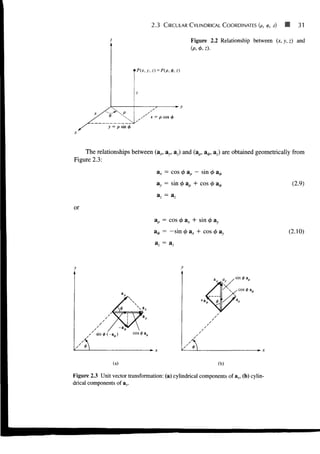
A point P in cylindrical coordinates is represented as (p, <j>, z) and is as shown in
Figure 2.1. Observe Figure 2.1 closely and note how we define each space variable: p is the
radius of the cylinder passing through P or the radial distance from the z-axis: <f>, called the
Figure 2.1 Point P and unit vectors in the cylindrical
coordinate system.
30 Coordinate Systems and Transformation
azimuthal angle, is measured from the x-axis in the xy-plane; and z is the same as in the
Cartesian system. The ranges of the variables are
0 < p < °°
0 < <
/
> < 27T
-00 < Z < 00
A vector A in cylindrical coordinates can be written as
(2.3)
(Ap, A^,, Az) or Apap (2.4)
where ap> a^, and az are unit vectors in the p-, <£-, and ^-directions as illustrated in
Figure 2.1. Note that a^ is not in degrees; it assumes the unit vector of A. For example, if a
force of 10 N acts on a particle in a circular motion, the force may be represented as
F = lOa^, N. In this case, a0 is in newtons.
The magnitude of A is
= (Al
p
,2x1/2 (2.5)
Notice that the unit vectors ap, a^, and az are mutually perpendicular because our co-
ordinate system is orthogonal; ap points in the direction of increasing p, a$ in the direction
of increasing 0, and az in the positive z-direction. Thus,
a^ = az • az = 1
a = a7 • a = 0
np X a<j> = a ,
a^ X az = a,
az X ap = a*
(2.6a)
(2.6b)
(2.6c)
(2.6d)
(2.6e)
where eqs. (2.6c) to (2.6e) are obtained in cyclic permutation (see Figure 1.9).
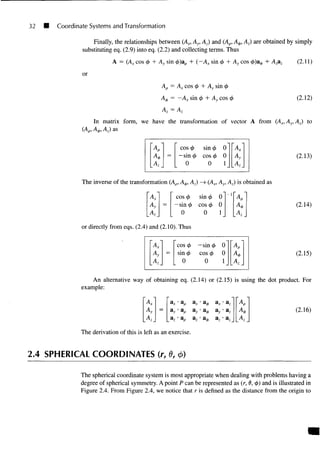
The relationships between the variables (x, y, z) of the Cartesian coordinate system
and those of the cylindrical system (p, <j>, z) are easily obtained from Figure 2.2 as
cj) = tan"1
-,
x z (2.7)
or
x = p cos 0, y = p sin <(>, z = z (2.8)
Whereas eq. (2.7) is for transforming a point from Cartesian (x, y, z) to cylindrical (p, <$>, z)
coordinates, eq. (2.8) is for (p, 4>, z) —»(x, y, z) transformation.
2.3 CIRCULAR CYLINDRICAL COORDINATES (p, 0, z) 11 31
Figure 2.2 Relationship between (x, y, z) and
(P, *. z).
The relationships between (ax, ay, az) and (ap, a^, a2) are obtained geometrically from
Figure 2.3:
or
= cos 0 ap - sin
ap = cos (j>ax + sin
= -sin
= a7
cos
(b)
Figure 2.3 Unit vector transformation: (a) cylindrical components of ax, (b) cylin-
drical components of a r
(2.9)
(2.10)
32 Coordinate Systems and Transformation
Finally, the relationships between (Ax, Ay, Az) and (Ap, A0, Az) are obtained by simply
substituting eq. (2.9) into eq. (2.2) and collecting terms. Thus
A = (Ax cos <j> + Ay sin <j>)ap + (~AX sin <j> + Ay cos 0)a0 + Azaz (2.
or
Ap = Ax cos <t> + Ay sin <f>
A,/, = ~AX sin <f> + Ay cos tj> (2.12)
In matrix form, we have the transformation of vector A from (Ax,Ay,Az) to
(Ap, A0, A,) as
(2.13)
A,
Az
=
cos <
/
> sin 0 0
— sin<j> cos 0 0
0 0 1
Ax
Ay
Az
The inverse of the transformation (Ap, A^, Az) —
> (Ax, Ay, Az) is obtained as
Ax cos <t> sin $ 0
-sin^> cos ^ 0
0 0 1 A,
(2.14)
or directly from eqs. (2.4) and (2.10). Thus
cos </> — sin 4> 0
sin <j> cos <j> 0
0 0 1
V
A.
(2.15)
An alternative way of obtaining eq. (2.14) or (2.15) is using the dot product. For
example:
(2.16)
"A/
Ay
Az
=
a ^ a p
az- ap
a ^ a 0
a y a 0
a z a 0
*x
az
• az
• az
•az
A
A
A
The derivation of this is left as an exercise.
2.4 SPHERICAL COORDINATES (r, 0, (/>)
The spherical coordinate system is most appropriate when dealing with problems having a
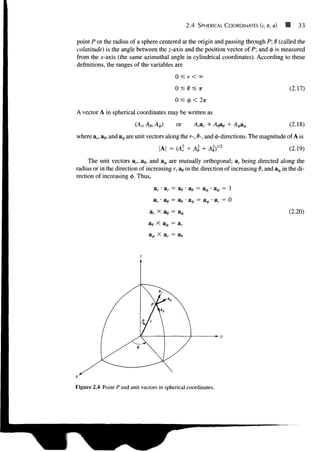
degree of spherical symmetry. A point P can be represented as (r, 6, 4>) and is illustrated in
Figure 2.4. From Figure 2.4, we notice that r is defined as the distance from the origin to
2.4 SPHERICAL COORDINATES (r, e, 33
point P or the radius of a sphere centered at the origin and passing through P; 6 (called the
colatitude) is the angle between the z-axis and the position vector of P; and 4> is measured
from the x-axis (the same azimuthal angle in cylindrical coordinates). According to these
definitions, the ranges of the variables are
O < 0 < i r (2.17)
0 < <f> < 2TT
A vector A in spherical coordinates may be written as
(Ar,Ae,A^) or A&r + Agae + A^ (2.18)
where an ae, and 3A are unit vectors along the r-, B-, and ^-directions. The magnitude of A is
|A| = (A2
r +A2
e+ Aj)112
(2.19)
The unit vectors an a^, and a^ are mutually orthogonal; ar being directed along the
radius or in the direction of increasing r, ae in the direction of increasing 6, and a0 in the di-
rection of increasing <f>. Thus,
ar • ar = ae •
ar • ae = ae •;
ar x ae = a^
ae X a^, = ar
a0 X ar = a9
ar = 0
(2.20)
Figure 2.4 Point P and unit vectors in spherical coordinates.
34 • Coordinate Systems and Transformation
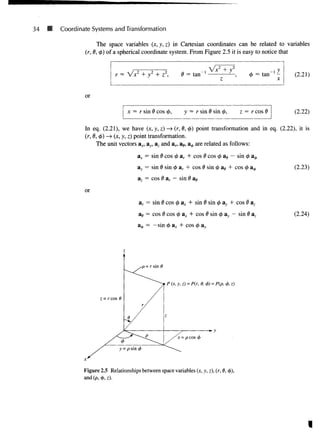
The space variables (x, y, z) in Cartesian coordinates can be related to variables
(r, 0, <p) of a spherical coordinate system. From Figure 2.5 it is easy to notice that
= Vx2
-
,/- HZ2
, 0 = tan '
z
or
x = r sin 0 cos 0, y = r sin 0 sin </>, z = r cos I
(2.21)
(2.22)
In eq. (2.21), we have (x, y, z) —
> (r, 0, #) point transformation and in eq. (2.22), it is
(r, 6, 4>) —»(x, y, z) point transformation.
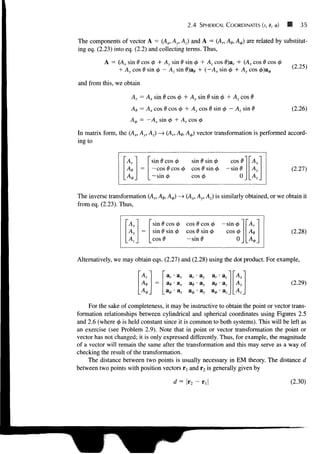
The unit vectors ax, ay, a2 and ar, ae, a^ are related as follows:
or
ax = sin 0 cos 4> ar + cos 0 cos <
£ as - sin
83, = sin 6 sin <
£ ar + cos 6 sin 0 ae + cos <j
az = cos 6 ar — sin 0 as
ar = sin 0 cos 0 a* + sin d sin <
£ ay + c o s
a^ = cos 0 cos <t> ax + cos 0 sin <
/
> ay — sin
(2.23)
(2.24)
= —sin cos <
/
> ay
Figure 2.5 Relationships between space variables (x, y, z), (r, 6,
and (p, <t>, z).
2.4 SPHERICAL COORDINATES (r, e, <t>) 35
The components of vector A = (Ax, Ay, Az) and A = (Ar, Ae, A^) are related by substitut-
ing eq. (2.23) into eq. (2.2) and collecting terms. Thus,
A = (Ax sin 0 cos 4> + Ay sin 0 sin 0 + Az cos 0)ar + (Ax cos 0 cos 0
+ Ay cos 0 sin 0 — Az sin d)ae + {—Ax sin 0 + Ay cos <A)a^, (2.25)
and from this, we obtain
Ar = A^ sin 0 cos <t> + Ay sin 0 sin <j> + Az cos 0
Ae = Ax cos 0 cos 4> + Ay cos 0 sin <f> — Az sin
A^ = —A* sin </> + Ay cos 0
(2.26)
A.
=
sin 6 cos 0 sin 0 sin 0 cos 0
—cos 0 cos 0 cos 0 sin <
/
> — sin 0
— sin 0 cos 4> 0
X
In matrix form, the (Ax, Ay, Az) -> (Ar, Ae, A$) vector transformation is performed accord-
ing to
(2.27)
The inverse transformation (An Ae, A^) —
> (Ax, Ay, Az) is similarly obtained, or we obtain it
from eq. (2.23). Thus,
(2.28)
Alternatively, we may obtain eqs. (2.27) and (2.28) using the dot product. For example,
AX~
Av =
sin
sin
cos
0
0
0
COS 0
sin 0
cos 0 cos <
/
>
cos 0 sin 0
-sin0
— sin
cos
T)
0_
Ar
As
Ar ar • ax ar • ay ar • az
(2.29)
For the sake of completeness, it may be instructive to obtain the point or vector trans-
formation relationships between cylindrical and spherical coordinates using Figures 2.5
and 2.6 (where <f> is held constant since it is common to both systems). This will be left as
an exercise (see Problem 2.9). Note that in point or vector transformation the point or
vector has not changed; it is only expressed differently. Thus, for example, the magnitude
of a vector will remain the same after the transformation and this may serve as a way of
checking the result of the transformation.
The distance between two points is usually necessary in EM theory. The distance d
between two points with position vectors rl and r2 is generally given by
d=r2- (2.30)
36 • Coordinate Systems and Transformation
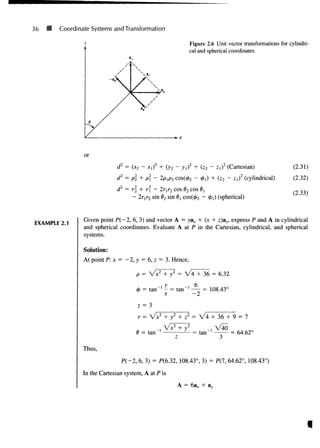
Figure 2.6 Unit vector transformations for cylindri-
cal and spherical coordinates.
or
d2
= (x2 - x,f + (y2 - yxf + (z2 - zif (Cartesian)
d2
= p + p2
- 2p,p2 cos((^2 - 0 0 + (z2 - Zf (cylindrical)
- 2r^r2 cos d2 cos 0j
sin 02 sin dx cos(</>2 - 0i) (spherical)
d2
= r + r - 2r^r2 cos d2 cos 0j
(2.31)
(2.32)
(2.33)
EXAMPLE 2.1
Given point P(—2, 6, 3) and vector A = yax + (x + z)ay, express P and A in cylindrical
and spherical coordinates. Evaluate A at P in the Cartesian, cylindrical, and spherical
systems.
Solution:
At point P: x = - 2 , y = 6, z = 3. Hence,
p = Vx2
+ y2
= V 4 + 36 = 6.32
4
> = tan"1
- = tan"1
= 108.43°
x - 2
r= Vx2
+ y2
+ z2
= V4 + 36 + 9 = 7
= 64.62°
_, Vx2
+ y2
_ V40
d = tan ' — - *— '
= tan
Z 5
Thus,
P(-2, 6, 3) = P(6.32, 108.43°, 3) = P(7, 64.62°, 108.43°)
In the Cartesian system, A at P is
A = 6ax + a^
2.4 SPHERICAL COORDINATES (r, e, • 37
For vector A, Ax = y, Ay = x + z, Az = 0. Hence, in the cylindrical system
Ap
A*
Az
=
cos
—sin
4>
<t>
0
sin
cos
0
0
0
0
0
1
y
X +
0
z
or
Ap = y cos (j) + (x + z) sin 0
A,/, = —y sin 0 + (JC + z) cos <
A, = 0
But x = p cos <j>,y = p sin 0, and substituting these yields
A = (Ap, A$, Az) = [p cos 0 sin 0 + (p cos 0 + z) sin 0]ap
+ [ - p sin 0 + (p cos 0 + z) cos
AtP
Hence,
= V40, tan <
/
> = —
cos </> =
A =
sin</> =
- 2
-2
V40'
V40 V40 V V40
40
6 / /— -2
V40- + 3 1
- ~6
_ 38
y ^p / '
V40 V40
Similarly, in the spherical system
V40 / V40-
= -0.9487a,, - 6.OO8a0
Ar
Ae
A*
or
sin 0 cos <
/
> sin 9 sin 0 cos 0
cos 6 cos 0 cos 6 sin 0 — sin 6
—sin 0 cos 0 0
Ar = y sin 0 cos <j> + (x + z)sin 6 sin 0
A9 = y cos 0 cos 0 + (x + z)cos 0 sin
A4, = ~y sin (j> + (x + z)cos 0
x + z
38 If Coordinate Systems and Transformation
But x = r sin 6 cos (j>, y = r sin 6 sin </>, and z = r cos 0. Substituting these yields
r 8 + )
= r[sin2
6 cos $ sin 0 + (sin 0 cos <
/
> + cos 6) sin 0 sin 4>]ar
+ r[sin 0 cos 6 sin <
/
> cos 0 + (sin 0 cos <
/
> + cos 0) cos 6 sin
AtP
Hence,
+ r[ —sin $ sin2
r = 1,
-2
(sin 6 cos 0 + cos 8) cos
tan 0 = tan0 =
40
40
cos <b =
V40' V40'
cos t) =
T
sin (7 =
49 V40 V40
I
" V^O 3 6
' L 7 7
40 - 2
>y
40 V40
V40
40 V 7
40 -2
7
- 6
7 40
18
40
- 2
+ - •-
7 V40-
38
— - a r ^ i
7
7V40 40
= -0.8571ar - 0.4066a9 - 6.OO8a0
Note that |A| is the same in the three systems; that is,
,z)| = |A(r, 0, <^)| = 6.083
PRACTICE EXERCISE 2.1
(a) Convert points P(, 3, 5), 7X0, - 4 , 3), and S(-3, - 4 , -10) from Cartesian to
cylindrical and spherical coordinates.
(b) Transform vector
Q =
Vx2
to cylindrical and spherical coordinates.
(c) Evaluate Q at T in the three coordinate systems.
2.4 SPHERICAL COORDINATES (r, e, 39
Answer: (a) P(3.162, 71.56°, 5), P(5.916, 32.31°, 71.56°), T(4, 270°, 3),
T(5, 53.13°, 270°), 5(5, 233.1°, - 1 0 ) , 5(11.18, 153.43°, 233.1°)
(b) : (cos 4> ap — sin <j> a^, — z sin <j> az), sin 9 (sin 0 cos <j> —
r cos2
0 sin <j>)ar + sin 0 cos 0 (cos 0 + r sin 0 sin </>)ag — sin 0 sin
(c) 0. 2.4az, 0. 2.4az, 1.44ar - 1.92a,,
EXAMPLE 2.2
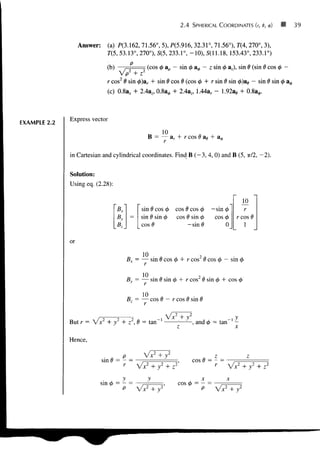
Express vector
10
B = — ar + r cos 6 ae + a,*
in Cartesian and cylindrical coordinates. Find B (—3, 4, 0) and B (5, TT/2, —2).
Solution:
Using eq. (2.28):
sin 0 cos <
sin 0 sin 4
cos 9
cos 0 cos <$> -sin</>
cos 0 sin 0 cos <t>
- s i n 0 0
K)
r
r cos I
1
or
10
Bx = — sin 0 cos <j) + r cos 0 cos <f> - sin <
10
5^ = — sin 0 sin <j> + r cos 0 sin $ + cos ^
10
57 = — cos 9 - r cos 0 sin 0
r
But r = Vx2
+ y2
+ z2
, 9 = tan"
Hence,
-, and 6 = tan —
x
40 H Coordinate Systems and Transformation
Substituting all these gives
loVx2
+ y2
x Vx2
+ / + z2
z2
x
'x2
+ y2
lOx
+
xz
x2
+ y2
+ z2
V(?
10W + y2
y ~~ / 2 , .2 , 2-.
y2
+ z2
) f)
Vx2
+ y2
+ z
2 • x2
+ y2
+ z2
+
y
lOy
+
B7 =
x2
+ y2
+ z2
V ( ? + y2
){x2
+ y2
+ z2
)
lOz
+
>xA
+ /
X
'x2
+ y2
zVx2
+ y2
x2
+ y2
+ z2
B = B A + Byay + Bzaz
where Bx, By, and Bz are as given above.
At (-3, 4, 0), x = - 3 , y = 4, and z = 0, so
Thus,
, = 0 - 0 = 0
B
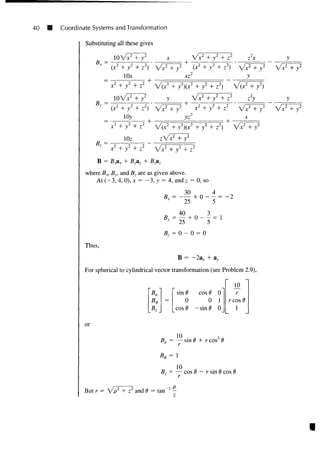
For spherical to cylindrical vector transformation (see Problem 2.9),
sin ^ cos 6 0
0 0 1
or
cos d -sin0 0
10 2
= — sin 6 + r cos
H)
r cos
10
7 = — cos d
r
- r sin 6 cos 6
But r = V p z
+ zl
and 6 = tan ' -
V + y2
^+7
2.5 CONSTANT-COORDINATE SURFACES • 41
Thus,
sin V =
/7T7'
cos C =
7 <•
T5
P + Z
P +
Hence,
B =
10p
At (5, TT/2, - 2 ) , p = 5, 0 = TT/2, and z = - 2 , so
B
50 4
29 V29/
V
p + Z
lOz
>2
+ z2
VTT?
-20 10
+
29 V29
= 2.467ap
Note that at (-3, 4, 0),
B(x,y,z) = |B(p,<A,z)| = |B(r, 0,0)| = 2.907
This may be used to check the correctness of the result whenever possible.
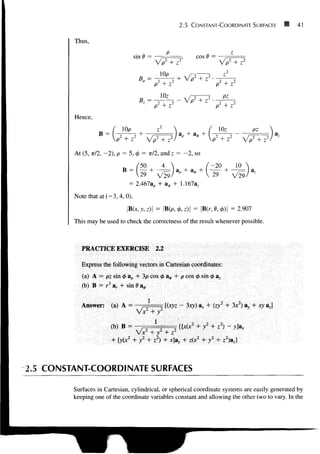
PRACTICE EXERCISE 2.2
Express the following vectors in Cartesian coordinates:
(a) A = pz sin 0 ap + 3p cos 0 a^, + p cos 0 sin 0 a.
(b) B = r2
ar + sin 6 a*
1
Answer: (a) A = [(xyz - 3xy) ar + (zj + 3x ) ay + xy a j
(b) B =
yixz
+ y2
+ zz
) + xay
2.5 CONSTANT-COORDINATE SURFACES
Surfaces in Cartesian, cylindrical, or spherical coordinate systems are easily generated by
keeping one of the coordinate variables constant and allowing the other two to vary. In the
42 M Coordinate Systems and Transformation
Cartesian system, if we keep x constant and allow y and z to vary, an infinite plane is gen-
erated. Thus we could have infinite planes
x = constant
y = constant
z = constant
(2.34)
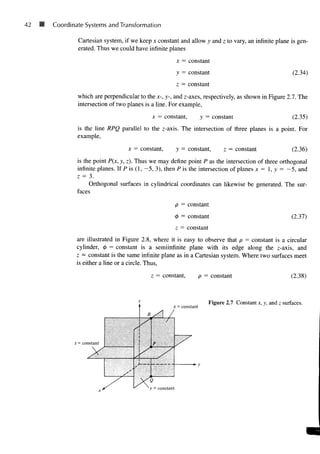
which are perpendicular to the x-, y-, and z-axes, respectively, as shown in Figure 2.7. The
intersection of two planes is a line. For example,
x = constant, y = constant (2.35)
is the line RPQ parallel to the z-axis. The intersection of three planes is a point. For
example,
x = constant, y = constant, z = constant (2.36)
is the point P(x, y, z). Thus we may define point P as the intersection of three orthogonal
infinite planes. If P is (1, - 5 , 3), then P is the intersection of planes x = 1, y = - 5 , and
z = 3.
Orthogonal surfaces in cylindrical coordinates can likewise be generated. The sur-
faces
p = constant
<> = constant
z = constant
(2.37)
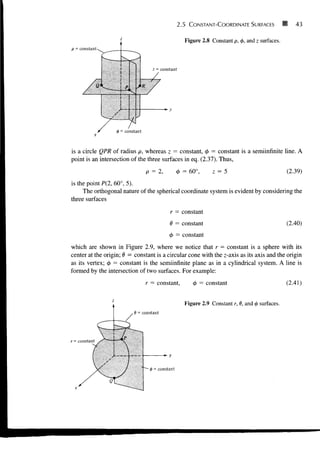
are illustrated in Figure 2.8, where it is easy to observe that p = constant is a circular
cylinder, <f> = constant is a semiinfinite plane with its edge along the z-axis, and
z = constant is the same infinite plane as in a Cartesian system. Where two surfaces meet
is either a line or a circle. Thus,
z = constant, p = constant (2.38)
z = constant
x = constant
Figure 2.7 Constant x, y, and z surfaces.
.
p = constant
z = constant
2.5 CONSTANT-COORDINATE SURFACES H 43
Figure 2.8 Constant p, (j>, and z surfaces.
*-y
<p = constant
is a circle QPR of radius p, whereas z = constant, <j> = constant is a semiinfinite line. A
point is an intersection of the three surfaces in eq. (2.37). Thus,
p = 2, <t> = 60°, z = 5 (2.39)
is the point P(2, 60°, 5).
The orthogonal nature of the spherical coordinate system is evident by considering the
three surfaces
r = constant
0 = constant
<f> = constant
(2.40)
which are shown in Figure 2.9, where we notice that r — constant is a sphere with its
center at the origin; 8 = constant is a circular cone with the z-axis as its axis and the origin
as its vertex; 0 = constant is the semiinfinite plane as in a cylindrical system. A line is
formed by the intersection of two surfaces. For example:
r = constant, tj> = constant
= constant
(2.41)
Figure 2.9 Constant r, 9, and <j> surfaces.
44 Coordinate Systems and Transformation
is a semicircle passing through Q and P. The intersection of three surfaces gives a point.
Thus,
r = 5, 0 = 30°, 0 = 60° (2.42)
is the point P(5, 30°, 60°). We notice that in general, a point in three-dimensional space can
be identified as the intersection of three mutually orthogonal surfaces. Also, a unit normal
vector to the surface n = constant is ± an, where n is x, y, z, p, <
/
>
, r, or 6. For example, to
plane* = 5, a unit normal vector is ±ax and to planed = 20°, a unit normal vector is a^.
EXAMPLE 2.3
Two uniform vector fields are given by E = -5ap +
23^, - 6az. Calculate
+ 3az and F = ap
(a) |E X F
(b) The vector component of E at P(5, TT/2, 3) parallel to the line x = 2, z = 3
(c) The angle E makes with the surface z = 3 at P
Solution:
(a) E X F = - 5 10
1 2 - 6
= (-60 - 6)a, + (3 - 3O)a0 + (-10 - 10)3,
= (-66, -27, -20)
|E X F| = V662
+ 272
+ 202
= 74.06
(b) Line x = 2, z = 3 is parallel to the y-axis, so the component of E parallel to the given
line is
(E • av)av
But at P(5, TT/2, 3)
Therefore,
= sin <t> ap + cos <j> a<*>
= sin TT/2 ap + cos •nil a^, = ap
(E diy = (E • ap)ap = - (or -5ay)
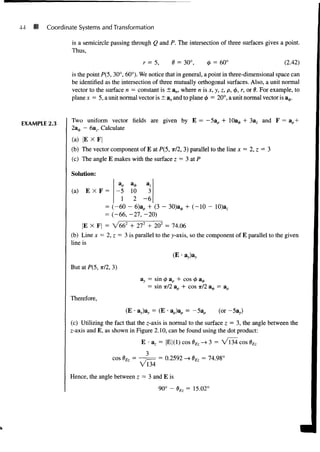
(c) Utilizing the fact that the z-axis is normal to the surface z = 3, the angle between the
z-axis and E, as shown in Figure 2.10, can be found using the dot product:
E az = |E|(1) cos 6Ez -> 3 = Vl34 cos $Ez
3
cos oEz =
'134
= 0.2592 -» BEz = 74.98°
Hence, the angle between z = 3 and E is
90° - BEz = 15.02°
J
2.5 CONSTANT-COORDINATE SURFACES
Figure 2.10 For Example 2.3(c).
45
PRACTICE EXERCISE 2.3
Given the vector field
H = pz cos 0 ap + e sin — a^ + p a.
At point (1,7r/3,0), find
(a) H • a,
(b) H X a ,
(c) The vector component of H normal to surface p = 1
(d) The scalar component of H tangential to the plane z = 0
Answer: (a) -0.433, (b) -0.5 ap, (c) 0 ap, (d) 0.5.
EXAMPLE 2.4
Given a vector field
D = r sin 0 ar sin 6 cos 0 ae + r2
a^
determine
(a) DatPQO, 150°, 330°)
(b) The component of D tangential to the spherical surface r = 10 at P
(c) A unit vector at P perpendicular to D and tangential to the cone d = 150°
Solution:
(a) At P, r = 10, 6 = 150°, and 0 = 330°. Hence,
D = 10 sin 330° ar - ~ sin 150° cos 330° ae + 100 a0 = (-5, 0.043, 100)
46 SB Coordinate Systems and Transformation
(b) Any vector D can always be resolved into two orthogonal components:
D = D, + Dn
where Dt is tangential to a given surface and Dn is normal to it. In our case, since ar is
normal to the surface r = 10,
Hence,
Dn = r sin 0 ar = —5ar
D, = D - Dn = 0.043a,, +
(c) A vector at P perpendicular to D and tangential to the cone 0 = 1 5 0 ° is the same as the
vector perpendicular to both D and ae. Hence,
D X afl =
ar ae a0
- 5 0.043 100
0 1 0
= - 1 0 0 a r - 5a*
A unit vector along this is
- 100ar - 53A
a = — , = -0.9988ar - 0.04993^
VlOO2
+ 52
PRACTICE EXERCISE 2.4
If A = 3ar + 2ae - 6a0 and B = 4a,. + 33^, determine
(a) A • B
(b) |A X B
(c) The vector component of A along az at (1, TT/3, 5ir/4)
Answer: (a) - 6 , (b) 34.48, (c) -0.116ar + 0.201a,,.
SUMMARY 1. The three common coordinate systems we shall use throughout the text are the Carte-
sian (or rectangular), the circular cylindrical, and the spherical.
2. A point P is represented as P(x, y, z), P(p, <j>, z), and P(r, 6, 4>) in the Cartesian, cylin-
drical, and spherical systems respectively. A vector field A is represented as (Ax, Ay, Az)
or A^nx + Ayay + Azaz in the Cartesian system, as (Ap, A$, Az) or Apap + A^a^ + Azaz
in the cylindrical system, and as (An Ae, A^) or A^ar + Aeae + A^a^ in the spherical
system. It is preferable that mathematical operations (addition, subtraction, product,
etc.) be performed in the same coordinate system. Thus, point and vector transforma-
tions should be performed whenever necessary.
3. Fixing one space variable defines a surface; fixing two defines a line; fixing three
defines a point.
4. A unit normal vector to surface n = constant is ± an.
REVIEW QUESTIONS • 47
PfVJEW QUtSTlONS
2.1 The ranges of d and (/> as given by eq. (2.17) are not the only possible ones. The following
are all alternative ranges of 6 and <j>, except
(a) 0 < 6 < 2TT, 0 < ct> < x
(b) 0 < 6 < 2x, 0 < 0 < 2x
(c) - TC <6<ir, 0<(/><7r
(d) - ir/2 < 0 < TT/2, 0 < 0 < 2TT
(e)O<0Sx, -7r<0<7r
(f) - 7 T < 0 < 7 r , - X < 0 < 7 T
2.2 At Cartesian point ( — 3, 4, — 1), which of these is incorrect?
(a) p = - 5 _
(b) r = Jlb
(c) 6 = tan"1
—
(d) <t> = t a n " 1
^ "
2.3 Which of these is not valid at point (0, 4, 0)?
(a)
(b)
(c)
(d)
a* =
a« =
ar =
= - a *
= — az
= 4ay
= a
y
A unit normal vector t
(a)
(b)
(c)
(d)
ar
a»
a0
none of the above
2.5 At every point in space, a0 • a# = 1.
(a) True
(b) False
2.6 If H = 4afi - 3a0 + 5az, at (1, x/2, 0) the component of H parallel to surface p = 1 is
(a) 4ap
(b) 5az
(c) - 3 a *
(d) -3a,,, + 5a2
(e) 5arf, + 3az
48 B Coordinate Systems and Transformation
2.7 Given G = 20ar + 50as + 4Oa0, at (1, T/2, TT/6) the component of G perpendicular to
surface 6 = TT/2 is
(a) 20ar
(b)
(c) 0
(d) 20ar +
(e) -40ar
2.8 Where surfaces p = 2 and z = 1 intersect is
(a) an infinite plane
(b) a semiinfinite plane
(c) a circle
(d) a cylinder
(e) a cone
2.9 Match the items in the left list with those in the right list. Each answer can be used once,
more than once, or not at all.
(a) 0 = ?r/4
(b) <$> = 2ir/3
(c) JC = - 1 0
(d) r = 1,0 =
(e) p = 5
(f) p = 3, <
A =
(g) p = 10, z =
(h) r = 4, <£ =
(i) r = 5, 0 =
x/3, <f> = w/2
5n73
= 1
TT/6
TT/3
(i)
(ii)
(iii)
(iv)
(v)
(vi)
(vii)
(viii)
(ix)
(x)
infinite plane
semiinfinite plane
circle
semicircle
straight line
cone
cylinder
sphere
cube
point
2.10 A wedge is described by z = 0, 30° < <t> < 60°. Which of the following is incorrect:
(a) The wedge lies in the x — y plane.
(b) It is infinitely long
(c) On the wedge, 0 < p < <*>
(d) A unit normal to the wedge is ± az
(e) The wedge includes neither the x-axis nor the y-axis
Answers: 2.1b,f, 2.2a, 2.3c, 2.4b, 2.5b, 2.6d, 2.7b, 2.8c, 2.9a-(vi), b-(ii), c-(i), d-(x),
e-(vii), f-(v), g-(iii), h-(iv), i-(iii), 2.10b.
PROBLEMS 49
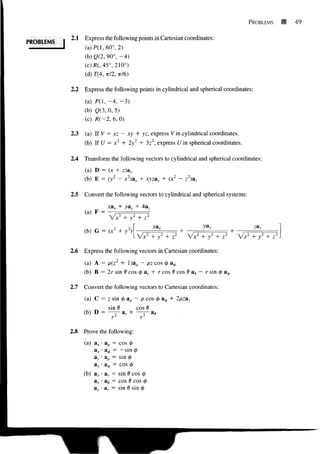
PROBLEMS
2.1 Express the following points in Cartesian coordinates:
(a)P(l,60°, 2)
(b) G(2, 90°, -4)
(c)R(, 45°, 210°)
(d) T(4, TT/2, TT/6)
2.2 Express the following points in cylindrical and spherical coordinates:
(a) P(l, - 4 , -3)
(b) g(3, 0, 5)
(c) R{-2, 6, 0)
2.3 (a) If V = xz — xy + yz, express V in cylindrical coordinates,
(b) If U = x2
+ 2>>2
+ 3z2
, express U in spherical coordinates.
2.4 Transform the following vectors to cylindrical and spherical coordinates:
(a) D = (x + z)ay
(b) E = (y2
- x2
)ax + xyzay + (x2
- Z
2
)az
2.5 Convert the following vectors to cylindrical and spherical systems:
xax + yay + Aaz
(a) F =
Vx2
(b) G = (x2
+ y2
) xar
Vx2
^
2.6 Express the following vectors in Cartesian coordinates:
(a) A = p(z2
+ l)ap - pz cos <j> a0
(b) B = 2r sin 6 cos <j> ar + r cos 8 cos 6 ae — r sin 4>
2.7 Convert the following vectors to Cartesian coordinates:
(a) C = z sin <f> ap - p cos <f> a0 + 2pzaz
sin d cos d
(b) D = —- ar + —r- ae
Vx2
2.8 Prove the following:
(a) ax • ap = cos ^
>
a x a 0 = - s i n ^
3^-3^ = sin <
£
3y • 30 = COS 0
(b) ax • ar = sin 6 cos
a^. • as = cos 0 cos
B
y • ar = sin 0 sin 0
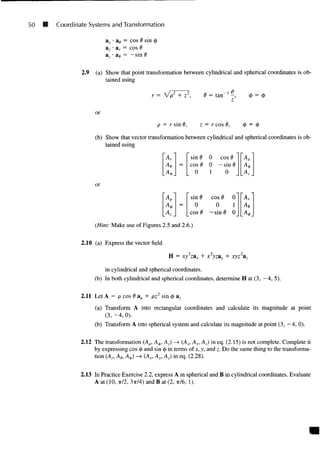
50 Coordinate Systems and Transformation
ay- ae = cos 6 sin
az • ar = cos 6
a • as = —sin 6
2.9 (a) Show that point transformation between cylindrical and spherical coordinates is ob-
tained using
p = r sin 9, z = r cos 9, 4> = 4>
(b) Show that vector transformation between cylindrical and spherical coordinates is ob-
tained using
or
Ar
Ae
A0_
A,
=
=
sin
cos
0
sin
0
cos
e
e
e
9
0 cos
0 -sin
1 0
cos 8
0
— sin 8
9
9
0
1
0
Ar
(Hint: Make use of Figures 2.5 and 2.6.)
2.10 (a) Express the vector field
H = xy2
zax + x2
yzay
in cylindrical and spherical coordinates,
(b) In both cylindrical and spherical coordinates, determine H at (3, —4, 5).
2.11 Let A = p cos 9 ap + pz2
sin <j> az
(a) Transform A into rectangular coordinates and calculate its magnitude at point
(3, - 4 , 0).
(b) Transform A into spherical system and calculate its magnitude at point (3, —4, 0).
2.12 The transformation (Ap, A0, Az) —•> (Ax, Ay, Az) in eq. (2.15) is not complete. Complete it
by expressing cos 4> and sin <f> in terms of x, y, and z. Do the same thing to the transforma-
tion (Ar, Ae, A^) -»(Ax , Ay, Az) in eq. (2.28).
2.13 In Practice Exercise 2.2, express A in spherical and B in cylindrical coordinates. Evaluate
A at (10, TT/2, 3TI74) and B at (2, TT/6, 1).
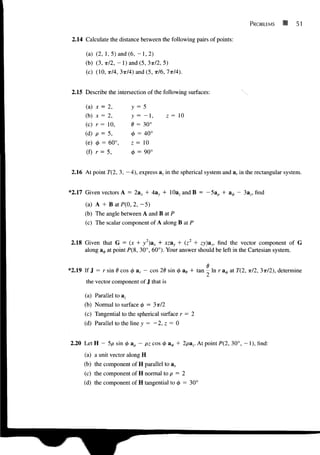
PROBLEMS • 51
2.14 Calculate the distance between the following pairs of points:
(a) (2, 1,5) and (6, - 1 , 2 )
(b) (3, T/2, -1) and (5, 3TT/2, 5)
(c) (10, TT/4, 3TT/4) and (5, x/6, 7*74).
2.15 Describe the intersection of the following surfaces:
= 10
(a)
(b)
(c)
(d)
(e)
(f)
X
X
r
p
r
= 2,
= 2,
= 10,
= g
= 60°,
y =
y =
e =
<t> =
z =
0 =
5
- 1 ,
30°
40°
10
90°
2.16 At point 7(2, 3, —4), express az in the spherical system and ar in the rectangular system.
*2.17 Given vectors A = 2a^ + 4ay + 10az and B = - 5 a p + a0 - 3az, find
(a) A + BatP(0,2, - 5 )
(b) The angle between A and B at P
(c) The scalar component of A along B at P
2.18 Given that G = (x + y2
)ax + xzay + (z2
+ zy)az, find the vector component of G
along a0 at point P(8, 30°, 60°). Your answer should be left in the Cartesian system.
*2.19 If J = r sin 0 cos <f> ar - cos 26 sin 4> ae + tan - In r a0 at T(2, TT/2, 3%12), determine
the vector component of J that is
(a) Parallel to az
(b) Normal to surface 4> = 37r/2
(c) Tangential to the spherical surface r = 2
(d) Parallel to the line y = - 2 , z = 0
2.20 Let H - 5p sin <f> ap - pz cos <j> a0 + 2paz. At point P(2, 30°, - 1), find:
(a) a unit vector along H
(b) the component of H parallel to ax
(c) the component of H normal to p = 2
(d) the component of H tangential to <j> = 30°
52 11 Coordinate Systems and Transformation
*2.21 Let
and
A = p(z2
- l)ap - pz cos <t> a^, + /o2
z2
az
B = r2
cos 0 ar + 2r sin 0 a0
At r(—3, 4, 1), calculate: (a) A and B, (b) the vector component in cylindrical coordi-
nates of A along B at T, (c) the unit vector in spherical coordinates perpendicular to both
A and B at T.
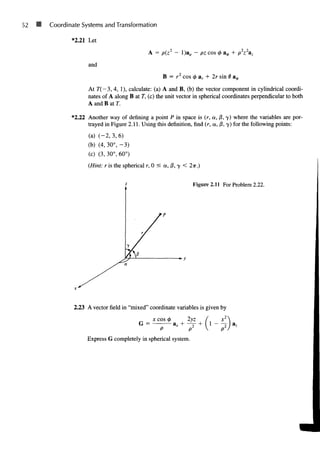
*2.22 Another way of defining a point P in space is (r, a, jS, 7) where the variables are por-
trayed in Figure 2.11. Using this definition, find (r, a, |8, 7) for the following points:
(a) (-2, 3, 6)
(b) (4, 30°, -3)
(c) (3, 30°, 60°)
(Hint: r is the spherical r, 0 < a, 0, 7 < 2ir.)
Figure 2.11 For Problem 2.22.
2.23 A vector field in "mixed" coordinate variables is given by
x cos 4> tyz ( x2
.
G = az + — + ( 1 - - j I a,
P p1
 pz
Express G completely in spherical system.

EMF

  • 1.
    Chapter 2 COORDINATE SYSTEMS ANDTRANSFORMATION Education makes a people easy to lead, but difficult to drive; easy to govern but impossible to enslave. —HENRY P. BROUGHAM 2.1 INTRODUCTION In general, the physical quantities we shall be dealing with in EM are functions of space and time. In order to describe the spatial variations of the quantities, we must be able to define all points uniquely in space in a suitable manner. This requires using an appropriate coordinate system. A point or vector can be represented in any curvilinear coordinate system, which may be orthogonal or nonorthogonal. An orthogonal system is one in which the coordinates arc mutually perpendicular. Nonorthogonal systems are hard to work with and they are of little or no practical use. Examples of orthogonal coordinate systems include the Cartesian (or rectangular), the cir- cular cylindrical, the spherical, the elliptic cylindrical, the parabolic cylindrical, the conical, the prolate spheroidal, the oblate spheroidal, and the ellipsoidal.1 A considerable amount of work and time may be saved by choosing a coordinate system that best fits a given problem. A hard problem in one coordi nate system may turn out to be easy in another system. In this text, we shall restrict ourselves to the three best-known coordinate systems: the Cartesian, the circular cylindrical, and the spherical. Although we have considered the Cartesian system in Chapter 1, we shall consider it in detail in this chapter. We should bear in mind that the concepts covered in Chapter 1 and demonstrated in Cartesian coordinates are equally applicable to other systems of coordinates. For example, the procedure for 'For an introductory treatment of these coordinate systems, see M. R. Spigel, Mathematical Hand- book ofFormulas and Tables. New York: McGraw-Hill, 1968, pp. 124-130. 28
  • 2.
    2.3 CIRCULAR CYLINDRICALCOORDINATES (R, F, Z) 29 finding dot or cross product of two vectors in a cylindrical system is the same as that used in the Cartesian system in Chapter 1. Sometimes, it is necessary to transform points and vectors from one coordinate system to another. The techniques for doing this will be presented and illustrated with examples. 2.2 CARTESIAN COORDINATES (X, Y, Z) As mentioned in Chapter 1, a point P can be represented as (x, y, z) as illustrated in Figure 1.1. The ranges of the coordinate variables x, y, and z are -00 < X < 00 -00<-y<o> (2.1) — 00 < I < 00 A vector A in Cartesian (otherwise known as rectangular) coordinates can be written as (Ax,Ay,AJ or A A + Ayay + Azaz (2.2) where ax, ay, and az are unit vectors along the x-, y-, and z-directions as shown in Figure 1.1. 2.3 CIRCULAR CYLINDRICAL COORDINATES (p, cj>, z) The circular cylindrical coordinate system is very convenient whenever we are dealing with problems having cylindrical symmetry. A point P in cylindrical coordinates is represented as (p, <j>, z) and is as shown in Figure 2.1. Observe Figure 2.1 closely and note how we define each space variable: p is the radius of the cylinder passing through P or the radial distance from the z-axis: <f>, called the Figure 2.1 Point P and unit vectors in the cylindrical coordinate system.
  • 3.
    30 Coordinate Systemsand Transformation azimuthal angle, is measured from the x-axis in the xy-plane; and z is the same as in the Cartesian system. The ranges of the variables are 0 < p < °° 0 < < / > < 27T -00 < Z < 00 A vector A in cylindrical coordinates can be written as (2.3) (Ap, A^,, Az) or Apap (2.4) where ap> a^, and az are unit vectors in the p-, <£-, and ^-directions as illustrated in Figure 2.1. Note that a^ is not in degrees; it assumes the unit vector of A. For example, if a force of 10 N acts on a particle in a circular motion, the force may be represented as F = lOa^, N. In this case, a0 is in newtons. The magnitude of A is = (Al p ,2x1/2 (2.5) Notice that the unit vectors ap, a^, and az are mutually perpendicular because our co- ordinate system is orthogonal; ap points in the direction of increasing p, a$ in the direction of increasing 0, and az in the positive z-direction. Thus, a^ = az • az = 1 a = a7 • a = 0 np X a<j> = a , a^ X az = a, az X ap = a* (2.6a) (2.6b) (2.6c) (2.6d) (2.6e) where eqs. (2.6c) to (2.6e) are obtained in cyclic permutation (see Figure 1.9). The relationships between the variables (x, y, z) of the Cartesian coordinate system and those of the cylindrical system (p, <j>, z) are easily obtained from Figure 2.2 as cj) = tan"1 -, x z (2.7) or x = p cos 0, y = p sin <(>, z = z (2.8) Whereas eq. (2.7) is for transforming a point from Cartesian (x, y, z) to cylindrical (p, <$>, z) coordinates, eq. (2.8) is for (p, 4>, z) —»(x, y, z) transformation.
  • 4.
    2.3 CIRCULAR CYLINDRICALCOORDINATES (p, 0, z) 11 31 Figure 2.2 Relationship between (x, y, z) and (P, *. z). The relationships between (ax, ay, az) and (ap, a^, a2) are obtained geometrically from Figure 2.3: or = cos 0 ap - sin ap = cos (j>ax + sin = -sin = a7 cos (b) Figure 2.3 Unit vector transformation: (a) cylindrical components of ax, (b) cylin- drical components of a r (2.9) (2.10)
  • 5.
    32 Coordinate Systemsand Transformation Finally, the relationships between (Ax, Ay, Az) and (Ap, A0, Az) are obtained by simply substituting eq. (2.9) into eq. (2.2) and collecting terms. Thus A = (Ax cos <j> + Ay sin <j>)ap + (~AX sin <j> + Ay cos 0)a0 + Azaz (2. or Ap = Ax cos <t> + Ay sin <f> A,/, = ~AX sin <f> + Ay cos tj> (2.12) In matrix form, we have the transformation of vector A from (Ax,Ay,Az) to (Ap, A0, A,) as (2.13) A, Az = cos < / > sin 0 0 — sin<j> cos 0 0 0 0 1 Ax Ay Az The inverse of the transformation (Ap, A^, Az) — > (Ax, Ay, Az) is obtained as Ax cos <t> sin $ 0 -sin^> cos ^ 0 0 0 1 A, (2.14) or directly from eqs. (2.4) and (2.10). Thus cos </> — sin 4> 0 sin <j> cos <j> 0 0 0 1 V A. (2.15) An alternative way of obtaining eq. (2.14) or (2.15) is using the dot product. For example: (2.16) "A/ Ay Az = a ^ a p az- ap a ^ a 0 a y a 0 a z a 0 *x az • az • az •az A A A The derivation of this is left as an exercise. 2.4 SPHERICAL COORDINATES (r, 0, (/>) The spherical coordinate system is most appropriate when dealing with problems having a degree of spherical symmetry. A point P can be represented as (r, 6, 4>) and is illustrated in Figure 2.4. From Figure 2.4, we notice that r is defined as the distance from the origin to
  • 6.
    2.4 SPHERICAL COORDINATES(r, e, 33 point P or the radius of a sphere centered at the origin and passing through P; 6 (called the colatitude) is the angle between the z-axis and the position vector of P; and 4> is measured from the x-axis (the same azimuthal angle in cylindrical coordinates). According to these definitions, the ranges of the variables are O < 0 < i r (2.17) 0 < <f> < 2TT A vector A in spherical coordinates may be written as (Ar,Ae,A^) or A&r + Agae + A^ (2.18) where an ae, and 3A are unit vectors along the r-, B-, and ^-directions. The magnitude of A is |A| = (A2 r +A2 e+ Aj)112 (2.19) The unit vectors an a^, and a^ are mutually orthogonal; ar being directed along the radius or in the direction of increasing r, ae in the direction of increasing 6, and a0 in the di- rection of increasing <f>. Thus, ar • ar = ae • ar • ae = ae •; ar x ae = a^ ae X a^, = ar a0 X ar = a9 ar = 0 (2.20) Figure 2.4 Point P and unit vectors in spherical coordinates.
  • 7.
    34 • CoordinateSystems and Transformation The space variables (x, y, z) in Cartesian coordinates can be related to variables (r, 0, <p) of a spherical coordinate system. From Figure 2.5 it is easy to notice that = Vx2 - ,/- HZ2 , 0 = tan ' z or x = r sin 0 cos 0, y = r sin 0 sin </>, z = r cos I (2.21) (2.22) In eq. (2.21), we have (x, y, z) — > (r, 0, #) point transformation and in eq. (2.22), it is (r, 6, 4>) —»(x, y, z) point transformation. The unit vectors ax, ay, a2 and ar, ae, a^ are related as follows: or ax = sin 0 cos 4> ar + cos 0 cos < £ as - sin 83, = sin 6 sin < £ ar + cos 6 sin 0 ae + cos <j az = cos 6 ar — sin 0 as ar = sin 0 cos 0 a* + sin d sin < £ ay + c o s a^ = cos 0 cos <t> ax + cos 0 sin < / > ay — sin (2.23) (2.24) = —sin cos < / > ay Figure 2.5 Relationships between space variables (x, y, z), (r, 6, and (p, <t>, z).
  • 8.
    2.4 SPHERICAL COORDINATES(r, e, <t>) 35 The components of vector A = (Ax, Ay, Az) and A = (Ar, Ae, A^) are related by substitut- ing eq. (2.23) into eq. (2.2) and collecting terms. Thus, A = (Ax sin 0 cos 4> + Ay sin 0 sin 0 + Az cos 0)ar + (Ax cos 0 cos 0 + Ay cos 0 sin 0 — Az sin d)ae + {—Ax sin 0 + Ay cos <A)a^, (2.25) and from this, we obtain Ar = A^ sin 0 cos <t> + Ay sin 0 sin <j> + Az cos 0 Ae = Ax cos 0 cos 4> + Ay cos 0 sin <f> — Az sin A^ = —A* sin </> + Ay cos 0 (2.26) A. = sin 6 cos 0 sin 0 sin 0 cos 0 —cos 0 cos 0 cos 0 sin < / > — sin 0 — sin 0 cos 4> 0 X In matrix form, the (Ax, Ay, Az) -> (Ar, Ae, A$) vector transformation is performed accord- ing to (2.27) The inverse transformation (An Ae, A^) — > (Ax, Ay, Az) is similarly obtained, or we obtain it from eq. (2.23). Thus, (2.28) Alternatively, we may obtain eqs. (2.27) and (2.28) using the dot product. For example, AX~ Av = sin sin cos 0 0 0 COS 0 sin 0 cos 0 cos < / > cos 0 sin 0 -sin0 — sin cos T) 0_ Ar As Ar ar • ax ar • ay ar • az (2.29) For the sake of completeness, it may be instructive to obtain the point or vector trans- formation relationships between cylindrical and spherical coordinates using Figures 2.5 and 2.6 (where <f> is held constant since it is common to both systems). This will be left as an exercise (see Problem 2.9). Note that in point or vector transformation the point or vector has not changed; it is only expressed differently. Thus, for example, the magnitude of a vector will remain the same after the transformation and this may serve as a way of checking the result of the transformation. The distance between two points is usually necessary in EM theory. The distance d between two points with position vectors rl and r2 is generally given by d=r2- (2.30)
  • 9.
    36 • CoordinateSystems and Transformation Figure 2.6 Unit vector transformations for cylindri- cal and spherical coordinates. or d2 = (x2 - x,f + (y2 - yxf + (z2 - zif (Cartesian) d2 = p + p2 - 2p,p2 cos((^2 - 0 0 + (z2 - Zf (cylindrical) - 2r^r2 cos d2 cos 0j sin 02 sin dx cos(</>2 - 0i) (spherical) d2 = r + r - 2r^r2 cos d2 cos 0j (2.31) (2.32) (2.33) EXAMPLE 2.1 Given point P(—2, 6, 3) and vector A = yax + (x + z)ay, express P and A in cylindrical and spherical coordinates. Evaluate A at P in the Cartesian, cylindrical, and spherical systems. Solution: At point P: x = - 2 , y = 6, z = 3. Hence, p = Vx2 + y2 = V 4 + 36 = 6.32 4 > = tan"1 - = tan"1 = 108.43° x - 2 r= Vx2 + y2 + z2 = V4 + 36 + 9 = 7 = 64.62° _, Vx2 + y2 _ V40 d = tan ' — - *— ' = tan Z 5 Thus, P(-2, 6, 3) = P(6.32, 108.43°, 3) = P(7, 64.62°, 108.43°) In the Cartesian system, A at P is A = 6ax + a^
  • 10.
    2.4 SPHERICAL COORDINATES(r, e, • 37 For vector A, Ax = y, Ay = x + z, Az = 0. Hence, in the cylindrical system Ap A* Az = cos —sin 4> <t> 0 sin cos 0 0 0 0 0 1 y X + 0 z or Ap = y cos (j) + (x + z) sin 0 A,/, = —y sin 0 + (JC + z) cos < A, = 0 But x = p cos <j>,y = p sin 0, and substituting these yields A = (Ap, A$, Az) = [p cos 0 sin 0 + (p cos 0 + z) sin 0]ap + [ - p sin 0 + (p cos 0 + z) cos AtP Hence, = V40, tan < / > = — cos </> = A = sin</> = - 2 -2 V40' V40 V40 V V40 40 6 / /— -2 V40- + 3 1 - ~6 _ 38 y ^p / ' V40 V40 Similarly, in the spherical system V40 / V40- = -0.9487a,, - 6.OO8a0 Ar Ae A* or sin 0 cos < / > sin 9 sin 0 cos 0 cos 6 cos 0 cos 6 sin 0 — sin 6 —sin 0 cos 0 0 Ar = y sin 0 cos <j> + (x + z)sin 6 sin 0 A9 = y cos 0 cos 0 + (x + z)cos 0 sin A4, = ~y sin (j> + (x + z)cos 0 x + z
  • 11.
    38 If CoordinateSystems and Transformation But x = r sin 6 cos (j>, y = r sin 6 sin </>, and z = r cos 0. Substituting these yields r 8 + ) = r[sin2 6 cos $ sin 0 + (sin 0 cos < / > + cos 6) sin 0 sin 4>]ar + r[sin 0 cos 6 sin < / > cos 0 + (sin 0 cos < / > + cos 0) cos 6 sin AtP Hence, + r[ —sin $ sin2 r = 1, -2 (sin 6 cos 0 + cos 8) cos tan 0 = tan0 = 40 40 cos <b = V40' V40' cos t) = T sin (7 = 49 V40 V40 I " V^O 3 6 ' L 7 7 40 - 2 >y 40 V40 V40 40 V 7 40 -2 7 - 6 7 40 18 40 - 2 + - •- 7 V40- 38 — - a r ^ i 7 7V40 40 = -0.8571ar - 0.4066a9 - 6.OO8a0 Note that |A| is the same in the three systems; that is, ,z)| = |A(r, 0, <^)| = 6.083 PRACTICE EXERCISE 2.1 (a) Convert points P(, 3, 5), 7X0, - 4 , 3), and S(-3, - 4 , -10) from Cartesian to cylindrical and spherical coordinates. (b) Transform vector Q = Vx2 to cylindrical and spherical coordinates. (c) Evaluate Q at T in the three coordinate systems.
  • 12.
    2.4 SPHERICAL COORDINATES(r, e, 39 Answer: (a) P(3.162, 71.56°, 5), P(5.916, 32.31°, 71.56°), T(4, 270°, 3), T(5, 53.13°, 270°), 5(5, 233.1°, - 1 0 ) , 5(11.18, 153.43°, 233.1°) (b) : (cos 4> ap — sin <j> a^, — z sin <j> az), sin 9 (sin 0 cos <j> — r cos2 0 sin <j>)ar + sin 0 cos 0 (cos 0 + r sin 0 sin </>)ag — sin 0 sin (c) 0. 2.4az, 0. 2.4az, 1.44ar - 1.92a,, EXAMPLE 2.2 Express vector 10 B = — ar + r cos 6 ae + a,* in Cartesian and cylindrical coordinates. Find B (—3, 4, 0) and B (5, TT/2, —2). Solution: Using eq. (2.28): sin 0 cos < sin 0 sin 4 cos 9 cos 0 cos <$> -sin</> cos 0 sin 0 cos <t> - s i n 0 0 K) r r cos I 1 or 10 Bx = — sin 0 cos <j) + r cos 0 cos <f> - sin < 10 5^ = — sin 0 sin <j> + r cos 0 sin $ + cos ^ 10 57 = — cos 9 - r cos 0 sin 0 r But r = Vx2 + y2 + z2 , 9 = tan" Hence, -, and 6 = tan — x
  • 13.
    40 H CoordinateSystems and Transformation Substituting all these gives loVx2 + y2 x Vx2 + / + z2 z2 x 'x2 + y2 lOx + xz x2 + y2 + z2 V(? 10W + y2 y ~~ / 2 , .2 , 2-. y2 + z2 ) f) Vx2 + y2 + z 2 • x2 + y2 + z2 + y lOy + B7 = x2 + y2 + z2 V ( ? + y2 ){x2 + y2 + z2 ) lOz + >xA + / X 'x2 + y2 zVx2 + y2 x2 + y2 + z2 B = B A + Byay + Bzaz where Bx, By, and Bz are as given above. At (-3, 4, 0), x = - 3 , y = 4, and z = 0, so Thus, , = 0 - 0 = 0 B For spherical to cylindrical vector transformation (see Problem 2.9), sin ^ cos 6 0 0 0 1 or cos d -sin0 0 10 2 = — sin 6 + r cos H) r cos 10 7 = — cos d r - r sin 6 cos 6 But r = V p z + zl and 6 = tan ' - V + y2 ^+7
  • 14.
    2.5 CONSTANT-COORDINATE SURFACES• 41 Thus, sin V = /7T7' cos C = 7 <• T5 P + Z P + Hence, B = 10p At (5, TT/2, - 2 ) , p = 5, 0 = TT/2, and z = - 2 , so B 50 4 29 V29/ V p + Z lOz >2 + z2 VTT? -20 10 + 29 V29 = 2.467ap Note that at (-3, 4, 0), B(x,y,z) = |B(p,<A,z)| = |B(r, 0,0)| = 2.907 This may be used to check the correctness of the result whenever possible. PRACTICE EXERCISE 2.2 Express the following vectors in Cartesian coordinates: (a) A = pz sin 0 ap + 3p cos 0 a^, + p cos 0 sin 0 a. (b) B = r2 ar + sin 6 a* 1 Answer: (a) A = [(xyz - 3xy) ar + (zj + 3x ) ay + xy a j (b) B = yixz + y2 + zz ) + xay 2.5 CONSTANT-COORDINATE SURFACES Surfaces in Cartesian, cylindrical, or spherical coordinate systems are easily generated by keeping one of the coordinate variables constant and allowing the other two to vary. In the
  • 15.
    42 M CoordinateSystems and Transformation Cartesian system, if we keep x constant and allow y and z to vary, an infinite plane is gen- erated. Thus we could have infinite planes x = constant y = constant z = constant (2.34) which are perpendicular to the x-, y-, and z-axes, respectively, as shown in Figure 2.7. The intersection of two planes is a line. For example, x = constant, y = constant (2.35) is the line RPQ parallel to the z-axis. The intersection of three planes is a point. For example, x = constant, y = constant, z = constant (2.36) is the point P(x, y, z). Thus we may define point P as the intersection of three orthogonal infinite planes. If P is (1, - 5 , 3), then P is the intersection of planes x = 1, y = - 5 , and z = 3. Orthogonal surfaces in cylindrical coordinates can likewise be generated. The sur- faces p = constant <> = constant z = constant (2.37) are illustrated in Figure 2.8, where it is easy to observe that p = constant is a circular cylinder, <f> = constant is a semiinfinite plane with its edge along the z-axis, and z = constant is the same infinite plane as in a Cartesian system. Where two surfaces meet is either a line or a circle. Thus, z = constant, p = constant (2.38) z = constant x = constant Figure 2.7 Constant x, y, and z surfaces. .
  • 16.
    p = constant z= constant 2.5 CONSTANT-COORDINATE SURFACES H 43 Figure 2.8 Constant p, (j>, and z surfaces. *-y <p = constant is a circle QPR of radius p, whereas z = constant, <j> = constant is a semiinfinite line. A point is an intersection of the three surfaces in eq. (2.37). Thus, p = 2, <t> = 60°, z = 5 (2.39) is the point P(2, 60°, 5). The orthogonal nature of the spherical coordinate system is evident by considering the three surfaces r = constant 0 = constant <f> = constant (2.40) which are shown in Figure 2.9, where we notice that r — constant is a sphere with its center at the origin; 8 = constant is a circular cone with the z-axis as its axis and the origin as its vertex; 0 = constant is the semiinfinite plane as in a cylindrical system. A line is formed by the intersection of two surfaces. For example: r = constant, tj> = constant = constant (2.41) Figure 2.9 Constant r, 9, and <j> surfaces.
  • 17.
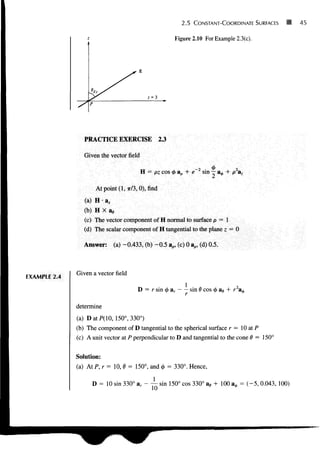
    44 Coordinate Systemsand Transformation is a semicircle passing through Q and P. The intersection of three surfaces gives a point. Thus, r = 5, 0 = 30°, 0 = 60° (2.42) is the point P(5, 30°, 60°). We notice that in general, a point in three-dimensional space can be identified as the intersection of three mutually orthogonal surfaces. Also, a unit normal vector to the surface n = constant is ± an, where n is x, y, z, p, < / > , r, or 6. For example, to plane* = 5, a unit normal vector is ±ax and to planed = 20°, a unit normal vector is a^. EXAMPLE 2.3 Two uniform vector fields are given by E = -5ap + 23^, - 6az. Calculate + 3az and F = ap (a) |E X F (b) The vector component of E at P(5, TT/2, 3) parallel to the line x = 2, z = 3 (c) The angle E makes with the surface z = 3 at P Solution: (a) E X F = - 5 10 1 2 - 6 = (-60 - 6)a, + (3 - 3O)a0 + (-10 - 10)3, = (-66, -27, -20) |E X F| = V662 + 272 + 202 = 74.06 (b) Line x = 2, z = 3 is parallel to the y-axis, so the component of E parallel to the given line is (E • av)av But at P(5, TT/2, 3) Therefore, = sin <t> ap + cos <j> a<*> = sin TT/2 ap + cos •nil a^, = ap (E diy = (E • ap)ap = - (or -5ay) (c) Utilizing the fact that the z-axis is normal to the surface z = 3, the angle between the z-axis and E, as shown in Figure 2.10, can be found using the dot product: E az = |E|(1) cos 6Ez -> 3 = Vl34 cos $Ez 3 cos oEz = '134 = 0.2592 -» BEz = 74.98° Hence, the angle between z = 3 and E is 90° - BEz = 15.02° J
  • 18.
    2.5 CONSTANT-COORDINATE SURFACES Figure2.10 For Example 2.3(c). 45 PRACTICE EXERCISE 2.3 Given the vector field H = pz cos 0 ap + e sin — a^ + p a. At point (1,7r/3,0), find (a) H • a, (b) H X a , (c) The vector component of H normal to surface p = 1 (d) The scalar component of H tangential to the plane z = 0 Answer: (a) -0.433, (b) -0.5 ap, (c) 0 ap, (d) 0.5. EXAMPLE 2.4 Given a vector field D = r sin 0 ar sin 6 cos 0 ae + r2 a^ determine (a) DatPQO, 150°, 330°) (b) The component of D tangential to the spherical surface r = 10 at P (c) A unit vector at P perpendicular to D and tangential to the cone d = 150° Solution: (a) At P, r = 10, 6 = 150°, and 0 = 330°. Hence, D = 10 sin 330° ar - ~ sin 150° cos 330° ae + 100 a0 = (-5, 0.043, 100)
  • 19.
    46 SB CoordinateSystems and Transformation (b) Any vector D can always be resolved into two orthogonal components: D = D, + Dn where Dt is tangential to a given surface and Dn is normal to it. In our case, since ar is normal to the surface r = 10, Hence, Dn = r sin 0 ar = —5ar D, = D - Dn = 0.043a,, + (c) A vector at P perpendicular to D and tangential to the cone 0 = 1 5 0 ° is the same as the vector perpendicular to both D and ae. Hence, D X afl = ar ae a0 - 5 0.043 100 0 1 0 = - 1 0 0 a r - 5a* A unit vector along this is - 100ar - 53A a = — , = -0.9988ar - 0.04993^ VlOO2 + 52 PRACTICE EXERCISE 2.4 If A = 3ar + 2ae - 6a0 and B = 4a,. + 33^, determine (a) A • B (b) |A X B (c) The vector component of A along az at (1, TT/3, 5ir/4) Answer: (a) - 6 , (b) 34.48, (c) -0.116ar + 0.201a,,. SUMMARY 1. The three common coordinate systems we shall use throughout the text are the Carte- sian (or rectangular), the circular cylindrical, and the spherical. 2. A point P is represented as P(x, y, z), P(p, <j>, z), and P(r, 6, 4>) in the Cartesian, cylin- drical, and spherical systems respectively. A vector field A is represented as (Ax, Ay, Az) or A^nx + Ayay + Azaz in the Cartesian system, as (Ap, A$, Az) or Apap + A^a^ + Azaz in the cylindrical system, and as (An Ae, A^) or A^ar + Aeae + A^a^ in the spherical system. It is preferable that mathematical operations (addition, subtraction, product, etc.) be performed in the same coordinate system. Thus, point and vector transforma- tions should be performed whenever necessary. 3. Fixing one space variable defines a surface; fixing two defines a line; fixing three defines a point. 4. A unit normal vector to surface n = constant is ± an.
  • 20.
    REVIEW QUESTIONS •47 PfVJEW QUtSTlONS 2.1 The ranges of d and (/> as given by eq. (2.17) are not the only possible ones. The following are all alternative ranges of 6 and <j>, except (a) 0 < 6 < 2TT, 0 < ct> < x (b) 0 < 6 < 2x, 0 < 0 < 2x (c) - TC <6<ir, 0<(/><7r (d) - ir/2 < 0 < TT/2, 0 < 0 < 2TT (e)O<0Sx, -7r<0<7r (f) - 7 T < 0 < 7 r , - X < 0 < 7 T 2.2 At Cartesian point ( — 3, 4, — 1), which of these is incorrect? (a) p = - 5 _ (b) r = Jlb (c) 6 = tan"1 — (d) <t> = t a n " 1 ^ " 2.3 Which of these is not valid at point (0, 4, 0)? (a) (b) (c) (d) a* = a« = ar = = - a * = — az = 4ay = a y A unit normal vector t (a) (b) (c) (d) ar a» a0 none of the above 2.5 At every point in space, a0 • a# = 1. (a) True (b) False 2.6 If H = 4afi - 3a0 + 5az, at (1, x/2, 0) the component of H parallel to surface p = 1 is (a) 4ap (b) 5az (c) - 3 a * (d) -3a,,, + 5a2 (e) 5arf, + 3az
  • 21.
    48 B CoordinateSystems and Transformation 2.7 Given G = 20ar + 50as + 4Oa0, at (1, T/2, TT/6) the component of G perpendicular to surface 6 = TT/2 is (a) 20ar (b) (c) 0 (d) 20ar + (e) -40ar 2.8 Where surfaces p = 2 and z = 1 intersect is (a) an infinite plane (b) a semiinfinite plane (c) a circle (d) a cylinder (e) a cone 2.9 Match the items in the left list with those in the right list. Each answer can be used once, more than once, or not at all. (a) 0 = ?r/4 (b) <$> = 2ir/3 (c) JC = - 1 0 (d) r = 1,0 = (e) p = 5 (f) p = 3, < A = (g) p = 10, z = (h) r = 4, <£ = (i) r = 5, 0 = x/3, <f> = w/2 5n73 = 1 TT/6 TT/3 (i) (ii) (iii) (iv) (v) (vi) (vii) (viii) (ix) (x) infinite plane semiinfinite plane circle semicircle straight line cone cylinder sphere cube point 2.10 A wedge is described by z = 0, 30° < <t> < 60°. Which of the following is incorrect: (a) The wedge lies in the x — y plane. (b) It is infinitely long (c) On the wedge, 0 < p < <*> (d) A unit normal to the wedge is ± az (e) The wedge includes neither the x-axis nor the y-axis Answers: 2.1b,f, 2.2a, 2.3c, 2.4b, 2.5b, 2.6d, 2.7b, 2.8c, 2.9a-(vi), b-(ii), c-(i), d-(x), e-(vii), f-(v), g-(iii), h-(iv), i-(iii), 2.10b.
  • 22.
    PROBLEMS 49 PROBLEMS 2.1 Expressthe following points in Cartesian coordinates: (a)P(l,60°, 2) (b) G(2, 90°, -4) (c)R(, 45°, 210°) (d) T(4, TT/2, TT/6) 2.2 Express the following points in cylindrical and spherical coordinates: (a) P(l, - 4 , -3) (b) g(3, 0, 5) (c) R{-2, 6, 0) 2.3 (a) If V = xz — xy + yz, express V in cylindrical coordinates, (b) If U = x2 + 2>>2 + 3z2 , express U in spherical coordinates. 2.4 Transform the following vectors to cylindrical and spherical coordinates: (a) D = (x + z)ay (b) E = (y2 - x2 )ax + xyzay + (x2 - Z 2 )az 2.5 Convert the following vectors to cylindrical and spherical systems: xax + yay + Aaz (a) F = Vx2 (b) G = (x2 + y2 ) xar Vx2 ^ 2.6 Express the following vectors in Cartesian coordinates: (a) A = p(z2 + l)ap - pz cos <j> a0 (b) B = 2r sin 6 cos <j> ar + r cos 8 cos 6 ae — r sin 4> 2.7 Convert the following vectors to Cartesian coordinates: (a) C = z sin <f> ap - p cos <f> a0 + 2pzaz sin d cos d (b) D = —- ar + —r- ae Vx2 2.8 Prove the following: (a) ax • ap = cos ^ > a x a 0 = - s i n ^ 3^-3^ = sin < £ 3y • 30 = COS 0 (b) ax • ar = sin 6 cos a^. • as = cos 0 cos B y • ar = sin 0 sin 0
  • 23.
    50 Coordinate Systemsand Transformation ay- ae = cos 6 sin az • ar = cos 6 a • as = —sin 6 2.9 (a) Show that point transformation between cylindrical and spherical coordinates is ob- tained using p = r sin 9, z = r cos 9, 4> = 4> (b) Show that vector transformation between cylindrical and spherical coordinates is ob- tained using or Ar Ae A0_ A, = = sin cos 0 sin 0 cos e e e 9 0 cos 0 -sin 1 0 cos 8 0 — sin 8 9 9 0 1 0 Ar (Hint: Make use of Figures 2.5 and 2.6.) 2.10 (a) Express the vector field H = xy2 zax + x2 yzay in cylindrical and spherical coordinates, (b) In both cylindrical and spherical coordinates, determine H at (3, —4, 5). 2.11 Let A = p cos 9 ap + pz2 sin <j> az (a) Transform A into rectangular coordinates and calculate its magnitude at point (3, - 4 , 0). (b) Transform A into spherical system and calculate its magnitude at point (3, —4, 0). 2.12 The transformation (Ap, A0, Az) —•> (Ax, Ay, Az) in eq. (2.15) is not complete. Complete it by expressing cos 4> and sin <f> in terms of x, y, and z. Do the same thing to the transforma- tion (Ar, Ae, A^) -»(Ax , Ay, Az) in eq. (2.28). 2.13 In Practice Exercise 2.2, express A in spherical and B in cylindrical coordinates. Evaluate A at (10, TT/2, 3TI74) and B at (2, TT/6, 1).
  • 24.
    PROBLEMS • 51 2.14Calculate the distance between the following pairs of points: (a) (2, 1,5) and (6, - 1 , 2 ) (b) (3, T/2, -1) and (5, 3TT/2, 5) (c) (10, TT/4, 3TT/4) and (5, x/6, 7*74). 2.15 Describe the intersection of the following surfaces: = 10 (a) (b) (c) (d) (e) (f) X X r p r = 2, = 2, = 10, = g = 60°, y = y = e = <t> = z = 0 = 5 - 1 , 30° 40° 10 90° 2.16 At point 7(2, 3, —4), express az in the spherical system and ar in the rectangular system. *2.17 Given vectors A = 2a^ + 4ay + 10az and B = - 5 a p + a0 - 3az, find (a) A + BatP(0,2, - 5 ) (b) The angle between A and B at P (c) The scalar component of A along B at P 2.18 Given that G = (x + y2 )ax + xzay + (z2 + zy)az, find the vector component of G along a0 at point P(8, 30°, 60°). Your answer should be left in the Cartesian system. *2.19 If J = r sin 0 cos <f> ar - cos 26 sin 4> ae + tan - In r a0 at T(2, TT/2, 3%12), determine the vector component of J that is (a) Parallel to az (b) Normal to surface 4> = 37r/2 (c) Tangential to the spherical surface r = 2 (d) Parallel to the line y = - 2 , z = 0 2.20 Let H - 5p sin <f> ap - pz cos <j> a0 + 2paz. At point P(2, 30°, - 1), find: (a) a unit vector along H (b) the component of H parallel to ax (c) the component of H normal to p = 2 (d) the component of H tangential to <j> = 30°
  • 25.
    52 11 CoordinateSystems and Transformation *2.21 Let and A = p(z2 - l)ap - pz cos <t> a^, + /o2 z2 az B = r2 cos 0 ar + 2r sin 0 a0 At r(—3, 4, 1), calculate: (a) A and B, (b) the vector component in cylindrical coordi- nates of A along B at T, (c) the unit vector in spherical coordinates perpendicular to both A and B at T. *2.22 Another way of defining a point P in space is (r, a, jS, 7) where the variables are por- trayed in Figure 2.11. Using this definition, find (r, a, |8, 7) for the following points: (a) (-2, 3, 6) (b) (4, 30°, -3) (c) (3, 30°, 60°) (Hint: r is the spherical r, 0 < a, 0, 7 < 2ir.) Figure 2.11 For Problem 2.22. 2.23 A vector field in "mixed" coordinate variables is given by x cos 4> tyz ( x2 . G = az + — + ( 1 - - j I a, P p1 pz Express G completely in spherical system.