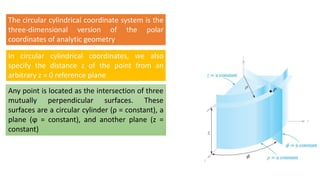
The circular cylindrical coordinate system is the
three-dimensional version of the polar
coordinates of analytic geometry
In circular cylindrical coordinates, we also
specify the distance z of the point from an
arbitrary z = 0 reference plane
Any point is located as the intersection of three
mutually perpendicular surfaces. These
surfaces are a circular cylinder (ρ = constant), a
plane (ϕ = constant), and another plane (z =
constant)
The three unit vectors are not defined along the
“coordinate axes,” for such axes exist only in
rectangular coordinates.
ax, ay and az were normal to the planes/surfaces
x=constant, y=constant and z= constant respectively.
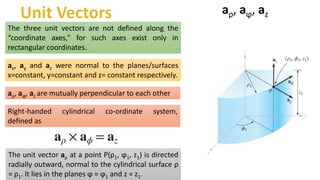
aρ, aϕ, az
The unit vector aρ at a point P(ρ1, ϕ1, z1) is directed
radially outward, normal to the cylindrical surface ρ
= ρ1. It lies in the planes ϕ = ϕ1 and z = z1.
aρ, aϕ, az are mutually perpendicular to each other
Right-handed cylindrical co-ordinate system,
defined as
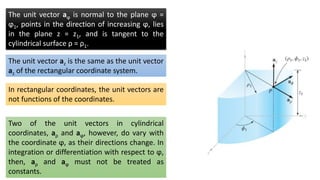
The unit vector aϕ is normal to the plane ϕ =
ϕ1, points in the direction of increasing ϕ, lies
in the plane z = z1, and is tangent to the
cylindrical surface ρ = ρ1.
The unit vector az is the same as the unit vector
az of the rectangular coordinate system.
In rectangular coordinates, the unit vectors are
not functions of the coordinates.
Two of the unit vectors in cylindrical
coordinates, aρ and aϕ, however, do vary with
the coordinate ϕ, as their directions change. In
integration or differentiation with respect to ϕ,
then, aρ and aϕ must not be treated as
constants.
Diferential Surfaces and Volume
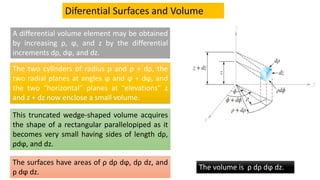
A differential volume element may be obtained
by increasing ρ, ϕ, and z by the differential
increments dρ, dϕ, and dz.
This truncated wedge-shaped volume acquires
the shape of a rectangular parallelopiped as it
becomes very small having sides of length dρ,
ρdϕ, and dz.
The two cylinders of radius ρ and ρ + dρ, the
two radial planes at angles ϕ and ϕ + dϕ, and
the two “horizontal” planes at “elevations” z
and z + dz now enclose a small volume.
The surfaces have areas of ρ dρ dϕ, dρ dz, and
ρ dϕ dz.
The volume is ρ dρ dϕ dz.

Cylinderical Coordinate System.pptx

  • 2.
    The circular cylindricalcoordinate system is the three-dimensional version of the polar coordinates of analytic geometry In circular cylindrical coordinates, we also specify the distance z of the point from an arbitrary z = 0 reference plane Any point is located as the intersection of three mutually perpendicular surfaces. These surfaces are a circular cylinder (ρ = constant), a plane (ϕ = constant), and another plane (z = constant)
  • 3.
    The three unitvectors are not defined along the “coordinate axes,” for such axes exist only in rectangular coordinates. ax, ay and az were normal to the planes/surfaces x=constant, y=constant and z= constant respectively. aρ, aϕ, az The unit vector aρ at a point P(ρ1, ϕ1, z1) is directed radially outward, normal to the cylindrical surface ρ = ρ1. It lies in the planes ϕ = ϕ1 and z = z1. aρ, aϕ, az are mutually perpendicular to each other Right-handed cylindrical co-ordinate system, defined as
  • 4.
    The unit vectoraϕ is normal to the plane ϕ = ϕ1, points in the direction of increasing ϕ, lies in the plane z = z1, and is tangent to the cylindrical surface ρ = ρ1. The unit vector az is the same as the unit vector az of the rectangular coordinate system. In rectangular coordinates, the unit vectors are not functions of the coordinates. Two of the unit vectors in cylindrical coordinates, aρ and aϕ, however, do vary with the coordinate ϕ, as their directions change. In integration or differentiation with respect to ϕ, then, aρ and aϕ must not be treated as constants.
  • 5.
    Diferential Surfaces andVolume A differential volume element may be obtained by increasing ρ, ϕ, and z by the differential increments dρ, dϕ, and dz. This truncated wedge-shaped volume acquires the shape of a rectangular parallelopiped as it becomes very small having sides of length dρ, ρdϕ, and dz. The two cylinders of radius ρ and ρ + dρ, the two radial planes at angles ϕ and ϕ + dϕ, and the two “horizontal” planes at “elevations” z and z + dz now enclose a small volume. The surfaces have areas of ρ dρ dϕ, dρ dz, and ρ dϕ dz. The volume is ρ dρ dϕ dz.