BY:NAILA SHUTTARY 
BRANCH:EEE 
ROLL NO:12D21A0213
 INTRODUCTION 
 OVERVIEW 
 COMPARISON 
 PURPOSE 
 VFD OPERATION 
 COMPONENTS OF VFD 
 WHY USE VFD? 
 BENEFITS OF VFD 
 INDUSTRIAL APPLICATIONS 
 CONCLUSION
 A Variable Frequency Drive (VFD) is a type of motor 
controller that drives an electric motor by varying the 
frequency and voltage supplied to the electric motor. 
 A variable frequency drive is an adjustable speed 
drive. 
 VFDs are available in a number of different low and 
medium voltage AC-AC and DC-AC topologies. 
 Other names for a VFD are variable speed 
drive, adjustable speed drive, adjustable frequency 
drive, AC drive, micro drive, and inverter.
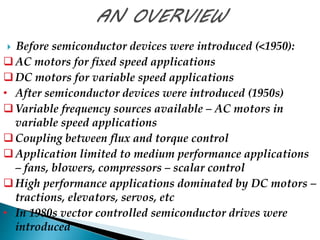
 Before semiconductor devices were introduced (<1950): 
 AC motors for fixed speed applications 
 DC motors for variable speed applications 
• After semiconductor devices were introduced (1950s) 
Variable frequency sources available – AC motors in 
variable speed applications 
Coupling between flux and torque control 
Application limited to medium performance applications 
– fans, blowers, compressors – scalar control 
 High performance applications dominated by DC motors – 
tractions, elevators, servos, etc 
• In 1980s vector controlled semiconductor drives were 
introduced
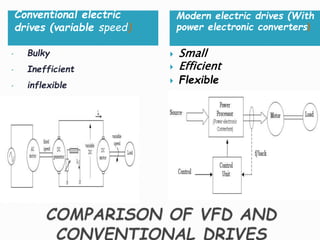
Conventional electric 
drives (variable speed) 
Modern electric drives (With 
power electronic converters) 
• Bulky 
• Inefficient 
• inflexible 
 Small 
 Efficient 
 Flexible
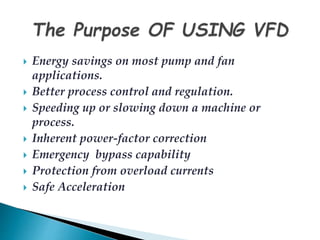
 Energy savings on most pump and fan 
applications. 
 Better process control and regulation. 
 Speeding up or slowing down a machine or 
process. 
 Inherent power-factor correction 
 Emergency bypass capability 
 Protection from overload currents 
 Safe Acceleration
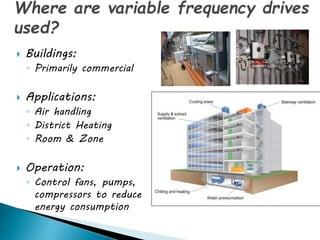
 Buildings: 
◦ Primarily commercial 
 Applications: 
◦ Air handling 
◦ District Heating 
◦ Room & Zone 
 Operation: 
◦ Control fans, pumps, 
compressors to reduce 
energy consumption
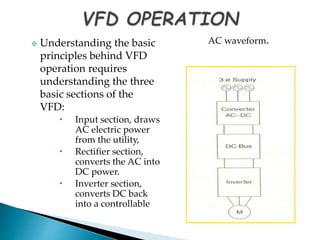
 Understanding the basic 
principles behind VFD 
operation requires 
understanding the three 
basic sections of the 
VFD: 
 Input section, draws 
AC electric power 
from the utility, 
 Rectifier section, 
converts the AC into 
DC power. 
 Inverter section, 
converts DC back 
into a controllable 
AC waveform.
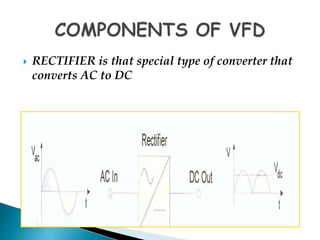
 RECTIFIER is that special type of converter that 
converts AC to DC
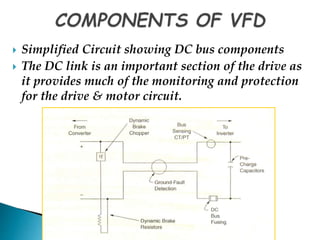
 Simplified Circuit showing DC bus components 
 The DC link is an important section of the drive as 
it provides much of the monitoring and protection 
for the drive & motor circuit.
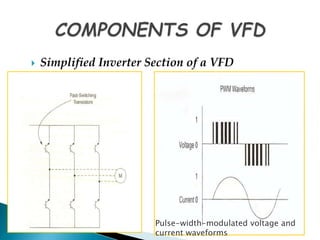
 Simplified Inverter Section of a VFD 
Pulse-width-modulated voltage and 
current waveforms
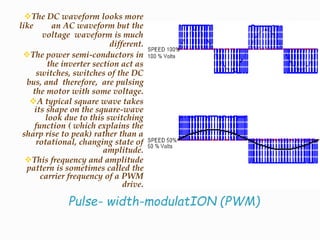
The DC waveform looks more 
like an AC waveform but the 
voltage waveform is much 
different. 
The power semi-conductors in 
the inverter section act as 
switches, switches of the DC 
bus, and therefore, are pulsing 
the motor with some voltage. 
A typical square wave takes 
its shape on the square-wave 
look due to this switching 
function ( which explains the 
sharp rise to peak) rather than a 
rotational, changing state of 
amplitude. 
This frequency and amplitude 
pattern is sometimes called the 
carrier frequency of a PWM 
drive. 
Pulse-width-modulated voltage and 
current waveforms 
Pulse- width-modulatION (PWM)
 Saves energy through fan and pump speed control 
◦ up to 70% energy savings in pump and fan applications 
 e.g. 32% average savings in a ventilation system → Payback 
period of 1 year 
 Decreases mechanical stress due to pressure spikes 
with direct on-line start & stop 
◦ VFDs creates a smooth start which reduces the pressure 
spikes that reduce system lifetime 
 Reduces the starting current of the motor 
◦ VFDs minimize the starting current of the motor, which 
means electrical installation investments can be lower
 As VFD usage in HVAC applications has increased, 
fans, pumps, air handlers, and chillers can benefit 
from speed control. Variable frequency drives 
provide the following advantages: 
 • energy savings 
 • low motor starting current 
 • reduction of thermal and mechanical 
 stresses on motors and belts during starts 
 • simple installation 
 • high power factor 
 • lower KVA
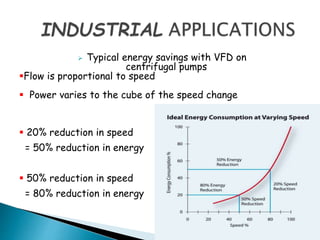
 Typical energy savings with VFD on 
centrifugal pumps 
Flow is proportional to speed 
 Power varies to the cube of the speed change 
 20% reduction in speed 
= 50% reduction in energy 
 50% reduction in speed 
= 80% reduction in energy
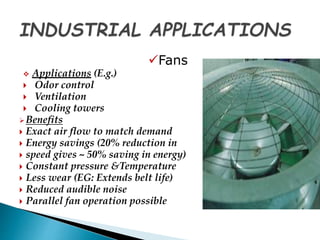
Fans 
 Applications (E.g.) 
 Odor control 
 Ventilation 
 Cooling towers 
Benefits 
 Exact air flow to match demand 
 Energy savings (20% reduction in 
 speed gives ~ 50% saving in energy) 
 Constant pressure &Temperature 
 Less wear (EG: Extends belt life) 
 Reduced audible noise 
 Parallel fan operation possible
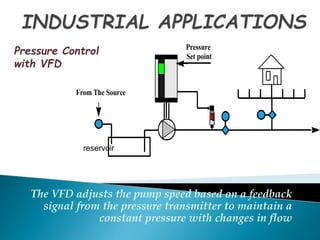
Pressure 
Set point 
From The Source 
reservoir 
The VFD adjusts the pump speed based on a feedback 
signal from the pressure transmitter to maintain a 
constant pressure with changes in flow 
Pressure Control 
with VFD
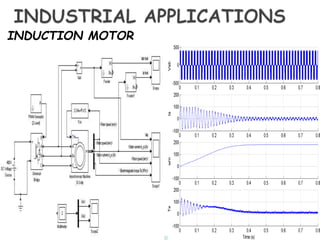
INDUCTION MOTOR
 Using VFDs, a small reduction in speed can save 
large amount of energy. 
 They help to reduce wear and tear. 
 This technology can meet even the most stringent 
harmonic standards and reduce backup sizing . 
 They provide lower KVA,helpin alleviate voltage 
sags. 
 They help to save money as well as energy losses 
are reduced.
Variable frequency drives for industrial applications

Variable frequency drives for industrial applications

  • 1.
    BY:NAILA SHUTTARY BRANCH:EEE ROLL NO:12D21A0213
  • 2.
     INTRODUCTION OVERVIEW  COMPARISON  PURPOSE  VFD OPERATION  COMPONENTS OF VFD  WHY USE VFD?  BENEFITS OF VFD  INDUSTRIAL APPLICATIONS  CONCLUSION
  • 3.
     A VariableFrequency Drive (VFD) is a type of motor controller that drives an electric motor by varying the frequency and voltage supplied to the electric motor.  A variable frequency drive is an adjustable speed drive.  VFDs are available in a number of different low and medium voltage AC-AC and DC-AC topologies.  Other names for a VFD are variable speed drive, adjustable speed drive, adjustable frequency drive, AC drive, micro drive, and inverter.
  • 4.
     Before semiconductordevices were introduced (<1950):  AC motors for fixed speed applications  DC motors for variable speed applications • After semiconductor devices were introduced (1950s) Variable frequency sources available – AC motors in variable speed applications Coupling between flux and torque control Application limited to medium performance applications – fans, blowers, compressors – scalar control  High performance applications dominated by DC motors – tractions, elevators, servos, etc • In 1980s vector controlled semiconductor drives were introduced
  • 5.
    Conventional electric drives(variable speed) Modern electric drives (With power electronic converters) • Bulky • Inefficient • inflexible  Small  Efficient  Flexible
  • 6.
     Energy savingson most pump and fan applications.  Better process control and regulation.  Speeding up or slowing down a machine or process.  Inherent power-factor correction  Emergency bypass capability  Protection from overload currents  Safe Acceleration
  • 7.
     Buildings: ◦Primarily commercial  Applications: ◦ Air handling ◦ District Heating ◦ Room & Zone  Operation: ◦ Control fans, pumps, compressors to reduce energy consumption
  • 8.
     Understanding thebasic principles behind VFD operation requires understanding the three basic sections of the VFD:  Input section, draws AC electric power from the utility,  Rectifier section, converts the AC into DC power.  Inverter section, converts DC back into a controllable AC waveform.
  • 9.
     RECTIFIER isthat special type of converter that converts AC to DC
  • 10.
     Simplified Circuitshowing DC bus components  The DC link is an important section of the drive as it provides much of the monitoring and protection for the drive & motor circuit.
  • 11.
     Simplified InverterSection of a VFD Pulse-width-modulated voltage and current waveforms
  • 12.
    The DC waveformlooks more like an AC waveform but the voltage waveform is much different. The power semi-conductors in the inverter section act as switches, switches of the DC bus, and therefore, are pulsing the motor with some voltage. A typical square wave takes its shape on the square-wave look due to this switching function ( which explains the sharp rise to peak) rather than a rotational, changing state of amplitude. This frequency and amplitude pattern is sometimes called the carrier frequency of a PWM drive. Pulse-width-modulated voltage and current waveforms Pulse- width-modulatION (PWM)
  • 13.
     Saves energythrough fan and pump speed control ◦ up to 70% energy savings in pump and fan applications  e.g. 32% average savings in a ventilation system → Payback period of 1 year  Decreases mechanical stress due to pressure spikes with direct on-line start & stop ◦ VFDs creates a smooth start which reduces the pressure spikes that reduce system lifetime  Reduces the starting current of the motor ◦ VFDs minimize the starting current of the motor, which means electrical installation investments can be lower
  • 14.
     As VFDusage in HVAC applications has increased, fans, pumps, air handlers, and chillers can benefit from speed control. Variable frequency drives provide the following advantages:  • energy savings  • low motor starting current  • reduction of thermal and mechanical  stresses on motors and belts during starts  • simple installation  • high power factor  • lower KVA
  • 15.
     Typical energysavings with VFD on centrifugal pumps Flow is proportional to speed  Power varies to the cube of the speed change  20% reduction in speed = 50% reduction in energy  50% reduction in speed = 80% reduction in energy
  • 16.
    Fans  Applications(E.g.)  Odor control  Ventilation  Cooling towers Benefits  Exact air flow to match demand  Energy savings (20% reduction in  speed gives ~ 50% saving in energy)  Constant pressure &Temperature  Less wear (EG: Extends belt life)  Reduced audible noise  Parallel fan operation possible
  • 17.
    Pressure Set point From The Source reservoir The VFD adjusts the pump speed based on a feedback signal from the pressure transmitter to maintain a constant pressure with changes in flow Pressure Control with VFD
  • 18.
  • 19.
     Using VFDs,a small reduction in speed can save large amount of energy.  They help to reduce wear and tear.  This technology can meet even the most stringent harmonic standards and reduce backup sizing .  They provide lower KVA,helpin alleviate voltage sags.  They help to save money as well as energy losses are reduced.