Title-
Variable Frequency Drive(VFD)
Presented By- Borse Rishikesh Sanjay
Introduction to Variable Frequency
Drive
A variable-frequency drive (VFD) (also
termed adjustable-frequency drive,
variable speed drive, AC drive, micro drive
or inverter drive) is a type of adjustable-
speed drive used in electro-mechanical
drive systems to control AC motor speed
and torque by varying motor input
frequency and voltage.
The Purpose Of VFD
1. Energy savings on most pump and fan applications.
2. Better process control and regulation.
3. Speeding up or slowing down a machine or
process.
4. Inherent power-factor correction
5. Emergency bypass capability
6. Protection from overload currents
7. Safe Acceleration
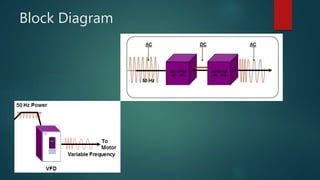
Block Diagram
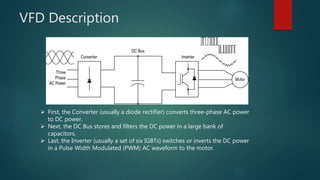
VFD Description
 First, the Converter (usually a diode rectifier) converts three-phase AC power
to DC power.
 Next, the DC Bus stores and filters the DC power in a large bank of
capacitors.
 Last, the Inverter (usually a set of six IGBTs) switches or inverts the DC power
in a Pulse Width Modulated (PWM) AC waveform to the motor.
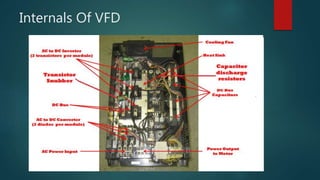
Internals Of VFD
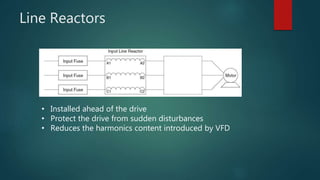
Line Reactors
• Installed ahead of the drive
• Protect the drive from sudden disturbances
• Reduces the harmonics content introduced by VFD
High peaks
without reactor
Reduction Up
to 35% after
reactor
VFD Features:
 High-performance optimized voltage space vector V/F algorithm and high efficiency VFD,
low noise and low electromagnetic interference.
 Motor speed monitor function allows smooth start for various loads such as centrifuges
and dewatering machines anytime.
 Built-in software special for constant pressure water supply system enables one VFD to
control two pumps simultaneously without adding extra expansion unit.
 English LED control panel with friendly human-computer interface.
 Real time clock timing control (easily set the variable frequency drive running time)
VFD applications
 Widely used in
1. textile
2. Cable
3. Printing& dying
4. Washing
5. Fans & pumps
6. Package
7. Plastic extruding machines,
8. Machinery
9. Constant pressure water supply
10. Constant temperature control
Manufactures of VFD
 Siemens
 ABB
 Danfoss
 Larsen and Turbo
 Mitsubishi
 Electrotech
• Significant Energy Savings can be
obtained by using VFD
• It requires less Space
• It has a Better design
• It has an Competitive edge
• Retrofits
Conclusion

Varaible frequency drive

  • 1.
  • 2.
    Introduction to VariableFrequency Drive A variable-frequency drive (VFD) (also termed adjustable-frequency drive, variable speed drive, AC drive, micro drive or inverter drive) is a type of adjustable- speed drive used in electro-mechanical drive systems to control AC motor speed and torque by varying motor input frequency and voltage.
  • 3.
    The Purpose OfVFD 1. Energy savings on most pump and fan applications. 2. Better process control and regulation. 3. Speeding up or slowing down a machine or process. 4. Inherent power-factor correction 5. Emergency bypass capability 6. Protection from overload currents 7. Safe Acceleration
  • 4.
  • 5.
    VFD Description  First,the Converter (usually a diode rectifier) converts three-phase AC power to DC power.  Next, the DC Bus stores and filters the DC power in a large bank of capacitors.  Last, the Inverter (usually a set of six IGBTs) switches or inverts the DC power in a Pulse Width Modulated (PWM) AC waveform to the motor.
  • 6.
  • 7.
    Line Reactors • Installedahead of the drive • Protect the drive from sudden disturbances • Reduces the harmonics content introduced by VFD
  • 8.
    High peaks without reactor ReductionUp to 35% after reactor
  • 9.
    VFD Features:  High-performanceoptimized voltage space vector V/F algorithm and high efficiency VFD, low noise and low electromagnetic interference.  Motor speed monitor function allows smooth start for various loads such as centrifuges and dewatering machines anytime.  Built-in software special for constant pressure water supply system enables one VFD to control two pumps simultaneously without adding extra expansion unit.  English LED control panel with friendly human-computer interface.  Real time clock timing control (easily set the variable frequency drive running time)
  • 10.
    VFD applications  Widelyused in 1. textile 2. Cable 3. Printing& dying 4. Washing 5. Fans & pumps 6. Package 7. Plastic extruding machines, 8. Machinery 9. Constant pressure water supply 10. Constant temperature control
  • 11.
    Manufactures of VFD Siemens  ABB  Danfoss  Larsen and Turbo  Mitsubishi  Electrotech
  • 12.
    • Significant EnergySavings can be obtained by using VFD • It requires less Space • It has a Better design • It has an Competitive edge • Retrofits Conclusion