MAGNETIC 
LEVITATION 
(MAGLEV) 
BY:NAILA SHUTTARY 
BRANCH :EEE 
ROLL NO :12D21A0213
CONTENTS 
INTRODUCTION 
BRIEF HISTORY 
BASIC PRINCIPLE 
TYPES OF LEVITATION 
TECHNIQUES 
APPLICATIONS 
ADVANTAGES 
DISADVANTAGES 
CONCLUSION
INTRODUCTION 
 ANY THING WHICH MAY LEVITATE (FLOAT OR RAISE) 
BY MEANS OF MAGNETIC POWER IS CALLED 
“MAGNETIC LEVITATION”. 
 It is a method to counteract with the effect of GRAVITATIONAL 
and OTHER ACCELERATIONS. 
 It is also known as “MAGLEV” or “MAGNETIC SUSPENSION” 
 It is a system of transportation that uses magnetic levitation to 
suspend, guide and propel vehicles from magnets rather than using 
mechanical methods, such as wheels, axles and bearings. 
 The term “MAGLEV” can be briefly explained by using the 
example of maglev trains.
BRIEF HISTORY 
The history of maglev train started already in the beginning 
of the 1900's century, when the scientists conceived the idea 
of frictionless trains. 
The Japanese started their research on maglev 
transportations in the beginning of the 1970s. 
Germans took them ten years to complete the construction 
of the first track model. In 1993 the longest nonstop test 
running was 1.674 km. 
 In China, 2003, they finished a 30 km long German variant 
of maglev train in Shanghai, that propels by attractive 
forces, EMS . 
This is the first commercial magnetic levitation train in the 
world. This project cost over 1 billion dollar!!!!!!
BASIC PRINCIPLE 
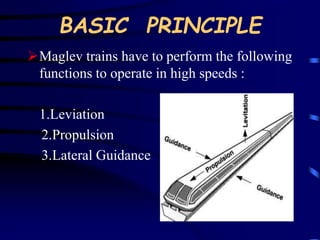
Maglev trains have to perform the following 
functions to operate in high speeds : 
1.Leviation 
2.Propulsion 
3.Lateral Guidance
PRINCIPLE OFMAGNET LEVITATION 
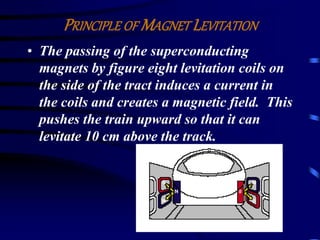
• The passing of the superconducting 
magnets by figure eight levitation coils on 
the side of the tract induces a current in 
the coils and creates a magnetic field. This 
pushes the train upward so that it can 
levitate 10 cm above the track.
Principle of PROPULSION 
Propulsion is a means of creating force leading 
to movement. 
The term propulsion is derived from two Latin 
words: pro meaning before or forwards and pellere meaning 
to drive. 
The propulsion coils located on the sidewalls on both sides 
of the guide way are energized by a three-phase alternating 
current from a substation, creating a shifting magnetic field 
on the guide way. 
The on-board superconducting magnets are attracted and 
pushed by the shifting field, propelling the Maglev vehicle. 
Braking is accomplished by sending an alternating current 
in the reverse direction so that it is slowed by attractive and 
repulsive forces.
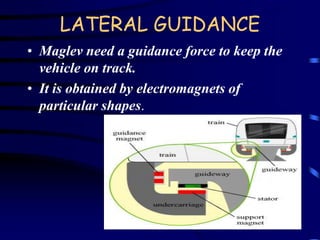
LATERAL GUIDANCE 
• Maglev need a guidance force to keep the 
vehicle on track. 
• It is obtained by electromagnets of 
particular shapes.
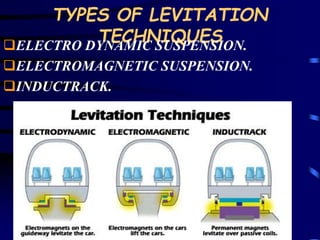
TYPES OF LEVITATION 
TECHNIQUES ELECTRO DYNAMIC SUSPENSION. 
ELECTROMAGNETIC SUSPENSION. 
INDUCTRACK.
APPLICATIONS 
High speed trains in Europe and 
Japan are perhaps the best example 
of magnetic levitation technology. 
Magnetic bearings are another 
application of magnetic levitation 
technology formed by electromagnetic 
suspension and electromagnets. 
Magnetic bearings support loads 
without any kind of physical contact. 
Two additional scientific applications 
for magnetic levitation include 
flywheels and levitation melting. 
Flywheels are rotating mechanisms
ADVANTAGES 
 Maglev uses 30% less energy than a high-speed train traveling at the same 
speed (1/3 more power for the same amount of energy). 
 The operating costs of a maglev system are approximately half that of 
conventional long-distance railroads. 
 Research has shown that the maglev is about 20 times safer than airplanes, 
250 times safer than conventional railroads, and 700 times safer than 
automobile travel. 
 Maglev vehicle carries no fuel to increase fire hazard 
 The materials used to construct maglev vehicles are non-combustible, poor 
penetration transmitters of heat, and able to withstand fire.
DISADVANTAGES 
• The high cost is incurred on the initial setup. 
• Maglev trains require an all new set up right from 
the scratch. 
• As the present railway infrastructure is of no use 
for maglev, it will either have to be replaced with 
the Maglev System or an entirely new set up will 
have to be created―both of which will cost a decent 
amount in terms of initial investment. 
• Although MagLev are pretty quiet, noise caused by 
air disturbance still occurs.
OTHER APPLICATIONS 
NASA plans to use magnetic levitation for launching 
of space vehicles into low earth orbit. 
 Boeing is pursuing research in Maglev to provide a 
Hypersonic Ground Test Facility for the Air Force. 
 The mining industry will also benefit from Maglev. 
 There are probably many more undiscovered 
applications!!!!!!
FUTURE PROPOSALS 
The Indian Ministry is currently in the 
process of reviewing a proposal to start a 
Maglev train system in India and has 
estimated the cost would be approx. $30 
billion!!!!!!!! 
Malaysia has decided to use Maglev 
technology to link important landmarks 
across the city. 
Japan, inventor of the world’s first bullet 
train, recently unveiled plans for an even 
faster and more radical train model: 
a floating train, powered by magnets, that will 
travel 100 mph faster than current 
bullet trains (about 300 mph).
CONCLUSION 
• The Maglev Train: Research on this ‘dream train' has 
been going on for the last 30 odd years in various parts of 
the world. 
• The chief advantages of this type of train are: 
Non-contact and non-wearing propulsion, independent of 
friction, no mechanical components like wheel, axle. 
• Maintenance costs decreases. 
• The Maglev offers a cheap, efficient alternative to the 
current rail system. A country like India could benefit 
very much if this were implemented here. Further 
possible applications need to be explored ………………
Magnetic levitation (MAGLEV)

Magnetic levitation (MAGLEV)

  • 1.
    MAGNETIC LEVITATION (MAGLEV) BY:NAILA SHUTTARY BRANCH :EEE ROLL NO :12D21A0213
  • 2.
    CONTENTS INTRODUCTION BRIEFHISTORY BASIC PRINCIPLE TYPES OF LEVITATION TECHNIQUES APPLICATIONS ADVANTAGES DISADVANTAGES CONCLUSION
  • 3.
    INTRODUCTION  ANYTHING WHICH MAY LEVITATE (FLOAT OR RAISE) BY MEANS OF MAGNETIC POWER IS CALLED “MAGNETIC LEVITATION”.  It is a method to counteract with the effect of GRAVITATIONAL and OTHER ACCELERATIONS.  It is also known as “MAGLEV” or “MAGNETIC SUSPENSION”  It is a system of transportation that uses magnetic levitation to suspend, guide and propel vehicles from magnets rather than using mechanical methods, such as wheels, axles and bearings.  The term “MAGLEV” can be briefly explained by using the example of maglev trains.
  • 4.
    BRIEF HISTORY Thehistory of maglev train started already in the beginning of the 1900's century, when the scientists conceived the idea of frictionless trains. The Japanese started their research on maglev transportations in the beginning of the 1970s. Germans took them ten years to complete the construction of the first track model. In 1993 the longest nonstop test running was 1.674 km.  In China, 2003, they finished a 30 km long German variant of maglev train in Shanghai, that propels by attractive forces, EMS . This is the first commercial magnetic levitation train in the world. This project cost over 1 billion dollar!!!!!!
  • 5.
    BASIC PRINCIPLE Maglevtrains have to perform the following functions to operate in high speeds : 1.Leviation 2.Propulsion 3.Lateral Guidance
  • 6.
    PRINCIPLE OFMAGNET LEVITATION • The passing of the superconducting magnets by figure eight levitation coils on the side of the tract induces a current in the coils and creates a magnetic field. This pushes the train upward so that it can levitate 10 cm above the track.
  • 7.
    Principle of PROPULSION Propulsion is a means of creating force leading to movement. The term propulsion is derived from two Latin words: pro meaning before or forwards and pellere meaning to drive. The propulsion coils located on the sidewalls on both sides of the guide way are energized by a three-phase alternating current from a substation, creating a shifting magnetic field on the guide way. The on-board superconducting magnets are attracted and pushed by the shifting field, propelling the Maglev vehicle. Braking is accomplished by sending an alternating current in the reverse direction so that it is slowed by attractive and repulsive forces.
  • 8.
    LATERAL GUIDANCE •Maglev need a guidance force to keep the vehicle on track. • It is obtained by electromagnets of particular shapes.
  • 9.
    TYPES OF LEVITATION TECHNIQUES ELECTRO DYNAMIC SUSPENSION. ELECTROMAGNETIC SUSPENSION. INDUCTRACK.
  • 10.
    APPLICATIONS High speedtrains in Europe and Japan are perhaps the best example of magnetic levitation technology. Magnetic bearings are another application of magnetic levitation technology formed by electromagnetic suspension and electromagnets. Magnetic bearings support loads without any kind of physical contact. Two additional scientific applications for magnetic levitation include flywheels and levitation melting. Flywheels are rotating mechanisms
  • 11.
    ADVANTAGES  Maglevuses 30% less energy than a high-speed train traveling at the same speed (1/3 more power for the same amount of energy).  The operating costs of a maglev system are approximately half that of conventional long-distance railroads.  Research has shown that the maglev is about 20 times safer than airplanes, 250 times safer than conventional railroads, and 700 times safer than automobile travel.  Maglev vehicle carries no fuel to increase fire hazard  The materials used to construct maglev vehicles are non-combustible, poor penetration transmitters of heat, and able to withstand fire.
  • 12.
    DISADVANTAGES • Thehigh cost is incurred on the initial setup. • Maglev trains require an all new set up right from the scratch. • As the present railway infrastructure is of no use for maglev, it will either have to be replaced with the Maglev System or an entirely new set up will have to be created―both of which will cost a decent amount in terms of initial investment. • Although MagLev are pretty quiet, noise caused by air disturbance still occurs.
  • 13.
    OTHER APPLICATIONS NASAplans to use magnetic levitation for launching of space vehicles into low earth orbit.  Boeing is pursuing research in Maglev to provide a Hypersonic Ground Test Facility for the Air Force.  The mining industry will also benefit from Maglev.  There are probably many more undiscovered applications!!!!!!
  • 14.
    FUTURE PROPOSALS TheIndian Ministry is currently in the process of reviewing a proposal to start a Maglev train system in India and has estimated the cost would be approx. $30 billion!!!!!!!! Malaysia has decided to use Maglev technology to link important landmarks across the city. Japan, inventor of the world’s first bullet train, recently unveiled plans for an even faster and more radical train model: a floating train, powered by magnets, that will travel 100 mph faster than current bullet trains (about 300 mph).
  • 15.
    CONCLUSION • TheMaglev Train: Research on this ‘dream train' has been going on for the last 30 odd years in various parts of the world. • The chief advantages of this type of train are: Non-contact and non-wearing propulsion, independent of friction, no mechanical components like wheel, axle. • Maintenance costs decreases. • The Maglev offers a cheap, efficient alternative to the current rail system. A country like India could benefit very much if this were implemented here. Further possible applications need to be explored ………………