Validation of Analytical Methods
Mr. Sagar Kishor Savale
M. Pharm [Pharmaceutics]
Mr. Sagar Kishor Savale
 Analytical methods plays a vital role in new drug development, Preformulation and
formulation studies, stability studies and quality control testing.
 This method must be simple, specific, accurate, precise, economical and convenient. The
method should be validated during its development and use.
Introduction
Mr. Sagar Kishor Savale
 Validation is relatively new concept in pharmaceutical manufacturing evolved in 1980’s.
 Validation is documented evidence which provides a high degree of assurance that a specific
process will consistently produce a product meeting its pre-determined specifications and
quality characteristics.
Concept of Validation
Mr. Sagar Kishor Savale
 Analytical validation refers to the evaluation and proving that an analytical method serves the
intended purpose.
 Analytical validation ensures that the selected analytical method will give reproducible and
reliable results adequate for Intended Purpose.
Analytical Validation
Mr. Sagar Kishor Savale
Considerations Prior to Method Validation
Suitability of Instrument: Status of Qualification and Calibration.
Suitability of Materials: Status of Reference Standards, Reagents, Placebo Lots.
Suitability of Analyst: Status of Training and Qualification Records.
Suitability of Documentation: Written analytical procedure and proper approved
protocol with pre-established acceptance criteria
Mr. Sagar Kishor Savale
Validation Step
 Define the application, purpose and scope of the method.
 Analytes? Concentration? Sample matrices?
 Develop a analytical method.
 Develop a validation protocol.
Mr. Sagar Kishor Savale
Validation Step
 Qualification of instrument.
 Qualify/train operator.
 Qualification of material.
 Perform pre-validation experiments.
Mr. Sagar Kishor Savale
Validation Step
 Adjust method parameters and/or acceptance criteria if necessary.
 Perform full validation experiments.
 Develop SOP for executing the method in routine analysis.
 Document validation experiments and results in the validation report.
Mr. Sagar Kishor Savale
Purpose of Method Validation
 Identification of Sources and Quantitation of Potential errors
 Determination if Method is Acceptable for Intended Use
 Establish Proof that a Method Can be Used for Decision Making
 Satisfy FDA Requirements
Mr. Sagar Kishor Savale
Published Validation Guidelines
 1978 Current Good Manufacturing Practices (cGMPs)
 1987 FDA Validation Guideline
 1989 Supplement 9 to USP XXI
 1994 CDER Reviewer Guidance: Validation of Chromatographic Method
Mr. Sagar Kishor Savale
 1995 ICH Validation Definitions: Q2A, Text on Validation of Analytical procedures.
 1997 ICH Validation Methodology: Q2B, Validation of Analytical Procedures:
Methodology.
 1999 Supplement 10 to USP 23 <1225>: Validation of Compendial Methods
Published Validation Guidelines
Mr. Sagar Kishor Savale
Published Validation Guidelines
 1999 CDER “Bio analytical Method: Validation for Human Studies”
 2000 CDER Draft “Analytical Procedures and Method Validation”
Mr. Sagar Kishor Savale
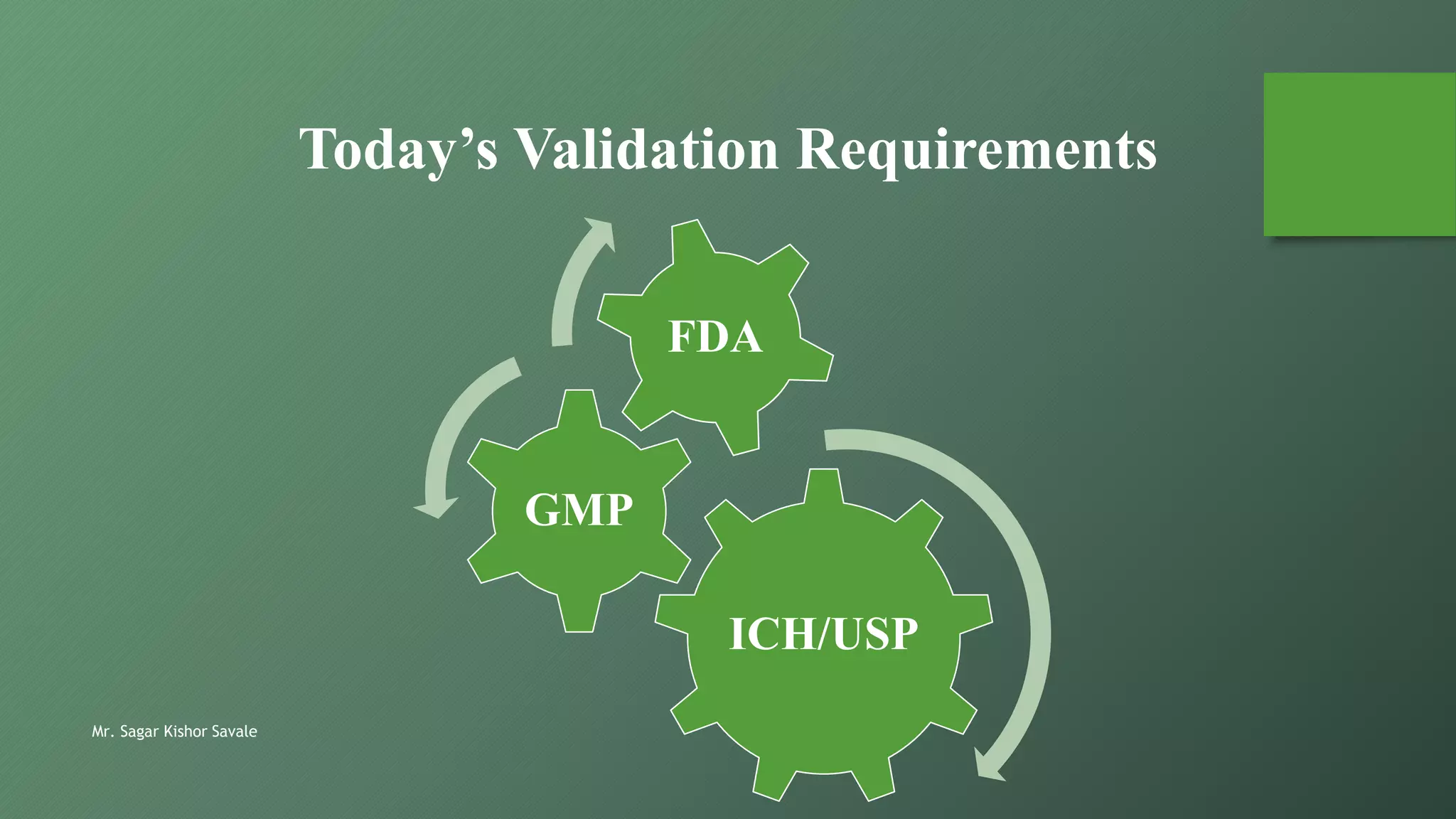
Today’s Validation Requirements
ICH/USP
GMP
FDA
Mr. Sagar Kishor Savale
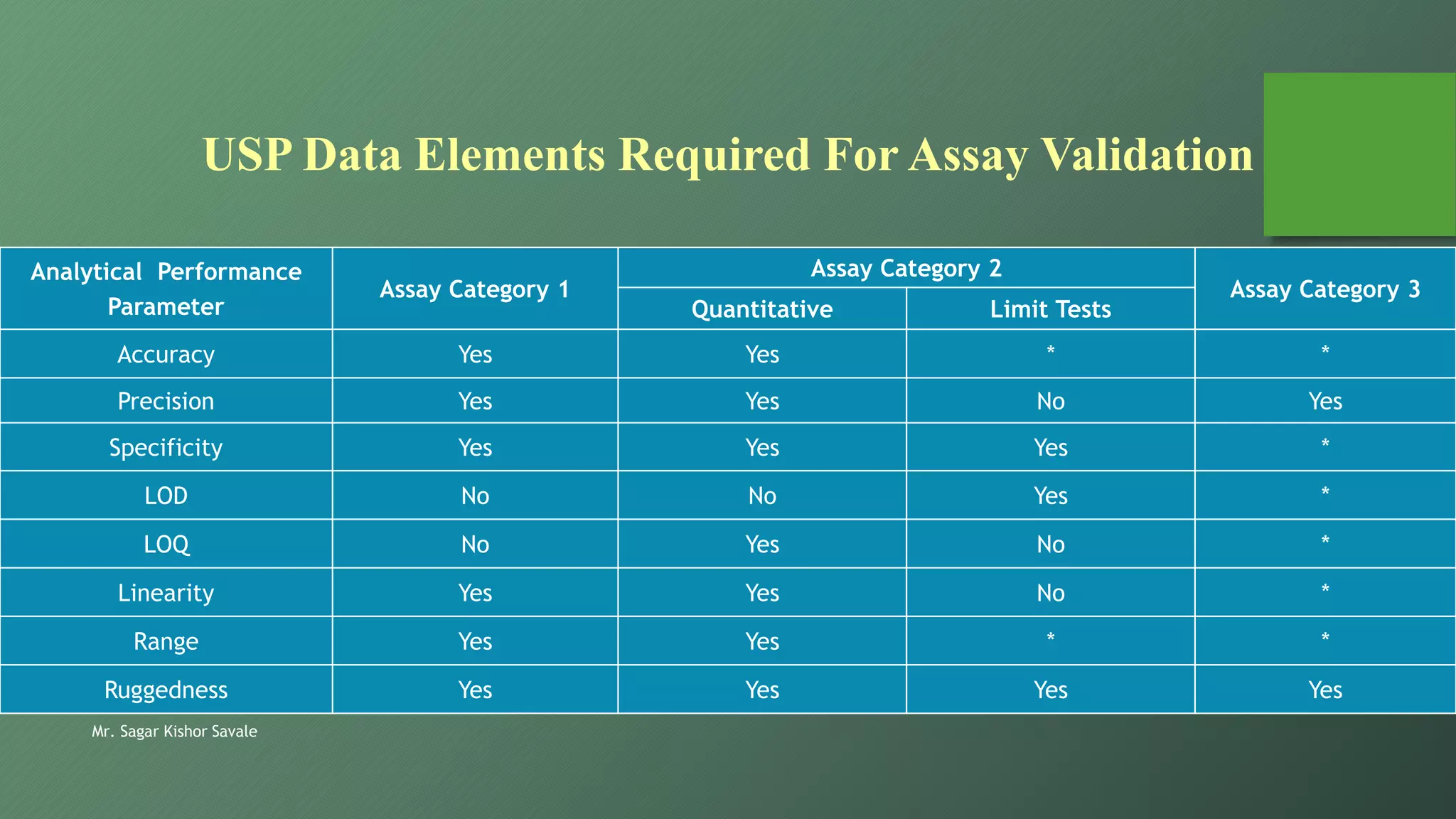
USP Data Elements Required For Assay Validation
Analytical Performance
Parameter
Assay Category 1
Assay Category 2
Assay Category 3
Quantitative Limit Tests
Accuracy Yes Yes * *
Precision Yes Yes No Yes
Specificity Yes Yes Yes *
LOD No No Yes *
LOQ No Yes No *
Linearity Yes Yes No *
Range Yes Yes * *
Ruggedness Yes Yes Yes Yes
Mr. Sagar Kishor Savale
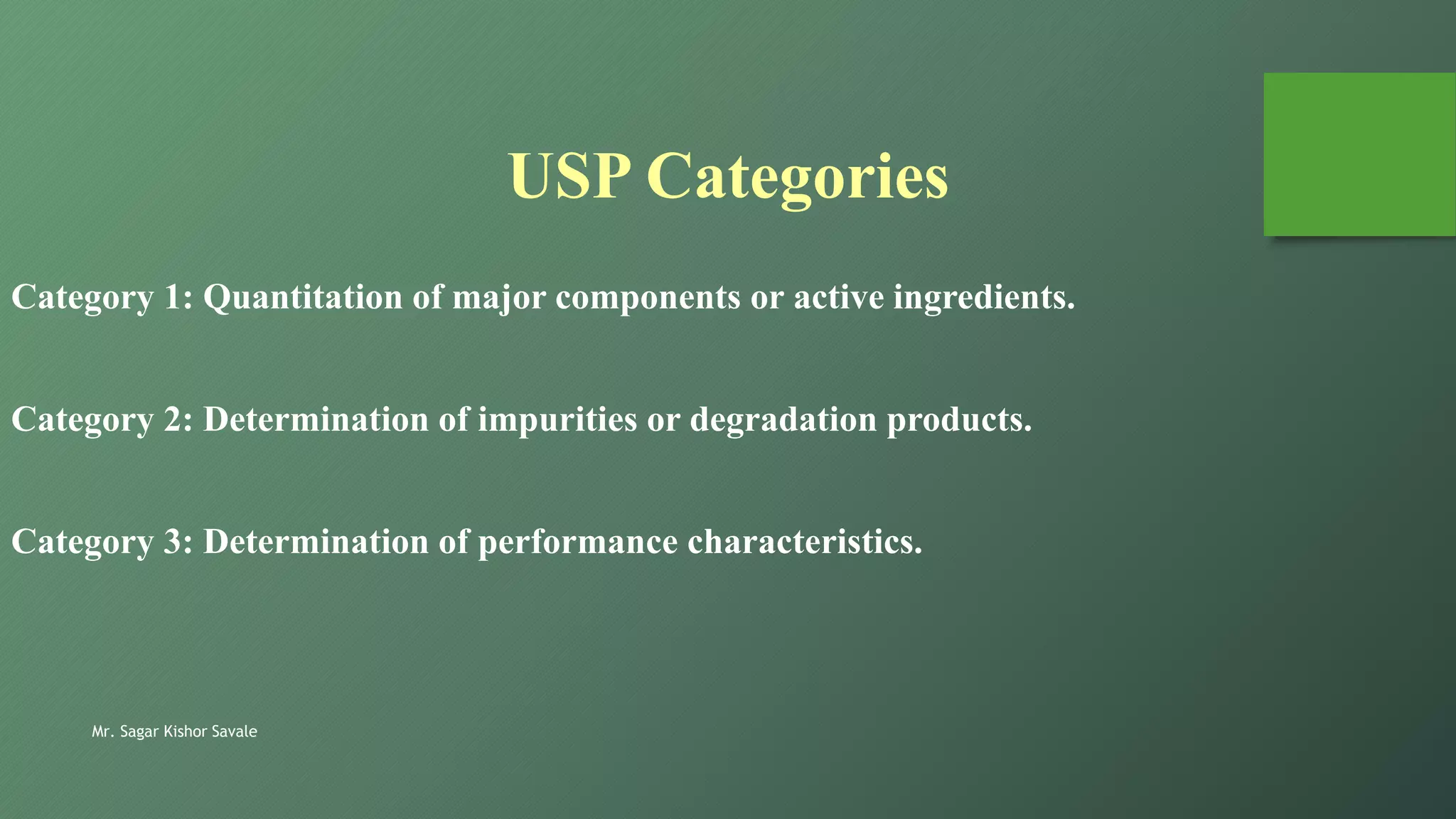
USP Categories
Category 1: Quantitation of major components or active ingredients.
Category 2: Determination of impurities or degradation products.
Category 3: Determination of performance characteristics.
Mr. Sagar Kishor Savale
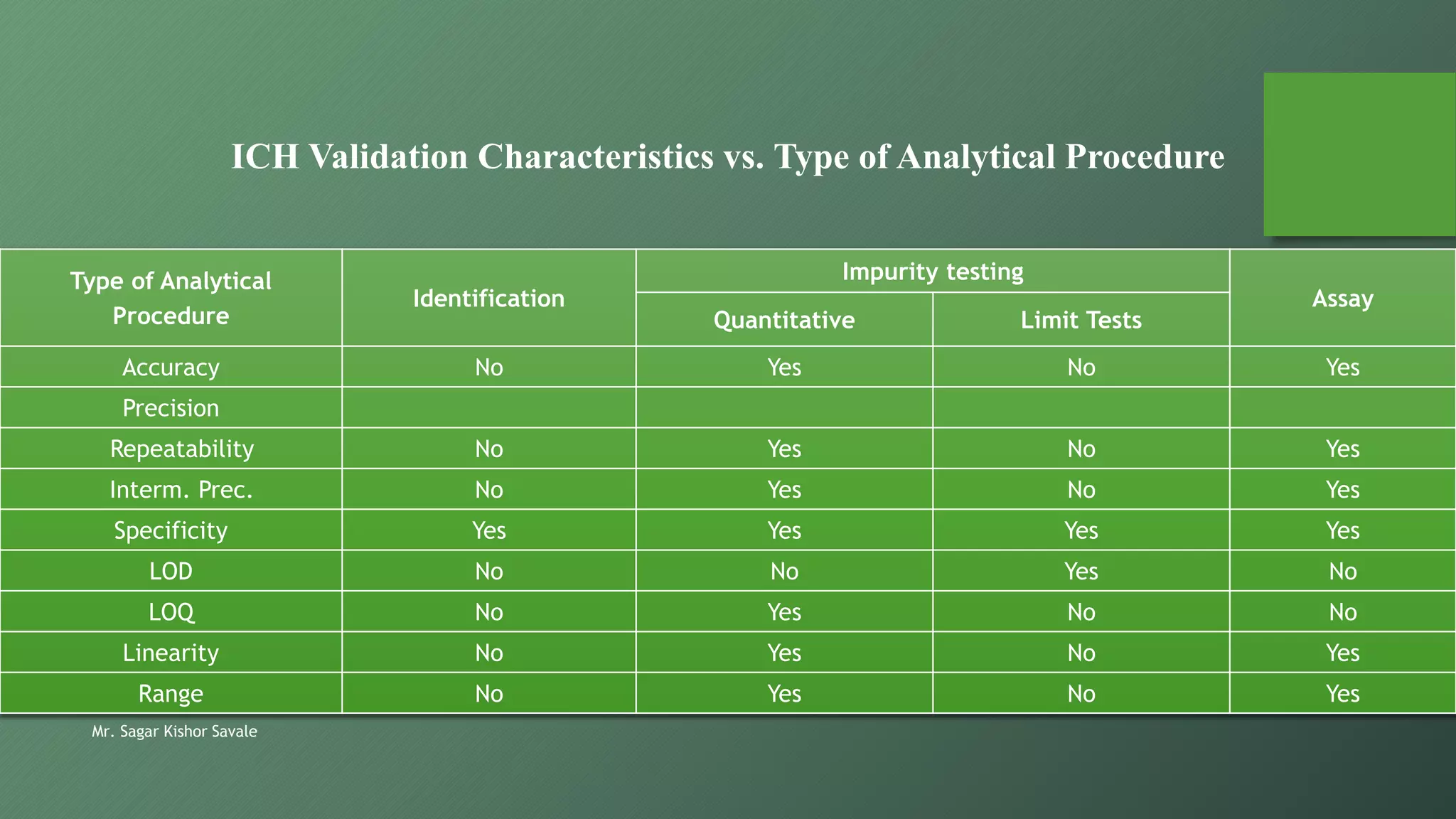
ICH Validation Characteristics vs. Type of Analytical Procedure
Type of Analytical
Procedure
Identification
Impurity testing
Assay
Quantitative Limit Tests
Accuracy No Yes No Yes
Precision
Repeatability No Yes No Yes
Interm. Prec. No Yes No Yes
Specificity Yes Yes Yes Yes
LOD No No Yes No
LOQ No Yes No No
Linearity No Yes No Yes
Range No Yes No Yes
Mr. Sagar Kishor Savale
Accuracy
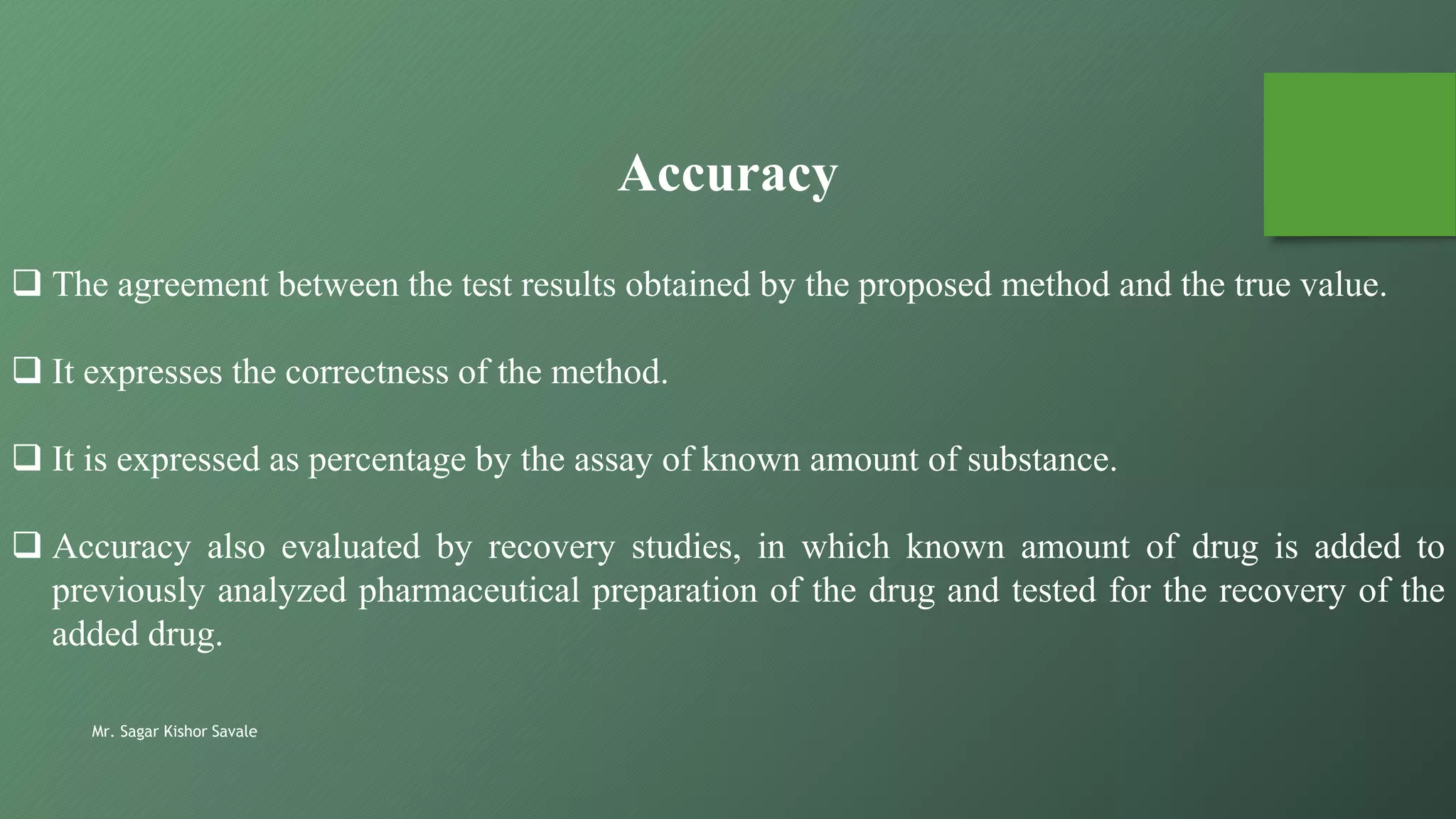
 The agreement between the test results obtained by the proposed method and the true value.
 It expresses the correctness of the method.
 It is expressed as percentage by the assay of known amount of substance.
 Accuracy also evaluated by recovery studies, in which known amount of drug is added to
previously analyzed pharmaceutical preparation of the drug and tested for the recovery of the
added drug.
Mr. Sagar Kishor Savale
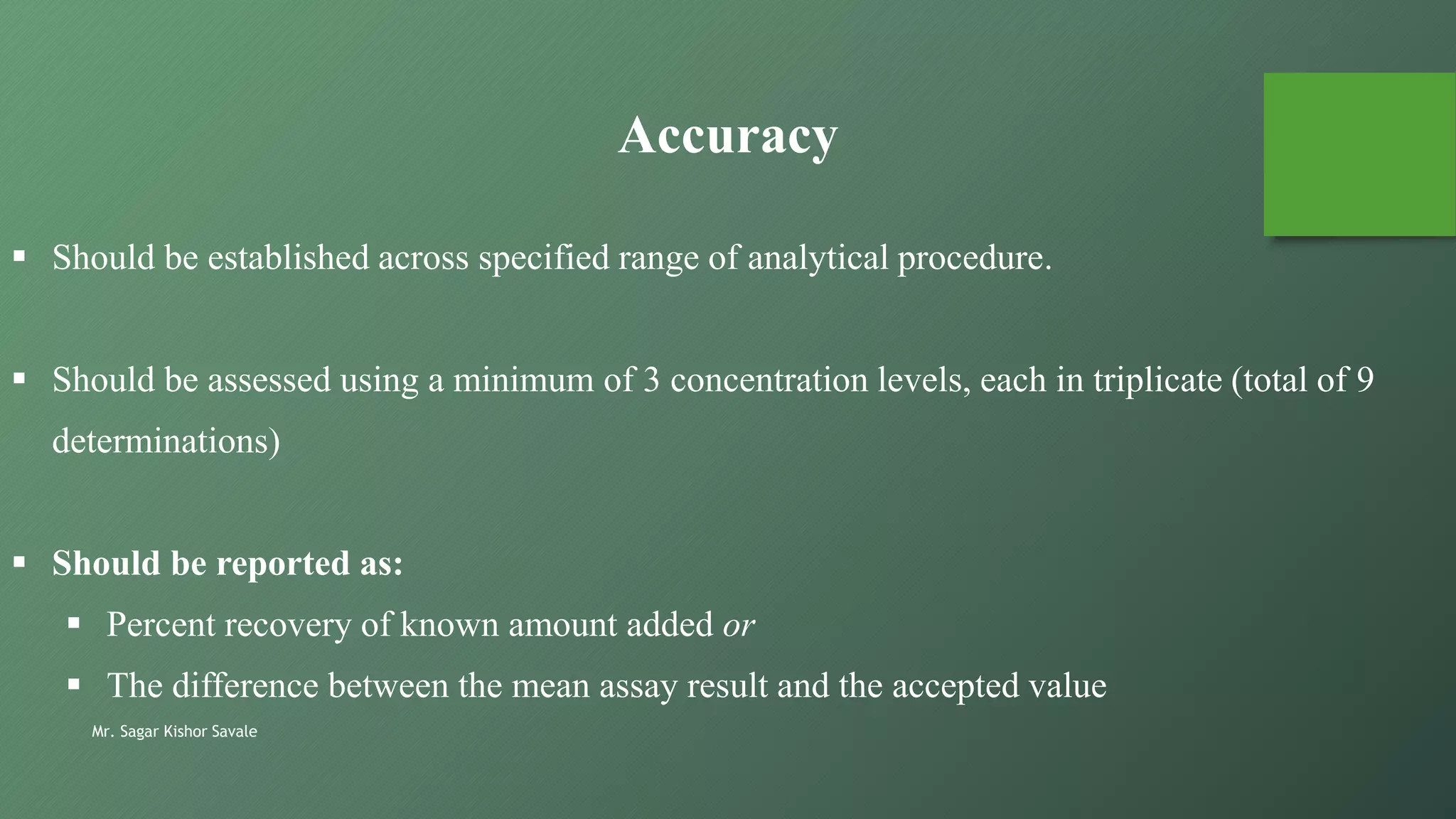
 Should be established across specified range of analytical procedure.
 Should be assessed using a minimum of 3 concentration levels, each in triplicate (total of 9
determinations)
 Should be reported as:
 Percent recovery of known amount added or
 The difference between the mean assay result and the accepted value
Accuracy
Mr. Sagar Kishor Savale
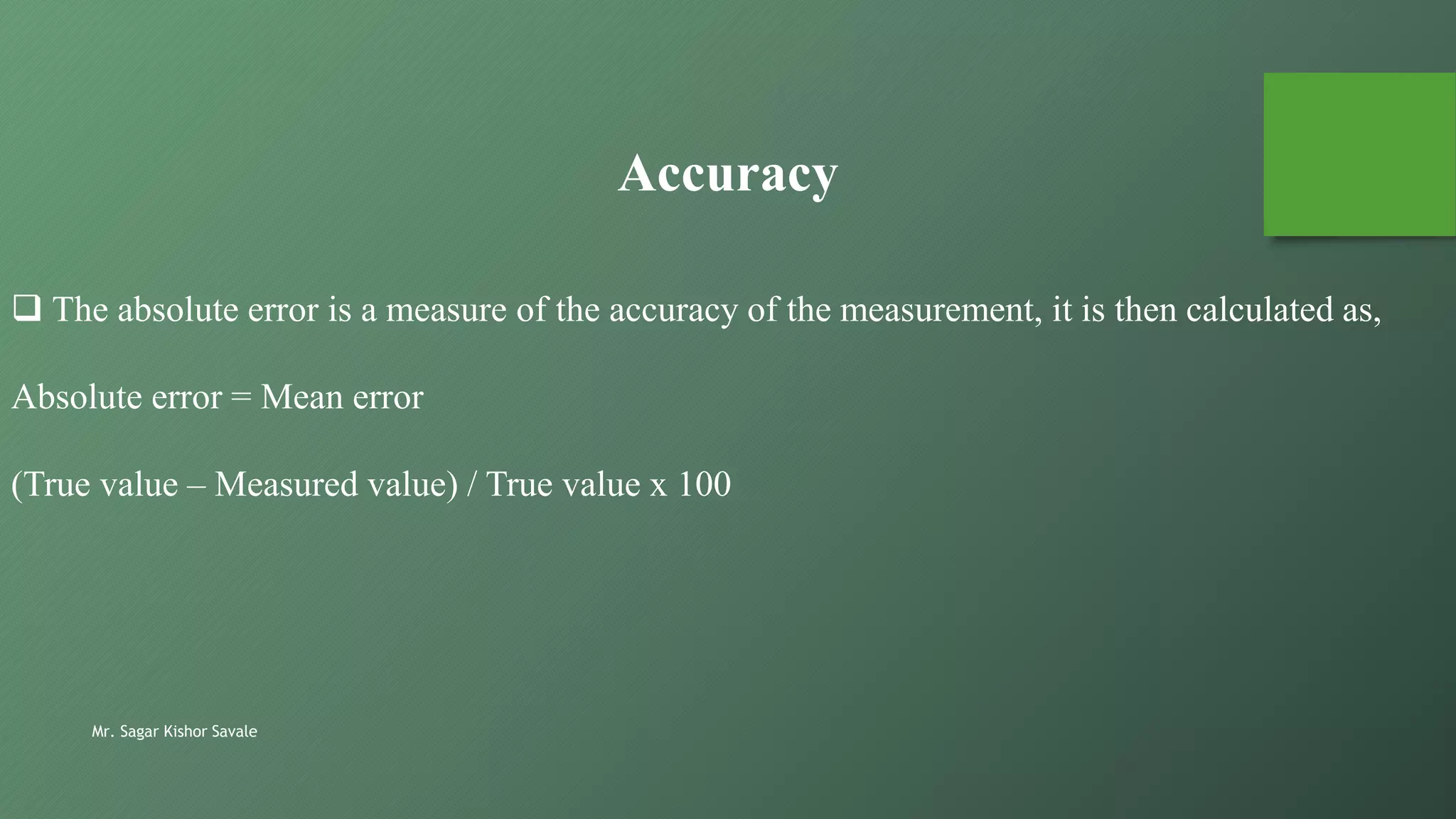
 The absolute error is a measure of the accuracy of the measurement, it is then calculated as,
Absolute error = Mean error
(True value – Measured value) / True value x 100
Accuracy
Mr. Sagar Kishor Savale
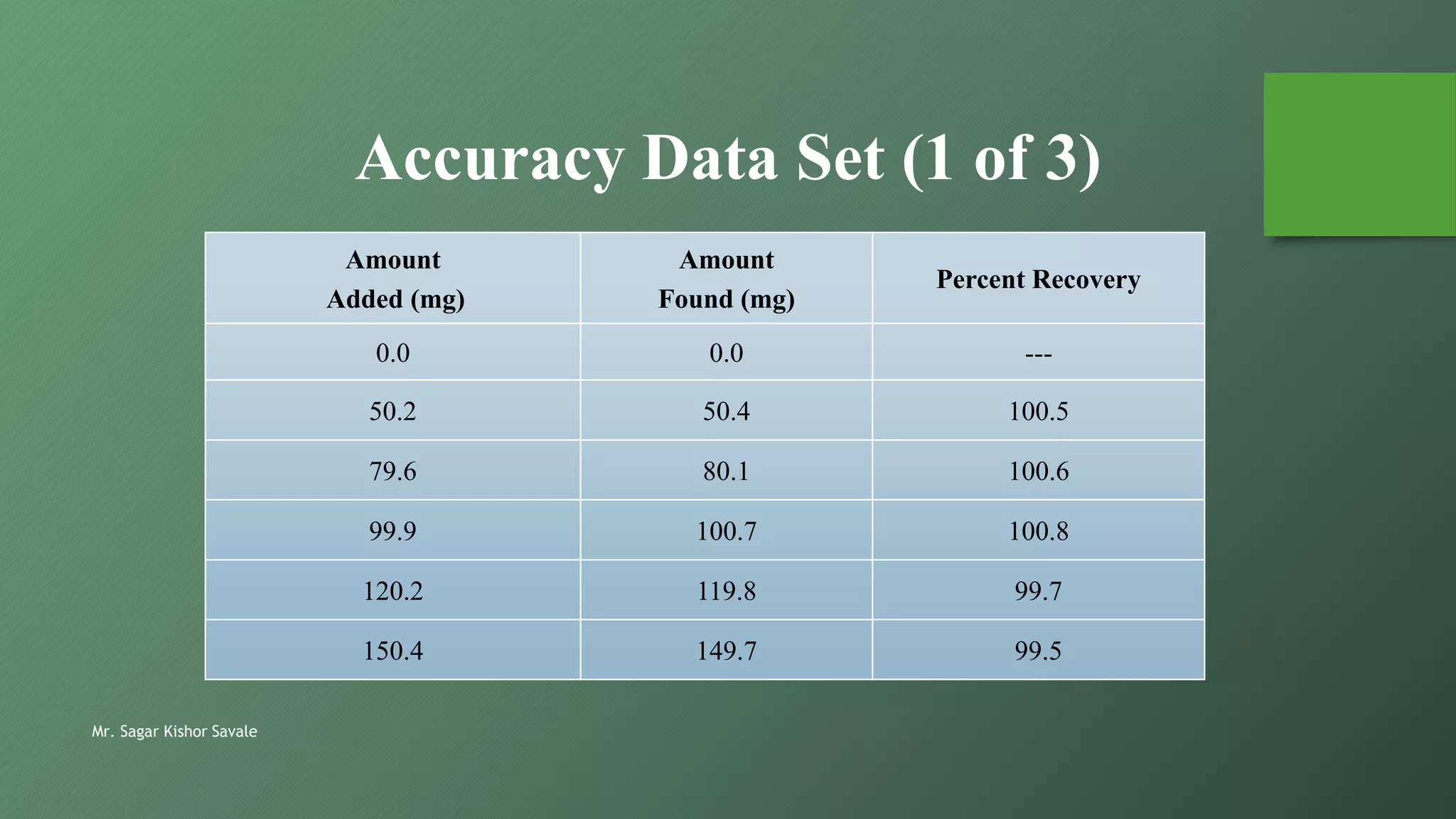
Accuracy Data Set (1 of 3)
Amount
Added (mg)
Amount
Found (mg)

Percent Recovery
0.0 0.0 ---
50.2 50.4 100.5
79.6 80.1 100.6
99.9 100.7 100.8
120.2 119.8 99.7
150.4 149.7 99.5
Mr. Sagar Kishor Savale
Precision
 Precision refers to the agreement among the individual test results when a method is applied
repeatedly to the same sample.
 It is a measure of degree of repeatability or reproducibility of a method.
Mr. Sagar Kishor Savale
Precision
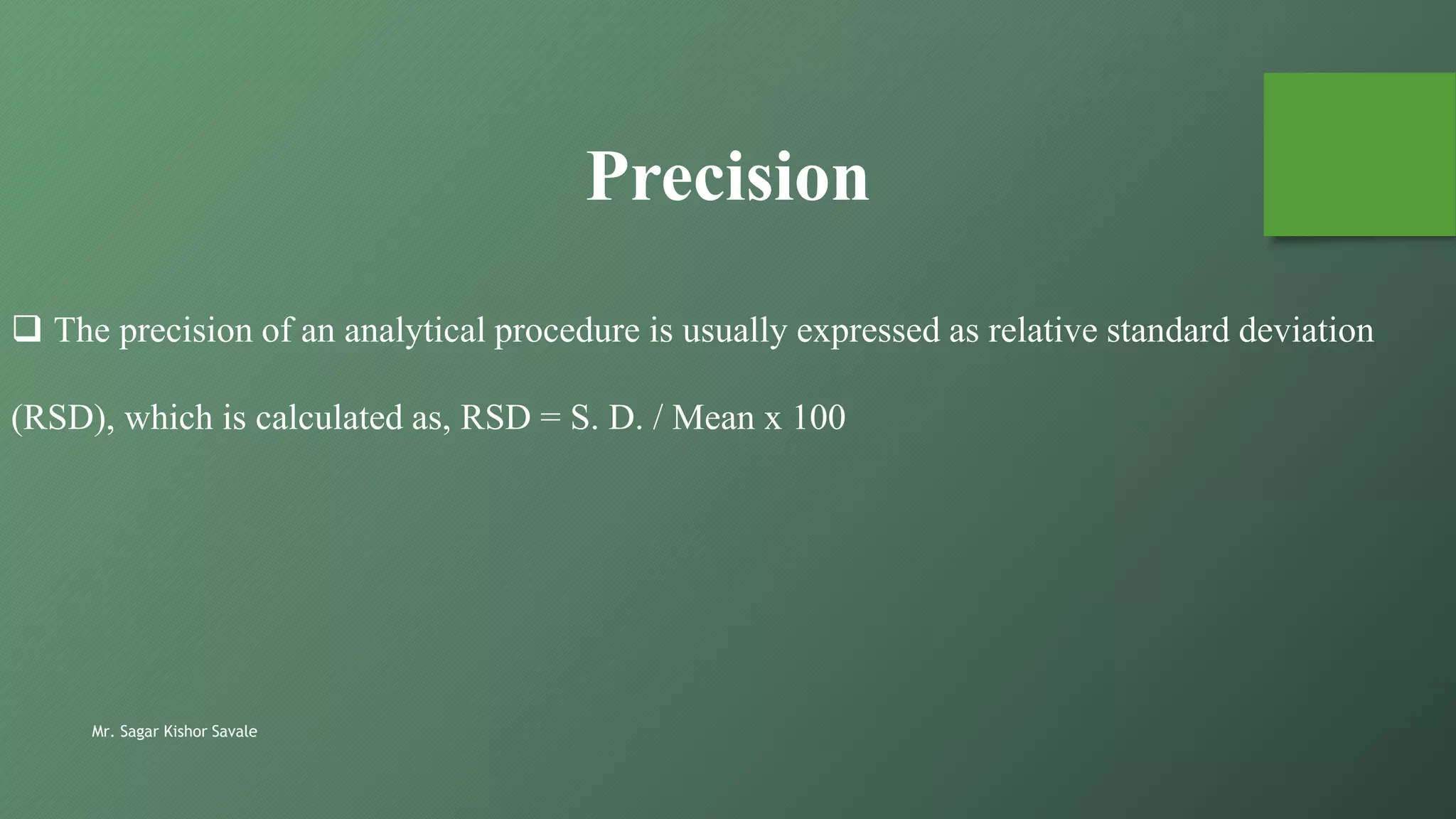
 The precision of an analytical procedure is usually expressed as relative standard deviation
(RSD), which is calculated as, RSD = S. D. / Mean x 100
Mr. Sagar Kishor Savale
 Specificity of a method refers to the ability of the method to measure accurately and
specifically the substance of interest in the sample as impurities, degradation products.
 For this the test results of analysis of samples containing other ingredients is compared with the
samples without containing ingredients.
Specificity
Mr. Sagar Kishor Savale
 The linearity of an analytical method is its ability to obtain test results which are directly
proportional to the concentration of analyte in the sample.
Linearity
Mr. Sagar Kishor Savale
Linearity Should be Evaluated
 By Visual Inspection of plot of signals vs. analyte concentration
 By Appropriate statistical methods
 Linear Regression (y = mx + b)
 Correlation Coefficient, y-intercept (b), slope (m)
 Acceptance criteria: Linear regression r2 > 0.95
Mr. Sagar Kishor Savale
 The range of an analytical method is the interval between the upper and lower concentration of
analyte in the sample.
 Beer’s law response – concentration curve should be linear at least 5-6 points in the range.
Range
Mr. Sagar Kishor Savale
 For Drug Substance & Drug product Assay: 80 to 120% of test Concentration.
 For Content Uniformity Assay: 70 to 130% of test Concentration.
 For Dissolution Test Method: +/- 20% over entire Specification Range.
Range
Acceptable range having linearity, accuracy, precision
Mr. Sagar Kishor Savale
Acceptable range having linearity, accuracy, precision
Range
 For Impurity Assays:
 From Reporting Level to 120% of Impurity Specification for Impurity Assays.
 From Reporting Level to 120% of Assay Specification for Impurity/Assay Methods.
Mr. Sagar Kishor Savale
 The detection limit of an individual analytical procedure is the lowest amount of analyte in a
sample which can be detected but not necessarily quantitated.
Detection Limit (LOD)
Mr. Sagar Kishor Savale
 The quantitation limit of an individual analytical procedure is the lowest amount of analyte in a
sample which can be quantitatively determined with suitable precision and accuracy.
Quantitation Limit (LOQ)
Mr. Sagar Kishor Savale
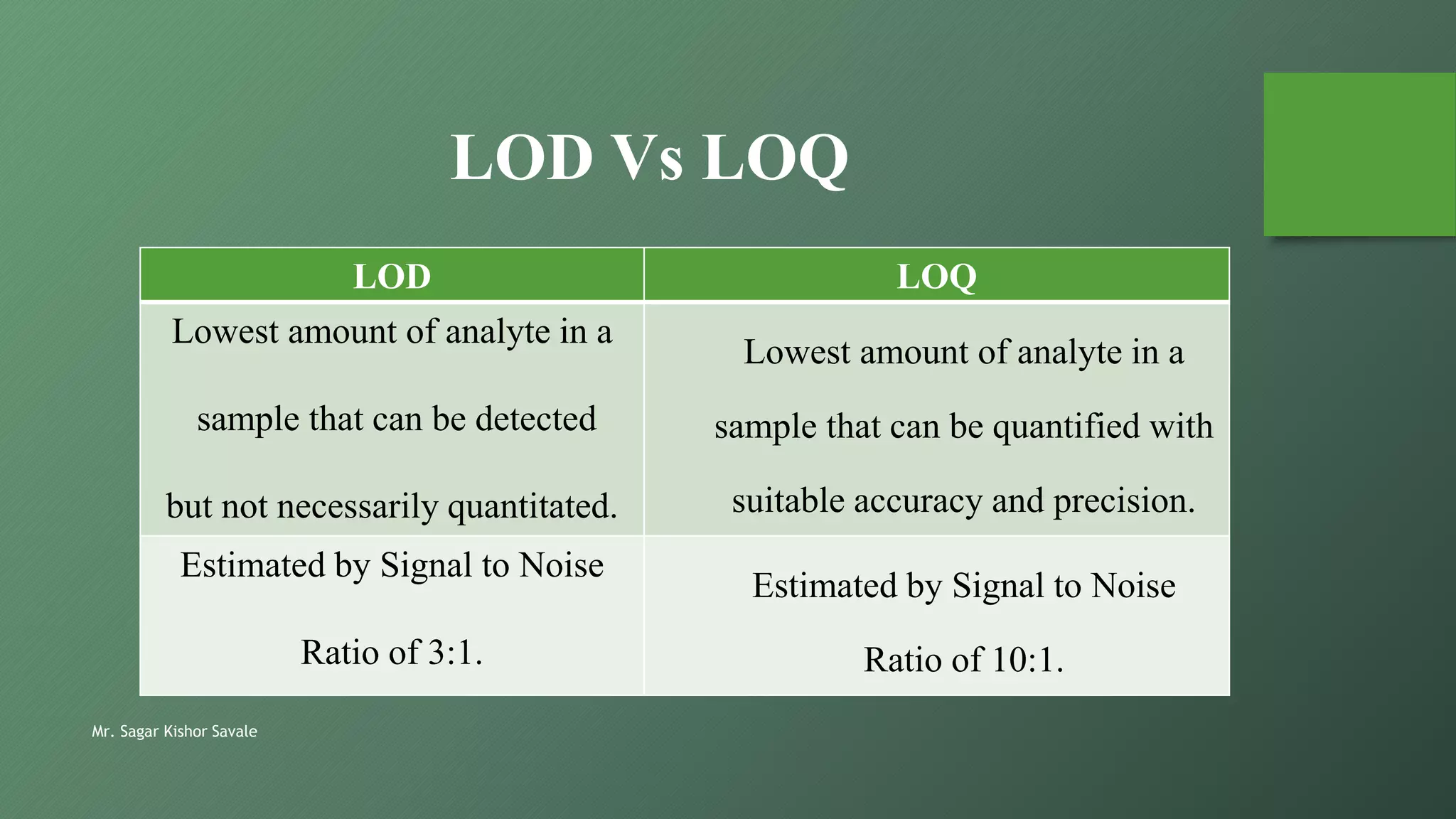
LOD Vs LOQ
LOD LOQ
Lowest amount of analyte in a
sample that can be detected
but not necessarily quantitated.
Lowest amount of analyte in a
sample that can be quantified with
suitable accuracy and precision.
Estimated by Signal to Noise
Ratio of 3:1.
Estimated by Signal to Noise
Ratio of 10:1.
Mr. Sagar Kishor Savale
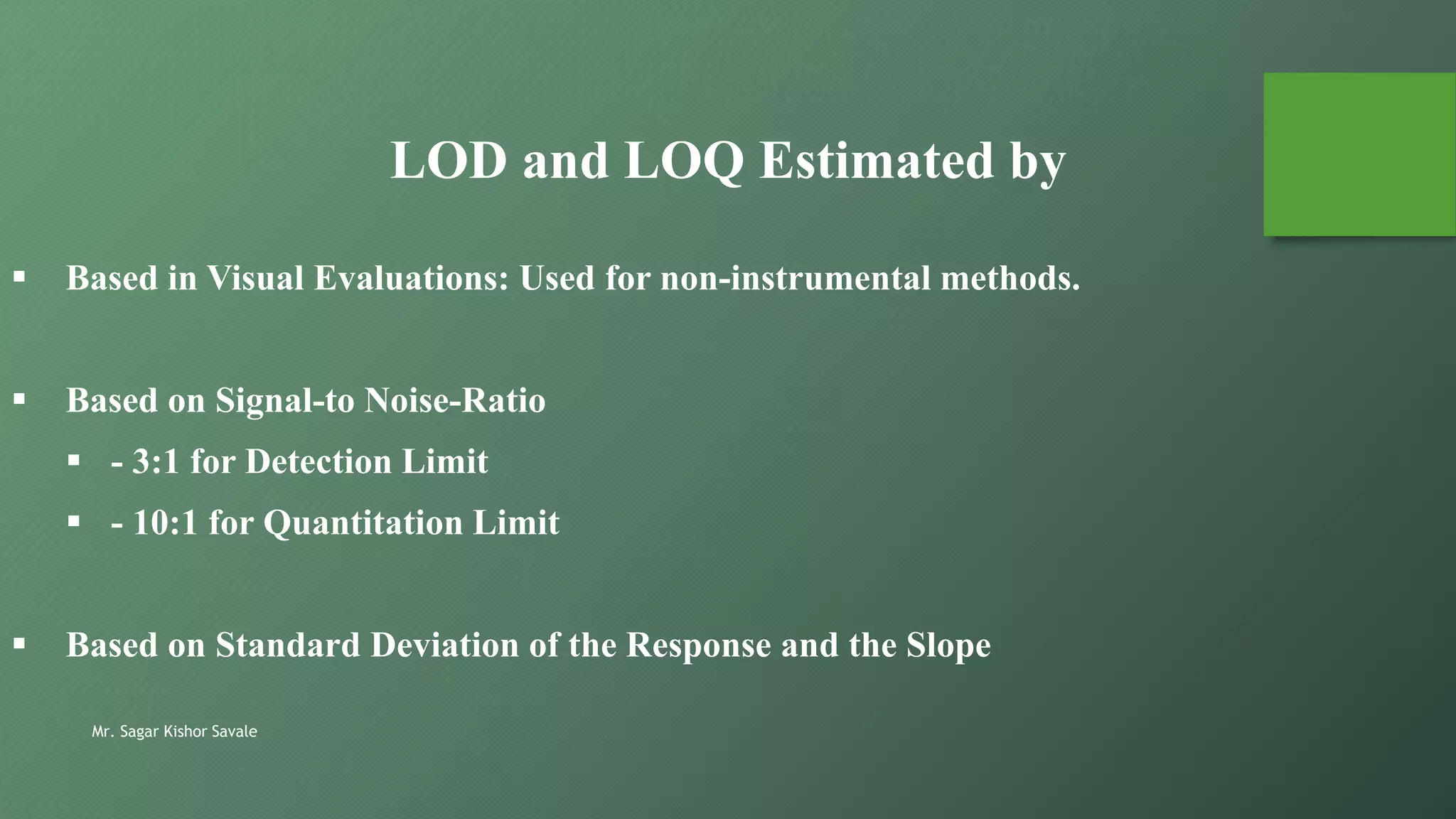
LOD and LOQ Estimated by
 Based in Visual Evaluations: Used for non-instrumental methods.
 Based on Signal-to Noise-Ratio
 - 3:1 for Detection Limit
 - 10:1 for Quantitation Limit
 Based on Standard Deviation of the Response and the Slope
Mr. Sagar Kishor Savale
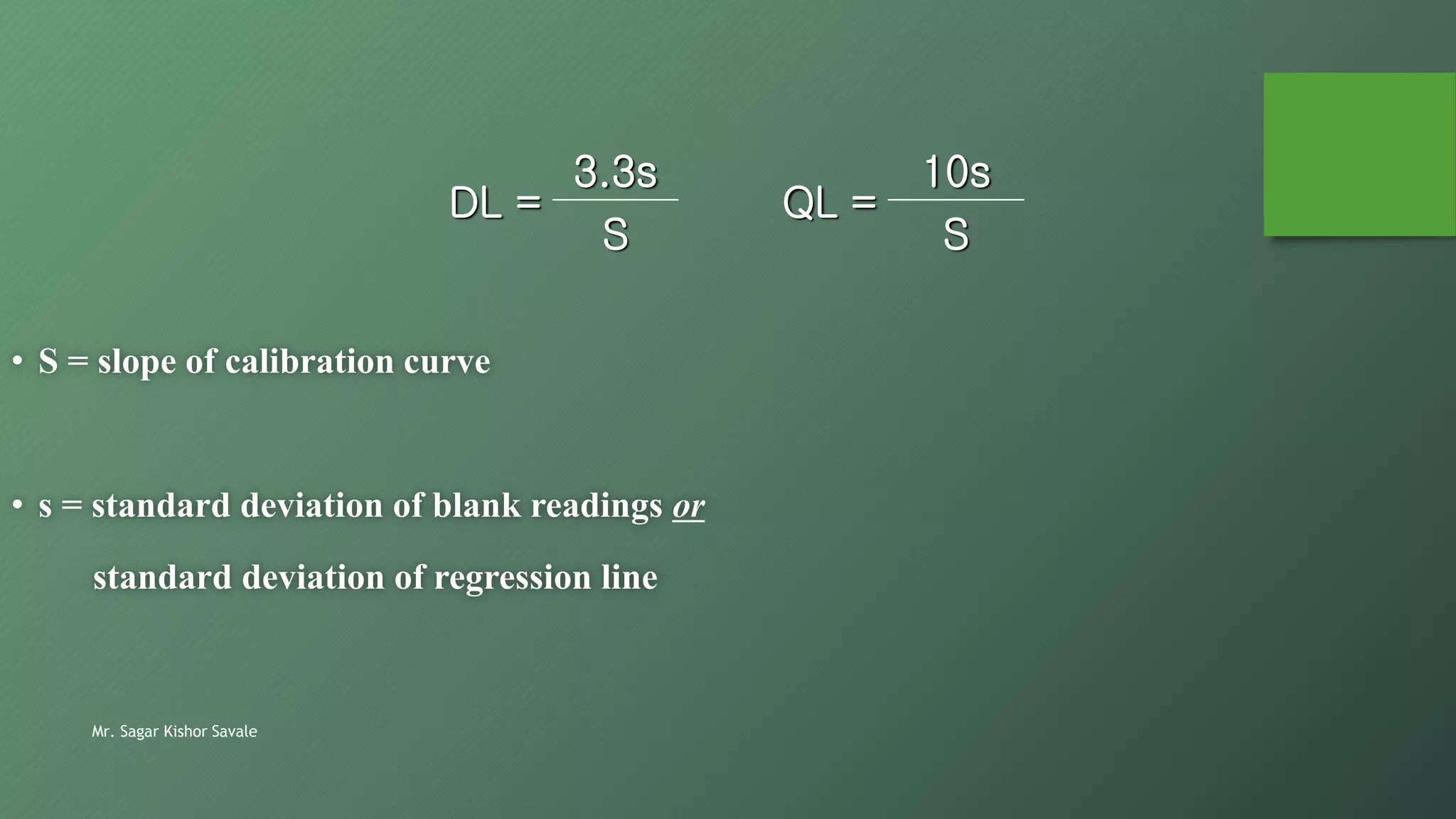
DL =
3.3s
QL =
10s
S S
• S = slope of calibration curve
• s = standard deviation of blank readings or
standard deviation of regression line
Mr. Sagar Kishor Savale
 Robustness is the measure of the capacity of the analytical method to remain unaffected by
small but deliberate variations in procedure.
Robustness
Mr. Sagar Kishor Savale
 Degree of reproducibility of test results obtained by analysing the same sample under variety of
normal test conditions is known as ruggedness.
Ruggedness
Mr. Sagar Kishor Savale
 Repeatability expresses the precision under the same operating conditions over a short interval
of time.
Repeatability
Mr. Sagar Kishor Savale
 Sensitivity refers to the smallest quantity that can be accurately measured.
 It also indicates the capacity of the method to measure small variations in concentration. In the
case of UV and Visible spectrophotometric methods, an estimate known as Sandell’s
Sensitivity’ is used to evaluate the sensitivity of the method.
Sensitivity
Mr. Sagar Kishor Savale
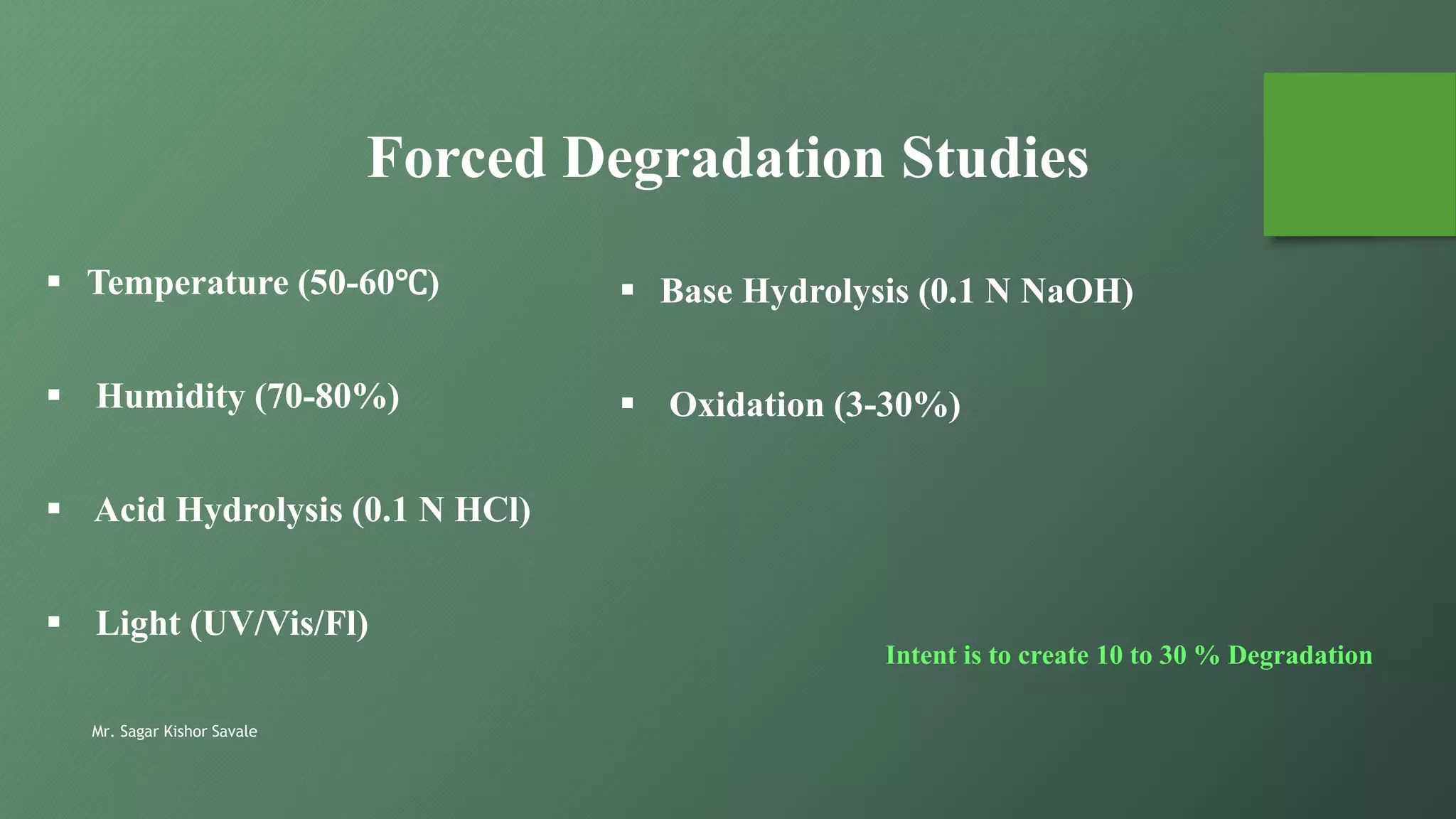
Forced Degradation Studies
 Temperature (50-60℃)
 Humidity (70-80%)
 Acid Hydrolysis (0.1 N HCl)
 Light (UV/Vis/Fl)
 Base Hydrolysis (0.1 N NaOH)
 Oxidation (3-30%)
Intent is to create 10 to 30 % Degradation
Mr. Sagar Kishor Savale
Contact
Email: savalesagar484@gmail.com
Mobile no.:
+919960885333

Validation of analytical methods

  • 1.
    Validation of AnalyticalMethods Mr. Sagar Kishor Savale M. Pharm [Pharmaceutics] Mr. Sagar Kishor Savale
  • 2.
     Analytical methodsplays a vital role in new drug development, Preformulation and formulation studies, stability studies and quality control testing.  This method must be simple, specific, accurate, precise, economical and convenient. The method should be validated during its development and use. Introduction Mr. Sagar Kishor Savale
  • 3.
     Validation isrelatively new concept in pharmaceutical manufacturing evolved in 1980’s.  Validation is documented evidence which provides a high degree of assurance that a specific process will consistently produce a product meeting its pre-determined specifications and quality characteristics. Concept of Validation Mr. Sagar Kishor Savale
  • 4.
     Analytical validationrefers to the evaluation and proving that an analytical method serves the intended purpose.  Analytical validation ensures that the selected analytical method will give reproducible and reliable results adequate for Intended Purpose. Analytical Validation Mr. Sagar Kishor Savale
  • 5.
    Mr. Sagar KishorSavale Considerations Prior to Method Validation Suitability of Instrument: Status of Qualification and Calibration. Suitability of Materials: Status of Reference Standards, Reagents, Placebo Lots. Suitability of Analyst: Status of Training and Qualification Records. Suitability of Documentation: Written analytical procedure and proper approved protocol with pre-established acceptance criteria
  • 6.
    Mr. Sagar KishorSavale Validation Step  Define the application, purpose and scope of the method.  Analytes? Concentration? Sample matrices?  Develop a analytical method.  Develop a validation protocol.
  • 7.
    Mr. Sagar KishorSavale Validation Step  Qualification of instrument.  Qualify/train operator.  Qualification of material.  Perform pre-validation experiments.
  • 8.
    Mr. Sagar KishorSavale Validation Step  Adjust method parameters and/or acceptance criteria if necessary.  Perform full validation experiments.  Develop SOP for executing the method in routine analysis.  Document validation experiments and results in the validation report.
  • 9.
    Mr. Sagar KishorSavale Purpose of Method Validation  Identification of Sources and Quantitation of Potential errors  Determination if Method is Acceptable for Intended Use  Establish Proof that a Method Can be Used for Decision Making  Satisfy FDA Requirements
  • 10.
    Mr. Sagar KishorSavale Published Validation Guidelines  1978 Current Good Manufacturing Practices (cGMPs)  1987 FDA Validation Guideline  1989 Supplement 9 to USP XXI  1994 CDER Reviewer Guidance: Validation of Chromatographic Method
  • 11.
    Mr. Sagar KishorSavale  1995 ICH Validation Definitions: Q2A, Text on Validation of Analytical procedures.  1997 ICH Validation Methodology: Q2B, Validation of Analytical Procedures: Methodology.  1999 Supplement 10 to USP 23 <1225>: Validation of Compendial Methods Published Validation Guidelines
  • 12.
    Mr. Sagar KishorSavale Published Validation Guidelines  1999 CDER “Bio analytical Method: Validation for Human Studies”  2000 CDER Draft “Analytical Procedures and Method Validation”
  • 13.
    Mr. Sagar KishorSavale Today’s Validation Requirements ICH/USP GMP FDA
  • 14.
    Mr. Sagar KishorSavale USP Data Elements Required For Assay Validation Analytical Performance Parameter Assay Category 1 Assay Category 2 Assay Category 3 Quantitative Limit Tests Accuracy Yes Yes * * Precision Yes Yes No Yes Specificity Yes Yes Yes * LOD No No Yes * LOQ No Yes No * Linearity Yes Yes No * Range Yes Yes * * Ruggedness Yes Yes Yes Yes
  • 15.
    Mr. Sagar KishorSavale USP Categories Category 1: Quantitation of major components or active ingredients. Category 2: Determination of impurities or degradation products. Category 3: Determination of performance characteristics.
  • 16.
    Mr. Sagar KishorSavale ICH Validation Characteristics vs. Type of Analytical Procedure Type of Analytical Procedure Identification Impurity testing Assay Quantitative Limit Tests Accuracy No Yes No Yes Precision Repeatability No Yes No Yes Interm. Prec. No Yes No Yes Specificity Yes Yes Yes Yes LOD No No Yes No LOQ No Yes No No Linearity No Yes No Yes Range No Yes No Yes
  • 17.
  • 18.
    Mr. Sagar KishorSavale Accuracy  The agreement between the test results obtained by the proposed method and the true value.  It expresses the correctness of the method.  It is expressed as percentage by the assay of known amount of substance.  Accuracy also evaluated by recovery studies, in which known amount of drug is added to previously analyzed pharmaceutical preparation of the drug and tested for the recovery of the added drug.
  • 19.
    Mr. Sagar KishorSavale  Should be established across specified range of analytical procedure.  Should be assessed using a minimum of 3 concentration levels, each in triplicate (total of 9 determinations)  Should be reported as:  Percent recovery of known amount added or  The difference between the mean assay result and the accepted value Accuracy
  • 20.
    Mr. Sagar KishorSavale  The absolute error is a measure of the accuracy of the measurement, it is then calculated as, Absolute error = Mean error (True value – Measured value) / True value x 100 Accuracy
  • 21.
    Mr. Sagar KishorSavale Accuracy Data Set (1 of 3) Amount Added (mg) Amount Found (mg) Percent Recovery 0.0 0.0 --- 50.2 50.4 100.5 79.6 80.1 100.6 99.9 100.7 100.8 120.2 119.8 99.7 150.4 149.7 99.5
  • 22.
    Mr. Sagar KishorSavale Precision  Precision refers to the agreement among the individual test results when a method is applied repeatedly to the same sample.  It is a measure of degree of repeatability or reproducibility of a method.
  • 23.
    Mr. Sagar KishorSavale Precision  The precision of an analytical procedure is usually expressed as relative standard deviation (RSD), which is calculated as, RSD = S. D. / Mean x 100
  • 24.
    Mr. Sagar KishorSavale  Specificity of a method refers to the ability of the method to measure accurately and specifically the substance of interest in the sample as impurities, degradation products.  For this the test results of analysis of samples containing other ingredients is compared with the samples without containing ingredients. Specificity
  • 25.
    Mr. Sagar KishorSavale  The linearity of an analytical method is its ability to obtain test results which are directly proportional to the concentration of analyte in the sample. Linearity
  • 26.
    Mr. Sagar KishorSavale Linearity Should be Evaluated  By Visual Inspection of plot of signals vs. analyte concentration  By Appropriate statistical methods  Linear Regression (y = mx + b)  Correlation Coefficient, y-intercept (b), slope (m)  Acceptance criteria: Linear regression r2 > 0.95
  • 27.
    Mr. Sagar KishorSavale  The range of an analytical method is the interval between the upper and lower concentration of analyte in the sample.  Beer’s law response – concentration curve should be linear at least 5-6 points in the range. Range
  • 28.
    Mr. Sagar KishorSavale  For Drug Substance & Drug product Assay: 80 to 120% of test Concentration.  For Content Uniformity Assay: 70 to 130% of test Concentration.  For Dissolution Test Method: +/- 20% over entire Specification Range. Range Acceptable range having linearity, accuracy, precision
  • 29.
    Mr. Sagar KishorSavale Acceptable range having linearity, accuracy, precision Range  For Impurity Assays:  From Reporting Level to 120% of Impurity Specification for Impurity Assays.  From Reporting Level to 120% of Assay Specification for Impurity/Assay Methods.
  • 30.
    Mr. Sagar KishorSavale  The detection limit of an individual analytical procedure is the lowest amount of analyte in a sample which can be detected but not necessarily quantitated. Detection Limit (LOD)
  • 31.
    Mr. Sagar KishorSavale  The quantitation limit of an individual analytical procedure is the lowest amount of analyte in a sample which can be quantitatively determined with suitable precision and accuracy. Quantitation Limit (LOQ)
  • 32.
    Mr. Sagar KishorSavale LOD Vs LOQ LOD LOQ Lowest amount of analyte in a sample that can be detected but not necessarily quantitated. Lowest amount of analyte in a sample that can be quantified with suitable accuracy and precision. Estimated by Signal to Noise Ratio of 3:1. Estimated by Signal to Noise Ratio of 10:1.
  • 33.
    Mr. Sagar KishorSavale LOD and LOQ Estimated by  Based in Visual Evaluations: Used for non-instrumental methods.  Based on Signal-to Noise-Ratio  - 3:1 for Detection Limit  - 10:1 for Quantitation Limit  Based on Standard Deviation of the Response and the Slope
  • 34.
    Mr. Sagar KishorSavale DL = 3.3s QL = 10s S S • S = slope of calibration curve • s = standard deviation of blank readings or standard deviation of regression line
  • 35.
    Mr. Sagar KishorSavale  Robustness is the measure of the capacity of the analytical method to remain unaffected by small but deliberate variations in procedure. Robustness
  • 36.
    Mr. Sagar KishorSavale  Degree of reproducibility of test results obtained by analysing the same sample under variety of normal test conditions is known as ruggedness. Ruggedness
  • 37.
    Mr. Sagar KishorSavale  Repeatability expresses the precision under the same operating conditions over a short interval of time. Repeatability
  • 38.
    Mr. Sagar KishorSavale  Sensitivity refers to the smallest quantity that can be accurately measured.  It also indicates the capacity of the method to measure small variations in concentration. In the case of UV and Visible spectrophotometric methods, an estimate known as Sandell’s Sensitivity’ is used to evaluate the sensitivity of the method. Sensitivity
  • 39.
    Mr. Sagar KishorSavale Forced Degradation Studies  Temperature (50-60℃)  Humidity (70-80%)  Acid Hydrolysis (0.1 N HCl)  Light (UV/Vis/Fl)  Base Hydrolysis (0.1 N NaOH)  Oxidation (3-30%) Intent is to create 10 to 30 % Degradation
  • 40.
    Mr. Sagar KishorSavale Contact Email: savalesagar484@gmail.com Mobile no.: +919960885333