Seminar onSeminar on
AND VALIDATION OF EQUIPMENT
ICH AND WHO GUIDELINES FOR CALIBRATIONICH AND WHO GUIDELINES FOR CALIBRATION
AND VALIDATION OF EQUIPMENT
ICH AND WHO GUIDELINES FOR CALIBRATION
AND VALIDATION OF EQUIPMENT
Prepared by :-
Miss. Sanap Deepali
S.
M. Pharm 1st Year
(Sem I).
Roll No.13
Guided By :-
Prof. A. W. Ambekar
M. Pharm
(Pharmaceutics)
Dr. Vithalrao Vikhe Patil Foundation’s
College of Pharmacy
Ahmednagar
(2018-2019)
1
CONTENTS










Introduction to equipment
Calibration
ICH guidelines for calibration of equipment
WHO guidelines for calibration of equipment
Example for calibration of UV
Validation
ICH guidelines for validation of equipment
WHO guidelines for validation of equipment
Example for validation of tablet compression machine
References
2
EQUIPMENT


1.
2.
Equipment may be defined as a physical entity
which is used to carry out a general or specific
activity in the plant.
Equipment can be-
Single piece for ex. tablet compression machine,
HPLC, FTIR, weighing balance
Integrated system for ex. water demineralizing
plant, an air handling system. 3
CALIBRATION




1.
2.
"Calibration of an instrument is the process of
determining it's accuracy. The process involves
obtaining a reading from the instrument and measuring
it's variation from the reading obtained from a standard
instrument."
Calibration adjust precision and accuracy of instrument.
Also important for adjustment of process of
qualification and validation.
Calibration achieves two main objectives:
Accuracy
Traceability
4
EQUIPMENTEQUIPMENT
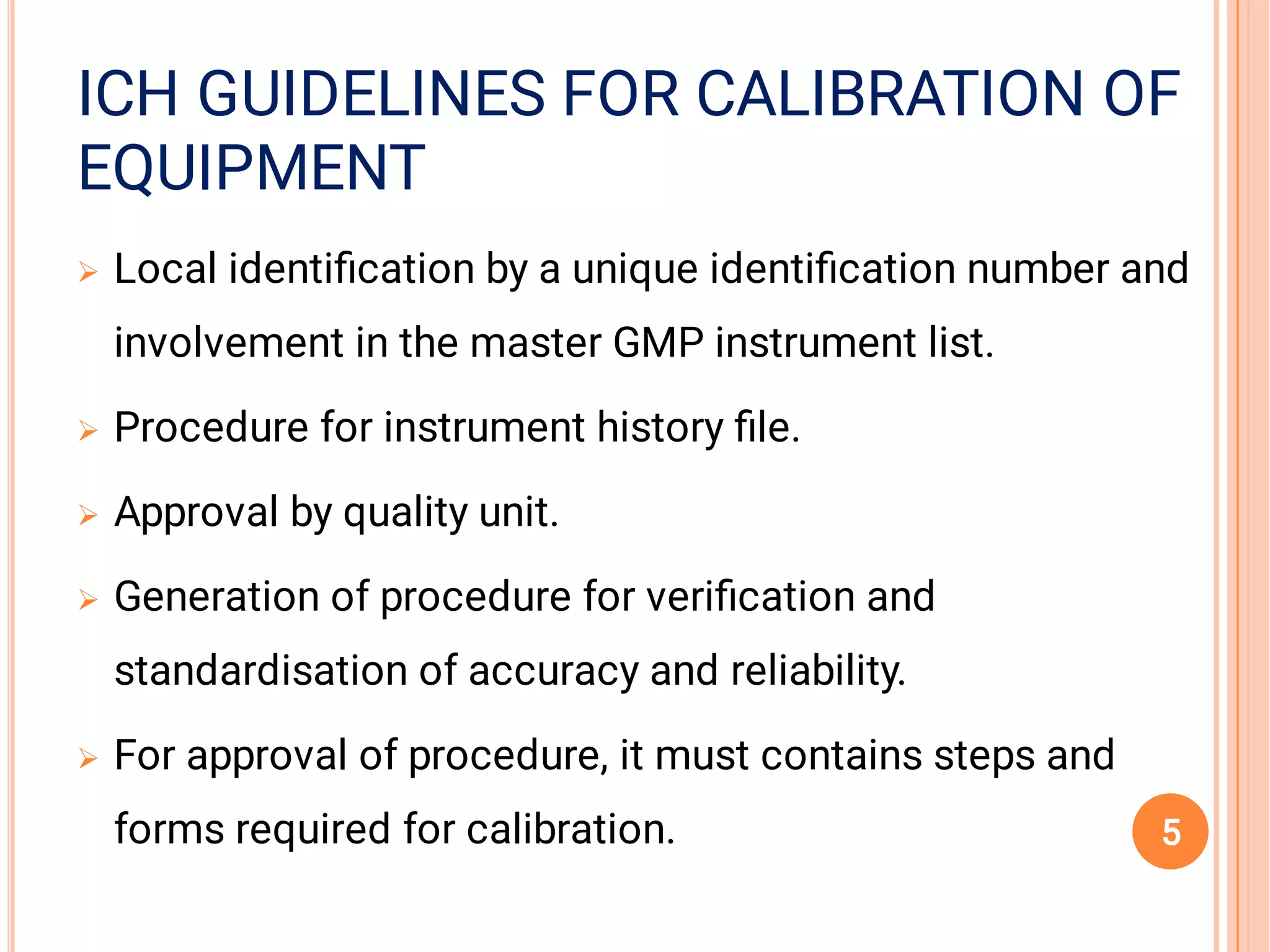
ICH GUIDELINES FOR CALIBRATION OFICH GUIDELINES FOR CALIBRATION OFICH GUIDELINES FOR CALIBRATION OF
EQUIPMENT





Local identification by a unique identification number and
involvement in the master GMP instrument list.
Procedure for instrument history file.
Approval by quality unit.
Generation of procedure for verification and
standardisation of accuracy and reliability.
For approval of procedure, it must contains steps and
forms required for calibration. 5






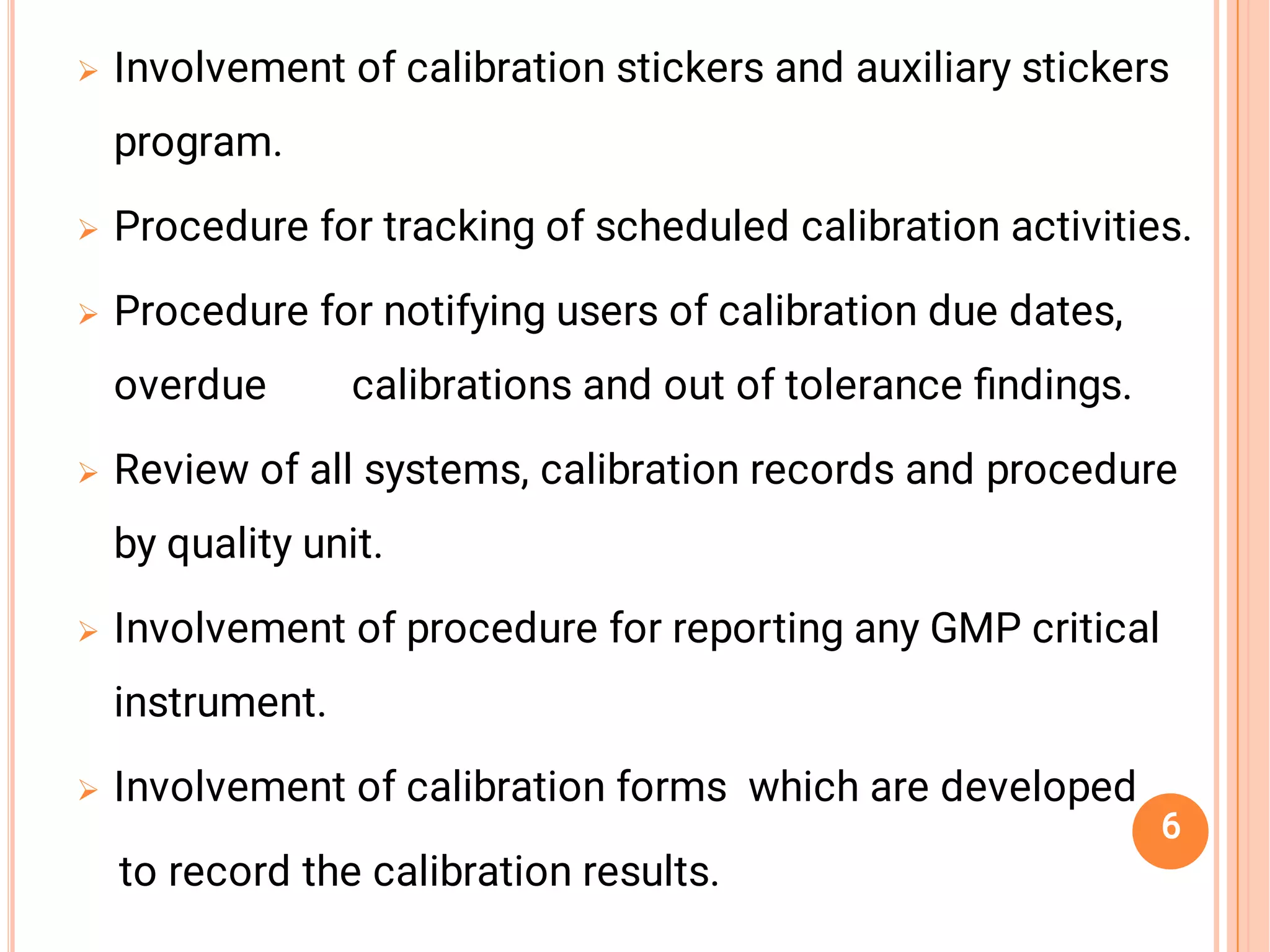
Involvement of calibration stickers and auxiliary stickers
program.
Procedure for tracking of scheduled calibration activities.
Procedure for notifying users of calibration due dates,
overdue calibrations and out of tolerance findings.
Review of all systems, calibration records and procedure
by quality unit.
Involvement of procedure for reporting any GMP critical
instrument.
Involvement of calibration forms which are developed
to record the calibration results.
6
OF EQUIPMENTOF EQUIPMENT
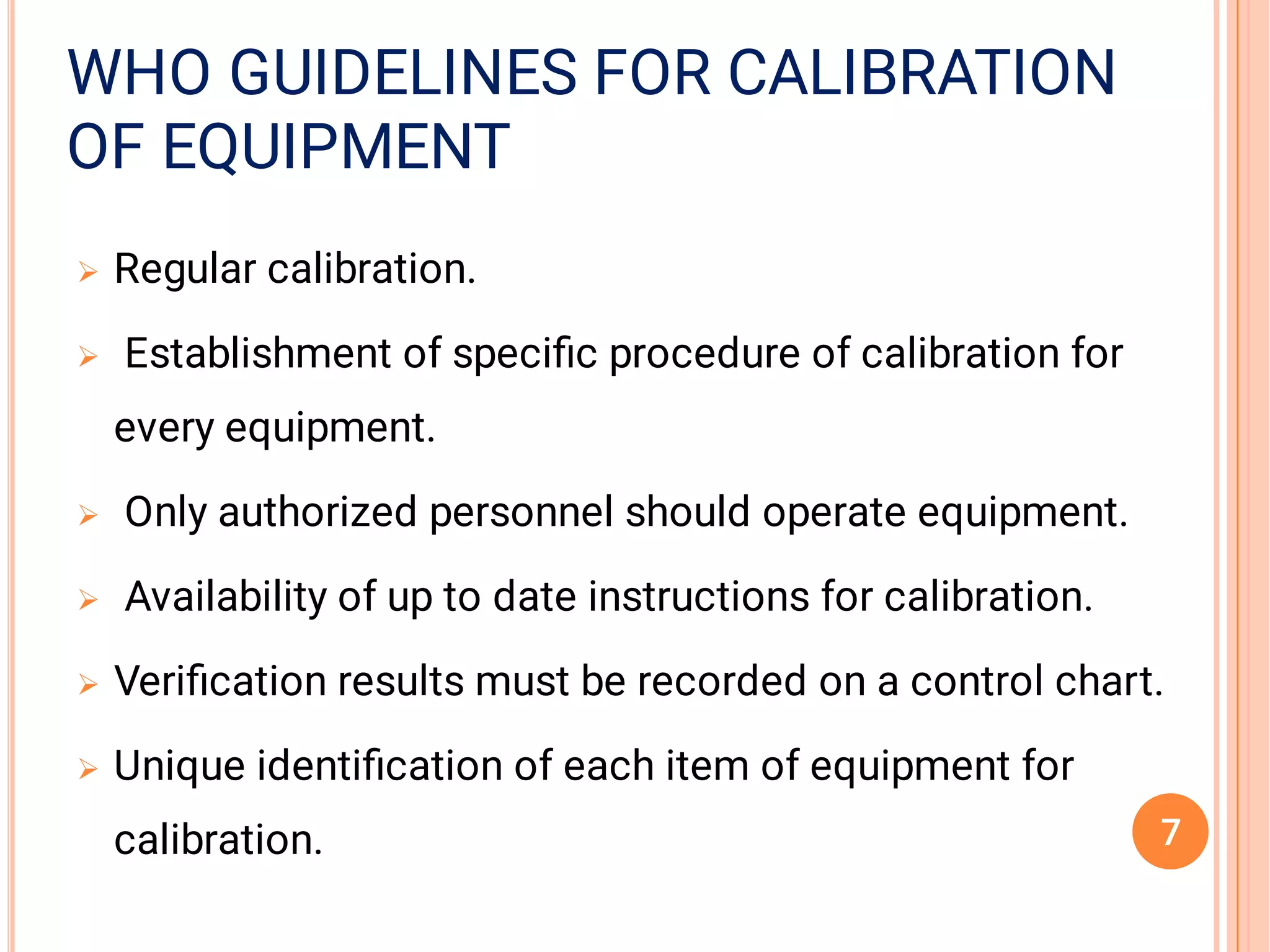
WHO GUIDELINES FOR CALIBRATIONWHO GUIDELINES FOR CALIBRATIONWHO GUIDELINES FOR CALIBRATION
OF EQUIPMENT






Regular calibration.
Establishment of specific procedure of calibration for
every equipment.
Only authorized personnel should operate equipment.
Availability of up to date instructions for calibration.
Verification results must be recorded on a control chart.
Unique identification of each item of equipment for
calibration. 7






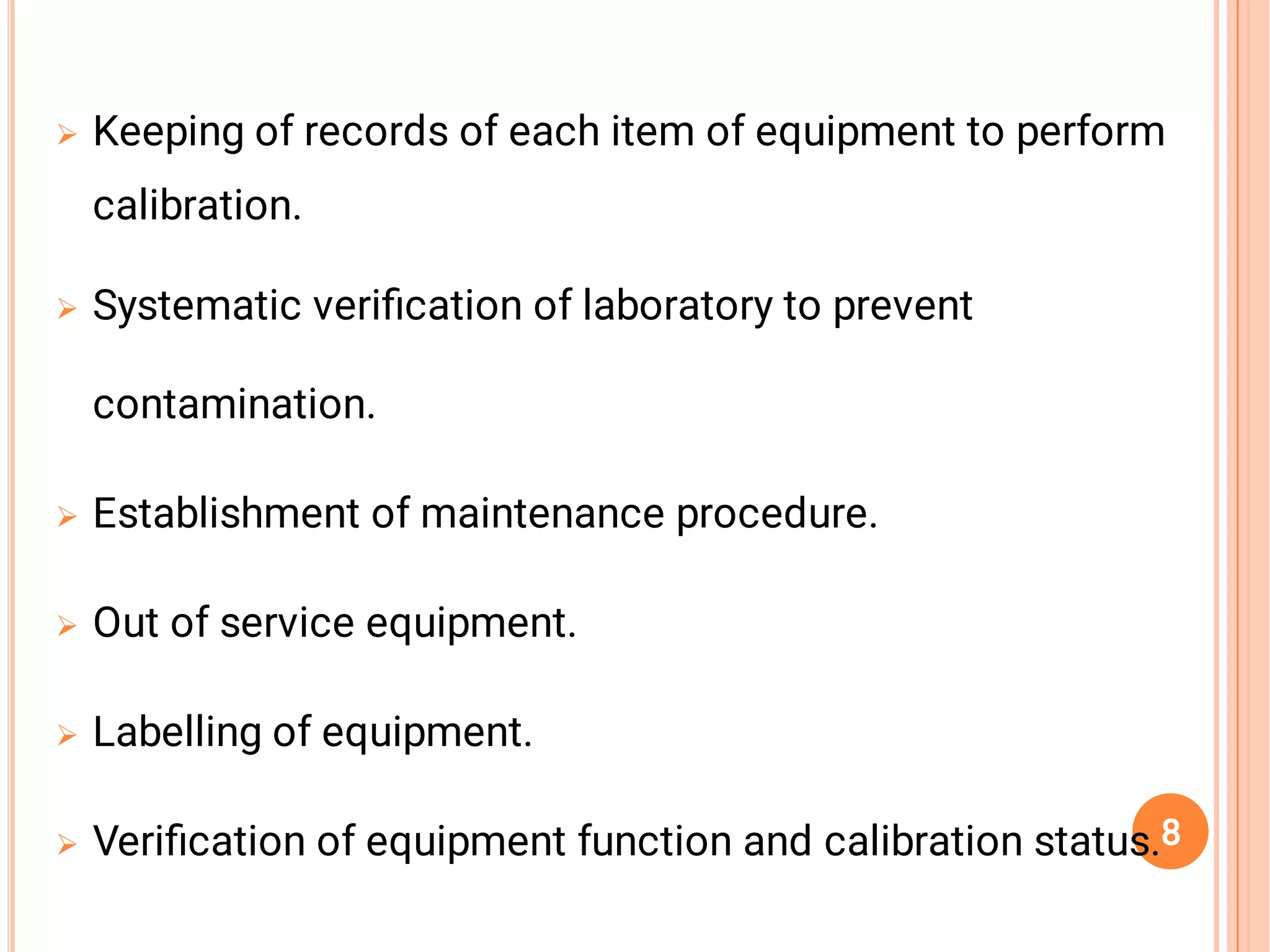
Keeping of records of each item of equipment to perform
calibration.
Systematic verification of laboratory to prevent
contamination.
Establishment of maintenance procedure.
Out of service equipment.
Labelling of equipment.
Verification of equipment function and calibration status.8
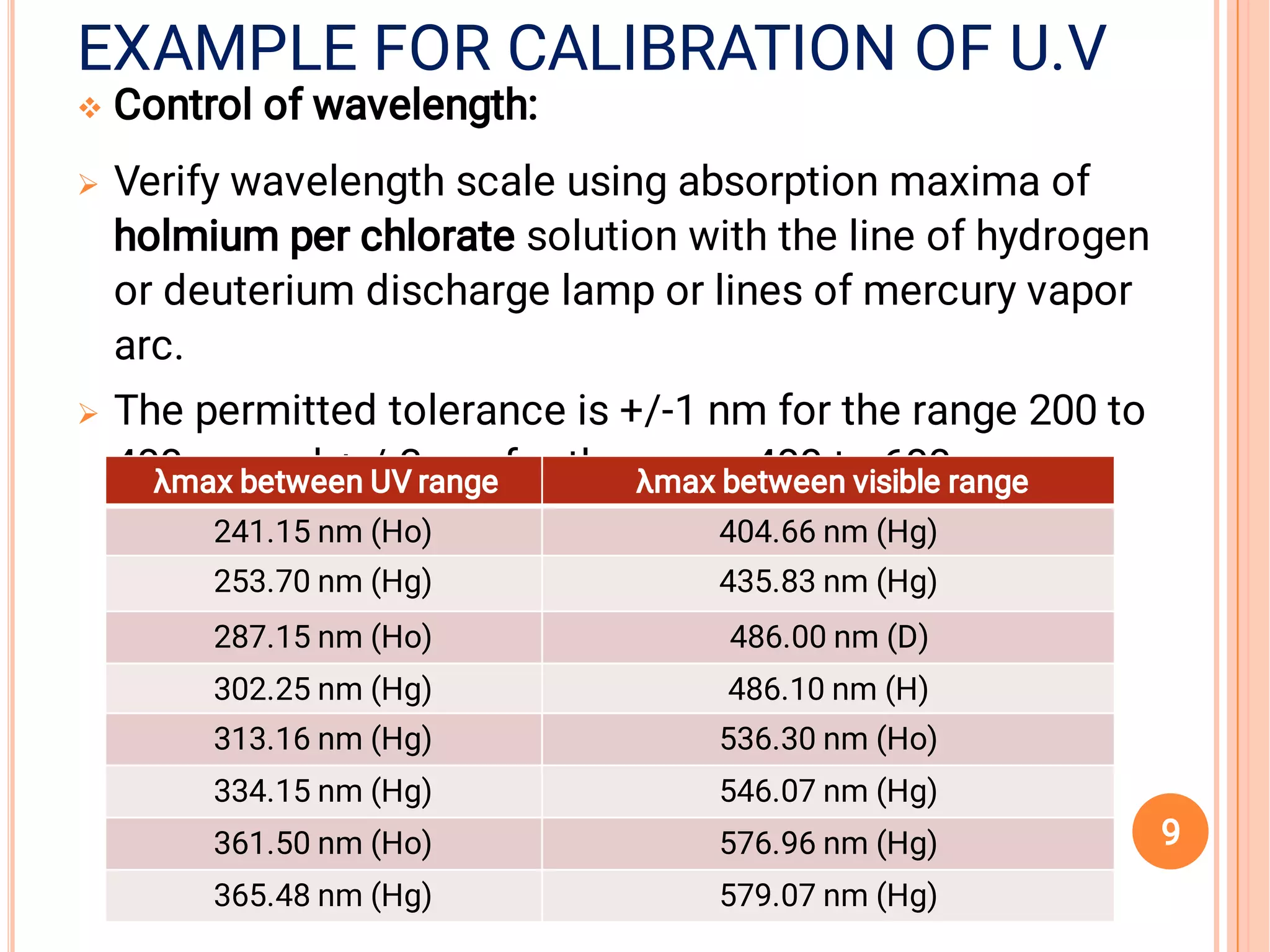
EXAMPLE FOR CALIBRATION OF U.V



Control of wavelength:
Verify wavelength scale using absorption maxima of
holmium per chlorate solution with the line of hydrogen
or deuterium discharge lamp or lines of mercury vapor
arc.
The permitted tolerance is +/-1 nm for the range 200 to
400nm and + /-3 nm for the range 400 to 600 nm.
9
λmax between UV range λmax between visible range
241.15 nm (Ho) 404.66 nm (Hg)
253.70 nm (Hg) 435.83 nm (Hg)
287.15 nm (Ho) 486.00 nm (D)
302.25 nm (Hg) 486.10 nm (H)
313.16 nm (Hg) 536.30 nm (Ho)
334.15 nm (Hg) 546.07 nm (Hg)
361.50 nm (Ho) 576.96 nm (Hg)
365.48 nm (Hg) 579.07 nm (Hg)
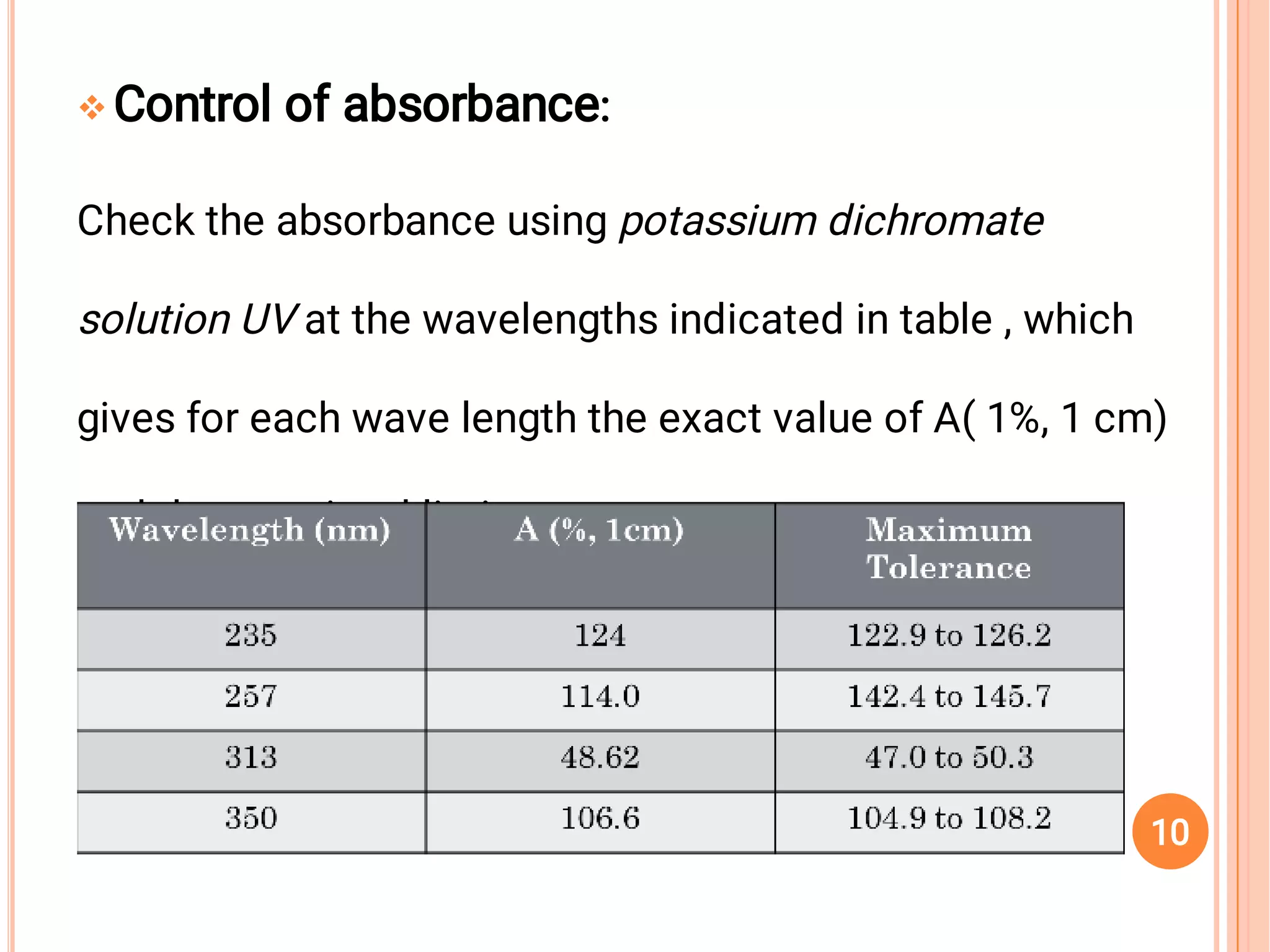
 Control of absorbance:
Check the absorbance using potassium dichromate
solution UV at the wavelengths indicated in table , which
gives for each wave length the exact value of A( 1%, 1 cm)
and the permitted limits.
10

•

1.
2.

•
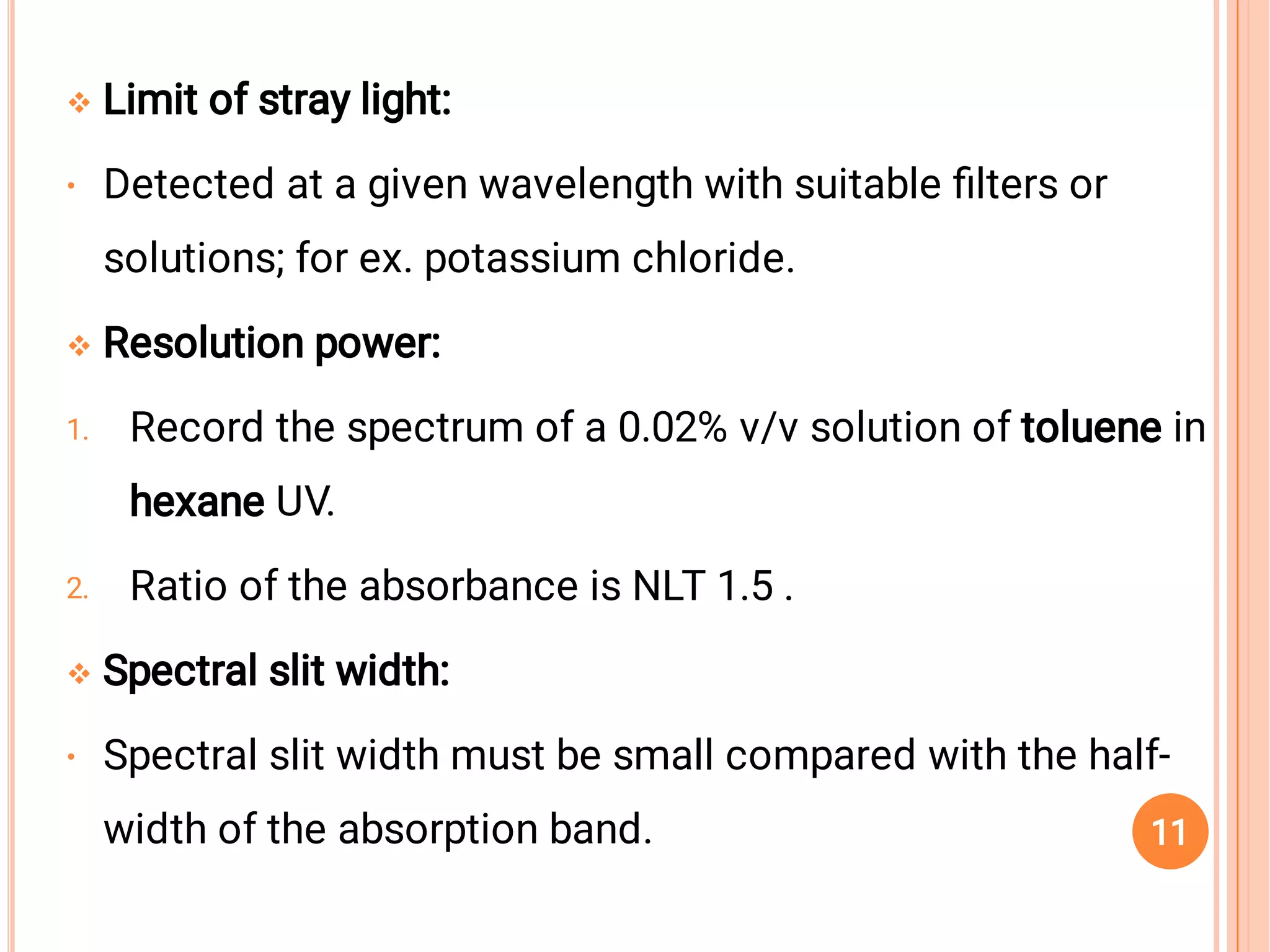
Limit of stray light:
Detected at a given wavelength with suitable filters or
solutions; for ex. potassium chloride.
Resolution power:
Record the spectrum of a 0.02% v/v solution of toluene in
hexane UV.
Ratio of the absorbance is NLT 1.5 .
Spectral slit width:
Spectral slit width must be small compared with the half-
width of the absorption band. 11
VALIDATION


1.
2.
3.
4.
5.
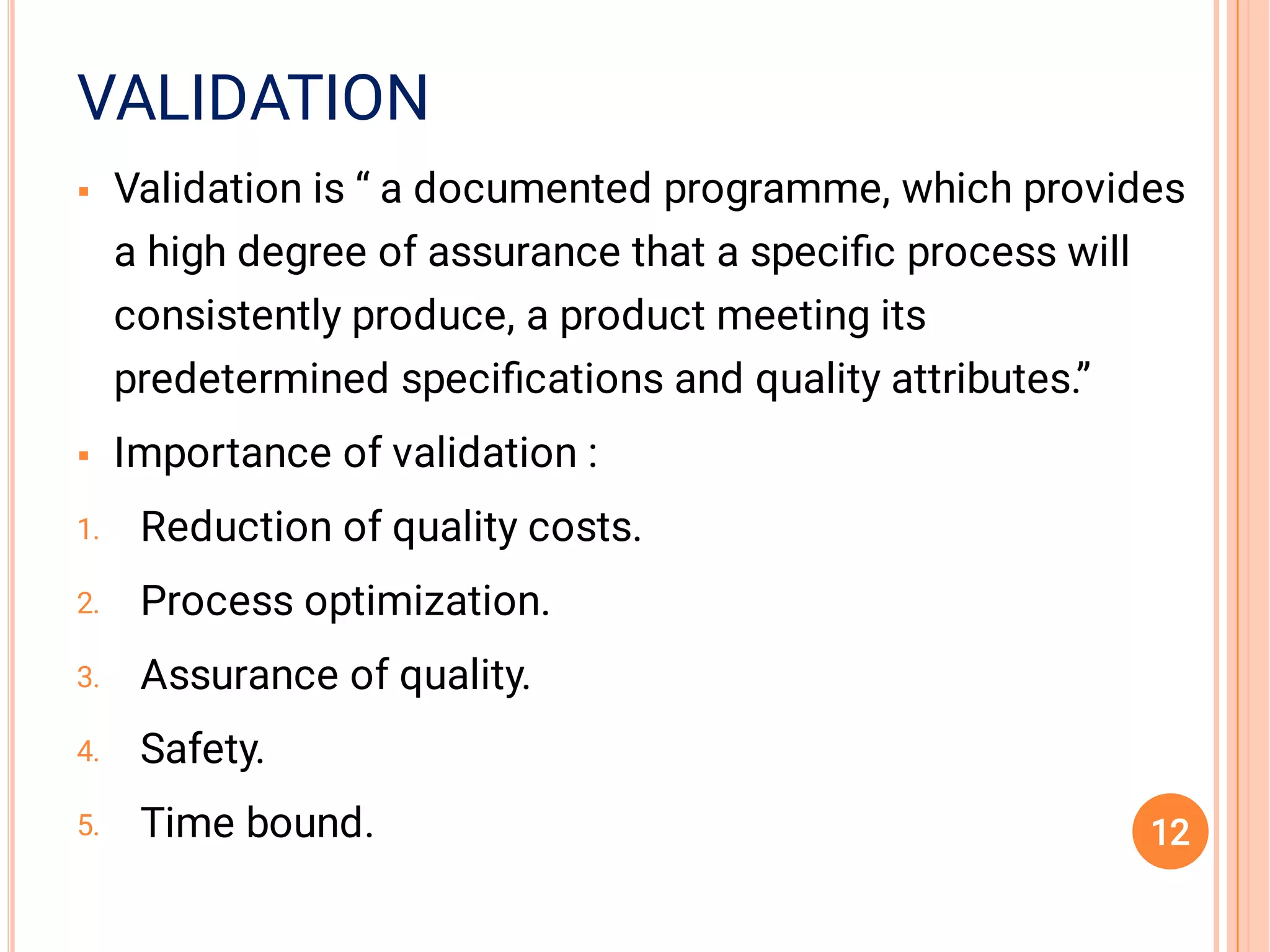
Validation is “ a documented programme, which provides
a high degree of assurance that a specific process will
consistently produce, a product meeting its
predetermined specifications and quality attributes.”
Importance of validation :
Reduction of quality costs.
Process optimization.
Assurance of quality.
Safety.
Time bound. 12
EQUIPMENTSEQUIPMENTS
ICH GUIDELINES FOR VALIDATION OFICH GUIDELINES FOR VALIDATION OFICH GUIDELINES FOR VALIDATION OF
EQUIPMENTS







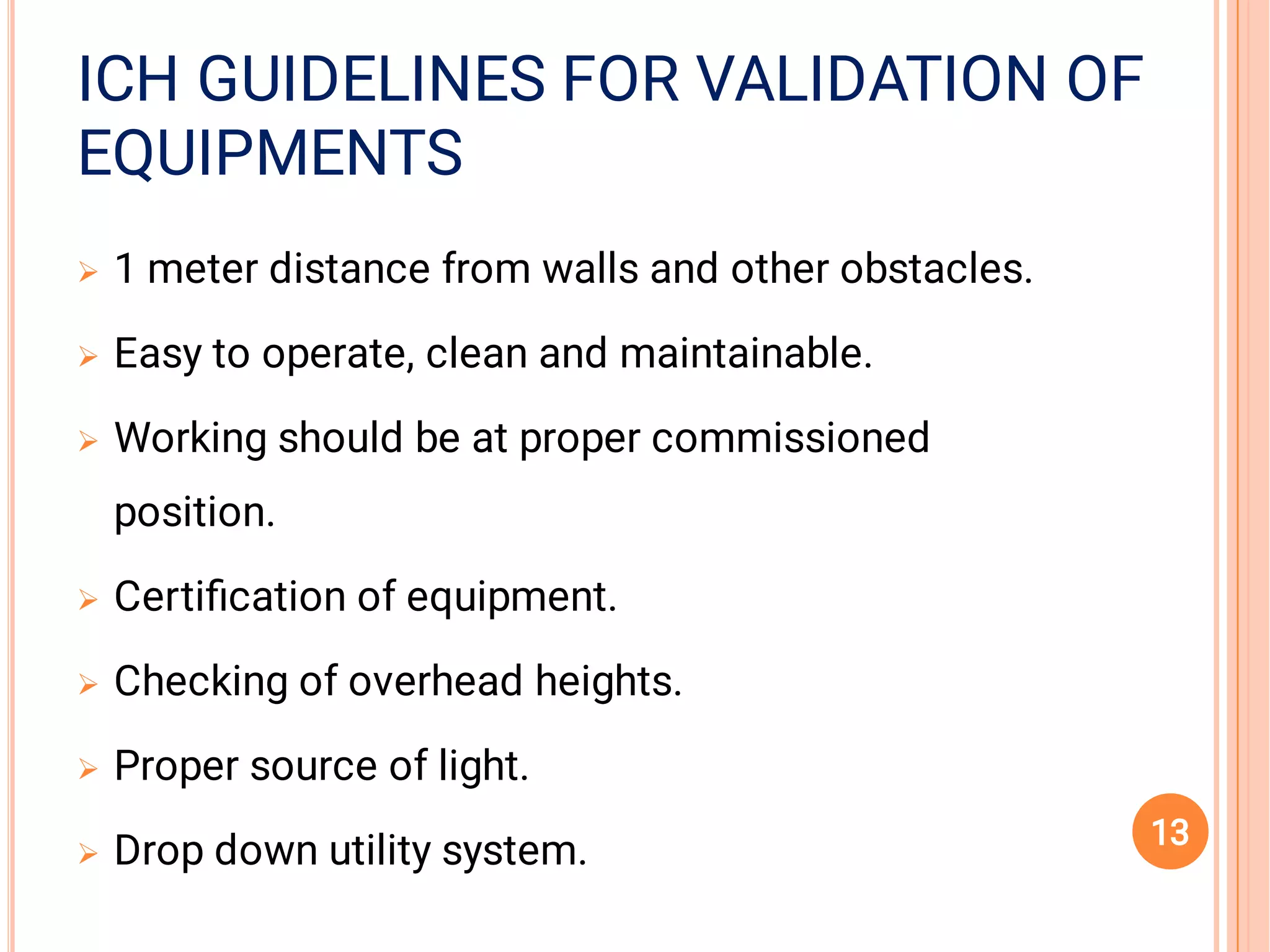
1 meter distance from walls and other obstacles.
Easy to operate, clean and maintainable.
Working should be at proper commissioned
position.
Certification of equipment.
Checking of overhead heights.
Proper source of light.
Drop down utility system. 13









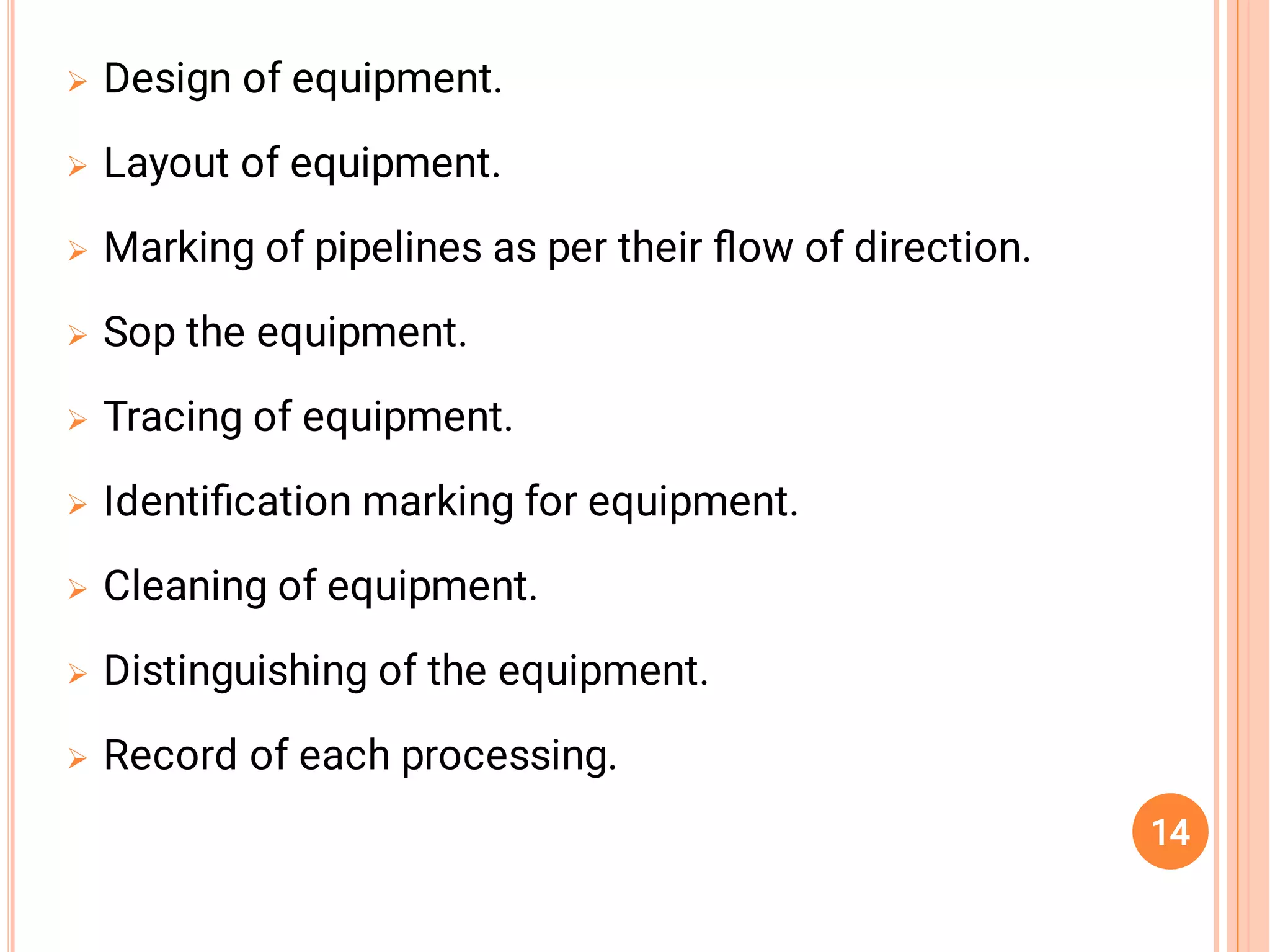
Design of equipment.
Layout of equipment.
Marking of pipelines as per their flow of direction.
Sop the equipment.
Tracing of equipment.
Identification marking for equipment.
Cleaning of equipment.
Distinguishing of the equipment.
Record of each processing.
14
VALIDATION OF EQUIPMENTSVALIDATION OF EQUIPMENTS
WHO GUIDELINES FORWHO GUIDELINES FORWHO GUIDELINES FOR
VALIDATION OF EQUIPMENTS









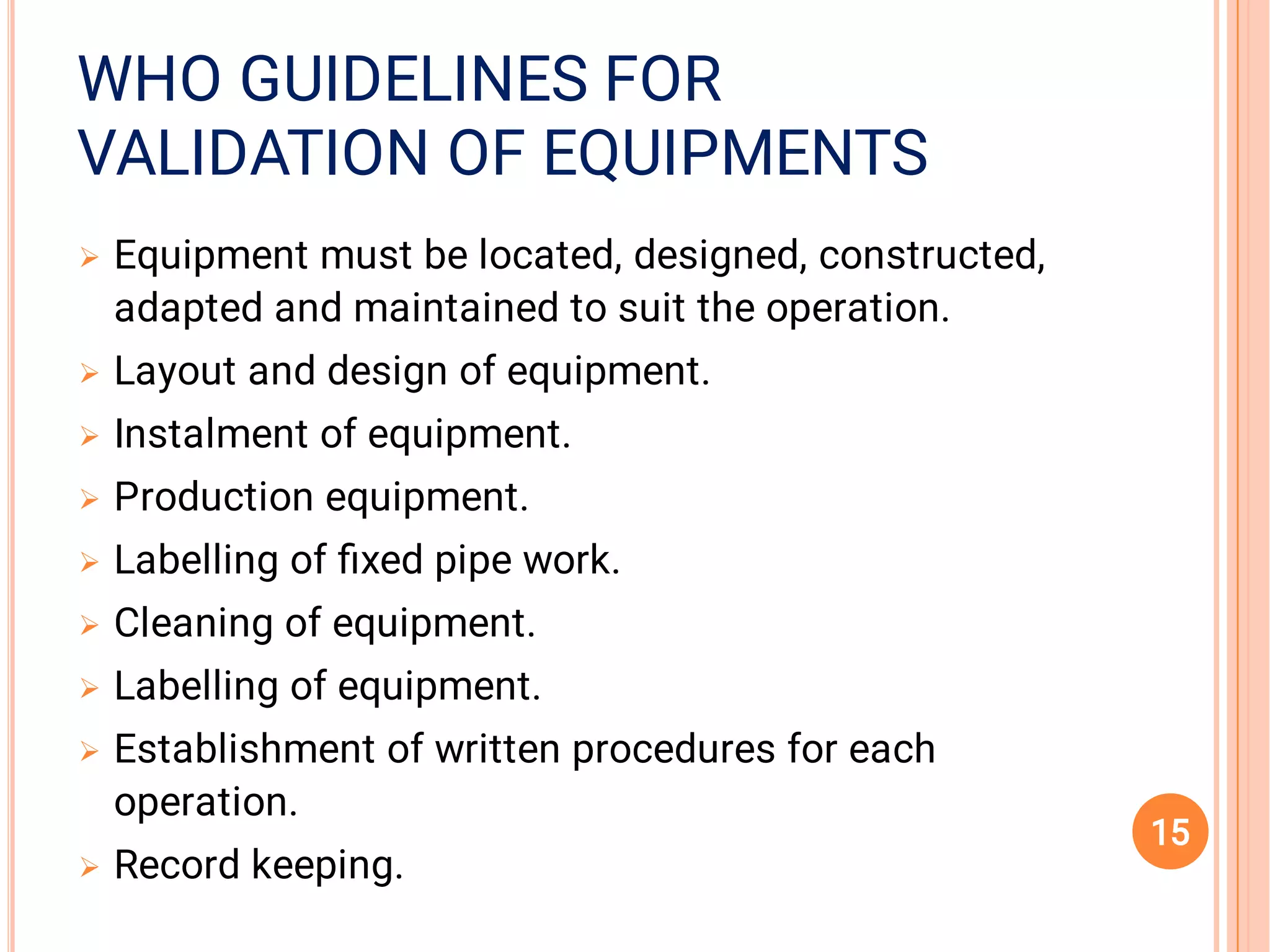
Equipment must be located, designed, constructed,
adapted and maintained to suit the operation.
Layout and design of equipment.
Instalment of equipment.
Production equipment.
Labelling of fixed pipe work.
Cleaning of equipment.
Labelling of equipment.
Establishment of written procedures for each
operation.
Record keeping.
15
COMPRESSION MACHINECOMPRESSION MACHINE
EXAMPLE OF VALIDATION OF TABLETEXAMPLE OF VALIDATION OF TABLETEXAMPLE OF VALIDATION OF TABLET
COMPRESSION MACHINE
1.
2.
3.

i.
ii.
iii.
iv.
v.
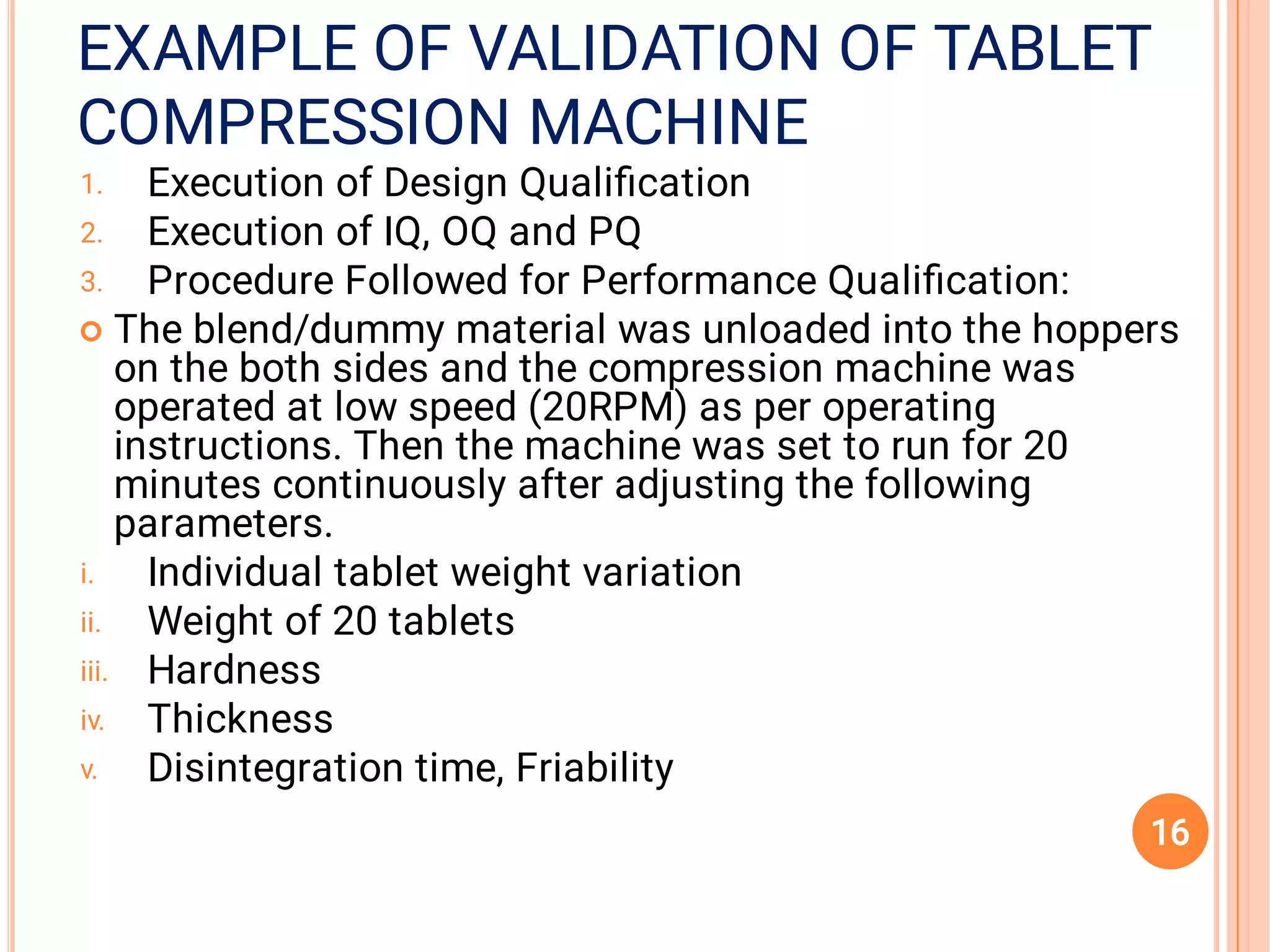
Execution of Design Qualification
Execution of IQ, OQ and PQ
Procedure Followed for Performance Qualification:
The blend/dummy material was unloaded into the hoppers
on the both sides and the compression machine was
operated at low speed (20RPM) as per operating
instructions. Then the machine was set to run for 20
minutes continuously after adjusting the following
parameters.
Individual tablet weight variation
Weight of 20 tablets
Hardness
Thickness
Disintegration time, Friability
16




I.
II.
a.
b.
c.
d.
e.
f.

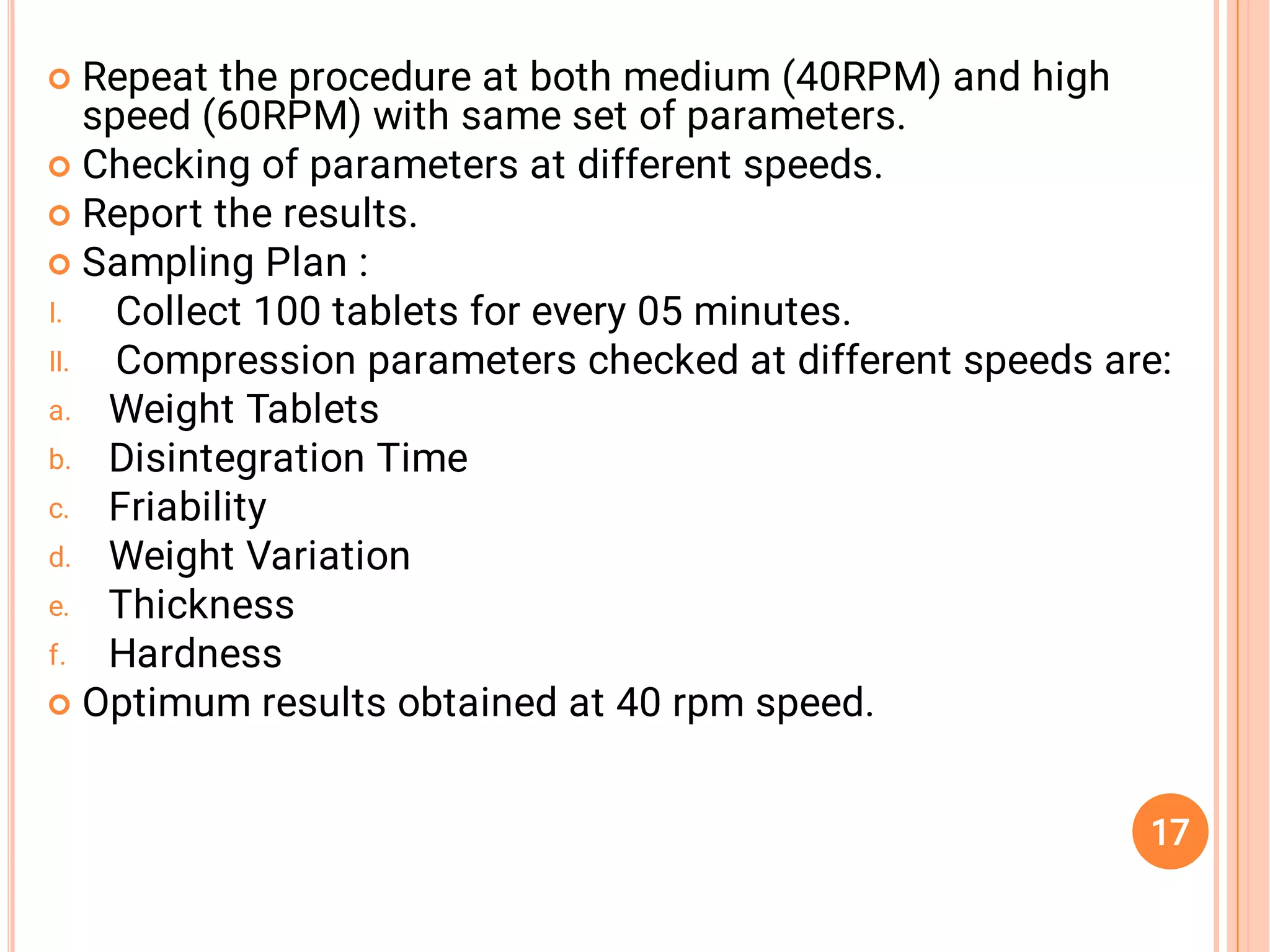
Repeat the procedure at both medium (40RPM) and high
speed (60RPM) with same set of parameters.
Checking of parameters at different speeds.
Report the results.
Sampling Plan :
Collect 100 tablets for every 05 minutes.
Compression parameters checked at different speeds are:
Weight Tablets
Disintegration Time
Friability
Weight Variation
Thickness
Hardness
Optimum results obtained at 40 rpm speed.
17




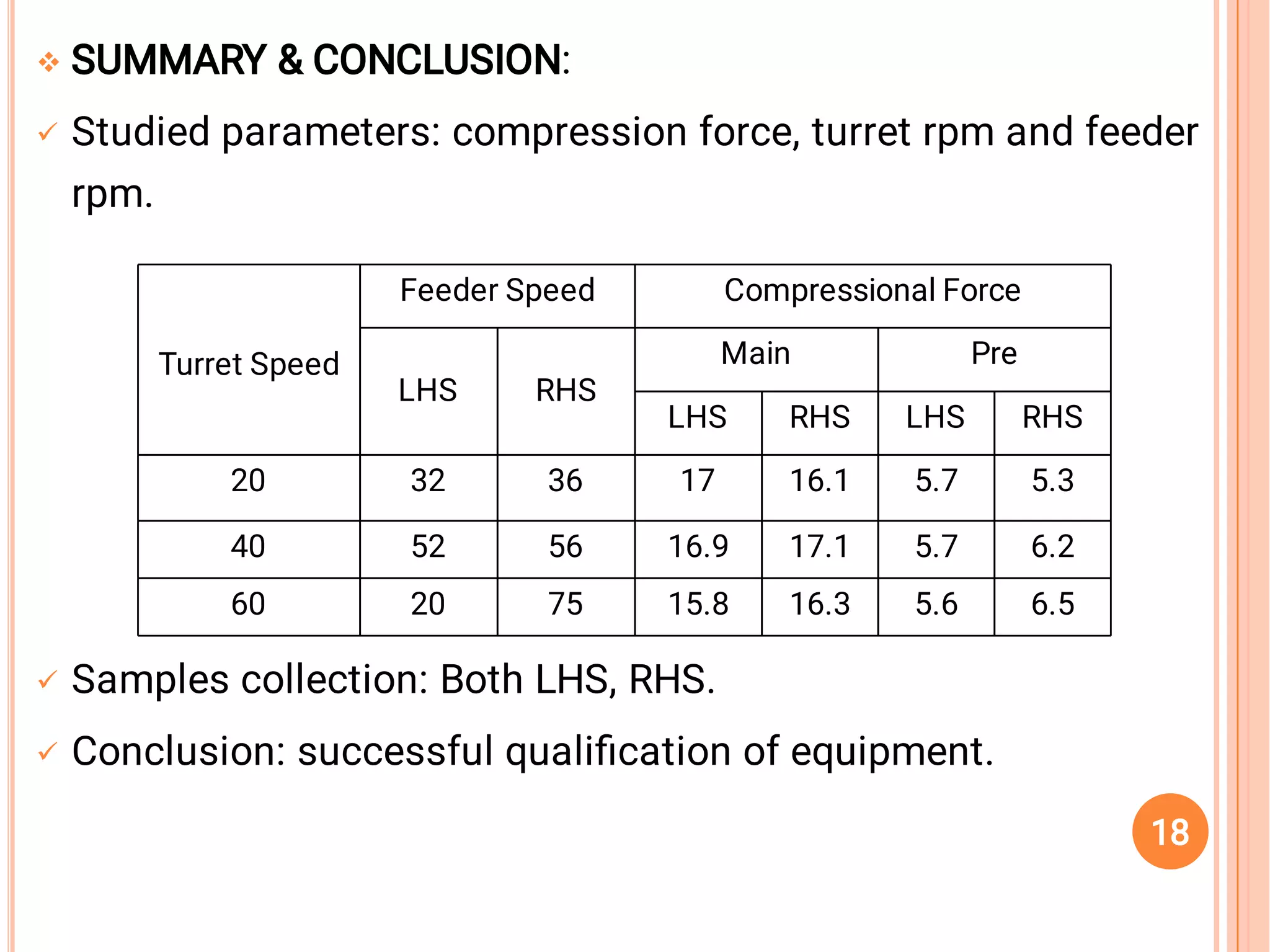
SUMMARY & CONCLUSION:
Studied parameters: compression force, turret rpm and feeder
rpm.
Samples collection: Both LHS, RHS.
Conclusion: successful qualification of equipment.
Turret Speed
Feeder Speed Compressional Force
LHS RHS
Main Pre
LHS RHS LHS RHS
20 32 36 17 16.1 5.7 5.3
40 52 56 16.9 17.1 5.7 6.2
60 20 75 15.8 16.3 5.6 6.5
18
REFERENCES




Potdar MA, “cGMP, current good manufacturing
practises for pharmaceuticals”, 2nd reprint,
Pharmamed press, Hyderabad, p. 85,88-101,413-423.
Joseph Busfield. cGMP, instrument and calibration.
“Facilities, utilities and requirements, GXP, Ivt network”.
Feb 21,2007;5-7. Available from: http://www.ivtnetwok.
com/article/cgmp-equipment-instruments-and-
calibration
Guidelines : ICH. “ICH harmonization for better health”.
Available from: http://www.ich.org/products/
guidelines.html.
Essential medicines and health products information
portal. “WHO expert committee on specifications for
pharmaceutical preparations”. World Health
Organization. Technical report series no. 902-36th
report.2002. Anex3.part2:12 19
Thank you.Thank you.
20

DATION OF EQUIPMENT ICH AND WHO GUIDELINES FOR CALIBRATION AND VALIDATION OF EQUIPMENT ICH AND WHO GUIDELINES FOR CALIBRATION AND

  • 1.
    Seminar onSeminar on ANDVALIDATION OF EQUIPMENT ICH AND WHO GUIDELINES FOR CALIBRATIONICH AND WHO GUIDELINES FOR CALIBRATION AND VALIDATION OF EQUIPMENT ICH AND WHO GUIDELINES FOR CALIBRATION AND VALIDATION OF EQUIPMENT Prepared by :- Miss. Sanap Deepali S. M. Pharm 1st Year (Sem I). Roll No.13 Guided By :- Prof. A. W. Ambekar M. Pharm (Pharmaceutics) Dr. Vithalrao Vikhe Patil Foundation’s College of Pharmacy Ahmednagar (2018-2019) 1
  • 2.
    CONTENTS           Introduction to equipment Calibration ICHguidelines for calibration of equipment WHO guidelines for calibration of equipment Example for calibration of UV Validation ICH guidelines for validation of equipment WHO guidelines for validation of equipment Example for validation of tablet compression machine References 2
  • 3.
    EQUIPMENT   1. 2. Equipment may bedefined as a physical entity which is used to carry out a general or specific activity in the plant. Equipment can be- Single piece for ex. tablet compression machine, HPLC, FTIR, weighing balance Integrated system for ex. water demineralizing plant, an air handling system. 3
  • 4.
    CALIBRATION     1. 2. "Calibration of aninstrument is the process of determining it's accuracy. The process involves obtaining a reading from the instrument and measuring it's variation from the reading obtained from a standard instrument." Calibration adjust precision and accuracy of instrument. Also important for adjustment of process of qualification and validation. Calibration achieves two main objectives: Accuracy Traceability 4
  • 5.
    EQUIPMENTEQUIPMENT ICH GUIDELINES FORCALIBRATION OFICH GUIDELINES FOR CALIBRATION OFICH GUIDELINES FOR CALIBRATION OF EQUIPMENT      Local identification by a unique identification number and involvement in the master GMP instrument list. Procedure for instrument history file. Approval by quality unit. Generation of procedure for verification and standardisation of accuracy and reliability. For approval of procedure, it must contains steps and forms required for calibration. 5
  • 6.
          Involvement of calibrationstickers and auxiliary stickers program. Procedure for tracking of scheduled calibration activities. Procedure for notifying users of calibration due dates, overdue calibrations and out of tolerance findings. Review of all systems, calibration records and procedure by quality unit. Involvement of procedure for reporting any GMP critical instrument. Involvement of calibration forms which are developed to record the calibration results. 6
  • 7.
    OF EQUIPMENTOF EQUIPMENT WHOGUIDELINES FOR CALIBRATIONWHO GUIDELINES FOR CALIBRATIONWHO GUIDELINES FOR CALIBRATION OF EQUIPMENT       Regular calibration. Establishment of specific procedure of calibration for every equipment. Only authorized personnel should operate equipment. Availability of up to date instructions for calibration. Verification results must be recorded on a control chart. Unique identification of each item of equipment for calibration. 7
  • 8.
          Keeping of recordsof each item of equipment to perform calibration. Systematic verification of laboratory to prevent contamination. Establishment of maintenance procedure. Out of service equipment. Labelling of equipment. Verification of equipment function and calibration status.8
  • 9.
    EXAMPLE FOR CALIBRATIONOF U.V    Control of wavelength: Verify wavelength scale using absorption maxima of holmium per chlorate solution with the line of hydrogen or deuterium discharge lamp or lines of mercury vapor arc. The permitted tolerance is +/-1 nm for the range 200 to 400nm and + /-3 nm for the range 400 to 600 nm. 9 λmax between UV range λmax between visible range 241.15 nm (Ho) 404.66 nm (Hg) 253.70 nm (Hg) 435.83 nm (Hg) 287.15 nm (Ho) 486.00 nm (D) 302.25 nm (Hg) 486.10 nm (H) 313.16 nm (Hg) 536.30 nm (Ho) 334.15 nm (Hg) 546.07 nm (Hg) 361.50 nm (Ho) 576.96 nm (Hg) 365.48 nm (Hg) 579.07 nm (Hg)
  • 10.
     Control ofabsorbance: Check the absorbance using potassium dichromate solution UV at the wavelengths indicated in table , which gives for each wave length the exact value of A( 1%, 1 cm) and the permitted limits. 10
  • 11.
     •  1. 2.  • Limit of straylight: Detected at a given wavelength with suitable filters or solutions; for ex. potassium chloride. Resolution power: Record the spectrum of a 0.02% v/v solution of toluene in hexane UV. Ratio of the absorbance is NLT 1.5 . Spectral slit width: Spectral slit width must be small compared with the half- width of the absorption band. 11
  • 12.
    VALIDATION   1. 2. 3. 4. 5. Validation is “a documented programme, which provides a high degree of assurance that a specific process will consistently produce, a product meeting its predetermined specifications and quality attributes.” Importance of validation : Reduction of quality costs. Process optimization. Assurance of quality. Safety. Time bound. 12
  • 13.
    EQUIPMENTSEQUIPMENTS ICH GUIDELINES FORVALIDATION OFICH GUIDELINES FOR VALIDATION OFICH GUIDELINES FOR VALIDATION OF EQUIPMENTS        1 meter distance from walls and other obstacles. Easy to operate, clean and maintainable. Working should be at proper commissioned position. Certification of equipment. Checking of overhead heights. Proper source of light. Drop down utility system. 13
  • 14.
             Design of equipment. Layoutof equipment. Marking of pipelines as per their flow of direction. Sop the equipment. Tracing of equipment. Identification marking for equipment. Cleaning of equipment. Distinguishing of the equipment. Record of each processing. 14
  • 15.
    VALIDATION OF EQUIPMENTSVALIDATIONOF EQUIPMENTS WHO GUIDELINES FORWHO GUIDELINES FORWHO GUIDELINES FOR VALIDATION OF EQUIPMENTS          Equipment must be located, designed, constructed, adapted and maintained to suit the operation. Layout and design of equipment. Instalment of equipment. Production equipment. Labelling of fixed pipe work. Cleaning of equipment. Labelling of equipment. Establishment of written procedures for each operation. Record keeping. 15
  • 16.
    COMPRESSION MACHINECOMPRESSION MACHINE EXAMPLEOF VALIDATION OF TABLETEXAMPLE OF VALIDATION OF TABLETEXAMPLE OF VALIDATION OF TABLET COMPRESSION MACHINE 1. 2. 3.  i. ii. iii. iv. v. Execution of Design Qualification Execution of IQ, OQ and PQ Procedure Followed for Performance Qualification: The blend/dummy material was unloaded into the hoppers on the both sides and the compression machine was operated at low speed (20RPM) as per operating instructions. Then the machine was set to run for 20 minutes continuously after adjusting the following parameters. Individual tablet weight variation Weight of 20 tablets Hardness Thickness Disintegration time, Friability 16
  • 17.
        I. II. a. b. c. d. e. f.  Repeat the procedureat both medium (40RPM) and high speed (60RPM) with same set of parameters. Checking of parameters at different speeds. Report the results. Sampling Plan : Collect 100 tablets for every 05 minutes. Compression parameters checked at different speeds are: Weight Tablets Disintegration Time Friability Weight Variation Thickness Hardness Optimum results obtained at 40 rpm speed. 17
  • 18.
        SUMMARY & CONCLUSION: Studiedparameters: compression force, turret rpm and feeder rpm. Samples collection: Both LHS, RHS. Conclusion: successful qualification of equipment. Turret Speed Feeder Speed Compressional Force LHS RHS Main Pre LHS RHS LHS RHS 20 32 36 17 16.1 5.7 5.3 40 52 56 16.9 17.1 5.7 6.2 60 20 75 15.8 16.3 5.6 6.5 18
  • 19.
    REFERENCES     Potdar MA, “cGMP,current good manufacturing practises for pharmaceuticals”, 2nd reprint, Pharmamed press, Hyderabad, p. 85,88-101,413-423. Joseph Busfield. cGMP, instrument and calibration. “Facilities, utilities and requirements, GXP, Ivt network”. Feb 21,2007;5-7. Available from: http://www.ivtnetwok. com/article/cgmp-equipment-instruments-and- calibration Guidelines : ICH. “ICH harmonization for better health”. Available from: http://www.ich.org/products/ guidelines.html. Essential medicines and health products information portal. “WHO expert committee on specifications for pharmaceutical preparations”. World Health Organization. Technical report series no. 902-36th report.2002. Anex3.part2:12 19
  • 20.