METHOD VALIDATION
ANALYTICAL METHOD VALIDATION
B. Sravan Kumar
METHOD VALIDATION
CONTENTS
 Validation
 Requirements of validation
 Parameters of validation
 Specificity
 Precision 1 – Repeatability 2 – Intermediate Precision 3 – Reproducibility
 Linearity and Range
 LOQ and LOD
 Accuracy or Recovery
 Robustness
 Solution Stability
 System suitability
 Revalidation
METHOD VALIDATION
Validation
 DEFINTION:
To Confirm that the analytical procedure is suitable for
intended use for all the parameters in drug substances and
drug products. (or)
Validation is to ensures that the analytical procedure is
accurate, specific, precise, linear, rugged and specified range
over the analyte to be analysed.
Validation is a very necessary element of any company and
the regulatory agencies as per cGMP guidelines.
 To trust the method
 Regulatory requirement
METHOD VALIDATION
Currently available common guidelines from various
regulatory bodies
ICH Q2(R1)
USFDA (Q2B)
USP Chapter <1225>
METHOD VALIDATION
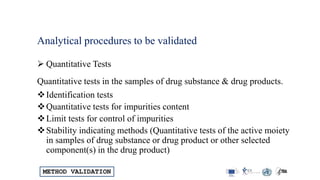
Analytical procedures to be validated
 Quantitative Tests
Quantitative tests in the samples of drug substance & drug products.
Identification tests
Quantitative tests for impurities content
Limit tests for control of impurities
Stability indicating methods (Quantitative tests of the active moiety
in samples of drug substance or drug product or other selected
component(s) in the drug product)
METHOD VALIDATION
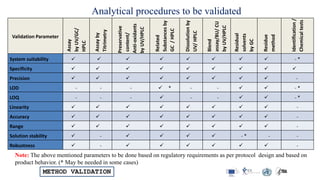
Analytical procedures to be validated
Validation Parameter
Assay
by
UV/GC/
HPLC
Assay
by
Titrimetry
Preservative
content/
Anti-oxidants
by
UV/HPLC
Related
Substances
by
GC
/
HPLC
Dissolution
by
UV/
HPLC
Blend
assay/BU/
CU
by
UV/HPLC
Residual
solvents
by
GC
Residue
method
Identification
/
Chemical
tests
System suitability         - *
Specificity         
Precision         -
LOD - - -  * - -   - *
LOQ - - -  - -   - *
Linearity         -
Accuracy         -
Range         -
Solution stability  -     - * - -
Robustness  -       -
Note: The above mentioned parameters to be done based on regulatory requirements as per protocol design and based on
product behavior. (* May be needed in some cases)
METHOD VALIDATION
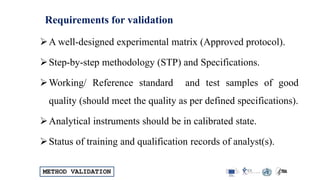
Requirements for validation
A well-designed experimental matrix (Approved protocol).
Step-by-step methodology (STP) and Specifications.
Working/ Reference standard and test samples of good
quality (should meet the quality as per defined specifications).
Analytical instruments should be in calibrated state.
Status of training and qualification records of analyst(s).
METHOD VALIDATION
Parameters to be validated
 Specificity
• Selectivity (Interference study)
• Forced degradation
 Precision
i. Repeatability (Method Precision)
ii. Intermediate precision (Ruggedness)
iii. Reproducibility
 Linearity and Range
 LOD and LOQ
 Accuracy or Recovery
 Robustness
 Solution Stability
 System suitability
METHOD VALIDATION
Specificity
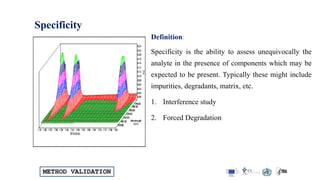
Definition:
Specificity is the ability to assess unequivocally the
analyte in the presence of components which may be
expected to be present. Typically these might include
impurities, degradants, matrix, etc.
1. Interference study
2. Forced Degradation
METHOD VALIDATION
Specificity
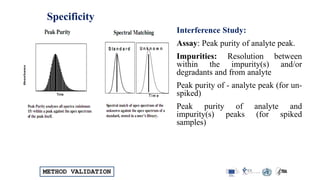
Interference Study:
Assay: Peak purity of analyte peak.
Impurities: Resolution between
within the impurity(s) and/or
degradants and from analyte
Peak purity of - analyte peak (for un-
spiked)
Peak purity of analyte and
impurity(s) peaks (for spiked
samples)
METHOD VALIDATION
Acceptance Criteria
Assay : No peak should be found at the retention time of analyte peak
and Peak purity of analyte peak should pass.
Impurities : Should pass Peak purity of -main analyte and Impurity
peaks
No peak should be found at the retention time of analyte/Impurity
Dissolution: No peak should be found at the retention time of analyte.
There should not be any interference from dissolution media, placebo
& degradants or unknown impurities with the analyte peak.
METHOD VALIDATION
Forced Degradation
Forced degradation is a degradation of new drug substance and drug product at conditions more severe than
accelerated conditions. ... Forced degradation studies show the chemical behavior of the molecule which in
turn helps in the development.
Perform analysis for each stressed (acid / base / peroxide (oxidation) / thermal / humidity / Photolytic)
sample as per methodology.
FDA guidance states that stress testing should be performed in phase III of regulatory submission process.
Normal initial stressed conditions to be applied
5M HCl
5M NaOH
10% H2O2
Temperature 105°C/at least 72 Hours
UV 12000 Lux/at least 72 (1.2 Million lux hours) 1200 watt.hrs/m2 light
High Humidity 80% RH/25°C/at least 72 Hours
METHOD VALIDATION
Why Forced Degradation Study?
 Address the stability of the compound and to solve the stability related
problems.
 Establish the degradation pathways
 Identify and characterization of the degradation products.
 To differentiate the degradation products that are related to drug products
from those that are generated from non-product in a formulation.
 To establish the stability indicating nature of a developed method.
 To generate more stable formulations.
 For regulatory requirements.
METHOD VALIDATION
ACCEPTANCE CRITERIA:
Assay, RS:
 There should not be any interference of placebo & degradants or unknown impurities
with the analyte peak and known impurities.
 Peak purity of analyte in Assay and peak purity of analyte and impurities in RS
should pass with PDA detector.
 Minimum 5-20% degradation should achieve in each degradation condition and
justification is acceptable based on product behavior.
 Mass balance should achieve NLT 95%.
METHOD VALIDATION
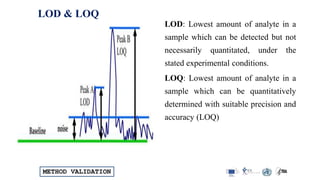
LOD & LOQ
LOD: Lowest amount of analyte in a
sample which can be detected but not
necessarily quantitated, under the
stated experimental conditions.
LOQ: Lowest amount of analyte in a
sample which can be quantitatively
determined with suitable precision and
accuracy (LOQ)
METHOD VALIDATION
LOD & LOQ
Different approaches suggested by ICH, USP & EP
Several approaches are given in the ICH guidelines for estimating LOD and LOQ
Depending on the procedure : instrumental / non-instrumental
As per ICH and USP, other approaches suggested above are also acceptable.
Approach methods LOD LOQ
Visual inspection Minimum level detectable Minimum level quantifiable
Signal to Noise ratio 2:1 or 3:1 10:1
SD of response (σ)& Slope (S) [3:3 x σ] / S] [10.0 x σ] / S]
METHOD VALIDATION
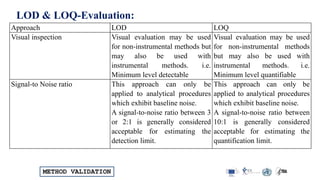
LOD & LOQ-Evaluation:
Approach LOD LOQ
Visual inspection Visual evaluation may be used
for non-instrumental methods but
may also be used with
instrumental methods. i.e.
Minimum level detectable
Visual evaluation may be used
for non-instrumental methods
but may also be used with
instrumental methods. i.e.
Minimum level quantifiable
Signal-to Noise ratio This approach can only be
applied to analytical procedures
which exhibit baseline noise.
A signal-to-noise ratio between 3
or 2:1 is generally considered
acceptable for estimating the
detection limit.
This approach can only be
applied to analytical procedures
which exhibit baseline noise.
A signal-to-noise ratio between
10:1 is generally considered
acceptable for estimating the
quantification limit.
METHOD VALIDATION
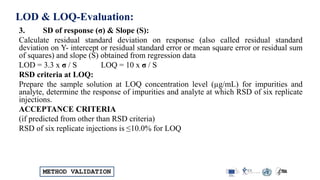
LOD & LOQ-Evaluation:
3. SD of response (σ) & Slope (S):
Calculate residual standard deviation on response (also called residual standard
deviation on Y- intercept or residual standard error or mean square error or residual sum
of squares) and slope (S) obtained from regression data
LOD = 3.3 x σ / S LOQ = 10 x σ / S
RSD criteria at LOQ:
Prepare the sample solution at LOQ concentration level (µg/mL) for impurities and
analyte, determine the response of impurities and analyte at which RSD of six replicate
injections.
ACCEPTANCE CRITERIA
(if predicted from other than RSD criteria)
RSD of six replicate injections is ≤10.0% for LOQ
METHOD VALIDATION
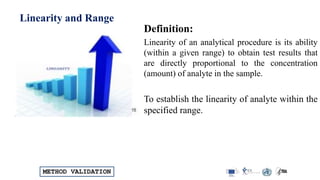
Linearity and Range
Definition:
Linearity of an analytical procedure is its ability
(within a given range) to obtain test results that
are directly proportional to the concentration
(amount) of analyte in the sample.
To establish the linearity of analyte within the
specified range.
METHOD VALIDATION
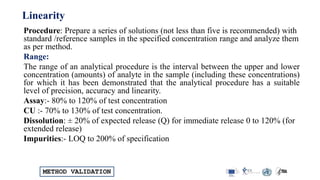
Linearity
Procedure: Prepare a series of solutions (not less than five is recommended) with
standard /reference samples in the specified concentration range and analyze them
as per method.
Range:
The range of an analytical procedure is the interval between the upper and lower
concentration (amounts) of analyte in the sample (including these concentrations)
for which it has been demonstrated that the analytical procedure has a suitable
level of precision, accuracy and linearity.
Assay:- 80% to 120% of test concentration
CU :- 70% to 130% of test concentration.
Dissolution: ± 20% of expected release (Q) for immediate release 0 to 120% (for
extended release)
Impurities:- LOQ to 200% of specification
METHOD VALIDATION
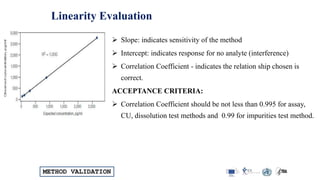
Linearity Evaluation
 Slope: indicates sensitivity of the method
 Intercept: indicates response for no analyte (interference)
 Correlation Coefficient - indicates the relation ship chosen is
correct.
ACCEPTANCE CRITERIA:
 Correlation Coefficient should be not less than 0.995 for assay,
CU, dissolution test methods and 0.99 for impurities test method.
METHOD VALIDATION
Precision
DEFINITION:
Measurements obtained from multiple
sampling of the same homogenous sample
under the prescribed conditions.
Precision may be considered at three levels
1. Repeatability (Method Precision)
2. Intermediate precision (Ruggedness)
3. Reproducibility
METHOD VALIDATION
The precision under the same operating conditions over a short interval of
time. Repeatability is also termed as intra-assay precision .
Repeatability (Method Precision)
Intermediate precision expresses within-laboratories variations: different days,
different analysts, different equipment, different reagents etc.
Note: Intermediate precision data can also be taken from method transfer activity.
Intermediate Precision (Ruggedness)
Reproducibility expresses the precision between laboratories (collaborative studies,
usually applied to standardization of methodology).
Reproducibility
Precision
METHOD VALIDATION
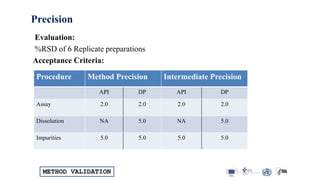
Evaluation:
%RSD of 6 Replicate preparations
Acceptance Criteria:
Procedure Method Precision Intermediate Precision
API DP API DP
Assay 2.0 2.0 2.0 2.0
Dissolution NA 5.0 NA 5.0
Impurities 5.0 5.0 5.0 5.0
Precision
METHOD VALIDATION
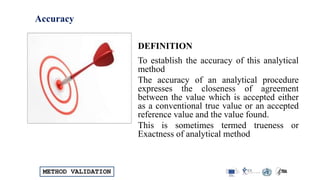
Accuracy
DEFINITION
To establish the accuracy of this analytical
method
The accuracy of an analytical procedure
expresses the closeness of agreement
between the value which is accepted either
as a conventional true value or an accepted
reference value and the value found.
This is sometimes termed trueness or
Exactness of analytical method
METHOD VALIDATION
Accuracy
 Assay:- Known amount of drug substance spiked with synthetic mixtures of
drug product components (excipients) – minimum of three levels
 80%, 100% & 120% of test concentration-assay;
 Impurities:- drug substance/drug product spiked with known amounts of
impurities- minimum of three levels
• LOQ level to 200% of specification and
 In each level is triplicate preparations.
EVALUATION
 Recovery from amount added and amount found
 Precision (%RSD) at each level (for three replicate preparations)
METHOD VALIDATION
Accuracy
ACCEPTANCE CRITERIA
Assay:- Recovery should be between 98% to 102% (Depends
upon the your Strength)
Dissolution:- 95% to 105%
Impurities:- if, Specification is ≤ 0.2% : 85% to 115%
if, Specification is > 0.2% : 90% to 110%
At LOQ level : 80% to 120%
A simple logic behind this performance characteristic is
whether the procedure is capable of estimating a true value or
not.
METHOD VALIDATION
Solution Stability
DISCUSSION
 It is often essential that solutions
(standards, test samples) be stable to
allow for delays covering
instrument break downs / overnight
analyses .
 A minimum of 12 Hrs, 18 Hrs, or 24
Hrs is routinely recommended for
chromatographic methods for which
vialed solutions may remain on an
auto-chromatographic methods for
which vialed solutions may remain
on an auto-samplers at ambient
temperatures due to various delays.
METHOD VALIDATION
Solution Stability
PROCEDURE:
Prepare test sample as per procedure and
analyze at initial and at different time intervals
by keeping the sample at room temperature (
25°C) / refrigerator condition (2-8°C).
EVALUATION. % Difference from initial
response to specified interval for analyte / each
impurity.
ACCEPTANCE CRITERIA:
Difference is not more than
Assay : 2.0
Dissolution : 3.0
Impurities : 5.0
METHOD VALIDATION
Solution Stability
A simple logic behind this
study is to determine the
period of time, a solution can
be held before analysis with
out compromising accuracy.
METHOD VALIDATION
Robustness
DEFINTION:
Measure of its capacity to remain
unaffected by small, but deliberate
variations in method parameters and
provides indication of its reliability
during its normal usage.
METHOD VALIDATION
Typical variations include under validation programme
 Flow rate (±10%)
 Wavelength (±2 nm)
 Mobile phase composition, generally, organic composition (up to 10%)
 Mobile phase Buffer Strength (±10%)
 Sonication time (For Drug product analysis)
 pH of the mobile phase (±0.2 units)
 Temperature (±5 °C)
 Filter Compatibility (For Drug product analysis)
METHOD VALIDATION
Acceptance criteria
Assay :
System suitability criteria should meet at each variable condition.
Overall RSD for % Assay results obtained at STP condition and
variable condition for each variability
Impurities :
System suitability criteria should meet at each variable conditions.
METHOD VALIDATION
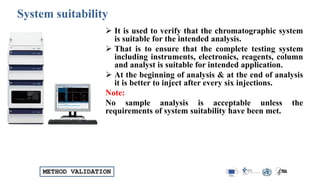
 It is used to verify that the chromatographic system
is suitable for the intended analysis.
 That is to ensure that the complete testing system
including instruments, electronics, reagents, column
and analyst is suitable for intended application.
 At the beginning of analysis & at the end of analysis
it is better to inject after every six injections.
Note:
No sample analysis is acceptable unless the
requirements of system suitability have been met.
System suitability
METHOD VALIDATION
System suitability Parameters:
Precision (% RSD of 6 replicate injections)
Theoretical plates (Efficiency)
Tailing factor or Asymmetric factor
Resolution
Capacity factor or Retention factor
Selectivity factor or Relative Retention
factor
System suitability
METHOD VALIDATION
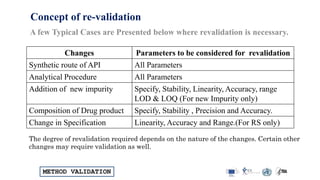
Concept of re-validation
A few Typical Cases are Presented below where revalidation is necessary.
Changes Parameters to be considered for revalidation
Synthetic route of API All Parameters
Analytical Procedure All Parameters
Addition of new impurity Specify, Stability, Linearity, Accuracy, range
LOD & LOQ (For new Impurity only)
Composition of Drug product Specify, Stability , Precision and Accuracy.
Change in Specification Linearity, Accuracy and Range.(For RS only)
The degree of revalidation required depends on the nature of the changes. Certain other
changes may require validation as well.
METHOD VALIDATION
Validation report
Listing of equipment's and its functional and performance
requirements
Methodology followed
Validation data (parameter wise- procedure, results ,conclusion
etc.)
Summary of data( results in brief – parameter wise)
Summary of report ( overall view of validation exercise, any
critical issues, recommendations etc. for the application of
method
METHOD VALIDATION
METHOD VALIDATION

Analytical Method Validations & Detailed Method Validation Parameters

  • 1.
    METHOD VALIDATION ANALYTICAL METHODVALIDATION B. Sravan Kumar
  • 2.
    METHOD VALIDATION CONTENTS  Validation Requirements of validation  Parameters of validation  Specificity  Precision 1 – Repeatability 2 – Intermediate Precision 3 – Reproducibility  Linearity and Range  LOQ and LOD  Accuracy or Recovery  Robustness  Solution Stability  System suitability  Revalidation
  • 3.
    METHOD VALIDATION Validation  DEFINTION: ToConfirm that the analytical procedure is suitable for intended use for all the parameters in drug substances and drug products. (or) Validation is to ensures that the analytical procedure is accurate, specific, precise, linear, rugged and specified range over the analyte to be analysed. Validation is a very necessary element of any company and the regulatory agencies as per cGMP guidelines.  To trust the method  Regulatory requirement
  • 4.
    METHOD VALIDATION Currently availablecommon guidelines from various regulatory bodies ICH Q2(R1) USFDA (Q2B) USP Chapter <1225>
  • 5.
    METHOD VALIDATION Analytical proceduresto be validated  Quantitative Tests Quantitative tests in the samples of drug substance & drug products. Identification tests Quantitative tests for impurities content Limit tests for control of impurities Stability indicating methods (Quantitative tests of the active moiety in samples of drug substance or drug product or other selected component(s) in the drug product)
  • 6.
    METHOD VALIDATION Analytical proceduresto be validated Validation Parameter Assay by UV/GC/ HPLC Assay by Titrimetry Preservative content/ Anti-oxidants by UV/HPLC Related Substances by GC / HPLC Dissolution by UV/ HPLC Blend assay/BU/ CU by UV/HPLC Residual solvents by GC Residue method Identification / Chemical tests System suitability         - * Specificity          Precision         - LOD - - -  * - -   - * LOQ - - -  - -   - * Linearity         - Accuracy         - Range         - Solution stability  -     - * - - Robustness  -       - Note: The above mentioned parameters to be done based on regulatory requirements as per protocol design and based on product behavior. (* May be needed in some cases)
  • 7.
    METHOD VALIDATION Requirements forvalidation A well-designed experimental matrix (Approved protocol). Step-by-step methodology (STP) and Specifications. Working/ Reference standard and test samples of good quality (should meet the quality as per defined specifications). Analytical instruments should be in calibrated state. Status of training and qualification records of analyst(s).
  • 8.
    METHOD VALIDATION Parameters tobe validated  Specificity • Selectivity (Interference study) • Forced degradation  Precision i. Repeatability (Method Precision) ii. Intermediate precision (Ruggedness) iii. Reproducibility  Linearity and Range  LOD and LOQ  Accuracy or Recovery  Robustness  Solution Stability  System suitability
  • 9.
    METHOD VALIDATION Specificity Definition: Specificity isthe ability to assess unequivocally the analyte in the presence of components which may be expected to be present. Typically these might include impurities, degradants, matrix, etc. 1. Interference study 2. Forced Degradation
  • 10.
    METHOD VALIDATION Specificity Interference Study: Assay:Peak purity of analyte peak. Impurities: Resolution between within the impurity(s) and/or degradants and from analyte Peak purity of - analyte peak (for un- spiked) Peak purity of analyte and impurity(s) peaks (for spiked samples)
  • 11.
    METHOD VALIDATION Acceptance Criteria Assay: No peak should be found at the retention time of analyte peak and Peak purity of analyte peak should pass. Impurities : Should pass Peak purity of -main analyte and Impurity peaks No peak should be found at the retention time of analyte/Impurity Dissolution: No peak should be found at the retention time of analyte. There should not be any interference from dissolution media, placebo & degradants or unknown impurities with the analyte peak.
  • 12.
    METHOD VALIDATION Forced Degradation Forceddegradation is a degradation of new drug substance and drug product at conditions more severe than accelerated conditions. ... Forced degradation studies show the chemical behavior of the molecule which in turn helps in the development. Perform analysis for each stressed (acid / base / peroxide (oxidation) / thermal / humidity / Photolytic) sample as per methodology. FDA guidance states that stress testing should be performed in phase III of regulatory submission process. Normal initial stressed conditions to be applied 5M HCl 5M NaOH 10% H2O2 Temperature 105°C/at least 72 Hours UV 12000 Lux/at least 72 (1.2 Million lux hours) 1200 watt.hrs/m2 light High Humidity 80% RH/25°C/at least 72 Hours
  • 13.
    METHOD VALIDATION Why ForcedDegradation Study?  Address the stability of the compound and to solve the stability related problems.  Establish the degradation pathways  Identify and characterization of the degradation products.  To differentiate the degradation products that are related to drug products from those that are generated from non-product in a formulation.  To establish the stability indicating nature of a developed method.  To generate more stable formulations.  For regulatory requirements.
  • 14.
    METHOD VALIDATION ACCEPTANCE CRITERIA: Assay,RS:  There should not be any interference of placebo & degradants or unknown impurities with the analyte peak and known impurities.  Peak purity of analyte in Assay and peak purity of analyte and impurities in RS should pass with PDA detector.  Minimum 5-20% degradation should achieve in each degradation condition and justification is acceptable based on product behavior.  Mass balance should achieve NLT 95%.
  • 15.
    METHOD VALIDATION LOD &LOQ LOD: Lowest amount of analyte in a sample which can be detected but not necessarily quantitated, under the stated experimental conditions. LOQ: Lowest amount of analyte in a sample which can be quantitatively determined with suitable precision and accuracy (LOQ)
  • 16.
    METHOD VALIDATION LOD &LOQ Different approaches suggested by ICH, USP & EP Several approaches are given in the ICH guidelines for estimating LOD and LOQ Depending on the procedure : instrumental / non-instrumental As per ICH and USP, other approaches suggested above are also acceptable. Approach methods LOD LOQ Visual inspection Minimum level detectable Minimum level quantifiable Signal to Noise ratio 2:1 or 3:1 10:1 SD of response (σ)& Slope (S) [3:3 x σ] / S] [10.0 x σ] / S]
  • 17.
    METHOD VALIDATION LOD &LOQ-Evaluation: Approach LOD LOQ Visual inspection Visual evaluation may be used for non-instrumental methods but may also be used with instrumental methods. i.e. Minimum level detectable Visual evaluation may be used for non-instrumental methods but may also be used with instrumental methods. i.e. Minimum level quantifiable Signal-to Noise ratio This approach can only be applied to analytical procedures which exhibit baseline noise. A signal-to-noise ratio between 3 or 2:1 is generally considered acceptable for estimating the detection limit. This approach can only be applied to analytical procedures which exhibit baseline noise. A signal-to-noise ratio between 10:1 is generally considered acceptable for estimating the quantification limit.
  • 18.
    METHOD VALIDATION LOD &LOQ-Evaluation: 3. SD of response (σ) & Slope (S): Calculate residual standard deviation on response (also called residual standard deviation on Y- intercept or residual standard error or mean square error or residual sum of squares) and slope (S) obtained from regression data LOD = 3.3 x σ / S LOQ = 10 x σ / S RSD criteria at LOQ: Prepare the sample solution at LOQ concentration level (µg/mL) for impurities and analyte, determine the response of impurities and analyte at which RSD of six replicate injections. ACCEPTANCE CRITERIA (if predicted from other than RSD criteria) RSD of six replicate injections is ≤10.0% for LOQ
  • 19.
    METHOD VALIDATION Linearity andRange Definition: Linearity of an analytical procedure is its ability (within a given range) to obtain test results that are directly proportional to the concentration (amount) of analyte in the sample. To establish the linearity of analyte within the specified range.
  • 20.
    METHOD VALIDATION Linearity Procedure: Preparea series of solutions (not less than five is recommended) with standard /reference samples in the specified concentration range and analyze them as per method. Range: The range of an analytical procedure is the interval between the upper and lower concentration (amounts) of analyte in the sample (including these concentrations) for which it has been demonstrated that the analytical procedure has a suitable level of precision, accuracy and linearity. Assay:- 80% to 120% of test concentration CU :- 70% to 130% of test concentration. Dissolution: ± 20% of expected release (Q) for immediate release 0 to 120% (for extended release) Impurities:- LOQ to 200% of specification
  • 21.
    METHOD VALIDATION Linearity Evaluation Slope: indicates sensitivity of the method  Intercept: indicates response for no analyte (interference)  Correlation Coefficient - indicates the relation ship chosen is correct. ACCEPTANCE CRITERIA:  Correlation Coefficient should be not less than 0.995 for assay, CU, dissolution test methods and 0.99 for impurities test method.
  • 22.
    METHOD VALIDATION Precision DEFINITION: Measurements obtainedfrom multiple sampling of the same homogenous sample under the prescribed conditions. Precision may be considered at three levels 1. Repeatability (Method Precision) 2. Intermediate precision (Ruggedness) 3. Reproducibility
  • 23.
    METHOD VALIDATION The precisionunder the same operating conditions over a short interval of time. Repeatability is also termed as intra-assay precision . Repeatability (Method Precision) Intermediate precision expresses within-laboratories variations: different days, different analysts, different equipment, different reagents etc. Note: Intermediate precision data can also be taken from method transfer activity. Intermediate Precision (Ruggedness) Reproducibility expresses the precision between laboratories (collaborative studies, usually applied to standardization of methodology). Reproducibility Precision
  • 24.
    METHOD VALIDATION Evaluation: %RSD of6 Replicate preparations Acceptance Criteria: Procedure Method Precision Intermediate Precision API DP API DP Assay 2.0 2.0 2.0 2.0 Dissolution NA 5.0 NA 5.0 Impurities 5.0 5.0 5.0 5.0 Precision
  • 25.
    METHOD VALIDATION Accuracy DEFINITION To establishthe accuracy of this analytical method The accuracy of an analytical procedure expresses the closeness of agreement between the value which is accepted either as a conventional true value or an accepted reference value and the value found. This is sometimes termed trueness or Exactness of analytical method
  • 26.
    METHOD VALIDATION Accuracy  Assay:-Known amount of drug substance spiked with synthetic mixtures of drug product components (excipients) – minimum of three levels  80%, 100% & 120% of test concentration-assay;  Impurities:- drug substance/drug product spiked with known amounts of impurities- minimum of three levels • LOQ level to 200% of specification and  In each level is triplicate preparations. EVALUATION  Recovery from amount added and amount found  Precision (%RSD) at each level (for three replicate preparations)
  • 27.
    METHOD VALIDATION Accuracy ACCEPTANCE CRITERIA Assay:-Recovery should be between 98% to 102% (Depends upon the your Strength) Dissolution:- 95% to 105% Impurities:- if, Specification is ≤ 0.2% : 85% to 115% if, Specification is > 0.2% : 90% to 110% At LOQ level : 80% to 120% A simple logic behind this performance characteristic is whether the procedure is capable of estimating a true value or not.
  • 28.
    METHOD VALIDATION Solution Stability DISCUSSION It is often essential that solutions (standards, test samples) be stable to allow for delays covering instrument break downs / overnight analyses .  A minimum of 12 Hrs, 18 Hrs, or 24 Hrs is routinely recommended for chromatographic methods for which vialed solutions may remain on an auto-chromatographic methods for which vialed solutions may remain on an auto-samplers at ambient temperatures due to various delays.
  • 29.
    METHOD VALIDATION Solution Stability PROCEDURE: Preparetest sample as per procedure and analyze at initial and at different time intervals by keeping the sample at room temperature ( 25°C) / refrigerator condition (2-8°C). EVALUATION. % Difference from initial response to specified interval for analyte / each impurity. ACCEPTANCE CRITERIA: Difference is not more than Assay : 2.0 Dissolution : 3.0 Impurities : 5.0
  • 30.
    METHOD VALIDATION Solution Stability Asimple logic behind this study is to determine the period of time, a solution can be held before analysis with out compromising accuracy.
  • 31.
    METHOD VALIDATION Robustness DEFINTION: Measure ofits capacity to remain unaffected by small, but deliberate variations in method parameters and provides indication of its reliability during its normal usage.
  • 32.
    METHOD VALIDATION Typical variationsinclude under validation programme  Flow rate (±10%)  Wavelength (±2 nm)  Mobile phase composition, generally, organic composition (up to 10%)  Mobile phase Buffer Strength (±10%)  Sonication time (For Drug product analysis)  pH of the mobile phase (±0.2 units)  Temperature (±5 °C)  Filter Compatibility (For Drug product analysis)
  • 33.
    METHOD VALIDATION Acceptance criteria Assay: System suitability criteria should meet at each variable condition. Overall RSD for % Assay results obtained at STP condition and variable condition for each variability Impurities : System suitability criteria should meet at each variable conditions.
  • 34.
    METHOD VALIDATION  Itis used to verify that the chromatographic system is suitable for the intended analysis.  That is to ensure that the complete testing system including instruments, electronics, reagents, column and analyst is suitable for intended application.  At the beginning of analysis & at the end of analysis it is better to inject after every six injections. Note: No sample analysis is acceptable unless the requirements of system suitability have been met. System suitability
  • 35.
    METHOD VALIDATION System suitabilityParameters: Precision (% RSD of 6 replicate injections) Theoretical plates (Efficiency) Tailing factor or Asymmetric factor Resolution Capacity factor or Retention factor Selectivity factor or Relative Retention factor System suitability
  • 36.
    METHOD VALIDATION Concept ofre-validation A few Typical Cases are Presented below where revalidation is necessary. Changes Parameters to be considered for revalidation Synthetic route of API All Parameters Analytical Procedure All Parameters Addition of new impurity Specify, Stability, Linearity, Accuracy, range LOD & LOQ (For new Impurity only) Composition of Drug product Specify, Stability , Precision and Accuracy. Change in Specification Linearity, Accuracy and Range.(For RS only) The degree of revalidation required depends on the nature of the changes. Certain other changes may require validation as well.
  • 37.
    METHOD VALIDATION Validation report Listingof equipment's and its functional and performance requirements Methodology followed Validation data (parameter wise- procedure, results ,conclusion etc.) Summary of data( results in brief – parameter wise) Summary of report ( overall view of validation exercise, any critical issues, recommendations etc. for the application of method
  • 38.
  • 39.