Presented by
Priyanka Yadav
1
Definition:
• Method validation is the process of proving
that an analytical method is acceptable for its
intended purposes.
• Validation of analytical procedures is the
process of determining the suitability of a
given methodology for providing useful
analytical data.
METHOD VALIDATION = ERROR ASSESSMENT
2
1. Develops confidence in using the method &
Proof that method is suitable for its intended
purpose, The purpose of analytical
measurement is to get consistent, reliable and
accurate data.
2. Regulatory requirement, Equal importance for
those working in a regulated and in an
accredited environment.
◦ U.S. FDA, ISO etc.
3
When to be validated?
• Partial validation
• Complete validation
Which methods are to be validated
• Compendial: Pharmacopoeial method
• Verification of suitability of method
• Non compendial methods: Laboratory
developed methods.
outside its scope.
4
5
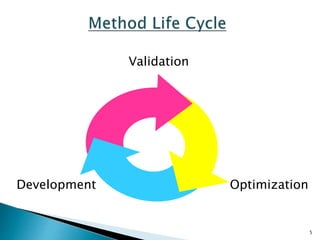
Validation
Development Optimization
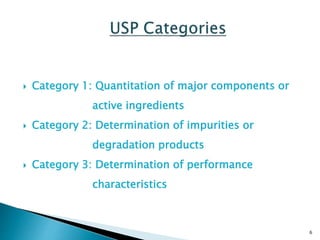
 Category 1: Quantitation of major components or
active ingredients
 Category 2: Determination of impurities or
degradation products
 Category 3: Determination of performance
characteristics
6
7
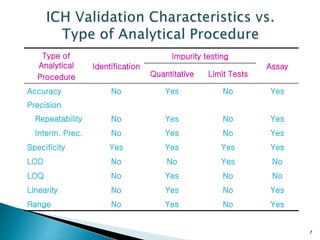
Type of
Analytical
Procedure
Identification
Impurity testing
Assay
Quantitative Limit Tests
Accuracy No Yes No Yes
Precision
Repeatability No Yes No Yes
Interm. Prec. No Yes No Yes
Specificity Yes Yes Yes Yes
LOD No No Yes No
LOQ No Yes No No
Linearity No Yes No Yes
Range No Yes No Yes
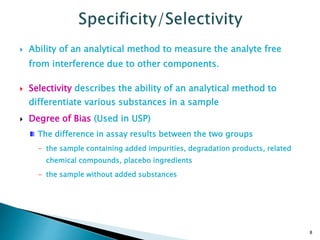
 Ability of an analytical method to measure the analyte free
from interference due to other components.
 Selectivity describes the ability of an analytical method to
differentiate various substances in a sample
 Degree of Bias (Used in USP)
The difference in assay results between the two groups
- the sample containing added impurities, degradation products, related
chemical compounds, placebo ingredients
- the sample without added substances
8
 Chromatographic Methods
◦ Demonstrate Resolution
 Impurities/Degradants Available
◦ Spike with impurities/degradants
◦ Show resolution and a lack of interference
 Impurities/Degradants Not Available
◦ Stress Samples
◦ For assay, Stressed and Unstressed Samples should be
compared.
◦ For impurity test, impurity profiles should be compared.
9
 Ability of an assay to
elicit a direct and
proportional
response to changes
in analyte
concentration.
10
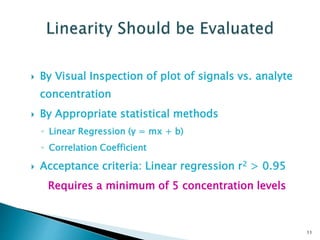
 By Visual Inspection of plot of signals vs. analyte
concentration
 By Appropriate statistical methods
◦ Linear Regression (y = mx + b)
◦ Correlation Coefficient
 Acceptance criteria: Linear regression r2 > 0.95
Requires a minimum of 5 concentration levels
11
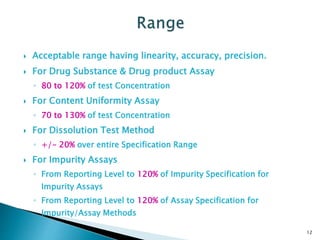
 Acceptable range having linearity, accuracy, precision.
 For Drug Substance & Drug product Assay
◦ 80 to 120% of test Concentration
 For Content Uniformity Assay
◦ 70 to 130% of test Concentration
 For Dissolution Test Method
◦ +/- 20% over entire Specification Range
 For Impurity Assays
◦ From Reporting Level to 120% of Impurity Specification for
Impurity Assays
◦ From Reporting Level to 120% of Assay Specification for
Impurity/Assay Methods
12
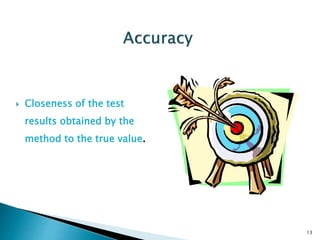
 Closeness of the test
results obtained by the
method to the true value.
13
 Should be established across specified range of
analytical procedure.
 Should be assessed using a minimum of 3
concentration levels, each in triplicate (total of 9
determinations)
 Should be reported as:
◦ Percent recovery of known amount added or
◦ The difference between the mean assay result and the
accepted value
14
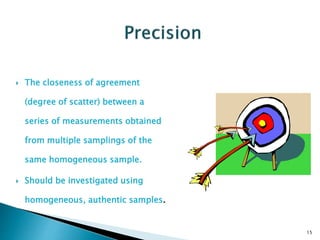
 The closeness of agreement
(degree of scatter) between a
series of measurements obtained
from multiple samplings of the
same homogeneous sample.
 Should be investigated using
homogeneous, authentic samples.
15
 Repeatability
 Intermediate Precision
 Reproducibility
16
 Express the precision under the same operating
conditions over a short interval of time.
 Also referred to as Intra-assay precision
17
Should be assessed using minimum of 9
determinations
(3 concentrations/ 3 replicates) or
Minimum of 6 determinations at the 100% level.
18
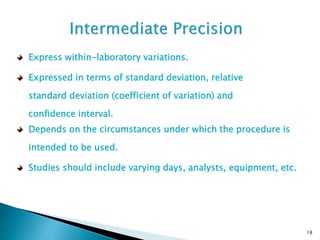
Express within-laboratory variations.
Expressed in terms of standard deviation, relative
standard deviation (coefficient of variation) and
confidence interval.
Depends on the circumstances under which the procedure is
intended to be used.
Studies should include varying days, analysts, equipment, etc.
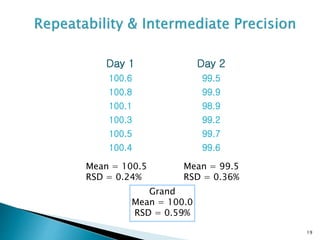
Day 1 Day 2
100.6 99.5
100.8 99.9
100.1 98.9
100.3 99.2
100.5 99.7
100.4 99.6
19
Grand
Mean = 100.0
RSD = 0.59%
Mean = 100.5
RSD = 0.24%
Mean = 99.5
RSD = 0.36%
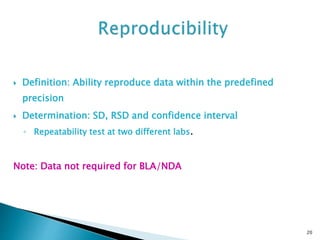
 Definition: Ability reproduce data within the predefined
precision
 Determination: SD, RSD and confidence interval
◦ Repeatability test at two different labs.
Note: Data not required for BLA/NDA
20
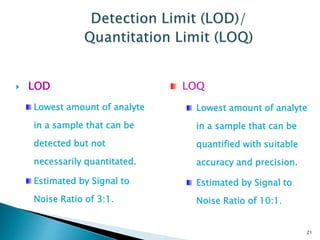
 LOD
Lowest amount of analyte
in a sample that can be
detected but not
necessarily quantitated.
Estimated by Signal to
Noise Ratio of 3:1.
21
LOQ
Lowest amount of analyte
in a sample that can be
quantified with suitable
accuracy and precision.
Estimated by Signal to
Noise Ratio of 10:1.
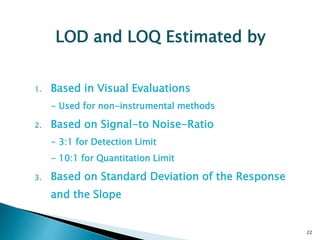
1. Based in Visual Evaluations
- Used for non-instrumental methods
2. Based on Signal-to Noise-Ratio
- 3:1 for Detection Limit
- 10:1 for Quantitation Limit
3. Based on Standard Deviation of the Response
and the Slope
22
LOD and LOQ Estimated by
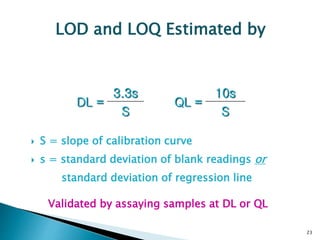
 S = slope of calibration curve
 s = standard deviation of blank readings or
standard deviation of regression line
Validated by assaying samples at DL or QL
23
DL =
3.3s
QL =
10s
S S
LOD and LOQ Estimated by
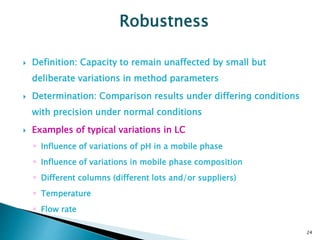
 Definition: Capacity to remain unaffected by small but
deliberate variations in method parameters
 Determination: Comparison results under differing conditions
with precision under normal conditions
 Examples of typical variations in LC
◦ Influence of variations of pH in a mobile phase
◦ Influence of variations in mobile phase composition
◦ Different columns (different lots and/or suppliers)
◦ Temperature
◦ Flow rate
24
Robustness
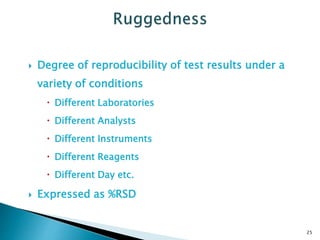
 Degree of reproducibility of test results under a
variety of conditions
 Different Laboratories
 Different Analysts
 Different Instruments
 Different Reagents
 Different Day etc.
 Expressed as %RSD
25
 When
◦ Method parameters have been changed
◦ The scope of the method has been changed
◦ Synthetic methods have been changed
◦ Impurity profile has been changed
 What
◦ Preferably everything. Exceptions should be
scientifically justified
26
27
Laboratory Instrument Qualification:
◦ Design Qualification (DQ): traditionally vendor
driven
◦ Installation Qualification (IQ): user/vendor driven
◦ Operational Qualification (OQ): user/vendor driven
◦ Performance Qualification (PQ): user driven
User is responsible for documenting all levels of
qualification
28
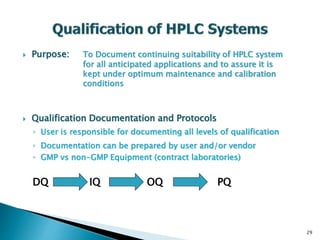
 Purpose: To Document continuing suitability of HPLC system
for all anticipated applications and to assure it is
kept under optimum maintenance and calibration
conditions
 Qualification Documentation and Protocols
◦ User is responsible for documenting all levels of qualification
◦ Documentation can be prepared by user and/or vendor
◦ GMP vs non-GMP Equipment (contract laboratories)
DQ IQ OQ PQ
29
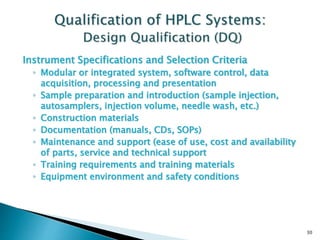
Instrument Specifications and Selection Criteria
◦ Modular or integrated system, software control, data
acquisition, processing and presentation
◦ Sample preparation and introduction (sample injection,
autosamplers, injection volume, needle wash, etc.)
◦ Construction materials
◦ Documentation (manuals, CDs, SOPs)
◦ Maintenance and support (ease of use, cost and availability
of parts, service and technical support
◦ Training requirements and training materials
◦ Equipment environment and safety conditions
30
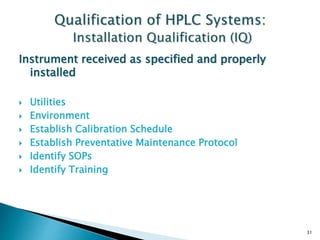
Instrument received as specified and properly
installed
 Utilities
 Environment
 Establish Calibration Schedule
 Establish Preventative Maintenance Protocol
 Identify SOPs
 Identify Training
31
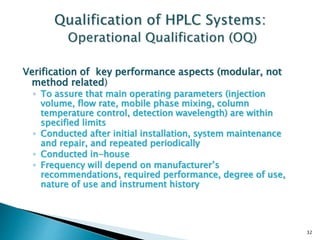
Verification of key performance aspects (modular, not
method related)
◦ To assure that main operating parameters (injection
volume, flow rate, mobile phase mixing, column
temperature control, detection wavelength) are within
specified limits
◦ Conducted after initial installation, system maintenance
and repair, and repeated periodically
◦ Conducted in-house
◦ Frequency will depend on manufacturer’s
recommendations, required performance, degree of use,
nature of use and instrument history
32
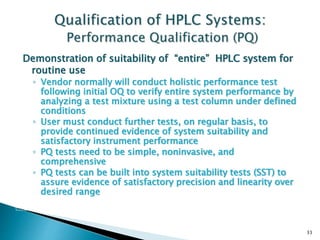
Demonstration of suitability of “entire” HPLC system for
routine use
◦ Vendor normally will conduct holistic performance test
following initial OQ to verify entire system performance by
analyzing a test mixture using a test column under defined
conditions
◦ User must conduct further tests, on regular basis, to
provide continued evidence of system suitability and
satisfactory instrument performance
◦ PQ tests need to be simple, noninvasive, and
comprehensive
◦ PQ tests can be built into system suitability tests (SST) to
assure evidence of satisfactory precision and linearity over
desired range
33
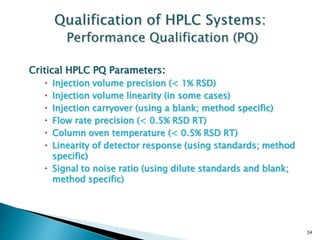
Critical HPLC PQ Parameters:
 Injection volume precision (< 1% RSD)
 Injection volume linearity (in some cases)
 Injection carryover (using a blank; method specific)
 Flow rate precision (< 0.5% RSD RT)
 Column oven temperature (< 0.5% RSD RT)
 Linearity of detector response (using standards; method
specific)
 Signal to noise ratio (using dilute standards and blank;
method specific)
34
 CALIBRATION OF INSTRUMENT:
◦ injector performance.
◦ pump performance
◦ detector performance
◦ column oven temperature
◦ computer data acquisition system performance
35
 PUMP PERFORMANCE:
 Gradient Accuracy and Precision
 Pressure Test.
 Flow Rate Accuracy
 Pump performance can be check by flow
rate of mobile phase, by simply collecting
the mobile phase at the detector outlet over
a specific time period or using a
commercially available flow meter.
 Acceptance criteria: the flow rate shall be
within ±1.0 ℅ of the set value/ min.
36
 INJECTOR PERFORMANCE:
 The overall system precision can be done by
injecting a standard and calculating the
percentage relative standard deviation.
(%RSD)
 As std. benzophenone or naphthalene is
used.
 Precision
 Carryover
 Linearity.
 Acceptance criteria: %RSD shall be less than
1.0%.
37
 DETECTOR PERFORMANCE:
 Wavelength Accuracy
 Noise and Drift.
 Linearity of Response
 Three std. solution of benzophenone is used to check
detector linearity
 Prepared std. solution of 0.025 mg/ml , 0.05mg/ml,
0.075mg/ml, 0.100mg/ml,0.150mg/ml in methanol.
 Duplicate of each stds are run on the system.
 After collecting data from the system, plot a graph of
peak area(Y) versus concentration(X) in mg/ml and
calculate the correlation coefficient.
Acceptance criteria: the correlation coefficient value
shall be not less than 0.98.
38
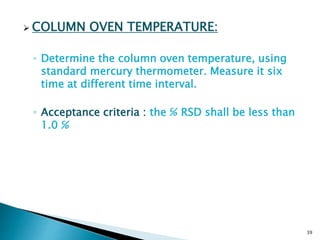
 COLUMN OVEN TEMPERATURE:
◦ Determine the column oven temperature, using
standard mercury thermometer. Measure it six
time at different time interval.
◦ Acceptance criteria : the ℅ RSD shall be less than
1.0 ℅
39
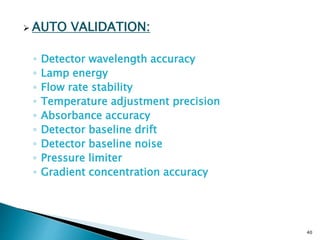
 AUTO VALIDATION:
◦ Detector wavelength accuracy
◦ Lamp energy
◦ Flow rate stability
◦ Temperature adjustment precision
◦ Absorbance accuracy
◦ Detector baseline drift
◦ Detector baseline noise
◦ Pressure limiter
◦ Gradient concentration accuracy
40
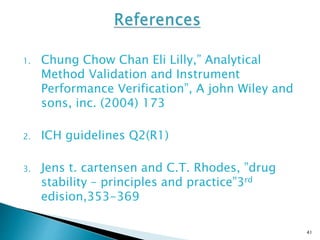
1. Chung Chow Chan Eli Lilly,” Analytical
Method Validation and Instrument
Performance Verification”, A john Wiley and
sons, inc. (2004) 173
2. ICH guidelines Q2(R1)
3. Jens t. cartensen and C.T. Rhodes, ”drug
stability – principles and practice”3rd
edision,353-369
41
42

Validation of Analytical method.ppt

  • 1.
  • 2.
    Definition: • Method validationis the process of proving that an analytical method is acceptable for its intended purposes. • Validation of analytical procedures is the process of determining the suitability of a given methodology for providing useful analytical data. METHOD VALIDATION = ERROR ASSESSMENT 2
  • 3.
    1. Develops confidencein using the method & Proof that method is suitable for its intended purpose, The purpose of analytical measurement is to get consistent, reliable and accurate data. 2. Regulatory requirement, Equal importance for those working in a regulated and in an accredited environment. ◦ U.S. FDA, ISO etc. 3
  • 4.
    When to bevalidated? • Partial validation • Complete validation Which methods are to be validated • Compendial: Pharmacopoeial method • Verification of suitability of method • Non compendial methods: Laboratory developed methods. outside its scope. 4
  • 5.
  • 6.
     Category 1:Quantitation of major components or active ingredients  Category 2: Determination of impurities or degradation products  Category 3: Determination of performance characteristics 6
  • 7.
    7 Type of Analytical Procedure Identification Impurity testing Assay QuantitativeLimit Tests Accuracy No Yes No Yes Precision Repeatability No Yes No Yes Interm. Prec. No Yes No Yes Specificity Yes Yes Yes Yes LOD No No Yes No LOQ No Yes No No Linearity No Yes No Yes Range No Yes No Yes
  • 8.
     Ability ofan analytical method to measure the analyte free from interference due to other components.  Selectivity describes the ability of an analytical method to differentiate various substances in a sample  Degree of Bias (Used in USP) The difference in assay results between the two groups - the sample containing added impurities, degradation products, related chemical compounds, placebo ingredients - the sample without added substances 8
  • 9.
     Chromatographic Methods ◦Demonstrate Resolution  Impurities/Degradants Available ◦ Spike with impurities/degradants ◦ Show resolution and a lack of interference  Impurities/Degradants Not Available ◦ Stress Samples ◦ For assay, Stressed and Unstressed Samples should be compared. ◦ For impurity test, impurity profiles should be compared. 9
  • 10.
     Ability ofan assay to elicit a direct and proportional response to changes in analyte concentration. 10
  • 11.
     By VisualInspection of plot of signals vs. analyte concentration  By Appropriate statistical methods ◦ Linear Regression (y = mx + b) ◦ Correlation Coefficient  Acceptance criteria: Linear regression r2 > 0.95 Requires a minimum of 5 concentration levels 11
  • 12.
     Acceptable rangehaving linearity, accuracy, precision.  For Drug Substance & Drug product Assay ◦ 80 to 120% of test Concentration  For Content Uniformity Assay ◦ 70 to 130% of test Concentration  For Dissolution Test Method ◦ +/- 20% over entire Specification Range  For Impurity Assays ◦ From Reporting Level to 120% of Impurity Specification for Impurity Assays ◦ From Reporting Level to 120% of Assay Specification for Impurity/Assay Methods 12
  • 13.
     Closeness ofthe test results obtained by the method to the true value. 13
  • 14.
     Should beestablished across specified range of analytical procedure.  Should be assessed using a minimum of 3 concentration levels, each in triplicate (total of 9 determinations)  Should be reported as: ◦ Percent recovery of known amount added or ◦ The difference between the mean assay result and the accepted value 14
  • 15.
     The closenessof agreement (degree of scatter) between a series of measurements obtained from multiple samplings of the same homogeneous sample.  Should be investigated using homogeneous, authentic samples. 15
  • 16.
     Repeatability  IntermediatePrecision  Reproducibility 16
  • 17.
     Express theprecision under the same operating conditions over a short interval of time.  Also referred to as Intra-assay precision 17 Should be assessed using minimum of 9 determinations (3 concentrations/ 3 replicates) or Minimum of 6 determinations at the 100% level.
  • 18.
    18 Express within-laboratory variations. Expressedin terms of standard deviation, relative standard deviation (coefficient of variation) and confidence interval. Depends on the circumstances under which the procedure is intended to be used. Studies should include varying days, analysts, equipment, etc.
  • 19.
    Day 1 Day2 100.6 99.5 100.8 99.9 100.1 98.9 100.3 99.2 100.5 99.7 100.4 99.6 19 Grand Mean = 100.0 RSD = 0.59% Mean = 100.5 RSD = 0.24% Mean = 99.5 RSD = 0.36%
  • 20.
     Definition: Abilityreproduce data within the predefined precision  Determination: SD, RSD and confidence interval ◦ Repeatability test at two different labs. Note: Data not required for BLA/NDA 20
  • 21.
     LOD Lowest amountof analyte in a sample that can be detected but not necessarily quantitated. Estimated by Signal to Noise Ratio of 3:1. 21 LOQ Lowest amount of analyte in a sample that can be quantified with suitable accuracy and precision. Estimated by Signal to Noise Ratio of 10:1.
  • 22.
    1. Based inVisual Evaluations - Used for non-instrumental methods 2. Based on Signal-to Noise-Ratio - 3:1 for Detection Limit - 10:1 for Quantitation Limit 3. Based on Standard Deviation of the Response and the Slope 22 LOD and LOQ Estimated by
  • 23.
     S =slope of calibration curve  s = standard deviation of blank readings or standard deviation of regression line Validated by assaying samples at DL or QL 23 DL = 3.3s QL = 10s S S LOD and LOQ Estimated by
  • 24.
     Definition: Capacityto remain unaffected by small but deliberate variations in method parameters  Determination: Comparison results under differing conditions with precision under normal conditions  Examples of typical variations in LC ◦ Influence of variations of pH in a mobile phase ◦ Influence of variations in mobile phase composition ◦ Different columns (different lots and/or suppliers) ◦ Temperature ◦ Flow rate 24 Robustness
  • 25.
     Degree ofreproducibility of test results under a variety of conditions  Different Laboratories  Different Analysts  Different Instruments  Different Reagents  Different Day etc.  Expressed as %RSD 25
  • 26.
     When ◦ Methodparameters have been changed ◦ The scope of the method has been changed ◦ Synthetic methods have been changed ◦ Impurity profile has been changed  What ◦ Preferably everything. Exceptions should be scientifically justified 26
  • 27.
  • 28.
    Laboratory Instrument Qualification: ◦Design Qualification (DQ): traditionally vendor driven ◦ Installation Qualification (IQ): user/vendor driven ◦ Operational Qualification (OQ): user/vendor driven ◦ Performance Qualification (PQ): user driven User is responsible for documenting all levels of qualification 28
  • 29.
     Purpose: ToDocument continuing suitability of HPLC system for all anticipated applications and to assure it is kept under optimum maintenance and calibration conditions  Qualification Documentation and Protocols ◦ User is responsible for documenting all levels of qualification ◦ Documentation can be prepared by user and/or vendor ◦ GMP vs non-GMP Equipment (contract laboratories) DQ IQ OQ PQ 29
  • 30.
    Instrument Specifications andSelection Criteria ◦ Modular or integrated system, software control, data acquisition, processing and presentation ◦ Sample preparation and introduction (sample injection, autosamplers, injection volume, needle wash, etc.) ◦ Construction materials ◦ Documentation (manuals, CDs, SOPs) ◦ Maintenance and support (ease of use, cost and availability of parts, service and technical support ◦ Training requirements and training materials ◦ Equipment environment and safety conditions 30
  • 31.
    Instrument received asspecified and properly installed  Utilities  Environment  Establish Calibration Schedule  Establish Preventative Maintenance Protocol  Identify SOPs  Identify Training 31
  • 32.
    Verification of keyperformance aspects (modular, not method related) ◦ To assure that main operating parameters (injection volume, flow rate, mobile phase mixing, column temperature control, detection wavelength) are within specified limits ◦ Conducted after initial installation, system maintenance and repair, and repeated periodically ◦ Conducted in-house ◦ Frequency will depend on manufacturer’s recommendations, required performance, degree of use, nature of use and instrument history 32
  • 33.
    Demonstration of suitabilityof “entire” HPLC system for routine use ◦ Vendor normally will conduct holistic performance test following initial OQ to verify entire system performance by analyzing a test mixture using a test column under defined conditions ◦ User must conduct further tests, on regular basis, to provide continued evidence of system suitability and satisfactory instrument performance ◦ PQ tests need to be simple, noninvasive, and comprehensive ◦ PQ tests can be built into system suitability tests (SST) to assure evidence of satisfactory precision and linearity over desired range 33
  • 34.
    Critical HPLC PQParameters:  Injection volume precision (< 1% RSD)  Injection volume linearity (in some cases)  Injection carryover (using a blank; method specific)  Flow rate precision (< 0.5% RSD RT)  Column oven temperature (< 0.5% RSD RT)  Linearity of detector response (using standards; method specific)  Signal to noise ratio (using dilute standards and blank; method specific) 34
  • 35.
     CALIBRATION OFINSTRUMENT: ◦ injector performance. ◦ pump performance ◦ detector performance ◦ column oven temperature ◦ computer data acquisition system performance 35
  • 36.
     PUMP PERFORMANCE: Gradient Accuracy and Precision  Pressure Test.  Flow Rate Accuracy  Pump performance can be check by flow rate of mobile phase, by simply collecting the mobile phase at the detector outlet over a specific time period or using a commercially available flow meter.  Acceptance criteria: the flow rate shall be within ±1.0 ℅ of the set value/ min. 36
  • 37.
     INJECTOR PERFORMANCE: The overall system precision can be done by injecting a standard and calculating the percentage relative standard deviation. (%RSD)  As std. benzophenone or naphthalene is used.  Precision  Carryover  Linearity.  Acceptance criteria: %RSD shall be less than 1.0%. 37
  • 38.
     DETECTOR PERFORMANCE: Wavelength Accuracy  Noise and Drift.  Linearity of Response  Three std. solution of benzophenone is used to check detector linearity  Prepared std. solution of 0.025 mg/ml , 0.05mg/ml, 0.075mg/ml, 0.100mg/ml,0.150mg/ml in methanol.  Duplicate of each stds are run on the system.  After collecting data from the system, plot a graph of peak area(Y) versus concentration(X) in mg/ml and calculate the correlation coefficient. Acceptance criteria: the correlation coefficient value shall be not less than 0.98. 38
  • 39.
     COLUMN OVENTEMPERATURE: ◦ Determine the column oven temperature, using standard mercury thermometer. Measure it six time at different time interval. ◦ Acceptance criteria : the ℅ RSD shall be less than 1.0 ℅ 39
  • 40.
     AUTO VALIDATION: ◦Detector wavelength accuracy ◦ Lamp energy ◦ Flow rate stability ◦ Temperature adjustment precision ◦ Absorbance accuracy ◦ Detector baseline drift ◦ Detector baseline noise ◦ Pressure limiter ◦ Gradient concentration accuracy 40
  • 41.
    1. Chung ChowChan Eli Lilly,” Analytical Method Validation and Instrument Performance Verification”, A john Wiley and sons, inc. (2004) 173 2. ICH guidelines Q2(R1) 3. Jens t. cartensen and C.T. Rhodes, ”drug stability – principles and practice”3rd edision,353-369 41
  • 42.