SHIVNAGAR VIDYA PRASARAK MANDAL
MALEGAON BK II
Presented by- Guided by-
Mr. Bora S.R. Dr. Jadhav S. G.
INTRODUCTION & BRIEF
HISTORY
Bioanalysis is a term generally used
to describe the quantitative
measurement of a compound (drug)
or their metabolite in biological fluids,
primarily blood, plasma, serum, urine
or tissue extracts.*
*Pandey S, Pandey P, Tiwari G, Tiwari R. Bioanalysis in drug discovery and development. Pharmaceutical methods. 2010 Oct 1;1(1):14-24.
In 1970s Bioanalysis was term derived to describe
the process of quantifying drug in biological fluids
for the purpose of defining their pharmacokinetics.
The first studies measuring drugs in biological fluids
were carried out to determine possible overdosing as
part of the new science of forensic
medicine/toxicology.
WHY
BIOANALYSIS?
Initially, Nonspecific assays were applied to measure
drugs in biological fluids. These were unable to
discriminate between the drug and its metabolites.
The 1930s saw the Rise of Pharmacokinetics , and as
such the desire for more specific assays.
Modern drugs are more potent, which has required more
sensitive bioanalytical assays to accurately and
reliably determine these drugs at lower concentrations
(A)
Hyphenated
techniques
LC–MS (liquid
chromatography–mass
spectrometry)
GC–MS (gas
chromatography–mass
spectrometry)
LC–DAD (liquid
chromatography–
array detection)
CE–MS (capillary
electrophoresis–mass
spectrometry)
Bioanalytical techniques
Some techniques commonly used in bioanalytical studies
include:
(B)
Chromatograp
hy
(C)
Mass
spectrometry
(D)
NMR
(E)
Electrophoresi
s
(F)
Ligand
binding assays
WHY TO GO FOR
BIOANALYTICAL
METHOD
DEVELOPMENT OF
LEVODOPAAND
CARBIDOPA? Carbidopa
Levodopa
PARKINSONS DISEASE
Levodopa/
Carbidopa
Carbidopa
Adverse
effects
Dopamine
Dopamine
Peripherrally
Carbidopa
Levodopa
Levodopa
Carbidopa
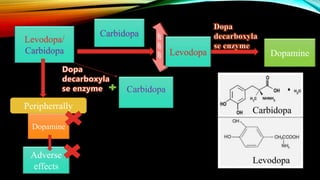
The conventional oral dosage forms of levodopa and
carbidopa may produce the fluctuations of drug
plasma levels that either exceed safe therapeutic
levels or quickly fall below the minimum effective
level. Thus, the determination of levodopa and
carbidopa in biological fluids has an essential role in
the diagnostics and control of Parkinson's diseases.
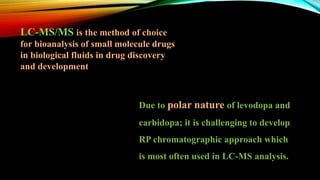
Due to polar nature of levodopa and
carbidopa; it is challenging to develop
RP chromatographic approach which
is most often used in LC-MS analysis.
LC-MS/MS is the method of choice
for bioanalysis of small molecule drugs
in biological fluids in drug discovery
and development
To improve chromatographic retention of polar molecules two
methods can be employed: -
1. Derivatization of polar compounds
2. Ion-pairing chromatography
1.Derivatization of polar compounds
Example: Fluroescamine
Increases hydrophobicity
2.Ion-pairingchromatography
Example: Perfluro pentanoic acid
Forms neutral ion pair
Method development
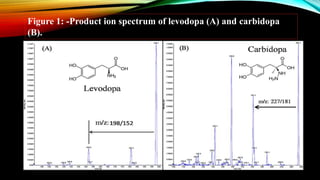
1.Mass spectrometry:-
The mass spectrometric detection was carried out on API6500 triple
quadrupole mass spectrometer equipped with a Turbo V Ion spray
source operating in positive mode. It was operated in Multiple-reaction
monitoring
Figure 1: -Product ion spectrum of levodopa (A) and carbidopa
(B).
Triple quadrupole mass spectrometer
2. Chromatography Development
1. Mobile phase A: Water/Ammonium Formate/Formic Acid (1000:10:5,
v/v/v),
2. Mobile phase B: Acetonitrile
Preparation of mobile phase:
RPC
Atlantis
dC18(W
aters)
Aquasil
C18(The
rmo)
Synergi
C18
(Pheno
mexex)
Zorbax
SB-AQ
(Agilent
)
Ultra
AQ C18
(Restek)
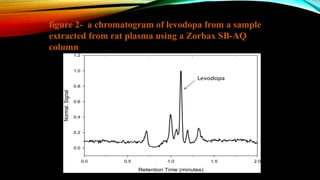
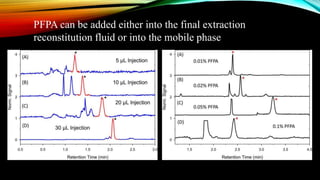
figure 2- a chromatogram of levodopa from a sample
extracted from rat plasma using a Zorbax SB-AQ
column
PFPA can be added either into the final extraction
reconstitution fluid or into the mobile phase
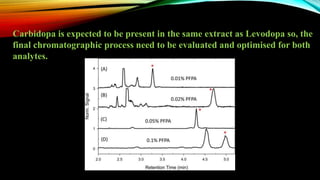
Carbidopa is expected to be present in the same extract as Levodopa so, the
final chromatographic process need to be evaluated and optimised for both
analytes.
Sample Preparation:-
Goal of sample preparation is to :-
1. Minimise risk
2. Increased sensitivity
3. Cleaner sample.
Separation techniques available for different pur
poses.
Method Validation
What is Method Validation?
Method validation is a comprehensive set of experiments to
investigate whether an analytical method is functioning according
to predefined acceptance criteria. For regulated bioanalysis criteria
should be in compliance with guidelines published by regulatory
authorities.
1. Full Validation
2. Partial validation
3. Cross validation
Types of Bioanalytical Method Validation-
2001 US FDA Bioanalytical Method Development
Requirements were followed to validate developed method
including selectivity, linearity, precision and accuracy,
recovery, matrix effect, and stability.
1. Selectivity
2. Lower Limit Of Quantification (LLOQ)
3. Calibration Curve
4. Accuracy, Precision
5. Matrix Effect,
6. Recovery,
7. Carry-Over,
8. Dilution Integrity,
9. Stability.
Validation Parameters
1.Selectivity :-
Selectivity is the ability of the bioanalytical method to measure
and differentiate the analytes in the presence of components that may
be expected to be present. These could include metabolites, impurities,
degradants or matrix components.
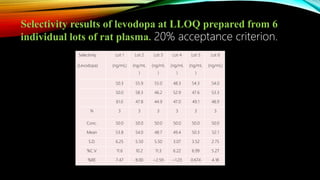
Selectivity
(Levodopa)
Lot 1
(ng/mL)
Lot 2
(ng/mL
)
Lot 3
(ng/mL
)
Lot 4
(ng/mL
)
Lot 5
(ng/mL
)
Lot 6
(ng/mL)
50.3 55.9 55.0 48.3 54.3 54.0
50.0 58.3 46.2 52.9 47.6 53.3
61.0 47.8 44.9 47.0 49.1 48.9
N 3 3 3 3 3 3
Conc. 50.0 50.0 50.0 50.0 50.0 50.0
Mean 53.8 54.0 48.7 49.4 50.3 52.1
S.D. 6.25 5.50 5.50 3.07 3.52 2.75
%C.V. 11.6 10.2 11.3 6.22 6.99 5.27
%RE 7.47 8.00 −2.59 −1.23 0.674 4.18
Selectivity results of levodopa at LLOQ prepared from 6
individual lots of rat plasma. 20% acceptance criterion.
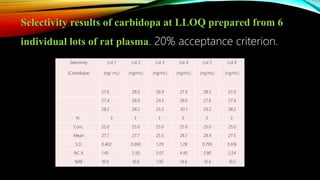
Selectivity
(Carbidopa)
Lot 1
(ng/ mL)
Lot 2
(ng/mL)
Lot 3
(ng/mL)
Lot 4
(ng/mL)
Lot 5
(ng/mL)
Lot 6
(ng/mL)
27.6 28.0 26.9 27.9 28.3 27.0
27.4 26.9 24.3 28.0 27.6 27.4
28.2 28.2 25.3 30.1 29.2 28.2
N 3 3 3 3 3 3
Conc. 25.0 25.0 25.0 25.0 25.0 25.0
Mean 27.7 27.7 25.5 28.7 28.4 27.5
S.D. 0.402 0.692 1.29 1.28 0.795 0.616
%C.V. 1.45 2.50 5.07 4.45 2.80 2.24
%RE 10.9 10.8 1.95 14.6 13.4 10.2
Selectivity results of carbidopa at LLOQ prepared from 6
individual lots of rat plasma. 20% acceptance criterion.
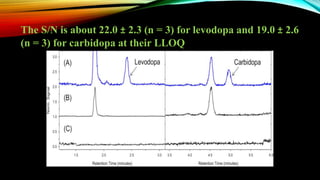
2. Sensitivity
Sensitivity Is the lowest analyte concentration that can be
measured above the noise with acceptable accuracy and
precision (i.e., lower limit of quantification [LLOQ]).
The S/N is about 22.0 ± 2.3 (n = 3) for levodopa and 19.0 ± 2.6
(n = 3) for carbidopa at their LLOQ
Precision and accuracy
Precision is the closeness of agreement (i.e., degree of scatter)
among a series of measurements obtained from the same
homogenous sample under controlled assay conditions and
Accuracy is the ability of an assay technique to measure the analyte
concentration correctly at the time of sampling.
spiked control samples spiked at 50, 120, 250, 700, 2000 and 7500
ng/mL for Levodopa and 25, 60, 125, 350, 1000 and 3750 ng/mL
for carbidopa.
Levodop
a
Conc.
(ng/mL)
Replicat
e (n)
Mean
(ng/mL)
C.V.
(%)
R.E.
(%)
QC 0 50.0 18 51.4 6.00 2.70
QC 1 120 18 124 6.98 3.43
QC 2 250 18 249 4.16 −0.4
9
QC 3 700 18 669 4.56 −4.3
7
QC 4 2000 18 1881 6.70 −5.97
QC 5 7500 18 7051 5.10 −5.9
9
Table 4:-Shows the inter-assay accuracy and precision of 6 levels
of Levodopa QCs
Carbidopa Conc.
(ng/mL)
replicate Mean
(ng/mL)
C.V. (%) R.E. (%)
QC 0 25.0 18 27.8 4.49 11.4
QC 1 60.0 18 61.8 5.95 2.98
QC 2 125 18 125 3.33 −0.400
QC 3 350 18 336 4.07 −3.94
QC 4 1000 18 941 7.15 −5.98
QC 5 3750 18 3529 4.78 −5.90
Table 5:-Shows the inter-assay accuracy and precision of
6 levels of carbidopa QCs
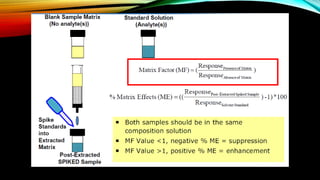
1.Matrix effect
Matrix effect is the direct or indirect alteration or interference in instrumental
response due to the presence of matrix constituents in extracted samples or
unextracted samples for LBAs), which the overall method selectivity is
inadequate to address.
The peak area ratio for each analyte or internal standard is defined as the matrix
factor (MF). The ratio of MF of an analyte to that of its internal standard is
defined as the internal standard normalized matrix factor (IS-MF).
value of 1 is indicative of no matrix effect
value > 1 suggests ionization enhancement
value < 1 points to ionization suppression
MATRIX FACTOR
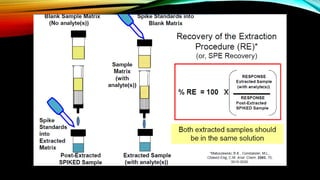
5. Recovery
The overall recoveries for levodo-pa/levodopa-d3/carbidopa/carbidopa-d3
were 46.5%, 46.7%, 50.1% and 48.5.
The extraction efficiency of an analytical process, reported as a
percentage of the known amount of an analyte carried through the
sample extraction and processing steps of the method.
7. Matrix stability
Sodium metabisulfite, an antioxidant, was used to stabilize levodopa and
carbidopa in rat plasma.The stability of both analytes in treated rat plasma
samples was shown to be unaffected by five freeze/thaw cycles at 2–8 °C
or storage at the same condition for a period of up to 25.7 h. Thus far, a
total of 49 days of frozen matrix stability has been established for samples
stored at −80 ± 10 °C.
7. Application
This experiment was used for the analysis of levodopa and
carbidopa sample in support of toxicokinetic studies
REFERENCES
1. Chi J, Ling Y, Jenkins R, Li F. Quantitation of levodopa and carbidopa in rat
plasma by LC–MS/MS: The key role of ion-pairing reversed-phase
chromatography. Journal of Chromatography B. 2017 Jun 1;1054:1-9.
2. Goncalves D, Alves G, Soares-da-Silva P, Falcão A. Bioanalytical
chromatographic methods for the determination of catechol-O-
methyltransferase inhibitors in rodents and human samples: a review. Analytica
chimica acta. 2012 Jan 13;710:17-32.
3. César IC, Byrro RM, Mundim IM, Souza Teixeira L, Gomes SA, Bonfim RR,
Pianetti GA. Development and validation of a high‐performance liquid
chromatography–electrospray ionization–MS/MS method for the simultaneous
quantitation of levodopa and carbidopa in human plasma. Journal of Mass
Spectrometry. 2011 Sep 1;46(9):943-8.
4.Pandey S, Pandey P, Tiwari G, Tiwari R. Bioanalysis in drug
discovery and development. Pharmaceutical methods. 2010
Oct 1;1(1):14-24.
5. Li SF, Wu HL, Yu YJ, Li YN, Nie JF, Fu HY, Yu RQ.
Quantitative analysis of levodopa, carbidopa and methyldopa
in human plasma samples using HPLC-DAD combined with
second-order calibration based on alternating trilinear
decomposition algorithm. Talanta. 2010 May 15;81(3):805-12.
6. Nyholm D. Pharmacokinetic optimisation in the treatment of
Parkinson’s disease. Clinical pharmacokinetics. 2006 Feb
1;45(2):109-36.
7. Remington, Joseph P. Remington, the Science and Practice of Pharmacy.
Easton, Pa: Mack Pub. Co, 1995. Print.1418-1419.
8. CHamsaz M, Safavi A, Fadaee J. Simultaneous kinetic-spectrophotometric
determination of carbidopa, levodopa and methyldopa in the presence of
citrate with the aid of multivariate calibration and artificial neural networks.
Analytica chimica acta. 2007 Nov 12;603(2):140-6.
9. Li SF, Wu HL, Yu YJ, Li YN, Nie JF, Fu HY, Yu RQ. Quantitative analysis of l
evodopa, carbidopa and methyldopa in human plasma samples using HPLC-
DAD combined with second-order calibration based on alternating trilinear
decomposition algorithm. Talanta. 2010 May 15;81(3):805-12.
10. Deng P, Chen X, Zhong D. Quantification of polar drugs in human plasma with
liquid chromatography–tandem mass spectrometry.

Bioanalytical method development and validation .

  • 1.
    SHIVNAGAR VIDYA PRASARAKMANDAL MALEGAON BK II Presented by- Guided by- Mr. Bora S.R. Dr. Jadhav S. G.
  • 2.
  • 3.
    Bioanalysis is aterm generally used to describe the quantitative measurement of a compound (drug) or their metabolite in biological fluids, primarily blood, plasma, serum, urine or tissue extracts.* *Pandey S, Pandey P, Tiwari G, Tiwari R. Bioanalysis in drug discovery and development. Pharmaceutical methods. 2010 Oct 1;1(1):14-24.
  • 4.
    In 1970s Bioanalysiswas term derived to describe the process of quantifying drug in biological fluids for the purpose of defining their pharmacokinetics. The first studies measuring drugs in biological fluids were carried out to determine possible overdosing as part of the new science of forensic medicine/toxicology.
  • 5.
  • 6.
    Initially, Nonspecific assayswere applied to measure drugs in biological fluids. These were unable to discriminate between the drug and its metabolites. The 1930s saw the Rise of Pharmacokinetics , and as such the desire for more specific assays. Modern drugs are more potent, which has required more sensitive bioanalytical assays to accurately and reliably determine these drugs at lower concentrations
  • 7.
    (A) Hyphenated techniques LC–MS (liquid chromatography–mass spectrometry) GC–MS (gas chromatography–mass spectrometry) LC–DAD(liquid chromatography– array detection) CE–MS (capillary electrophoresis–mass spectrometry) Bioanalytical techniques Some techniques commonly used in bioanalytical studies include:
  • 8.
  • 9.
    WHY TO GOFOR BIOANALYTICAL METHOD DEVELOPMENT OF LEVODOPAAND CARBIDOPA? Carbidopa Levodopa
  • 10.
  • 11.
  • 12.
    The conventional oraldosage forms of levodopa and carbidopa may produce the fluctuations of drug plasma levels that either exceed safe therapeutic levels or quickly fall below the minimum effective level. Thus, the determination of levodopa and carbidopa in biological fluids has an essential role in the diagnostics and control of Parkinson's diseases.
  • 13.
    Due to polarnature of levodopa and carbidopa; it is challenging to develop RP chromatographic approach which is most often used in LC-MS analysis. LC-MS/MS is the method of choice for bioanalysis of small molecule drugs in biological fluids in drug discovery and development
  • 14.
    To improve chromatographicretention of polar molecules two methods can be employed: - 1. Derivatization of polar compounds 2. Ion-pairing chromatography
  • 15.
    1.Derivatization of polarcompounds Example: Fluroescamine Increases hydrophobicity 2.Ion-pairingchromatography Example: Perfluro pentanoic acid Forms neutral ion pair
  • 16.
  • 17.
    1.Mass spectrometry:- The massspectrometric detection was carried out on API6500 triple quadrupole mass spectrometer equipped with a Turbo V Ion spray source operating in positive mode. It was operated in Multiple-reaction monitoring
  • 18.
    Figure 1: -Production spectrum of levodopa (A) and carbidopa (B).
  • 19.
  • 20.
    2. Chromatography Development 1.Mobile phase A: Water/Ammonium Formate/Formic Acid (1000:10:5, v/v/v), 2. Mobile phase B: Acetonitrile Preparation of mobile phase:
  • 21.
  • 22.
    figure 2- achromatogram of levodopa from a sample extracted from rat plasma using a Zorbax SB-AQ column
  • 23.
    PFPA can beadded either into the final extraction reconstitution fluid or into the mobile phase
  • 24.
    Carbidopa is expectedto be present in the same extract as Levodopa so, the final chromatographic process need to be evaluated and optimised for both analytes.
  • 25.
    Sample Preparation:- Goal ofsample preparation is to :- 1. Minimise risk 2. Increased sensitivity 3. Cleaner sample.
  • 26.
    Separation techniques availablefor different pur poses.
  • 27.
  • 28.
    What is MethodValidation? Method validation is a comprehensive set of experiments to investigate whether an analytical method is functioning according to predefined acceptance criteria. For regulated bioanalysis criteria should be in compliance with guidelines published by regulatory authorities.
  • 29.
    1. Full Validation 2.Partial validation 3. Cross validation Types of Bioanalytical Method Validation-
  • 30.
    2001 US FDABioanalytical Method Development Requirements were followed to validate developed method including selectivity, linearity, precision and accuracy, recovery, matrix effect, and stability.
  • 31.
    1. Selectivity 2. LowerLimit Of Quantification (LLOQ) 3. Calibration Curve 4. Accuracy, Precision 5. Matrix Effect, 6. Recovery, 7. Carry-Over, 8. Dilution Integrity, 9. Stability. Validation Parameters
  • 32.
    1.Selectivity :- Selectivity isthe ability of the bioanalytical method to measure and differentiate the analytes in the presence of components that may be expected to be present. These could include metabolites, impurities, degradants or matrix components.
  • 33.
    Selectivity (Levodopa) Lot 1 (ng/mL) Lot 2 (ng/mL ) Lot3 (ng/mL ) Lot 4 (ng/mL ) Lot 5 (ng/mL ) Lot 6 (ng/mL) 50.3 55.9 55.0 48.3 54.3 54.0 50.0 58.3 46.2 52.9 47.6 53.3 61.0 47.8 44.9 47.0 49.1 48.9 N 3 3 3 3 3 3 Conc. 50.0 50.0 50.0 50.0 50.0 50.0 Mean 53.8 54.0 48.7 49.4 50.3 52.1 S.D. 6.25 5.50 5.50 3.07 3.52 2.75 %C.V. 11.6 10.2 11.3 6.22 6.99 5.27 %RE 7.47 8.00 −2.59 −1.23 0.674 4.18 Selectivity results of levodopa at LLOQ prepared from 6 individual lots of rat plasma. 20% acceptance criterion.
  • 34.
    Selectivity (Carbidopa) Lot 1 (ng/ mL) Lot2 (ng/mL) Lot 3 (ng/mL) Lot 4 (ng/mL) Lot 5 (ng/mL) Lot 6 (ng/mL) 27.6 28.0 26.9 27.9 28.3 27.0 27.4 26.9 24.3 28.0 27.6 27.4 28.2 28.2 25.3 30.1 29.2 28.2 N 3 3 3 3 3 3 Conc. 25.0 25.0 25.0 25.0 25.0 25.0 Mean 27.7 27.7 25.5 28.7 28.4 27.5 S.D. 0.402 0.692 1.29 1.28 0.795 0.616 %C.V. 1.45 2.50 5.07 4.45 2.80 2.24 %RE 10.9 10.8 1.95 14.6 13.4 10.2 Selectivity results of carbidopa at LLOQ prepared from 6 individual lots of rat plasma. 20% acceptance criterion.
  • 35.
    2. Sensitivity Sensitivity Isthe lowest analyte concentration that can be measured above the noise with acceptable accuracy and precision (i.e., lower limit of quantification [LLOQ]).
  • 36.
    The S/N isabout 22.0 ± 2.3 (n = 3) for levodopa and 19.0 ± 2.6 (n = 3) for carbidopa at their LLOQ
  • 37.
    Precision and accuracy Precisionis the closeness of agreement (i.e., degree of scatter) among a series of measurements obtained from the same homogenous sample under controlled assay conditions and Accuracy is the ability of an assay technique to measure the analyte concentration correctly at the time of sampling. spiked control samples spiked at 50, 120, 250, 700, 2000 and 7500 ng/mL for Levodopa and 25, 60, 125, 350, 1000 and 3750 ng/mL for carbidopa.
  • 38.
    Levodop a Conc. (ng/mL) Replicat e (n) Mean (ng/mL) C.V. (%) R.E. (%) QC 050.0 18 51.4 6.00 2.70 QC 1 120 18 124 6.98 3.43 QC 2 250 18 249 4.16 −0.4 9 QC 3 700 18 669 4.56 −4.3 7 QC 4 2000 18 1881 6.70 −5.97 QC 5 7500 18 7051 5.10 −5.9 9 Table 4:-Shows the inter-assay accuracy and precision of 6 levels of Levodopa QCs
  • 39.
    Carbidopa Conc. (ng/mL) replicate Mean (ng/mL) C.V.(%) R.E. (%) QC 0 25.0 18 27.8 4.49 11.4 QC 1 60.0 18 61.8 5.95 2.98 QC 2 125 18 125 3.33 −0.400 QC 3 350 18 336 4.07 −3.94 QC 4 1000 18 941 7.15 −5.98 QC 5 3750 18 3529 4.78 −5.90 Table 5:-Shows the inter-assay accuracy and precision of 6 levels of carbidopa QCs
  • 40.
    1.Matrix effect Matrix effectis the direct or indirect alteration or interference in instrumental response due to the presence of matrix constituents in extracted samples or unextracted samples for LBAs), which the overall method selectivity is inadequate to address. The peak area ratio for each analyte or internal standard is defined as the matrix factor (MF). The ratio of MF of an analyte to that of its internal standard is defined as the internal standard normalized matrix factor (IS-MF).
  • 42.
    value of 1is indicative of no matrix effect value > 1 suggests ionization enhancement value < 1 points to ionization suppression MATRIX FACTOR
  • 43.
    5. Recovery The overallrecoveries for levodo-pa/levodopa-d3/carbidopa/carbidopa-d3 were 46.5%, 46.7%, 50.1% and 48.5. The extraction efficiency of an analytical process, reported as a percentage of the known amount of an analyte carried through the sample extraction and processing steps of the method.
  • 45.
    7. Matrix stability Sodiummetabisulfite, an antioxidant, was used to stabilize levodopa and carbidopa in rat plasma.The stability of both analytes in treated rat plasma samples was shown to be unaffected by five freeze/thaw cycles at 2–8 °C or storage at the same condition for a period of up to 25.7 h. Thus far, a total of 49 days of frozen matrix stability has been established for samples stored at −80 ± 10 °C.
  • 46.
    7. Application This experimentwas used for the analysis of levodopa and carbidopa sample in support of toxicokinetic studies
  • 47.
    REFERENCES 1. Chi J,Ling Y, Jenkins R, Li F. Quantitation of levodopa and carbidopa in rat plasma by LC–MS/MS: The key role of ion-pairing reversed-phase chromatography. Journal of Chromatography B. 2017 Jun 1;1054:1-9. 2. Goncalves D, Alves G, Soares-da-Silva P, Falcão A. Bioanalytical chromatographic methods for the determination of catechol-O- methyltransferase inhibitors in rodents and human samples: a review. Analytica chimica acta. 2012 Jan 13;710:17-32. 3. César IC, Byrro RM, Mundim IM, Souza Teixeira L, Gomes SA, Bonfim RR, Pianetti GA. Development and validation of a high‐performance liquid chromatography–electrospray ionization–MS/MS method for the simultaneous quantitation of levodopa and carbidopa in human plasma. Journal of Mass Spectrometry. 2011 Sep 1;46(9):943-8.
  • 48.
    4.Pandey S, PandeyP, Tiwari G, Tiwari R. Bioanalysis in drug discovery and development. Pharmaceutical methods. 2010 Oct 1;1(1):14-24. 5. Li SF, Wu HL, Yu YJ, Li YN, Nie JF, Fu HY, Yu RQ. Quantitative analysis of levodopa, carbidopa and methyldopa in human plasma samples using HPLC-DAD combined with second-order calibration based on alternating trilinear decomposition algorithm. Talanta. 2010 May 15;81(3):805-12. 6. Nyholm D. Pharmacokinetic optimisation in the treatment of Parkinson’s disease. Clinical pharmacokinetics. 2006 Feb 1;45(2):109-36.
  • 49.
    7. Remington, JosephP. Remington, the Science and Practice of Pharmacy. Easton, Pa: Mack Pub. Co, 1995. Print.1418-1419. 8. CHamsaz M, Safavi A, Fadaee J. Simultaneous kinetic-spectrophotometric determination of carbidopa, levodopa and methyldopa in the presence of citrate with the aid of multivariate calibration and artificial neural networks. Analytica chimica acta. 2007 Nov 12;603(2):140-6. 9. Li SF, Wu HL, Yu YJ, Li YN, Nie JF, Fu HY, Yu RQ. Quantitative analysis of l evodopa, carbidopa and methyldopa in human plasma samples using HPLC- DAD combined with second-order calibration based on alternating trilinear decomposition algorithm. Talanta. 2010 May 15;81(3):805-12. 10. Deng P, Chen X, Zhong D. Quantification of polar drugs in human plasma with liquid chromatography–tandem mass spectrometry.