
UV-Vis. Spectroscopy 
By- 
Saurav K. Rawat 
(Rawat DA Greatt) 1
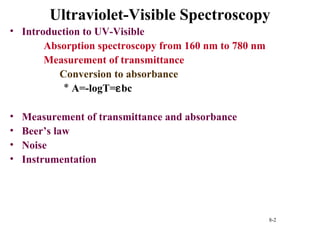
Ultraviolet-Visible Spectroscopy 
8-2 
• Introduction to UV-Visible 
 Absorption spectroscopy from 160 nm to 780 nm 
 Measurement of transmittance 
 Conversion to absorbance 
* A=-logT=ebc 
• Measurement of transmittance and absorbance 
• Beer’s law 
• Noise 
• Instrumentation
8-3 
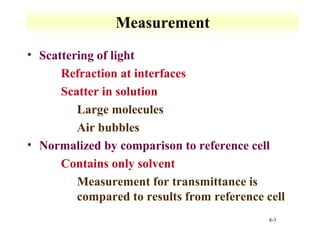
Measurement 
• Scattering of light 
 Refraction at interfaces 
 Scatter in solution 
 Large molecules 
 Air bubbles 
• Normalized by comparison to reference cell 
 Contains only solvent 
 Measurement for transmittance is 
compared to results from reference cell
adn 
P n 
- ò = ò 
an 
- = 
8-4 
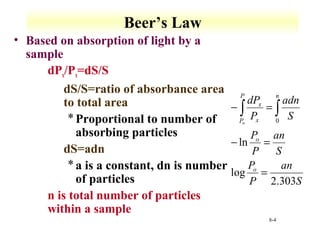
Beer’s Law 
• Based on absorption of light by a 
sample 
 dPx/Px=dS/S 
 dS/S=ratio of absorbance area 
to total area 
*Proportional to number of 
absorbing particles 
 dS=adn 
* a is a constant, dn is number 
of particles 
 n is total number of particles 
within a sample 
S 
an 
dP 
P x 
P 
P 
o 
P 
S 
P 
S 
P 
o 
x 
o 
2.303 
ln 
log 
0 
=
8-5 
Beer’s Law 
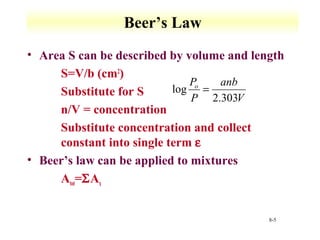
• Area S can be described by volume and length 
 S=V/b (cm2) 
P Substitute for S 
o 
 n/V = concentration 
 Substitute concentration and collect 
constant into single term e 
anb 
• Beer’s law can be applied to mixtures 
 Atot=SAx 
V 
P 
2.303 
log =
8-6 
Beer’s Law Limitations 
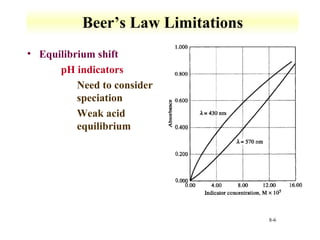
• Equilibrium shift 
 pH indicators 
 Need to consider 
speciation 
 Weak acid 
equilibrium
8-7 
Beer’s Law Limitation 
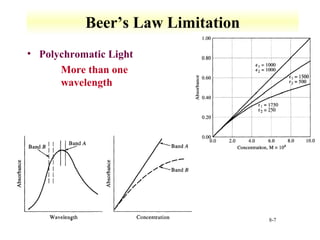
• Polychromatic Light 
 More than one 
wavelength
8-8 
Noise 
• Limited readout resolution 
• Dark current and electronic noise 
• Photon detector shot noise 
• Cell position uncertainty 
 Changing samples 
• Flicker
8-9 
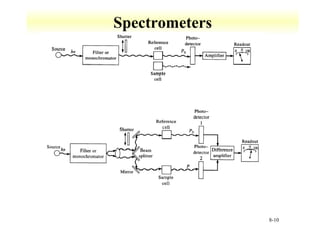
Instrumentation 
• Light source 
 Deuterium and hydrogen lamps 
 W filament lamp 
 Xe arc lamps 
• Sample containers 
 Cuvettes 
 Plastic 
 Glass 
 Quartz
8-10 
Spectrometers
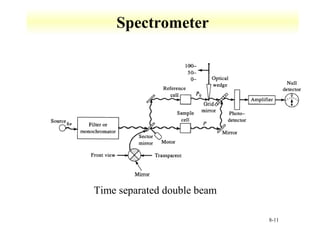
8-11 
Spectrometer 
Time separated double beam
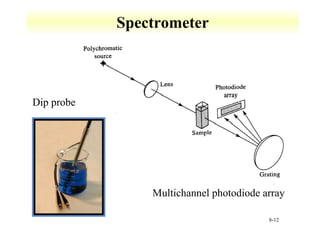
8-12 
Spectrometer 
Multichannel photodiode array 
Dip probe
Application of UV-Visible Spectroscopy 
• Identification of inorganic and organic species 
• Widely used method 
8-13 
• Magnitude of molar absorptivities 
• Absorbing species 
• methods
8-14 
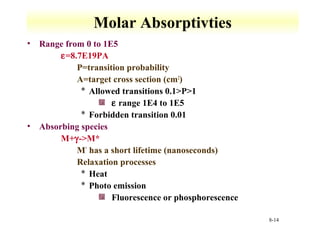
Molar Absorptivties 
• Range from 0 to 1E5 
 e=8.7E19PA 
 P=transition probability 
 A=target cross section (cm2) 
* Allowed transitions 0.1P1 
e range 1E4 to 1E5 
* Forbidden transition 0.01 
• Absorbing species 
 M+g-M* 
 M* has a short lifetime (nanoseconds) 
 Relaxation processes 
* Heat 
* Photo emission 
Fluorescence or phosphorescence
8-15 
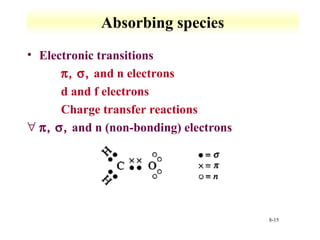
Absorbing species 
• Electronic transitions 
 p, s, and n electrons 
 d and f electrons 
 Charge transfer reactions 
 p, s, and n (non-bonding) electrons
8-16 
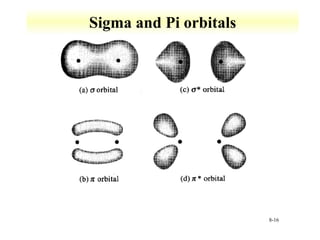
Sigma and Pi orbitals
8-17 
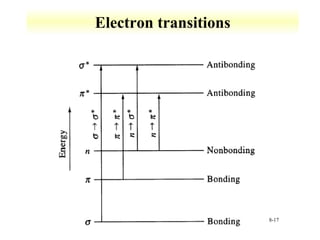
Electron transitions
8-18 
Transitions 
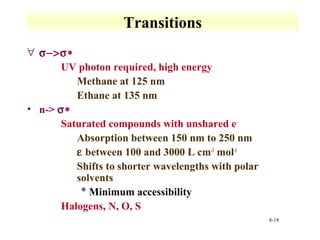
 s-s* 
 UV photon required, high energy 
 Methane at 125 nm 
 Ethane at 135 nm 
• n- s* 
 Saturated compounds with unshared e- 
 Absorption between 150 nm to 250 nm 
 e between 100 and 3000 L cm-1 mol-1 
 Shifts to shorter wavelengths with polar 
solvents 
* Minimum accessibility 
 Halogens, N, O, S
8-19 
Transitions 
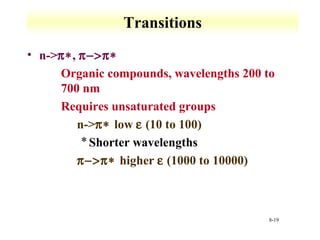
• n-p*, p-p* 
 Organic compounds, wavelengths 200 to 
700 nm 
 Requires unsaturated groups 
 n-p* low e (10 to 100) 
* Shorter wavelengths 
 p-p* higher e (1000 to 10000)
8-20 
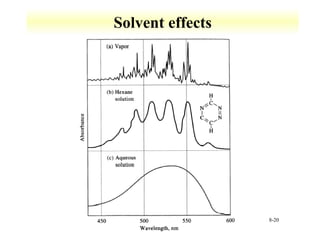
Solvent effects
8-21 
Transitions 
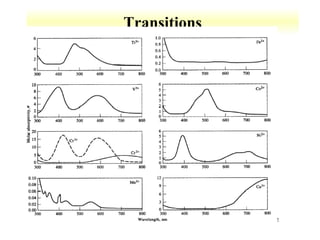
• d-d 
 3d and 4d 1st and 2nd transitions series 
 Broad transitions 
 Impacted by solution
8-22 
Transitions
8-23 
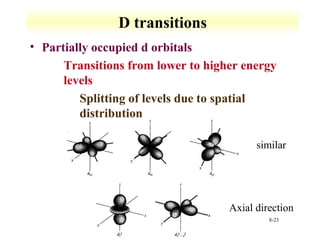
D transitions 
• Partially occupied d orbitals 
 Transitions from lower to higher energy 
levels 
 Splitting of levels due to spatial 
distribution 
similar 
Axial direction
8-24 
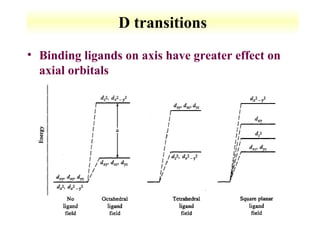
D transitions 
• Binding ligands on axis have greater effect on 
axial orbitals
8-25 
D transitions 
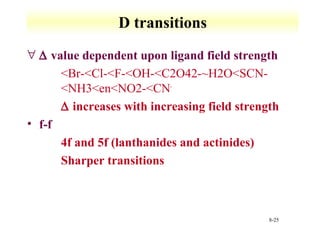
 D value dependent upon ligand field strength 
 Br-Cl-F-OH-C2O42-~H2OSCN- 
NH3enNO2-CN- 
 D increases with increasing field strength 
• f-f 
 4f and 5f (lanthanides and actinides) 
 Sharper transitions
8-26 
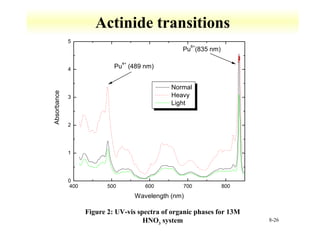
Actinide transitions 
5 
4 
3 
2 
1 
0 
Pu6+(835 nm) 
Normal 
Heavy 
Light 
Pu4+ (489 nm) 
400 500 600 700 800 
Absorbance 
Wavelength (nm) 
Figure 2: UV-vis spectra of organic phases for 13M 
HNO3 system
8-27 
Charge-transfer Transitions 
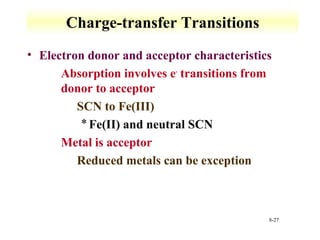
• Electron donor and acceptor characteristics 
 Absorption involves e- transitions from 
donor to acceptor 
 SCN to Fe(III) 
*Fe(II) and neutral SCN 
 Metal is acceptor 
 Reduced metals can be exception
8-28 
Electronic Spectra 
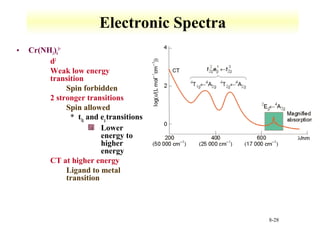
• Cr(NH3)6 
3+ 
 d3 
 Weak low energy 
transition 
 Spin forbidden 
 2 stronger transitions 
 Spin allowed 
* t2g and eg transitions 
Lower 
energy to 
higher 
energy 
 CT at higher energy 
 Ligand to metal 
transition
8-29 
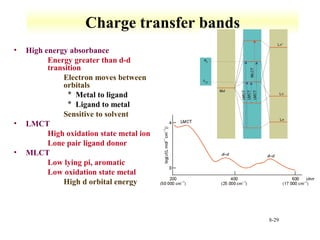
Charge transfer bands 
• High energy absorbance 
 Energy greater than d-d 
transition 
 Electron moves between 
orbitals 
* Metal to ligand 
* Ligand to metal 
 Sensitive to solvent 
• LMCT 
 High oxidation state metal ion 
 Lone pair ligand donor 
• MLCT 
 Low lying pi, aromatic 
 Low oxidation state metal 
 High d orbital energy
8-30 
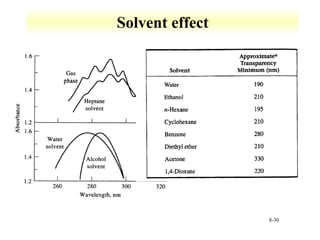
Solvent effect
8-31 
Methods 
• Titration 
 Change of absorbance with solution 
variation 
 pH, ligand, metal 
• Photoacoustic effect 
 Emission of sound
Rawat’s Creation-rwtdgreat@ 
gmail.com 
rwtdgreat@yahoo.co.uk 
RawatDAgreatt/LinkedIn 
www.slideshare.net/ 
RawatDAgreatt 
Google+/blogger/Facebook 
/ 
Twitter-@RawatDAgreatt 
+919808050301 
+919958249693

Uv visible

  • 1.
    UV-Vis. Spectroscopy By- Saurav K. Rawat (Rawat DA Greatt) 1
  • 2.
    Ultraviolet-Visible Spectroscopy 8-2 • Introduction to UV-Visible Absorption spectroscopy from 160 nm to 780 nm Measurement of transmittance Conversion to absorbance * A=-logT=ebc • Measurement of transmittance and absorbance • Beer’s law • Noise • Instrumentation
  • 3.
    8-3 Measurement •Scattering of light Refraction at interfaces Scatter in solution Large molecules Air bubbles • Normalized by comparison to reference cell Contains only solvent Measurement for transmittance is compared to results from reference cell
  • 4.
    adn P n - ò = ò an - = 8-4 Beer’s Law • Based on absorption of light by a sample dPx/Px=dS/S dS/S=ratio of absorbance area to total area *Proportional to number of absorbing particles dS=adn * a is a constant, dn is number of particles n is total number of particles within a sample S an dP P x P P o P S P S P o x o 2.303 ln log 0 =
  • 5.
    8-5 Beer’s Law • Area S can be described by volume and length S=V/b (cm2) P Substitute for S o n/V = concentration Substitute concentration and collect constant into single term e anb • Beer’s law can be applied to mixtures Atot=SAx V P 2.303 log =
  • 6.
    8-6 Beer’s LawLimitations • Equilibrium shift pH indicators Need to consider speciation Weak acid equilibrium
  • 7.
    8-7 Beer’s LawLimitation • Polychromatic Light More than one wavelength
  • 8.
    8-8 Noise •Limited readout resolution • Dark current and electronic noise • Photon detector shot noise • Cell position uncertainty Changing samples • Flicker
  • 9.
    8-9 Instrumentation •Light source Deuterium and hydrogen lamps W filament lamp Xe arc lamps • Sample containers Cuvettes Plastic Glass Quartz
  • 10.
  • 11.
    8-11 Spectrometer Timeseparated double beam
  • 12.
    8-12 Spectrometer Multichannelphotodiode array Dip probe
  • 13.
    Application of UV-VisibleSpectroscopy • Identification of inorganic and organic species • Widely used method 8-13 • Magnitude of molar absorptivities • Absorbing species • methods
  • 14.
    8-14 Molar Absorptivties • Range from 0 to 1E5 e=8.7E19PA P=transition probability A=target cross section (cm2) * Allowed transitions 0.1P1 e range 1E4 to 1E5 * Forbidden transition 0.01 • Absorbing species M+g-M* M* has a short lifetime (nanoseconds) Relaxation processes * Heat * Photo emission Fluorescence or phosphorescence
  • 15.
    8-15 Absorbing species • Electronic transitions p, s, and n electrons d and f electrons Charge transfer reactions p, s, and n (non-bonding) electrons
  • 16.
    8-16 Sigma andPi orbitals
  • 17.
  • 18.
    8-18 Transitions s-s* UV photon required, high energy Methane at 125 nm Ethane at 135 nm • n- s* Saturated compounds with unshared e- Absorption between 150 nm to 250 nm e between 100 and 3000 L cm-1 mol-1 Shifts to shorter wavelengths with polar solvents * Minimum accessibility Halogens, N, O, S
  • 19.
    8-19 Transitions •n-p*, p-p* Organic compounds, wavelengths 200 to 700 nm Requires unsaturated groups n-p* low e (10 to 100) * Shorter wavelengths p-p* higher e (1000 to 10000)
  • 20.
  • 21.
    8-21 Transitions •d-d 3d and 4d 1st and 2nd transitions series Broad transitions Impacted by solution
  • 22.
  • 23.
    8-23 D transitions • Partially occupied d orbitals Transitions from lower to higher energy levels Splitting of levels due to spatial distribution similar Axial direction
  • 24.
    8-24 D transitions • Binding ligands on axis have greater effect on axial orbitals
  • 25.
    8-25 D transitions D value dependent upon ligand field strength Br-Cl-F-OH-C2O42-~H2OSCN- NH3enNO2-CN- D increases with increasing field strength • f-f 4f and 5f (lanthanides and actinides) Sharper transitions
  • 26.
    8-26 Actinide transitions 5 4 3 2 1 0 Pu6+(835 nm) Normal Heavy Light Pu4+ (489 nm) 400 500 600 700 800 Absorbance Wavelength (nm) Figure 2: UV-vis spectra of organic phases for 13M HNO3 system
  • 27.
    8-27 Charge-transfer Transitions • Electron donor and acceptor characteristics Absorption involves e- transitions from donor to acceptor SCN to Fe(III) *Fe(II) and neutral SCN Metal is acceptor Reduced metals can be exception
  • 28.
    8-28 Electronic Spectra • Cr(NH3)6 3+ d3 Weak low energy transition Spin forbidden 2 stronger transitions Spin allowed * t2g and eg transitions Lower energy to higher energy CT at higher energy Ligand to metal transition
  • 29.
    8-29 Charge transferbands • High energy absorbance Energy greater than d-d transition Electron moves between orbitals * Metal to ligand * Ligand to metal Sensitive to solvent • LMCT High oxidation state metal ion Lone pair ligand donor • MLCT Low lying pi, aromatic Low oxidation state metal High d orbital energy
  • 30.
  • 31.
    8-31 Methods •Titration Change of absorbance with solution variation pH, ligand, metal • Photoacoustic effect Emission of sound
  • 32.
    Rawat’s Creation-rwtdgreat@ gmail.com rwtdgreat@yahoo.co.uk RawatDAgreatt/LinkedIn www.slideshare.net/ RawatDAgreatt Google+/blogger/Facebook / Twitter-@RawatDAgreatt +919808050301 +919958249693