UV-VISIBLE SPECTROSCOPY
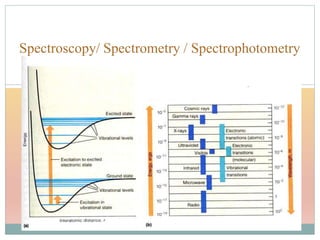
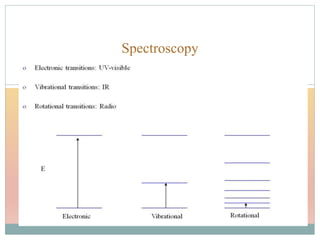
Spectroscopy/ Spectrometry / Spectrophotometry
Spectroscopy
Spectroscopy
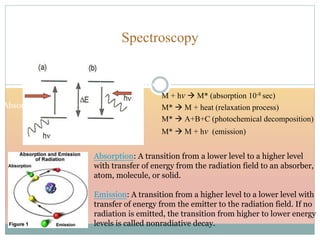
Emission
Absorption
Absorption: A transition from a lower level to a higher level
with transfer of energy from the radiation field to an absorber,
atom, molecule, or solid.
Emission: A transition from a higher level to a lower level with
transfer of energy from the emitter to the radiation field. If no
radiation is emitted, the transition from higher to lower energy
levels is called nonradiative decay.
M + hv  M* (absorption 10-8 sec)
M*  M + heat (relaxation process)
M*  A+B+C (photochemical decomposition)
M*  M + hv (emission)
UV Spectroscopy
 Although the UV spectrum extends below 100 nm (high energy), atmospheric oxygen in
the atmosphere is not transparent below 200 nm hence Vacuum UV region < 200 nm
 Special equipment to study vacuum or far UV is required
 Routine organic UV spectra are typically collected from 200-700 nm
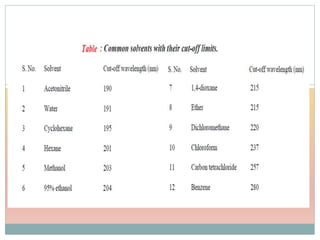
 Solvents to be used in UV spectroscopy should have absorbance up to 220 nm.
 In UV spectroscopy, the sample is irradiated with the broad spectrum of the UV
radiation.
 If a particular electronic transition matches the energy of a certain band of UV, it will be
absorbed.
 The remaining UV light passes through the sample and is detected.
 From this residual radiation a spectrum is obtained with “gaps” at these discrete
energies – this is called an absorption spectrum
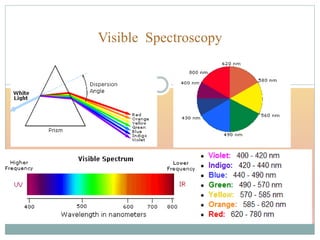
Visible Spectroscopy
8
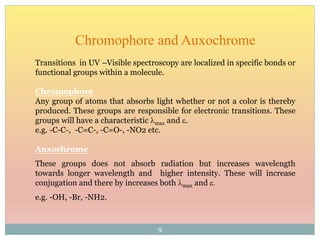
Chromophore and Auxochrome
Transitions in UV –Visible spectroscopy are localized in specific bonds or
functional groups within a molecule.
Chromophore
Any group of atoms that absorbs light whether or not a color is thereby
produced. These groups are responsible for electronic transitions. These
groups will have a characteristic lmax and e.
e.g. -C-C-, -C=C-, -C=O-, -NO2 etc.
Auxochrome
These groups does not absorb radiation but increases wavelength
towards longer wavelength and higher intensity. These will increase
conjugation and there by increases both lmax and e.
e.g. -OH, -Br, -NH2.
9
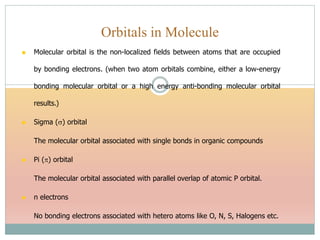
 Molecular orbital is the non-localized fields between atoms that are occupied
by bonding electrons. (when two atom orbitals combine, either a low-energy
bonding molecular orbital or a high energy anti-bonding molecular orbital
results.)
 Sigma () orbital
The molecular orbital associated with single bonds in organic compounds
 Pi () orbital
The molecular orbital associated with parallel overlap of atomic P orbital.
 n electrons
No bonding electrons associated with hetero atoms like O, N, S, Halogens etc.
Orbitals in Molecule
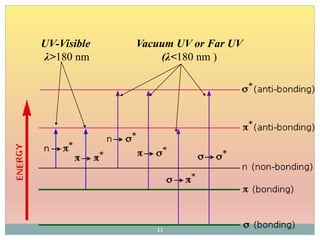
UV-Visible
λ>180 nm
Vacuum UV or Far UV
(λ<180 nm )
11
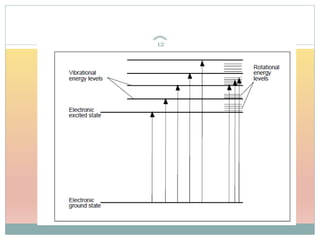
12
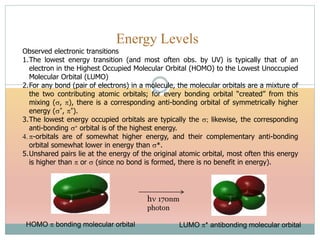
Energy Levels
Observed electronic transitions
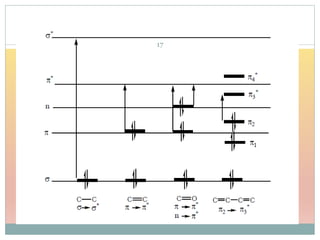
1.The lowest energy transition (and most often obs. by UV) is typically that of an
electron in the Highest Occupied Molecular Orbital (HOMO) to the Lowest Unoccupied
Molecular Orbital (LUMO)
2.For any bond (pair of electrons) in a molecule, the molecular orbitals are a mixture of
the two contributing atomic orbitals; for every bonding orbital “created” from this
mixing (, ), there is a corresponding anti-bonding orbital of symmetrically higher
energy (*, *).
3.The lowest energy occupied orbitals are typically the ; likewise, the corresponding
anti-bonding * orbital is of the highest energy.
4. -orbitals are of somewhat higher energy, and their complementary anti-bonding
orbital somewhat lower in energy than *.
5.Unshared pairs lie at the energy of the original atomic orbital, most often this energy
is higher than  or  (since no bond is formed, there is no benefit in energy).
HOMO  bonding molecular orbital LUMO * antibonding molecular orbital
h 170nm
photon
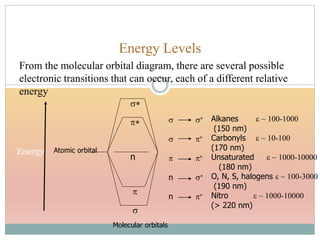
Energy Levels
From the molecular orbital diagram, there are several possible
electronic transitions that can occur, each of a different relative
energy
*


*
n
Atomic orbital
Molecular orbitals
Energy



n
n
*
*
*
*
*
Alkanes e ~ 100-1000
(150 nm)
Carbonyls e ~ 10-100
(170 nm)
Unsaturated e ~ 1000-10000
(180 nm)
O, N, S, halogens e ~ 100-3000
(190 nm)
Nitro e ~ 1000-10000
(> 220 nm)
Effect of Conjugation
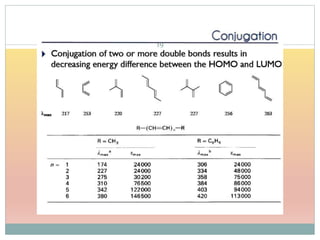
15Molecular structure or environment [Conjugation (substitution) / Auxochrome or change of
solvent]can influence λmax and ε.
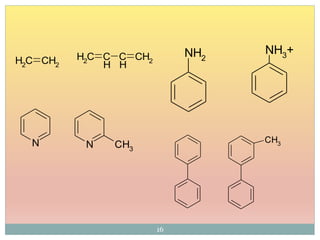
Shift to longer λ  bathochromic/red e.g. Ethylene (170 nm) 1,3 –butadiene (217 nm)
Shift to shorter λ  hypsochromic/ blue e.g. aniline (285 nm) and anilinium ion (254 nm)
Increase in ε  hyperchromic effect e.g. pyridine (2750) 2-methyl pyridine (3560)
Decrease in ε  hypochromic effect e.g. biphenyl (6540) 3- methyl biphenyl (5970)
Due to solvent change, UV-Visible spectral changes in next slides, Solvent Effect.
N N CH3
CH2 CH2
CH2
C
H
C
H
CH2
NH2
NH3+
CH3
16
17
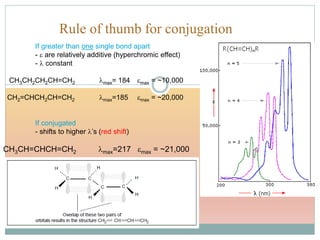
If greater than one single bond apart
- e are relatively additive (hyperchromic effect)
- l constant
CH3CH2CH2CH=CH2 lmax= 184 emax = ~10,000
CH2=CHCH2CH=CH2 lmax=185 emax = ~20,000
If conjugated
- shifts to higher l’s (red shift)
CH3CH=CHCH=CH2 lmax=217 emax = ~21,000
Rule of thumb for conjugation
19
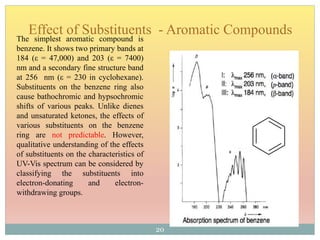
Effect of Substituents - Aromatic Compounds
The simplest aromatic compound is
benzene. It shows two primary bands at
184 (ε = 47,000) and 203 (ε = 7400)
nm and a secondary fine structure band
at 256 nm (ε = 230 in cyclohexane).
Substituents on the benzene ring also
cause bathochromic and hypsochromic
shifts of various peaks. Unlike dienes
and unsaturated ketones, the effects of
various substituents on the benzene
ring are not predictable. However,
qualitative understanding of the effects
of substituents on the characteristics of
UV-Vis spectrum can be considered by
classifying the substituents into
electron-donating and electron-
withdrawing groups.
20
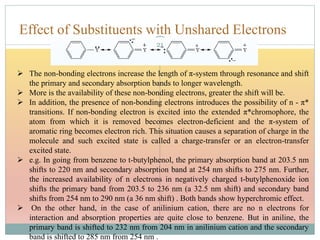
 The non-bonding electrons increase the length of π-system through resonance and shift
the primary and secondary absorption bands to longer wavelength.
 More is the availability of these non-bonding electrons, greater the shift will be.
 In addition, the presence of non-bonding electrons introduces the possibility of n - π*
transitions. If non-bonding electron is excited into the extended π*chromophore, the
atom from which it is removed becomes electron-deficient and the π-system of
aromatic ring becomes electron rich. This situation causes a separation of charge in the
molecule and such excited state is called a charge-transfer or an electron-transfer
excited state.
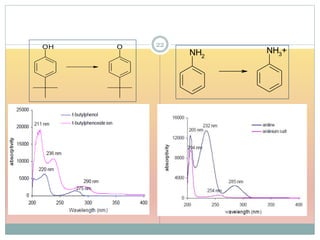
 e.g. In going from benzene to t-butylphenol, the primary absorption band at 203.5 nm
shifts to 220 nm and secondary absorption band at 254 nm shifts to 275 nm. Further,
the increased availability of n electrons in negatively charged t-butylphenoxide ion
shifts the primary band from 203.5 to 236 nm (a 32.5 nm shift) and secondary band
shifts from 254 nm to 290 nm (a 36 nm shift) . Both bands show hyperchromic effect.
 On the other hand, in the case of anilinium cation, there are no n electrons for
interaction and absorption properties are quite close to benzene. But in aniline, the
primary band is shifted to 232 nm from 204 nm in anilinium cation and the secondary
band is shifted to 285 nm from 254 nm .
Effect of Substituents with Unshared Electrons
21
OH O
NH3
+NH2
22
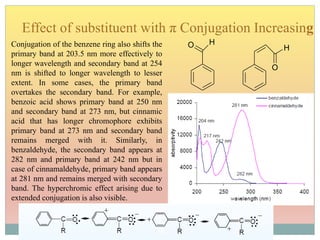
Conjugation of the benzene ring also shifts the
primary band at 203.5 nm more effectively to
longer wavelength and secondary band at 254
nm is shifted to longer wavelength to lesser
extent. In some cases, the primary band
overtakes the secondary band. For example,
benzoic acid shows primary band at 250 nm
and secondary band at 273 nm, but cinnamic
acid that has longer chromophore exhibits
primary band at 273 nm and secondary band
remains merged with it. Similarly, in
benzaldehyde, the secondary band appears at
282 nm and primary band at 242 nm but in
case of cinnamaldehyde, primary band appears
at 281 nm and remains merged with secondary
band. The hyperchromic effect arising due to
extended conjugation is also visible.
Effect of substituent with π Conjugation Increasing
O H
O
H
23
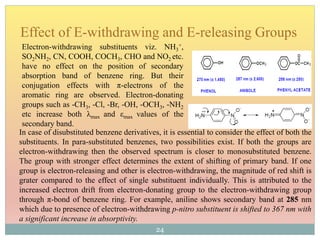
Electron-withdrawing substituents viz. NH3
+,
SO2NH2, CN, COOH, COCH3, CHO and NO2 etc.
have no effect on the position of secondary
absorption band of benzene ring. But their
conjugation effects with π-electrons of the
aromatic ring are observed. Electron-donating
groups such as -CH3, -Cl, -Br, -OH, -OCH3, -NH2
etc increase both λmax and εmax values of the
secondary band.
Effect of E-withdrawing and E-releasing Groups
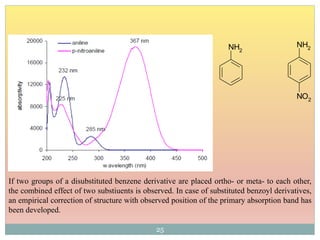
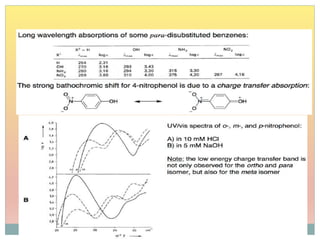
In case of disubstituted benzene derivatives, it is essential to consider the effect of both the
substituents. In para-substituted benzenes, two possibilities exist. If both the groups are
electron-withdrawing then the observed spectrum is closer to monosubstituted benzene.
The group with stronger effect determines the extent of shifting of primary band. If one
group is electron-releasing and other is electron-withdrawing, the magnitude of red shift is
grater compared to the effect of single substituent individually. This is attributed to the
increased electron drift from electron-donating group to the electron-withdrawing group
through π-bond of benzene ring. For example, aniline shows secondary band at 285 nm
which due to presence of electron-withdrawing p-nitro substituent is shifted to 367 nm with
a significant increase in absorptivity.
24
NH2
NH2
NO2
If two groups of a disubstituted benzene derivative are placed ortho- or meta- to each other,
the combined effect of two substiuents is observed. In case of substituted benzoyl derivatives,
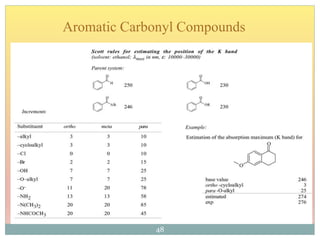
an empirical correction of structure with observed position of the primary absorption band has
been developed.
25
26
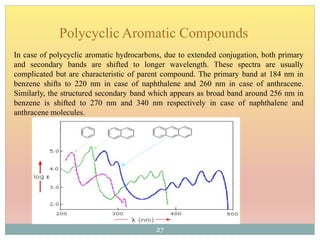
In case of polycyclic aromatic hydrocarbons, due to extended conjugation, both primary
and secondary bands are shifted to longer wavelength. These spectra are usually
complicated but are characteristic of parent compound. The primary band at 184 nm in
benzene shifts to 220 nm in case of naphthalene and 260 nm in case of anthracene.
Similarly, the structured secondary band which appears as broad band around 256 nm in
benzene is shifted to 270 nm and 340 nm respectively in case of naphthalene and
anthracene molecules.
Polycyclic Aromatic Compounds
27
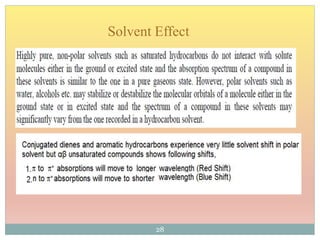
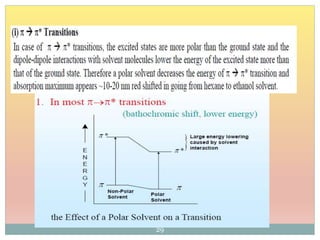
Solvent Effect
28
29
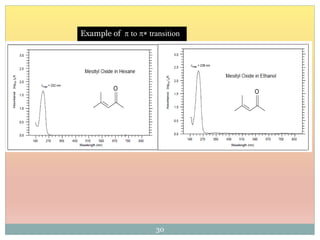
Example of  to * transition
O O
30
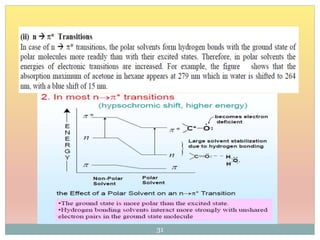
31
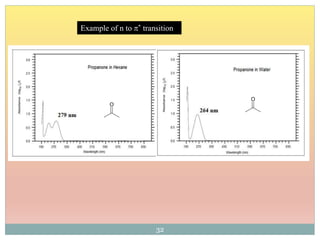
Example of n to * transition
O
O
32
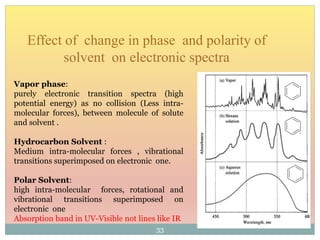
Effect of change in phase and polarity of
solvent on electronic spectra
Vapor phase:
purely electronic transition spectra (high
potential energy) as no collision (Less intra-
molecular forces), between molecule of solute
and solvent .
Hydrocarbon Solvent :
Medium intra-molecular forces , vibrational
transitions superimposed on electronic one.
Polar Solvent:
high intra-molecular forces, rotational and
vibrational transitions superimposed on
electronic one
Absorption band in UV-Visible not lines like IR
33
Stereochemical Factors
It is possible to predict wavelength maxima for specific structure by empirical rules
specified here over . But these calculated values do not match practically observed
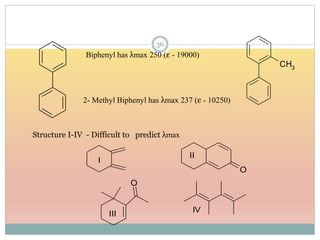
values and in few cases, it is difficult to predict (structure I-IV)The reasons being
different like solvent, instrumental factors but an important factor will be
stereochemical .
The angular strain or stereochemical overcrowding may be the reason for problem,
which has justified in following example of biphenyls. An angular distortion or cross
conjugation (conjugation at site other than chromophore in molecule) will lead
inhibition of resonance and hence it is possible to detect compounds with different
stereochemistry by electronic spectroscopy.
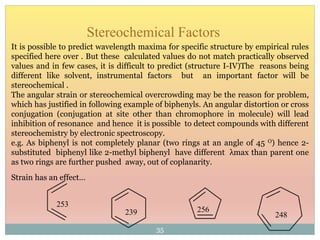
e.g. As biphenyl is not completely planar (two rings at an angle of 45 O) hence 2-
substituted biphenyl like 2-methyl biphenyl have different λmax than parent one
as two rings are further pushed away, out of coplanarity.
Strain has an effect…
253
239 256
248
35
CH3
Biphenyl has λmax 250 (ε - 19000)
2- Methyl Biphenyl has λmax 237 (ε - 10250)
O
O
I
II
III IV
Structure I-IV - Difficult to predict λmax
36
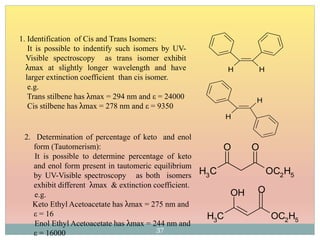
2. Determination of percentage of keto and enol
form (Tautomerism):
It is possible to determine percentage of keto
and enol form present in tautomeric equilibrium
by UV-Visible spectroscopy as both isomers
exhibit different λmax & extinction coefficient.
e.g.
Keto Ethyl Acetoacetate has λmax = 275 nm and
ε = 16
Enol Ethyl Acetoacetate has λmax = 244 nm and
ε = 16000
CH3
OC2H5
O O
CH3
OC2H5
OH O
1. Identification of Cis and Trans Isomers:
It is possible to indentify such isomers by UV-
Visible spectroscopy as trans isomer exhibit
λmax at slightly longer wavelength and have
larger extinction coefficient than cis isomer.
e.g.
Trans stilbene has λmax = 294 nm and ε = 24000
Cis stilbene has λmax = 278 nm and ε = 9350
H H
H
H
37
Selection Rules
 These rules are designed to explain energy transitions (allowed and forbidden)
due to absorption of radiations of electromagnetic spectrum by molecule or
atoms in molecules.
 Electronic transitions may be classed as intense or weak according to the
magnitude of εmax that corresponds to allowed or forbidden transition as
governed by the following selection rules of electronic transition.Transitions
not permitted by selection rules are said forbidden, which means they may occur
in practice but with low probabilities.
• Spin-forbidden transitions
– Transitions involving a change in the spin state of the molecule are
forbidden and strongly obeyed
– Relaxed by effects that make spin a poor quantum number (heavy atoms)
• Symmetry-forbidden transitions
– Transitions between states of the same parity (Symmetry) are forbidden
– Particularly important for centro-symmetric molecules (ethene)
– Relaxed by coupling of electronic transitions to vibrational transitions
(vibronic coupling)
Selection Rules
These are of two types in case of electronic energy transitions involved in UV
Visible spectroscopy.
1. Spin Rule: It states that allowed transitions must involve the promotion of
electrons without a change in their spin. ΔS = 0 (Transition Allowed)
Or There should be no change in spin orientation or no spin inversion during
these transitions.
 Thus, S→S, T→T, are allowed, but S→T, T→S are forbidden.
S stands for singlet and T for triplet.
 Under the influence of external field, there are three values (i.e. 3 energy
states) of +1, 0, -1 times the angular momentum. Such states are called
triplet states (T).
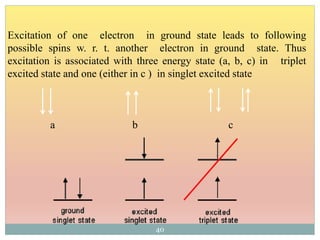
Excitation of one electron in ground state leads to following
possible spins w. r. t. another electron in ground state. Thus
excitation is associated with three energy state (a, b, c) in triplet
excited state and one (either in c ) in singlet excited state
a b c
40
2. Orbital Rule (Laporte): If the molecule has a centre of symmetry, transitions
within a given set of p or d orbitals (i.e. those which only involve a
redistribution of electrons within a given subshell) are forbidden.
Or In a centrosymmetric environment transitions between like atomic
orbitals such as s-s, p-p, d-d, or f-f, transitions are forbidden.
Laporte-allowed transitions: g  u or u  g
Laporte-forbidden transitions: g  g or u  u
g stands for gerade – compound with a center of symmetry
u stands for ungerade – compound without a center of symmetry (loss of
symmetry on excitation due to energy absorption)
Exceptions of these rules:
a) Vibronic coupling – The vibrational energies superimposed on electronic
energy
b) Geometry relaxation during transition – The π-acceptor and π-donor
ligands can mix with the d-orbitals so transitions are no longer purely d-d.
41
Polyenes, and Unsaturated Carbonyl groups
42
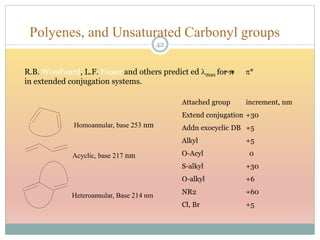
R.B. Woodward, L.F. Fieser and others predict ed lmax for π *
in extended conjugation systems.
Homoannular, base 253 nm
Heteroannular, Base 214 nm
Acyclic, base 217 nm
Attached group increment, nm
Extend conjugation +30
Addn exocyclic DB +5
Alkyl +5
O-Acyl 0
S-alkyl +30
O-alkyl +6
NR2 +60
Cl, Br +5
Some Examples
43
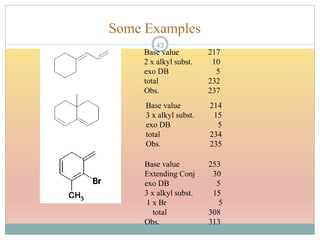
Base value 217
2 x alkyl subst. 10
exo DB 5
total 232
Obs. 237
Base value 214
3 x alkyl subst. 15
exo DB 5
total 234
Obs. 235
Base value 253
Extending Conj 30
exo DB 5
3 x alkyl subst. 15
1 x Br 5
total 308
Obs. 313
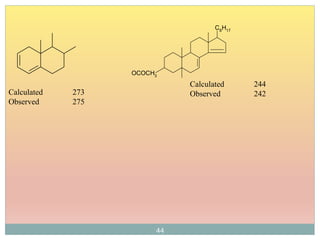
Calculated 273
Observed 275
C8
H17
OCOCH3
Calculated 244
Observed 242
44
O
O
O O
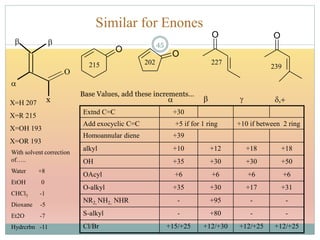
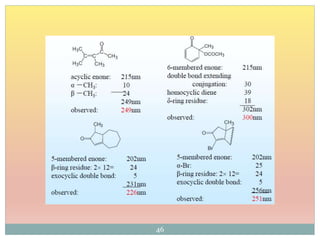
Similar for Enones
45
O
x

bb
X=H 207
X=R 215
X=OH 193
X=OR 193
215 202 227
239
Base Values, add these increments…
Extnd C=C +30
Add exocyclic C=C +5 if for 1 ring +10 if between 2 ring
Homoannular diene +39
alkyl +10 +12 +18 +18
OH +35 +30 +30 +50
OAcyl +6 +6 +6 +6
O-alkyl +35 +30 +17 +31
NR2, NH2, NHR - +95 - -
S-alkyl - +80 - -
Cl/Br +15/+25 +12/+30 +12/+25 +12/+25
 b g d,+
With solvent correction
of…..
Water +8
EtOH 0
CHCl3 -1
Dioxane -5
Et2O -7
Hydrcrbn -11
46
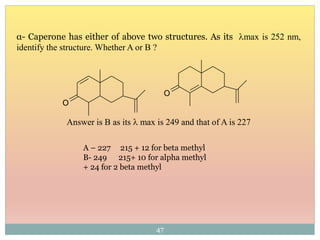
α- Caperone has either of above two structures. As its lmax is 252 nm,
identify the structure. Whether A or B ?
A – 227 215 + 12 for beta methyl
B- 249 215+ 10 for alpha methyl
+ 24 for 2 beta methyl
Answer is B as its l max is 249 and that of A is 227
47
O
O
Aromatic Carbonyl Compounds
48
NH
CH3
CH3
O
OH
O
O
OH
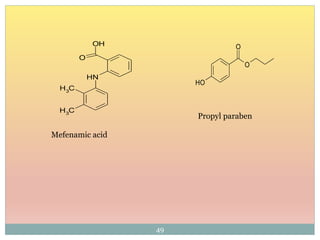
Mefenamic acid
Propyl paraben
49
50
51

UV SPECTROSCOPY [ULTRA-VIOLET SPECTROSCOPY]

  • 1.
  • 2.
  • 4.
  • 5.
    Spectroscopy Emission Absorption Absorption: A transitionfrom a lower level to a higher level with transfer of energy from the radiation field to an absorber, atom, molecule, or solid. Emission: A transition from a higher level to a lower level with transfer of energy from the emitter to the radiation field. If no radiation is emitted, the transition from higher to lower energy levels is called nonradiative decay. M + hv  M* (absorption 10-8 sec) M*  M + heat (relaxation process) M*  A+B+C (photochemical decomposition) M*  M + hv (emission)
  • 6.
    UV Spectroscopy  Althoughthe UV spectrum extends below 100 nm (high energy), atmospheric oxygen in the atmosphere is not transparent below 200 nm hence Vacuum UV region < 200 nm  Special equipment to study vacuum or far UV is required  Routine organic UV spectra are typically collected from 200-700 nm  Solvents to be used in UV spectroscopy should have absorbance up to 220 nm.  In UV spectroscopy, the sample is irradiated with the broad spectrum of the UV radiation.  If a particular electronic transition matches the energy of a certain band of UV, it will be absorbed.  The remaining UV light passes through the sample and is detected.  From this residual radiation a spectrum is obtained with “gaps” at these discrete energies – this is called an absorption spectrum
  • 7.
  • 8.
  • 9.
    Chromophore and Auxochrome Transitionsin UV –Visible spectroscopy are localized in specific bonds or functional groups within a molecule. Chromophore Any group of atoms that absorbs light whether or not a color is thereby produced. These groups are responsible for electronic transitions. These groups will have a characteristic lmax and e. e.g. -C-C-, -C=C-, -C=O-, -NO2 etc. Auxochrome These groups does not absorb radiation but increases wavelength towards longer wavelength and higher intensity. These will increase conjugation and there by increases both lmax and e. e.g. -OH, -Br, -NH2. 9
  • 10.
     Molecular orbitalis the non-localized fields between atoms that are occupied by bonding electrons. (when two atom orbitals combine, either a low-energy bonding molecular orbital or a high energy anti-bonding molecular orbital results.)  Sigma () orbital The molecular orbital associated with single bonds in organic compounds  Pi () orbital The molecular orbital associated with parallel overlap of atomic P orbital.  n electrons No bonding electrons associated with hetero atoms like O, N, S, Halogens etc. Orbitals in Molecule
  • 11.
    UV-Visible λ>180 nm Vacuum UVor Far UV (λ<180 nm ) 11
  • 12.
  • 13.
    Energy Levels Observed electronictransitions 1.The lowest energy transition (and most often obs. by UV) is typically that of an electron in the Highest Occupied Molecular Orbital (HOMO) to the Lowest Unoccupied Molecular Orbital (LUMO) 2.For any bond (pair of electrons) in a molecule, the molecular orbitals are a mixture of the two contributing atomic orbitals; for every bonding orbital “created” from this mixing (, ), there is a corresponding anti-bonding orbital of symmetrically higher energy (*, *). 3.The lowest energy occupied orbitals are typically the ; likewise, the corresponding anti-bonding * orbital is of the highest energy. 4. -orbitals are of somewhat higher energy, and their complementary anti-bonding orbital somewhat lower in energy than *. 5.Unshared pairs lie at the energy of the original atomic orbital, most often this energy is higher than  or  (since no bond is formed, there is no benefit in energy). HOMO  bonding molecular orbital LUMO * antibonding molecular orbital h 170nm photon
  • 14.
    Energy Levels From themolecular orbital diagram, there are several possible electronic transitions that can occur, each of a different relative energy *   * n Atomic orbital Molecular orbitals Energy    n n * * * * * Alkanes e ~ 100-1000 (150 nm) Carbonyls e ~ 10-100 (170 nm) Unsaturated e ~ 1000-10000 (180 nm) O, N, S, halogens e ~ 100-3000 (190 nm) Nitro e ~ 1000-10000 (> 220 nm)
  • 15.
    Effect of Conjugation 15Molecularstructure or environment [Conjugation (substitution) / Auxochrome or change of solvent]can influence λmax and ε. Shift to longer λ  bathochromic/red e.g. Ethylene (170 nm) 1,3 –butadiene (217 nm) Shift to shorter λ  hypsochromic/ blue e.g. aniline (285 nm) and anilinium ion (254 nm) Increase in ε  hyperchromic effect e.g. pyridine (2750) 2-methyl pyridine (3560) Decrease in ε  hypochromic effect e.g. biphenyl (6540) 3- methyl biphenyl (5970) Due to solvent change, UV-Visible spectral changes in next slides, Solvent Effect.
  • 16.
    N N CH3 CH2CH2 CH2 C H C H CH2 NH2 NH3+ CH3 16
  • 17.
  • 18.
    If greater thanone single bond apart - e are relatively additive (hyperchromic effect) - l constant CH3CH2CH2CH=CH2 lmax= 184 emax = ~10,000 CH2=CHCH2CH=CH2 lmax=185 emax = ~20,000 If conjugated - shifts to higher l’s (red shift) CH3CH=CHCH=CH2 lmax=217 emax = ~21,000 Rule of thumb for conjugation
  • 19.
  • 20.
    Effect of Substituents- Aromatic Compounds The simplest aromatic compound is benzene. It shows two primary bands at 184 (ε = 47,000) and 203 (ε = 7400) nm and a secondary fine structure band at 256 nm (ε = 230 in cyclohexane). Substituents on the benzene ring also cause bathochromic and hypsochromic shifts of various peaks. Unlike dienes and unsaturated ketones, the effects of various substituents on the benzene ring are not predictable. However, qualitative understanding of the effects of substituents on the characteristics of UV-Vis spectrum can be considered by classifying the substituents into electron-donating and electron- withdrawing groups. 20
  • 21.
     The non-bondingelectrons increase the length of π-system through resonance and shift the primary and secondary absorption bands to longer wavelength.  More is the availability of these non-bonding electrons, greater the shift will be.  In addition, the presence of non-bonding electrons introduces the possibility of n - π* transitions. If non-bonding electron is excited into the extended π*chromophore, the atom from which it is removed becomes electron-deficient and the π-system of aromatic ring becomes electron rich. This situation causes a separation of charge in the molecule and such excited state is called a charge-transfer or an electron-transfer excited state.  e.g. In going from benzene to t-butylphenol, the primary absorption band at 203.5 nm shifts to 220 nm and secondary absorption band at 254 nm shifts to 275 nm. Further, the increased availability of n electrons in negatively charged t-butylphenoxide ion shifts the primary band from 203.5 to 236 nm (a 32.5 nm shift) and secondary band shifts from 254 nm to 290 nm (a 36 nm shift) . Both bands show hyperchromic effect.  On the other hand, in the case of anilinium cation, there are no n electrons for interaction and absorption properties are quite close to benzene. But in aniline, the primary band is shifted to 232 nm from 204 nm in anilinium cation and the secondary band is shifted to 285 nm from 254 nm . Effect of Substituents with Unshared Electrons 21
  • 22.
  • 23.
    Conjugation of thebenzene ring also shifts the primary band at 203.5 nm more effectively to longer wavelength and secondary band at 254 nm is shifted to longer wavelength to lesser extent. In some cases, the primary band overtakes the secondary band. For example, benzoic acid shows primary band at 250 nm and secondary band at 273 nm, but cinnamic acid that has longer chromophore exhibits primary band at 273 nm and secondary band remains merged with it. Similarly, in benzaldehyde, the secondary band appears at 282 nm and primary band at 242 nm but in case of cinnamaldehyde, primary band appears at 281 nm and remains merged with secondary band. The hyperchromic effect arising due to extended conjugation is also visible. Effect of substituent with π Conjugation Increasing O H O H 23
  • 24.
    Electron-withdrawing substituents viz.NH3 +, SO2NH2, CN, COOH, COCH3, CHO and NO2 etc. have no effect on the position of secondary absorption band of benzene ring. But their conjugation effects with π-electrons of the aromatic ring are observed. Electron-donating groups such as -CH3, -Cl, -Br, -OH, -OCH3, -NH2 etc increase both λmax and εmax values of the secondary band. Effect of E-withdrawing and E-releasing Groups In case of disubstituted benzene derivatives, it is essential to consider the effect of both the substituents. In para-substituted benzenes, two possibilities exist. If both the groups are electron-withdrawing then the observed spectrum is closer to monosubstituted benzene. The group with stronger effect determines the extent of shifting of primary band. If one group is electron-releasing and other is electron-withdrawing, the magnitude of red shift is grater compared to the effect of single substituent individually. This is attributed to the increased electron drift from electron-donating group to the electron-withdrawing group through π-bond of benzene ring. For example, aniline shows secondary band at 285 nm which due to presence of electron-withdrawing p-nitro substituent is shifted to 367 nm with a significant increase in absorptivity. 24
  • 25.
    NH2 NH2 NO2 If two groupsof a disubstituted benzene derivative are placed ortho- or meta- to each other, the combined effect of two substiuents is observed. In case of substituted benzoyl derivatives, an empirical correction of structure with observed position of the primary absorption band has been developed. 25
  • 26.
  • 27.
    In case ofpolycyclic aromatic hydrocarbons, due to extended conjugation, both primary and secondary bands are shifted to longer wavelength. These spectra are usually complicated but are characteristic of parent compound. The primary band at 184 nm in benzene shifts to 220 nm in case of naphthalene and 260 nm in case of anthracene. Similarly, the structured secondary band which appears as broad band around 256 nm in benzene is shifted to 270 nm and 340 nm respectively in case of naphthalene and anthracene molecules. Polycyclic Aromatic Compounds 27
  • 28.
  • 29.
  • 30.
    Example of to * transition O O 30
  • 31.
  • 32.
    Example of nto * transition O O 32
  • 33.
    Effect of changein phase and polarity of solvent on electronic spectra Vapor phase: purely electronic transition spectra (high potential energy) as no collision (Less intra- molecular forces), between molecule of solute and solvent . Hydrocarbon Solvent : Medium intra-molecular forces , vibrational transitions superimposed on electronic one. Polar Solvent: high intra-molecular forces, rotational and vibrational transitions superimposed on electronic one Absorption band in UV-Visible not lines like IR 33
  • 35.
    Stereochemical Factors It ispossible to predict wavelength maxima for specific structure by empirical rules specified here over . But these calculated values do not match practically observed values and in few cases, it is difficult to predict (structure I-IV)The reasons being different like solvent, instrumental factors but an important factor will be stereochemical . The angular strain or stereochemical overcrowding may be the reason for problem, which has justified in following example of biphenyls. An angular distortion or cross conjugation (conjugation at site other than chromophore in molecule) will lead inhibition of resonance and hence it is possible to detect compounds with different stereochemistry by electronic spectroscopy. e.g. As biphenyl is not completely planar (two rings at an angle of 45 O) hence 2- substituted biphenyl like 2-methyl biphenyl have different λmax than parent one as two rings are further pushed away, out of coplanarity. Strain has an effect… 253 239 256 248 35
  • 36.
    CH3 Biphenyl has λmax250 (ε - 19000) 2- Methyl Biphenyl has λmax 237 (ε - 10250) O O I II III IV Structure I-IV - Difficult to predict λmax 36
  • 37.
    2. Determination ofpercentage of keto and enol form (Tautomerism): It is possible to determine percentage of keto and enol form present in tautomeric equilibrium by UV-Visible spectroscopy as both isomers exhibit different λmax & extinction coefficient. e.g. Keto Ethyl Acetoacetate has λmax = 275 nm and ε = 16 Enol Ethyl Acetoacetate has λmax = 244 nm and ε = 16000 CH3 OC2H5 O O CH3 OC2H5 OH O 1. Identification of Cis and Trans Isomers: It is possible to indentify such isomers by UV- Visible spectroscopy as trans isomer exhibit λmax at slightly longer wavelength and have larger extinction coefficient than cis isomer. e.g. Trans stilbene has λmax = 294 nm and ε = 24000 Cis stilbene has λmax = 278 nm and ε = 9350 H H H H 37
  • 38.
    Selection Rules  Theserules are designed to explain energy transitions (allowed and forbidden) due to absorption of radiations of electromagnetic spectrum by molecule or atoms in molecules.  Electronic transitions may be classed as intense or weak according to the magnitude of εmax that corresponds to allowed or forbidden transition as governed by the following selection rules of electronic transition.Transitions not permitted by selection rules are said forbidden, which means they may occur in practice but with low probabilities. • Spin-forbidden transitions – Transitions involving a change in the spin state of the molecule are forbidden and strongly obeyed – Relaxed by effects that make spin a poor quantum number (heavy atoms) • Symmetry-forbidden transitions – Transitions between states of the same parity (Symmetry) are forbidden – Particularly important for centro-symmetric molecules (ethene) – Relaxed by coupling of electronic transitions to vibrational transitions (vibronic coupling)
  • 39.
    Selection Rules These areof two types in case of electronic energy transitions involved in UV Visible spectroscopy. 1. Spin Rule: It states that allowed transitions must involve the promotion of electrons without a change in their spin. ΔS = 0 (Transition Allowed) Or There should be no change in spin orientation or no spin inversion during these transitions.  Thus, S→S, T→T, are allowed, but S→T, T→S are forbidden. S stands for singlet and T for triplet.  Under the influence of external field, there are three values (i.e. 3 energy states) of +1, 0, -1 times the angular momentum. Such states are called triplet states (T).
  • 40.
    Excitation of oneelectron in ground state leads to following possible spins w. r. t. another electron in ground state. Thus excitation is associated with three energy state (a, b, c) in triplet excited state and one (either in c ) in singlet excited state a b c 40
  • 41.
    2. Orbital Rule(Laporte): If the molecule has a centre of symmetry, transitions within a given set of p or d orbitals (i.e. those which only involve a redistribution of electrons within a given subshell) are forbidden. Or In a centrosymmetric environment transitions between like atomic orbitals such as s-s, p-p, d-d, or f-f, transitions are forbidden. Laporte-allowed transitions: g  u or u  g Laporte-forbidden transitions: g  g or u  u g stands for gerade – compound with a center of symmetry u stands for ungerade – compound without a center of symmetry (loss of symmetry on excitation due to energy absorption) Exceptions of these rules: a) Vibronic coupling – The vibrational energies superimposed on electronic energy b) Geometry relaxation during transition – The π-acceptor and π-donor ligands can mix with the d-orbitals so transitions are no longer purely d-d. 41
  • 42.
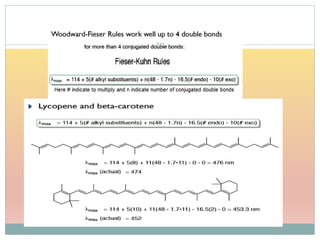
    Polyenes, and UnsaturatedCarbonyl groups 42 R.B. Woodward, L.F. Fieser and others predict ed lmax for π * in extended conjugation systems. Homoannular, base 253 nm Heteroannular, Base 214 nm Acyclic, base 217 nm Attached group increment, nm Extend conjugation +30 Addn exocyclic DB +5 Alkyl +5 O-Acyl 0 S-alkyl +30 O-alkyl +6 NR2 +60 Cl, Br +5
  • 43.
    Some Examples 43 Base value217 2 x alkyl subst. 10 exo DB 5 total 232 Obs. 237 Base value 214 3 x alkyl subst. 15 exo DB 5 total 234 Obs. 235 Base value 253 Extending Conj 30 exo DB 5 3 x alkyl subst. 15 1 x Br 5 total 308 Obs. 313
  • 44.
  • 45.
    O O O O Similar forEnones 45 O x  bb X=H 207 X=R 215 X=OH 193 X=OR 193 215 202 227 239 Base Values, add these increments… Extnd C=C +30 Add exocyclic C=C +5 if for 1 ring +10 if between 2 ring Homoannular diene +39 alkyl +10 +12 +18 +18 OH +35 +30 +30 +50 OAcyl +6 +6 +6 +6 O-alkyl +35 +30 +17 +31 NR2, NH2, NHR - +95 - - S-alkyl - +80 - - Cl/Br +15/+25 +12/+30 +12/+25 +12/+25  b g d,+ With solvent correction of….. Water +8 EtOH 0 CHCl3 -1 Dioxane -5 Et2O -7 Hydrcrbn -11
  • 46.
  • 47.
    α- Caperone haseither of above two structures. As its lmax is 252 nm, identify the structure. Whether A or B ? A – 227 215 + 12 for beta methyl B- 249 215+ 10 for alpha methyl + 24 for 2 beta methyl Answer is B as its l max is 249 and that of A is 227 47 O O
  • 48.
  • 49.
  • 50.
  • 51.