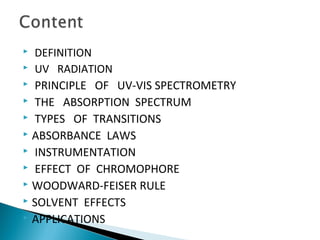
This document provides an overview of ultraviolet-visible spectroscopy. It defines UV-VIS spectroscopy and discusses the principle, instrumentation, and applications. Key points include:
1) UV-VIS spectroscopy measures the attenuation of light passing through a sample, allowing detection of electronic transitions in molecules from absorption measurements.
2) The absorption spectrum provides information on maximum wavelength of absorption and intensity. Instrumentation includes a light source, monochromator, sample holder, and detector.
3) Applications include qualitative and quantitative analysis of compounds, detection of functional groups and impurities, and determination of concentration. UV-VIS spectroscopy is useful for studying kinetics, tautomers, and inorganic compounds.