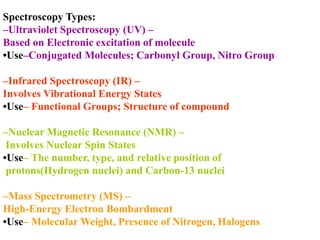
UV-visible spectroscopy involves using electromagnetic radiation to obtain information about atoms and molecules. It is based on electronic excitation of molecules that causes promotion of an electron from a ground state to an excited state. Factors like conjugation, solvents, and pH can affect the position and intensity of UV absorption. Applications of UV spectroscopy include determining molecular weight, identifying impurities, and characterizing aromatic compounds and conjugation.