PRINCIPLE:
• Uv absorption spectra arise from transition occur in a molecules
electron from lower energy level to higher energy level .
• A molecule absorbs uv radiation of frequency 𝜗 and undergoes
transition of different enegy level .
• Energy can be calculated by E= h 𝜗 .
• It works on a famous law called beer- lambert’s law.
• Vibrational energy of molecule is taken inaccount .
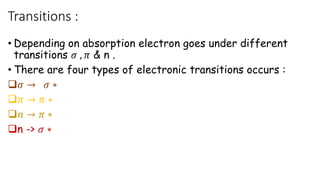
Transitions :
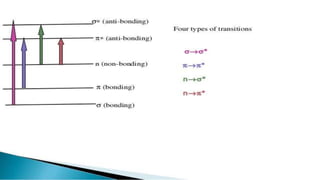
• Depending on absorption electron goes under different
transitions 𝜎 , 𝜋 & n .
• There are four types of electronic transitions occurs :
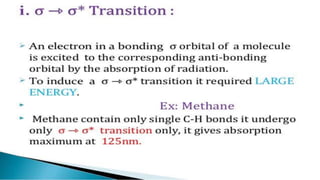
𝜎 → 𝜎 ∗
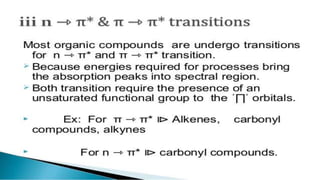
𝜋 → 𝜋 ∗
𝑛 → 𝜋 ∗
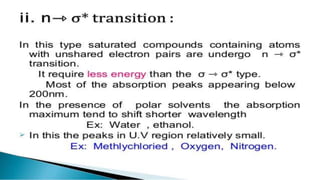
n -> 𝜎 ∗
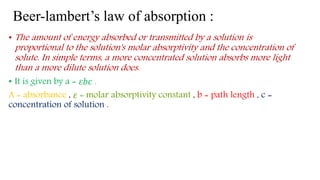
Beer-lambert’s law of absorption :
• The amount of energy absorbed or transmitted by a solution is
proportional to the solution's molar absorptivity and the concentration of
solute. In simple terms, a more concentrated solution absorbs more light
than a more dilute solution does.
• It is given by a = 𝜀𝑏𝑐 .
A = absorbance , 𝜀 = molar absorptivity constant , b = path length , c =
concentration of solution .
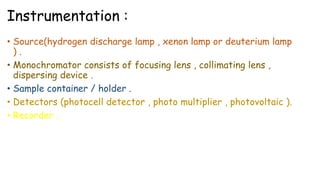
Instrumentation :
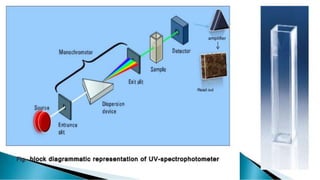
• Source(hydrogen discharge lamp , xenon lamp or deuterium lamp
) .
• Monochromator consists of focusing lens , collimating lens ,
dispersing device .
• Sample container / holder .
• Detectors (photocell detector , photo multiplier , photovoltaic ).
• Recorder .
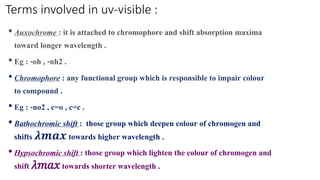
Terms involved in uv-visible :
•Auxochrome : it is attached to chromophore and shift absorption maxima
toward longer wavelength .
•Eg : -oh , -nh2 .
•Chromophore : any functional group which is responsible to impair colour
to compound .
•Eg : -no2 , c=o , c=c .
•Bathochromic shift : those group which deepen colour of chromogen and
shifts 𝝀𝒎𝒂𝒙 towards higher wavelength .
•Hypsochromic shift : those group which lighten the colour of chromogen and
shift 𝜆𝑚𝑎𝑥towards shorter wavelength .
Application :
• Additional impurities :additional peaks can be observed due to
impurities in the sample and it can be compared with that of
standard raw material .
• Structure elucidation : UV spectroscopy is useful in the
structure elucidation of organic molecules, the presence or
absence of unsaturation, the presence of hetero atoms. Whether
the compound is saturated or unsaturated .
• Quantitative analysis : uv absorption spectroscopy can
characterize those types of compounds which absorbs UV
radiation. Identification is done by comparing the absorption
spectrum with the spectra of known compounds. Uv absorption
spectroscopy is generally used for characterizing aromatic
compounds and aromatic olefins.
REFERENCES :
• https://www.pharmatutor.org/pharma-analysis/analytical-
aspects-of-uv-visible-spectroscopy/applications.html
• https://en.wikipedia.org/wiki/Ultraviolet%E2%80%93visible_
spectroscopy
• https://www.slideshare.net/Santachem/uv-visible-
spectroscopy
Uv spectroscopy

Uv spectroscopy

  • 4.
    PRINCIPLE: • Uv absorptionspectra arise from transition occur in a molecules electron from lower energy level to higher energy level . • A molecule absorbs uv radiation of frequency 𝜗 and undergoes transition of different enegy level . • Energy can be calculated by E= h 𝜗 . • It works on a famous law called beer- lambert’s law. • Vibrational energy of molecule is taken inaccount .
  • 5.
    Transitions : • Dependingon absorption electron goes under different transitions 𝜎 , 𝜋 & n . • There are four types of electronic transitions occurs : 𝜎 → 𝜎 ∗ 𝜋 → 𝜋 ∗ 𝑛 → 𝜋 ∗ n -> 𝜎 ∗
  • 10.
    Beer-lambert’s law ofabsorption : • The amount of energy absorbed or transmitted by a solution is proportional to the solution's molar absorptivity and the concentration of solute. In simple terms, a more concentrated solution absorbs more light than a more dilute solution does. • It is given by a = 𝜀𝑏𝑐 . A = absorbance , 𝜀 = molar absorptivity constant , b = path length , c = concentration of solution .
  • 11.
    Instrumentation : • Source(hydrogendischarge lamp , xenon lamp or deuterium lamp ) . • Monochromator consists of focusing lens , collimating lens , dispersing device . • Sample container / holder . • Detectors (photocell detector , photo multiplier , photovoltaic ). • Recorder .
  • 13.
    Terms involved inuv-visible : •Auxochrome : it is attached to chromophore and shift absorption maxima toward longer wavelength . •Eg : -oh , -nh2 . •Chromophore : any functional group which is responsible to impair colour to compound . •Eg : -no2 , c=o , c=c . •Bathochromic shift : those group which deepen colour of chromogen and shifts 𝝀𝒎𝒂𝒙 towards higher wavelength . •Hypsochromic shift : those group which lighten the colour of chromogen and shift 𝜆𝑚𝑎𝑥towards shorter wavelength .
  • 19.
    Application : • Additionalimpurities :additional peaks can be observed due to impurities in the sample and it can be compared with that of standard raw material . • Structure elucidation : UV spectroscopy is useful in the structure elucidation of organic molecules, the presence or absence of unsaturation, the presence of hetero atoms. Whether the compound is saturated or unsaturated . • Quantitative analysis : uv absorption spectroscopy can characterize those types of compounds which absorbs UV radiation. Identification is done by comparing the absorption spectrum with the spectra of known compounds. Uv absorption spectroscopy is generally used for characterizing aromatic compounds and aromatic olefins.
  • 20.
    REFERENCES : • https://www.pharmatutor.org/pharma-analysis/analytical- aspects-of-uv-visible-spectroscopy/applications.html •https://en.wikipedia.org/wiki/Ultraviolet%E2%80%93visible_ spectroscopy • https://www.slideshare.net/Santachem/uv-visible- spectroscopy