
UV- Vis. Spectroscopy 
By- 
Saurav K. Rawat 
(Rawat DA Greatt) 1
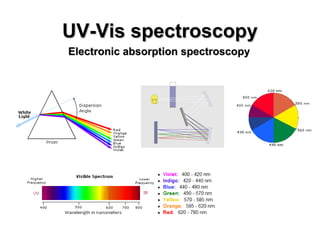
UUVV--VViiss ssppeeccttrroossccooppyy 
EElleeccttrroonniicc aabbssoorrppttiioonn ssppeeccttrroossccooppyy
Absortpion ssppeeccttrroossccooppyy 
• Provide information about presence and absence of 
unsaturated functional groups 
• Useful adjunct to IR 
• Determination of concentration, especially in 
chromatography 
• For structure proof, usually not critical data, but 
essential for further studies 
• NMR, MS not good for purity
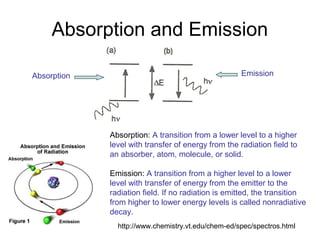
Absorption and Emission 
Emission 
Absorption: A transition from a lower level to a higher 
level with transfer of energy from the radiation field to 
an absorber, atom, molecule, or solid. 
Emission: A transition from a higher level to a lower 
level with transfer of energy from the emitter to the 
radiation field. If no radiation is emitted, the transition 
from higher to lower energy levels is called nonradiative 
decay. 
Absorption 
http://www.chemistry.vt.edu/chem-ed/spec/spectros.html
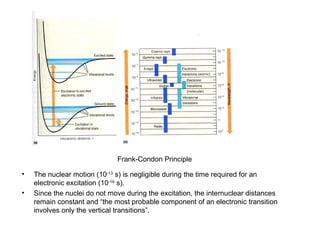
Frank-Condon Principle 
• The nuclear motion (10-13 s) is negligible during the time required for an 
electronic excitation (10-16 s). 
• Since the nuclei do not move during the excitation, the internuclear distances 
remain constant and “the most probable component of an electronic transition 
involves only the vertical transitions”.
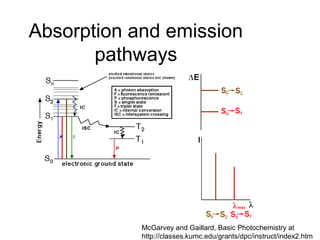
Absorption and emission 
pathways 
McGarvey and Gaillard, Basic Photochemistry at 
http://classes.kumc.edu/grants/dpc/instruct/index2.htm
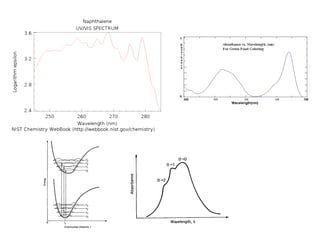
Origin of electronic spectra 
Absorptions of UV-vis photons by molecule results in 
electronic excitation of molecule with chromophore. 
chromophore Any group of atoms that absorbs light whether or not a color is 
thereby produced. 
The electronic transition involves promotion of electron 
from a electronic ground state to higher energy state, 
usually from a molecular orbital called HOMO to LUMO.
Biological chromophores 
1. The peptide bonds and amino acids in proteins 
• The p electrons of the peptide group are delocalized over the 
carbon, nitrogen, and oxygen atoms. The n-p* transition is 
typically observed at 210-220 nm, while the main p-p* transition 
occurs at ~190 nm. 
• Aromatic side chains contribute to absorption at l> 230 nm 
2. Purine and pyrimidine bases in nucleic acids and 
their derivatives 
3. Highly conjugated double bond systems
Selection Rules 
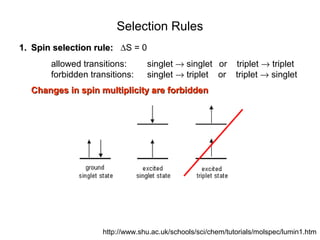
11.. SSppiinn sseelleeccttiioonn rruullee:: DS = 0 
allowed transitions: singlet ® singlet or triplet ® triplet 
forbidden transitions: singlet ® triplet or triplet ® singlet 
CChhaannggeess iinn ssppiinn mmuullttiipplliicciittyy aarree ffoorrbbiiddddeenn 
http://www.shu.ac.uk/schools/sci/chem/tutorials/molspec/lumin1.htm
Selection rules 
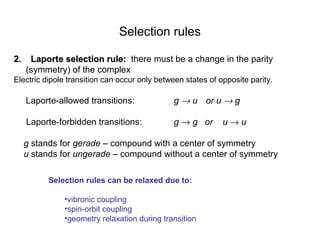
22.. LLaappoorrttee sseelleeccttiioonn rruullee:: there must be a change in the parity 
(symmetry) of the complex 
Electric dipole transition can occur only between states of opposite parity. 
Laporte-allowed transitions: g ® u or u ® g 
Laporte-forbidden transitions: g ® g or u ® u 
g stands for gerade – compound with a center of symmetry 
u stands for ungerade – compound without a center of symmetry 
Selection rules can be relaxed due to: 
•vibronic coupling 
•spin-orbit coupling 
•geometry relaxation during transition
• Spin-forbidden transitions 
– Transitions involving a change in the spin 
state of the molecule are forbidden 
– Strongly obeyed 
– Relaxed by effects that make spin a poor 
quantum number (heavy atoms) 
• Symmetry-forbidden transitions 
– Transitions between states of the same 
parity are forbidden 
– Particularly important for centro-symmetric 
molecules (ethene) 
– Relaxed by coupling of electronic 
transitions to vibrational transitions 
(vibronic coupling)
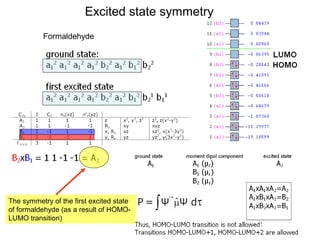
Excited state symmetry 
Formaldehyde 
The symmetry of the first excited state 
of formaldehyde (as a result of HOMO-LUMO 
transition)
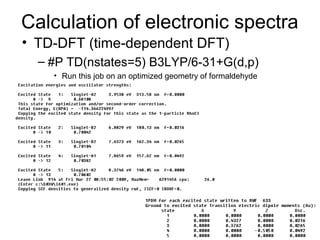
Calculation of electronic spectra 
• TD-DFT (time-dependent DFT) 
– #P TD(nstates=5) B3LYP/6-31+G(d,p) 
• Run this job on an optimized geometry of formaldehyde
Plot the HOMO-2, HOMO-1, HOMO, LUMO, LUMO+1, LUMO+2, 
LUMO+3 orbitals, using the Gaussview program. 
Use a chk file in your Gaussian calculation
Rawat’s Creation-rwtdgreat@ 
gmail.com 
rwtdgreat@yahoo.co.uk 
RawatDAgreatt/LinkedIn 
www.slideshare.net/ 
RawatDAgreatt 
Google+/blogger/Facebook 
/ 
Twitter-@RawatDAgreatt 
+919808050301 
+919958249693

Uv vis

  • 1.
    UV- Vis. Spectroscopy By- Saurav K. Rawat (Rawat DA Greatt) 1
  • 2.
    UUVV--VViiss ssppeeccttrroossccooppyy EElleeccttrroonniiccaabbssoorrppttiioonn ssppeeccttrroossccooppyy
  • 3.
    Absortpion ssppeeccttrroossccooppyy •Provide information about presence and absence of unsaturated functional groups • Useful adjunct to IR • Determination of concentration, especially in chromatography • For structure proof, usually not critical data, but essential for further studies • NMR, MS not good for purity
  • 4.
    Absorption and Emission Emission Absorption: A transition from a lower level to a higher level with transfer of energy from the radiation field to an absorber, atom, molecule, or solid. Emission: A transition from a higher level to a lower level with transfer of energy from the emitter to the radiation field. If no radiation is emitted, the transition from higher to lower energy levels is called nonradiative decay. Absorption http://www.chemistry.vt.edu/chem-ed/spec/spectros.html
  • 5.
    Frank-Condon Principle •The nuclear motion (10-13 s) is negligible during the time required for an electronic excitation (10-16 s). • Since the nuclei do not move during the excitation, the internuclear distances remain constant and “the most probable component of an electronic transition involves only the vertical transitions”.
  • 6.
    Absorption and emission pathways McGarvey and Gaillard, Basic Photochemistry at http://classes.kumc.edu/grants/dpc/instruct/index2.htm
  • 7.
    Origin of electronicspectra Absorptions of UV-vis photons by molecule results in electronic excitation of molecule with chromophore. chromophore Any group of atoms that absorbs light whether or not a color is thereby produced. The electronic transition involves promotion of electron from a electronic ground state to higher energy state, usually from a molecular orbital called HOMO to LUMO.
  • 8.
    Biological chromophores 1.The peptide bonds and amino acids in proteins • The p electrons of the peptide group are delocalized over the carbon, nitrogen, and oxygen atoms. The n-p* transition is typically observed at 210-220 nm, while the main p-p* transition occurs at ~190 nm. • Aromatic side chains contribute to absorption at l> 230 nm 2. Purine and pyrimidine bases in nucleic acids and their derivatives 3. Highly conjugated double bond systems
  • 11.
    Selection Rules 11..SSppiinn sseelleeccttiioonn rruullee:: DS = 0 allowed transitions: singlet ® singlet or triplet ® triplet forbidden transitions: singlet ® triplet or triplet ® singlet CChhaannggeess iinn ssppiinn mmuullttiipplliicciittyy aarree ffoorrbbiiddddeenn http://www.shu.ac.uk/schools/sci/chem/tutorials/molspec/lumin1.htm
  • 12.
    Selection rules 22..LLaappoorrttee sseelleeccttiioonn rruullee:: there must be a change in the parity (symmetry) of the complex Electric dipole transition can occur only between states of opposite parity. Laporte-allowed transitions: g ® u or u ® g Laporte-forbidden transitions: g ® g or u ® u g stands for gerade – compound with a center of symmetry u stands for ungerade – compound without a center of symmetry Selection rules can be relaxed due to: •vibronic coupling •spin-orbit coupling •geometry relaxation during transition
  • 13.
    • Spin-forbidden transitions – Transitions involving a change in the spin state of the molecule are forbidden – Strongly obeyed – Relaxed by effects that make spin a poor quantum number (heavy atoms) • Symmetry-forbidden transitions – Transitions between states of the same parity are forbidden – Particularly important for centro-symmetric molecules (ethene) – Relaxed by coupling of electronic transitions to vibrational transitions (vibronic coupling)
  • 14.
    Excited state symmetry Formaldehyde The symmetry of the first excited state of formaldehyde (as a result of HOMO-LUMO transition)
  • 15.
    Calculation of electronicspectra • TD-DFT (time-dependent DFT) – #P TD(nstates=5) B3LYP/6-31+G(d,p) • Run this job on an optimized geometry of formaldehyde
  • 16.
    Plot the HOMO-2,HOMO-1, HOMO, LUMO, LUMO+1, LUMO+2, LUMO+3 orbitals, using the Gaussview program. Use a chk file in your Gaussian calculation
  • 18.
    Rawat’s Creation-rwtdgreat@ gmail.com rwtdgreat@yahoo.co.uk RawatDAgreatt/LinkedIn www.slideshare.net/ RawatDAgreatt Google+/blogger/Facebook / Twitter-@RawatDAgreatt +919808050301 +919958249693