AttitudesAttitudes
Evaluative statements or judgments concerning objects,
people, or events.
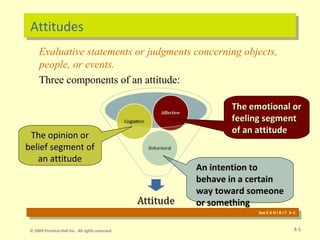
Three components of an attitude:
The emotional orThe emotional or
feeling segmentfeeling segment
of an attitudeof an attitude
The opinion orThe opinion or
belief segment ofbelief segment of
an attitudean attitude
An intention toAn intention to
behave in a certainbehave in a certain
way toward someoneway toward someone
or somethingor something
See E X H I B I T 3–1
3-1© 2009 Prentice-Hall Inc. All rights reserved.
Does Behavior Always Follow from Attitudes?Does Behavior Always Follow from Attitudes?
 Leon Festinger – No, the reverse is sometimes true!
 Cognitive Dissonance: Any incompatibility between two
or more attitudes or between behavior and attitudes
– Individuals seek to reduce this uncomfortable gap, or
dissonance, to reach stability and consistency
– Consistency is achieved by changing the attitudes,
modifying the behaviors, or through rationalization
– Desire to reduce dissonance depends on:
• Importance of elements
• Degree of individual influence
• Rewards involved in dissonance
3-2© 2009 Prentice-Hall Inc. All rights reserved.
Moderating VariablesModerating Variables
 The most powerful moderators of the attitude-
behavior relationship are:
– Importance of the attitude
– Correspondence to behavior
– Accessibility
– Existence of social pressures
– Personal and direct experience of the attitude.
3-3© 2009 Prentice-Hall Inc. All rights reserved.
Predicting Behavior from AttitudesPredicting Behavior from Attitudes
– Important attitudes have a strong relationship to
behavior.
– The closer the match between attitude and
behavior, the stronger the relationship:
• Specific attitudes predict specific behavior
• General attitudes predict general behavior
– The more frequently expressed an attitude, the
better predictor it is.
– High social pressures reduce the relationship and
may cause dissonance.
– Attitudes based on personal experience are
stronger predictors.
3-4© 2009 Prentice-Hall Inc. All rights reserved.
What are the Major Job Attitudes?What are the Major Job Attitudes?
 Job Satisfaction
– A positive feeling about the job
resulting from an evaluation of its
characteristics
 Job Involvement
– Degree of psychological
identification with the job where
perceived performance is important
to self-worth
 Psychological Empowerment
– Belief in the degree of influence
over the job, competence, job
meaningfulness, and autonomy
3-5© 2009 Prentice-Hall Inc. All rights reserved.
Another Major Job AttitudeAnother Major Job Attitude
 Organizational Commitment
– Identifying with a particular organization and its goals, while
wishing to maintain membership in the organization.
– Three dimensions:
• Affective – emotional attachment to organization
• Continuance Commitment – economic value of staying
• Normative - moral or ethical obligations
– Has some relation to performance, especially for new
employees.
– Less important now than in past – now perhaps more of
occupational commitment, loyalty to profession rather than a
given employer.
3-6© 2009 Prentice-Hall Inc. All rights reserved.
And Yet More Major Job Attitudes…And Yet More Major Job Attitudes…
 Perceived Organizational Support (POS)
– Degree to which employees believe the organization values
their contribution and cares about their well-being.
– Higher when rewards are fair, employees are involved in
decision-making, and supervisors are seen as supportive.
– High POS is related to higher OCBs and performance.
 Employee Engagement
– The degree of involvement with, satisfaction with, and
enthusiasm for the job.
– Engaged employees are passionate about their work and
company.
3-7© 2009 Prentice-Hall Inc. All rights reserved.
Outcomes of Job SatisfactionOutcomes of Job Satisfaction
 Job Performance
– Satisfied workers are more productive AND more
productive workers are more satisfied!
– The causality may run both ways.
 Organizational Citizenship Behaviors
– Satisfaction influences OCB through perceptions of
fairness.
 Customer Satisfaction
– Satisfied frontline employees increase customer
satisfaction and loyalty.
 Absenteeism
– Satisfied employees are moderately less likely to miss
work.
3-8© 2009 Prentice-Hall Inc. All rights reserved.
More Outcomes of Job SatisfactionMore Outcomes of Job Satisfaction
 Turnover
– Satisfied employees are less likely to quit.
– Many moderating variables in this relationship.
• Economic environment and tenure
• Organizational actions taken to retain high performers and to
weed out lower performers
 Workplace Deviance
– Dissatisfied workers are more likely to unionize, abuse
substances, steal, be tardy, and withdraw.
Despite the overwhelming evidence of the impact of job
satisfaction on the bottom line, most managers are either
unconcerned about or overestimate worker satisfaction.
3-9© 2009 Prentice-Hall Inc. All rights reserved.
Summary and Managerial ImplicationsSummary and Managerial Implications
 Managers should watch employee attitudes:
– They give warnings of potential problems
– They influence behavior
 Managers should try to increase job satisfaction and
generate positive job attitudes
– Reduces costs by lowering turnover, absenteeism, tardiness,
theft, and increasing OCB
 Focus on the intrinsic parts of the job: make work
challenging and interesting
– Pay is not enough
3-10© 2009 Prentice-Hall Inc. All rights reserved.

Attitudes

  • 1.
    AttitudesAttitudes Evaluative statements orjudgments concerning objects, people, or events. Three components of an attitude: The emotional orThe emotional or feeling segmentfeeling segment of an attitudeof an attitude The opinion orThe opinion or belief segment ofbelief segment of an attitudean attitude An intention toAn intention to behave in a certainbehave in a certain way toward someoneway toward someone or somethingor something See E X H I B I T 3–1 See E X H I B I T 3–1 3-1© 2009 Prentice-Hall Inc. All rights reserved.
  • 2.
    Does Behavior AlwaysFollow from Attitudes?Does Behavior Always Follow from Attitudes?  Leon Festinger – No, the reverse is sometimes true!  Cognitive Dissonance: Any incompatibility between two or more attitudes or between behavior and attitudes – Individuals seek to reduce this uncomfortable gap, or dissonance, to reach stability and consistency – Consistency is achieved by changing the attitudes, modifying the behaviors, or through rationalization – Desire to reduce dissonance depends on: • Importance of elements • Degree of individual influence • Rewards involved in dissonance 3-2© 2009 Prentice-Hall Inc. All rights reserved.
  • 3.
    Moderating VariablesModerating Variables The most powerful moderators of the attitude- behavior relationship are: – Importance of the attitude – Correspondence to behavior – Accessibility – Existence of social pressures – Personal and direct experience of the attitude. 3-3© 2009 Prentice-Hall Inc. All rights reserved.
  • 4.
    Predicting Behavior fromAttitudesPredicting Behavior from Attitudes – Important attitudes have a strong relationship to behavior. – The closer the match between attitude and behavior, the stronger the relationship: • Specific attitudes predict specific behavior • General attitudes predict general behavior – The more frequently expressed an attitude, the better predictor it is. – High social pressures reduce the relationship and may cause dissonance. – Attitudes based on personal experience are stronger predictors. 3-4© 2009 Prentice-Hall Inc. All rights reserved.
  • 5.
    What are theMajor Job Attitudes?What are the Major Job Attitudes?  Job Satisfaction – A positive feeling about the job resulting from an evaluation of its characteristics  Job Involvement – Degree of psychological identification with the job where perceived performance is important to self-worth  Psychological Empowerment – Belief in the degree of influence over the job, competence, job meaningfulness, and autonomy 3-5© 2009 Prentice-Hall Inc. All rights reserved.
  • 6.
    Another Major JobAttitudeAnother Major Job Attitude  Organizational Commitment – Identifying with a particular organization and its goals, while wishing to maintain membership in the organization. – Three dimensions: • Affective – emotional attachment to organization • Continuance Commitment – economic value of staying • Normative - moral or ethical obligations – Has some relation to performance, especially for new employees. – Less important now than in past – now perhaps more of occupational commitment, loyalty to profession rather than a given employer. 3-6© 2009 Prentice-Hall Inc. All rights reserved.
  • 7.
    And Yet MoreMajor Job Attitudes…And Yet More Major Job Attitudes…  Perceived Organizational Support (POS) – Degree to which employees believe the organization values their contribution and cares about their well-being. – Higher when rewards are fair, employees are involved in decision-making, and supervisors are seen as supportive. – High POS is related to higher OCBs and performance.  Employee Engagement – The degree of involvement with, satisfaction with, and enthusiasm for the job. – Engaged employees are passionate about their work and company. 3-7© 2009 Prentice-Hall Inc. All rights reserved.
  • 8.
    Outcomes of JobSatisfactionOutcomes of Job Satisfaction  Job Performance – Satisfied workers are more productive AND more productive workers are more satisfied! – The causality may run both ways.  Organizational Citizenship Behaviors – Satisfaction influences OCB through perceptions of fairness.  Customer Satisfaction – Satisfied frontline employees increase customer satisfaction and loyalty.  Absenteeism – Satisfied employees are moderately less likely to miss work. 3-8© 2009 Prentice-Hall Inc. All rights reserved.
  • 9.
    More Outcomes ofJob SatisfactionMore Outcomes of Job Satisfaction  Turnover – Satisfied employees are less likely to quit. – Many moderating variables in this relationship. • Economic environment and tenure • Organizational actions taken to retain high performers and to weed out lower performers  Workplace Deviance – Dissatisfied workers are more likely to unionize, abuse substances, steal, be tardy, and withdraw. Despite the overwhelming evidence of the impact of job satisfaction on the bottom line, most managers are either unconcerned about or overestimate worker satisfaction. 3-9© 2009 Prentice-Hall Inc. All rights reserved.
  • 10.
    Summary and ManagerialImplicationsSummary and Managerial Implications  Managers should watch employee attitudes: – They give warnings of potential problems – They influence behavior  Managers should try to increase job satisfaction and generate positive job attitudes – Reduces costs by lowering turnover, absenteeism, tardiness, theft, and increasing OCB  Focus on the intrinsic parts of the job: make work challenging and interesting – Pay is not enough 3-10© 2009 Prentice-Hall Inc. All rights reserved.