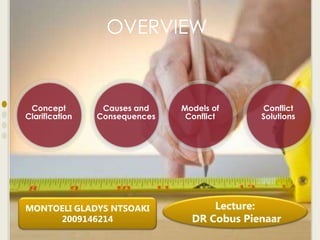

OVERVIEW
Models of
Conflict
Concept
Clarification
Causes and
Consequences
Conflict
Solutions
MONTOELI GLADYS NTSOAKI
2009146214
Lecture:
DR Cobus Pienaar
01Concept
Definition
and
Clarification
01
Definitions
Past and Present Views of Conflict
Levels of Conflict
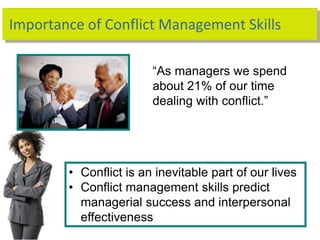
“As managers we spend
about 21% of our time
dealing with conflict.”
• Conflict is an inevitable part of our lives
• Conflict management skills predict
managerial success and interpersonal
effectiveness
Importance of Conflict Management Skills
Conflict Defined
 A process that begins when one party perceives that
another party has negatively affected, or is about to
negatively affect, something that the first party cares
about (Robbins & Judge, 2013)
– That point in an ongoing activity when an interaction
“crosses over” to become an interparty conflict
 Encompasses a wide range of conflicts that people
experience in organizations
– Incompatibility of goals
– Differences over interpretations of facts
– Disagreements based on behavioral expectations
3
Conflict Defined
 Organizational Conflict
• The discord that arises when goals, interests or values of
different individuals or groups are incompatible and those
people block or thwart each other’s efforts to achieve their
objectives. Jones and George (2013)
 Four Critical Elements
• “Conflict is a felt struggle between two or more
interdependent individuals over perceived incompatible
differences in beliefs, values, and goals, or over differences in
desires for esteem, control, and connectedness” Wilmot and Hocker
(201)
4
Conflict Defined
 All definitions agree that conflict needs to be recognised
by at least two parties before it exists.
 Common to most definitions is the idea that conflict is a
perception and key ingredients for the conflict process
are opposition or incompatibility or differences and
some form of interaction.
 However, differences alone do not create conflict. It is
the expression of those differences in the way people
behave with each other that results in conflict. Thus,
another core aspect of conflict is the concept of
interdependence.
5
Views of Conflict
6
Past and Present Perspectives of Conflict
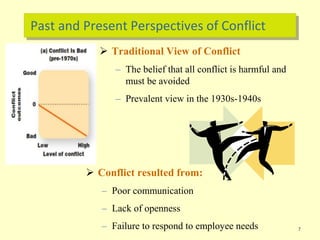
 Traditional View of Conflict
– The belief that all conflict is harmful and
must be avoided
– Prevalent view in the 1930s-1940s
7
 Conflict resulted from:
– Poor communication
– Lack of openness
– Failure to respond to employee needs
Past and Present Perspectives of Conflict
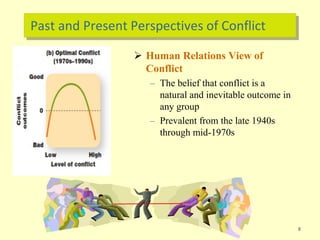
 Human Relations View of
Conflict
– The belief that conflict is a
natural and inevitable outcome in
any group
– Prevalent from the late 1940s
through mid-1970s
8
Past and Present Perspectives of Conflict
9
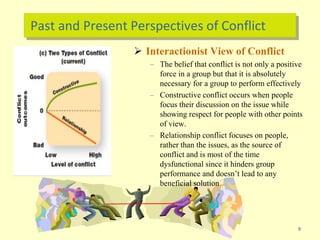
 Interactionist View of Conflict
– The belief that conflict is not only a positive
force in a group but that it is absolutely
necessary for a group to perform effectively
– Constructive conflict occurs when people
focus their discussion on the issue while
showing respect for people with other points
of view.
– Relationship conflict focuses on people,
rather than the issues, as the source of
conflict and is most of the time
dysfunctional since it hinders group
performance and doesn’t lead to any
beneficial solution
Forms of Interactionist Conflict
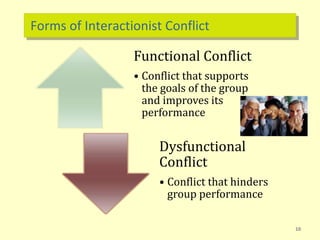
Functional Conflict
• Conflict that supports
the goals of the group
and improves its
performance
Dysfunctional
Conflict
• Conflict that hinders
group performance
10
Types of Interactionist Conflict
 Task Conflict
– Conflicts over content and goals of the work
– Low-to-moderate levels of this type are
FUNCTIONAL
 Relationship Conflict
– Conflict based on interpersonal relationships
– Almost always DYSFUNCTIONAL
 Process Conflict
– Conflict over how work gets done
– Low levels of this type are FUNCTIONAL
11
Levels of Conflict
12
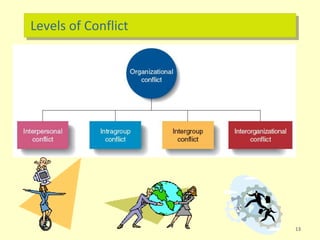
Levels of Conflict
13
Summary – Definitions and Clarification
 Conflict arises when individuals are not able to choose among the available
alternative courses of action.
 Conflict between two individuals implies that they have conflicting perceptions,
values, attitudes and goals.
 Conflict is a dynamic process as it indicates a series of events. Each conflict is made
of a series of interlocking conflict episodes.
 Conflict must be perceived by the parties. If no one is aware of the conflict, then it
is generally agreed that no conflict exists.
 Conflict is a natural and inevitable outcome in any group and that need not to be
an evil, but rather, with the potential to be a positive force in determining group
performance.
 Conflict can be a positive force in a group and that is also absolutely necessary for
a group to perform effectively.
 Optimal organisational performance requires a moderate level of conflict.
 The task of management is to manage the level of conflict and its resolution for
optimal organisational performance.
 Conflict between groups is inevitable in the workplace. This conflict may be
positive or negative, depending on its impact on the organisation’s goal
achievement.
14
01Causes and
Consequences02
Sources of Conflict
Consequences of Conflict
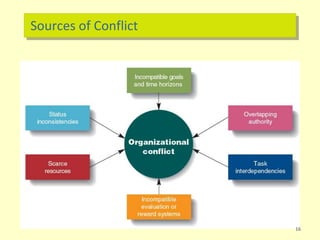
Sources of Conflict
16
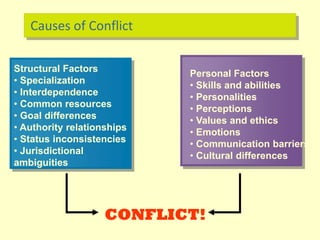
Personal Factors
• Skills and abilities
• Personalities
• Perceptions
• Values and ethics
• Emotions
• Communication barriers
• Cultural differences
Structural Factors
• Specialization
• Interdependence
• Common resources
• Goal differences
• Authority relationships
• Status inconsistencies
• Jurisdictional
ambiguities
CONFLICT!
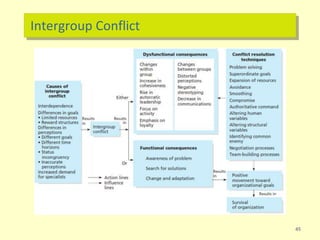
Causes of Conflict
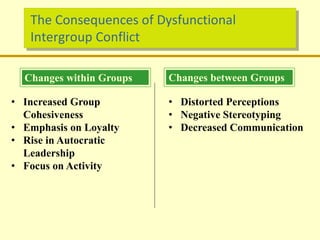
The Consequences of Dysfunctional
Intergroup Conflict
Changes within Groups
• Increased Group
Cohesiveness
• Emphasis on Loyalty
• Rise in Autocratic
Leadership
• Focus on Activity
• Distorted Perceptions
• Negative Stereotyping
• Decreased Communication
Changes between Groups
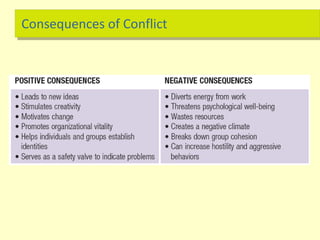
Consequences of Conflict
01Models of
Conflict03
Conflict Process
Pondy’s Stages of Conflict
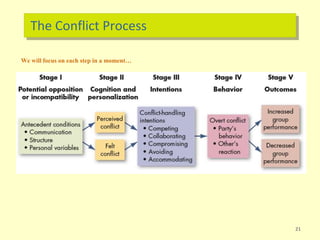
The Conflict Process
21
We will focus on each step in a moment…
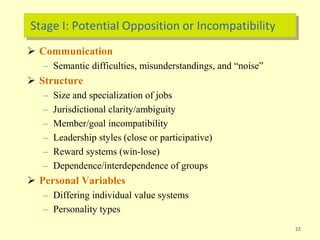
Stage I: Potential Opposition or Incompatibility
 Communication
– Semantic difficulties, misunderstandings, and “noise”
 Structure
– Size and specialization of jobs
– Jurisdictional clarity/ambiguity
– Member/goal incompatibility
– Leadership styles (close or participative)
– Reward systems (win-lose)
– Dependence/interdependence of groups
 Personal Variables
– Differing individual value systems
– Personality types
22
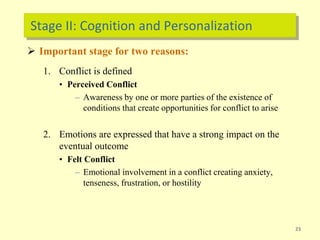
Stage II: Cognition and Personalization
 Important stage for two reasons:
1. Conflict is defined
• Perceived Conflict
– Awareness by one or more parties of the existence of
conditions that create opportunities for conflict to arise
2. Emotions are expressed that have a strong impact on the
eventual outcome
• Felt Conflict
– Emotional involvement in a conflict creating anxiety,
tenseness, frustration, or hostility
23
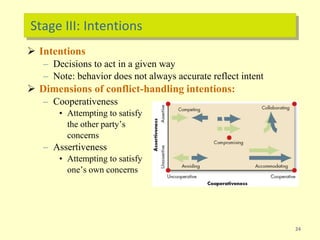
Stage III: Intentions
 Intentions
– Decisions to act in a given way
– Note: behavior does not always accurate reflect intent
 Dimensions of conflict-handling intentions:
– Cooperativeness
• Attempting to satisfy
the other party’s
concerns
– Assertiveness
• Attempting to satisfy
one’s own concerns
24
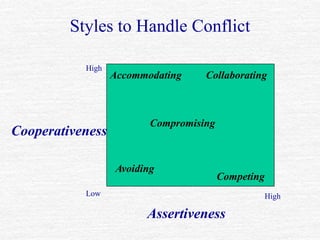
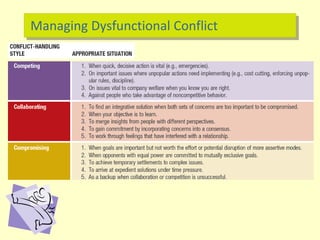
Styles to Handle Conflict
Cooperativeness
Assertiveness
Low High
High
Competing
Avoiding
Compromising
Accommodating Collaborating
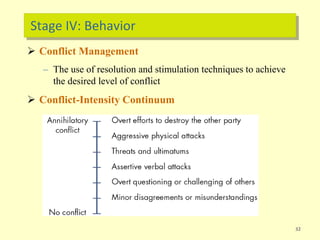
Stage IV: Behavior
 Conflict Management
– The use of resolution and stimulation techniques to achieve
the desired level of conflict
 Conflict-Intensity Continuum
32
Stage V: Outcomes
 Functional
– Increased group performance
– Improved quality of decisions
– Stimulation of creativity and
innovation
– Encouragement of interest and
curiosity
– Provision of a medium for
problem-solving
– Creation of an environment for
self-evaluation and change
33
 Dysfunctional
– Development of discontent
– Reduced group
effectiveness
– Retarded communication
– Reduced group
cohesiveness
– Infighting among group
members overcomes group
goals
 Creating Functional
Conflict
– Reward dissent and punish
conflict avoiders
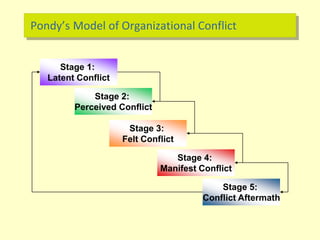
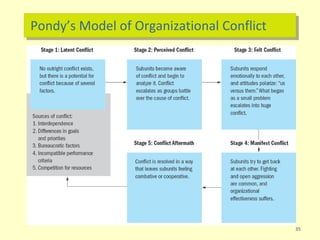
Pondy’s Model of Organizational Conflict
Stage 1:
Latent Conflict
Stage 2:
Perceived Conflict
Stage 3:
Felt Conflict
Stage 4:
Manifest Conflict
Stage 5:
Conflict Aftermath
Pondy’s Model of Organizational Conflict
35
01Conflict
Solutions04
Conflict Management
Conflict Resolution
Conflict Solutions
 Conflict management involves designing effective strategies to
minimise the dysfunctions of conflict and enhancing the
constructive functions of conflict.
37
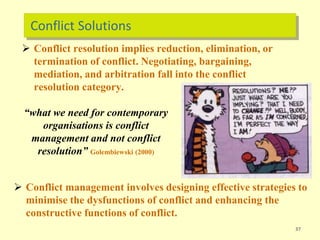
 Conflict resolution implies reduction, elimination, or
termination of conflict. Negotiating, bargaining,
mediation, and arbitration fall into the conflict
resolution category.
“what we need for contemporary
organisations is conflict
management and not conflict
resolution” Golembiewski (2000)
Managing Conflict
 Organizational conflict can escalate rapidly and sour
an organization’s culture
– Managing conflict is an important priority
 Organizations must balance the need to have some
“good” conflict without letting it escalate into “bad”
conflict
 Choice of conflict resolution method depends on the
source of the problem
38
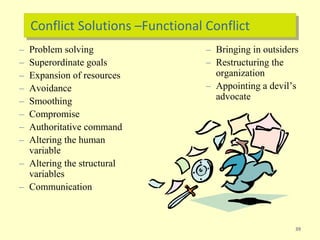
Conflict Solutions –Functional Conflict
39
– Problem solving
– Superordinate goals
– Expansion of resources
– Avoidance
– Smoothing
– Compromise
– Authoritative command
– Altering the human
variable
– Altering the structural
variables
– Communication
– Bringing in outsiders
– Restructuring the
organization
– Appointing a devil’s
advocate
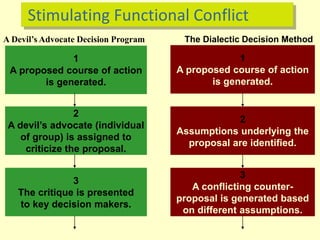
Stimulating Functional Conflict
A Devil’s Advocate Decision Program The Dialectic Decision Method
1
A proposed course of action
is generated.
1
A proposed course of action
is generated.
2
A devil’s advocate (individual
of group) is assigned to
criticize the proposal.
2
Assumptions underlying the
proposal are identified.
3
The critique is presented
to key decision makers.
3
A conflicting counter-
proposal is generated based
on different assumptions.
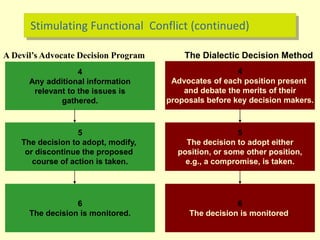
Stimulating Functional Conflict (continued)
A Devil’s Advocate Decision Program The Dialectic Decision Method
6
The decision is monitored.
6
The decision is monitored.
4
Any additional information
relevant to the issues is
gathered.
4
Advocates of each position present
and debate the merits of their
proposals before key decision makers.
5
The decision to adopt, modify,
or discontinue the proposed
course of action is taken.
5
The decision to adopt either
position, or some other position,
e.g., a compromise, is taken.
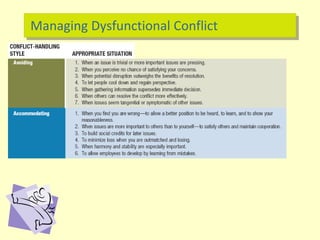
Managing Dysfunctional Conflict
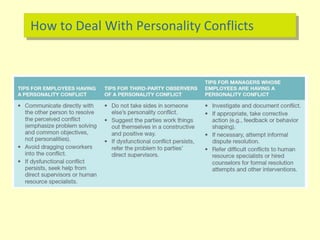
How to Deal With Personality Conflicts
Intergroup Conflict
45
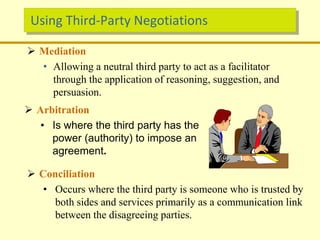
Using Third-Party Negotiations
 Mediation
• Allowing a neutral third party to act as a facilitator
through the application of reasoning, suggestion, and
persuasion.
 Arbitration
• Is where the third party has the
power (authority) to impose an
agreement.
 Conciliation
• Occurs where the third party is someone who is trusted by
both sides and services primarily as a communication link
between the disagreeing parties.
Negotiation
Negotiations may be viewed as a
process in which two or more parties
attempt to reach acceptable
agreement in a situation characterized
by some level of disagreement.
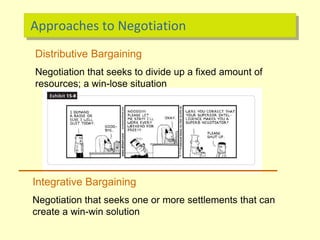
Approaches to Negotiation
Integrative Bargaining
Negotiation that seeks one or more settlements that can
create a win-win solution
Distributive Bargaining
Negotiation that seeks to divide up a fixed amount of
resources; a win-lose situation
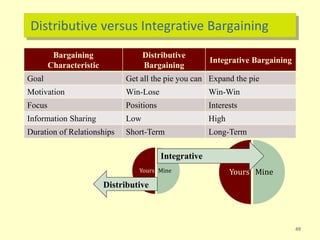
Distributive versus Integrative Bargaining
Bargaining
Characteristic
Distributive
Bargaining
Integrative Bargaining
Goal Get all the pie you can Expand the pie
Motivation Win-Lose Win-Win
Focus Positions Interests
Information Sharing Low High
Duration of Relationships Short-Term Long-Term
49
MineYours MineYours
Distributive
Integrative
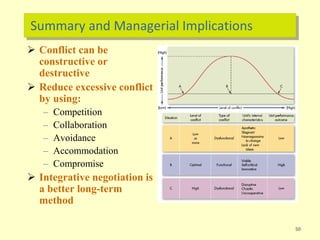
Summary and Managerial Implications
 Conflict can be
constructive or
destructive
 Reduce excessive conflict
by using:
– Competition
– Collaboration
– Avoidance
– Accommodation
– Compromise
 Integrative negotiation is
a better long-term
method
50
51

Conflict Management ELAB6814

  • 1.
  • 2.
  • 3.
    “As managers wespend about 21% of our time dealing with conflict.” • Conflict is an inevitable part of our lives • Conflict management skills predict managerial success and interpersonal effectiveness Importance of Conflict Management Skills
  • 4.
    Conflict Defined  Aprocess that begins when one party perceives that another party has negatively affected, or is about to negatively affect, something that the first party cares about (Robbins & Judge, 2013) – That point in an ongoing activity when an interaction “crosses over” to become an interparty conflict  Encompasses a wide range of conflicts that people experience in organizations – Incompatibility of goals – Differences over interpretations of facts – Disagreements based on behavioral expectations 3
  • 5.
    Conflict Defined  OrganizationalConflict • The discord that arises when goals, interests or values of different individuals or groups are incompatible and those people block or thwart each other’s efforts to achieve their objectives. Jones and George (2013)  Four Critical Elements • “Conflict is a felt struggle between two or more interdependent individuals over perceived incompatible differences in beliefs, values, and goals, or over differences in desires for esteem, control, and connectedness” Wilmot and Hocker (201) 4
  • 6.
    Conflict Defined  Alldefinitions agree that conflict needs to be recognised by at least two parties before it exists.  Common to most definitions is the idea that conflict is a perception and key ingredients for the conflict process are opposition or incompatibility or differences and some form of interaction.  However, differences alone do not create conflict. It is the expression of those differences in the way people behave with each other that results in conflict. Thus, another core aspect of conflict is the concept of interdependence. 5
  • 7.
  • 8.
    Past and PresentPerspectives of Conflict  Traditional View of Conflict – The belief that all conflict is harmful and must be avoided – Prevalent view in the 1930s-1940s 7  Conflict resulted from: – Poor communication – Lack of openness – Failure to respond to employee needs
  • 9.
    Past and PresentPerspectives of Conflict  Human Relations View of Conflict – The belief that conflict is a natural and inevitable outcome in any group – Prevalent from the late 1940s through mid-1970s 8
  • 10.
    Past and PresentPerspectives of Conflict 9  Interactionist View of Conflict – The belief that conflict is not only a positive force in a group but that it is absolutely necessary for a group to perform effectively – Constructive conflict occurs when people focus their discussion on the issue while showing respect for people with other points of view. – Relationship conflict focuses on people, rather than the issues, as the source of conflict and is most of the time dysfunctional since it hinders group performance and doesn’t lead to any beneficial solution
  • 11.
    Forms of InteractionistConflict Functional Conflict • Conflict that supports the goals of the group and improves its performance Dysfunctional Conflict • Conflict that hinders group performance 10
  • 12.
    Types of InteractionistConflict  Task Conflict – Conflicts over content and goals of the work – Low-to-moderate levels of this type are FUNCTIONAL  Relationship Conflict – Conflict based on interpersonal relationships – Almost always DYSFUNCTIONAL  Process Conflict – Conflict over how work gets done – Low levels of this type are FUNCTIONAL 11
  • 13.
  • 14.
  • 15.
    Summary – Definitionsand Clarification  Conflict arises when individuals are not able to choose among the available alternative courses of action.  Conflict between two individuals implies that they have conflicting perceptions, values, attitudes and goals.  Conflict is a dynamic process as it indicates a series of events. Each conflict is made of a series of interlocking conflict episodes.  Conflict must be perceived by the parties. If no one is aware of the conflict, then it is generally agreed that no conflict exists.  Conflict is a natural and inevitable outcome in any group and that need not to be an evil, but rather, with the potential to be a positive force in determining group performance.  Conflict can be a positive force in a group and that is also absolutely necessary for a group to perform effectively.  Optimal organisational performance requires a moderate level of conflict.  The task of management is to manage the level of conflict and its resolution for optimal organisational performance.  Conflict between groups is inevitable in the workplace. This conflict may be positive or negative, depending on its impact on the organisation’s goal achievement. 14
  • 16.
    01Causes and Consequences02 Sources ofConflict Consequences of Conflict
  • 17.
  • 18.
    Personal Factors • Skillsand abilities • Personalities • Perceptions • Values and ethics • Emotions • Communication barriers • Cultural differences Structural Factors • Specialization • Interdependence • Common resources • Goal differences • Authority relationships • Status inconsistencies • Jurisdictional ambiguities CONFLICT! Causes of Conflict
  • 19.
    The Consequences ofDysfunctional Intergroup Conflict Changes within Groups • Increased Group Cohesiveness • Emphasis on Loyalty • Rise in Autocratic Leadership • Focus on Activity • Distorted Perceptions • Negative Stereotyping • Decreased Communication Changes between Groups
  • 20.
  • 21.
  • 22.
    The Conflict Process 21 Wewill focus on each step in a moment…
  • 23.
    Stage I: PotentialOpposition or Incompatibility  Communication – Semantic difficulties, misunderstandings, and “noise”  Structure – Size and specialization of jobs – Jurisdictional clarity/ambiguity – Member/goal incompatibility – Leadership styles (close or participative) – Reward systems (win-lose) – Dependence/interdependence of groups  Personal Variables – Differing individual value systems – Personality types 22
  • 24.
    Stage II: Cognitionand Personalization  Important stage for two reasons: 1. Conflict is defined • Perceived Conflict – Awareness by one or more parties of the existence of conditions that create opportunities for conflict to arise 2. Emotions are expressed that have a strong impact on the eventual outcome • Felt Conflict – Emotional involvement in a conflict creating anxiety, tenseness, frustration, or hostility 23
  • 25.
    Stage III: Intentions Intentions – Decisions to act in a given way – Note: behavior does not always accurate reflect intent  Dimensions of conflict-handling intentions: – Cooperativeness • Attempting to satisfy the other party’s concerns – Assertiveness • Attempting to satisfy one’s own concerns 24
  • 26.
    Styles to HandleConflict Cooperativeness Assertiveness Low High High Competing Avoiding Compromising Accommodating Collaborating
  • 27.
    Stage IV: Behavior Conflict Management – The use of resolution and stimulation techniques to achieve the desired level of conflict  Conflict-Intensity Continuum 32
  • 28.
    Stage V: Outcomes Functional – Increased group performance – Improved quality of decisions – Stimulation of creativity and innovation – Encouragement of interest and curiosity – Provision of a medium for problem-solving – Creation of an environment for self-evaluation and change 33  Dysfunctional – Development of discontent – Reduced group effectiveness – Retarded communication – Reduced group cohesiveness – Infighting among group members overcomes group goals  Creating Functional Conflict – Reward dissent and punish conflict avoiders
  • 29.
    Pondy’s Model ofOrganizational Conflict Stage 1: Latent Conflict Stage 2: Perceived Conflict Stage 3: Felt Conflict Stage 4: Manifest Conflict Stage 5: Conflict Aftermath
  • 30.
    Pondy’s Model ofOrganizational Conflict 35
  • 31.
  • 32.
    Conflict Solutions  Conflictmanagement involves designing effective strategies to minimise the dysfunctions of conflict and enhancing the constructive functions of conflict. 37  Conflict resolution implies reduction, elimination, or termination of conflict. Negotiating, bargaining, mediation, and arbitration fall into the conflict resolution category. “what we need for contemporary organisations is conflict management and not conflict resolution” Golembiewski (2000)
  • 33.
    Managing Conflict  Organizationalconflict can escalate rapidly and sour an organization’s culture – Managing conflict is an important priority  Organizations must balance the need to have some “good” conflict without letting it escalate into “bad” conflict  Choice of conflict resolution method depends on the source of the problem 38
  • 34.
    Conflict Solutions –FunctionalConflict 39 – Problem solving – Superordinate goals – Expansion of resources – Avoidance – Smoothing – Compromise – Authoritative command – Altering the human variable – Altering the structural variables – Communication – Bringing in outsiders – Restructuring the organization – Appointing a devil’s advocate
  • 35.
    Stimulating Functional Conflict ADevil’s Advocate Decision Program The Dialectic Decision Method 1 A proposed course of action is generated. 1 A proposed course of action is generated. 2 A devil’s advocate (individual of group) is assigned to criticize the proposal. 2 Assumptions underlying the proposal are identified. 3 The critique is presented to key decision makers. 3 A conflicting counter- proposal is generated based on different assumptions.
  • 36.
    Stimulating Functional Conflict(continued) A Devil’s Advocate Decision Program The Dialectic Decision Method 6 The decision is monitored. 6 The decision is monitored. 4 Any additional information relevant to the issues is gathered. 4 Advocates of each position present and debate the merits of their proposals before key decision makers. 5 The decision to adopt, modify, or discontinue the proposed course of action is taken. 5 The decision to adopt either position, or some other position, e.g., a compromise, is taken.
  • 37.
  • 38.
  • 39.
    How to DealWith Personality Conflicts
  • 40.
  • 41.
    Using Third-Party Negotiations Mediation • Allowing a neutral third party to act as a facilitator through the application of reasoning, suggestion, and persuasion.  Arbitration • Is where the third party has the power (authority) to impose an agreement.  Conciliation • Occurs where the third party is someone who is trusted by both sides and services primarily as a communication link between the disagreeing parties.
  • 42.
    Negotiation Negotiations may beviewed as a process in which two or more parties attempt to reach acceptable agreement in a situation characterized by some level of disagreement.
  • 43.
    Approaches to Negotiation IntegrativeBargaining Negotiation that seeks one or more settlements that can create a win-win solution Distributive Bargaining Negotiation that seeks to divide up a fixed amount of resources; a win-lose situation
  • 44.
    Distributive versus IntegrativeBargaining Bargaining Characteristic Distributive Bargaining Integrative Bargaining Goal Get all the pie you can Expand the pie Motivation Win-Lose Win-Win Focus Positions Interests Information Sharing Low High Duration of Relationships Short-Term Long-Term 49 MineYours MineYours Distributive Integrative
  • 45.
    Summary and ManagerialImplications  Conflict can be constructive or destructive  Reduce excessive conflict by using: – Competition – Collaboration – Avoidance – Accommodation – Compromise  Integrative negotiation is a better long-term method 50
  • 46.