Organizational Conflict, Negotiation, Politics, and Change PowerPoint Presentation by Rogelio R. Corpuz M.M.E © Copyright The McGraw-Hill Companies, Inc., 2003. All rights reserved. 16 Chapter
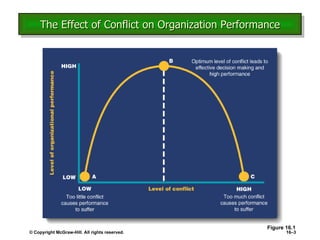
Organizational Conflict Organizational Conflict The discord that arises when goals, interests or values of different individuals or groups are incompatible and those people block or thwart each other’s efforts to achieve their objectives. Conflict is inevitable given the wide range of goals for the different stakeholder in the organization. Lack of conflict signals that management emphasizes conformity and stifles innovation. Conflict is good for organizational performance although excessive conflict causes managers to spend too much time achieving their own ends. © Copyright McGraw-Hill. All rights reserved. 16 –
The Effect of Conflict on Organization Performance © Copyright McGraw-Hill. All rights reserved. 16 – Figure 16.1
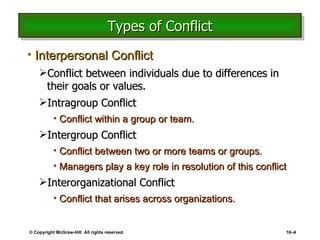
Types of Conflict Interpersonal Conflict Conflict between individuals due to differences in their goals or values. Intragroup Conflict Conflict within a group or team. Intergroup Conflict Conflict between two or more teams or groups. Managers play a key role in resolution of this conflict Interorganizational Conflict Conflict that arises across organizations. © Copyright McGraw-Hill. All rights reserved. 16 –
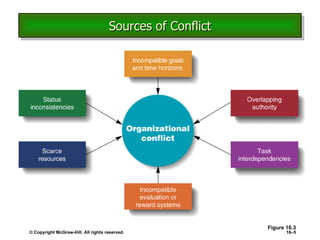
Sources of Conflict © Copyright McGraw-Hill. All rights reserved. 16 – Figure 16.3
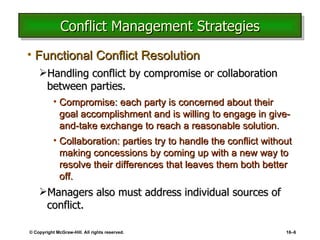
Conflict Management Strategies Functional Conflict Resolution Handling conflict by compromise or collaboration between parties. Compromise: each party is concerned about their goal accomplishment and is willing to engage in give-and-take exchange to reach a reasonable solution. Collaboration: parties try to handle the conflict without making concessions by coming up with a new way to resolve their differences that leaves them both better off. Managers also must address individual sources of conflict. © Copyright McGraw-Hill. All rights reserved. 16 –
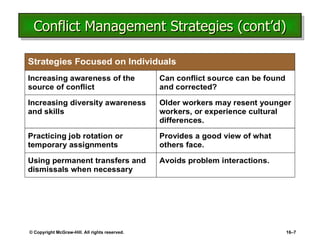
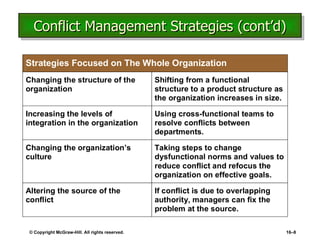
Conflict Management Strategies (cont’d) © Copyright McGraw-Hill. All rights reserved. 16 –
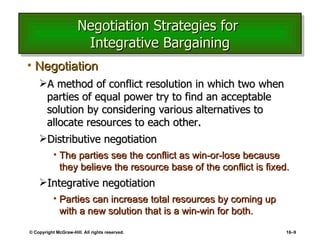
Negotiation Strategies for  Integrative Bargaining Negotiation A method of conflict resolution in which two when parties of equal power try to find an acceptable solution by considering various alternatives to allocate resources to each other. Distributive negotiation The parties see the conflict as win-or-lose because they believe the resource base of the conflict is fixed. Integrative negotiation Parties can increase total resources by coming up with a new solution that is a win-win for both. © Copyright McGraw-Hill. All rights reserved. 16 –
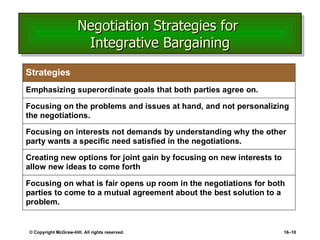
Negotiation Strategies for  Integrative Bargaining © Copyright McGraw-Hill. All rights reserved. 16 –
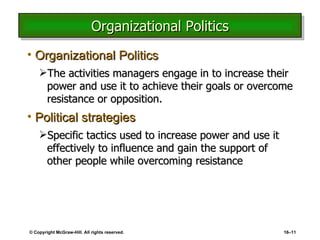
Organizational Politics Organizational Politics The activities managers engage in to increase their power and use it to achieve their goals or overcome resistance or opposition. Political strategies Specific tactics used to increase power and use it effectively to influence and gain the support of other people while overcoming resistance © Copyright McGraw-Hill. All rights reserved. 16 –
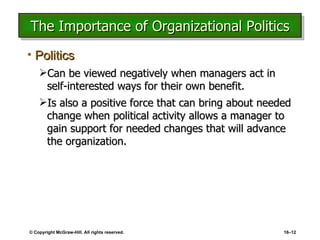
The Importance of Organizational Politics Politics Can be viewed negatively when managers act in self-interested ways for their own benefit. Is also a positive force that can bring about needed change when political activity allows a manager to gain support for needed changes that will advance the organization. © Copyright McGraw-Hill. All rights reserved. 16 –
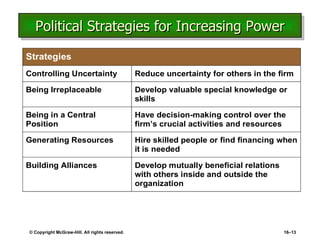
Political Strategies for Increasing Power © Copyright McGraw-Hill. All rights reserved. 16 –
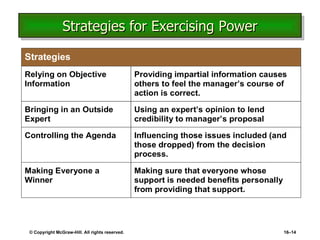
Strategies for Exercising Power © Copyright McGraw-Hill. All rights reserved. 16 –
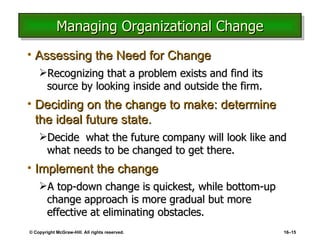
Managing Organizational Change Assessing the Need for Change Recognizing that a problem exists and find its source by looking inside and outside the firm. Deciding on the change to make: determine the ideal future state. Decide  what the future company will look like and what needs to be changed to get there. Implement the change A top-down change is quickest, while bottom-up change approach is more gradual but more effective at eliminating obstacles. © Copyright McGraw-Hill. All rights reserved. 16 –
Managing Organizational Change Evaluate the Change Compare pre-change performance with post-change performance Benchmark your change to other firms in similar situations. © Copyright McGraw-Hill. All rights reserved. 16 –

Organizational Conflict

  • 1.
    Organizational Conflict, Negotiation,Politics, and Change PowerPoint Presentation by Rogelio R. Corpuz M.M.E © Copyright The McGraw-Hill Companies, Inc., 2003. All rights reserved. 16 Chapter
  • 2.
    Organizational Conflict OrganizationalConflict The discord that arises when goals, interests or values of different individuals or groups are incompatible and those people block or thwart each other’s efforts to achieve their objectives. Conflict is inevitable given the wide range of goals for the different stakeholder in the organization. Lack of conflict signals that management emphasizes conformity and stifles innovation. Conflict is good for organizational performance although excessive conflict causes managers to spend too much time achieving their own ends. © Copyright McGraw-Hill. All rights reserved. 16 –
  • 3.
    The Effect ofConflict on Organization Performance © Copyright McGraw-Hill. All rights reserved. 16 – Figure 16.1
  • 4.
    Types of ConflictInterpersonal Conflict Conflict between individuals due to differences in their goals or values. Intragroup Conflict Conflict within a group or team. Intergroup Conflict Conflict between two or more teams or groups. Managers play a key role in resolution of this conflict Interorganizational Conflict Conflict that arises across organizations. © Copyright McGraw-Hill. All rights reserved. 16 –
  • 5.
    Sources of Conflict© Copyright McGraw-Hill. All rights reserved. 16 – Figure 16.3
  • 6.
    Conflict Management StrategiesFunctional Conflict Resolution Handling conflict by compromise or collaboration between parties. Compromise: each party is concerned about their goal accomplishment and is willing to engage in give-and-take exchange to reach a reasonable solution. Collaboration: parties try to handle the conflict without making concessions by coming up with a new way to resolve their differences that leaves them both better off. Managers also must address individual sources of conflict. © Copyright McGraw-Hill. All rights reserved. 16 –
  • 7.
    Conflict Management Strategies(cont’d) © Copyright McGraw-Hill. All rights reserved. 16 –
  • 8.
    Conflict Management Strategies(cont’d) © Copyright McGraw-Hill. All rights reserved. 16 –
  • 9.
    Negotiation Strategies for Integrative Bargaining Negotiation A method of conflict resolution in which two when parties of equal power try to find an acceptable solution by considering various alternatives to allocate resources to each other. Distributive negotiation The parties see the conflict as win-or-lose because they believe the resource base of the conflict is fixed. Integrative negotiation Parties can increase total resources by coming up with a new solution that is a win-win for both. © Copyright McGraw-Hill. All rights reserved. 16 –
  • 10.
    Negotiation Strategies for Integrative Bargaining © Copyright McGraw-Hill. All rights reserved. 16 –
  • 11.
    Organizational Politics OrganizationalPolitics The activities managers engage in to increase their power and use it to achieve their goals or overcome resistance or opposition. Political strategies Specific tactics used to increase power and use it effectively to influence and gain the support of other people while overcoming resistance © Copyright McGraw-Hill. All rights reserved. 16 –
  • 12.
    The Importance ofOrganizational Politics Politics Can be viewed negatively when managers act in self-interested ways for their own benefit. Is also a positive force that can bring about needed change when political activity allows a manager to gain support for needed changes that will advance the organization. © Copyright McGraw-Hill. All rights reserved. 16 –
  • 13.
    Political Strategies forIncreasing Power © Copyright McGraw-Hill. All rights reserved. 16 –
  • 14.
    Strategies for ExercisingPower © Copyright McGraw-Hill. All rights reserved. 16 –
  • 15.
    Managing Organizational ChangeAssessing the Need for Change Recognizing that a problem exists and find its source by looking inside and outside the firm. Deciding on the change to make: determine the ideal future state. Decide what the future company will look like and what needs to be changed to get there. Implement the change A top-down change is quickest, while bottom-up change approach is more gradual but more effective at eliminating obstacles. © Copyright McGraw-Hill. All rights reserved. 16 –
  • 16.
    Managing Organizational ChangeEvaluate the Change Compare pre-change performance with post-change performance Benchmark your change to other firms in similar situations. © Copyright McGraw-Hill. All rights reserved. 16 –