Organizational Conflict 
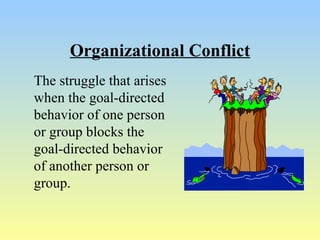
The struggle that arises 
when the goal-directed 
behavior of one person 
or group blocks the 
goal-directed behavior 
of another person or 
group.
Transitions in Conflict Thought 
Causes: 
• Poor communication 
• Lack of openness 
• Failure to respond to 
employee needs 
Causes: 
• Poor communication 
• Lack of openness 
• Failure to respond to 
employee needs
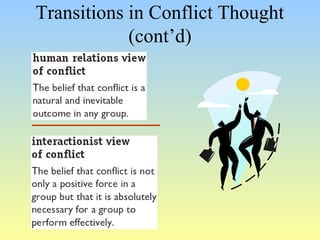
Transitions in Conflict Thought 
(cont’d)
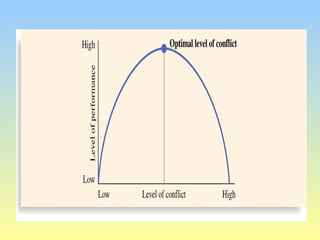
Insert Figure 18.4 here
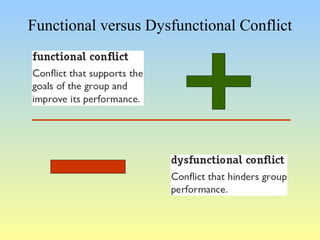
Functional versus Dysfunctional Conflict
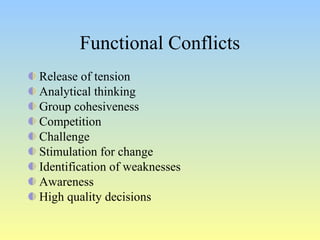
Functional Conflicts 
Release of tension 
Analytical thinking 
Group cohesiveness 
Competition 
Challenge 
Stimulation for change 
Identification of weaknesses 
Awareness 
High quality decisions
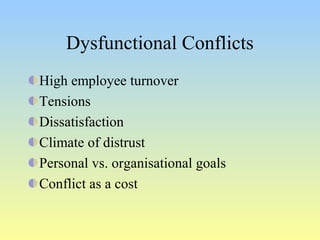
Dysfunctional Conflicts 
High employee turnover 
Tensions 
Dissatisfaction 
Climate of distrust 
Personal vs. organisational goals 
Conflict as a cost
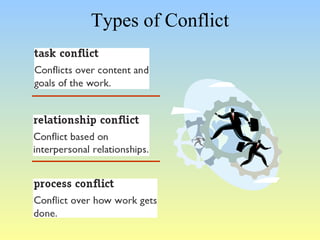
Types of Conflict
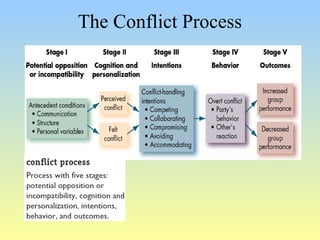
The Conflict Process
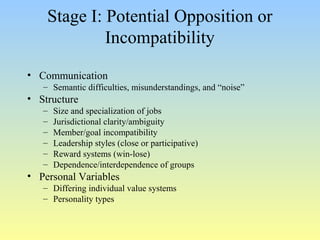
Stage I: Potential Opposition or 
Incompatibility 
• Communication 
– Semantic difficulties, misunderstandings, and “noise” 
• Structure 
– Size and specialization of jobs 
– Jurisdictional clarity/ambiguity 
– Member/goal incompatibility 
– Leadership styles (close or participative) 
– Reward systems (win-lose) 
– Dependence/interdependence of groups 
• Personal Variables 
– Differing individual value systems 
– Personality types
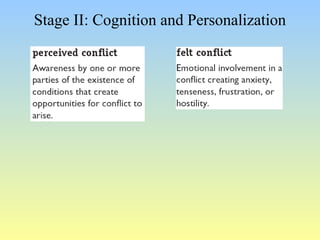
Stage II: Cognition and Personalization
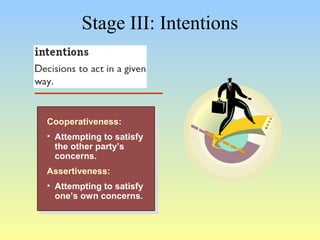
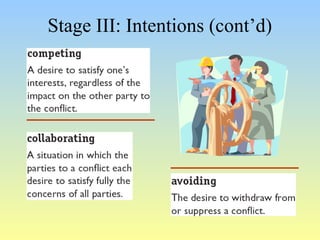
Stage III: Intentions 
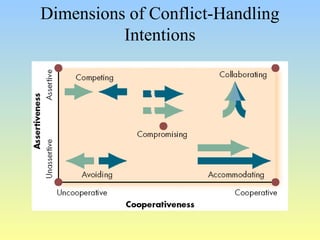
Cooperativeness: 
• Attempting to satisfy 
the other party’s 
concerns. 
Assertiveness: 
• Attempting to satisfy 
one’s own concerns. 
Cooperativeness: 
• Attempting to satisfy 
the other party’s 
concerns. 
Assertiveness: 
• Attempting to satisfy 
one’s own concerns.
Stage III: Intentions (cont’d)
Dimensions of Conflict-Handling 
Intentions
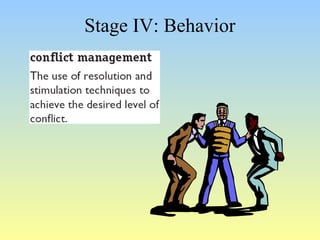
Stage IV: Behavior
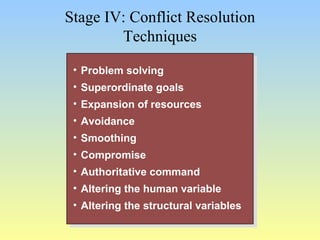
Stage IV: Conflict Resolution 
Techniques 
• Problem solving 
• Superordinate goals 
• Expansion of resources 
• Avoidance 
• Smoothing 
• Compromise 
• Authoritative command 
• Altering the human variable 
• Altering the structural variables 
• Problem solving 
• Superordinate goals 
• Expansion of resources 
• Avoidance 
• Smoothing 
• Compromise 
• Authoritative command 
• Altering the human variable 
• Altering the structural variables
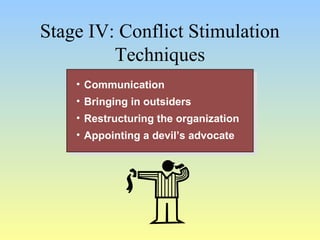
Stage IV: Conflict Stimulation 
Techniques 
• Communication 
• Bringing in outsiders 
• Restructuring the organization 
• Appointing a devil’s advocate 
• Communication 
• Bringing in outsiders 
• Restructuring the organization 
• Appointing a devil’s advocate
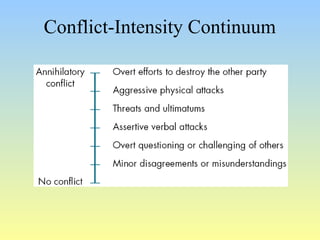
Conflict-Intensity Continuum
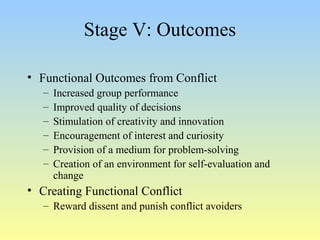
Stage V: Outcomes 
• Functional Outcomes from Conflict 
– Increased group performance 
– Improved quality of decisions 
– Stimulation of creativity and innovation 
– Encouragement of interest and curiosity 
– Provision of a medium for problem-solving 
– Creation of an environment for self-evaluation and 
change 
• Creating Functional Conflict 
– Reward dissent and punish conflict avoiders
Stage V: Outcomes (cont’d) 
• Dysfunctional Outcomes from Conflict 
– Development of discontent 
– Reduced group effectiveness 
– Retarded communication 
– Reduced group cohesiveness 
– Infighting among group members overcomes 
group goals
Levels of Conflict 
• Interpersonal conflict 
• Group-level conflict 
• Organization-level conflict 
– Vertical conflict 
– Horizontal conflict 
– Diagonal conflict
Individual level of conflict 
It is caused by unacceptability incompatability and uncertainty 
1. Frustration: when an individual is unable to do what he wants to do 
Defence mechanisms adopted are aggression, withdrawal, fixation and 
compromise 
2. Goal conflict: occurs when two or more motives block each other. Three type 
of goal conflicts are 
a. Approach approach conflict- occurs when an individual approaches two or 
more equally attractive but mutually exclusive goals 
b. Approach avoidance conflict- is a situation in which a single goal has both 
positive and negative characteristics 
c. Avoidance avoidance conflict- arises when an individual has to choose 
between two alternatives each with negative aspects 
3. Role conflict: it arises when the role expectations are understood, but due to 
some reason, they cannot be complied with
Interpersonal conflict 
Involves conflict between two or more 
individuals 
Four sources of interpersonal conflict are 
Personal differences 
Information deficiency 
Role incompatibility 
Environmental stress
Group level conflict 
I. Intra group conflict arises in three ways 
a. When group faces a new problem 
b. When new values are incorporated from 
social environment 
c. When a person’s extra group role comes 
into conflict with his intra group role 
II. Inter group conflict arises because of 
a. Absence of joint decision making 
b. Difference in goals 
c. Differences in perception
Organisational Level Conflict 
Can be between buyer and seller organisations, union and 
organisations and is divided into two categories 
1. Institutional conflicts: arise due to division of work. 
When two departments have mutually incompatible 
goals, conflicts arise between employees in these 
departments and is further divided into five categories 
a. Individual vs. Individual conflict 
b. Individual vs. orgn conflict 
c. Hierarchical conflict 
d. Functional conflict 
e. Line vs. staff conflict
Contd. 
2. Emergent Conflicts: arise due to social and 
personal reasons in an organisational 
environment. 
They are classified into four categories 
a. Individual vs. informal group conflict 
b. Formal-informal conflict 
c. Status conflict 
d. Political conflict

Conflict

  • 1.
    Organizational Conflict Thestruggle that arises when the goal-directed behavior of one person or group blocks the goal-directed behavior of another person or group.
  • 2.
    Transitions in ConflictThought Causes: • Poor communication • Lack of openness • Failure to respond to employee needs Causes: • Poor communication • Lack of openness • Failure to respond to employee needs
  • 3.
    Transitions in ConflictThought (cont’d)
  • 4.
  • 5.
  • 6.
    Functional Conflicts Releaseof tension Analytical thinking Group cohesiveness Competition Challenge Stimulation for change Identification of weaknesses Awareness High quality decisions
  • 7.
    Dysfunctional Conflicts Highemployee turnover Tensions Dissatisfaction Climate of distrust Personal vs. organisational goals Conflict as a cost
  • 8.
  • 9.
  • 10.
    Stage I: PotentialOpposition or Incompatibility • Communication – Semantic difficulties, misunderstandings, and “noise” • Structure – Size and specialization of jobs – Jurisdictional clarity/ambiguity – Member/goal incompatibility – Leadership styles (close or participative) – Reward systems (win-lose) – Dependence/interdependence of groups • Personal Variables – Differing individual value systems – Personality types
  • 11.
    Stage II: Cognitionand Personalization
  • 12.
    Stage III: Intentions Cooperativeness: • Attempting to satisfy the other party’s concerns. Assertiveness: • Attempting to satisfy one’s own concerns. Cooperativeness: • Attempting to satisfy the other party’s concerns. Assertiveness: • Attempting to satisfy one’s own concerns.
  • 13.
  • 14.
  • 15.
  • 16.
  • 17.
    Stage IV: ConflictResolution Techniques • Problem solving • Superordinate goals • Expansion of resources • Avoidance • Smoothing • Compromise • Authoritative command • Altering the human variable • Altering the structural variables • Problem solving • Superordinate goals • Expansion of resources • Avoidance • Smoothing • Compromise • Authoritative command • Altering the human variable • Altering the structural variables
  • 18.
    Stage IV: ConflictStimulation Techniques • Communication • Bringing in outsiders • Restructuring the organization • Appointing a devil’s advocate • Communication • Bringing in outsiders • Restructuring the organization • Appointing a devil’s advocate
  • 19.
  • 20.
    Stage V: Outcomes • Functional Outcomes from Conflict – Increased group performance – Improved quality of decisions – Stimulation of creativity and innovation – Encouragement of interest and curiosity – Provision of a medium for problem-solving – Creation of an environment for self-evaluation and change • Creating Functional Conflict – Reward dissent and punish conflict avoiders
  • 21.
    Stage V: Outcomes(cont’d) • Dysfunctional Outcomes from Conflict – Development of discontent – Reduced group effectiveness – Retarded communication – Reduced group cohesiveness – Infighting among group members overcomes group goals
  • 22.
    Levels of Conflict • Interpersonal conflict • Group-level conflict • Organization-level conflict – Vertical conflict – Horizontal conflict – Diagonal conflict
  • 23.
    Individual level ofconflict It is caused by unacceptability incompatability and uncertainty 1. Frustration: when an individual is unable to do what he wants to do Defence mechanisms adopted are aggression, withdrawal, fixation and compromise 2. Goal conflict: occurs when two or more motives block each other. Three type of goal conflicts are a. Approach approach conflict- occurs when an individual approaches two or more equally attractive but mutually exclusive goals b. Approach avoidance conflict- is a situation in which a single goal has both positive and negative characteristics c. Avoidance avoidance conflict- arises when an individual has to choose between two alternatives each with negative aspects 3. Role conflict: it arises when the role expectations are understood, but due to some reason, they cannot be complied with
  • 24.
    Interpersonal conflict Involvesconflict between two or more individuals Four sources of interpersonal conflict are Personal differences Information deficiency Role incompatibility Environmental stress
  • 25.
    Group level conflict I. Intra group conflict arises in three ways a. When group faces a new problem b. When new values are incorporated from social environment c. When a person’s extra group role comes into conflict with his intra group role II. Inter group conflict arises because of a. Absence of joint decision making b. Difference in goals c. Differences in perception
  • 26.
    Organisational Level Conflict Can be between buyer and seller organisations, union and organisations and is divided into two categories 1. Institutional conflicts: arise due to division of work. When two departments have mutually incompatible goals, conflicts arise between employees in these departments and is further divided into five categories a. Individual vs. Individual conflict b. Individual vs. orgn conflict c. Hierarchical conflict d. Functional conflict e. Line vs. staff conflict
  • 27.
    Contd. 2. EmergentConflicts: arise due to social and personal reasons in an organisational environment. They are classified into four categories a. Individual vs. informal group conflict b. Formal-informal conflict c. Status conflict d. Political conflict