MERCHANT BANKING


        PRASHANT S. PAWAR
        MBA (G) – B
        ROLL NO. 89
CONTENTS

DEFINATION
HISTORY
INTRODUCTION & CONCEPT
OBJECTIVES OF MERCHANT BANKS
ACTIVITIES OF MERCHANT BANKS
PRASHANT S. PAWAR


DEFINATION OF MERCHANT
       BANKING
A merchant bank is a financial institution which provides
capital to companies in the form of share ownership instead
of loans.
 A merchant bank also provides advisory on corporate
matters to the firms.
In other words,
      The merchant banks are those financial intermediary
involved with the activity of transferring capital funds to those
borrowers who are interested in borrowing.
PRASHANT S. PAWAR


                   HISTORY
Merchant banks first arose in the Italian states in the Middle
Ages, when Italian merchant houses—generally small,
family-owned import-export and commodity trading
businesses—began to use their excess capital to finance
foreign trade in return for a share of the profits.

Merchant Banking, as the term has evolved in Europe from
the 18th century to today, pertained to an individual or a
banking house whose primary function was to facilitate the
business process between a product and the financial
requirements for its development.
PRASHANT S. PAWAR


  Merchant Banks - Concept
Definition
  In the Indian context, merchant banking is understood to
  be non-fund based and non-banking services.
  Rule 2(e) of SEBI (merchant bankers) Rules 1992, defines
  who a merchant banker is. “merchant banker means any
  person who is engaged in the business of issue
  management either by making arrangements regarding
  selling, buying or subscribing to securities as manager-
  consultant, advisor or rendering corporate advisory
  services in relation to such issue management”
  Merchant bankers are neither merchants nor bankers.
PRASHANT S. PAWAR


 Merchant Banking in India
Till early 1960s there was no merchant banking in
the Indian banking system. It was the Grindlays
Bank which started merchant banking services as
far back as 1967 in India. Others to follow were
Citibank (1970), SBI (1972)
The boom in the capital market in mid 1970s
encouraged other banks and financial institutions
to set up MB divisions.
Private financial brokers also started private MB
organizations
PRASHANT S. PAWAR


          Merchant Banking in India
                       Merchant Banking Divisions


Foreign            Indian                                             Private
                                           Financial
Banks              Banks                                             Merchant
                                          Institutions
                                                                     Bankers


                            Division in
      Subsidiary              Bank
PRASHANT S. PAWAR


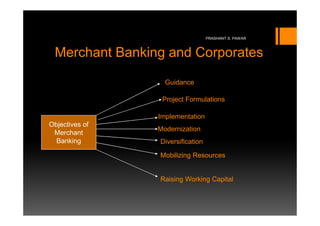
 Merchant Banking and Corporates

                  Guidance

                 Project Formulations

                Implementation
Objectives of
                Modernization
 Merchant
  Banking       Diversification

                Mobilizing Resources


                Raising Working Capital
PRASHANT S. PAWAR


Merchant banking V/s Commercial banking


  A bank can undertake merchant
  banking business, but an MB can not
  undertake banking business.
PRASHANT S. PAWAR


Activities of Merchant Bankers
Some of the important functions of a MB are

   Project counseling or reinvestment studies for
   investors
   Identify promising projects
   Prepare feasibility studies – economic and
   financial
   Prepare in-depth project reports
   Assist investors in obtaining licenses
   Give guidance on amalgamations, mergers and
   takeovers
PRASHANT S. PAWAR


Activities of Merchant Bankers
 Some of the important functions of a MB
 are
  Provision of working capital
  Foreign Currency Loans
  Portfolio Management
PRASHANT S. PAWAR

Merchant banking

  • 1.
    MERCHANT BANKING PRASHANT S. PAWAR MBA (G) – B ROLL NO. 89
  • 2.
    CONTENTS DEFINATION HISTORY INTRODUCTION & CONCEPT OBJECTIVESOF MERCHANT BANKS ACTIVITIES OF MERCHANT BANKS
  • 3.
    PRASHANT S. PAWAR DEFINATIONOF MERCHANT BANKING A merchant bank is a financial institution which provides capital to companies in the form of share ownership instead of loans. A merchant bank also provides advisory on corporate matters to the firms. In other words, The merchant banks are those financial intermediary involved with the activity of transferring capital funds to those borrowers who are interested in borrowing.
  • 4.
    PRASHANT S. PAWAR HISTORY Merchant banks first arose in the Italian states in the Middle Ages, when Italian merchant houses—generally small, family-owned import-export and commodity trading businesses—began to use their excess capital to finance foreign trade in return for a share of the profits. Merchant Banking, as the term has evolved in Europe from the 18th century to today, pertained to an individual or a banking house whose primary function was to facilitate the business process between a product and the financial requirements for its development.
  • 5.
    PRASHANT S. PAWAR Merchant Banks - Concept Definition In the Indian context, merchant banking is understood to be non-fund based and non-banking services. Rule 2(e) of SEBI (merchant bankers) Rules 1992, defines who a merchant banker is. “merchant banker means any person who is engaged in the business of issue management either by making arrangements regarding selling, buying or subscribing to securities as manager- consultant, advisor or rendering corporate advisory services in relation to such issue management” Merchant bankers are neither merchants nor bankers.
  • 6.
    PRASHANT S. PAWAR Merchant Banking in India Till early 1960s there was no merchant banking in the Indian banking system. It was the Grindlays Bank which started merchant banking services as far back as 1967 in India. Others to follow were Citibank (1970), SBI (1972) The boom in the capital market in mid 1970s encouraged other banks and financial institutions to set up MB divisions. Private financial brokers also started private MB organizations
  • 7.
    PRASHANT S. PAWAR Merchant Banking in India Merchant Banking Divisions Foreign Indian Private Financial Banks Banks Merchant Institutions Bankers Division in Subsidiary Bank
  • 8.
    PRASHANT S. PAWAR Merchant Banking and Corporates Guidance Project Formulations Implementation Objectives of Modernization Merchant Banking Diversification Mobilizing Resources Raising Working Capital
  • 9.
    PRASHANT S. PAWAR Merchantbanking V/s Commercial banking A bank can undertake merchant banking business, but an MB can not undertake banking business.
  • 10.
    PRASHANT S. PAWAR Activitiesof Merchant Bankers Some of the important functions of a MB are Project counseling or reinvestment studies for investors Identify promising projects Prepare feasibility studies – economic and financial Prepare in-depth project reports Assist investors in obtaining licenses Give guidance on amalgamations, mergers and takeovers
  • 11.
    PRASHANT S. PAWAR Activitiesof Merchant Bankers Some of the important functions of a MB are Provision of working capital Foreign Currency Loans Portfolio Management
  • 12.