Disorder of Perception
- JEET
What Is perception ?
it is conscious awareness of element in the environment by
which all kind of data (Intellectual, emotional, and sensory)
are meaningfully organized.
It can be classified into
-Sensory distortions.
-Sensory deceptions.
Sensory distortions
Disturbance of mental state with or without organic brain
pathology may cause sensory distortion.
Distortion may involve any of the component or elementary
aspect of perception such as size, shape, color, location, motion
or general quality.
1. Changes in the Intensity
(Hyperaesthesia and hypoaesthesis)
i.e increased or decrease intensity of sensation.
Some hypochondriacal personality are neurotics and very
sensitive to noise.
And some anxious and depressed patients complaints of voices
of other people seem to come from a long way off.
• Hypoacusis ( partial loss of hearing ) occurs in delirium where
the threshold of all sensation is raised.
On should speak slow and loud to such patients.
2. Change in Quality
• Visual Hyperaesthesia – different aspect of colour perception
can be affected, intensity of colour, quality of colour may be
affected (occurs in schizophrenia).
• Achromatopsia – complete absence of colour (occurs in
uni/bilateral occipital lesions ).
• Dyschromatopsia – refers to the perversion of colour perception
(occurs in uni post lesion).
3. Change in Spatial form
• Macropsia /Micropsia - size of perception may be larger or small
(occurs in disorder of accommodation, retinal disease, temporal
lobe lesion).
• Metamorphopsia – alteration in the customary shape of the
perceived object.
( one women saw people upside down on their head,
bleuler1950)
• When metamorphosis affects faces it is referred as
paraprosopia.
• Teleopsia – objects appear far away.
• Pelopsia – object appear nearer than it is.
• Alloaesthesia – transposition of object from right to left.
• Akinetopsia – impairment of visual perception of motion
(occurs in bi lat. Post cortical damage)
Normally perceptions are accompanied by affect which may be
feeling of familiarity of enjoyment, dislike of involvement of
proximity and so on.
E g: A factory worker sees a grass hopper and becomes very
disturbed and excited at the sight of this very strange and
unknown animal (bleuler, 1950).
This can be also called as de realization.
Sensory deceptions
Illusion
It is misinterpretation of stimuli arising from external object.
Types
• Completion illusion
• Affect illusion
• Pareidolic illusion
1. Completion illusions
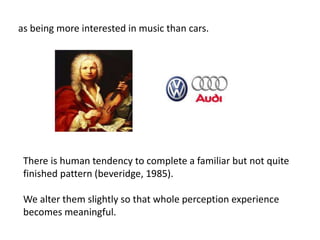
Depends on inattention for their occurrence, the faded lettering
of an advertisement outside a garage is read as vivaldi,
as being more interested in music than cars.
There is human tendency to complete a familiar but not quite
finished pattern (beveridge, 1985).
We alter them slightly so that whole perception experience
becomes meaningful.
2. Affect illusion
When illusion arise through affect, perception of everyday
object is changed.
Eg – A child who is afraid of dark wakes up in half light and
mistakes a towel hanging by the wall for a person moving.
It gets banished by attention.
The degree of completion or affect involved is variable, for eg-
A man looking through adv. for a post found a job that he liked
and misread the written word “suitable” for the illusional
word “superior…..applicant is required”
This was both an affective and completion illusion.
3. Pareidolic illusion
Vivid illusion occurs with or without the patient making any
effort. These illusion are the result of excessive fantasy thinking
and a vivid impressive visual imagery.
Eg- subject sees vivid pictures in fire or clouds.
• Fantastic interpretations – or elaborate daydreaming can be
very similar to pareidolic illusion.
• Perceptual misinterpretations – simply making a mistake
without perception being influenced by emotion mixed with
fantasy . Eg- piece of rock is a precious stone.
• Functional hallucination
it must be distinguished from an illusion.
- Certain percept is necessary to provoke a hallucination.
- It occurs as a response to environmental stimulus.
- provoking stimulus and the hallucination both are perceived by
the patient .
- for eg - patient hear voice of running water he hear voice when
tap Is turned on but voice and noise of water are quite distinct .
Hallucinations
Definitions
• (Esquirol 1817) - A perception without an object.
• (Jaspers 1962) – hallucination proper are false perceptions
that are not in any way distortion of real perception but spring
up on their own as something new and occurs simultaneously
with and alongside real perceptions.
• (slade 1976)- Three criteria
1. Percept like experience in absence of external stimuli.
2. Percept like experience that has full force and impact of a
real perception.
3. Percept like experience that is unwilled, occurs spontaneously
and cannot be readily controlled by the percipient.
• (Smythies,1956)- A hallucination is an exteroceptive or an
interoceptive percept that does not correspond to actual object.
• (Cutting,1997) – A hallucination is a perception without an
object (within a realistic philosophical framework) or the
appearance of an individual thing in the world without any
corresponding material event.
• (Horowitz 1975) – by using cognitive approach, looking at
each of following four constructs in term of coding, appraising
and transforming informations.
“ hallucinations are mental images that
 Occur in the form of images.
 Are derived from internal source of information.
 Are appraised incorrectly as if from external source of
information.
 Usually occur intrusively.
Types of hallucinations
• Auditory hallucinations
• Visual hallucinations
• Tactile hallucination
• Olfactory hallucinations
• Gustatory hallucinations
Other abnormalities in perception
• Autoscopy
• Extracampine hallucinations
• Hypnagogic and Hypnopompic hallucinations
• Functional hallucinations
• Reflex hallucinations
• Abnormal imagery
• Sensory deprivation
Auditory hallucinations
• These may be elementary in form of noises, or partly organized as
music or completely organized as hallucinatory voices.
• elementary hallucinations Eg : whistling, machinery sounds, musics
can occur in schizophrenia.
• Hallucinatory voices were called “Phonemes” by Wernicke in 1990.
• Hallucinatory voices may very in quality, ranging from those are
quite clear and can be located in space and ascribed to specific
individual, and some are extreme vague which patient cannot
explain.
• In chronic alcohol hallucinosis / affective psychosis simple words
short sentence experienced coming from outside his head or self.
• In some, voices give instruction to some patient, who may or
may not feel obliged to carry them out this is “imperative
hallucinations”.
• In schizophrenia, hearing of one’s own thoughts being spoken
aloud this is also known as “Thought Eco” or “echo de pensees” in
french or “Gedankenlautwerden”in germany.
• In some cases the voices talk about the person in third person
and may even give a running commentary on his actions.
First rank symptoms of schizophrenia (kurt schneider,1959)
1. Hearing one’s though spoken aloud.
2. Pt hears voices speaking about him in the third person.
3. hallucinatory voices in form of running commentary.
4. Bodily hallucinations i.e. bodily sensations which the pt. knows
are produced by external stimuli.
5. Thought withdrawal (thoughts taken out from his mind),
Thought insertion (another person thinks through his mind),
Thought broadcasting (other person can hear what he thinks).
6. Delusional perception.
Visual hallucination
• In from of flashes of light, partly organized as patterns or
completely organized as vision of people, animal or objects.
• Occurs in organic state rather than functional psychosis.
• Lilliputian hallucination are often seen in delirium tremens which
is alcohol withdrawal syndrome.
• hallucinations produced by drugs abuse (LSD, mescaline)-typically
consist of diffuse distortion of the existing visual world, can often
been seen more readily with closed eyes.
• Scenic hallucinations are more common in psychiatric disorder
associated with epilepsy, these pt may also have vision of fire and
religious scenes such as the Crucifixion.
• Some visual hallucinations are also accompanied with auditory
hallucination seen in temporal lobe epilepsy it has been called as
“experiential hallucinations”.
• visual hallucinations are extremely rare in schizophrenia.
Hallucinations of bodily sensations / tactile hallucinations
It may be superficial, kinaesthetic or visceral.
• superficial – thermic(abnormal perception of heat or cold)
haptic of touch(a dead hand touched me), hygeric – perception of
fluid.
• paraesthesias – sensations of tingling or “pins or needles”it may
be delusionally ascribed, although of course they are often
neurologically mediated, for E g- ulnar nerver compression causing
pins and needle in forearm
• kinaesthetic – hallucinations are those of muscle or joint sense.
Pt feels that his limbs are being bent or twisted or muscles
squeezed.
• Visceral hallucinations are false perceptions of the inner
organs
( limited possibility of visceral sensations for e g – pain,
heaviness, stretching or distension ) common in schizophrenia.
• Haptic hallucinations – may experienced as touch (like a hand
stroking me) or painful ( knives stabbing my neck ).
• Unpleasant form of haptic hallucination is called
“formication”(latin formica – ant) the sensation of little animals
or insects crawling over the body.
Olfactory hallucinations
• Occurs in schizophrenia, epilepsy and some organic state.
• The pt has hallucinations of smell, it may be pleasant or
unpleasant
E g – pumping of poisonous or anaesthetic gas into the house,
which the pt alone can smell.
• olfactory hallucinations occurs in epilepsy, especially in
association with temporal lobe focus and commonly form the
aura of such fits
E g – pt describe smell of burning rubber regularly just before
he becomes unconscious.
Gustatory hallucination
• In schizophrenia they sometimes occurs with delusion of
being poisoned.
There may be persistent taste for example ‘onions’ or ‘metallic
taste’ or some bizarre taste.
• In depression and schizophrenia, the flavor of the food may
disappear altogether or become unpleasant.
• Lithium carbonate or disulfiram may cause change in
gustatory perceptions therefore it is difficult to describe
whether it is hallucinatory or not.
Other abnormalities in perceptions
Autoscopy
• It is the experience of seeing oneself and knowing that it is
oneself
It is sometimes called as “phantom mirror image”.
• It is seen in schizophrenia, organic state and parietal lobe
lesions.
• negative autoscopy has also been described, in which, for
instance
the patient looks in the mirror and sees no image at all.
Extracampine hallucination (concrete awareness)
“ I know that there is someone behind me on the left all the
time, he moves when i move” ‘ I keep on hearing them talking
about my disease
down in my office’(half a mile away)
• This hallucinations are experienced outside the limits of the
sensory field, outside the visual field or beyond the range of
audibility.
• They occur in schizophrenia, epilepsy and other organic state
and also as hypnagogic hallucinations.
• the phenomenon is quite definitely experienced as a
perception by the patient and not just as a belief or an idea.
Hypnagogic and hypnopompic
• These are the perceptions that occurs while going to sleep
(hypnagogic) and on waking (hypnopompic).
• They are associated with toxic state such as acute fever, post
infective depressive state, phobic anxiety.
Functional hallucination
• An external stimulus is necessary to provoke hallucination,
but the normal perception of the stimulus and the hallucination
is the same modality are experienced simultaneously.
• E g – a schizophrenia patient heard hallucinatory voices only
when water was running through pipe in the ward.
Reflex hallucination
• As a doctor was writing in his case notes during his interview
of a pt
said ‘I can feel you writing in my stomach’.
the pt. saw and heard the act of writing and was quite sure that
it accounted for the tactile sensation in her abdomen.
“A stimulus in one sensory modality producing a hallucination in
another is called a ‘reflex hallucination’.
Is in fact a hallucinatory form of synaesthesia.
Synaesthesia - an experience of a stimulus image in one sense
modality producing an image in another.
For eg – feeling of discomfort caused by seeing and hearing
somebody scratch a blackboard with their fingernail.
A women experienced pain when certain words were
mentioned .
Abnormal imagery
• Mental imagery tasks are designed to assess a subject’s
capacity for the mental representation of the perceived
world.
• In case of hemineglect there has been interest in whether
the observed deficit in imagery are due to inattention or to
impairment of mental imagery.
Sensory deprivation
• The deleterious effect of sensory deprivation have been
considered by slade (1984) as
• Inability to tolerate the situation.
• Perceptual changes.
• Intellectual and cognitive impairment.
• Psychomotor effects.
• Physiological changes in terms of the
electroencephalograph and galvanic skin response measure.
Fantasy is often used as a measure of reducing the
unpleasant affective component of sensory deprivation
Thank you !

Perception

  • 1.
  • 2.
    What Is perception? it is conscious awareness of element in the environment by which all kind of data (Intellectual, emotional, and sensory) are meaningfully organized. It can be classified into -Sensory distortions. -Sensory deceptions.
  • 3.
    Sensory distortions Disturbance ofmental state with or without organic brain pathology may cause sensory distortion. Distortion may involve any of the component or elementary aspect of perception such as size, shape, color, location, motion or general quality. 1. Changes in the Intensity (Hyperaesthesia and hypoaesthesis) i.e increased or decrease intensity of sensation. Some hypochondriacal personality are neurotics and very sensitive to noise.
  • 4.
    And some anxiousand depressed patients complaints of voices of other people seem to come from a long way off. • Hypoacusis ( partial loss of hearing ) occurs in delirium where the threshold of all sensation is raised. On should speak slow and loud to such patients. 2. Change in Quality • Visual Hyperaesthesia – different aspect of colour perception can be affected, intensity of colour, quality of colour may be affected (occurs in schizophrenia). • Achromatopsia – complete absence of colour (occurs in uni/bilateral occipital lesions ).
  • 5.
    • Dyschromatopsia –refers to the perversion of colour perception (occurs in uni post lesion). 3. Change in Spatial form • Macropsia /Micropsia - size of perception may be larger or small (occurs in disorder of accommodation, retinal disease, temporal lobe lesion). • Metamorphopsia – alteration in the customary shape of the perceived object. ( one women saw people upside down on their head, bleuler1950)
  • 6.
    • When metamorphosisaffects faces it is referred as paraprosopia. • Teleopsia – objects appear far away. • Pelopsia – object appear nearer than it is. • Alloaesthesia – transposition of object from right to left. • Akinetopsia – impairment of visual perception of motion (occurs in bi lat. Post cortical damage)
  • 7.
    Normally perceptions areaccompanied by affect which may be feeling of familiarity of enjoyment, dislike of involvement of proximity and so on. E g: A factory worker sees a grass hopper and becomes very disturbed and excited at the sight of this very strange and unknown animal (bleuler, 1950). This can be also called as de realization.
  • 8.
    Sensory deceptions Illusion It ismisinterpretation of stimuli arising from external object. Types • Completion illusion • Affect illusion • Pareidolic illusion
  • 9.
    1. Completion illusions Dependson inattention for their occurrence, the faded lettering of an advertisement outside a garage is read as vivaldi,
  • 10.
    as being moreinterested in music than cars. There is human tendency to complete a familiar but not quite finished pattern (beveridge, 1985). We alter them slightly so that whole perception experience becomes meaningful.
  • 11.
    2. Affect illusion Whenillusion arise through affect, perception of everyday object is changed. Eg – A child who is afraid of dark wakes up in half light and mistakes a towel hanging by the wall for a person moving. It gets banished by attention. The degree of completion or affect involved is variable, for eg- A man looking through adv. for a post found a job that he liked and misread the written word “suitable” for the illusional word “superior…..applicant is required” This was both an affective and completion illusion.
  • 12.
    3. Pareidolic illusion Vividillusion occurs with or without the patient making any effort. These illusion are the result of excessive fantasy thinking and a vivid impressive visual imagery. Eg- subject sees vivid pictures in fire or clouds. • Fantastic interpretations – or elaborate daydreaming can be very similar to pareidolic illusion. • Perceptual misinterpretations – simply making a mistake without perception being influenced by emotion mixed with fantasy . Eg- piece of rock is a precious stone.
  • 13.
    • Functional hallucination itmust be distinguished from an illusion. - Certain percept is necessary to provoke a hallucination. - It occurs as a response to environmental stimulus. - provoking stimulus and the hallucination both are perceived by the patient . - for eg - patient hear voice of running water he hear voice when tap Is turned on but voice and noise of water are quite distinct .
  • 14.
    Hallucinations Definitions • (Esquirol 1817)- A perception without an object. • (Jaspers 1962) – hallucination proper are false perceptions that are not in any way distortion of real perception but spring up on their own as something new and occurs simultaneously with and alongside real perceptions. • (slade 1976)- Three criteria 1. Percept like experience in absence of external stimuli. 2. Percept like experience that has full force and impact of a real perception.
  • 15.
    3. Percept likeexperience that is unwilled, occurs spontaneously and cannot be readily controlled by the percipient. • (Smythies,1956)- A hallucination is an exteroceptive or an interoceptive percept that does not correspond to actual object. • (Cutting,1997) – A hallucination is a perception without an object (within a realistic philosophical framework) or the appearance of an individual thing in the world without any corresponding material event.
  • 16.
    • (Horowitz 1975)– by using cognitive approach, looking at each of following four constructs in term of coding, appraising and transforming informations. “ hallucinations are mental images that  Occur in the form of images.  Are derived from internal source of information.  Are appraised incorrectly as if from external source of information.  Usually occur intrusively.
  • 17.
    Types of hallucinations •Auditory hallucinations • Visual hallucinations • Tactile hallucination • Olfactory hallucinations • Gustatory hallucinations Other abnormalities in perception • Autoscopy • Extracampine hallucinations • Hypnagogic and Hypnopompic hallucinations • Functional hallucinations • Reflex hallucinations • Abnormal imagery • Sensory deprivation
  • 18.
    Auditory hallucinations • Thesemay be elementary in form of noises, or partly organized as music or completely organized as hallucinatory voices. • elementary hallucinations Eg : whistling, machinery sounds, musics can occur in schizophrenia. • Hallucinatory voices were called “Phonemes” by Wernicke in 1990. • Hallucinatory voices may very in quality, ranging from those are quite clear and can be located in space and ascribed to specific individual, and some are extreme vague which patient cannot explain.
  • 19.
    • In chronicalcohol hallucinosis / affective psychosis simple words short sentence experienced coming from outside his head or self. • In some, voices give instruction to some patient, who may or may not feel obliged to carry them out this is “imperative hallucinations”. • In schizophrenia, hearing of one’s own thoughts being spoken aloud this is also known as “Thought Eco” or “echo de pensees” in french or “Gedankenlautwerden”in germany. • In some cases the voices talk about the person in third person and may even give a running commentary on his actions.
  • 20.
    First rank symptomsof schizophrenia (kurt schneider,1959) 1. Hearing one’s though spoken aloud. 2. Pt hears voices speaking about him in the third person. 3. hallucinatory voices in form of running commentary. 4. Bodily hallucinations i.e. bodily sensations which the pt. knows are produced by external stimuli. 5. Thought withdrawal (thoughts taken out from his mind), Thought insertion (another person thinks through his mind), Thought broadcasting (other person can hear what he thinks). 6. Delusional perception.
  • 21.
    Visual hallucination • Infrom of flashes of light, partly organized as patterns or completely organized as vision of people, animal or objects. • Occurs in organic state rather than functional psychosis. • Lilliputian hallucination are often seen in delirium tremens which is alcohol withdrawal syndrome. • hallucinations produced by drugs abuse (LSD, mescaline)-typically consist of diffuse distortion of the existing visual world, can often been seen more readily with closed eyes.
  • 22.
    • Scenic hallucinationsare more common in psychiatric disorder associated with epilepsy, these pt may also have vision of fire and religious scenes such as the Crucifixion. • Some visual hallucinations are also accompanied with auditory hallucination seen in temporal lobe epilepsy it has been called as “experiential hallucinations”. • visual hallucinations are extremely rare in schizophrenia.
  • 23.
    Hallucinations of bodilysensations / tactile hallucinations It may be superficial, kinaesthetic or visceral. • superficial – thermic(abnormal perception of heat or cold) haptic of touch(a dead hand touched me), hygeric – perception of fluid. • paraesthesias – sensations of tingling or “pins or needles”it may be delusionally ascribed, although of course they are often neurologically mediated, for E g- ulnar nerver compression causing pins and needle in forearm • kinaesthetic – hallucinations are those of muscle or joint sense. Pt feels that his limbs are being bent or twisted or muscles squeezed.
  • 24.
    • Visceral hallucinationsare false perceptions of the inner organs ( limited possibility of visceral sensations for e g – pain, heaviness, stretching or distension ) common in schizophrenia. • Haptic hallucinations – may experienced as touch (like a hand stroking me) or painful ( knives stabbing my neck ). • Unpleasant form of haptic hallucination is called “formication”(latin formica – ant) the sensation of little animals or insects crawling over the body.
  • 25.
    Olfactory hallucinations • Occursin schizophrenia, epilepsy and some organic state. • The pt has hallucinations of smell, it may be pleasant or unpleasant E g – pumping of poisonous or anaesthetic gas into the house, which the pt alone can smell. • olfactory hallucinations occurs in epilepsy, especially in association with temporal lobe focus and commonly form the aura of such fits E g – pt describe smell of burning rubber regularly just before he becomes unconscious.
  • 26.
    Gustatory hallucination • Inschizophrenia they sometimes occurs with delusion of being poisoned. There may be persistent taste for example ‘onions’ or ‘metallic taste’ or some bizarre taste. • In depression and schizophrenia, the flavor of the food may disappear altogether or become unpleasant. • Lithium carbonate or disulfiram may cause change in gustatory perceptions therefore it is difficult to describe whether it is hallucinatory or not.
  • 27.
    Other abnormalities inperceptions Autoscopy • It is the experience of seeing oneself and knowing that it is oneself It is sometimes called as “phantom mirror image”. • It is seen in schizophrenia, organic state and parietal lobe lesions. • negative autoscopy has also been described, in which, for instance the patient looks in the mirror and sees no image at all.
  • 28.
    Extracampine hallucination (concreteawareness) “ I know that there is someone behind me on the left all the time, he moves when i move” ‘ I keep on hearing them talking about my disease down in my office’(half a mile away) • This hallucinations are experienced outside the limits of the sensory field, outside the visual field or beyond the range of audibility. • They occur in schizophrenia, epilepsy and other organic state and also as hypnagogic hallucinations. • the phenomenon is quite definitely experienced as a perception by the patient and not just as a belief or an idea.
  • 29.
    Hypnagogic and hypnopompic •These are the perceptions that occurs while going to sleep (hypnagogic) and on waking (hypnopompic). • They are associated with toxic state such as acute fever, post infective depressive state, phobic anxiety. Functional hallucination • An external stimulus is necessary to provoke hallucination, but the normal perception of the stimulus and the hallucination is the same modality are experienced simultaneously. • E g – a schizophrenia patient heard hallucinatory voices only when water was running through pipe in the ward.
  • 30.
    Reflex hallucination • Asa doctor was writing in his case notes during his interview of a pt said ‘I can feel you writing in my stomach’. the pt. saw and heard the act of writing and was quite sure that it accounted for the tactile sensation in her abdomen. “A stimulus in one sensory modality producing a hallucination in another is called a ‘reflex hallucination’. Is in fact a hallucinatory form of synaesthesia. Synaesthesia - an experience of a stimulus image in one sense modality producing an image in another. For eg – feeling of discomfort caused by seeing and hearing somebody scratch a blackboard with their fingernail. A women experienced pain when certain words were mentioned .
  • 31.
    Abnormal imagery • Mentalimagery tasks are designed to assess a subject’s capacity for the mental representation of the perceived world. • In case of hemineglect there has been interest in whether the observed deficit in imagery are due to inattention or to impairment of mental imagery. Sensory deprivation • The deleterious effect of sensory deprivation have been considered by slade (1984) as
  • 32.
    • Inability totolerate the situation. • Perceptual changes. • Intellectual and cognitive impairment. • Psychomotor effects. • Physiological changes in terms of the electroencephalograph and galvanic skin response measure. Fantasy is often used as a measure of reducing the unpleasant affective component of sensory deprivation
  • 33.